Japan plans to apply for UNESCO heritage for sake brewing #ศาสตร์เกษตรดินปุ๋ย

#ศาสตร์เกษตรดินปุ๋ย : ขอบคุณแหล่งข้อมูล : หนังสือพิมพ์ The Nation

https://www.nationthailand.com/lifestyle/30381848?utm_source=category&utm_medium=internal_referral

Japan plans to apply for UNESCO heritage for sake brewing

Feb 08. 2020
By Syndication Washington Post, Japan News-Yomiuri 

The Japanese government has decided to apply to have Japanese sake listed as a UNESCO Intangible Cultural Heritage, with the aim of boosting name recognition and brand power as part of efforts to expand overseas exports.

The government expects to file the application in early 2020s.

In April, the Cultural Affairs Agency will set up a team of a dozen or so officials to prepare the application. They plan to visit breweries across the nation and exchange opinions with master sake brewers, known as toji. These conversations will contribute to their study of the range of brewing processes and techniques to be covered by the UNESCO application, and of ways to support branding.

The UNESCO listing process starts with the government making a decision in consultation with the Council for Cultural Affairs, then a proposal is submitted. UNESCO’s intergovernmental committee then decides whether it will be approved for inclusion on its Intangible Cultural Heritage list.

It remains to be seen how the government will create momentum aimed at earning registration and protect the technology of sake brewing.

Prior to submitting the application, the government is considering designating techniques, such as temperature control, essential for sake brewing as important intangible cultural assets based on the Protection of Cultural Properties Law.

The government is also considering recognizing master brewers as living national treasures and providing them with subsidies.

Exports of Japanese agricultural products and foodstuffs, including Japanese sake, have been on the rise. With the inclusion of washoku on UNESCO’s Intangible Cultural Heritage list in 2013, it has become popular the world over and overseas demand has been increasing.

Japan’s exports of agricultural products and foodstuffs reached ¥906.8 billion in 2018, marking a record high for the sixth consecutive year.

Riding this trend, sake exports in 2018 increased 19% from the previous year to about ¥22.2 billion, the ninth straight year of increase and a tripling in 10 years. According to the National Tax Agency, more than half of the nation’s breweries have exported sake.

Though the market share of sake among the world’s alcoholic beverages remains low, it is possible to significantly increase exports through brand strategies and other means, according to the agency.

The agency will establish an export promotion office in its Liquor Tax and Industry Division in July.

There is a precedent for brewing methods being listed as a UNESCO Intangible Cultural Heritage. Mongolia’s traditional technique of making airag liquor, made of fermented mare’s milk and listed in 2019, is one such example.

Book World: Why are Gen X women such a mess? A new book explores the many possible reasons. #ศาสตร์เกษตรดินปุ๋ย

#ศาสตร์เกษตรดินปุ๋ย : ขอบคุณแหล่งข้อมูล : หนังสือพิมพ์ The Nation

https://www.nationthailand.com/lifestyle/30381811?utm_source=category&utm_medium=internal_referral

Book World: Why are Gen X women such a mess? A new book explores the many possible reasons.

Feb 08. 2020
Why We Can't Sleep
Photo by: Grove/Atlantic — HANDOUT

Why We Can’t Sleep Photo by: Grove/Atlantic — HANDOUT
By Special To The Washington Post · Jennifer Reese · ENTERTAINMENT

Why We Can’t Sleep: Women’s New Midlife Crisis By Ada Calhoun. Grove/Atlantic. 288 pp. $26.99

In her early 40s, Ada Calhoun found herself racked with doubt about past and future decisions. Despite a long marriage and professional success as a journalist and author of the book “Wedding Toasts I’ll Never Give,” she lay awake at night worrying about credit card debt and evaporating job opportunities. She had heavy periods and crying jags. There was a sketchy mammogram and she was gaining weight. Her response to her image on her smartphone, even after putting on makeup and changing filters: “Still house of horrors.”

“I knew I felt lousy, but I didn’t yet fully understand why,” she writes in the introduction to her new book “Why We Can’t Sleep: Women’s New Midlife Crisis.” As the title suggests, the book is her attempt to answer that question.

Actually, it’s pretty clear from the introduction why Calhoun was feeling lousy. The real mystery: Were other Gen X women – those born between 1965 and 1980 – brooding over this same constellation of problems? And what cultural, economic and biological factors might undergird the malaise?

Calhoun interviewed hundreds of middle-class American women and plumbed the literature of midlife, from Gail Sheehy’s classic “Passages” to Darcey Steinke’s 2019 “Flash Count Diary.” She spoke to gynecologists, economists, sociologists and a “small army of therapists” to contextualize what she learned.

The resulting book is a sprint through everything – and I mean everything – that is bothering Generation X women, from irritation with slacker husbands and endless nagging email threads about school bake sales to fears of ending up in a cardboard box on the street. It’s a remarkably slender and breezy book, given the sheer quantity and variety of existential dread Calhoun has managed to funnel into its pages. If you aren’t having trouble sleeping already, you may start to after you’ve read a few chapters.

(BEGIN ITAL)[Elizabeth Wurtzel was right all along](END ITAL)

The anecdotal evidence Calhoun marshals for widespread Gen X unhappiness is abundant and depressing, if not scientific. Using only their first names and sometimes no names at all, Calhoun introduces us to a blur of agitated women in their 40s, most of whom we meet for a paragraph or two. There’s a woman who regularly pays a babysitter so that she can go to a movie theater and cry. A fed-up single mother smashes her son’s iPad with a hammer. A Silicon Valley executive worries she’ll lose her edge if people see her and think “Oh look, here comes the dowdy middle-aged woman.”An unmarried aerobics instructor muses, as she loads her boombox and gear into the car every week, “(BEGIN ITAL)Will I never have a man to help me?(END ITAL)”

Everyone in this book wonders whether she’d be happier if she’d chosen a different path. Everyone feels slightly – sometime desperately – disappointed in herself and in her life, no matter how it might look to an outsider.

Why is this? Calhoun offers a plethora of explanations. To start with, there was the divorce and instability of many 1970s and 1980s childhoods, which made Gen Xers fearful of both marriage and ending a marriage, even a bad one. Calhoun calls up invidious role models of the era that many of us “still keep in our psychic filing cabinet” like the foxy briefcase-carrying, bacon-frying blond woman in the 1980 Enjoli perfume ad who suggested women could, with no apparent effort, do it all. A lot of Gen Xers entered the workforce when the job market was soft, and now they find themselves sandwiched between two more populous demographic cohorts – the boomers, who haven’t retired, and cute, energetic millennials, who sometimes seem to have an edge with employers.

Gen Xers (along with a few older millennials) – are also the last group who remember the world before the it went online and, Calhoun argues, we “have no natural immunity to the Internet.” Gen Xers spend more time on social media than boomers or millennials and are vulnerable to its toxic effects. As Calhoun writes: “In our mothers’ and grandmothers’ eras, phones and mirrors sensibly sat on tables or hung on walls. But Generation X women noticed their first wrinkles in a zoomable smartphone camera.”

Throw in some hormonal mayhem, and it’s no wonder the women in the book feel blue. The trouble is, there are far too many of them. Reading “Why We Can’t Sleep” is like attending a party where the hostess didn’t want to leave anyone off the list: It’s noisy, crowded and everyone remains a stranger. And they’re all complaining. There are guests whose complaints we would benefit from hearing more about and others who shouldn’t be here at all.

In the book’s last chapters, Calhoun unveils her personal remedies for at least some midlife woes: She began hanging out with female friends, treating her perimenopausal symptoms with hormone therapy, and spending less time on social media. She stopped being so hard on herself. She touts the value of laughter. The advice is common-sensical, a little corny and hardly a panacea for the multitude of problems she’s spent the previous 200 pages describing.

But the final chapter is the most accessible and engaging in the book. Calhoun’s ambitious wide-angle shot of Gen X midlife malaise is blurry and overwhelming. Paradoxically, when she zeroes in on a specific woman with a first and last name, a strong voice, and a textured backstory – herself – that larger picture starts to come into focus.

Book World: Paul Krugman battles conservative ‘zombies’ #ศาสตร์เกษตรดินปุ๋ย

#ศาสตร์เกษตรดินปุ๋ย : ขอบคุณแหล่งข้อมูล : หนังสือพิมพ์ The Nation

https://www.nationthailand.com/lifestyle/30381796?utm_source=category&utm_medium=internal_referral

Book World: Paul Krugman battles conservative ‘zombies’

Feb 07. 2020
Arguing with Zombies
Photo by: Norton — HANDOUT

Arguing with Zombies Photo by: Norton — HANDOUT
By Special To The Washington Post · Stephanie Mehta · BOOKWORLD

Arguing With Zombies: Economics, Politics, and the Fight for a Better Future By Paul Krugman Norton. 444 pp. $29.95

A U.S. president with slipping approval ratings moves to shore up his conservative bona fides by pledging to reform a crucial government safety net program. He and his surrogates breathlessly insist that the current system is in crisis. Broadcast news outlets provide little in the way of context and economic analysis of the claims.

Sounds a lot like President Trump’s attacks on the Affordable Care Act, also known as Obamacare, but as Paul Krugman reminds us in his new book, “Arguing With Zombies: Economics, Politics, and the Fight for a Better Future,” conservatives’ use of misleading or inaccurate information to justify cuts to assistance and entitlement programs dates back years, most notably to George W. Bush’s failed 2004 effort to privatize Social Security.

Loyal readers of Krugman’s twice-weekly column in the New York Times will not be surprised by the central themes of the book, which includes and expands on his Times writings. He forcefully and repeatedly contends that Republican lawmakers are carrying water for corporations and the wealthiest Americans by rolling back regulations and cutting taxes for the rich on the basis of the fake or “zombie” theory that what’s good for the 1 percent is good for everybody. (In Krugman’s vivid language, zombie ideas are those “that should have been killed by contrary evidence, but instead keep shambling along, eating people’s brains.”)

Still, the book is a revelation. It showcases the range of Krugman’s intellect – he can toggle authoritatively from climate change and the Green New Deal to the Maastricht Treaty and currency crises – and his gift for clear, accessible writing. He neatly mixes pop cultural references and economic data; one column calling for 1950s-era tax policies (back then the marginal tax rate on top incomes was more than 90 percent) is whimsically titled “The Twinkie Manifesto.”

But Krugman’s real superpower may be his longevity. He began contributing to the Times in 2000, and he has chronicled numerous economic policies and proposals that have been promoted or propped up by zombie claims. He opens his book with a chapter on the push to privatize Social Security – by turning it over to financial services companies – with a series of columns showing that, contrary to Bush administration reports, the program is highly functional. He proceeds to dismantle other corporate and conservative talking points in vogue over the years: The Trump tax cut will pay for itself! (In fact, federal tax receipts on corporate income have plunged, and the budget deficit is now more than $1 trillion.) Government needs to be more fiscally responsible! (See aforementioned tax cut, which didn’t come with concomitant spending cuts.) A disciple of John Maynard Keynes, Krugman eviscerates lawmakers in the United States for wringing their hands, post-financial crisis, over budget deficits caused by stimulus spending, which actually keep an economy from ruinous contraction. Without, say, unemployment benefits, families cut their spending, which in turn hurts vendors of goods and services.

Taken together, all these arguments with zombies reveal much about the electorate and the Republican Party of today. Krugman writes: “I see Trump not as a departure from the past so much as the culmination of where movement conservatism” – an elitist dogma wrapped in populist rhetoric – “has been taking us for decades.”

Krugman doesn’t shy from calling out the mean-spiritedness that underlies much of the conservative agenda. One new essay is titled “The Cruelty Caucus.” Indeed, there’s little economic rationale for cutting food stamps for work-eligible adults, as the Trump administration has; Krugman notes that the United States actually spends very little helping low-income Americans. Nor is there a financial rationale for opting out of Medicaid expansion, as 14 states have. “Refusing free money that would help the poor is something else – it’s cruelty for its own sake,” Krugman writes.

The book is unexpectedly light on the topic of trade, for which he won what he calls the “Swedish thingie.” (Krugman won his Nobel Prize for an analysis of trade patterns.) In the introduction to his 13-page chapter on trade wars, Krugman notes that “international trade and international trade policy aren’t as important as people think they are,” as if to justify the glossing over of what’s (not) to come. But I would have loved more insight into his thinking on the flavor of free trade that has become commonplace among liberal elites in business, even as the rise of populists on the left and the right has exposed the shortcomings of globalization.

Krugman’s critics on the right will surely take issue with his writings on Trump’s economic policies by pointing to record-high stock prices and the 11-year expansion of the U.S. gross domestic product. But it is becoming increasingly difficult to quibble with Krugman’s underlying message that the current system is hurting the poor to the benefit of the rich and corporations. According to the Census Bureau, a key index that measures the gap between the wealthiest and poorest Americans is the highest it has been in 50 years.

The problem is so acute that some businesses – the very beneficiaries of many of Trump’s policies – have proactively embraced the notion of inclusive capitalism, essentially acknowledging that the system is broken if it doesn’t work for everyone. Companies such as Bank of America are voluntarily raising their minimum wages; others, such as Mastercard, are enhancing their retirement plans. The Business Roundtable, which represents the chief executives of some of the country’s biggest corporations, last year adopted a new statement of purpose, acknowledging that Americans are struggling, and modernizing its principles to invest in employees and support the communities where its members operate.

Krugman probably wouldn’t object to these measures, but he might offer another suggestion. Corporations have entire teams dedicated to finding ways to reduce their payments to the federal government. Maybe in addition to being more benevolent to their workers, they could just pay their taxes.

India to share treasures of its Northeast with Bangkok this month #ศาสตร์เกษตรดินปุ๋ย

#ศาสตร์เกษตรดินปุ๋ย : ขอบคุณแหล่งข้อมูล : หนังสือพิมพ์ The Nation

https://www.nationthailand.com/lifestyle/30381765?utm_source=category&utm_medium=internal_referral

India to share treasures of its Northeast with Bangkok this month

Feb 07. 2020
By THE NATION

The Indian Embassy is hosting the Northeast India Festival at an open-air site at Bangkok’s Central World shopping mall on February 22-23.

India’s Northeast is the closest to Thailand geographically, culturally and even linguistically, with a language called Tai spoken in some parts of the region.

The eight states of the region are noted for their amazing wildlife, flora, mountains, Buddhist temples, folk forms, textiles, tea and cuisine.

All these will be on display at the festival, which Indian Ambassador Suchitra Durai describes as “a holistic presentation of the region”.

This second annual festival in Bangkok will be bigger than the last, with more participants and policymakers, more interactive zones and more people-to-people sessions.

These include morning meetings of academics, business executives and tourism operators at the Centara Grand Hotel and cultural events in the evenings.

The latter will include colourful folk dances like the Bhihu, Wangala and Naga dances, as well as performances by popular rock bands Papon and Thailand’s Slot Machine.

Alongside food stalls will be others exhibiting handicrafts, textiles and famous Assam tea, fashion shows by well-known designers from the Northeast and greetings from 50 university students enjoying an exchange visit.

India’s “Act East” policy makes the Northeast its gateway to Southeast Asia. Thailand is the first country outside India to host such a major regional event from India.

Book World: Arthur Phillips shows that choosing a leader was no easier 400 years ago #ศาสตร์เกษตรดินปุ๋ย

#ศาสตร์เกษตรดินปุ๋ย : ขอบคุณแหล่งข้อมูล : หนังสือพิมพ์ The Nation

https://www.nationthailand.com/lifestyle/30381607?utm_source=category&utm_medium=internal_referral

Book World: Arthur Phillips shows that choosing a leader was no easier 400 years ago

Feb 05. 2020

“The King at the Edge of the World” by Arthur Phillips. MUST CREDIT: Random House
By The Washington Post · Ron Charles · BOOKWORLD 

“The King at the Edge of the World” By Arthur Phillips Random House. 288 pp. $27 —- Centuries from now, when our amphibian descendants look back at this contentious era, they may have trouble understanding what exactly we were arguing about.

I first realized this when I was teaching high school and saw my students struggling to fathom the theological disputes of the Reformation. To most of those smart but unchurched adolescents, the distinction between, say, being saved by grace or saved by works seemed obscure – and, in any case, a thin excuse to butcher fellow Christians in the name of divine love.

Nobody has ever satirized our fixation on such immaterial differences better than Jonathan Swift. In the first voyage of “Gulliver’s Travels,” the tiny people of Lilliput are locked in a ferocious battle with the tiny people of a neighboring island who insist – against all decency! – on breaking their boiled eggs on the big end instead of the little end. We are creatures, Swift suggests, more enamored of certainty than reason.

Arthur Phillips explores this human tendency and much more in his rich historical novel “The King at the Edge of the World.” A former “Jeopardy!” champion, Phillips has always been interested in the search for truth – and the strange dynamics of that quest. His first novel, “Prague,” begins with a group of young travelers sitting in a Hungarian cafe playing a game: Each person makes four “apparently sincere statements,” only one of which is actually true. Whoever fools the greatest number of players wins.

Now, with his signature wry humor, Phillips has recast that idle game in the tense world of early 17th-century European politics. As Queen Elizabeth lies dying, everyone is making “apparently sincere statements,” almost none of which are actually true. Whoever fools the greatest number of players wins.

The novel opens around 1600, when England has enjoyed a long period of domestic respite from sectarian turmoil. During her shrewd rule, Elizabeth has managed to keep the country Protestant and repel the attacks of Roman Catholics. But now that she’s about to receive her heavenly reward – without leaving an heir – England risks slipping back into spiritual chaos with all its attendant bloodshed. Unfortunately, to speak or even to think of the queen’s eventual death is an act of treason, which makes planning for a successor terribly inconvenient. But her counselors have secretly identified the best candidate: the King of Scotland, Elizabeth’s cousin, James VI. The fact that James is obsessed with witches and may be sleeping with a pretty young man is troublesome, but not a dealbreaker. What really worries the royal advisers in London is that James may be a covert Catholic – a tool of Rome playing the long game to wrest England back to popish abomination.

All this historical and theological detail is not so much the content of the novel as its premise, which sets the bar for entry fairly high. But Phillips is a terrifically engaging teacher, and he’s devised the perfect guide. The protagonist of “The King at the Edge of the World” is Mahmoud Ezzedine, a Muslim physician who knows nothing of Britain or the incomprehensible intricacies of its “false religion.” As the novel begins, Ezzedine is sent to accompany the ambassador of the Ottoman sultan on a diplomatic mission to Queen Elizabeth. It’s a dismal assignment to a cold and ignorant land, but Ezzedine is a faithful servant and assumes he’ll soon return to his loving wife and son.

Those travel plans get rather dramatically revised once the good doctor arrives in court, which is sad for him but wonderful for us. Endlessly detained and passed off from one host to another, Ezzedine is an ingenious foil for exploring the treacherous territory of Elizabethan England. He’s essentially a Turkish Gulliver, continually astonished by the strange ways of these backward people who treat him with such condescension even while depending on his medical knowledge.

Phillips laces Ezzedine’s sojourn in England with melancholy wit, but the novel’s real energy comes from its exploration of two related industries that flourished under Queen Elizabeth: theater and spycraft. While Shakespeare’s men and his competitors are playing their many parts upon the stage, a vast network of spies is acting out across Europe. And as the queen’s death grows imminent, spooks of every denomination are desperate to determine the true nature of King James’ faith.

The Turkish physician would seem a ludicrous candidate for the leading role in this treacherous drama. After all, despite his best efforts to pay attention, the distinctions between Catholics and Protestants strike him as minuscule. But clandestine forces in Her Majesty’s service believe Ezzedine could be the perfect spy to lodge in James’s dank castle on the edge of the world. All he has to do is diagnose – with scientific certainty! – whether the Scottish king is infected with the “damnably contagious” disease of Roman Catholicism.

It’s an absurd assignment, of course, but no different from other plots and counterplots of the era. And, in fact, not so different from the challenges we face in our own hyper-political times, struggling to discern the hearts of candidates who are far from ideal. What values do they really hold dear? Which philanderer truly abhors abortion? Which representative addicted to lobbyists’ bribes will really pass campaign finance reforms? Could a senator who has called someone a dangerous kook later become that dangerous kook’s most rabid sycophant?

We may have better science than the Renaissance, but we still have no medicine or magic capable of divining our leaders’ souls. And yet now, as then, the fate of the realm depends upon such knowledge.

Mary Higgins Clark, spinner of best-selling suspenseful yarns, dies at 92 #ศาสตร์เกษตรดินปุ๋ย

#ศาสตร์เกษตรดินปุ๋ย : ขอบคุณแหล่งข้อมูล : หนังสือพิมพ์ The Nation

https://www.nationthailand.com/lifestyle/30381416?utm_source=category&utm_medium=internal_referral

Mary Higgins Clark, spinner of best-selling suspenseful yarns, dies at 92

Feb 01. 2020
By The Washington Post · Emily Langer · NATIONAL, BOOKWORLD, OBITUARIES 
Mary Higgins Clark, who as a widowed mother of five in her 40s began a long reign as one of the most successful crime writers of all time, pouring out novel after novel about resilient women befallen by unnatural deaths, disappearances and wicked criminal deeds, died Jan. 31 in Naples, Florida. She was 92.

Her death was announced on her website and by her publisher, Simon and Schuster. The cause was not immediately available.

Known to her legions of fans as the “queen of suspense,” Clark was an almost instant sensation with the publication in 1975 of her first thriller, “Where Are the Children?” The story centered on a mother who, not for the first time, must prove her innocence when her children go missing.

Clark, who until then had struggled alone to support her family, described herself in that moment as a “prospector stumbling on a vein of gold.”

Her output included dozens of novels that sold tens of millions of copies in hard copy, in paperback and in translation. Few if any critics placed her writing in the category of high literature. But Clark had discovered a crowd-pleasing – and profitable – formula for fictional crime.

After selling her first book for $3,000, she collected $1.5 million, including paperback rights, for her second novel, “A Stranger Is Watching” (1977), about a kidnapping in New York City’s Grand Central Station.

In 2000, after increasingly generous advances over the years, Simon and Schuster awarded Clark a $64 million contract for five books. The deal made her, per volume, the highest paid female writer in the world, the New York Times reported.

Her books were practically guaranteed to be page-turners from their covers, which often were emblazoned with the words MARY HIGGINS CLARK in type larger than the font used for their shuddersome titles.

They included “The Cradle Will Fall” (1980), about a sinister obstetrician-gynecologist; “Loves Music, Loves to Dance” (1991), about a killer who stalks the personal ads; “Let Me Call You Sweetheart” (1995), about a plastic surgeon who modifies his patients’ faces to resemble the visage of a murdered woman; and “Daddy’s Gone A Hunting” (2013), a dark tale of family secrets.

In addition to her novels, Clark wrote short stories, children’s books and a memoir, “Kitchen Privileges,” that recounted a life marked by hardship, including the loss at a young age of her father and the deaths of two brothers. Like many of her fictional heroines, she overcame adversity with plucky self-reliance.

A typical Mary Higgins Clark protagonist was a self-possessed, professional woman whose life, through no fault of her own, was struck by evil.

“My people are never looking for trouble,” the author once told the Times. “The example I use is this: a young woman is in a see-through blouse and a black leather miniskirt and walks along Ninth Avenue at three in the morning. Something happens to her, you say, ‘My goodness, that is terrible.’

“On the other hand, if you take the same young woman, and she’s in her home, and she looks at her watch and says, ‘Oh gosh, it’s time to pick up the baby from Mother’s,’ and she gets in the car and at the end of the driveway, from the floor of the back seat someone says, ‘Don’t turn right, dear. Turn left,’ then she is your sister or your daughter and you become emotionally involved in it. I write about nice people whose lives are in danger.”

Her narratives, while not often lauded for their subtlety, were highly readable.

“Elizabeth began to shiver uncontrollably at the image she could not banish from her mind,” Clark wrote in “Weep No More, My Lady” (1987). “Leila’s beautiful body, wrapped in the white satin pajamas, her long red hair cascading behind her, plummeting forty stories to the concrete courtyard. . . . If I had stayed with her, Elizabeth thought, it never would have happened. . . .”

Clark extensively researched the topics addressed in her fiction. She attended murder trials and confirmed medical terminology with doctors. Attempting to describe a New England murder, she contacted the Coast Guard to determine precisely where a body might wash ashore if it were dumped in the waters off Cape Cod.

Many of her plotlines were inspired by crimes recounted in the news. Once, she told The Washington Post, she heard a broadcast in Chicago about a man who had hidden in a couple’s attic for a month. When eventually he ambushed the woman, he repeated to her the conversations he overheard in the bedroom she shared with her husband.

“Imagine the terror of that – a man who comes in and out of the attic and eavesdrops,” she said. “Such a marvelous idea!”

Clark, who was Catholic, abstained from the gory and the risque, a decision that was said to have resulted in TV and movie deals that were less lucrative than those obtained by thriller writers who did not similarly restrain themselves. On the printed page, however, her stories were blockbusters.

“You want to be number one,” Clark once told the Boston Globe, recalling her purchase of “Carolina Moon,” a Nora Roberts suspenseful romance that had been behind her own book on the paperback bestseller chart. “Then she bumped me. That copy could have put her over the top!”

Mary Theresa Eleanor Higgins was born Dec. 24, 1927, in the New York City borough of the Bronx. Her father, an Irish immigrant, owned and operated a bar and grill that catered to the local Irish-American community. He struggled during the Depression and died in his sleep one day while Mary was at church.

His widow took in boarders, offering them “kitchen privileges,” a phrase Clark resurrected years later for her memoir. One of three children, Clark outlived both her brothers: Joseph died of meningitis while serving in the Navy during World War II, and John died after slipping down a flight of stairs when he was in his 40s.

As a teenager, Mary worked as a telephone operator at a hotel where she said she listened in on the conversations of a then-unknown playwright, Tennessee Williams. She went to secretarial school before joining a friend as a stewardess with Pan American World Airways. After a year of flights to Europe, Africa and Asia, she came home and was married in 1949 to Warren Clark, a longtime acquaintance.

While raising their children, she nurtured an interest in writing and endured the disappointment of rejection slips before selling her first story, “Stowaway,” in 1956 to Extension magazine for $100. Its protagonist was a flight attendant who discovers a member of the Czech underground hidden on her plane.

Clark’s husband died in 1964 after suffering from a chronic heart ailment that had made life insurance unattainable. To support her family, Clark began writing radio copy. A program called “Portrait of a Patriot” led her to write her first book, a historical novel about George Washington titled “Aspire to the Heavens” (1969). She said that booksellers contributed to its poor sales by mistakenly shelving it in the religion section.

Undeterred and seeking inspiration for her next effort, she perused her own book collection and realized that a large portion of her library consisted of suspense novels. Stealing time to write in the early-mornings before her children awoke, she produced another manuscript that became “Where Are the Children?”

“An old house perched near the sea, a beautiful woman pursued by a ghoulish murderer with a one-track mind, an ominous storm that wipes out all connection to the outside world: The classic elements of Gothic fiction are alive and kicking in Mary Higgins Clark’s very first thriller,” mystery reviewer Maureen Corrigan once wrote in The Post. “What’s also evident is Clark’s determination to renovate the time-honored but creaky Gothic formula and give its heroines something more to do than shiver and swoon.”

Clark’s financial success allowed her to return to school and receive, in 1979, a bachelor’s degree in philosophy from Fordham University in New York. She had several homes, including an apartment near Central Park that was noticeably similar to the abode of a regular character in her fiction, the former cleaning lady Alvirah who wins the lottery.

In one book, Alvirah is poisoned and would have died if not for the intervention of Clark’s daughter Carol Higgins Clark, who typed her mother’s manuscripts and became a mystery writer. Together they wrote books including the holiday-themed mysteries “Deck the Halls” (2000) and “Dashing Through the Snow” (2008).

Clark’s second marriage, to lawyer Raymond Ploetz, was annulled. In 1996, she married John Conheeney, a retired Merrill Lynch executive. A complete list of survivors was not immediately available.

Clark, a former president of the Mystery Writers of America, found that her genre offered reassurance amid the precariousness of life.

“We all hang by a thread, and there are many things we cannot choose about our lives. It’s how we react to the inevitable that counts,” she once told an interviewer. “At the end of a suspense novel or a mystery the problem is solved, the culprit is punished, satisfaction has been taken for the victim’s life. And I think there is a sense of harmony that we too often don’t find in life.”

Never-before-seen works by Val to go on display at Redsea Gallery #ศาสตร์เกษตรดินปุ๋ย

#ศาสตร์เกษตรดินปุ๋ย : ขอบคุณแหล่งข้อมูล : หนังสือพิมพ์ The Nation

https://www.nationthailand.com/lifestyle/30381314?utm_source=category&utm_medium=internal_referral

Never-before-seen works by Val to go on display at Redsea Gallery

Jan 30. 2020
Introspection II

Introspection II
By The Nation

A retrospective exhibition showcasing 45 of French sculptor Valérie Goutard’s enigmatic bronze and glass sculptures will be staged at the Redsea Gallery in Singapore. The show will shine a spotlight on the defining works of her art career from 2004 – 2016, and also release new sculptures to the public for the first time.

Val

Val

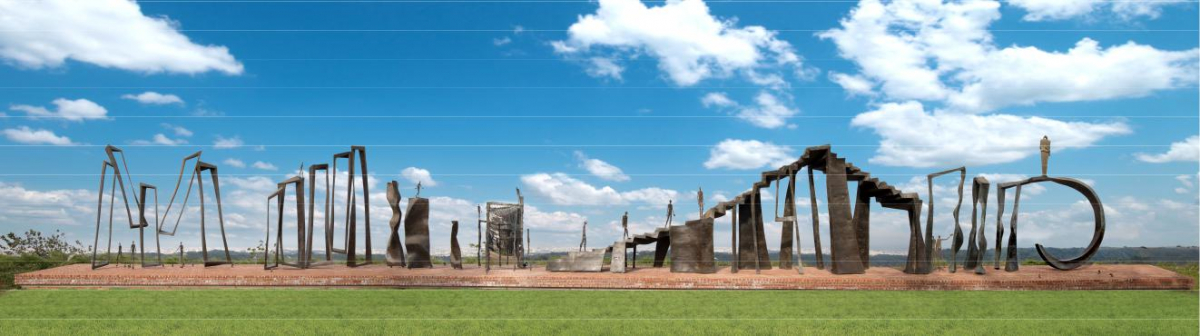
In loving tribute to Val, who for her whole career was based in Bangkok, this exhibition will take a fresh perspective on Val’s oeuvre ranging from her iconic bold and striking works of Bronze such as the 36-metre long sculpture, “Du chaos à la sagesse” to the intricate Murano glass and bronze sculptures such as the “Ombre Rouge”. It is in these artworks that we find Val’s innate ability to cast an alluring duality in her art pieces; On one hand, her artworks offer an intimate peer into the inner workings of her mind, yet on the other, her pieces of work as a catalyst to unfurl the viewer’s artistic interpretations, ensures a connection between art and the viewer.

Ombre rouge

Ombre rouge

Valérie Goutard (Val), 1967 – 2016, was a highly lauded bronze and glass sculptor whose works today can be found displayed at the Art Museum of the Central Academy of Fine Arts of Beijing (CAFA), the New Square in Taipei, the Benjasiri Park in Bangkok, the Art and Arch Museum in Taiwan, and the Sky Suites @ Anson and the Sorento Residence in Singapore, among others. Her work have also been featured in various art fairs, namely Shanghai Art Fair, Art Taipei, Art Busan, and India Art Fair.

La montagne suspendue

La montagne suspendue

It was after a major exhibition held at the Redsea Gallery called “Theatre of Life” in 2010, along with a very notable participation at the Shanghai Art Fair in 2010 as part of the Jing’An International Sculpture Park Project, where her very first monumental sculpture entitled “Urban life” was displayed, that Val saw her sculptures gain broad acclaim.

Every work by Val is infused with an intensity of her self-expression and often explores the delicate balance between man and his environment. In 2016, Val embarked on an artistic and ecological grand feat of installing three monumental sculptures on the seabed of Koh Tao in Thailand, which introduced extinct coral reefs back into Koh Tao’s ecosystem. The sculpture series entitled “Ocean Utopia” was made up of bronze, marine concrete, and the extinct coral, and has since flourished into its own ecosystem underwater.

Du chaos à la sagesse

Du chaos à la sagesse

At the time of her passing, Val was working on a 36-metre long sculptural project due to be installed in Taichung, Taiwan in 2017. It was not installed until 2017 on the heights of Taichung, Taiwan, a few months after her tragic death in Thailand in October 2016.

The exhibition will take place from February 20 to 29 at the RedSea Gallery in Singapore, from 11 am to 8 pm daily.

Famed Buddhist nun Pema Chodron resigns from Shambhala – cites community’s lack of ‘accountability’ to alleged abuse victims #ศาสตร์เกษตรดินปุ๋ย

#ศาสตร์เกษตรดินปุ๋ย : ขอบคุณแหล่งข้อมูล : หนังสือพิมพ์ The Nation

https://www.nationthailand.com/lifestyle/30380751?utm_source=category&utm_medium=internal_referral

Famed Buddhist nun Pema Chodron resigns from Shambhala – cites community’s lack of ‘accountability’ to alleged abuse victims

Jan 18. 2020

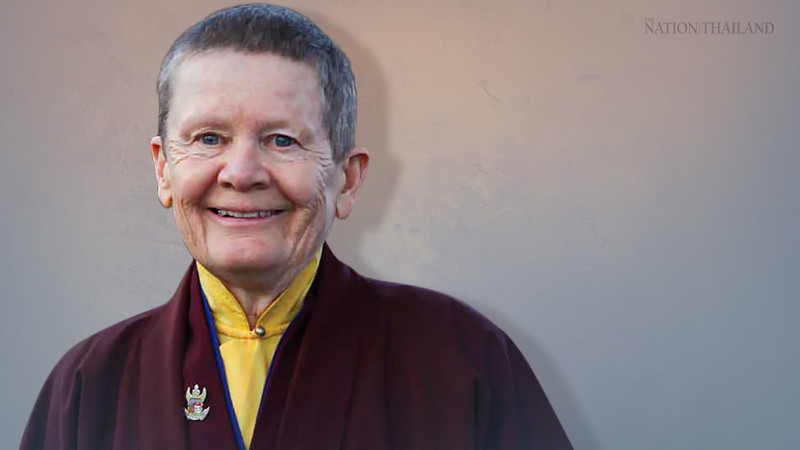
Pema Chodron

Pema Chodron
By The Washington Post · Michelle Boorstein 
Sexual misconduct charges against its leader continued to roil the Shambhala Buddhist community this week, with famed nun and best-selling author Pema Chodron stepping down as a Shambhala teacher, saying adherents are “yearning for accountability.”

The 83-year-old American nun has written multiple best-selling books, including “When Things Fall Apart” in 1996, and is one of the best-known faces of American Buddhism. She announced her retirement as a teacher in the Halifax, Nova Scotia-based global community in a Tuesday letter to the Shambhala board.

Chodron pointed to recent news that Sakyong Mipham Rinpoche, whose father founded the Shambhala movement and who has been the group’s longtime spiritual leader, had been approved by the group’s board to lead an initiation ceremony in Europe in June, as reported in the Buddhist news magazine Tricycle. “I was dumbfounded,” Chodron wrote.

The sakyong, whose birth name is Osel Rangdrol Mukpo, had “stepped away” from teaching and administrative duties in 2018 after allegations of sexual abuse and misconduct were made against Shambhala teachers and leaders, including him, Tricycle reported Friday.

The community’s board of directors resigned in 2018. A new, interim board hired an outside law firm to investigate. A report was released in February that found that Mukpo had in two cases probably forced himself on two women, Tricycle reported. The report, by the firm Wickwire Holm, also “painted a picture” that Mukpo in the 1990s and early 2000s frequently had sexual contact with women who were his students.

In a statement to The Washington Post on Friday, the Shambhala board did not comment on the sakyong’s upcoming public role. It emphasized that Pema remains a part of the Shambhala community and that the board is in dialogue with her about trying to find a “path forward” together, the board statement said.

A spokesperson for Mukpo said he is on retreat and unavailable.

In two letters he wrote in 2018 addressed to the Shambhala community, the sakyong apologized to anyone he hurt and said he accepts responsibility for the pain he had caused. Citing the stress of taking over leadership of the community at a young age after his father’s passing, and of an alcohol addiction, he said he is “like all of you, human and on the path,” he wrote in June of 2018.

A few weeks later, in a second letter, he said he was in a “state of complete heartbreak, I write to you, humble, embarrassed, and thoroughly apologetic for disappointing you.”

A message to Chodron’s spokesperson was not immediately returned Friday.

Chodron appeared on Oprah Winfrey’s “Super Soul Sunday” this past fall and has written several best-selling books. In her retirement letter, she acknowledged she had not been teaching in her Nova Scotia-based community for a while but felt that the reemergence of Mukpo, without what Chodron sees as a public accounting, made this seem like the right time.

“The seemingly very clear message that we are returning to business as usual distresses me deeply,” Chodron wrote. “How can we return to business as usual when there is no path forward for the vast majority of the community who are devoted to the vision of Shambhala and are yearning for accountability, a fresh start, and some guidance on how to proceed? I find it discouraging that the bravery of those who had the courage to speak out does not seem to be effecting more significant change in the path forward.”

Issues of sexual misconduct have been pushed to the forefront by Buddhist Project Sunshine, a group that investigates and hosts discussion about complaints related to alleged sexual misconduct and violence in Shambhala.

In 2018, Chodron publicly apologized for dismissing a woman who accused a different Shambhala director of rape. Chodron, the woman said, told her “I don’t believe you,” and, “If it’s true I suspect that you were into it.” The unnamed woman’s allegation is in a 2018 Project Sunshine report that did not specify when the alleged conversation happened.

In a 2018 statement, reported on by the Buddhist news site Lion’s Roar, Chodron said she apologized: “I was able to tell her that I feel very differently now; I believe what she told me and, going forward, I hope to be a better listener and not again say such insensitive and hurtful remarks to those who come to me for help.”

The battle for Notre Dame: As the cathedral rises from the ashes, a tug-of-war is waged over its transformation #ศาสตร์เกษตรดินปุ๋ย

#ศาสตร์เกษตรดินปุ๋ย : ขอบคุณแหล่งข้อมูล : หนังสือพิมพ์ The Nation

https://www.nationthailand.com/lifestyle/30380734?utm_source=category&utm_medium=internal_referral

The battle for Notre Dame: As the cathedral rises from the ashes, a tug-of-war is waged over its transformation

Jan 18. 2020
On an island in the Seine, in the heart of the ancient city of Paris, the land where Notre Dame would be built had been devoted to religious worship for centuries. In 1160, Maurice de Sully, a brilliant administrator, was elected bishop of Paris and almost immediately began plans for a large cathedral, dedicated to the Virgin Mary. To clear space for Notre Dame, other structures, including the cathedral of Saint-Étienne, were gradually dismantled. MUST CREDIT: Washington Post illustration by Aaron Steckelberg

On an island in the Seine, in the heart of the ancient city of Paris, the land where Notre Dame would be built had been devoted to religious worship for centuries. In 1160, Maurice de Sully, a brilliant administrator, was elected bishop of Paris and almost immediately began plans for a large cathedral, dedicated to the Virgin Mary. To clear space for Notre Dame, other structures, including the cathedral of Saint-Étienne, were gradually dismantled. MUST CREDIT: Washington Post illustration by Aaron Steckelberg
By The Washington Post · Philip Kennicott · FEATURES

The battle for Notre Dame: As the cathedral rises from the ashes, a tug-of-war is waged over its transformation. PARIS – Earlier this month, the French general tasked with overseeing the restoration of Notre Dame confirmed some terrible news: Even now, nine months after a catastrophic fire in April destroyed the cathedral’s spire, roof and some of its vaults, its fate remains uncertain. “The cathedral is still in a state of peril,” Jean-Louis Georgelin told the French broadcaster CNews.

There has been renewed anguish in France. The holidays passed without a Christmas Mass in the beloved national icon or a Christmas tree on the public square outside its richly decorated west facade. When I visited in October, I passed by only once, and it was painful to see the great church off-limits. The writer Hilaire Belloc once described Notre Dame as a matriarch whose authority is familiar, tacit and silent. But she now seems not just reticent, but mute.
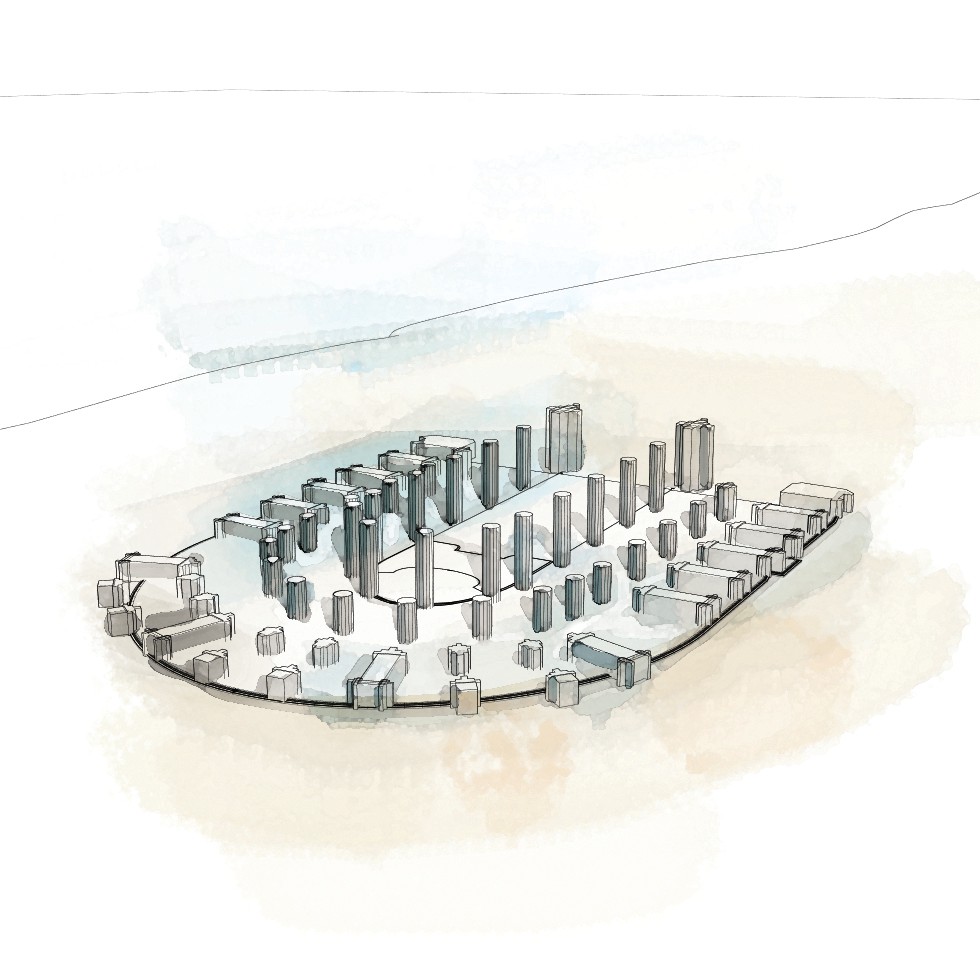
With King Louis VII and Pope Alexander III in attendance, the first major phase of construction began with the laying of the cornerstone in 1163. MUST CREDIT: Washington Post illustration by Aaron Steckelberg

With King Louis VII and Pope Alexander III in attendance, the first major phase of construction began with the laying of the cornerstone in 1163. MUST CREDIT: Washington Post illustration by Aaron Steckelberg

As the public commission headed by Georgelin met for the first time in December, it was clear that the country was still far from any consensus on how the cathedral will be restored. Weeks earlier, Philippe Villeneuve, chief architect of the country’s historic monuments service, said in a broadcast interview that he would resign rather than allow a modern spire – as proposed by French President Emmanuel Macron – to be built atop the cathedral’s roof. In response, Georgelin told the architect to “shut his gob.”

By 1182, much of the cathedral's choir - the liturgical core of the building, then reserved for the clergy - with its iconic flying buttresses supporting its tall walls and roof, had been completed. MUST CREDIT: Washington Post illustration by Aaron Steckelberg

By 1182, much of the cathedral’s choir – the liturgical core of the building, then reserved for the clergy – with its iconic flying buttresses supporting its tall walls and roof, had been completed. MUST CREDIT: Washington Post illustration by Aaron Steckelberg

That comment made international news, although in France it wasn’t out of character for public discussion of architecture and preservation.
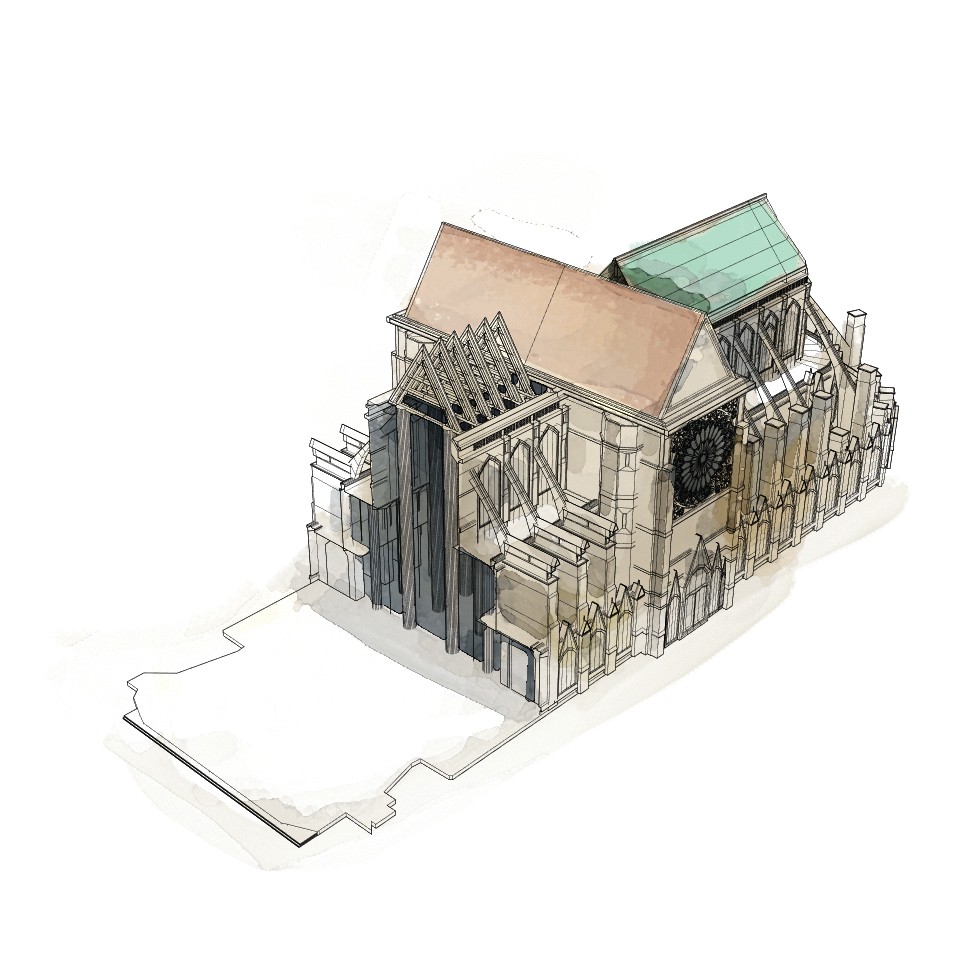
Over the next decades, work on the nave pushed the cathedral's spine to the west. MUST CREDIT: Washington Post illustration by Aaron Steckelberg

Over the next decades, work on the nave pushed the cathedral’s spine to the west. MUST CREDIT: Washington Post illustration by Aaron Steckelberg

“This debate is classic,” Philippe Barbat, director general of heritage at the French Ministry of Culture, said in interview last fall. “Do we restore it as close as possible to what we understand by analyzing the historical context of the building, or do we try to make something more creative?” Barbat cites the glass pyramid at the Louvre, designed by I.M. Pei as a modernist intervention at the heart of one of the city’s sacred cultural spaces, as an example of the latter.
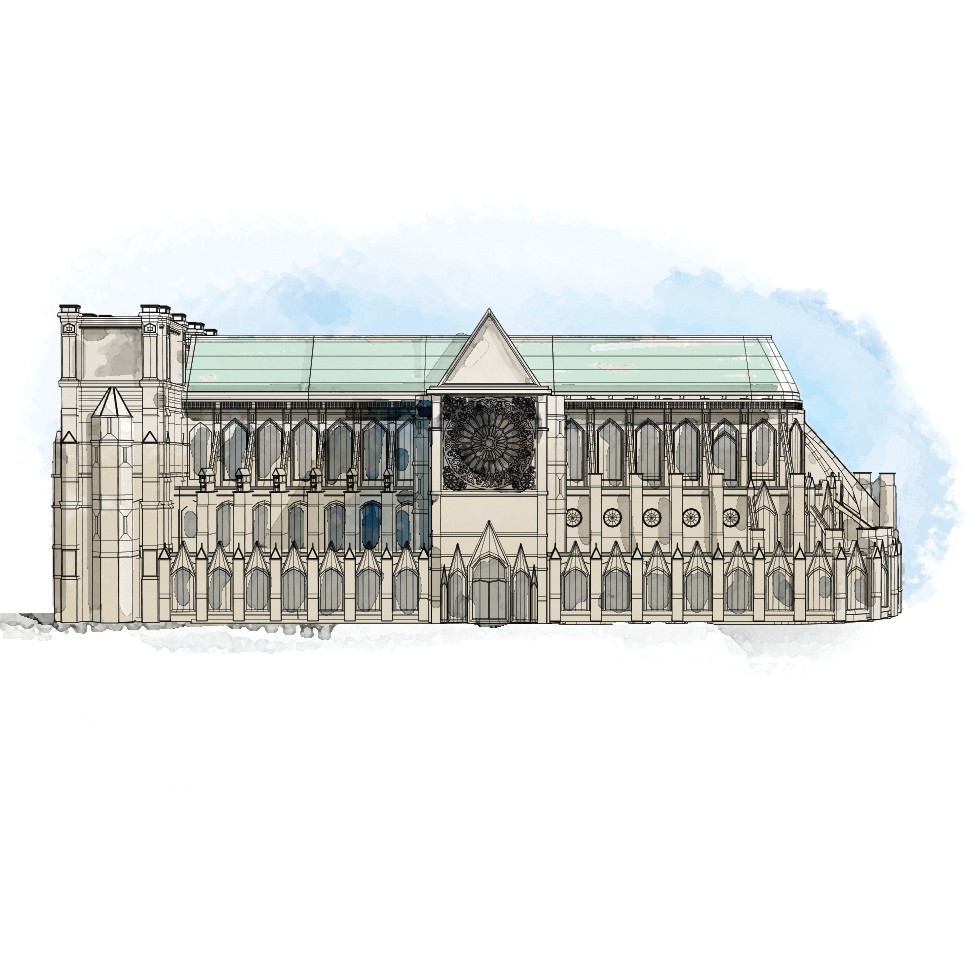
By 1220, the basic form of the early cathedral was essentially finished. MUST CREDIT: Washington Post illustration by Aaron Steckelberg

By 1220, the basic form of the early cathedral was essentially finished. MUST CREDIT: Washington Post illustration by Aaron Steckelberg

And change is classic, too. Although there have been centuries during which the architecture of Notre Dame stayed mostly the same, especially after the major construction work was finished in the middle of the 13th century, it has undergone major transformations throughout its history. As France, and much of the rest of the world, contemplates what will become of the grand cathedral, it’s clear that the final result will be an amalgam: of history and fantasy, the 12th century and the 21st, the imaginary building seen in art and described in literature, and a pile of stones that has been made and remade for almost nine centuries.
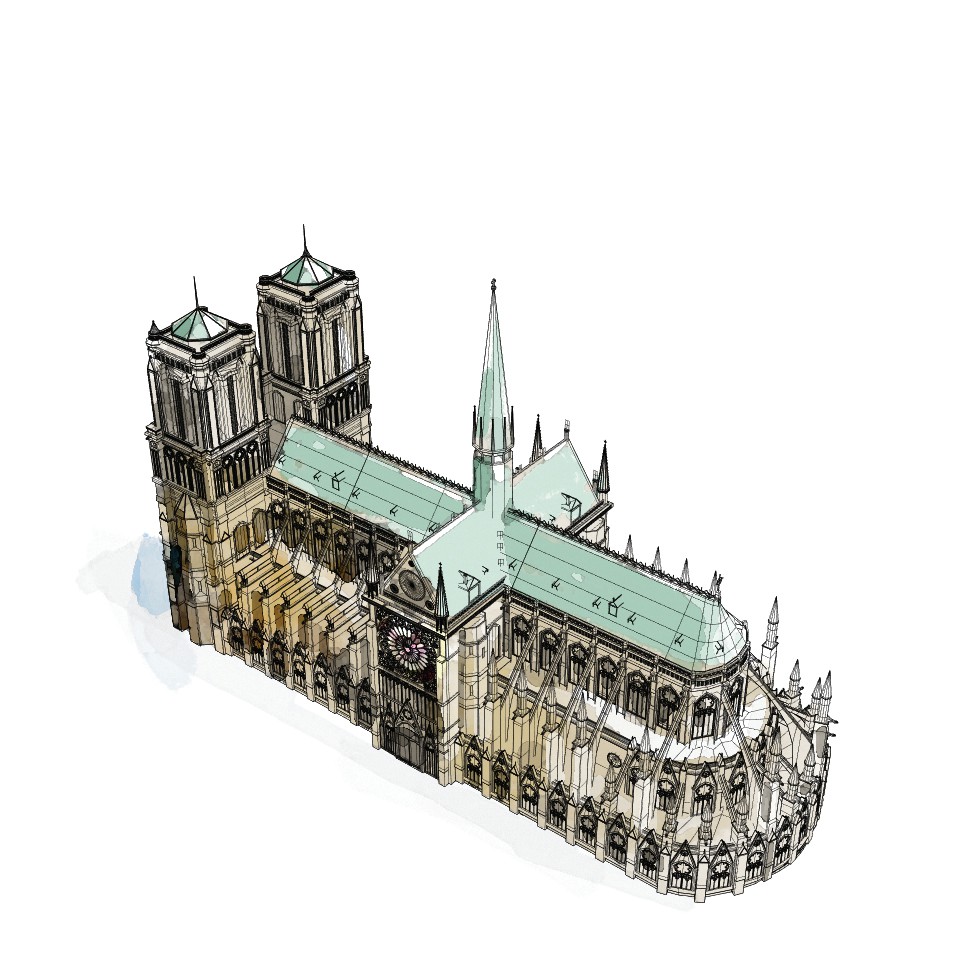
Beginning in the mid-1220s, much of Notre Dame was remade to be more in line with contemporary architectural tastes. The two western towers were finished and a spire was added to the crossing of the nave and transept. The last major phase of the original construction ended in the mid-14th century, more than 150 years after it had begun. By the late 18th century, the original spire was removed before it could collapse from decay. The cathedral remained without a spire until 1859, when one designed by Eugène Emmanuel Viollet-le-Duc was added as part of an extensive 20-year renovation. Over the next 160 years, alterations and repairs continued to be made. MUST CREDIT: Washington Post illustration by Aaron Steckelberg

Beginning in the mid-1220s, much of Notre Dame was remade to be more in line with contemporary architectural tastes. The two western towers were finished and a spire was added to the crossing of the nave and transept. The last major phase of the original construction ended in the mid-14th century, more than 150 years after it had begun. By the late 18th century, the original spire was removed before it could collapse from decay. The cathedral remained without a spire until 1859, when one designed by Eugène Emmanuel Viollet-le-Duc was added as part of an extensive 20-year renovation. Over the next 160 years, alterations and repairs continued to be made. MUST CREDIT: Washington Post illustration by Aaron Steckelberg

As Notre Dame has been rebuilt and repaired over the centuries, there have been many cries of sacrilege. Shortly before the French Revolution, it was whitewashed, leading one prominent critic to grumble that the edifice had “lost its venerable color and its imposing darkness that had commended fervent respect.” And beginning in the 1840s, after decades of little maintenance, sporadic use and sometimes misguided efforts at repair, it was “restored” so thoroughly that many historians came to think of it as a 19th-century church, not a medieval one.
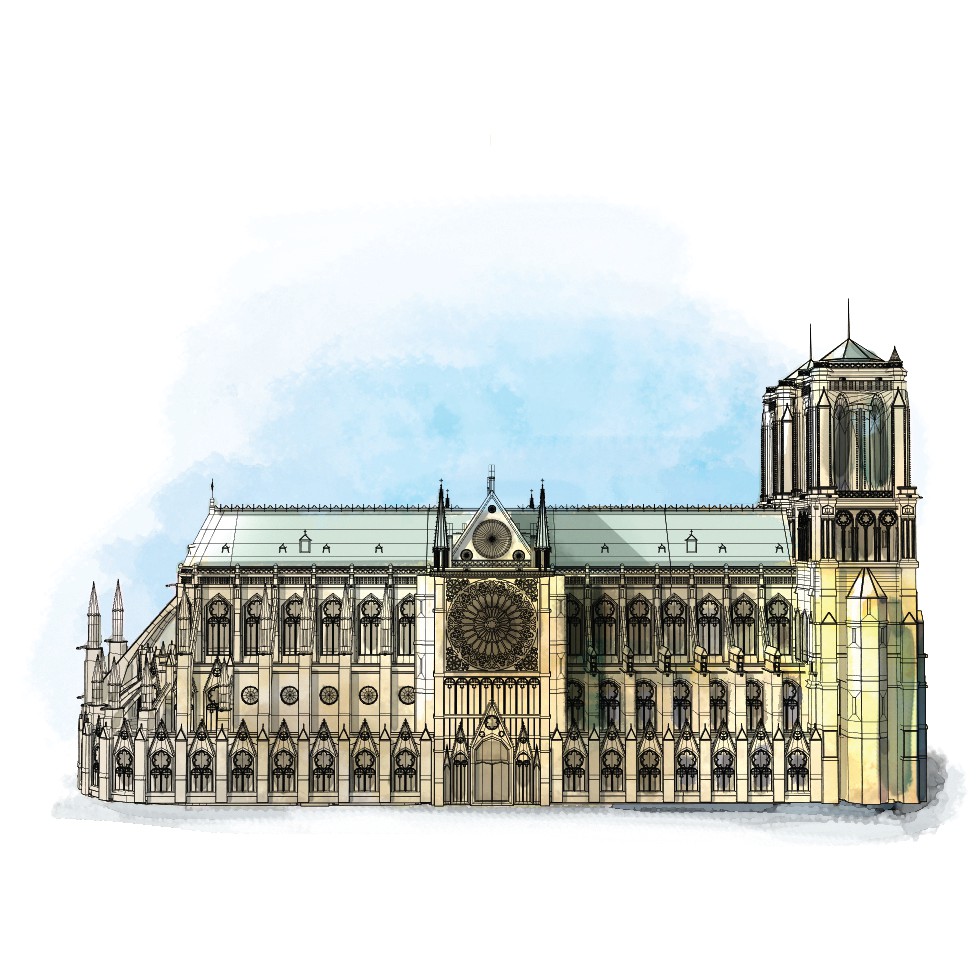
In the spring of 2019, the most recent renovations to the cathedral were underway. Scaffolding was erected around the spire to make repairs, and days before the fire, 16 statues at the base of the spire were removed. MUST CREDIT: Washington Post illustration by Aaron Steckelberg

In the spring of 2019, the most recent renovations to the cathedral were underway. Scaffolding was erected around the spire to make repairs, and days before the fire, 16 statues at the base of the spire were removed. MUST CREDIT: Washington Post illustration by Aaron Steckelberg

One of the most significant transformations was probably precipitated by a fire in the 13th century, perhaps similar to the one in 2019, in the roof space above the vaults. Whether the damage forced the cathedral’s stewards to rebuild, or was simply a good pretext to update the building, isn’t clear. But the change was extensive.
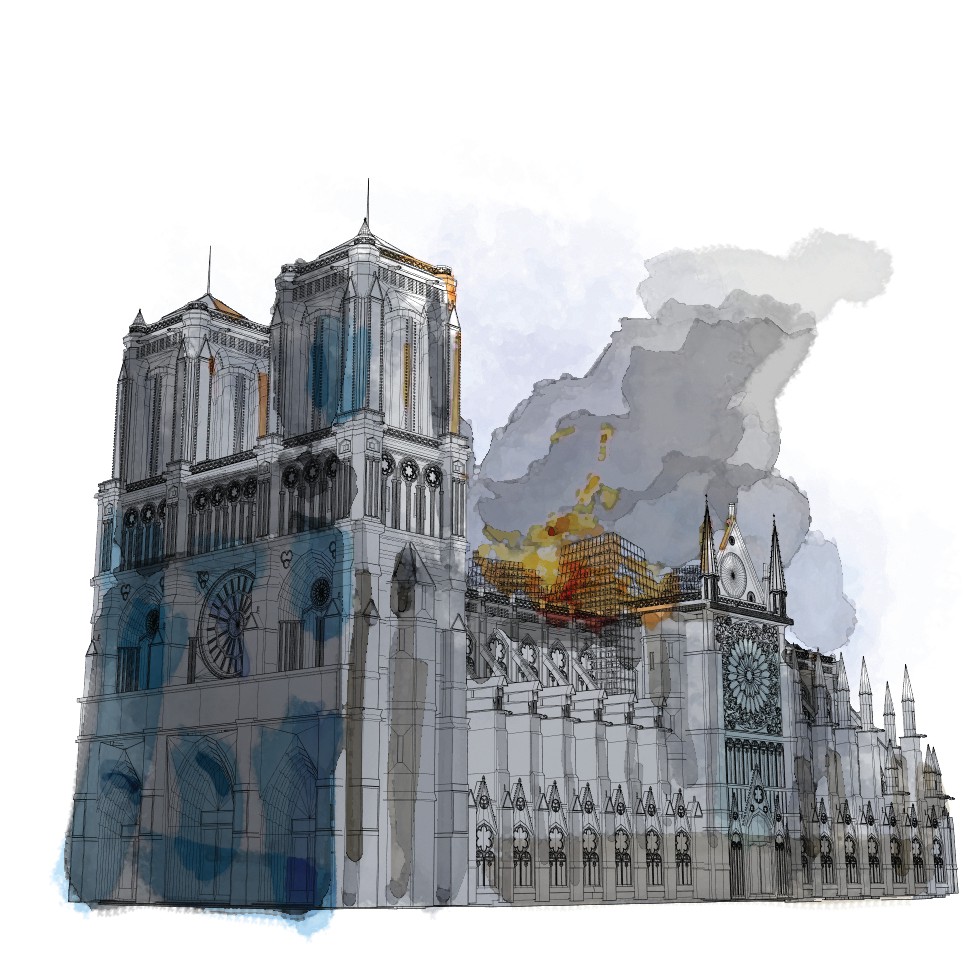
On April 15, a massive fire broke out. Over several hours, flames raged and eventually destroyed Notre Dame's spire, roof and timbers within. An official cause has still not been determined, although early speculation centered on an electrical source, or a discarded cigarette. MUST CREDIT: Washington Post illustration by Aaron Steckelberg

On April 15, a massive fire broke out. Over several hours, flames raged and eventually destroyed Notre Dame’s spire, roof and timbers within. An official cause has still not been determined, although early speculation centered on an electrical source, or a discarded cigarette. MUST CREDIT: Washington Post illustration by Aaron Steckelberg

“Having been around for a mere sixty years, Notre Dame had already been eclipsed,” Dany Sandron of the Sorbonne and the late Andrew Tallon of Vassar write in a forthcoming book about the cathedral, based in part on their comprehensive laser measurement of Notre Dame before the 2019 fire. Elsewhere, in 13th-century France, new cathedrals were being built, and old ones disassembled and reconstructed, to make them taller, lighter and more vertical, and to introduce more light, as if they were made from taut curtains of glass, not heavy columns of stone. And so Notre Dame’s clerestory windows were enlarged, the roofs changed and the flying buttresses reconstructed, although the cathedral remained relatively dark despite its fashionable update.
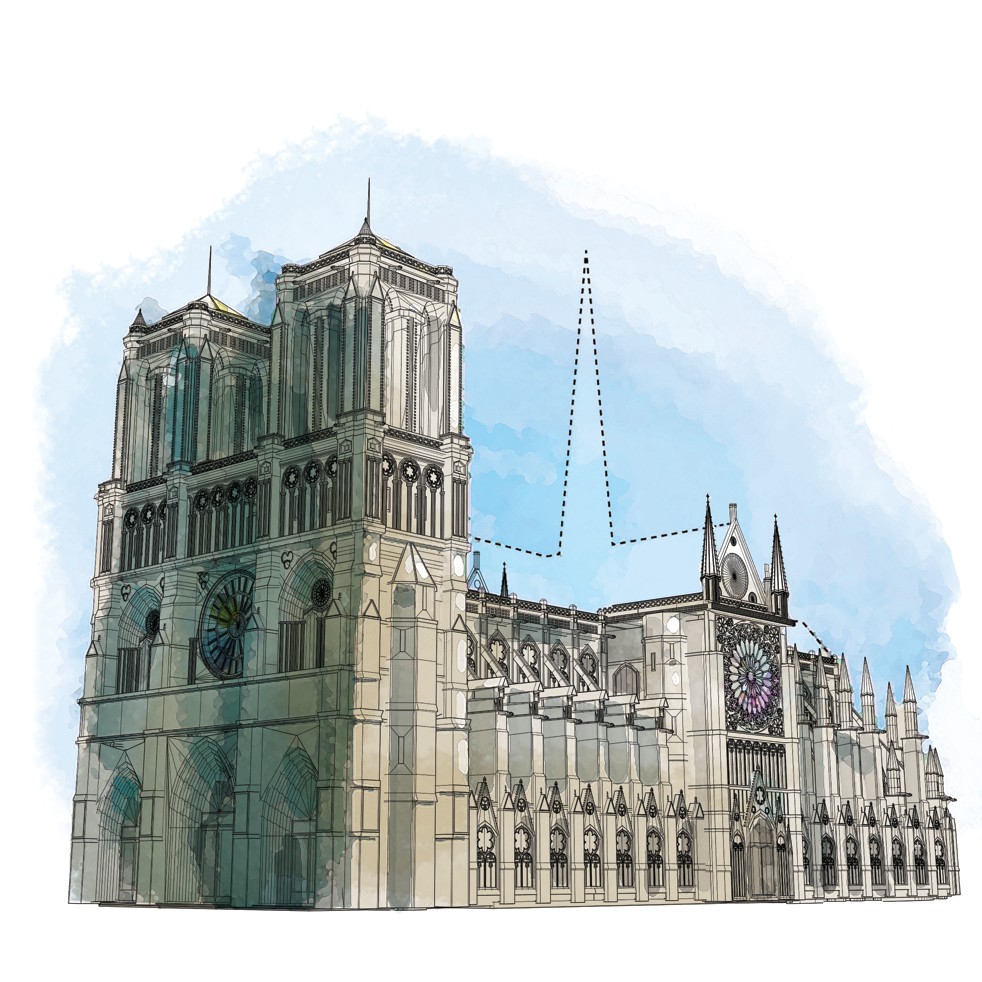
After the fire, debate began almost immediately about the cathedral's restoration. Should it be returned to its exact pre-fire configuration? Should the 19th-century spire be rebuilt? Or should it be updated for the 21st century and beyond? MUST CREDIT: Washington Post illustration by Aaron Steckelberg

After the fire, debate began almost immediately about the cathedral’s restoration. Should it be returned to its exact pre-fire configuration? Should the 19th-century spire be rebuilt? Or should it be updated for the 21st century and beyond? MUST CREDIT: Washington Post illustration by Aaron Steckelberg

The second radical transformation dates, in part, to 1831, when Victor Hugo published the novel known in English as “The Hunchback of Notre Dame.” The book, set in the 15th century, was a phenomenal success, and the church itself was a major character in its drama of love, lust and betrayal. Hugo intended the novel to ignite interest in France’s legacy of gothic and medieval architecture, and he succeeded. Notre Dame, then in a state of grave disrepair, was rediscovered, and various government committees and commissions were established to help the country address what we now call cultural heritage and historic preservation.

Repairing Notre Dame was one of the most urgent projects, and Eugène Emmanuel Viollet-le-Duc, one of two architects put in charge of restoration, began to undertake extensive and controversial changes. Perhaps no one in the history of the cathedral understood it better – its quirks, structural oddities and weak spots – and no one was more passionately hostile to earlier renovations that had altered its gothic design. But Viollet-le-Duc’s definition of restoration was more like that of a contemporary theater director approaching an old script than a preservationist working with scientific and historical rigor: “To restore a building,” he wrote, “is not to maintain, repair, or redo it, but to reestablish it in a finished state that may never have existed at a given time.”

Viollet-le-Duc changed the windows, added decorative elements to the base of the flying buttresses, remade statues, and created wholesale many of the grotesques, chimeras and gargoyles that visitors often assume are the essence of the cathedral’s gothic character. He also built a new spire, out of wood and lead, to replace the one that had been removed in the mid-18th century because it was no longer sound.

Those changes rapidly became embedded in the public memory of the building. I recall receiving a postcard from Paris that showed a classic image: the Eiffel Tower, with one of Viollet-le-Duc’s gargoyle figures in the foreground. But it didn’t contrast old and new, simply two visions of the 19th-century remake of the city.

One of the most famous images of 19th-century France was an 1853 etching by Charles Meryon called “Le Stryge,” or “The Vampire,” which shows another of Viollet-le-Duc’s grotesque Notre Dame figures, its tongue sticking out contemptuously as it watches over a fantasy of old Paris. It helped to define the curiously Parisian sense that the city’s essence is woven of both beauty and squalor, that it teems with contradictions and harsh contrasts, as in a famous poem by Charles Baudelaire: “Brothels and hospitals, prison, purgatory, hell/Monstrosities flowering like a flower …”

After the fire, the Cité de l’Architecture et du Patrimoine, a Paris museum that includes Viollet-le-Duc’s invaluable collection of full-scale architectural casts of historic French facades and medieval sculptural elements, displayed models, sculpture and other objects related to Notre Dame. The museum embodies the complicated legacy of Viollet-le-Duc, who was for much of the 20th century considered a fantasist, a Walt Disney-like figure who invented his own version of historic architecture. But he also was a meticulous observer, and the documentation he left behind may be essential to restoring Notre Dame.

“We know we can construct it exactly like it was,” says Francis Rambert, director of the museum’s architectural design department. He is standing in front of Viollet-le-Duc’s model for the wooden spire, a small-scale sculptural marvel in itself. “But the question is, do we need to sacrifice all those trees?”

The spire and the wood have become intertwined flash points that seem to divide French opinion not into clearly opposed ideological camps, but into myriad fragmentary alignments of opinion, as complex as one of the cathedral’s rose windows. There are environmental issues, aesthetic issues, cultural issues, patrimony issues and financial issues.

Is wood necessary? Would lighter materials be better, or do the vaults need the heavy weight of wood to make them secure? Is satisfactory wood available? At one point last year, a Ghanaian company even offered to dredge up giant trees preserved and strengthened by submersion when land was flooded for a dam in Africa in 1965.

The current debates and controversies have uncovered a deeper admiration for Viollet-le-Duc and his architectural changes than might have been apparent a quarter century ago. “Was he some kind of genius or someone who was a megalomaniac?” asks Barbat, the government heritage director, who adds that opinion about Viollet-le-Duc has changed markedly since the 1990s, with growing acknowledgment that his changes have become part of the cathedral’s history. Indeed, when a damaged part of the church’s Porte Rouge was repaired recently, one of Viollet-le-Duc’s elements was meticulously reproduced, a sign that preservation now includes older, 19th-century restoration efforts.

In the end, it will probably be Macron who determines the new form of Notre Dame, although it’s unclear how much he will defer to experts, traditionalist voices, the Catholic Church and the concerns of preservationists. French presidents generally want to put their stamp on Paris, such as Georges Pompidou’s support for a modern cultural center, which eventually became the Centre Pompidou, a bristling postmodern architectural masterpiece, or Francois Mitterand’s championing of I.M. Pei’s Louvre pyramid project. Macron, young, arrogant and determined to chart a new middle course through the fault lines of French political life, has his perfect signature project: the restoration of an ancient building with a modern twist.

“As for the decision itself, I would say that only the president can answer this,” Barbat says. “He was really involved since the night of the fire when he was present at the cathedral. Most likely he will speak about it with the head of the (commission), General Georgelin, but also the minister of culture. Afterward, I cannot answer precisely what he will decide alone in the loneliness of the presidency.”

Guzheng adds magic to New Year in Bangkok show #ศาสตร์เกษตรดินปุ๋ย

#ศาสตร์เกษตรดินปุ๋ย : ขอบคุณแหล่งข้อมูล : หนังสือพิมพ์ The Nation

https://www.nationthailand.com/lifestyle/30380709?utm_source=category&utm_medium=internal_referral

Guzheng adds magic to New Year in Bangkok show

Jan 17. 2020
By THE NATION

An expert player of the venerable Chinese instrument the guzheng will be onstage on January 26 for a performance welcoming the Lunar New Year, presented by Mahidol University’s College of Music.

The two-hour “Night of Chinese Festival” begins at 6pm at the Neilson Hays Library in Bangkok.

Punnakrid Thirasuthphathorn plays the guzheng with the Siam Huqin Ensemble as well as being a harpist with the Thailand Philharmonic Orchestra.

Music lovers will recall him playing Thai music with Her Royal Highness Princess Sirindhorn at the Thai Higher Education Music Festival hosted by Silpakorn University.

Punnakrid also won the silver medal in the 2019 SET Youth Music Competition.

The strings of the guzheng, also known as the Chinese zither, were made of silk when it first evolved some 2,500 years ago and there was great diversity in the number of strings.

The modern version usually has 21 metal strings and movable bridges. It is often richly decorated.

Punnakrid will be accompanied on guitar by Nutthapat Ruangboon, who is also skilled with the piano, drums, violin and the Thai flute known as a klui.

He won second prize at the 2015 His Majesty King Bhumibol’s Cup Sornthong Thai Music Competition playing the klui and earned medals in two SET Youth Music competitions.

Punnakrid and Nutthapat will perform the ancient air “High Mountain Flowing Water”, “The Moon’s Reflection on the Lake”, the folksong “Jasmine Flower”, a Chinese-Mongolian folksong called “Wild Goose”, “Spring Comes to Lhasa” by Shi Zhao Yuan, “Yi Tribe Dance” by Wang Hui Ren, “Pipa Language” by Lin Hai, and the folksong “Purple Bamboo”.

After an intermission, they will continue with “Liu Yang River” by Wang Jian Zhong, “Beautiful Cloud Chasing the Moon” by Ren Guang, “Butterfly Lover” by He Zhan Hao and Chen Gang, the folksong “Beautiful Girl of Alishan”, “Dream Back to Ordos” by Chen Yue, “Fighting the Typhoon” by Wang Chang Yuan, and “Spring View” by Seiichi Kyoda.

Seats cost Bt450 (Bt350 for library members, Bt100 for students) online and at the library and can be reserved at (02) 233 1731 or info@neilsonhayslibrary.org.