A Malaysian security force officer was killed in a clash with a group of drug smugglers on the Malaysia-Thailand border near Songkhla province at 2.10am on Tuesday.
The General Operations Force was patrolling on the Malaysian side when they encountered 13 kratom smugglers on the Thai border.
The clash also left one officer injured. One of the suspects was captured after he got injured and three others were hit by bullets.
Malaysian officers believe they would try to get some treatment in Thailand, as the smuggling operation was likely a collaboration between Thais and Malaysians.
Thailand’s police were notified of the incident and they went to the area to set up a perimeter to find the suspects.
The Centre for Covid-19 Situation Administration on Tuesday reported two new cases over a 24-hour period.
A five-month old Indian baby, which arrived in Thailand on November 11, tested positive on November 16 in an alternative state quarantine hotel in Bangkok after it suffered from fever and nausea.
A 31-year-old Pakistani male merchant arrived in Thailand on November 16 after taking a connecting flight in Dubai and tested positive in an alternative state quarantine hotel in Samut Prakarn province.
Meanwhile, six patients have recovered and been discharged.
The total number of confirmed cases in Thailand increased to 3,922 (961 in state quarantine), 90 are in hospital, 3,772 have recovered and been discharged and 60 have died.
According to Worldometer, as of 10am on Tuesday, the total number of confirmed cases rose to 59.5 million (up by 503,724), 41.15 million have recovered, 16.96 million are active cases (103,565 in severe condition) and 1.4 million have died (up by 7,949).
Thailand ranks 151st for most cases in the world, while the US has the most number with 12.78 million, followed by India 9.17 million, Brazil 6.09 million, France 2.14 million and Russia 2.11 million.
A pro-democracy doctor, Tosaporn Sererak, has demanded that the government stop using dangerous actions towards protesters, as was done during a demonstration last Tuesday at the Kiak Kai intersection in Bangkok.
On Monday, the doctor spoke at the Pheu Thai Party headquarters on the effects of the government action against demonstrators at the intersection. He was accompanied by some of those injured on November 17.
Tosaporn did not reveal the total number of people injured. He classified the injuries into three types: those who were shot, those who inhaled chemicals, and those who suffered burns due to the chemicals.
On November 17, some people were shot by royalists during the conflict between the two groups, after police suddenly abandoned the barriers that separated the two groups. The doctor stated that two people were shot in the legs, and one was shot in the stomach and the sides.
The worst injuries were suffered by a person who suffered a broken bone after being hit by a bullet on the left leg.
“Luckily the bullet did not reach the aorta, or he would have died,” the doctor said.
During the protest, police used tear gas to prevent demonstrators from approaching their barriers.
Tosaporn said that those who inhaled the chemical suffered difficulties in breathing. Some of them were coughing for days after the event.
The strong chemical solution was not only dangerous to the respiratory system, but even the protesters’ bodies. The doctor explained that burns caused by the chemical-mixed solution would damage both the epidermis and dermis, and make it is easier for viruses to enter the human bodies via their weakened skin.
Tosaporn urged the government, as well as the police, not to commit violence against the people. He urged people injured from the demonstration to inform Pheu Thai Party on telephone No. 02-653-4000 or 02-653-4001.
The baht opened at 30.34 to the US dollar on Tuesday, weakening from 30.28 at close on Monday.
The Thai currency is likely to move between 30.25 and 30.45, said Jitipol Puksamatanan, senior director of the chief investment office at SCB Securities.
On Monday night, the S&P 500 index rose by 0.6 per cent, due to positive reports on development of a Covid-19 vaccine.
Meanwhile, WTI crude oil price increased by 1.1 per cent to the highest point since late September. Gold price shrank by 1.9 per cent.
In Europe, the Stoxx 600 index fell by 0.2 per cent, as investors are wary of investing in the region in the post-coronavirus era.
In the financial markets, the dollar strengthened by 0.2 per cent, compared to the other main currencies.
The US Ten-Year Treasury increased by 3 basis points to 0.85 per cent.
In Thailand, the baht weakened due the present dollar situation. Jitipol predicted that the baht at the end of this year would strengthen to 30.20 to the US dollar, supported mainly by capital inflows.
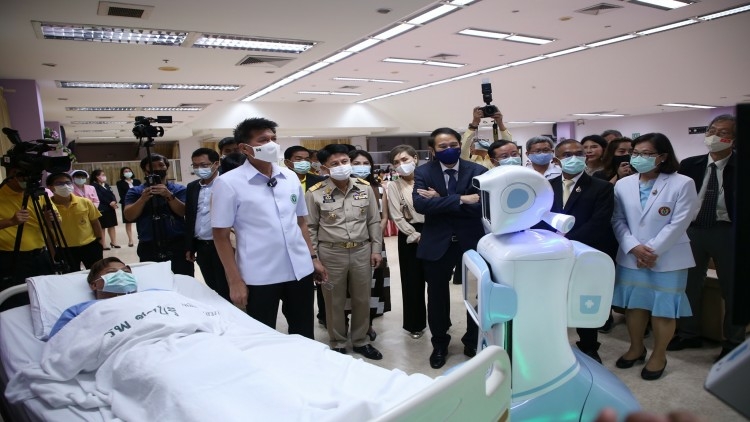
The Office of the Eastern Economic Corridor (EEC) has been working with the Institute of Field Robotics (FIBO) at King Mongkut’s University of Technology Thonburi to manufacture and distribute “Mod Borirak” (Caregiver Ants) medical robots to hospitals in EEC areas in a bid to help medical professionals in the treatment of Covid-19 patients.
“In the pilot phase, Chonburi, Phutthasothorn, Rayong and Bang La Mung hospitals will receive three robots each,” said office secretary-general Kanit Sangsubhan. “They include the “SOFA” robot, which provides remote patient diagnosis via video conferencing system, the “CARVER” robot that transports drugs and foods to patient rooms, and a service robot that provides a lot of medical assistance and is controlled from the hospital’s central control room. The 12 robots to be distributed cost over Bt8 million.”
Kanit added that under the cooperation with FIBO, the EEC office has invited over 200 companies in the robotics industry to participate in technology transfer to develop and manufacture medical robots for commercial purpose.
“FIBO has the innovation and technology, but they still lack manufacturing facilities and investment,” he added. “The project has been well-received, and even hospitals overseas, such as the United States, France and Singapore have expressed their interest in buying the Mod Borirak robots. However, we aim to produce them for domestic hospitals first in order to help minimise the risk of medical professionals contracting diseases from patients.
“Currently there are many private investors, most of which are industrial estate developers, expressing their interest in building hospitals in EEC areas, which will help improve the area’s medical service capability without relying on government budget,” added Kanit.
“New hospitals will also attract future investment in medical technology, such as medical robotics, genomics study and manufacturing of drugs and advanced medical equipment.”
By THE NATIONThe Government Housing Bank (GHB) is offering up to Bt1,000 cash back to customers with good repayment records as a new year gift, bank president Chatchai Sirilai said.
“We have earmarked Bt100 million for this campaign, which aims to give cash back to customers so they can spend during the year-end until early 2021 and help boost the economy.
“Customers who repaid their loans either at the bank’s branches or via GHB All mobile application would be eligible for the cash back,” he said.
GHB has divided customers eligible to receive the cash into two groups. The first group consists of borrowers with less than Bt1 million loan and a good repayment record of at least 48 consecutive months. This group will receive Bt1,000 cash.
“Good repayment record means customers paid on time and at higher than minimum amount,” Chatchai explained.
The second group, which is limited to the first 100,000 customers, comprises those whose debt amount and repayment record does not qualify to be in the first group. They will receive Bt500 cash.
“Eligible customers for both groups must have their account status listed as ‘normal’ and must not have undergone debt restructuring,” added Chatchai.
He added that the GHB board had recently approved an additional budget of Bt35 billion to issue the second batch of GHB’s “Kled Dao” saving bonds, after the first batch of Bt15 billion received a warm welcome from the public.
“We have already sold about Bt10 billion worth of Kled Dao bonds, and expect that the balance Bt5 billion will be sold out by December 16.”
The two-year bond offers 0.4 per cent interest and each unit is priced at Bt5,000.
For more information, contact 0-2645-9000 or visit www.ghbank.co.th
The government’s car-exchange scheme should be limited to domestically produced cars in order to truly boost the domestic economy, the Federation of Thai Industries (FTI) suggested.
“The private sector agrees that this scheme will help boost the country’s economy, but only if there are criteria stipulating that cars under the scheme must be domestically produced,” said Surapong Paisitpatnapong, vice president and spokesman of the FTI’s Automotive Industry Club.
Back in May, the FTI had proposed to the government a car-exchange measure under which vehicles 20 years or older could be handed over when a new car is bought, and buyers could be given a Bt100,000 discount. The authorities are working on the details and the criteria should be announced soon.
“Other criteria must also be considered carefully, such as the types of vehicles to be exchanged [cars, pickup trucks], as well as the fuel types [gas, electric, hybrid],” he added. “We need to consider which types of vehicles need to be promoted in the domestic market, and whether or not the exchange of vehicles of different types will be allowed.
“Limiting the scheme to only domestically produced cars would help not only local manufacturers, but also those in related industries and the supply chain,” added Surapong.
“We expect this campaign to help create more than 1 million jobs, most of which are in tier 3 automotive parts manufacturers, which are mostly small and medium-sized enterprises.”
The Thailand Meteorological Department forecast on Monday that a moderate high-pressure system from China covers upper Thailand and the South China Sea.
The upper North and Northeast will have cool weather and a slight drop in temperature. The easterly winds bring humidity from the South China Sea into the lower Northeast, the East, the Central and the lower North, causing thundershowers and gusty winds in some areas. Farmers in the North and the Northeast should beware of damage to crop, the department said. The northeast monsoon in the South and the Gulf will strengthen and bring isolated heavy rain. People in the South should beware of the severe conditions, the department said.
The weather forecast for the next 24 hours:
North: Cool weather in the morning with thundershowers in 20 per cent of the areas; temperature lows of 16-23 degrees Celsius, highs of 31-35°C; temperature on hilltops are likely to drop to 7-16°C.
Northeast: Cool weather in the morning; temperature lows of 20-23°C, highs of 32-34°C. Temperature on hilltops are likely to drop to 10-17°C.
Central: Mostly cloudy and strong winds with thundershowers in 20 per cent of the areas; temperature lows of 23-24°C, highs of 32-35°C.
East: Mostly cloudy with thundershowers in 10 per cent of the areas; temperature lows of 23-25°C, highs of 32-34°C; waves a metre high and 1-2 metres offshore.
South (east coast): Mostly cloudy with thundershowers in 60 per cent of the areas and isolated heavy rain; temperature lows of 23-24°C, highs of 30-33°C; waves 1-2 metres high and over two metres during thundershowers.
South (west coast): Mostly cloudy with thundershowers in 60 per cent of the areas and isolated heavy rain; temperature lows of 22-24°C, highs of 30-33°C; waves a metre high and 1-2 metres during thundershowers.
Bangkok and surrounding areas: Mostly cloudy with thundershowers in 10 per cent of the area; temperature lows of 24-25°C, highs of 33-35°C.
Calls for education reform spread to the world of medicine on Monday, when medical students and doctors turned “#BadMedicalStudent” (#นักเรียนแพทย์เลว) into a top-trending hashtag.
The phenomenon followed a Facebook post on Sunday by Dr Manoch Chockjamsai, a lecturer at Chiang Mai University’s Faculty of Medicine. “I want to hear the voice of ‘bad medical students’, saying what the faculty does not want to hear,” stated Dr Manoch, in a post plainly inspired by the “Bad Student” group’s call for education reform.
By Monday, Manoch’s post had been shared more than 4,100 times and attracted over 700 comments. Most complained of authoritarianism under the rigid staff hierarchy in hospitals. Another frequent complaint was the amount of overtime that doctors and trainee medics must work.
Manoch’s post came a day after Bad Student supporters rallied in Bangkok to demand changes to the education system – their contribution to the nationwide pro-democracy movement.
Netizens proposed that others could expose rottenness in their own professions by posting under hashtags like “#bad teacher” or “#bad civil servant”.
Skytrain operator Bangkok Mass Transit System (BTSC) has defended the bid to extend its Green Line concession, after criticism that the Blue Line is much cheaper by comparison.
The Cabinet last week withheld approval for a 30-year extension of the concession from 2029 to 2059 after the Transport Ministry objected to the Bt65 top fare. The ministry pointed out that the MRT’s Blue Line only charges a maximum Bt48.
Surapong Laoha-Unya, chief operating officer of BTSC, explained that the Green Line and Blue Line had different costs. He said that under the contract, BTS must share Bt200 billion annual revenue from the Green Line with the Bangkok Metropolitan Administration.
He added that the Green Line charged higher fares because it was longer and had more stations than the Blue Line.
“If we compare the fares with distances on the BTS Green Line and MRT Blue Line, the fare average is similar,” he added. “The Green Line is 68 kilometres long with 59 stations and a maximum fare of Bt65, while the Blue Line is 48km with 38 stations and a maximum fare of Bt42.”
However, while the Blue Line was constructed by the state, BTS had to pay Bt60 billion to build the Green Line, Surapong said.
When combined with various debts and new investment, renewing the Green Line concession would lift the BMTA’s annual cost burden to Bt300 billion, he added.
Meanwhile the BMA’s own market sounding had found no companies interested in taking over the concession in 2036, when it would become available if it was not extended, he said.
Surapong urged renewal of the concession, saying it would allow the opening of seven more BTS stations to complete the Green Line route connecting the provinces of Bangkok, Samut Prakan and Pathum Thani.
Failure to renew the concession would mean the Green Line reverted to the maximum fare of Bt158, rather than Bt65 under the proposed extension contract, he said.