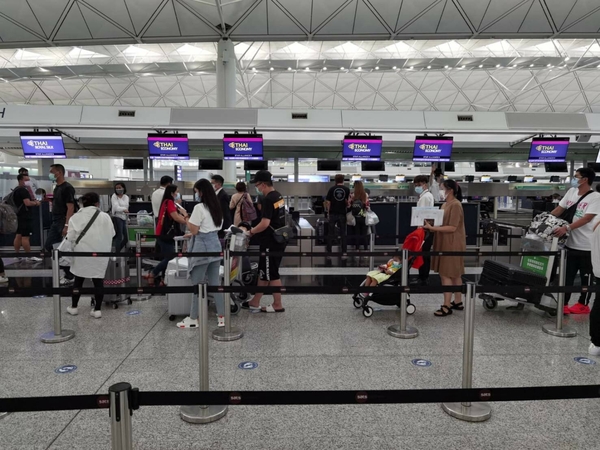
A Thai Airways International (THAI) flight on Saturday (August 29) brought back Thai nationals stranded in Hong Kong.
A total of 216 Thais departed Hong Kong at 8.48pm (local time) and landed at Suvarnabhumi Airport at 10.24pm (Thailand time) on flight TG 607. THAI also delivered cargo on the round-trip flight.
The flight was arranged in collaboration with the Foreign Ministry and Royal Thai Consulate-General in Hong Kong.
Sqn Leader Anirut Sangrit, vice president of the airline’s flight operations department, said THAI is always prepared to operate special flights to fly Thais home during this difficult time, and will work with related agencies to ensure smooth operation and convenience of all passengers.
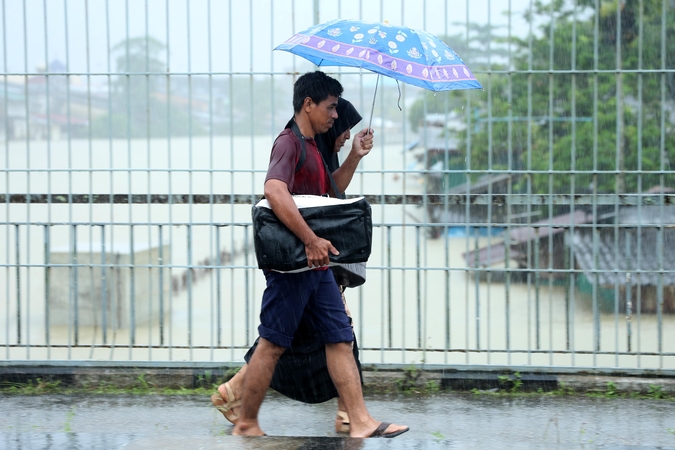
The Thailand Meteorological Department forecast on Monday (August 31) less rainfall than in recent days due to the southwest monsoon prevailing over the Andaman Sea and Thailand while a low pressure cell covers the Gulf of Tonkin.
Meanwhile the category 5 typhoon, “Maysak”, over the western North Pacific or east of the Philippines is moving north and is expected to move to the Korean peninsula on September 2-3, but with no effect on Thailand.
The weather forecast for the next 24 hours is as follows:
North: Mostly cloudy with thundershowers in 40 per cent of the areas; minimum temperature 22-26 degrees Celsius, maximum 34-37°C.
Northeast: Mostly cloudy with thundershowers in 40 per cent of the areas; minimum temperature 24-26°C and maximum 33-35°C.
Central: Mostly cloudy with thundershowers in 40 per cent of the areas; minimum temperature 24-27°C, maximum 36-37°C.
East: Mostly cloudy with thundershowers in 40 per cent of the areas; minimum temperature 25-27°C, maximum 33-36°C; waves a metre high and 1-2 metres during thundershowers.
South (east coast): Mostly cloudy with thundershowers in 60 per cent of the areas; minimum temperature 23-26°C, maximum 33-37°C; waves less than a metre high and one metre high during thundershowers.
South (west coast): Mostly cloudy with thundershowers in 40 per cent of the areas; minimum temperature 24-26°C, maximum 32-34°C; waves a metre high and two metres high during thundershowers.
Bangkok and surrounding areas: Mostly cloudy with thundershowers in 60 per cent of the areas; minimum temperature 24-27°C, maximum 34-37°C.
Deputy Interior Minister Songsak Thongsri inspects the Thap Ma raw water storage pool project in Rayong province.
The Thap Ma raw water storage project in Rayong province, with a capacity of approximately 12 million cubic metres for consumption of the people during the dry season, is on course to be ready by the end of the year.
Deputy Minister of Interior, Songsak Thongsri, and his aides went to follow up on the progress of this project, which involves a systematic management of the reserve water source by pumping water from Rayong River and Thap Ma canal to the reserve pool.
Jirayut Rungsrithong, president and chief executive of Eastern Water Resources Development and Management Plc, said that the Thap Ma raw water pool development project is the original soil well development and additional ponds have been dug up to serve as a reservoir with a capacity of approximately 12 million cubic metres. The water is diverted from the Rayong River and Thap Khlong to this raw water reserve pool, which will manage water to be available for an additional 32-47 million cubic metres per year.
It also supports the expansion of both the consumer and industrial sectors in Rayong province. The project is expected to be completed by the end of 2020.
“This project has a water pumping station at Rayong River and Thap Ma Canal, with an average pumping rate of 250,000 to 400,000 cubic metres per day. It is another way to help reduce the impact from flooding problems in Rayong city, as the raw water collection pool will act as a monkey cheek project — a flood control measure based on the vision of King Rama IX to receive floodwater in the rainy season. It is also used as a reserve water source for solving drought problems in the Rayong city area,” said Jirayut.
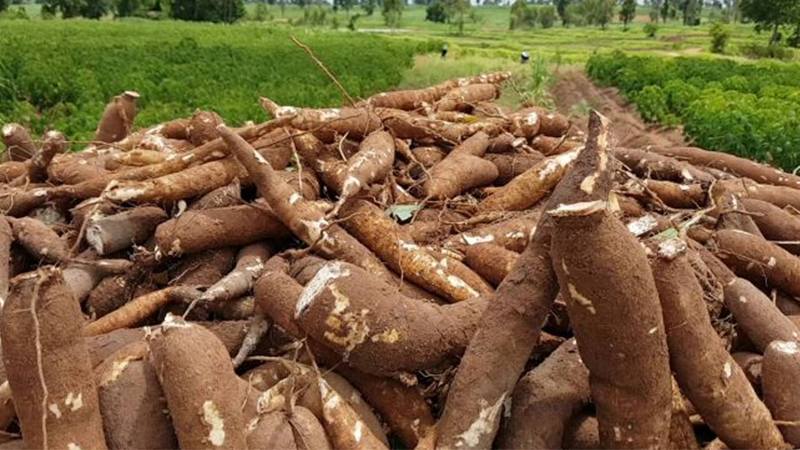
The demand for tapioca chips should be rising soon, as China is exhausting its stocks of 200-300 million tonnes for manufacturing alcohol, Boonchai Srichaiyongpanich, the newly appointed president of Thai Tapioca Trade Association, said.
“We estimate that China will soon have only 50 million tonnes of tapioca chips left in stock and would import more from Thailand,” he said. “This should help drive the price of fresh tapioca from the current under Bt2 per kg to Bt2.5 per kg.”
Boonchai added that the reason behind this was the rising price of corn for animal feed, as China has been using tapioca chips for manufacturing alcohol. “Now that corn is becoming more expensive, it should be a great chance for tapioca farmers to penetrate the Chinese market,” he added.
The association said that export of tapioca chips within the past year was only 2.9 million tonnes, while in the past exports used to average around 7 million tonnes.
“Thai tapioca farmers have suffered from such factors as mosaic disease and drought problem earlier this year, which could result in lower output compared to last year,” added Boonchai.
“Next week the association and related partners from both public and private sectors will survey the plantation areas of tapioca nationwide to estimate total output for 2020, which in our estimates might not exceed 30 million tonnes.”
Meanwhile, the Office of Agricultural Economics reported that in crop year 2020-21, Thailand’s tapioca plantation area was 8.844 million rai (1.415 hectares), a 1.2 per cent increase from the previous year with estimated total output at 29.9 million tonnes, up 4.83 per cent year on year. The average output per plantation area is at 3,382 kilogram per rai, a 3.58 per cent increase year on year.
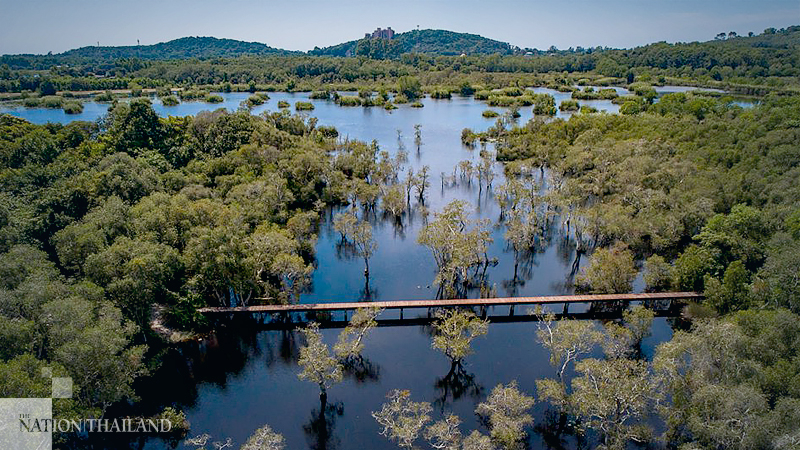
The Rayong Botanical Garden will be developed as a tourist attraction in the Eastern Economic Corridor (EEC).
Last week, officials from the Pid Thong Lang Phra Foundation took government executives to the Rayong Botanical Garden, during their mobile meeting in the province.
The foundation chief, Wanchana Boonchai, informed the executives that the idea for creating botanical gardens in the country came from the Queen Mother.
The first botanical garden emerged in Chiang Mai province, before the Botanical Garden Organisation built more gardens, he added.
The botanical gardens also host educational and conservation centres of endangered species. The Rayong Botanical Garden was built on an area of Bueng Samnak Yai, or Samnak Yai Marsh.
Wanchana added that there were numerous plant species in the province, which needed to be conserved and studied, such as rare orchids.
He added that the botanical garden aimed to be a tourist attraction in the EEC area with a Bt50-million budget.
In addition, the head mentioned that one of the centre’s important activities was to study and propagate bulrushes, a local plant in Rayong’s Klaeng district, which are similar to papyruses in appearance.
Former senator Ruangkrai Leekitwattana wants the State Audit Office to scrutinise if the performance of Airports of Thailand (AOT) was costing the government billions of baht after changes in contracts with the private sector.
AOT reported an adjustment in contracts to the Stock Exchange of Thailand, and that is expected to hurt AOT, including the share value and dividend.
The Ministry of Finance is the major shareholder with 10 billion shares, making up a 70 per cent stake. AOT’s shares closed at Bt56.75 per share on August 28. If AOT’s value drops by even Bt1 per share, the loss for the ministry in market valuation will be Bt10 billion.
Ruangkrai said the report to the stock exchange was evidence that AOT had caused damage to the Ministry of Finance and the Social Security Office, which also held 164 million shares and was likely to face the same consequence.
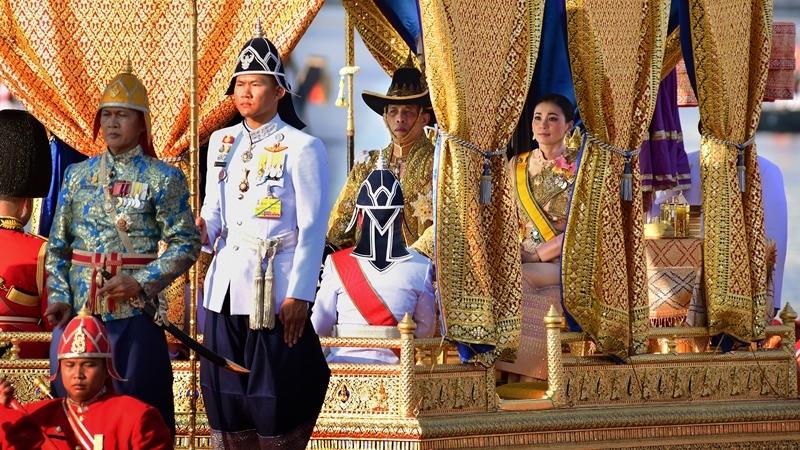
A royal command recently appointed 68 commissioned military officers and commissioned police officers as Royal Guard.
Among the prominent names are: Defence Forces chief General Pornpipat Benyasri, Army chief General Apirat Kongsompong, Navy chief Admiral Luechai Ruddit, Air Force chief Manat Wongwat and the National Police chief, Pol General Chakthip Chaijinda.
The royal command, published on an official website, was issued by HM King Maha Vajiralongkorn on Thursday (August 27) under Section 15 of the Thai Constitution, along with sections 6, 7 and 10.
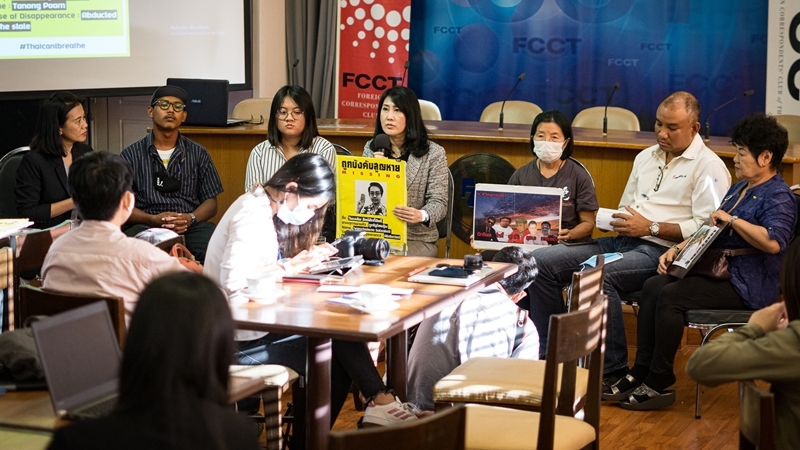
The families of victims of enforced disappearance gathered on August 27 to demand that the government reveal the truth behind the disappearances, and arrest the culprits.
They also called for passing new torture and enforced disappearance law, and presented four proposals to prevent their recurrence.
The Foreign Correspondents’ Club of Thailand, Amnesty International, Cross Cultural Foundation, Thai Lawyers for Human Rights, Union for Civil Liberty and Human Rights Lawyers’ Association helped organise the gathering to commemorate International Day of the Victims of Enforced Disappearances on August 30.
Adisorn Pho-an, whose labour leader father Tanong Pho-an was allegedly abducted for opposing the National Peace Keeping Council’s decision to scrap labour unions in 1994, said that after his disappearance he realised how the Army could easily abduct and kill people citing national security reasons.
Jutatip Sirikhan said that her grandfather, Tieng Sirikhan, was abducted and killed when she was young and she could not understand the notion of enforced disappearance until political activist Wanchalearm Satsaksit was abducted in Cambodia recently.
She later focused on this subject and learned that the government had undermined Tieng’s history of protesting against the military government during World War II.
She vowed to dedicate herself to the cause so that no one was abducted due to political differences, and “we could create a society with equality”.
This December will mark the second anniversary of the disappearance of Surachai Danwattananusorn, better known as Surachai Saedan. He was an opponent of the coup.
His wife, Pranee Danwattananusorn, said that his abduction was a serious violation of human rights, as expression of a political viewpoint was not a crime.
She hoped that the proposed new torture and enforced disappearance law would solve the problem and victims’ families get relief, because the number of enforced disappearance cases was not getting better.
“Surachai was not guilty of the charges of disrupting an Asean meeting in Pattaya. But the government officials still accused him and seized his right to seek asylum in other countries. I had to pay Bt500,000 but I could not sue them back after evidence that he was injured to death was gone. I want the law to have more humanity.”
Wanchalearm Satsaksit’s sister Sitanan Satsaksit said that both the Thai and Cambodian governments could not clarify the case of her brother’s disappearance on June 4, and he was not the first.
“Thai people should be educated about the torture and enforced disappearance law. It would be a relief to know that similar cases would be followed up in the future,” she said.
Siam Theerawut is one of three exiled activists who are missing after being extradited from Vietnam.
Siam’s mother Kanya Theerawut said that she felt excruciating every minute that she thought about her son and wondered whether those who abducted him saw him as a human.
“I don’t understand why he had to run away from his country for playing a role in a theatre,” she said. Siam was charged with violating the lese majeste law that prohibits any kind of undermining of the monarchy after he gave a performance in a period comedy play “The Wolf Bride”.
Kittithat Sueree, a representative from Thai southern borders, said that the government had misinformed the media about the insurgency situation and intimidated those who contradicted their statements, as a result local youth had to leave their homes to study elsewhere.
“The southern borders have the most number of cases of enforced disappearance. One of them was my school senior whose wife and child are still waiting for him.”
Sanhwan Srisod, a legal adviser to the International Commission of Jurists, said the torture and enforced disappearance law had faced struggles for 12 years.
“The current draft makes torture and enforced disappearance a crime. The offender, the accomplice, the collaborator and the operator are all guilty. The DSI [the Department of Special Investigation] will be responsible for the case except that if the DSI is a suspect, the police will fill the gap. Moreover, the draft has suggested the establishment of a committee to ameliorate the victims’ families and stated that every organisation that controls or limits a person’s freedom had to collect sufficient information and the court could force the government organisation to reveal the information if the victim’s family complained.”
She also noticed that the government’s draft did not follow international convention, such as the unspecified definition of enforced disappearance and the involvement of military courts.
Somchai Homlaor, an adviser to Cross Cultural Foundation, said the people’s draft would hasten the government to draft their own version but several cases were allegedly done by the officials.
“If Thailand becomes more democratic, people will come out and demand justice more than before,” he said.
Sunai Phasuk, adviser to Human Rights Watch, said the government had promised the international community that they would prevent enforced disappearance, but they had not honoured their commitment.
“The government’s draft doesn’t correspond to international regulations and it should not be encouraged. Thai people should support the public draft to enter the House so that the new law is in line with international standard,” he said.
Angkhana Neelapaijit, former member of the National Human Rights Commission and the wife of disappeared human rights lawyer Somchai Neelaphaijit, said that countless liars had diminished the public’s confidence in the law and the government.
She mentioned three government measures in past years that had led to cases of enforced disappearance — the communist suppression, public suppression during Black May, and drug traffic suppression in the southern borders.
“The draft will be sent to the House but it will be considered by senators appointed by the National Council for Peace and Order from the military regime,” she said, adding that the senators would be an obstacle to improve the legal system on human rights.
“The United Nations reported in June that there were 87 enforced disappearance cases, but the government still denied it.”
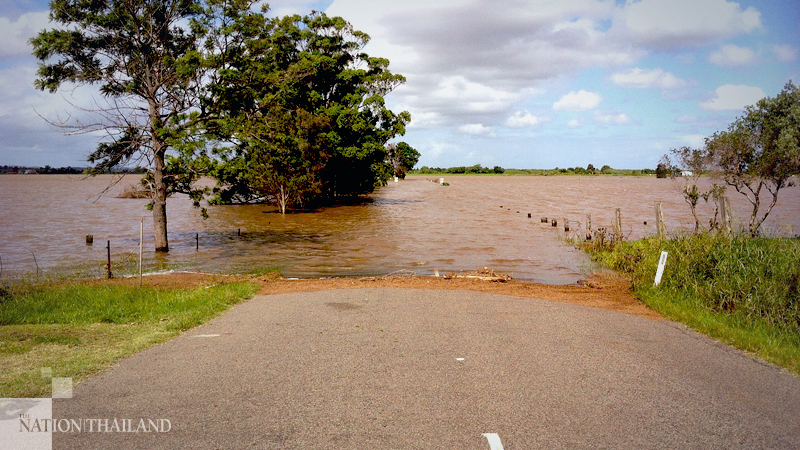
Aid is being accelerated to 15 flood-hit provinces, the Department of Disaster Prevention and Mitigation said on Sunday.
The 15 affected provinces are: Nan, Phrae, Chiang Mai, Lampang, Phayao, Uttaradit, Lamphun, Mae Hong Son, Sukhothai, Tak, Phitsanulok, Kalasin, Nakhon Phanom, Khon Kaen and Singburi.
Department director-general Chayabol Thitisak revealed that the influence of the monsoon lay across the North and the upper Northeast, together with the southwest monsoon prevailing over the upper Andaman Sea and the Gulf of Thailand since August 20. This had brought flash floods, windstorms and landslides to 15 provinces. Overall, 62 districts, 221 sub-districts, 959 villages and 20,878 households had been affected.
At present, the situation has resolved in 14 provinces but there is still flooding in Phitsanulok, Chayabol said, adding people in 17 households were still affected though the water level was decreasing steadily. He predicted that without additional rain or extra water in the area, the situation would return to normal within 1-2 days.
There was no case of Covid-19 in Thailand over a 24-hour period, the Centre for Covid-19 Situation Administration reported on Sunday (August 30), while global cases crossed 25 million since the outbreak.
It was the 97th day without any domestic cases in Thailand since May.
Meanwhile, 10 patients were discharged after full recovery.
The total number of confirmed cases in Thailand stood at 3,411 (474 in state quarantine), of whom 101 are in hospital and 3,252 have recovered and been discharged. The death toll remains unchanged at 58.
As of 10am (Thailand time), the total number of confirmed cases globally passed 25 million. Of them, 17.5 million have recovered, while over 846,000 have died so far.
Thailand ranks 121st for most cases in the world, while the US has the most number with 6.13 million, followed by Brazil 3.84 million, India 3.53 million, Russia 985,405, and Peru 639,435.


 Ruangkrai Leekitwattana