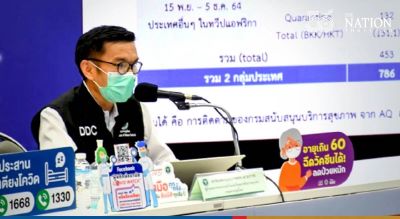
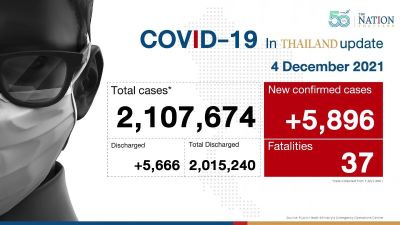
Ministry of Public Health reported on Saturday (December 4) morning that in the past 24 hours there are 5,896 new patients who tested positive for Covid-19, 1,127 of whom have been found in prisons.
Death toll increased by 37, while 5,666 patients were cured and allowed to leave hospitals.
Cumulative cases in the country are at 2,136,537 with 20,917 total deaths.
The Thailand Meteorological Department said on Saturday (December 4) that the strong high-pressure system covers upper Thailand, resulting in cool to cold weather and strong winds in the areas with a drop in temperature by 1-3 degrees Celsius. Mountaintops in the North will be cold to very cold with frost in some areas.
Meanwhile, the weak northeast monsoon prevails over the Gulf and the South, bringing less rains in the South.
The weather forecast for the next 24 hours is as follows:
North: Cool to cold weather; temperature lows of 13-18 degrees and highs of 27-30 degrees Celsius. Temperature on hilltops is likely to drop to 4-10 degrees Celsius with frost in some areas.
Northeast: Cool to cold weather with strong winds; temperature lows of 9-17 degrees and highs of 26-28 degrees Celsius. Temperature on hilltops is likely to drop to 7-12 degrees Celsius.
Central: Cool weather with strong winds; temperature lows of 18-20 degrees, highs of 29-30 degrees Celsius.
East: Cool weather with strong winds; temperature lows of 17-22 degrees, highs of 30-32 degrees Celsius; waves a meter high and 1-2 meters offshore.
South (east coast): Thundershowers in 30 per cent of the areas; temperature lows of 20-23 degrees, highs of 28-30 degrees Celsius; waves 1-2 meters high and 2 meters during thundershowers.
South (west coast): Thundershowers in 20 per cent of the areas; temperature lows of 21-25 degrees, highs of 32-33 degrees Celsius; waves a meter high and 1-2 meters offshore.
Bangkok and surrounding areas: Cool weather with strong winds; temperature lows of 19-20 degrees, highs of 29-30 degrees Celsius.
The verdict cites LGBTQ as a different “species” that needs to be separated and studied as it is incapable of creating the “delicate” bond of human relationships.
Many members of Thailand’s LGBTQ community were stunned, even hurt, when they read the content of the court ruling recently published online.
Several paragraphs of the ruling explained that the tradition of marriage is only preserved for heterosexual men and women, and that “different species” should be “treated differently” because same-sex marriage defies the laws of nature and family.
“…The purpose of a marriage is to allow a man and woman to live together as husband and wife, so they can establish a family unit to have children, to maintain the human race according to natural order and to further allow the passing of wealth, inheritance and bonds between father, mother, sisters, brothers, aunts and uncles. But marriage between LGBT+ persons cannot establish such delicate bonds or relationships,” the verdict, numbered 20/2564, read.
Subtle meanings behind Thai Constitutional Court’s ruling against same-sex marriage
“However, when advanced technology in the future finds more details that certain species have different behaviours or biological traits, then they shall be categorised into a different group for further studies. The same applies to the State or the Legislature treating or acknowledging people of different sexual orientations differently
… After weighing the benefits of making marriage a possibility for couples of the same sex, there is a net loss of benefits for both traditional unions between men and women, and same sex-couples.
“Along with the loss of benefits, there will also be the destruction of the laws of nature and family unity, which are important foundations for society and the survival of mankind,” the ruling continued.
The LGBTQ community found the verdict extremely upsetting.
Akekawat Pimsawan, leader of the advocacy group Queer Riot, said this indicated that the state’s attitude and opinions were influenced homophobia.
When general thought heads in this direction, it has an immense impact on LGBTQ people who are also members of society. Laws supporting or related to same-sex marriage and equal rights have an immense impact on the quality of life for many people, and for some it can mean life and death or just living as a human with dignity, he said.
“I am angry, hurt and pained by this verdict. There are still other changes in the legislature pending consideration, but I do believe that the verdict has called for us all to have faith in working together and find solidarity among LGBTQ communities and their allies,” Akekawat added.
Nikorn Arthit, president of the Bangkok Rainbow Organisation (BRO), said it’s unbelievable that the verdict goes into such details about procreation, family values and technology.
“I think it’s time to rethink the notions of being LGBTQ and reproduction. Family values are naturally respected in Thai society, and LGBTQ people have always wished to form families and build familial bonds as well,” Nikorn added.
Same-sex marriage law expert and Phd candidate, Chawinroj Terapachalaphon, said the verdict does not specifically prohibit possible changes in LGBTQ people’s right to a relationship, but it may be twisted when employed in a discourse or debate on their rights.
The Constitutional Court ruled on November 10 that Article 1448 of the Civil and Commercial Code only defines marriage as a constitutional right for men and women. The ruling was in response to a petition filed by two lesbians seeking to marry legally.
Thai government and its Tourism Authority of Thailand have promoted the country as being friendly to and tolerant of LGBTQ. Last year, the Cabinet approved the Civil Partnership Bill, making it a promising stepping-stone for same-sex marriage in the future. However, the bill was rejected in Parliament.
Next year will mark 10 years of the battle in Thailand to seek equality for the LGBTQ community and their right to get married.
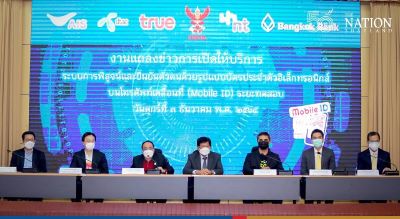
The National Broadcasting and Telecommunications Commission (NBTC) is launching a new “mobile ID” system to help protect consumers’ identities and save their accounts from being hacked.
Consumers can register for a unique mobile ID on their smartphone with their national ID card or passport. This applies to all mobile network providers and is only available via smartphones.
NBTC is providing this service in cooperation with Advanced Wireless Network, dtac Trinet, True Move H Universal Communication and Bangkok Bank.
Initially, people can use their mobile ID to open an account at the Bangkok Bank headquarters or at its branches in Central Embassy, Central Ladprao, Central Village, The EmQuartier, Chamchuri Square, The Mall Ngamwongwan, The Crystal 2 and Future Park Rangsit 2.
This mobile ID will give consumers a safer alternative to performing online and offline transactions, NBTC deputy secretary-general Sutisak Tantayotin said.
“The new services will also cover services, such as tax payment, transportation and stock trading,” he said.
Advanced Info Service (AIS) users can open a Bangkok Bank account online, while National Telecom customers will be able to use the service later this year.
In the second phase, the mobile ID can be used to access services at the Department of Land Transport, Social Security Office, Revenue Department, Thailand Post, Stock Exchange of Thailand, Deposit Protection Agency and credit bureaus. This should be in place within the first quarter of 2022.
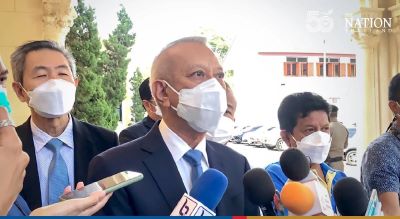
The Public Health Ministry is keeping track of all tourists at risk of Covid-19 infection, Tourism and Sports Minister Phiphat Ratchakitprakarn said on Friday.
He added that 330 tourists from eight African countries where the risk of Omicron transmission is high, are under quarantine for up to two weeks and will undergo three RT-PCR tests.
Of the 330 tourists, 252 arrived under Thailand’s sandbox scheme and 78 under the quarantine scheme between November 15 and 27.
“The Public Health Ministry is still able to contain the spread of Covid-19,” he said.
Phiphat added that at present there are no worries about an Omicron outbreak because nobody in Thailand has tested positive for the strain, so far.
He also advised people not to worry about travellers from the eight high-risk African countries because they fall under the Immigration Bureau’s control.
As of December 1, Thailand has banned flights from Botswana, Eswatini, Lesotho, Malawi, Mozambique, Namibia, South Africa and Zimbabwe.
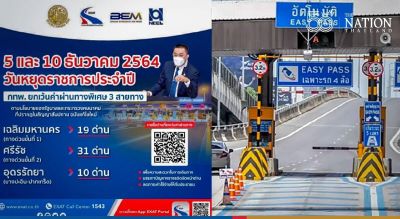
The Expressway Authority of Thailand (Exat) announced on Friday that three expressways under its administration would be opened for free use on December 5 and 10, to facilitate people’s traveling during public holidays of King Bhumibol Adulyadej the Great’s birthday (and National Father’s Day) and Constitution Day, respectively.
From 0.01am until midnight of said dates, vehicles can zip through any toll booths of the Chalerm Maha Nakhon, Sirat and Udon Ratthaya expressways free of charge.
Exat also urged people to use Easy Pass system to pay for toll fees instead of cash or coins to limit the physical contact, which could spread the Covid-19 virus and other germs.
Easy Pass can be easily topped up using Exat Portal mobile application, which can also check for available balance and latest promotions. Exat also offers an application called Exat Traffic for those who require roadside assistance on the expressway. For more information, contact call centre 1543.
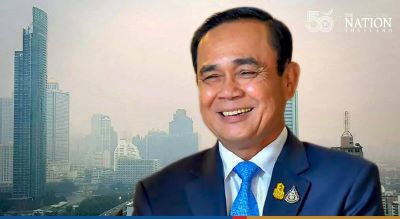
The ongoing cool dry season and lack of winds to blow away dust particles are bringing heavy pollution to many parts of Thailand.
Government spokesman Thanakorn Wangboonkongchana said on Friday that Prime Minister Prayut Chan-o-cha has instructed government agencies to keep a close eye on the PM2.5 situation nationwide.
The level of PM2.5 dust recently exceeded safe levels in Bangkok and adjoining provinces and is expected to continue rising because most vehicles in the country use diesel engines.
Dust particles less than 2.5 micrometres in diameter (PM2.5) can penetrate the lungs and impair their function. The elderly and young children are most at risk. The World Health Organisation recommends that PM2.5 readings should stay below 25 for safety, though the Thai government has set the safe level at 50.
Bangkok has been struggling with PM2.5 pollution for several years now and the Bangkok Metropolitan Administration (BMA) set up 70 permanent particle dust measuring stations in different parts of the city.
BMA is also regularly measuring exhaust emissions in areas with heavy traffic, residential zones and public parks, and has deployed monitoring vehicles in other parts of the capital.
As for other provinces, Thanakorn said the pollution came from open fires and neighbouring countries. He added that all provinces have been instructed to monitor pollution and provide information in line with the Natural Resources and Environment Ministry’s plan to put air-pollution controls in place from 2022.
He advised people to avoid outdoor activities, wear masks, especially the N95 type, get their cars tuned regularly and immediately report any outdoor fires.
Meanwhile, Bangkok governor General Aswin Kwanmuang said in a Facebook post on Friday that winds from the Northeast have collided with those from the Southwest, causing the airstream to slow down. This has increased the amount of dust, especially PM2.5 particles, in the air.
This week winds will drop to 11-12 kilometres per hour. Temperatures will also drop by 1 to 3 degrees, which will increase the presence of PM2.5 particles in Bangkok’s Klong Sam Wa, Min Buri, Nong Khaem, Thawee Watthana, Bang Khae, Bang Khunthien and Bang Bon districts.
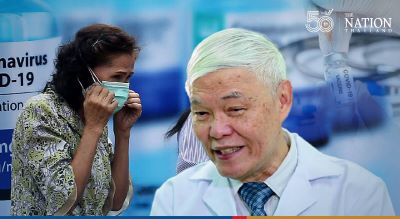
Dr Yong Poovorawan, an expert virologist from Chulalongkorn University, offered advice in a Facebook post on Friday on how people can prepare for the Omicron variant.
He said that though Thailand will not be able to escape Omicron, especially if it has spread worldwide, it can take steps to delay its arrival. He listed three factors that can prevent an Omicron outbreak, namely:
• Vaccination: Though the vaccines available at present may not be as effective against the Omicron variant, they will still prevent severe symptoms, hospitalisation or death. Data from South Africa shows that 90 per cent of Omicron patients in hospitals are unvaccinated. Thailand’s vaccine stocks should be enough to provide double shots and a booster to everybody.
• Diagnosis: Infections should be diagnosed quickly and patients isolated immediately to control transmission.
• Protection: People should continue strictly adhering to Covid-19 prevention measures, including washing hands frequently, maintaining hygienic habits, wearing masks and social distancing.
The virologist said sharing knowledge, ensuring transparency and obeying rules will help prevent an outbreak.
He also said that the new variant may soon replace the Delta variant if it is more widely transmitted.
Dr Yong explained that initially in December 2019, the S (Serine) and L (Leucine) variants were discovered in China’s Wuhan city. The first variant detected in Thailand was the S variant. However, the more transmissible L variant spread across Europe, causing the S variant to disappear.
Then came the G (Glycine) variant, which spread even faster and replaced the L variant. The G variant sparked infections in Samut Sakhon in the second wave of Covid-19 in Thailand.
Then came the Alpha variant, which was brought into Thailand from a neighbouring country and spread quickly, replacing the G variant.
After that came the Delta variant, which was first detected in India. This variant was more transmissible than the Alpha variant and resulted in more severe symptoms. It is believed that this variant was brought into Thailand by construction workers and spread quickly. The Delta variant also spread very quickly globally because its infectious period is longer than other variants.
The Omicron variant, which was detected in South Africa on November 24, may spread quickly and replace the Delta variant.
The virologist pointed out that though this variant can enter the country through air, land and water, he believes closely monitoring Thailand’s large natural border can help prevent an Omicron outbreak.
The 252 tourists from southern African countries, who entered Thailand between November 27 and 30, are fully vaccinated and are at low risk of transmitting the Omicron variant, the Department of Disease Control (DDC) said on Thursday.
“These travellers will be quarantined for 14 days and will undergo RT-PCR tests to confirm they are completely free of Covid-19,” said Dr Chawetsan Namwat, director of the DDC’s emergency disease and health hazards control division.
“They had entered Thailand under the Phuket Sandbox programme and their RT-PCR tests taken 72 hours before arrival and upon arrival have all returned negative results.”
The Public Health Ministry had announced last week that flights from eight African countries will be banned from December 1 in a bid to prevent the spread of a new, more easily transmissible variant of Covid-19. These countries are Botswana, Eswatini, Lesotho, Malawi, Mozambique, Namibia, South Africa and Zimbabwe.
South African reported the variant to the World Health Organisation on November 24.
The DDC also said that Omicron cases have been reported in 30 countries so far, including South Africa, Nigeria, Botswana, Mozambique, Zimbabwe, Namibia, Malawi, Eswatini, Lesotho, Brazil, Canada, Japan, Israel, Austria, South Korea, Singapore, Hong Kong, United Kingdom, Turkey, Germany, Spain, Italy, the Netherlands, Czech Republic, Belgium, Sweden, Portugal, Switzerland, Denmark and Australia.
“Most cases in these countries were brought in by international travellers,” he said. “Though no Omicron cases have been reported in Thailand yet, DDC and other related agencies will monitor the situation closely and keep the public updated regularly.”
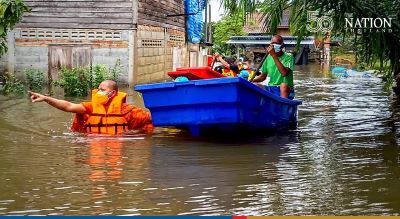
A generous Buddhist monk joined police officers in Nakhon Si Thammarat on Thursday and waded through chest-high floodwaters to hand survival kits to households in difficult to reach areas.
Phra Santi Tisaro, assistant abbot of Wat Na Phra Lan temple, joined the provincial police team to rice, dry and canned food, drinking water and basic medicines to 25 households in the Muang district’s Bang Pu area.
Two days of continuous heavy rain has submerged 23 districts in up to two metres of water and caused widespread damages.
Flooding in Nakhon Si Thammarat is expected to worsen and the provincial governor marked the province as a high-risk area on Thursday.
People who need help can call the Disaster Prevention and Mitigation Department at (075) 348118, (075) 342880 extension 138 or the 199 hotline any time of the day or night.


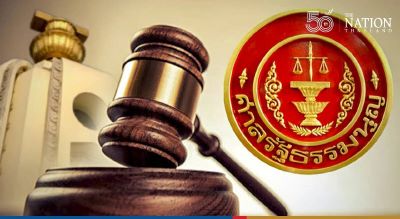
 Subtle meanings behind Thai Constitutional Court’s ruling against same-sex marriage
 Subtle meanings behind Thai Constitutional Court’s ruling against same-sex marriage

 Subtle meanings behind Thai Constitutional Court’s ruling against same-sex marriage