King Power lone buyer of TOR for airport pick-up service bids

ศาสตร์เกษตรดินปุ๋ย : ขอบคุณแหล่งข้อมูล : หนังสือพิมพ์ The Nation

https://www.nationthailand.com/business/30378915?utm_source=category&utm_medium=internal_referral

 King Power lone buyer of TOR for airport pick-up service bids

Nov 30. 2019
By THE NATION207 Viewed

Duty-free shop operator King Power Group was the only company picking up the bidding documents for operating duty-free pick-up counter service under concessions at Don Mueang Airport and Suvarnabhumi Airport, on the first day of TOR sales on Thursday (November 28).

Airports of Thailand (AOT)’s president Nitinai Sirismatthakarn said the group purchased Term of Reference for both bids.

AOT senior executive vice president for Business Development and Marketing Wichai Bunyu said he was confident that private retail business operators would join in the bids.

The ToR will be available until December 13. Bidders can submit proposals for Suvarnabhumi Airport on January 17, 2020, and Don Mueang Airport on January 20, 2020.

AOT will open proposals for both bids at the same time on January 27, 2020. Both concession are valid for 10 years and 3 months.

Buffett outbid by private equity in Berkshire’s big deal hunt

ศาสตร์เกษตรดินปุ๋ย : ขอบคุณแหล่งข้อมูล : หนังสือพิมพ์ The Nation

https://www.nationthailand.com/business/30378906?utm_source=category&utm_medium=internal_referral

Buffett outbid by private equity in Berkshire’s big deal hunt

Nov 30. 2019
Warren Buffett, chairman and chief executive officer of Berkshire Hathaway Inc. (center) tours the shopping floor ahead of the Berkshire Hathaway annual meeting in Omaha, Neb., on May 5, 2018. MUST CREDIT: Bloomberg photo by David Williams.Photo by: David Williams — Bloomberg

Warren Buffett, chairman and chief executive officer of Berkshire Hathaway Inc. (center) tours the shopping floor ahead of the Berkshire Hathaway annual meeting in Omaha, Neb., on May 5, 2018. MUST CREDIT: Bloomberg photo by David Williams.Photo by: David Williams — Bloomberg
By Syndication Washington Post,Bloomberg · Katherine Chiglinsky

921 Viewed

Warren Buffett has frequently touted his Berkshire Hathaway as a home for businesses away from what he said was the debt-fueled, quick-turnover appetite of private equity firms. But the Berkshire name wasn’t enough for Tech Data Corp.

Berkshire made a $140-a-share bid for the distributor of technology products that was topped by a $145 offer from Apollo Global Management Inc., CNBC reported. The offer was another effort by the billionaire investor to put a chunk of his record $128 billion cash pile to use and signals that while Buffett is still on the prowl, he may not be willing to outbid private equity firms flush with money.

Buffett has been stymied on the acquisition front in recent years, causing the billionaire investor to express frustration about the “sky-high” prices for decent businesses. He said earlier this year that he was working on a large deal in the fourth quarter of 2018 but it eventually fell through. The lack of deals has also pressured Buffett’s ability to maintain the stock returns that helped make him famous. Berkshire’s stock is on track for its worst underperformance since 2009.

Berkshire’s interest forced Apollo to raise its bid to one that values Tech Data at about $6 billion, including debt. Tech Data helps bring products to market for firms such as Microsoft Corp. and Apple Inc., which is Berkshire’s largest public stock investment as it has a roughly $56 billion stake in the iPhone maker.

“He’s just not going to throw the money out and earn a rate of return below what his minimum target is,” David Kass, a professor of finance at the University of Maryland’s Robert H. Smith School of Business. “He is Buffett because he’s patient.”

The biggest private-equity firms are on a tear. Apollo’s Leon Black said earlier this month that the firm is on track to almost double its assets under management to $600 billion in five years.

A Tech Data buyout by Berkshire would have pushed the Omaha, Nebraska-based conglomerate further into the technology realm, an area that Buffett avoided for decades. It also would have added another family-built business to Berkshire’s mix of retailers, insurers and energy companies. Edward Raymund founded the company and his son Steven Raymund ran the firm for about two decades before becoming chairman. Steven Raymund stepped down in 2017.

For Berkshire, the Tech Data saga likely ends here. Buffett isn’t planning to make a higher bid, according to CNBC. His appetite for a large buyout may continue.

“We continue, nevertheless, to hope for an elephant-sized acquisition,” Buffett said in his annual shareholder letter released earlier this year.

Hot responses to Thai Union’s Bt6-bn debenture issuance

ศาสตร์เกษตรดินปุ๋ย : ขอบคุณแหล่งข้อมูล : หนังสือพิมพ์ The Nation

https://www.nationthailand.com/business/30378898?utm_source=category&utm_medium=internal_referral

Hot responses to Thai Union’s Bt6-bn debenture issuance

Nov 29. 2019
 CEO Thiraphong Chansiri

CEO Thiraphong Chansiri
By THE NATION

1,089 Viewed

Sales of Thai Union’s subordinated perpetual debentures met strong market responses with investors taking up all of the Bt4 billion offering and the additional greenshoe of Bt2 billion.

Proceeds from the debenture issuance will be used to refinance bonds reaching maturity this year and to keep the company’s total debt at the same level. It will, however, adjust the net debt to equity ratio (ND/E) of 1.35-1.40 times currently to 1.15 – 1.20 times.

The company will utilise the funds to strengthen its financial structure and build a strong foundation. It said the success of the offering signaled that investors have confidence in the business capabilities and outlook for one of the world’s largest seafood companies. The debentures will offer an annual return of 5 per cent for the first five years.

“I would like to thank both institutional and general investors for their support, and our financial institution partners for arranging the debentures,” said CEO Thiraphong Chansiri.

“These funds are important, not only in adding strength to our financial structure, but will also allow us to continue expanding our business as part of our strategy to build sustainable growth.”

The debentures were rated A-/Stable by Tris Rating, while Thai Union was rated A+ with a stable outlook.

Separately, Thai Union Group also succeeded in issuing Bt6 billion worth of senior unsecured debentures to institutional investors on November 6.

The debentures were offered in two tranches – 7-year, Bt2 billion bonds with an interest rate of 2.78 per cent per annum and 10-year, Bt4 billion bonds with an annual interest rate of 3.00 per cent.

The average interest rate of the senior debentures is 2.93 per cent per annum and the average tenor is nine years. More than 20 institutional investors participated in the book building process.

The debentures received overwhelming demand and were oversubscribed by more than 3.5 times by institutional investors.

Biotech stocks post their second-best month of 2019

ศาสตร์เกษตรดินปุ๋ย : ขอบคุณแหล่งข้อมูล : หนังสือพิมพ์ The Nation

https://www.nationthailand.com/business/30378911?utm_source=category&utm_medium=internal_referral

Biotech stocks post their second-best month of 2019

Nov 30. 2019
By Syndication Washington Post, Bloomberg · Tatiana Darie ·210 Viewed

Biotech stocks are on pace for their second-best month of the year with momentum revived by a return of M&A activity and early FDA approvals for highly anticipated drugs.

The Nasdaq Biotechnology Index rose for its eighth consecutive session on Friday. The benchmark has gained 12% in November, its largest monthly gain since January when the gauge posted its best-ever start to the year. The broader S&P 500 Index has climbed 3.6% since the start of November, while the S&P 500 Health Index has risen about 4.8%.

Industry experts are anticipating more mergers and acquisitions after Novartis’s nearly $10 billion deal for Medicines Co, an $85 a share bid which represents a 45% premium to the company’s closing price on Nov. 18.

“In terms of more deals, we expect more, and believe the Street will begin to position for further announcements into early 2020,” Jefferies health-care strategist Jared Holz wrote to clients on Wednesday.

He sees Sanofi, Gilead Sciences, Merck & Co. and Denmark-based Novo Nordisk as likely buyers. Premiums could come in far higher than expectations if the Novartis/Medicines tie-up and other deals are any indication, Holz said.

Small- to medium-sized biotech companies that could be snapped up by larger drugmakers have led gains in the Nasdaq Biotechnology Index. Among them, Clovis Oncology has surged 367% this month while Arrowhead Pharmaceuticals gained 83%. Earlier this week, a Cantor Fitzgerald analyst said Arrowhead’s stock increase “reflects anticipation of M&A.”

Bristol-Myers Squibb’s record takeout of Celgene kicked off this year’s string of acquisitions. News of that tie-up came ahead of the JPMorgan Health Care Conference in January, an annual industry confab in San Francisco that is frequently a catalyst for mergers and other deals. The event will take place again in early 2020.

U.S. stocks drop from record highs; crude declines

ศาสตร์เกษตรดินปุ๋ย : ขอบคุณแหล่งข้อมูล : หนังสือพิมพ์ The Nation

https://www.nationthailand.com/business/30378910?utm_source=category&utm_medium=internal_referral

U.S. stocks drop from record highs; crude declines

Nov 30. 2019
By Syndication Washington Post, Bloomberg · Vildana Hajric, Claire Ballentine233 Viewed

U.S. stocks dropped from record highs in the wake of lower European and Asian equities, rounding out a lackluster finale to the third straight month of gains for global benchmarks. The dollar strengthened.

The S&P 500, Nasdaq 100 and Dow Jones Industrial Average all finished lower as trading resumed on Wall Street after the Thanksgiving break. Shares of energy and consumer discretionary goods companies were the biggest decliners, with overall trading volume about 30% below the 30-day average. The Stoxx Europe 600 Index slumped, while Asian shares closed lower.

Treasuries were mixed as they returned to trading post-holiday. The dollar posted a ninth straight session of gains, the longest winning streak since January 2016. U.S. equity markets closed at 1 p.m. New York time, while bond trading is slated to end an hour later.

“It looks like it will be a lazy day with the U.S. half day of trading,” said Didier Anthamatten, senior portfolio manager at Unigestion. “Very low liquidity and most of the traders digesting the turkey.”

Investors are hungry for evidence of progress on a Sino-U.S. trade deal, with the next batch of American tariffs on Chinese goods due to begin Dec. 15 and additional tension building over Hong Kong. China’s foreign ministry warned again of unspecified retaliation for President Donald Trump’s signing of legislation that expresses support for protesters in Hong Kong.

“The real issue is not the Hong Kong bill,” Macquarie Group’s Thierry Wizman told Bloomberg TV. “The real issue is whether or not if you do not see convergence on those negotiations by Dec. 15, do we get an increase, a scheduled increase, in those U.S. tariffs and does that derail the negotiations?”

Elsewhere, West Texas-grade oil traded dropped below $57 a barrel amid signals OPEC and allied crude producers are averse to deepening output cuts when they convene next week. The won closed lower in normal trading hours after the Bank of Korea kept its policy rate unchanged, as expected.

These are the main moves in markets:

Stocks:

– The S&P 500 Index sank 0.4% to 3,141.49 as of 1:01 p.m. New York time, the first retreat in more than a week and the largest decrease in six weeks.The Index closed at 3,140.98.

– The Nasdaq Composite Index dipped 0.5% to 8,665.47, the first retreat in more than a week.

– The Dow Jones Industrial Average decreased 0.4% to 28,054.64, hitting the lowest in a week with the first retreat in more than a week. It closed at 28,051.41.

– Germany’s DAX Index declined 0.1% to 13,236.38, the lowest in a week.

– The MSCI All-Country World Index sank 0.5% to 546.72, the lowest in a week on the largest decrease in more than seven weeks.

Currencies:

– The Bloomberg Dollar Spot Index was little changed at 1,209, the first retreat in more than a week.

– The euro advanced 0.1% to $1.1019.

– The Japanese yen strengthened 0.1% to 109.41 per dollar, the biggest climb in more than a week.

– The British pound increased 0.2% to $1.2932, the strongest in more than a week.

Bonds:

– The yield on two-year Treasuries sank two basis points to 1.60%.

– The yield on 10-year Treasuries advanced one basis point to 1.78%, the highest in more than a week.

– Germany’s 10-year yield gained less than one basis point to -0.36%.

– Britain’s 10-year yield climbed two basis points to 0.697%, the highest in a week.

Commodities:

– West Texas Intermediate crude sank 4.3% to $55.59 a barrel, the lowest in more than a week on the biggest tumble in more than 10 weeks.

– Gold strengthened 0.6% to $1,464.06 an ounce, the highest in more than a week on the largest climb in more than four weeks.

Economic downtrend continues in Oct despite private consumption, tourism growth

ศาสตร์เกษตรดินปุ๋ย : ขอบคุณแหล่งข้อมูล : หนังสือพิมพ์ The Nation

https://www.nationthailand.com/business/30378905?utm_source=category&utm_medium=internal_referral

Economic downtrend continues in Oct despite private consumption, tourism growth

Nov 30. 2019
Private consumption indicators expanded at a higher pace compared with the previous month after temporarily benefiting from the government’s economic stimulus measures.

Private consumption indicators expanded at a higher pace compared with the previous month after temporarily benefiting from the government’s economic stimulus measures.
By The Nation

1,034 Viewed

The Thai economy stayed on the path of deceleration in October, the Bank of Thailand said in a report yesterday (November 29).

The value of merchandise exports continued to contract, mainly due to the economic slowdown of trading partners, consistent with deterioration in manufacturing production and private investment indicators.

Public spending contracted again, after an expansion in September from capital expenditures. However, private consumption indicators expanded at a higher pace compared with the previous month after temporarily benefiting from the government’s economicstimulus measures.

New measures out to boost economic growth

The tourism sector also continued to grow. On the stability front, headline inflation edged lower on the back of falling energy prices while core inflation held steady. The seasonally adjusted unemployment rate slightly decreased, in line with the rising number of employed persons in agricultural sector. The current account registered a smaller surplus from trade balance while the capital and financial accounts posted a deficit from the asset position.

Details of the economic conditions are as follows:

The value of merchandise exports, both including and excluding gold, dropped by 5.0 per cent compared with the same period last year. The contraction of exports in several categories was due to 1) the economic slowdown of trading partners; 2) the continued downturn in electronic cycle without clear sign of recovery; and 3) the contraction of global crude oil prices, coupled with the temporary maintenance shutdown of oil refineries, leading to the contraction of petroleum-related products exports, both in terms of prices and quantity. Nevertheless, the value of exports in some categories, including agro-manufacturing products, electrical appliances, and automotive and parts, continued to expand, partly as substitution for Chinese products in the US market. In addition, the exports of hard disk drive grew for the first time in 12 months, thanks to the relocation of production base to Thailand. As a consequence of the merchandise exports contraction, manufacturing production continued to decline.
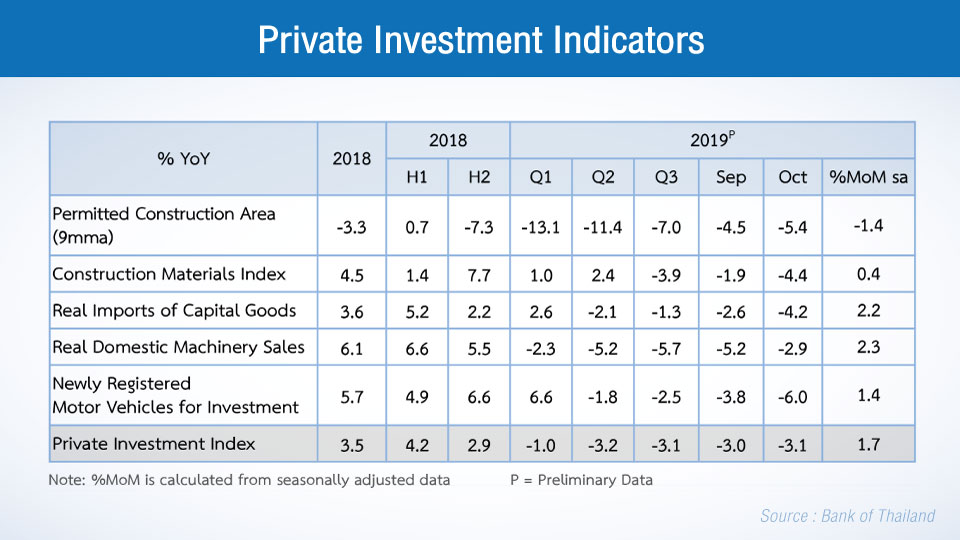
Private investment indicators continued to deteriorate from the same period last year, in line with weak domestic and external demand. Investment in machinery and equipment continued to contract from imports of capital goods, domestic machinery sales, and the number of newly-registered motor vehicles. Meanwhile, investment in construction in permitted areas for almost all purposes declined, consistent with subdued activities. Nevertheless, the permitted construction area for manufacturing purposes continued to grow.

The value of merchandise imports contracted by 9.2 per cent from the same period last year in almost every category, consistent with softening economic activities.

The contraction was attributable to the decrease in imports of raw materials and intermediate goods, particularly in 1) crude oil, due to the maintenance shutdown of oil refineries; and 2) electronic parts, partly owing to the high base effect in the previous year as well as the contraction in the exports of electronic products. In addition, after last month expansion, imports of consumer goods contracted, especially in seafood, mainly due to the high base effect in the previous year.

However, imports of capital goods accelerated due to imports of aircraft, ships, floating structures, and locomotive, though mostly in form of operational leasing. Excluding the category, the imports of capital goods continued to contract. Public spending, excluding transfers, contracted due to 1) central government’s capital expenditures, as the FY2020 budget has yet to be enforced; and 2) state enterprises’ capital expenditures, particularly disbursement of the Mass Rapid Transit Authority of Thailand (MRTA). Meanwhile, current expenditures continued to grow owing to the compensation of civil servants and purchases of goods and services.

Private consumption indicators expanded at a higher pace compared with the previous month but continued on a downward trend. This month, the private consumption indicators temporarily benefited from the government’s economic stimulus measures, boosting spending on non-durable goods and services.
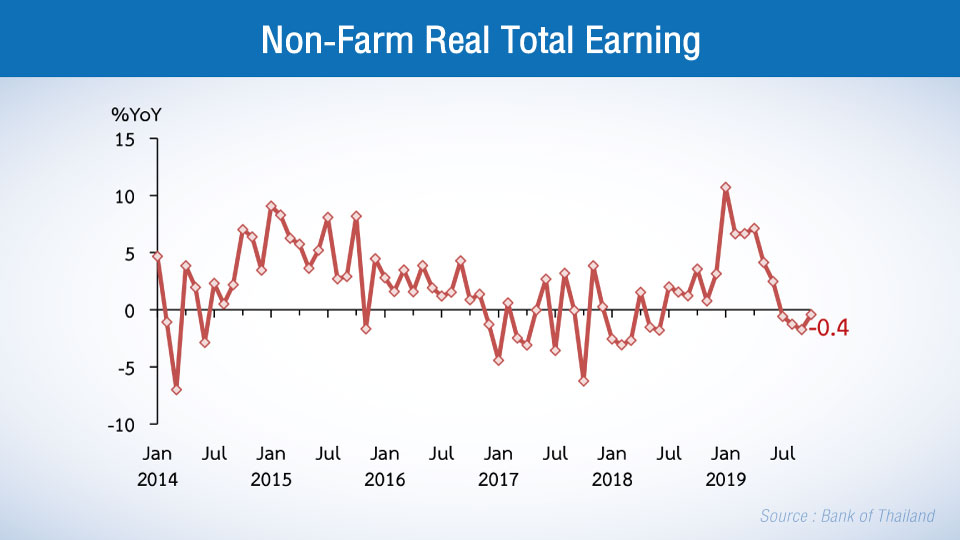
On the other hand, spending on semi-durable and durable goods contracted, especially on vehicles, in line with weakening supporting factors, namely continued contraction in non-farm income, softer farm income growth, and lower consumer confidence, together with financial institutions’ tightening of credit standards for auto-leasing loans after credit quality deteriorated.

The number of foreign tourist arrivals continued to expand, rising 12.5 per cent compared with the same period last year. This was driven by 1) the low base effect from the tour boat incident in Phuket; and 2) the exemption of the visa on arrival fee, encouraging more visitors from China, India, and Taiwan. Additionally, the number of tourists from other Asian countries continued to grow such as those from South Korea, Japan, and Laos. The number of Malaysian visitors also rebounded from a temporary factor as Deepavali Holiday was celebrated at the end of October this year.

The current account surplus narrowed from trade balance as a result of the increase in merchandise imports value compared with the previous month. The overall capital and financial accounts registered a deficit from the asset position following the increase in Thai Other Depository Corporations’ (ODCs) deposits and Thai portfolio investment abroad.

Govt looking for new export markets for Thai rubber

ศาสตร์เกษตรดินปุ๋ย : ขอบคุณแหล่งข้อมูล : หนังสือพิมพ์ The Nation

https://www.nationthailand.com/business/30378904?utm_source=category&utm_medium=internal_referral

Govt looking for new export markets for Thai rubber

Nov 29. 2019
By THE NATION

977 Viewed

The government is aggressively exploring new export markets for rubber, Prime Minister Prayut Chan-o-cha said on Friday (November 29) on the first day of the “Thailand Rubber Expo”.

The premier presided over the opening ceremony of the event held by the Rubber Authority of Thailand at the Impact Muang Thong Thani exhibition centre. It ends on December 1.

Prayut said that the government was aggressively exploring new markets such as India and Turkey for Thai rubber exports.

He added that Thailand’s rubber industry was facing challenges. Its main rubber importers like US and Europe are facing a slowing economy, while China can increase its own rubber capacity for domestic consumption.

He urged all related agencies to seek ways to address the problems.

EU paper outlines measures to boost business ties with Thailand

ศาสตร์เกษตรดินปุ๋ย : ขอบคุณแหล่งข้อมูล : หนังสือพิมพ์ The Nation

https://www.nationthailand.com/business/30378902?utm_source=category&utm_medium=internal_referral

EU paper outlines measures to boost business ties with Thailand

Nov 29. 2019
By THE NATION

1,166 Viewed

The European Association for Business and Commerce (EABC) on Friday (November 29) called for enhanced competitiveness, further improvement of ease of doing business, and negotiation of an EU‐Thailand Free Trade Agreement.

Tht EABC said these factors were crucial to strengthen Thailand’s economy, support the Thailand 4.0 vision and bring about enhanced trade and investment for Thailand.

The launch of the 2019‐20 European Business Position Paper was held at the Anantara Siam Bangkok Hotel.

The paper “reflects the shared efforts from European business leaders in Thailand from a broad range of industries and policy areas to provide practical recommendations for Thailand to become a more competitive economy. It is a reference and guideline to develop enhanced policy for Thailand. There is no better proof of the commitment of EU businesses to Thailand,” Ambassador Pirkka Tapiola, EU Ambassador to Thailand, said in his opening remarks.

He noted the importance of defending the rules-based multilateral trading system as a powerful instrument to deliver on economic growth and social development.

Sansern Samalapa, Vice Minister of Commerce, delivered the keynote address and said, “this is an important opportunity to improve trade and investment between Thailand and the EU”.

He noted that closer economic ties between Thailand and the EU were vital for ensuring sustainable regional economic development.

Jan Eriksson, president of the EABC, commended the Thai government for its efforts in promoting trade and investment through carrying out various measures to enhance competitiveness and improveease of doing business.

He admitted, however, that in today’s highly competitive environment, investors looked for advantages beyond investment incentives, to ensure that their business would be competitive and profitable in the longer term and could be used as highly effective regional bases as needed. Ongoing reforms to support competitiveness and ease of doing business continued to be essential.

While investment incentives available in Thailand may have attraction in terms of tax benefits, some relaxation of foreign ownership limits, hiring of foreigners and importing equipment, they do not alleviate the general daily interactions with doing business nor address fundamental reforms, so further progress is needed.

He urged the Thai government to address a number of areas of competitiveness, including structural reform, services liberalisation, streamlining the regulatory frameworks for increased ease of doing business and to join the European Union in the EU‐Thailand FTAnegotiation to achieve and make it a meaningful differentiator.

The Position Paper reflects five key policy recommendations for Thailand:

1 General reduction of trade barriers in goods and services, non-tariff Barriers, non-tariff measures

2 Service sector liberalisation

3 Structural reforms (often deep) to achieve the major vision and goal of Thailand 4.0 in a reasonable time

4 Ease of doing business beyond the World Bank’s existing criteria, with new ways of quality law-making, digital government and heightened respect for the rule of law;

5 Engagement on EU‐Thailand FTA negotiations to achieve a meaningful differentiator.

GPF seeks expansion in foreign investment

ศาสตร์เกษตรดินปุ๋ย : ขอบคุณแหล่งข้อมูล : หนังสือพิมพ์ The Nation

https://www.nationthailand.com/business/30378899?utm_source=category&utm_medium=internal_referral

GPF seeks expansion in foreign investment

Nov 29. 2019
GPF secretary-General Vithai Rattanakorn

GPF secretary-General Vithai Rattanakorn
By THE NATION

1,026 Viewed

The Government Pension Fund (GPF) plans to raise the proportion of its investment in overseas asset to 40 per cent of total portfolio from the current 28 per cent.

The Finance Ministry caps the fund’s holdings in foreign asset at 30 per cent of its total investment.

GPF secretary-General Vithai Rattanakorn said that GPF was seeking the board’s approval to raise the ceiling to 40 per cent, adding that it needed to raise foreign asset investment to divert risks from local holdings and to seek better return.

The GPF will focus on alternative assets in foreign countries, such as infrastructure funds, private equity funds, foreign equities, or governments’ bonds, Vithai said.

Despite strengthening of the baht by about 7 per cent against the dollar this year, GPF investment in international assets, including foreign stocks, has yielded return of 18 per cent in term of baht value.

The GPF has 1.1 million members. As of October this year, its net asset amounted to Bt935 billion.

MoU signed with major universities to train staff for EEC businesses

ศาสตร์เกษตรดินปุ๋ย : ขอบคุณแหล่งข้อมูล : หนังสือพิมพ์ The Nation

https://www.nationthailand.com/business/30378893?utm_source=category&utm_medium=internal_referral

MoU signed with major universities to train staff for EEC businesses

Nov 29. 2019
EA deputy chief executive officer Amorn Sapthaweekul

EA deputy chief executive officer Amorn Sapthaweekul
By THE NATION

1,166 Viewed

Energy Absolute (EA) business group today (November 29) signed a memorandum of understanding (MoU) with ten educational institutes and Double P Land to develop human resources to serve its business expansion in the Eastern Economic Corridor (EEC).

EA deputy chief executive officer Amorn Sapthaweekul said that the companies under EA group that signed the deal are involved in energy storage, oleochemicals and electric vehicles. Double P Land plans to develop the Chachoengsao Bluetech City Industrial Zone.

The participating EA companies in the MoU are EA, Amita Technology (Thailand) Co., EA Bio Innovation, and MINE Mobility Corporation Co while the educational institutes have been named as Burapha University, Rajamangala University of Technology Tawan-ok, Kasetsart University Si Racha Campus, Thammaset University Pattaya Campus, Prachin Buri Technical College, Chon Buri Technical College, Chachoengsao Technical College, Chachoengsao Vocational College, Thai-Austrian Technical College, and Rayong Technical College.