Bitcoin touches six-month low as more supports give way

ศาสตร์เกษตรดินปุ๋ย : ขอบคุณแหล่งข้อมูล : หนังสือพิมพ์ The Nation

https://www.nationthailand.com/business/30378667?utm_source=category&utm_medium=internal_referral

Bitcoin touches six-month low as more supports give way

Nov 23. 2019
By Syndication Washington Post, Bloomberg · Todd White, Vildana Hajric

465 Viewed

Bitcoin’s sell-off deepened on Friday, putting the digital token at the lowest level since May, after it dropped below yet another key support level.

The world’s most-traded cryptocurrency declined as much as 11% to $6,798, before trimming losses. Alternative coins such as Ether and Litecoin also slumped. For the first time since April, Bitcoin fell below its 200-day moving average without bouncing back, a signal that traders see the breach as a sign of weakness rather than an opportunity to buy.

Feeding the anxiety were lingering concerns about the status of exchanges such as Binance Holdings Ltd. in China after officials there formally announced a crackdown on crypto-related businesses. Binance has denied reports of a police raid of offices in Shanghai, saying it doesn’t have formal operations there as of now.

“There’s been a general apathy in the market, and low sentiment,” said Mati Greenspan, the ex-senior market analyst at eToro in Tel Aviv. “There was excitement when Xi Jinping said China needed to embrace blockchain, but it has faded and the market is returning to levels before” the Chinese president’s comments in late October, he said.

Technicals have a big role in powering trades for virtual tokens because they lack the kind of fundamentals that can be analyzed with traditional securities. Many investors say the tokens have little intrinsic value beyond the anonymity some seek for illegal financial transactions.

“Crypto traders get awfully superstitious about technical indicators, like momentum,” said Greenspan, who set up his own research outfit this week. The relative-strength index, which measures the velocity of a security’s price movement, is a technical signal of momentum.

Rumors also persist that firms who mint new Bitcoins, known as miners, have been selling into the downdraft, Greenspan and others said.

Bitcoin was 3.6% lower at $7,328 as of 3:20 p.m. in New York. It’s down 13% this week.

Google workers protest company’s ‘brute force intimidation’

ศาสตร์เกษตรดินปุ๋ย : ขอบคุณแหล่งข้อมูล : หนังสือพิมพ์ The Nation

https://www.nationthailand.com/business/30378662?utm_source=category&utm_medium=internal_referral

Google workers protest company’s ‘brute force intimidation’

Nov 23. 2019
By Syndication Washington Post, Bloomberg · Mark Bergen343 Viewed

Google employees demonstrated outside the company’s San Francisco office Friday to protest the internet giant’s recent decision to put two staff members on leave.

The event is the latest sign of a growing rift between management and rank-and-file workers at Alphabet Inc.’s Google, which was once praised for its open corporate culture. Protesting staff believe the company is trying to quell internal activism and quash dissension about Google’s work with the military and other potentially controversial customers.

Roughly 200 workers gathered about 11 a.m. local time Friday outside a Google office overlooking San Francisco bay.

“Over the past two years, many of my coworkers have asked the company to take meaningful action to curtail sexual harassment and systemic racism, improve the working conditions of temps, vendors and contractors, and divest from harmful tech,” said Zora Tung, a Google software engineer. “Instead of listening to us, the company has chosen to silence us.”

The Google workers who protested also said the company had unjustly put Laurence Berland and Rebecca Rivers on indefinite administrative leave without warning. They demanded that Google bring the employees back to work immediately.

Earlier this month, Bloomberg News reported that Google had put two workers on leave, which a spokeswoman said was for allegedly violating company policies. In an email, the Google protesters said neither Berland nor Rivers was given an explanation for their punishment. Rivers was involved in internal protests against U.S. Customs and Border Protection, which is currently testing a Google cloud product. Berland was active in protests against YouTube for its handling of hate speech policies.

“It’s a brute force intimidation attempt to silence workers,” the employees said in an email.

Rivers said that Google’s official reason for putting her on leave was to investigate her document access at the company to ensure “everything’s on the up and up.”

“However, many of the questions during this interrogation focused on my involvement in the Customs and Border Protection petition and social media usage,” Rivers said. “I helped my coworkers learn about and act on Google’s collaboration with CBP. Many of my coworkers are immigrants and this directly affects their lives and communities.”

Berland said Google punished him for his involvement in protests against YouTube and for demanding, with other colleagues, that Google not work with the CBP.

“Even though Rebecca and I are experiencing the full force of Google’s retaliation, this is not really about me. It’s not about Rebecca. It’s about us, all of us, and the open culture we built and treasure together,” Berland said. “If they can do this to me, they can do this to anyone, and that culture is lost forever.”

A company spokeswoman said Google is investigating the access of confidential documents and other information that made some employees feel unsafe.

“We have clear guidelines about appropriate conduct at work, and we’ve had a number of concerns raised,” the spokeswoman said. “We always investigate such issues thoroughly.”

In the last 18 months or so, a divide has grown between Google’s leaders and outspoken staff. Employees have protested leadership’s handling of sexual harassment complaints and launched internal campaigns against some Google projects, such as a censored search engine for China, a military contract and Google’s cloud deals with energy companies. These areas were seen as potential sources of revenue growth for Google.

More recently, some workers accused managers of attempting to censor internal discussions and shut down meetings about labor rights. At least some of the tensions stem from new community guidelines Google introduced in August that were intended to curb incivility in the workplace.

Last week, Google scrapped its weekly all-hands staff meeting in favor of a monthly gathering that will focus on business and strategy topics.

True Corporation gets two co-presidents

ศาสตร์เกษตรดินปุ๋ย : ขอบคุณแหล่งข้อมูล : หนังสือพิมพ์ The Nation

https://www.nationthailand.com/business/30378648?utm_source=category&utm_medium=internal_referral

True Corporation gets two co-presidents

Nov 22. 2019
Anat, left, and Sarit

Anat, left, and Sarit
By THE NATION

1,245 Viewed

The board of directors of True Corporation Plc has appointed Anat Mekpaiboonvatana and Sarit Jinnasith as co-presidents to strengthen the company’s business operations, effective from Friday (November 22).

They will replace Kittinut Tikawan and Siripoj Kunakornphan, who have been appointed as True Corporation’s members of the executive committee to drive the company’s strategies, according to a statement on Friday.

Prior to the current appointment, Anat was senior group managing director, regional management. At the new post, he is in charge of all nationwide management and commercial operations including content and media business, enterprise customer segment and other supporting functions.

He has been with True Group for more than 25 years. Previously he was group managing director, regional management. He was responsible for regional management and operations in BMA and southern provinces.

His areas of expertise are commercial and operations especially in targeted and localised marketing campaigns. He also once served as managing director of TrueVisions Group in commercialising and driving TrueVisions’ content management.

Prior to his current position, Sarit was chief operations officer and chief regulatory officer. At his new post, he is responsible for managing networks, information technology, customer service management, and other supporting operations.

He joined True Group more than 28 years ago and played an important role in network infrastructure engineering and operations including various strategic projects for True Group.

First female boss of Scania Siam sets out her vision

ศาสตร์เกษตรดินปุ๋ย : ขอบคุณแหล่งข้อมูล : หนังสือพิมพ์ The Nation

https://www.nationthailand.com/business/30378639?utm_source=category&utm_medium=internal_referral

First female boss of Scania Siam sets out her vision

Nov 22. 2019
Stina Fagerman, the first female managing director at Scania Siam

Stina Fagerman, the first female managing director at Scania Siam
By THE NATION

1,141 Viewed

Stina Fagerman, the first female managing director at Scania Siam, will focus on presenting Scania’s premium products and services to current and potential clients as well as leading the shift towards a more sustainable transport industry in Thailand.

Fagerman assumed the post on August 1 amid a challenging economic environment and fierce competition in the domestic market.

However, she is convinced that in times like this, it is even more important to invest in reliable, high-quality solutions, in order to minimise the risk of unplanned downtime and cost. The need of going for more sustainable solutions has also never been greater.

“At Scania, we want to drive the shift to sustainable transport solutions in the industry. It is our vision,” said Fagerman.

“We all know the economic outlook of Thailand is on a slight decline, but Scania still has a firm belief in the Thai market for its strong potential and Scania has great potential to grow in the market. In February 2019, our investment in a new factory in Bangkok sent a strong signal to the market. We will make Thailand one of our important hubs for Scania in Asia.”

As the first female at Scania Siam to assume this position, Fagerman proudly states that the number of female managers at Scania Siam is around 40 per cent , which is higher than in most markets.

Scania believes in equal opportunity and diversity. Having a balanced gender mix in the work environment helps strengthening teamwork, resolving problems and drive business growth.

Scania has been the market leader for European truck brands in the past two years in the Thai market.

“We aim much higher than that. Scania wants to meet as many customers as possible and make sure that they get the possibility to try out our great trucks and how we can meet their needs. Our sale representatives recognise that every business operation has different requirements and we can help achieving best profitability and up-time while shifting their operations to lasting sustainability,” she added.

She said that going forward next year, the company has a lot of activities planned, such as mini road-shows to allow customers to explore its best products and experience the comfort and performance from test-drives.

Scania will also expand dealer network and service portfolio to offer more choices to customers, she said.

Fagerman began her career at the Sales and Marketing department at Scania’s headquarter 12 years ago. For the last seven years she was managing the Sales department at Scania Switzerland and she succeeded in placing Scania as the market leader for the first time.

Scania is part of Volkswagen Truck & Bus GmbH and one of the world’s leading manufacturers of trucks and buses for heavy transport applications.

In Thailand, Scania first started with trucks in 1986 via Forefront (Thailand) Co Ltd, an importer. In 2000, Scania Siam Co Ltd was established as a wholly-owned subsidiary of Scania Sweden.

Offering of first ‘perps’ a success, BGrim says

ศาสตร์เกษตรดินปุ๋ย : ขอบคุณแหล่งข้อมูล : หนังสือพิมพ์ The Nation

https://www.nationthailand.com/business/30378634?utm_source=category&utm_medium=internal_referral

Offering of first ‘perps’ a success, BGrim says

Nov 22. 2019
By THE NATION

1,196 Viewed

B Grimm Power Public Company Limited (BGrim), Thailand’s leading private power producer, has successfully closed the offering of its very first subordinated perpetual debentures (“perps”) with the total offering amount (including greenshoe option) of Bt8 billion.

Confidence in the company’s financial strength and credible business expansion plan has consistently led to strong demand from investors which the company decided to accommodate by exercising the Greenshoe option.

Preeyanart Soontornwata, BGrim’s president, said that the major reason for such great feedback from investors, apart from the perps’ attractive interest rate, is the investors’ confidence in BGRIM’s financial strength and business expansion plans, on which the company has always delivered.

BGrim is one of the core businesses under B Grimm Group, which has been established in Thailand for over 140 years, and has been a pioneer for investment in many infrastructure projects. It was also among the first private power producers in the country and has operated in the power business for more than two decades.

As of now, approximately 75 per cent of BGrim’s power capacity comes from its power plants in Thailand, and 25 per cent from overseas. The company has strategic plans in order to boost its power capacity to 5,000 megawatts by 2022.

BGrim currently has 56 power plant projects, some of which are in the construction and development stage which will have a total capacity of 3,245 megawatts and will be fully operational by 2025.

Most recently, the company signed an agreement with Petro Vietnam Power to jointly develop a 3,000-megawatt LNG power plant and an import-and-distribution project for the LNG to be used as energy for power plants in Vietnam.

The LNG power plant is divided into the existing 1,500-megawatt facility, located in Ca Mau province and operated by Petro Vietnam Power since 2014, and the new second-phase investment in a 1,500-megawatt power plant. The second plant will also be in the same area.

“We are looking to expand our investments in potential markets overseas, especially in countries where there is potential demand for electricity including Vietnam, Cambodia and other Asian countries. This opportunity will contribute to future revenues and will be the significant driver for the company’s power capacity to reach 5,000 megawatts by 2022 as targeted,” Preeyanart said.

Five myths about the stock market

ศาสตร์เกษตรดินปุ๋ย : ขอบคุณแหล่งข้อมูล : หนังสือพิมพ์ The Nation

https://www.nationthailand.com/business/30378656?utm_source=category&utm_medium=internal_referral

Five myths about the stock market

Nov 23. 2019
Kristina Hooper is the chief global market strategist for Invesco, an investment management firm.

Kristina Hooper is the chief global market strategist for Invesco, an investment management firm.
By Special To The Washington Post · Kristina Hooper · OPINION, OP-ED

902 Viewed

Americans have become increasingly responsible for their own financial destinies. The certitude of Social Security has been evaporating for younger people, while 401(k)s have displaced pensions across corporate America, leaving more investment decisions in the hands of individual workers. Those decisions should be based on facts, yet myths abound when it comes to the stock market. Here are five I hear constantly in my conversations with investors.

Myth No. 1: The stock market is a proxy for the economy’s health.

There is a widely held view that when the stock market is rising, the economy is doing well, and vice versa. The website Economics Help explains, “Generally speaking, the stock market will reflect the economic conditions of an economy.” President Donald Trump often makes this connection; on Sept. 26 he tweeted: “Do you think it was luck that got us to the best Stock Market and Economy in our history. It wasn’t!”

This view is not always accurate. Historically the stock market has risen in advance of improvements in economic growth and has fallen ahead of downturns. So it is often viewed as a leading indicator, rather than a simultaneous one. Stocks began dropping in 2000, for instance, preceding the recession of the early 2000s. Similarly, another decline started in 2007, before the Great Recession.

There are even times when the stock market is doing well because the economy is decelerating. If the Fed lowers interest rates in response to a deteriorating economy, stocks may perform better – which happened this year as expectations grew that the Fed would cut rates because of a global slowdown. Conversely, in 2018 stocks fell as the Fed tightened, responding to a strong U.S. economy.

Myth No. 2: Investors have to tolerate lots of volatility.

“Market volatility is inevitable. It’s the nature of the markets to move up and down over the short-term,”says Investopedia. A Forbes column in March noted that volatility is “a necessary part of how an efficient market behaves.”

But there are ways for investors to lower the volatility of their stock portfolios and lessen the impact of the market’s ups and downs. First, certain strategies filter out companies with histories of high volatility. A benchmark index for these strategies is the S&P 500 Low Volatility Index, which has been a strong performer over the past year, especially in the last quarter of 2018 and the second quarter of 2019, when sharp stock sell-offs favored stocks with lower volatility. In fact, in 14 of the past 15 downturns, the low-volatility factor outperformed the broader market.

Another potentially way to lower volatility is to invest in actively managed funds, in which professional managers pick and choose the equities (vs. passive funds that track broad market benchmarks). Active U.S. equity funds have performed better than the benchmark during market downturns. For example, after the tech bubble burst in 2000, actively managed large-cap core funds fell 34.1% while the overall S&P 500 Index fell 42.1%.

Myth No. 3: Emerging-market stocks are too risky to invest in.

Many American investors are wary of stock markets in developing nations – especially now that Washington is involved in several trade spats. A September column in the Financial Times noted that the “long grind of trade talks holds back enthusiasm” for emerging-market stocks and charted their “tough decade” vs. Wall Street. In response to such concerns, investors have withdrawn large amounts from emerging markets in recent months.

In 1952, Nobel prize winning economist Harry Markowitz developed a theory about portfolio diversification: that investors can achieve lower risk by holding a variety of asset classes. This theory suggests that owning just Treasury bonds could be riskier than owning a mix of investments that includes emerging-market stocks. And there are good reasons to invest in these countries: China and India together are likely to constitute 35% of global gross domestic product by 2050, while the U.S. share is expected to shrink to 12%; Asian emerging equities should get a boost from fiscal stimulus in China and India. Chinese stocks in particular should benefit as Beijing liberalizes the nation’s economy.

Myth No. 5: Close attention to financial news can bring success.

Every stock market move is avidly followed and interpreted by financial media, and there is a widely held belief that investors must pay lots of attention to every headline. “Don’t take your eyes off these markets,”says one trading coach website. CNBC host and investor Jim Cramer advises people to follow financial news closely: “You’ll either miss the opportunity to make money in the market or not pay enough attention and end up losing your shirt.”

The problem is that tracking the constant waves of news can reduce returns. People who follow financial news closely and react to the latest economic data, Fed statements or U.S.-China trade war developments by moving in and out of the market – a behavior called “timing the market” – don’t fare better in the long term. Morningstar, an independent investment research firm, compared the returns of open-end funds (full of “buy and hold” investors) with those of individual investors, whose behavior differed as they moved in and out of the funds in reaction to the news. Over the 10 years ending in March 2018, the average open-end fund returned 5.8%, while investors made 5.5%.

Myth No. 5: High stock prices right now represent a bubble.

The U.S. stock market has been on a tear, with the S&P 500 Index hitting a new high this month;Trump tweets all the time about its performance. Some valuations that analysts use to assess whether a trend will continue – price-to-earnings ratios, price-to-sales ratios, the price/earnings-to-growth ratio – have looked above-average relative to history. Celia Dallas, chief investment strategist at Cambridge Associates, tackled this topic in a recent essay titled “US equity valuations have been too high for too long.” Yale economist Robert Shiller recently said, “I see bubbles everywhere.”

But valuations are poor predictors of stock market performance in the near term, because stocks can remain at high valuations for several years. Valuations have greater predictive power over the longer term (say, 10 years or more) when reversions to the mean are more likely to occur. And valuations aren’t useful in a vacuum; it’s better to assess them against other asset classes. The Fed model, which compares the earnings yield on stocks to the yield available on bonds, indicates that stocks are almost as cheap relative to bonds as they have ever been. The S&P 500 Index has a 5.1% earnings yield compared with approximately 1.7% for the 10-year Treasury yield. This is a spread of nearly 3.4% in favor of stocks – which is near historical highs and suggests that stocks are very attractively valued relative to bonds.

Visa debit cardholders in Southeast Asia can now get money transfers

ศาสตร์เกษตรดินปุ๋ย : ขอบคุณแหล่งข้อมูล : หนังสือพิมพ์ The Nation

https://www.nationthailand.com/business/30378673?utm_source=category&utm_medium=internal_referral

Visa debit cardholders in Southeast Asia can now get money transfers

Nov 23. 2019
A new digital cross-border payments platform, Nium enables users to make real-time money transfers to Visa debit cardholders across Southeast Asia including Viet Nam. — Photo Courtesy Visa Vietnam

A new digital cross-border payments platform, Nium enables users to make real-time money transfers to Visa debit cardholders across Southeast Asia including Viet Nam. — Photo Courtesy Visa Vietnam
By Viet Nam News

186 Viewed

Nium Pte Ltd, a digital cross-border payments platform, is enabling users to make real-time money transfers to Visa debit cardholders across Southeast Asia including Viet Nam.

It is based on Visa’s real-time push payments solution Visa Direct.

Nium is the first fintech-based money transfer service provider in Southeast Asia to offer instant money transfer services through recipients’ 16-digit Visa debit card numbers.

Now available in Singapore, it offers both peer-to-peer and business-to-business transfers.

In the first phase, remittances can be made to various Southeast Asia countries.

Prajit Nanu, co-founder and CEO of Nium said: “We understand that individuals and businesses need to receive money quickly, especially in markets where there are no instant payment solutions like FAST or IMPS. The partnership using Visa’s push payment solution and secure network will allow our consumers to transfer money in a faster, convenient and more secure way.”

According to a recent Visa survey, more than one in three respondents in Singapore make international money transfers at least once a year. Almost half of them expect their funds to be successfully transferred in less than a day.

Singapore has a Vietnamese community of around 12,000, many of them migrant workers who remit money back to their families.

Visa country manager for Vietnam and Laos, Dang Tuyet Dung, said: “Remittances are incredibly important for many families here, and in fact, Viet Nam is among the top 10 receivers of remittances in the world. As such, having fast, reliable and cost-effective means of sending money isn’t just a necessity, it also helps drive the economy.” — VNS

Vietnam’s economic growth could reach 7 per cent in 2021-25

ศาสตร์เกษตรดินปุ๋ย : ขอบคุณแหล่งข้อมูล : หนังสือพิมพ์ The Nation

https://www.nationthailand.com/business/30378672?utm_source=category&utm_medium=internal_referral

Vietnam’s economic growth could reach 7 per cent in 2021-25

Nov 23. 2019

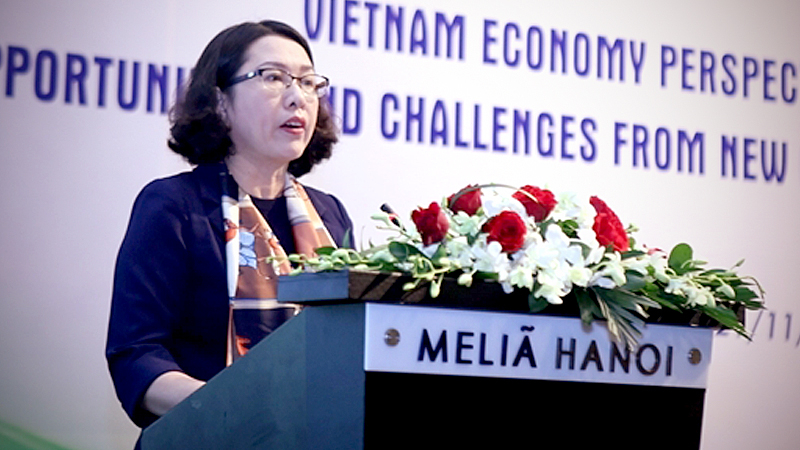
NCIF’s Director Tran Thi Hong Minh addresses a seminar held in Hanoi on Thursday, themed “Vietnam economy perspective for 2021-25: opportunities and challenges from new generation free trade agreements”. — VNA/VNS Photo Danh Lam

NCIF’s Director Tran Thi Hong Minh addresses a seminar held in Hanoi on Thursday, themed “Vietnam economy perspective for 2021-25: opportunities and challenges from new generation free trade agreements”. — VNA/VNS Photo Danh Lam
By Viet Nam News212 Viewed

Hanoi – Vietnam’s economic growth is forecast to reach 7 per cent in the 2021-25 period thanks to the country’s participation in new-generation free trade agreements.

During the period, inflation will stand at a moderate rate of 3.5-4.5 per cent year. Labour productivity will be improved with an annual growth rate of about 6.3 per cent.

The information was released during a seminar held in Hanoi on Thursday, themed “Vietnam economy perspective for 2021-25: opportunities and challenges from new generation free trade agreements”.

It was organised by the National Centre for Socio-Economic Information and Forecast (NCIF) under the Ministry of Planning and Investment.

According to NCIF’s Director Tran Thi Hong Minh, the signing and implementation of new generation free trade agreements, especially the Comprehensive and Progressive Agreement for Trans-Pacific Partnership (CPTPP) and the Vietnam-EU Free Trade Agreement (EVFTA) would put a profound and wide impact on Vietnam’s economy in the period of 2021-25.

“Both CPTPP and EVFTA have wider range of ​​commitment compared to other trade pacts, as they cover import and export terms while setting production methods for goods exchanges,” Minh said.

“They have positive influence on economic growth, especially in markets of the signatories.”

EVFTA and CPTPP, respectively, can boost Vietnam’s GDP up by 4.3 per cent and 1.3 per cent by 2030, Minh said, adding that Vietnam’s export turnover to the EU by 2030 is expected to surge 44.4 per cent while that to CPTPP member countries will rise by 14.3 per cent by 2035 .

“The trade deals will exert influence on the Vietnamese economy in mid-and long-terms as they put pressure on the Government to improve institutions and business climate,” she said.

In another scenario, Vietnam’s GDP could expand 7.5 per cent if the country can take advantage of the Fourth Industrial Revolution, improve quality of investment and well develop the modern economy, Minh said.

Meanwhile, Tran Toan Thang, an official from the NCIF, said the EVFTA and CPTPP’s commitments were higher than WTO in terms of investment openness, investment protection and dispute settlement, and they helped Vietnam promote exports as well as improve supply chains.

Although Vietnam could improve its competitive capacity in terms of market scale and labour productivity, it could take time for the country to better infrastructure and promote innovation and technology readiness, Thang said.

The country should work more to renew its growth model, accelerate key drivers of economic growth, and make good use of opportunities from global integration, science-technology development and the Fourth Industrial Revolution, Thang said.

Digital transformation

Also on Thursday, the Vietnam Chamber of Commerce and Industry (VCCI) co-operated with Alibaba Group and OSB Investment and Technology JSC to hold the seminar “Vietnam exports on the eve of the EVFTA and digital transformation trends”.

VCCI Deputy Chairman Doan Duy Khuong said EVFTA created motivation for the development of Vietnam’s economy in general and exporting enterprises in particular.

After the trade deal takes effect, the EU will eliminate about 85.6 per cent of import tariffs on Vietnamese goods, equivalent to 70.3 per cent of Vietnam’s revenue from exports to the EU.

The trend of switching from traditional businesses to digital platforms was becoming increasingly popular and was considered a useful solution to help businesses expand export markets, in the context of Vietnam’s deeper integration into the global economy, Khuong said.

The seminar provided attendees with useful information about EVFTA, digital transformation trends as well as the importance of e-commerce application in seeking commodity sources for global importers.

It also provides effective marketing and promotion methods on e-commerce site Alibaba.com.

Bernard Dewamme from Belgium-based Mentally Fit Global Group shared useful information to help Vietnamese exporters enhance their leadership capacity, improving the competitiveness of Vietnamese businesses. — VNS

Xi calls for collective effort to innovate

ศาสตร์เกษตรดินปุ๋ย : ขอบคุณแหล่งข้อมูล : หนังสือพิมพ์ The Nation

https://www.nationthailand.com/business/30378670?utm_source=category&utm_medium=internal_referral

Xi calls for collective effort to innovate

Nov 23. 2019

President Xi Jinping meets with Henry Kissinger (second from left), former US secretary of state, and others attending the 2019 New Economy Forum in Beijing on Friday. [FENG YONGBIN / CHINA DAILY]

President Xi Jinping meets with Henry Kissinger (second from left), former US secretary of state, and others attending the 2019 New Economy Forum in Beijing on Friday. [FENG YONGBIN / CHINA DAILY]
By China Daily221 Viewed

President says China, US should strengthen their communication China would like to promote innovation cooperation with all countries, including the United States, to bring more benefits to the people of all nations, President Xi Jinping said Friday.

Xi made the remark while meeting with foreign representatives at the 2019 New Economy Forum at the Great Hall of the People in Beijing.

Innovation outcomes should benefit the whole world rather than being a treasure hidden in a mountain cave, Xi said. No country can be the only center for innovation or exclusively benefit from its outcomes, Xi said.

Given that both China and the US are major centers of innovation, Xi said, they should promote cooperation on innovation.

Xi recalled China’s ancient civilization, saying that the Chinese people have never surrendered despite China becoming a semicolonial and semifeudal society after the Opium Wars.

China’s remarkable achievements are attributed to the right path — socialism with Chinese characteristics — that fits China’s national conditions, follows the trend of the times and wins the hearts of the people, Xi said. He added that the people are confident in staying on the path.

The Chinese Dream of national rejuvenation is not a dream of hegemony, and China will not seek to replace any other country, Xi said, adding that China only strives to restore the country’s dignity and the position it deserves.

China will uphold the path of peace and development and be dedicated to cooperation with all other countries, Xi said. China will continue to follow the path of reform and opening-up despite obstacles deliberately set by others, and the obstacles and difficulties will make the country more determined to boost opening-up, he said. China will fulfill its commitment and keep its promises, Xi added.

Belt and Road cooperation has achieved fruitful outcomes, and win-win cooperation through this initiative will not be slowed but will move further in the right direction, he said.

Five representatives, including Henry Kissinger, former US secretary of state, and Henry Paulson, former US treasury secretary, delivered speeches at the meeting. They spoke highly of China’s achievements and the country’s contributions to global peace and development.

The representatives said protectionism has caused trade frictions, and the world situation is full of uncertainties. China’s efforts to boost opening-up are of great significance in promoting sustainable development and stabilizing international relations, they said.

Speakers said that all parties should enhance innovation cooperation to avoid the development of an “economic iron curtain”.

The 2019 New Economy Forum, held in suburban Beijing, was attended by over 500 people from the political and business sectors of over 60 countries.

Meeting with Kissinger

In a separate meeting with Kissinger on the same day, Xi said China and the US should strengthen communication on strategic issues to avoid misunderstandings and misjudgments. The China-US relationship is now at a critical juncture and facing some difficulties and challenges, he said.

Xi said the two nations should act in the fundamental interests of people in both countries as well as the world, respect each other, seek common ground and achieve win-win results through cooperation so as to advance bilateral ties’ development in the right direction.

Xi recalled that Kissinger, with profound historical vision and deep understanding of traditional Chinese culture, worked with the leaders of China and the US at the time to promote the normalization of relations between two countries with different national conditions.

The two countries and the world are still feeling the effect of those moves, he said.

The president also praised the 96-year-old veteran diplomat’s sincere feelings and active efforts in promoting the development of relations between the two great countries over the years, saying that his significant contribution will be written into history.

Kissinger said he was honored to have visited China almost 100 times over the past 50 years and witnessed the country’s earthshaking transformations.

The US-China relationship has kept moving forward despite ups and downs over the past five decades, he said, and now this relationship has become even more important as times have changed.

Trump says he might veto legislation that aims to protect human rights in Hong Kong

ศาสตร์เกษตรดินปุ๋ย : ขอบคุณแหล่งข้อมูล : หนังสือพิมพ์ The Nation

https://www.nationthailand.com/business/30378660?utm_source=category&utm_medium=internal_referral

Trump says he might veto legislation that aims to protect human rights in Hong Kong

Nov 23. 2019
President Trump might veto legislation designed to support pro-democracy protesters in Hong Kong. File Photo: Getty Images

President Trump might veto legislation designed to support pro-democracy protesters in Hong Kong. File Photo: Getty Images
By The Washington Post · David J. Lynch

500 Viewed

WASHINGTON – President Donald Trump suggested Friday that he might veto legislation designed to support pro-democracy protesters in Hong Kong – despite its near-unanimous support in the House and Senate – to pave the way for a trade deal with China.

Speaking on the “Fox & Friends” morning program, the president said that he was balancing competing priorities in the U.S.-China relationship.

“We have to stand with Hong Kong, but I’m also standing with President Xi [Jinping],” Trump said. “He’s a friend of mine. He’s an incredible guy…But I’d like to see them work it out. OK. We have to see and work it out. But I stand with Hong Kong. I stand with freedom. I stand with all of the things that we want to do, but we also are in the process of making the largest trade deal in history. And if we could do that, that would be great.”

The House on Wednesday passed the Hong Kong Human Rights and Democracy Act by a vote of 417 to 1. The lone holdout was Rep. Thomas Massie, R-Ky. That came one day after the Senate had approved the measure on a unanimous vote.


The veto-proof majorities indicate that Congress could overrule the president if he tries to block the bill from becoming law. As the U.S.-China trade talks approach the one-year mark, the episode shows how other elements of the relationship between the world’s two largest economies are influencing prospects for a deal.


The president’s uncertain remarks drew swift opposition from members of both parties. Sen. Ted Cruz, R-Texas, said the Hong Kong bill “will become law. This was a true bipartisan moment and a clear signal to the rest of the world that political threats from corrupt regimes will not stand in the way of America supporting the millions of freedom fighters in Hong Kong.”

Senate Minority Leader Charles Schumer, D-N.Y., accused the president of going soft on the Chinese leader. “For a guy who promised to be tough on China, President Trump’s reliable deference to President Xi is all the more bewildering,” Schumer said in a statement. “Being tough on China when it comes to human rights will also help us win the battle on trade.”

Once a bill is passed by both chambers of Congress, the president has 10 days to sign it into law or to veto it. If he does neither, it will become law automatically. That means Trump has until early December to decide.

The legislation authorizes sanctions on Chinese and Hong Kong officials involved in human rights abuses and requires the State Department to conduct an annual review of the special status that the U.S. grants Hong Kong in trade matters.

The bill threatens to complicate trade negotiations that already are stalled on several key issues. Chinese officials have criticized the congressional action as interference in their internal affairs. Vice President Pence said this week it would be “very hard” to finalize a trade deal if China resorts to violence to put down the protests, now in their sixth month.

But some experts say Xi will keep the trade talks and the Hong Kong protests on separate tracks. The Chinese economy grew at a 6 percent annual rate in the quarter that ended September 30, its slowest pace in 27 years. And the trans-Pacific tariff war is only adding to economic pressures, giving officials an incentive to negotiate a ceasefire. If Xi sees a trade deal as easing his economic woes, he will sign it regardless of other irritants in China’s relationship with the U.S., said Aaron Friedberg, a China scholar at Princeton University.

“The idea of linkage between Hong Kong and the trade talks is largely a figment of Trump’s imagination. I doubt that the Chinese side has made any such overt connection although, now that Trump has done so, they may be happy to reinforce the idea that, if we somehow go easy on them on Hong Kong, they may eventually ink that illusive ‘great deal,’ ” said Friedberg, a former adviser to Vice President Dick Cheney.

China regained sovereignty over Hong Kong in 1997, ending more than 150 years of British colonial rule. Maintaining control over the prosperous enclave, which Beijing governs under “the one-country, two-systems framework,” is a top priority for Xi. But there has been widespread tension in Hong Kong for months over China’s governance of the economic hub, triggering large – at times, violent – protests that have led to multiple deaths.

Chinese officials would likely react sharply if the U.S. legislation becomes law. But that reaction wouldn’t necessarily imperil the negotiations, according to Jeff Moon, a former U.S. trade negotiator in the Obama administration. In the past, China has reacted to perceived slights by denying permission for U.S. Navy vessels to make port visits to Hong Kong, he noted.

“Trump’s task is to de-link Hong Kong from trade, and to help Xi find a way to express displeasure over U.S. legislation without taking precipitous action that will create indefinite deadlock in the trade war,” Moon said. “The irony here is that Trump’s comments on Fox signal uncertain resolve and negotiating weakness in the trade war while talks are faltering and he needs to show determination to press China on the whole range of issues, not just agricultural products and tariffs.”

Trump last month announced an “agreement in principle” with China on a partial trade deal, which he hoped to sign by mid-November. But talks have deadlocked over the details of Chinese purchases of U.S. farm products and plans for the removal of Trump’s tariffs on $360 billion in Chinese goods.

Trump’s comments Friday come one day after Sen. Marco Rubio, R-Fla., one of the authors of the Hong Kong legislation, predicted on CNBC that the president would sign the measure.

“My understanding is that they will sign it,” Rubio said, referring to the White House.

Trump’s public comments about Hong Kong have been inconsistent. In June, he said a resolution of the protests was between Hong Kong and China “because Hong Kong is part of China.”

Two months later, he tweeted that Xi should “humanely” deal with the situation before a trade deal was inked. “Of course China wants to make a deal. Let them work humanely with Hong Kong first!” the president wrote.

The president has faced calls from lawmakers in both parties to speak out about what’s at stake in Hong Kong’s escalating demonstrations. “The world should hear from him directly that the United States stands with these brave men and women,” Senate Majority Leader Mitch McConnell said this week.

On Friday, Sen. Ron Wyden, the senior Democrat on the Senate Finance Committee, said: “Basic human rights in Hong Kong aren’t something Donald Trump can bargain away. Congress has overwhelmingly spoken against the Chinese government’s violent repression of peaceful protest, and any action by Donald Trump to side with China over Congress must be quickly overridden.”

The president also told Fox, without evidence, that he had saved the lives of thousands of Hong Kong demonstrators by telling Xi not to intervene.

“The only reason he’s not going in is because I’m saying it’s going to affect our trade deal,” Trump said.

The U.S.-China trade talks have charted a winding path for the past year. Trump and Xi agreed to launch negotiations last December 1 over a steak dinner in Buenos Aires, on the sidelines of the Group of 20 leaders’ summit.

Negotiators failed to meet their initial March 1 deadline, but Trump agreed to delay a planned tariff increase while talks continued. At the beginning of April, Trump said negotiators were close to an “epic” deal that could be finalized “within the next four weeks.”

Instead, the talks fell apart in May, with U.S. officials accusing the Chinese of reneging on a nearly-complete deal and the president expanded tariffs to additional Chinese products later in the summer.