Though establishing connections between climate change and tornadoes is difficult, the correlation between El Nino/La Nina and tornadoes is strong — La Nina seasons tend to have increased tornado activity in the United States, and it is worth noting that this country is currently experiencing La Nina, which is expected to last into spring of next year.
Powerful storms like the ones that tore through parts of the central United States this weekend are the “new normal” in an era of climate change, and the severity, duration and magnitude of the storms this late in the year were “unprecedented,” Deanne Criswell, administrator of the U.S. Federal Emergency Management Agency (FEMA), told CNN on Sunday.
“This is going to be our new normal,” said Criswell. “The effects we are seeing of climate change are the crisis of our generation … We’re taking a lot of efforts at FEMA to work with communities to help reduce the impacts that we’re seeing from these severe weather events and help to develop systemwide projects that can help protect communities.”
Meanwhile, CNN said in its report that “scientific research on the role that climate change is playing in the formation and intensity of tornadoes is not as robust as for other types of extreme weather like droughts, floods and even hurricanes. The short and small scale of tornadoes, along with an extremely spotty and unreliable historical record for them, makes assessing their relationships to long-term, human-caused climate change very difficult.”
Though establishing connections between climate change and tornadoes is difficult, the correlation between El Nino/La Nina and tornadoes is strong — La Nina seasons tend to have increased tornado activity in the United States, and it is worth noting that this country is currently experiencing La Nina, which is expected to last into spring of next year, it added.
Photo taken on Dec. 11, 2021 shows houses damaged in tornadoes in Mayfield, Kentucky, the United States. (Photo by Caromirna Sanchez/Xinhua)
“The vicious centerpiece (of the weekend tornadoes) was a monster supercell that carved an hours-long, 250-mile path from eastern Arkansas to western Kentucky … A powerful storm system set up the chaos as it swept from the Rockies toward Canada, triggering high winds over large areas of the Mid-South, Midwest and Great Lakes,” reported The Washington Post (WP).
On Sunday, rescuers in the middle of the United States resumed search operations for victims of a deadly tornado outbreak that left dozens of people dead and flattened entire communities when it tore through six states late Friday, including Arkansas, Illinois, Kentucky, Mississippi, Missouri and Tennessee.
U.S. Homeland Security Secretary Alejandro Mayorkas said that he is heading to Kentucky on Sunday to meet with the governor and local officials and assess the damage caused by the storms. “I am on my way to Kentucky with @FEMA_Deanne to meet with @GovAndyBeshear, state, and local officials,” he tweeted.
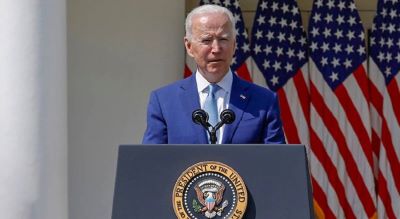
U.S. President Joe Biden signed an emergency declaration for Kentucky on Saturday, opening the door for the FEMA and other federal entities to coordinate disaster relief efforts. “Whatever is needed, the federal government is going to find a way to supply it,” Biden said on Saturday in Delaware.
Photo taken on Dec. 11, 2021 shows a vehicle damaged in tornadoes in Mayfield, Kentucky, the United States. (Photo by Caromirna Sanchez/Xinhua)
HARDEST HIT
Kentucky Governor Andy Beshear confirmed that the tornadoes that tore a 200-mile gash across his state and leveled homes and businesses left “devastation like none of us have ever seen before,” telling CBS’s “Face the Nation” on Sunday that “this tornado didn’t discriminate against anybody in its path, even if they were trying to be safe.”
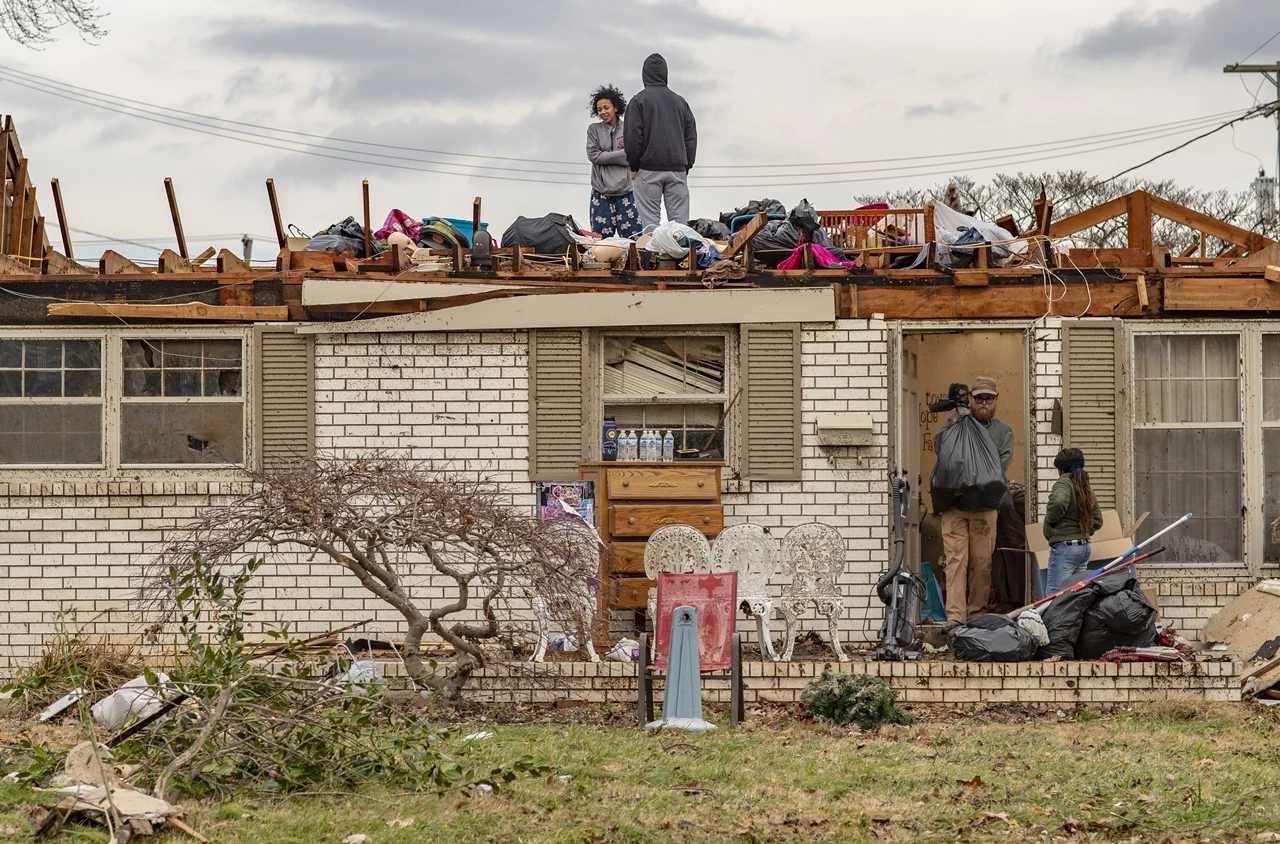
Mayfield, Kentucky, was one of the hardest hit communities, with satellite photos showing a swath of destruction, including at a candle factory that was completely flattened. More than 100 workers were in the factory when the tornado struck, and 40 of them had been rescued as of Saturday.
The official number of confirmed deaths from the tornadoes and severe storms stood at 25 Sunday morning, with Kentucky suffering the most deaths, but Beshear estimated the actual death toll in his state would exceed 80 and could rise to more than 100 as crews continue sifting through the wreckage.
According to WP, over 100 people are feared to have been killed after rare winter tornadoes ripped through parts of the South and the Midwest late Friday and early Saturday. Thousands of people woke up to power and water outages on Sunday, as rescue work goes on to determine the exact number of deaths.
Another 1,239 Omicron cases have been found in Britain, the biggest daily increase since the variant was detected in the country, taking the total cases detected in Britain to 3,137.
Britain’s COVID-19 alert level has been raised from Level 3 to Level 4 “in light of the rapid increase in Omicron cases,” British chief medical officers said in a joint statement Sunday.
In the statement, the four chief medical officers and the National Health Service (NHS) England national medical director said the emergence of Omicron “adds additional and rapidly increasing risk to the public and healthcare services.”
“Early evidence shows that Omicron is spreading much faster than Delta and that vaccine protection against symptomatic disease from Omicron is reduced,” said the statement.
The statement suggested people should continue to “take sensible precautions including ventilating rooms, using face coverings, testing regularly and isolating when symptomatic.”
A passenger wearing a face mask is seen on a bus in London, Britain, on Dec. 9, 2021. (Photo by Stephen Chung/Xinhua)
Level 4 means the virus is “in general circulation” and “transmission is high and direct COVID-19 pressure on healthcare services is widespread and substantial or rising.”
Another 1,239 Omicron cases have been found in Britain, the biggest daily increase since the COVID-19 variant was detected in the country, taking the total cases found in the country to 3,137, the UK health security agency confirmed Sunday.
Britain reported 48,854 new COVID-19 cases, bringing the total in the country to 10,819,515, according to official figures released Sunday. The country also reported a further 52 COVID-related deaths, taking the national death toll to 146,439.
People walk on the street in London, Britain, on Dec. 9, 2021. (Photo by Stephen Chung/Xinhua)
More than 89 percent of people aged 12 and over in Britain have had their first vaccine dose, and over 81 percent have received both, according to the latest figures. Some 40 percent have received their booster jab, or the third dose.
“The bodies were transferred to the Sucua morgue,” it said, adding that the 25 injured people, including minors and adults, were taken to various local hospitals.
At least 18 people were killed and 25 others injured in a passenger bus accident in the Sucua canton of the Amazonian province of Morona Santiago in southern Ecuador, the Integrated Security Service ECU 911 reported Sunday.
The accident occurred on Saturday night in Huambi, when the bus covering the Macas-Loja route veered off its lane and overturned, the agency said in a statement.
“The bodies were transferred to the Sucua morgue,” it said, adding that the 25 injured people, including minors and adults, were taken to various local hospitals.
Immediate assistance was activated with personnel from various relief institutions and fire department rescue units heading to the scene.
Members of the Traffic Accident Investigation Service and Criminalistics were also on hand to carry out procedures for this type of accident.
The number of Covid-19 cases crossed 14.39 million across Southeast Asia, with 24,421 new cases reported on Sunday (December 12). New deaths are at 495, bringing accumulated Covid-19 deaths in Asean to 297,354.
Nearly 300,000 doses of Covid-19 vaccines, donated by the Dutch government through the Covax Facility, touched down in Cambodia on December 10, with 600,000 more set to be shipped through the facility in the next week. Ministry of Health said Cambodia also hopes to receive 2.3 million doses from Australia by the end of the year.
More donations are in the pipeline for next year and awaiting confirmation to the ministry and government from the Covax Facility, whereas a considerable share would be used as boosters.
Meanwhile, health experts in Malaysia warned that those who test positive for Covid-19 through self-test kits but are not reporting their cases to the Health Ministry as required by law are making it hard for health authorities to track and assess the pandemic in the country.
Those who fail to report their Covid-19 positive results are considered to have committed an offence under Section 22 of the Prevention and Control of Infectious Diseases Act and risk facing jail of up to two years, a fine, or both.
LIVERPOOL, England – The Group of Seven leading industrial democracies warned Russia on Sunday of “massive consequences” and “severe cost” if it launches an attack on Ukraine, a day before President Joe Bidens top diplomat for Europe travels to Kyiv and Moscow to address the high-stakes standoff.
The joint statement from G-7 ministers meeting in this northern English city said they are united in their opposition to Russia’s military buildup near the border of Ukraine and called on the Kremlin to de-escalate.
The statement, representing countries with a hawkish outlook on Russia, such as the United States and Britain, and more dovish ones, such as Italy and France, is the latest effort by the Biden administration to rally international support for Ukraine as U.S. intelligence finds that the Kremlin has planned out a potential multi-front offensive in Ukraine involving up to 175,000 troops. Russia has denied having any such plans.
“Any use of force to change borders is strictly prohibited under international law. Russia should be in no doubt that further military aggression against Ukraine would have massive consequences and severe cost in response,” the G-7 statement said, calling on the Kremlin to “de-escalate” and “pursue diplomatic channels.”
Projecting a united front against Russia has been a challenge for the Biden administration, as continental Europe interprets the threat from Russia in different and sometimes conflicting ways.
Last week, when Biden told reporters that the United States would be announcing a meeting between the United States, Russia and a select group of European allies to see if “accommodations” could be made with Moscow to resolve the crisis, it set off alarm bells in Eastern European capitals where a fear persists of Washington negotiating their region’s fate in their absence.
“Western capitals talking directly to Moscow, us not being at the table – this has ominous vibes from our 20th century history,” said a senior Eastern European official, speaking on the condition of anonymity to discuss a sensitive issue.
Senior State Department officials have since clarified that no such announcement of a meeting of the kind Biden described was forthcoming. The White House also scrambled to set up a call on Thursday between Biden and Eastern European officials to provide assurances that nothing would be decided in meetings with Russian officials without their input on matters that affect them.
U.S. and European officials hailed the statement on Sunday as a sign of Western unity.
“What we have shown this weekend is that the world’s largest economies are united. We have sent a powerful signal to our adversaries,” said British Foreign Secretary Liz Truss during a news conference in Liverpool.
The statement, however, does not specify what type of costs Russia would face. The Biden administration has for weeks threatened harsh economic sanctions, but Moscow has worked to insulate its economy against U.S. Treasury Department actions. The most consequential economic penalties would come from U.S. allies with deeper economic ties to Russia, such as Germany, where the all-but-completed Nord Stream 2 pipeline will bring Russian natural gas to Europe.
Berlin, Paris and Rome have been more cautious with imposing economic sanctions on Moscow, to the chagrin of some in Washington, but a senior State Department official said that Western European capitals were increasingly seeing the gravity of the Russian threat.
“I think we’re having more and more convergence every day,” said the official, speaking on the condition of anonymity to discuss sensitive diplomacy.
Asked whether European leaders would be prepared to impose national sanctions should Russia attack Ukraine, the official said: “I’m quite confident if that awful day comes, not only the countries that were in the room today, but a large number of democratic countries will join us in imposing costs.”
William Taylor, a former U.S. ambassador to Ukraine, said he believes that Russian President Vladimir Putin would probably not end up invading Ukraine but that the possibility is strong enough that it should be taken seriously.
“I think it’s 55-45, but 45% chance that there’s a major war in Europe? You have to take it seriously. You have to be prepared. You have to be ready,” Taylor said during a Sunday appearance on ABC’s “This Week.”
Earlier in his appearance, Taylor said an invasion would be “very, very costly” for Russia because of the likelihood of economic sanctions, heavy troop losses and losing a pipeline to Germany.
On Monday, Karen Donfried, assistant secretary of state for European and Eurasian affairs, travels to Ukraine and then Russia for meetings with senior government officials “to discuss Russia’s military buildup and to reinforce the United States’ commitment to Ukraine’s sovereignty, independence, and territorial integrity,” the State Department said in a statement.
In seeking to allay the concerns of Eastern European countries, the State Department official said no major decisions on the future of European security would be decided until Donfried consults with Ukrainian officials in Kyiv.
At least 30 tornadoes swept through U.S. central states of Arkansas, Mississippi, Illinois, Kentucky, Tennessee and Missouri.
Death toll may rise to 100 after at least 30 tornadoes swept through six states overnight in the central parts of the United States, including Arkansas, Mississippi, Illinois, Kentucky, Tennessee and Missouri.
A candle factory in Kentucky has been completely destroyed, local media reported on Saturday.
“There were about 110 people in it (candle factory) at the time that the tornado hit it,” Kentucky Governor Andy Beshear said. “We believe our death toll from this event will exceed 50 Kentuckians and probably end up 70 to 100.”
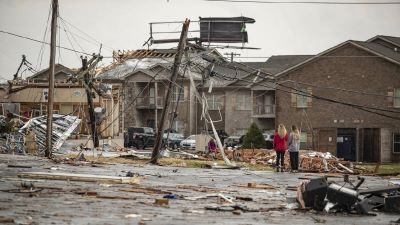
Photo taken on Dec. 11, 2021 shows a heap of rubble after tornadoes in Mayfield, Kentucky, the United States. (Photo by Caromirna Sanchez/Xinhua)
Beshear has declared a state of emergency in the area.
Tornadoes also hit a nursing home in Arkansas and took off the roof of an Amazon warehouse in Illinois, causing certain fatalities. Another nursing home and a fire station in Trumann of Tennessee also caused substantial damage.
It was the worst tornado that touched down in northeastern Arkansas and stayed on the ground for about 223 miles into Kentucky, and most likely the longest reported tornado in history, local media reported.
Photo taken on Dec. 11, 2021 shows a tree toppled in tornadoes in Mayfield, Kentucky, the United States. (Photo by Caromirna Sanchez/Xinhua)
According to PowerOutage.US, at least 331,549 utility customers in four states were left without power.
Issuing tornado warning on Friday, the National Weather Service said at least 25 million people were under threat from massive thunderstorm systems.
Ambassador Han Zhiqiang delivered a speech on Saturday at the inauguration ceremony of the 16th Chairperson of the Thai-Chinese President Club, stating that the Summit for Democracy by the US is an outright farce.
“During which, the US claimed itself as a world democracy model and preacher, and even invited criminals who had organised street riots for beating, smashing, looting and burning in Hong Kong to speak,” he said.
Ambassador Han said that the US boasts the world’s most advanced medical technology and resources, but its failing response to the Covid-19 pandemic has resulted in more than 800,000 lives claimed there and over 50 million infections caught. The US has been domestically plagued with political polarisation, disparities between rich and poor, severe racial discrimination and frequent gun violence, which the US Administration reveals no competence to deal with.
“The US-launched wars and military operations in the past 20 years in Afghanistan, Iraq, Libya, and Syria have led to the loss of hundreds of thousands of lives and the displacement of tens of millions. The US-instigated colour revolutions in one place and another have caused political turmoil, economic depression and untold sufferings of the people in many developing countries. Now the US has been attempting to contain China’s development out of US hegemonic self-interests by stirring up chaos in Hong Kong and Xinjiang and supporting “Taiwan independence”, which is completely in vain,” he said.
With such a myriad of heinous acts and such notorious state governance, the US self-proclaiming as a model of the world democracy is explicitly and utterly an attempt to deceive the world for a fabricated reputation. In recent years, the US has coined many new expressions for attacking other countries, such as the “failed state” or “evil state”. It now appears that these expressions are the most appropriate to be used for the US itself.
Ambassador Han also stated that democracy is a common value of the humanity. Ways to realise democracy are multiple and diverse. The kinds of egoistical democracy and hegemony-serving democracy are not true democracy but fake democracy that trample on and blaspheme against true democracy.
The ambassodor pointed out that China has always adhered to an independent foreign policy of peace and promoted the common values of peace, development, fairness, justice, democracy, and freedom for all humanity. The path of peaceful development and promote world peace and development can adhere through China’s own development while striving to forge a sound external environment.
He added that the country has stayed committed to mutual benefit and win-win results, uphold fairness and justice, stand on the right side of the history and the right side of the cause of human progress. China will always be a builder of world peace, a contributor to global development and a defender of the international order.
European leaders and scientists warned Friday that the omicron variant could become dominant in some countries startlingly soon, overtaking the delta variant, which has remained the most common version of the virus globally for months.
“We expect it to overtake delta within days, not weeks,” Nicola Sturgeon, the first minister of Scotland, said Friday about the spread of omicron there.
That echoes the latest update from the U.K. Health Security Agency, which has high confidence that omicron has a growth advantage over delta and estimates that, spreading at its current rate, it will become dominant in Britain by mid-December, with more than a million infections by the end of the month.
In Denmark, too, omicron on its current trajectory could become dominant by “the end of next week,” said Mads Albertsen, a professor at Aalborg University.
The sense is that Britain and Denmark aren’t standouts. Rather, they are tracking and modeling the spread especially carefully, and what they’re reporting may reflect what’s emerging elsewhere in Europe. And since so often during the pandemic Europe has served as a preview of what’s to come in the United States, U.S. officials are watching closely, as well.
Epidemiologists already know omicron has spread rapidly in South Africa – the earliest sample of the variant identified there was from the first week of November, and it was dominant within a month.
But South Africa had fairly low levels of the coronavirus when omicron emerged, meaning it didn’t take much for the new variant to prevail. Also, only a quarter of people in South Africa have been fully vaccinated. Europe offers a truer test of whether omicron can beat out delta in places where the majority of people are vaccinated.
“The speed of it is surprising,” said Linda Bauld, a professor at the University of Edinburgh. “If it can overcome delta in Scotland and the U.K., then it will do elsewhere.”
Key questions remain open, including about the severity of illness it causes and the extent to which extent vaccines will continue to provide protection.
WHO Director General Tedros Adhanom Ghebreyesus warned against drawing “firm conclusions” at this point.
Anthony S. Fauci, America’s top infectious-disease expert, said earlier this week that, based on preliminary data, the omicron variant may cause less severe illness than earlier variants of the virus.
But many countries in Europe aren’t waiting to find out more. They have been reintroducing or adopting a range of control measures – from travel restrictions and mask requirements to limited lockdowns and vaccine mandates.
Some experts worry that even if the variant causes less severe illness, its rapid growth may overburden hospitals that were already strained by the continent’s latest wave of delta cases.
“While hopeful, we are not certain any reduction [in the severity of illness] would be enough to keep the total number of hospitalizations from going up substantially – beyond our capacity to absorb them,” Rowland Kao, a University of Edinburgh professor, told the Science Media Center.
Neil Ferguson, an epidemiologist at Imperial College London whose models have shaped government policy in Britain and the United States, told the Guardian that the omicron variant “could very substantially overwhelm the NHS, getting up to peak levels of admissions of 10,000 people per day.”
Sturgeon warned of a “potential tsunami of infections” and urged Scots to defer their Christmas parties.
The suspected proportion of omicron among all coronavirus infections in Scotland surged from 2% Sunday to more than 15% Friday, suggesting that cases are doubling every two to three days.
“What we are seeing in the data just now is perhaps the fastest exponential growth that we have seen in this pandemic so far,” Sturgeon said.
Albertson in Denmark said that new restrictions announced Wednesday – which include longer school vacations over Christmas and nightlife curbs – could delay, slightly, the point omicron surpasses delta there.
“It will come very fast in most countries now,” he said.
Though Europe has gone much further than the United States in imposing new restrictions in recent weeks, European governments have sought to avoid measures as rigid or as wide-ranging as last winter.
Bauld, the University of Edinburgh professor, said restrictions are important to give more people time to receive their booster shots and to avoid hospitals being overwhelmed.
Despite uncertainty over how much omicron reduces vaccine effectiveness, Bauld said her advice remains unchanged: “Anybody who’s had any vaccines is hugely better off than people who have had no vaccines.”
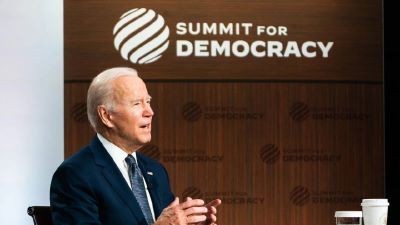
WASHINGTON – For two days last week, President Joe Biden gathered, virtually, representatives of more than 100 countries for what was billed as a “Summit for Democracy.” The goal was to rally nations in the face of rising authoritarianism around the world. “Democracy needs champions,” the president said.
The administration, seeking to show global leadership, released a list of initiatives designed to strengthen and encourage democracies overseas – efforts to strengthen a free press, to fight corruption, to support democratic reformers, to defend free and fair elections.
The summit drew some criticism, in part for who was and who wasn’t invited. But the most persistent questions focused on whether the United States, at a time when democracy is threatened at home, could stand as a beacon for the rest of the world in this most important undertaking.
“One of the ironies here is it’s never been more important that the United States lead the world in promoting democracy,” said Nathaniel Persily, a professor at Stanford University Law School. “But it’s also the case that the United States is more hobbled in its capacity to do so. It’s difficult to say, ‘Be more like us’ in the wake of the Jan. 6 insurrection.”
Freedom House does annual surveys of nations around the world, measuring the health of democracy country by country. Over the past decade, the United States’ score, on a scale of 0 to 100 has gone from 94 to 83 and now ranks 53rd globally in the state of its democracy.
“Compared to many other countries, we’re doing pretty well still,” said Michael J. Abramowitz, president of Freedom House. He cited a robust U.S. media and strong protections for the media, along with a strong rule of law and an independent judiciary. “But we have been declining,” he said.
The nation is deeply divided and those divisions have affected the state of democratic institutions. In an era of polarized voting and the drop in ticket-splitting, Republicans enjoy structural advantages in the Senate and the electoral college. Increasingly, the majority of the population can be ruled by a minority of the population.
The number of competitive House districts shrinks with every decennial redistricting, thanks to gerrymandering and the geographic sorting of the population, often leaving it to the political wings of the two parties to pick their House members and to set the tone and agendas.
The executive branch is ill-prepared for many crises, anticipated or not, as the coronavirus pandemic has shown. It is further constrained by a personnel process, in conjunction with the Senate’s role confirmation responsibilities, that has left this and other administrations with gaping holes in departments and agencies well in a president’s term.
The Supreme Court is in danger of being seen as reflective of the country’s political divisions rather than independent of them, to the point that there is more talk than ever on the left about whether changes should be made to its structure.
Biden was able to offer the democracy summit little in the way of concrete reassurances for repairing America’s democratic institutions. With Republicans implacably opposed, Biden’s support for a Democratic-sponsored national voting rights bill is stuck in the Senate, unable to move forward unless there is a change in the filibuster rules, which isn’t likely anytime soon. In the states, Republican-controlled legislatures have enacted restrictions on voting laws.
“It’s true that the administration can’t deliver on its own the things that need to be done to fix U.S. democracy,” Abramowitz said. “So the inability to agree across the political aisles makes it hard for Biden to propose new things the U.S. can do. He is handicapped by the inherent gridlock and polarization in our country, and he’s been unable to break that.”
Does that negate the value of a democracy summit? No, said Timothy Snyder, a Yale University historian. “I personally think there’s tremendous value in it,” he said. “It’s important to name democracy as an aspiration. We’ve spent too long imagining that democracy is the normal state of affairs, that democracy is something everybody wants.”
The Russians, he said, present democracy as a joke. The Chinese present it as a mess. Both U.S. adversaries are effective in undermining a system of government that too often is taken for granted. “My basic background point is that democracy is always a struggle,” Snyder added. “It’s never the status quo. The idea that the people should rule is always a radical idea and one you have to make sacrifices for or it will erode.”
In Snyder’s view, the United States should not shrink from acknowledging that its democracy is imperfect, or that it can learn from others. “The approach should not be democracy promotion but the approach should be every teacher is a student,” he said. “. . . The people who are against democracy have been cooperating quite well, learning from one another. But the people who are for democracy are behind on this.”
Here in the United States, threats to the integrity of the electoral process are growing, as a recent article in the Atlantic highlighted. Former president Donald Trump continues to falsely claim the 2020 election was rigged and stolen. He badgers Republicans to do something, and Republican legislators in some key states have responded by seeking to make it easier, if there is a repeat of the 2020 results, to turn the administration of elections over to partisan politicians and to make it possible to challenge the certification of results and potentially overturn the next election.
To Snyder and others, the clear and present danger is the prospect that Trump could lose the popular vote in 2024 by an even bigger margin than in 2020, lose in the electoral college and yet still be installed as president. “If we just kind of let this keep rolling downhill and following gravity, the most likely thing is the guy who loses will be installed,” he said. “If we don’t name the risk, we’re going to make [that outcome] much more likely.”
Persily noted that roughly a third of the population believes that the last election was marred by fraud and that Biden is therefore an illegitimate president. But he speculated that it is possible that in a year, if Democrats lose the House, the Senate or both, many of their voters will see voter suppression as the principal reason.
“It is extremely difficult to build trust in political institutions,” Persily said. “Once you lose it, there are very few examples of building it back. We are at a critical period right now where the population is losing confidence in the basic fairness of the election infrastructure. Unless leaders stop sending signals that the process is rigged, we’re going to be in this situation for a long time.”
Many Americans spend little time thinking or worrying about issues of democracy. Some see these kinds of warnings as alarmist or question the credibility of those who sound them. After all, Trump tried to overturn the election and failed, though not before an attack on the Capitol by a Trump-inspired mob.
Given the former president’s relentless campaign of untruths and his seeming desire to run in 2024, there’s no guarantee that the system will hold the next time around. As Biden put it when opening the democracy summit, “Here in the United States, we know as well as anyone that renewing our democracy and strengthening our democratic institutions requires constant effort.”
MAYFIELD, Ky. – A desperate search and rescue operation unfolded Saturday across six states mauled the previous evening by rare late-season tornadoes that may have left more than 70 people dead.
More than 30 separate tornadoes moved with devastating power and speed through an area stretching from Mississippi in the south to Illinois in the north.As they swept through the region over several hours, the twisters killed dozens, including workers in a candle factory in a flattened Kentucky town, lakeside vacationers in Tennessee and a nursing home resident in Arkansas.
While the stream of tornadoes battered dozens of communities, none suffered morethan this town of about 10,000 people in southwestern Kentucky, not far from a sweeping bend in the Mississippi River marking the border with Missouri. As the wind stiffened into the high 70 mph range, some employees stuck in the disintegrating Mayfield Consumer Products candle factory took to Facebook to make a video plea for help.
“This has been the most devastating tornado event in our state’s history,” Kentucky Gov. Andy Beshear, D, told reporters Saturday at a late-morning news conference, calling the scale of damage “indescribable.”
“The level of devastation is unlike anything I’ve ever seen,” he continued. “You see parts of industrial buildings’ roofs or sidings in trees, if trees are lucky enough to stand. Huge metal poles bent in half, if not broken. Buildings that are no longer there. Huge trucks that have been picked up and thrown. And sadly, far too many homes that people were likely in, entirely devastated.”
Beshear spoke with President Joe Biden early Saturday to outline the scope of the damage and the federal assistance necessary to help speed the recovery. Biden later declared a federal emergency for Kentucky, freeing up FEMA assistance and federally subsidized aid, calling the tornado “an unimaginable tragedy.”
The tornadoes that swept through parts of the Midwest and Tennessee River Valley on Friday night and into early Saturday likely may be recorded as the worst on record in the United States during December. Peak tornado season in the region is usually late spring through early summer.
The tornadoes were triggered by a powerful low-pressure system, which lifted from the Southern Great Plains into the Great Lakes. The low-pressure intensified as the polar jet stream, the high-altitude current along which storms track, plunged into the central United States ahead of a blast of record-setting warm air.
The unusual combination – the polar cold meeting the unseasonably hot – created unstable air over Arkansas Friday evening that generated numerous thunderstorms. Those rotating storm systems eventually evolved into tornadoes.
The National Weather Service received 37 reports of tornadoes on Friday in six states. The most destructive tornado, or series of tornadoes, carved an approximately 250-mile path through northeast Arkansas, southeast Missouri, northwest Tennessee and into western Kentucky.
“Last night was one of the most shocking weather events in my 40 years as a meteorologist – a violent tornado (in December!) drawing comparisons to the deadliest and longest-tracking tornado in U.S. history,” tweeted Jeff Masters, a meteorologist and expert on extreme weather.
The longest paths on record top 200 miles – but with some caveats. A 235-mile track in March 1953 is the modern record, according to data from the Storm Prediction Center. Since none of these tornadoes have occurred since 1971, it is possible they were actually tornado “families,” rather than a single sustained event.
The 219-mile-long Tri-State Tornado of March 1925 is widely considered to be the longest tornado path. The deadliest tornado in U.S. history, that tornado killed 695 people as it rumbled through Missouri, Illinois and Indiana in the dark of night.
This event’s path could exceed that in length. But Rick Smith, a meteorologist at the Weather Service office in Norman, Okla., tweeted that the quad-state tornado was more likely multiple twisters rather than just one. On-the-ground surveys to sort this out may be “a complex process that could take some time,” Smith wrote.
Kentucky authorities on Saturday were unable to say how many people had died at the candle factory because rescue operations were still underway. But Beshear said about 40 people were rescued from the facility and that about 110 were believed to have been inside at the time.
Authorities described massive damage to the plant, and dangerous conditions – including toppled metal drums leaking corrosive chemicals – that complicated rescue efforts.
“We had to at times crawl over casualties to get to victims” who were still alive, Mayfield Fire Chief Jeremy Creason told reporters. As first responders worked throughout the night to reach people amid the debris, Creason said, there was also “a steady flow of walking wounded” in addition to rescues.
Mayfield officials said both the city’s main fire station and police station were in the direct path of the tornado on Friday, and they had to extricate first responders from the destroyed stations before they could move to rescue other tornado victims.
Beshear said the casualties from the storm’s path will likely span about 10 counties. While Mayfield was severely hit, state officials said Dawson Springs, about 70 miles to the northeast, was also devastated.
Ryan Mitchum is usually the one standing outside on the porch to watch storms roll into western Kentucky. This time, though, he knew something awful was on its way.
For days, communities along the Kentucky-Tennessee border were warned that strong tornadoes were possible. A local news channel pleaded with residents to take the forecast seriously. ” ‘Don’t take this as a joke,’ they told us,” Mitchum said.
Mitchum hunkered down with his girlfriend in their hallway. But a gust shook the house so violently that the couple moved into a closet. The house, about a 10-minute drive from Mayfield, swayed but survived the storm.
On Saturday morning, Mitchum drove through his hometown, stunned by its ruins.
“It was like a movie scene,” he said. “I don’t think anybody expected it to be as bad as it was.”
Mitchum recorded his tour from his truck as he drove through debris-laden streets and what was the historic downtown.
“Mayfield’s wiped,” he said.
Cars and trucks had been launched into fields. His great-grandparents’ home was flattened. Their donkey was killed.
The downtown buildings left standing had their windows completely blown out and their window-frames left dangling. Businesses were destroyed, he said, and there was nothing left of a lower-income community behind the town’s main boulevard.
“Mayfield needs some prayers,” he said in the video. Mitchum’s Facebook video was shared widely, and his phone was flooded with messages from people sending addresses, asking for help to check on loved ones.
In Edwardsville, Ill., one tornado caved in part of an Amazon distribution warehouse, leaving people inside stranded and at least two dead, authorities said.
About a dozen agencies responded to the scene, about 20 miles northeast of St. Louis. Excavators and rescuers were seen entering the site early Saturday morning.
The Edwardsville Fire Department confirmed at least two fatalities. “One individual was transported by air medical from the scene,” said a fire department official, who spoke on the condition of anonymity because they were not authorized to comment on the operation.
“It’s obviously a large area to try to clear,” the official said, adding that about 30 people were transported by bus from the scene.
Clayton Cope, a 29-year-old maintenance worker known for his kindness, was one of the people killed inside the Amazon warehouse. Tributes honoring Cope flooded across social media, with his loved ones reminiscing about his fun personality.
In one post, Rachel Cope, his sister, described him as her “biggest idol” and recounted the times when the two siblings would search for Christmas presents to ruin their surprises and annoyed each other “till we couldn’t stand it.”
“He’s the reason I’m into video games and anything that I enjoy because I just wanted to be like him,” his sister wrote on Facebook. “I loved him and looked up to him so much, and I genuinely don’t know what I’ll do without him.”
Around 40 workers at the Amazon warehouse were briefly sent to a Pontoon Beach Police Department office, which was being used as a gathering and recovery point, said Rich Schardan, a department assistant chief. None required medical care. People were given access to chaplains, food and drink.
“Our thoughts, prayers, and deepest sympathies are with the victims, their loved ones, and everyone impacted,” said Amazon spokesman Richard Rocha in a statement, adding that the company was assessing the situation. “This is a devastating tragedy for our Amazon family and our focus is on supporting our employees and partners.”
(Amazon founder Jeff Bezos owns The Washington Post.)
In Arkansas, Gov. Asa Hutchinson, R, arrived Saturday morning to the shredded ruins of a nursing home in the town of Monette, where one of the state’s two tornado deaths occurred.
Hutchinson and other state officials stepped over rubble strewn with pink insulation, which had been ripped from the walls by the storm.
“It’s total destruction,” Hutchinson told reporters. “Makes you grateful there wasn’t a greater loss of life.”
Shortly before 9 p.m. Friday, the roof of the 86-bed nursing home collapsed, trapping scores of residents inside. One person was found dead and five were injured.
Survivors were evacuated to a local school as active storms remained in the area, said Rachel Bunch, executive director of the Arkansas Health Care Association.
Hutchinson and other officials touring the damage by helicopter said the use of warning sirens helped lessen the loss of life, alerting towns and communities 15 to 25 minutes before the tornado struck.
Hutchinson said about 20,000 Arkansas residents remain without power. He told reporters that he planned to travel next to the town of Leachville, where a second fatality occurred at a Dollar General store.
“We may have to do a lot of debris removal. We have a lot of homes that have been significantly damaged, if not totally destroyed,” he said.
Bob Blankenship, the mayor of Monette, told reporters the tornado was the most powerful to strike the town since 1984.
At least three people were killed in Tennessee after a tornado swept through the state, according to emergency officials in Lake and Obion counties, where search and rescue operations are underway.
Two died at Cypress Point, a collection of cabins that people use for weekend getaways on the banks of Reelfoot Lake, said Jack Mauldin, director of the Lake County Emergency Management Agency. A third adult is missing in Lake County.
Mauldin said Tiptonville, the county seat, was largely undamaged as the tornado wove along its outer edge toward the lake.
“It just destroyed whatever it touched,” Mauldin said. “There was only one tornado here, but it was on the ground an awfully long time.”
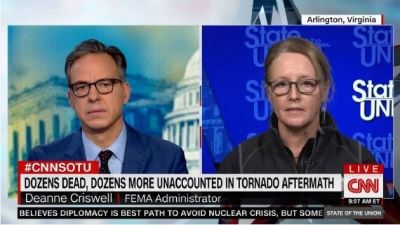
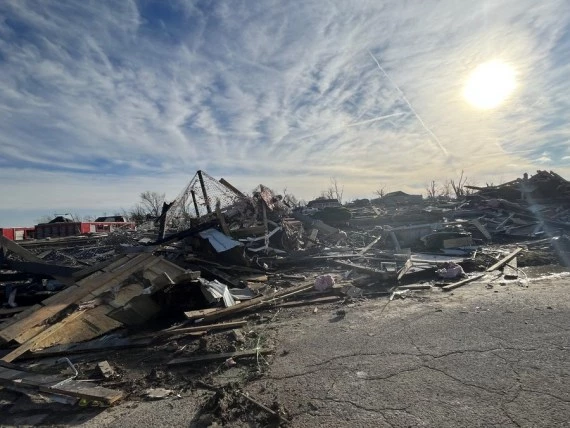 Photo taken on Dec. 11, 2021 shows houses damaged in tornadoes in Mayfield, Kentucky, the United States. (Photo by Caromirna Sanchez/Xinhua)
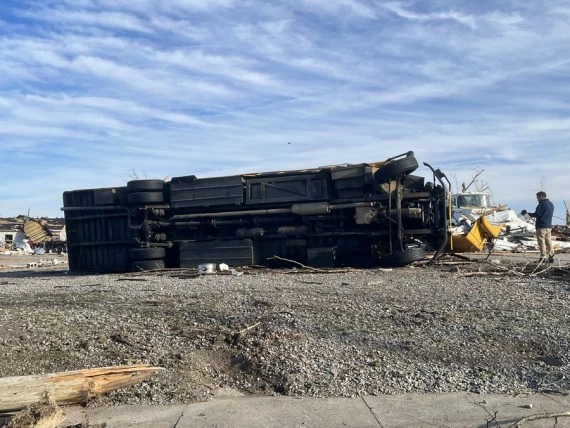 Photo taken on Dec. 11, 2021 shows a vehicle damaged in tornadoes in Mayfield, Kentucky, the United States. (Photo by Caromirna Sanchez/Xinhua)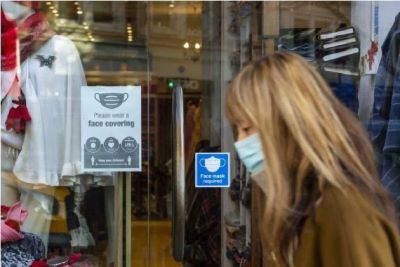
 A passenger wearing a face mask is seen on a bus in London, Britain, on Dec. 9, 2021. (Photo by Stephen Chung/Xinhua)
 People walk on the street in London, Britain, on Dec. 9, 2021. (Photo by Stephen Chung/Xinhua)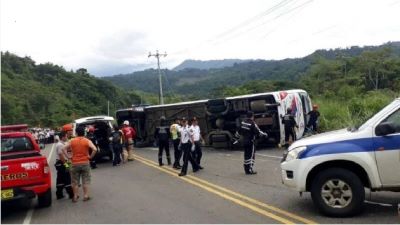
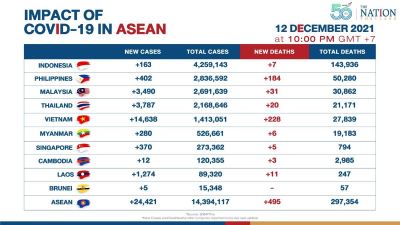

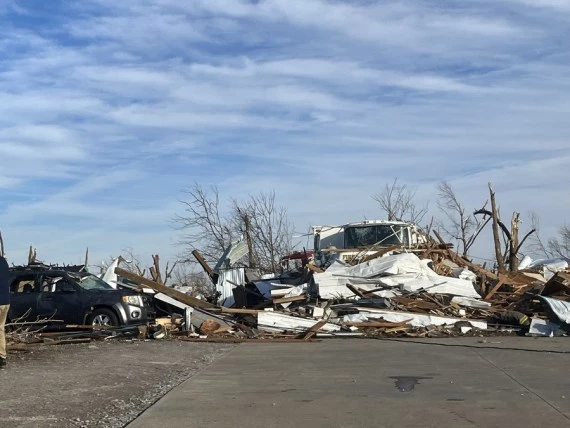 Photo taken on Dec. 11, 2021 shows a heap of rubble after tornadoes in Mayfield, Kentucky, the United States. (Photo by Caromirna Sanchez/Xinhua)
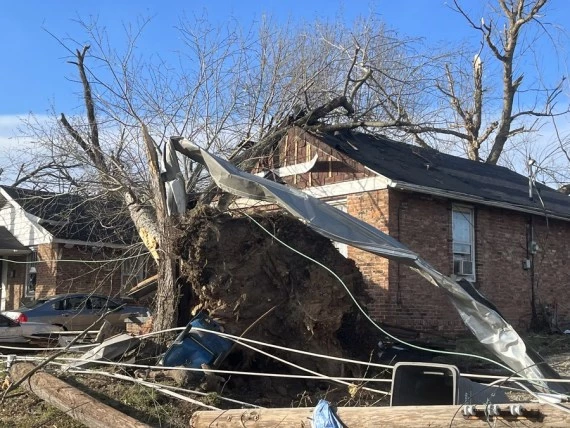 Photo taken on Dec. 11, 2021 shows a tree toppled in tornadoes in Mayfield, Kentucky, the United States. (Photo by Caromirna Sanchez/Xinhua)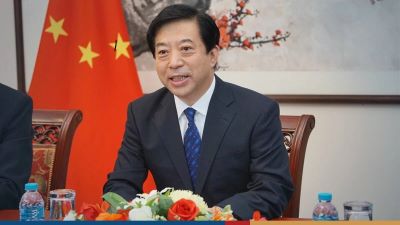
 SootinClaimon.Com