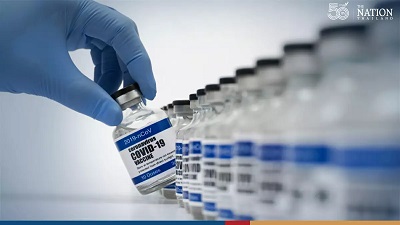
Existing COVID-19 vaccines are effective against the highly contagious delta variant, according to several reports.
The findings confirm the importance of continuing the ongoing vaccination rollout in Japan, where infections with the delta variant first detected in India are also spreading.
Moderna Inc. on Tuesday released the results of a study involving eight people who had received two doses of the U.S. biotechnology firm’s vaccine. The amount of antibodies against the delta variant in the participants’ blood was about half that of antibodies for the other circulating variants. However, the vaccine was effective in suppressing infection and the onset of COVID-19.
According to a study by the University of Edinburgh and others, the efficacy of the vaccine manufactured by U.S. pharmaceutical giant Pfizer Inc. in preventing infections with the delta variant was about 79%, while that of British pharmaceutical company AstraZeneca PLC’s vaccine was about 60%. Public Health England has estimated that both vaccines were able to reduce hospitalizations by more than 90%.
On Thursday, U.S. firm Johnson & Johnson also announced that its single-shot vaccine can generate sufficient antibodies against the delta variant, and immunity lasts for at least eight months.
Initially, the delta variant was thought to be more resistant to existing vaccines compared to the other widely circulating variants.
[Singapore] Govt offering Sinovac Covid-19 vaccine to some of those allergic to mRNA jabs as part of study
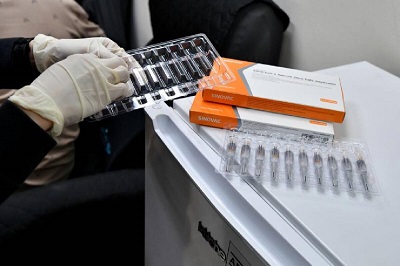
SINGAPORE – Thousands of people here who have had allergic reactions to the Covid-19 vaccines used in Singapores national inoculation programme will be offered Sinovac jabs by the Government, as part of a study to understand the immunity offered by different vaccines.
About 3,600 people who were allergic to the first dose of the mRNA vaccines have been contacted, and more than 1,400 have indicated interest in the programme, The Straits Times has learnt.
A spokesman for the Ministry of Health (MOH) said on Thursday (July 1): “To better understand the immunity conferred by the use of different vaccines, we will work with the National Centre for Infectious Diseases to follow up with a sub-group of these persons who have received the mRNA vaccine, followed by the Sinovac-CoronaVac vaccine, under a research study on Covid-19 vaccine immune response.”
MOH has been in touch with the people who have indicated interest in this programme to keep them updated with details on how they can receive the Sinovac vaccine, the spokesman added.
The Sinovac vaccine is not part of Singapore’s national vaccination regime, which currently uses the Pfizer-BioNTech/Comirnaty and Moderna vaccines. Both these vaccines use mRNA technology and have been authorised by the Health Sciences Authority (HSA).
Sinovac’s jab remains unregistered and is not authorised by the HSA, and is to be provided here only under the Special Access Route framework. Vaccines under this framework are not covered under the Vaccine Injury Financial Assistance Programme, which supports people who suffer adverse effects from their Covid-19 jabs.
MOH said on Thursday that if people who have had allergic reactions to mRNA vaccines wish to receive the Sinovac vaccine, it has established a dedicated programme for them to be vaccinated at a public hospital clinic for closer monitoring of any side effects.
This programme will take into account their previous allergic reaction and a lack of data on the safety profile of receiving Sinovac following one dose of an mRNA vaccine, said MOH’s spokesman.
The ministry also said that those who have received one dose of an mRNA Covid-19 vaccine but are unable to receive the second dose due to allergic reactions may choose to wait for the non-mRNA vaccines that MOH plans to bring in for use in the national vaccination programme.
Such vaccines will have to first be assessed for quality, safety and effectiveness under HSA’s Pandemic Special Access Route.
On Wednesday, ST reported that people who have received the Sinovac vaccine will not be exempted from pre-event testing.
MOH said vaccines not included in Singapore’s national vaccination programme may lack sufficient documentation of how effective they are at protecting people against Covid-19 infection and, in particular, against the Delta variant of the virus currently circulating. The Delta strain is a new mutation of the coronavirus that is more infectious.
The authorities gave approval last month to 24 private healthcare clinics to draw on the Government’s existing stock of the Sinovac vaccine.
Over the past two weeks, many of these clinics have been inundated with calls and requests from residents wanting the Sinovac jab, as many rushed to register their interest in getting the China-made vaccine.
This is despite the authorities saying that the Sinovac vaccine is not entirely effective in preventing infection, based on evidence from other countries.
[Myanmar] Explosions occur on Myaynigon Overpass, EPC office in Hline Township
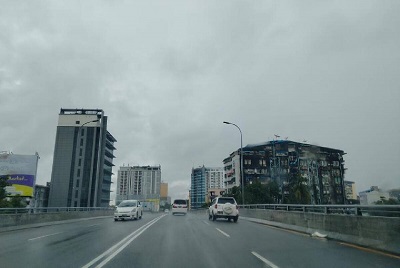
Explosions occurred on Myaynigon Overpass in Sanchaung Township and near the electric power corporation office on Insein Road in Hline Township, Yangon Region this morning.
One explosion occurred on the overpass when security forces got off their car and removed a poster hanged at the bridge handrail reading anti-government words.
“Today, an explosion occurred on the overpass. Yesterday, an explosion occurred at the traffic police post under this overpass. The blast was loud. Police cars arrived and they blocked the bridge,” said a resident in Sanchaung Township.
After the explosion today, Myaynigon Overpass was blocked temporarily for security checks. Whether there was any casualty is still under investigation.
Another explosion occurred near the township EPC office on Insein Road in Hline Township at about 10 am today. But no one was hurt, according to nearby sources.
“When I just started opening our shop (on Insein Road) in the morning, I heard an explosion,” said a worker of the shop. “Police cars and military trucks arrived at the scene. They carried out security checks and patrolled the area.”
After the explosion, a truck with security forces was seen in front of the EPC office at about 1pm. In the previous days, people were queuing in front of the office in Hline Township to pay electricity bills.
Playbooks take effect; overseas athletes coming to Japan
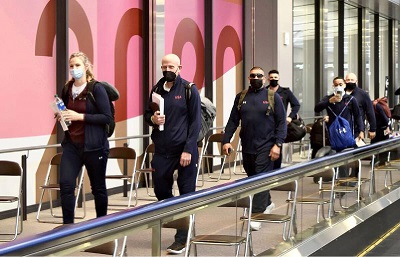
The latest edition of the Tokyo 2020 Playbooks, which include strict novel coronavirus control guidelines for all participants of the Tokyo Olympics and Paralympics, were being consulted as athletes and officials arrived in Japan on Thursday.
In response to a member of the Ugandan Olympic team testing positive at Narita Airport, the central government changed its plan so that team members suspected of having close contact with COVID-19 patients will travel from airports to their training camps using separate transportation.
■ Athletes streaming in
On Thursday afternoon, about 20 members of the U.S. boxing team arrived at Narita Airport.
Airport liaison officials — a group sent from the Tokyo Games organizing committee to guide overseas teams and confirm whether anyone tested positive — met and boarded the plane. After the general passengers had disembarked, the officials ushered the U.S. team to the virus testing area via a special lane. On the same day, the 40-member German rowing team arrived at Haneda Airport.
In all, more than 100 athletes entered Japan on the day. A smartphone app for athletes to record their body temperature each day has also been launched.
According to Tokyo Games sources, about 3,400 people are scheduled to come to Japan for training before the opening of the athletes’ village on July 13 in Chuo Ward, Tokyo. Private buses will be used in principle for their travel from airports, but 1,500 of them will have to use airplanes or Shinkansen trains as their destinations in Japan are far from Tokyo.
■ Lessons from Ugandan case
According to the third edition of the Playbooks released last month by the International Olympic Committee (IOC), athletes will undergo testing twice within 96 hours before departure from their home countries. Upon entering Japan, they will undergo a saliva test at the airport. They will proceed to their training camps if they test negative and will commute between their hotels and training grounds by special car.
When the Ugandan team arrived in Japan in June, one of the members tested positive at Narita Airport and was quarantined. However, the remaining eight people continued on to Izumi-Sano, Osaka Prefecture, by bus without officials identifying which of them had been in close contact with the infected person. Later, another person was found to have been infected, and an Izumi-Sano city employee and a bus driver who accompanied the team were identified as close contacts.
“We didn’t quite simulate a scenario in which team members tested positive at an airport quarantine,” a senior Cabinet Secretariat official said Wednesday. A new government quarantine scheme was later announced.
■ State vehicles
From July 1, if a person tests positive at the airport, he or she will be taken to a clinic in the athletes’ village by a specially designated car prepared by the organizing committee, and get a PCR test with a swab sample. If they test positive again, the athlete will be sent to a nearby recuperation facility or a hospital.
Those who enter Japan together with the infected person will be designated as “possible” high-risk contacts if their seat on the plane was within two rows of the patient, regardless of their test results. They will travel to their training camps separately from their teammates, in a vehicle prepared by the central government. Whether they are definitely high-risk contacts will be confirmed by a local public health center near the camp after their arrival. In that sense, they will continue being isolated from others at the “suspected” stage in order to prevent possible virus transmission during travel within Japan.
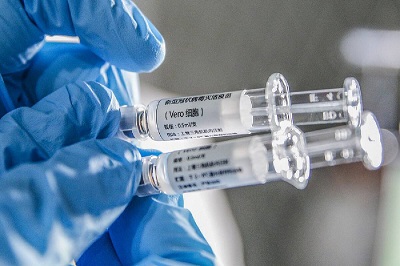
The domestic COVID-19 vaccine developed by Sinovac Biotech is safe and can elicit a strong antibody response in people aged 3 to 17 in early and mid-stage clinical trials, according to a study published recently in a medical journal.
The study is the world’s first that examines the safety and protection effects of a COVID-19 vaccine for children as young as 3 years old. It also came as the spread of highly transmissible variants worldwide has prompted calls for accelerating mass immunization, and more countries are considering expanding the use of vaccines to cover young people, including China.
The study, published in The Lancet Infectious Disease this week, enrolled 72 children and adolescents during the phase 1 trial from late October to early December, and enrolled 480 participants during the phase 2 in December. Both trials were conducted in Hebei province.
Participants were given two doses of the vaccine in either 1.5 micrograms or 3 micrograms per dose, or a placebo during the double-blind, randomized clinical trial.
No significant differences were observed in the rates of adverse reaction among the three groups, and the majority of adverse effects were mild or moderate, with pain at the injection site the most common, the study said.
In phase 1, all vaccinated participants produced antibodies against the virus. In phase 2, a total of 96.8 percent of people in the 1.5 microgram group generated antibodies, compared with 100 percent in the 3 microgram group.
The study concluded that the vaccine’s seroconversion rate-the proportion of people developing neutralizing antibodies against the virus after inoculation-was above 96 percent among those aged 3 to 17.
Because a higher amount of antibodies-which signals a stronger immune response-was detected among people receiving the higher dose of 3 micrograms, researchers said future work can focus on the use of two doses at 3 micrograms among the younger population.
The study added that compared with adults and the elderly vaccinated with the same dosage, the younger population is capable of mounting a more robust antibody response. The finding that the vaccine-triggered immune response declines with rising age is in alignment with widely used vaccines against hepatitis B, seasonal influenza and others.
Researchers said the study was limited, in that the sample size was relatively small, and long-term results are currently unavailable. The study also did not assess T-cell responses, another important marker of immune response.
They said the participants in the study will be followed for at least a year, and larger trials in different regions and involving more diverse groups will be conducted in the future.
Researchers from the provincial and county-level disease control and prevention centers in Hebei, as well as those from Sinovac Biotech and the National Institutes for Food and Drug Control, jointly published the study.
Although children are believed to be less likely to develop severe COVID-19 infections, a number of countries have started extending inoculations amid a raging pandemic.
“A small number of them may be still at risk of severe illness. They can also transmit the virus to others, making it vital to test the safety and effectiveness of COVID-19 vaccines in younger age groups,” said Gao Qiang, general manager of Sinovac Biotech.
Zhong Nanshan, a top infectious disease expert, said in an earlier interview that during the recent outbreaks in Guangdong province that were caused by the Delta variant, some serious cases were found in the elderly and children, pointing to the need to step up immunization among them.
China’s mass vaccination strategy started with a focus on people aged 18-59, and has gradually expanded to include seniors at 60 or above.
Korean biz community expresses concerns about OECD ‘digital tax’
South Korea’s business community expressed concerns Friday about a global move toward additional taxes on technology companies that would affect Korean tech giants such as Samsung Electronics and SK hynix.
The Federation of Korean Industries, an organization that represents the interests of Korean businesses, said in a statement, “We express concerns about the side effects of an agreement on the digital tax announced by the Organization for Economic Cooperation and Development.
“It appears that almost all sectors of industries are subject to the tax, which could strain normal operations of businesses that are not related to acts of tax evasion,” the federation said.
The Korean business group said discussions about digital taxes had initially started with the aim of preventing tax evasion by digital service companies.
According to the Ministry of Economy, the OECD announced an agreement on the digital tax, which would take effect in 2023 and impact global businesses that surpassed 27 trillion won ($23.79 billion) in annual sales with operating margins of over 10 percent.
The aim of the digital tax, known as Pillar I, is to ensure that companies operating in multiple countries pay taxes in all the countries where they provide services and earn profit, not just in their home countries.
Around 100 businesses are expected to be subject to the new tax.
According to the agreement, companies subject to the tax will have to pay 20 percent to 30 percent of the profit they generate in different countries beyond a 10 percent baseline.
Samsung and SK hynix appear to be subject to the Pillar I digital tax, according to the ministry.
The Pillar II tax, a 15 percent global corporate tax rule, would additionally apply to multinational companies with consolidated sales of over 1.1 trillion won.
This is a response to the phenomenon of multinationals circumventing taxes by establishing subsidiaries in countries with lower corporate tax rates.
Under Pillar II, if a company paid 10 percent corporate tax in a country where it operated a subsidiary, it would have to pay the other 5 percent in its home country.
“Pillar II also would limit sound competition in tax payment among countries, which could hinder the free operations of businesses,” the Federation of Korean Industries said. “We hope the OECD will come up with a more reasonable measure by listening to opinions from the private economic sector.”
Malaysia embarks on digitalisation journey with national 4IR policy launch
PETALING JAYA: A national policy on the Fourth Industrial Revolution (National 4IR Policy) was launched on Thursday (July 1), with the aim of transforming Malaysia into a high-income nation through the use of technology and digitalisation.
WAWANCARA MENTERI DI JABATAN PERDANA MENTERI (EKONOMI) SETAHUN PENCAPAIAN MALAYSIA PRIHATINby Datuk Seri Mustafa Mohamed
LOW BOON TAT/ The Star.
The policy also seeks to increase the country’s readiness in making use of the 4IR, while supporting the country’s development policies such as Shared Prosperity Vision 2030 (SPV 2030) and Five-year Malaysia Plans.
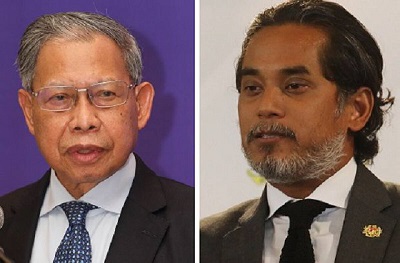
The ceremony was jointly officiated by Minister in the Prime Minister’s Department (Economy) Datuk Seri Mustapa Mohamed, and Science, Technology and Innovation (Mosti) Minister Khairy Jamaluddin.
Mustafa said that as Malaysia embarked on a journey towards greater digitalisation and sustainable development, more effort was needed to ensure the nation was abreast with current trends to stay competitive in the future.
“The Covid-19 pandemic has brought upon numerous challenges and changed the lives of people, with the government, businesses and the people having to adapt to technology and digitalisation,” he said.
Khairy said that the rapid development of 4IR around the world saw a radical paradigm shift in technology involving various sectors and industries, with a need for all to act in line with it.
“This is because advanced technology will be the transformation that covers a wide spectrum and affects all layers of society,” he said.
He said that there was a need to embrace 4IR to ensure the country remained competitive and managed to face the changes of the future that were volatile, uncertain, complex, and ambiguous.
Khairy said that the five foundational technologies of the 4IR policy include artificial intelligence, the Internet of Things, blockchain, cloud computing and big data analytics, as well as advanced materials and technologies.
The 4IR policy will have four main thrusts – equipping the rakyat with knowledge, forging a connected nation through digital infrastructure development, future proofing regulations to be agile with technological challenges, and accelerating its innovation and adaptation.
The policy has 10 sectoral focuses and 60 sectoral initiatives.
After a pangovernmental meeting, officials said they have decided to earmark 10.4 trillion won for the nation’s fifth cash relief program. The money will be funneled from the nation’s 33 trillion-won second COVID-19 extra budget for this year, which the ruling party and government jointly unveiled Tuesday.
The “bottom 80 percent income bracket” will be the beneficiaries of the program, the ruling Democratic Party of Korea said earlier, and the recipients would be determined by the same calculations used to group beneficiaries of the National Health Insurance Service. Vice Finance Minister Ahn Do-geol said in Tuesday’s briefing that the NHIS standard was chosen as the program covers all of Korea’s population.
Unlike the first emergency cash handout program that was carried out in mid-2020 — which placed a cap on the money handed out depending on the number of people in a household – all recipients considered as “the bottom 80 percent income bracket” will receive 250,000 won each.
Some 18 million households out of a total 23 million households here would be eligible to apply for the program, the government said.
Applications will be received both online and offline, similar to the first cash handout program, and the cash is to be distributed in the form of debit or prepaid cards.
Some 3 million people in lower income brackets living off basic income or those who are members of single-parent families will receive an additional 100,000 won per person.
The government plans to launch a task force to draw up a specific system and other details for the cash relief program. It aims to start handing out the subsidies within a month after the National Assembly approves the latest extra budget. The budget is slated to be approved on Friday.
Despite mounting public anticipation for the cash subsidy program, the NHIS yardstick used to determine the recipients is expected to reignite criticism that the standards are “too vague.” Last year, some complained they had received lackluster support due the NHIS’ belated move to take job and income losses due to COVID-19 into account.
Referring to the concerns, a Finance Ministry official said that necessary procedures to review any on-year income losses in 2020 will take place.
Myanmar coordinating purchase of Covid-19 vaccines from Russia, China
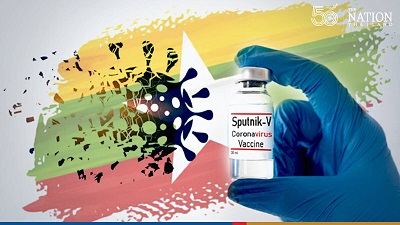
Myanmar is coordinating with Russia and China to purchase Covid-19 vaccines, according to the ministry of health and sports.
Seven million doses of Spunink vaccine are set to be bought from Russian while discussion is underway to purchase China-made vaccines. Sputnik V and Sputnik Light vaccines are likely to be available soon.
An agreement was signed with India to purchase 30 million doses of COVISHIELD vaccine. Vaccine availability has halted as cases spike in India.
However, Myanmar will be prioritized if the Indian government allows vaccine export again. Those who have received the first does have to wait. According to the Indian vaccination expert group NITAG, first and second doses of COVISHIELD can be administered in a six-month gap.
The Myanmar government has also allowed private pharmaceutical entrepreneurs since March this year to import and distribute vaccines and carry out vaccination process.
Private hospitals need to follow the vaccination rules and instructions issued by the ministry of health and sports. The union minister said that government-private cooperation would contribute to national healthcare system.
According to the WHO, under the Covax programme, developing countries including Myanmar will be provided with 1.8 billion doses of Covid-19 vaccines.
Till May 29, Myanmar had over 1.4 million people fully vaccinated and over 1.8 million who have received first doses.
India’s covid infection and death rate still manageable: PM Modi
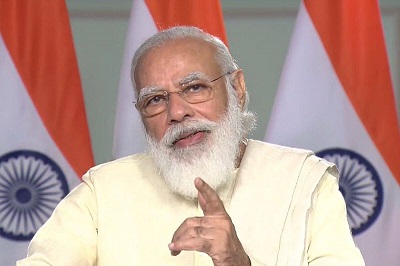
Despite limitations of “long-neglected medical infrastructure” and “pressure of population”, India’s per lakh population rate of Covid-19 infection and death rate is still “manageable” compared to other developed countries, Prime Minister Narendra Modi said on Thursday.
Addressing the doctors’ community on the occasion of Doctor’s Day, he said the loss of lives is always painful, but many lives have been saved too and the credit goes to hard-working doctors, healthcare workers, and frontline workers.
Modi’s remarks came at a time when the second wave of Covid seems to be loosening its grip with 48,786 new cases and 1,005 deaths reported in the last 24 hours. On May 7, 4,14,188 new Covid cases were registered in one day, the highest ever.
He underlined the focus of the government on strengthening healthcare, saying “about Rs 15,000 crore was allocated for healthcare during the ‘first wave’ and this year, health sector budget has been doubled to more than Rs 2 lakh crore”.
“As much as Rs 50,000 crore has been allocated for credit guarantee scheme to develop health infrastructure in the under-served area. New AIIMS, medical colleges are being established. Work has been initiated on 15 AIIMS as opposed to a total of six AIIMS that existed in 2014.
“Number of medical colleges have increased one and half times. Undergraduate medical seats have increased one and half times and PG seats have grown by 80 per cent,” he said.
Modi reiterated the government’s commitment to the safety of doctors and mentioned that stringent laws have been brought in for preventing violence against doctors. “Along with this, a free insurance cover scheme has been brought for the Covid warriors.”
The Prime Minister called upon the doctors to continue to inspire the people to get vaccinated and adopt Covid appropriate behaviour and commended the medical fraternity for spreading awareness about yoga.
He praised the doctors for giving their time to evidence-based studies on the benefits of yoga for dealing with post-Covid complications and asked if Indian Medical Association can take up the evidence-based studies on yoga in a mission mode.
He also suggested that studies on yoga could be published in international journals.
Stressing on the importance of documentation of experiences by doctors, the Prime Minister further said symptoms of the patients and treatment plan needs to be documented in great detail along with the experiences. “This can be taken up as a research study where effects of various medicines and treatments are noted.”
Noting that the sheer number of patients served by Indian doctors put them ahead of the world, he said: “Now is the time when the world takes cognizance and take benefit from these scientific studies. A covid pandemic can be a good starting point for this.”
The Prime Minister also asked if doctors could study more deeply how vaccines and early diagnosis helps. “There is no documentation available about the last century’s pandemic but now we have the technology and our documentation about how we faced Covid will help humanity,” he said.