Japan to study plastic waste in Southeast Asia #ศาสตร์เกษตรดินปุ๋ย

#ศาสตร์เกษตรดินปุ๋ย : ขอบคุณแหล่งข้อมูล : หนังสือพิมพ์ The Nation

https://www.nationthailand.com/ann/30381730?utm_source=category&utm_medium=internal_referral

Japan to study plastic waste in Southeast Asia

Feb 07. 2020
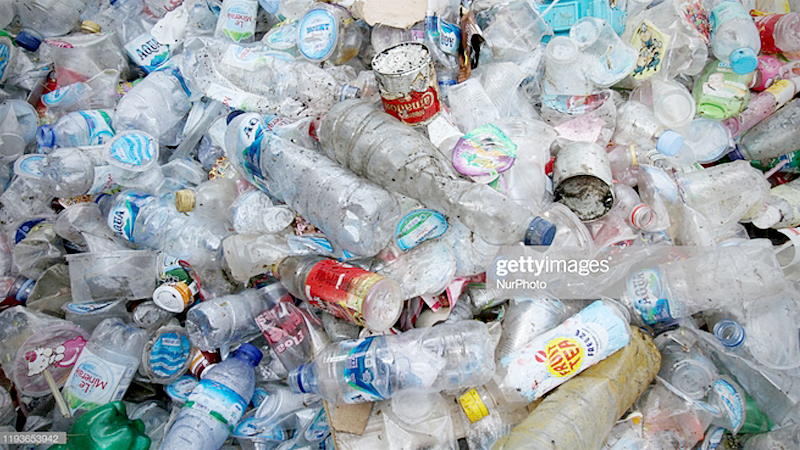
Photo: Getty Images

Photo: Getty Images

By The Japan News
Asia News Network
Bangkok

To help Southeast Asia address a growing problem with marine pollution from plastic waste, a Japanese research group is planning to launch a full-fledged investigation into the issue in April.

The Thailand-based study will use drones and other methods to examine the currents that carry waste and amounts of refuse to help formulate an action plan for reducing garbage.

The group plans to make policy proposals to the government of Thailand and other members of Asean.

The project is to be conducted under the auspices of the Japan International Cooperation Agency. One of the leaders of the research group is Kyushu University Prof Atsuhiko Isobe, an expert in marine physics who studies microplastics, a variety of plastic waste.

The group will work with researchers from Chulalongkorn University in Thailand. It held a preparatory meeting on January 29. The effort will be based in Sattahip on the Gulf of Thailand, and is expected to last for five years.

Isobe said he expected the study would use drones, as well as marine-survey vessels from the Southeast Asian Fisheries Development Centre, which is managed jointly by Japan and Asean member nations.

The group will make a detailed study of factors such as the origins of plastic waste, how it accumulates and how it drifts in the sea. The data will be used to determine matters that include the locations and times most efficient for removing plastic waste.

The group’s goal is to formulate an action plan for reducing plastic waste based on the results of its study, then establish this as a trash-reduction model first in Thailand and eventually in all Asean member states. The group has been conducting personnel exchanges with Indonesia and Vietnam.

“We can smoothly present proposals to each nation. We think of ourselves as being on the frontline of this problem worldwide,” Isobe said.

Southeast Asia is a major consumption area of disposable plastic. China was the largest importer of plastic waste in the world until it banned such imports in 2017, an action that ended up redirecting massive amounts of the refuse to Southeast Asia.

Plastic waste that cannot be processed sometimes ends up in the ocean, creating a serious problem for society.

Since last year, some Asean member states have been restricting imports of plastic waste or returning it to its country of origin.

Malaysian Energy, Science, Technology, Environment and Climate Change Minister Yeo Bee Yin held a press conference in January, announcing that the equivalent of 150 shipping containers of plastic waste that was illegally imported would be sent back to the countries of origin, a list that includes Japan.

In Thailand, more than 40 major retailers, including 7-Eleven, said they would no longer offer free plastic bags.

Efforts in Vietnam to encourage businesses to stop using the plastic products that become plastic waste are accelerating. As part of this, some stores are using banana leaves for packaging.

Waste products made from synthetic resin, primarily petroleum, including shopping bags, straws, drink bottles and other containers as well as fishing implements. This waste is difficult to process and some of it ends up in the ocean at an estimated rate of 8 million tons per year.
‘If you asked me, I’d say no:’ Jokowi personally against repatriation of Indonesian IS members #ศาสตร์เกษตรดินปุ๋ย

#ศาสตร์เกษตรดินปุ๋ย : ขอบคุณแหล่งข้อมูล : หนังสือพิมพ์ The Nation

https://www.nationthailand.com/ann/30381656?utm_source=category&utm_medium=internal_referral

‘If you asked me, I’d say no:’ Jokowi personally against repatriation of Indonesian IS members

Feb 05. 2020
By The Jakarta Post/ANN
President Joko “Jokowi” Widodo has voiced his personal disapproval of the idea of repatriating Indonesian nationals who belonged to the Islamic State (IS), although he added that a Cabinet meeting would be held to discuss the matter further.


“If you asked me, before the Cabinet meeting, I would say no [repatriation], but it will be [discussed] in the Cabinet meeting,” said Jokowi at the State Palace on Wednesday.

“We will calculate in detail the pluses and minuses, and the decision will be made after hearing from relevant ministries,” he added.

Some 660 Indonesian citizens have been identified as foreign terrorist fighters who have pledged allegiance to IS and joined the movement in Syria and surrounding countries.

Coordinating Legal, Political and Security Affairs Minister Mahfud MD separately conveyed a view similar to Jokowi’s, saying that he personally disagreed with the idea of repatriating Indonesian citizens who went abroad to join IS.

“I agree that they should not be repatriated because they could pose a danger to the country, and in legal terms, their passports could be revoked as they went there [to IS territory] illegally,” he said.

Mahfud said that many countries from which foreign terrorist fighters departed have yet to repatriate their citizens with the exception of certain special cases.

He added, however, that the government was still considering the legal and constitutional aspects of transnational terrorism, particularly related to its citizens who joined terrorist movements abroad.

Coronavirus: After 2 cases, Yong Thai Hang health products shop closed as more than 10 workers quarantined #ศาสตร์เกษตรดินปุ๋ย

#ศาสตร์เกษตรดินปุ๋ย : ขอบคุณแหล่งข้อมูล : หนังสือพิมพ์ The Nation

https://www.nationthailand.com/ann/30381655?utm_source=category&utm_medium=internal_referral

Coronavirus: After 2 cases, Yong Thai Hang health products shop closed as more than 10 workers quarantined

Feb 05. 2020
Two Yong Thai Hang workers, a 28-year-old woman and a 48-year-old woman, are among the first four cases of local transmission of the coronavirus with no travel history to Wuhan.ST PHOTO: KEVIN LIM

Two Yong Thai Hang workers, a 28-year-old woman and a 48-year-old woman, are among the first four cases of local transmission of the coronavirus with no travel history to Wuhan.ST PHOTO: KEVIN LIM
By The Straits Times/ANN

SINGAPORE – Yong Thai Hang, the Chinese health products shop in Lavender with two employees who are confirmed coronavirus cases, will not reopen until the situation takes a turn for the better.

The shop owner said more than 10 of his other employees have since been quarantined, according to a report by Chinese-language evening daily Shin Min Daily News on Wednesday (Feb 5).

The two workers, a 28-year-old woman and a 48-year-old woman, are among the first four cases of local transmission of the coronavirus with no travel history to Wuhan, the epicentre of the outbreak, said the Ministry of Health on Tuesday.

The other two cases are a 32-year-old tour guide who had taken Chinese tour groups to Yong Thai Hang, and a 44-year-old Indonesian maid who worked for one of the affected employees.

The shop owner said his store, which caters to Chinese tour groups, has been closed since Feb 1, as his employees had been concerned about getting infected.

After Wuhan, the capital of China’s Hubei province, was placed on lockdown by the Chinese authorities on Jan 23, all his employees were instructed to wear masks, and the shop’s premises were disinfected daily, he added.

He estimated his losses to date at more than several tens of thousands of dollars. But the important thing now is that his employees can recover soon, he said.

Some people who have had contact with the new cases on Tuesday have been quarantined.

The female Singaporean tour guide, who did not want to be named, told Shin Min that her husband was also quarantined in a hospital, while her Primary 2 son was quarantined at home, along with a maid and a relative who are taking care of him.

She had gone to the National Centre for Infectious Diseases on Monday as a precaution after she found out that a father-daughter pair in a tour group from Guangxi, China, had been diagnosed with the coronavirus after returning home.

She said that she had spent about 12 hours with the group of 19 and took them to various tourist attractions. The group had travelled in a private tour bus.

The 28-year-old Yong Thai Hang employee who was affected said the tour group spent about 30 minutes in the shop.

While the tourists and sales staff are usually separated by a counter, the Singapore permanent resident said that she would occasionally apply medicated oil on their arms as part of the job.

The Ministry of Health said on Tuesday that the woman had developed a sore throat and fever on Jan 29 and was taken to Tan Tock Seng Hospital last Thursday, but was discharged from hospital after her chest X-ray result did not indicate she had pneumonia.

She did not leave her home in Jalan Bukit Merah from Friday to Sunday and was admitted to the Singapore General Hospital on Monday, along with her maid, who also tested positive for the virus.

Although she had prepared herself for the diagnosis, the woman, who is married with a son, said she was shocked.

“I cried, not just because I was worried about myself. I was worried about my family, and felt guilty for infecting someone else,” she told Shin Min.

She added that the maid had been working with the family for only a few months.

Her husband and son have since been quarantined as well, she said.

Coronavirus: Grand Hyatt Singapore disinfecting rooms and public areas after two travellers test positive #ศาสตร์เกษตรดินปุ๋ย

#ศาสตร์เกษตรดินปุ๋ย : ขอบคุณแหล่งข้อมูล : หนังสือพิมพ์ The Nation

https://www.nationthailand.com/ann/30381649?utm_source=category&utm_medium=internal_referral

Coronavirus: Grand Hyatt Singapore disinfecting rooms and public areas after two travellers test positive

Feb 05. 2020
The Grand Hyatt Singapore is disinfecting its public areas and rooms after two business travellers linked to a conference at the hotel tested positive for the coronavirus.ST PHOTO: KEVIN LIM

The Grand Hyatt Singapore is disinfecting its public areas and rooms after two business travellers linked to a conference at the hotel tested positive for the coronavirus.ST PHOTO: KEVIN LIM
By The Straits Times/ANN

SINGAPORE – The Grand Hyatt Singapore is disinfecting its public areas and rooms after two business travellers linked to a conference at the hotel tested positive for the coronavirus.

Mr Parveen Kumar, the hotel’s manager, told The Straits Times on Tuesday (Feb 4) night that Singapore’s Ministry of Health (MOH) had informed the hotel earlier in the day that a guest had been diagnosed with the virus more than a week after returning to Malaysia.

Malaysian health authorities on Tuesday confirmed the first citizen to be infected with the coronavirus, bringing the total number of confirmed cases in the country to 10.

The virus was first reported in the central Chinese city of Wuhan.

The Malaysian man had travelled to Singapore for a meeting from Jan 16 to 23 that involved Chinese nationals, said MOH. It said that the meeting had taken place at the Grand Hyatt Hotel, and that it was working to identify individuals who had close contact with the man.

“The guest experienced symptoms following his return home and was subsequently diagnosed by local authorities in Malaysia,” said Mr Kumar.

MOH did not provide the hotel with details on how, where and when the man was infected, he said, and investigations were continuing.

The hotel is meanwhile taking measures such as disinfecting public areas, restaurants, meeting spaces and rooms to ensure the health and safety of its guests and employees, he said.

“The hotel had implemented precautionary measures and operational protocols in early January in response to growing coronavirus concerns and cases in the region,” said Mr Kumar.

South Korea’s Yonhap news agency, quoting the Korea Centers for Disease Control and Prevention, said on Wednesday (Feb 5) that one of the country’s two new confirmed cases included a 38-year-old South Korean man who had visited Singapore for work and came into contact with a Malaysian who tested positive for the virus.

The South Korean man, who became the 17th case reported in the country, had attended a week-long conference in Singapore from Jan 18.

He had a meal with the Malaysian man as well as several other South Koreans during the conference, Reuters reported, citing South Korea’s Joongang Ilbo newspaper.

The South Korean man visited a clinic on Tuesday after he was informed that a Malaysian who attended the same conference was infected. He tested positive for the virus the next day, said South Korean health authorities. They added that they had informed their Singapore counterparts.

The Grand Hyatt Singapore said it had not yet been informed by MOH of any other confirmed or suspected cases among its guests or employees. It said it was closely monitoring ongoing developments, but did not respond to queries on details about the conference and how many others were present.

The hotel was operating as usual on Wednesday with crowded restaurants when The Straits Times visited during lunchtime.

Korea confirms three more coronavirus cases #ศาสตร์เกษตรดินปุ๋ย

#ศาสตร์เกษตรดินปุ๋ย : ขอบคุณแหล่งข้อมูล : หนังสือพิมพ์ The Nation

https://www.nationthailand.com/ann/30381648?utm_source=category&utm_medium=internal_referral

Korea confirms three more coronavirus cases

Feb 05. 2020

Korea Centers for Disease Control and Prevention officials transfer a patient who had been in isolation at a hosptial in Gwangju to another facility on Wednesday. Yonhap

Korea Centers for Disease Control and Prevention officials transfer a patient who had been in isolation at a hosptial in Gwangju to another facility on Wednesday. Yonhap
By The Korea Herald/ANN

South Korea on Wednesday confirmed three more cases of coronavirus infection, pushing up the total to 19, while the second confirmed patient was released from hospital later in the day.

According to the Korea Centers for Disease Control and Prevention three more people have been confirmed to have the virus, including another individual who appears to have contracted the virus in a third country.

The patient discharged is a 55-year-old man who was the second Korean to be infected with the virus after visiting Wuhan in Hubei province. The man was treated at the National Medical Center in Seoul, where he was given treatments including drugs used for treating HIV.

As for the newly confirmed patients, the KCDC said that one is a 38-year-old man who had visited Singapore from Jan. 18 to 24 to attend a conference. He visited a medical facility designated for coronavirus treatment on Tuesday after being informed that another conference attendee was found to have the virus in Malaysia.

The man, tagged the 17th patient here, is the third case in which a Korean was confirmed to have the virus without a clear link to Wuhan, China.

The first such case involved a 49-year-old man who had visited Japan, and the second involved a 42-year-old woman — the 16th patient — who had visited Thailand before being confirmed to be infected with the virus.

The 42-year-old woman is also the mother of the other patient confirmed Wednesday. According to the KCDC, the 16th patient appears to have passed on the virus to her daughter while the latter was recovering from an unrelated medical procedure at a hospital in Gwangju.

All patients and staff who were on the same floor as the 18th patient have since been placed in isolation. Individuals who were on different floors of the hospital will be monitored and placed in isolation or self-quarantine. In all, the 16th patient is believed to have come into contact with 306 people since Jan. 19, when she returned to Korea from Thailand, before being placed in isolation.

As the virus continues to spread, the government and the ruling Democratic Party agreed to use 3.4 trillion won ($2.8 billion) of the reserve budget for coronavirus response measures. According to the ruling party, the funds will be used for quarantine and prevention measures, and to support industries affected by the outbreak.

The issue of expanding entry restrictions to a wider area of China was not discussed at the meeting despite rising calls from the public and experts to expand the measure. Korea rolled out measures to restrict entry to foreigners who have visited Hubei Province from midnight Monday.

In addition, individuals of all nationalities arriving from China are required to go through a separate quarantine process upon arriving in Korea.

Although the ruling party said the situation needs to be monitored before expanding the measures, applying such measures to other areas of China and other countries may be a possibility.

“Necessary measures will be taken after closely looking at (the situation) in Hubei province and surrounding areas,” Prime Minister Chung Sye-kyun said at the meeting.

Chung hinted that the government could subject people arriving from other countries to additional immigration procedures, saying such measures could be introduced if necessary.

By Choi He-suk (cheesuk@heraldcorp.com)

Korea sees population fall for 2 consecutive months #ศาสตร์เกษตรดินปุ๋ย

#ศาสตร์เกษตรดินปุ๋ย : ขอบคุณแหล่งข้อมูล : หนังสือพิมพ์ The Nation

https://www.nationthailand.com/ann/30381583?utm_source=category&utm_medium=internal_referral

Korea sees population fall for 2 consecutive months

Feb 04. 2020
This photo shows a village in the Gamcheon-dong area of Busan, which is attracting more and more local and inbound tourists. The nation’s second-most-populous city posted the largest on-month population decline among eight major cities in January, having lost 2,022 people. (Korea Tourism Organization)

This photo shows a village in the Gamcheon-dong area of Busan, which is attracting more and more local and inbound tourists. The nation’s second-most-populous city posted the largest on-month population decline among eight major cities in January, having lost 2,022 people. (Korea Tourism Organization)
By The Korea Herald/ANN

SEJONG — South Korea may have already entered the era of population decline, as the official government figure fell for the second consecutive month.

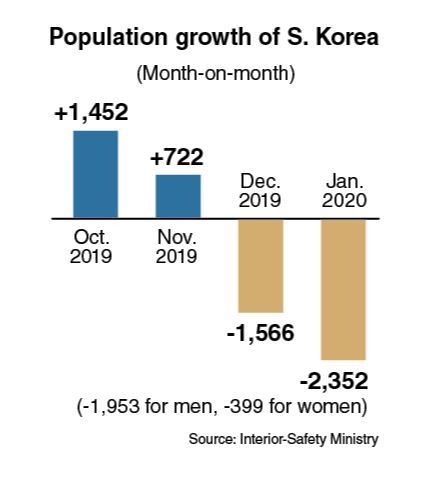
According to data from the Ministry of Interior and Safety, Korea’s population posted 51.847 million in January 2020, down 2,352 from 51.849 million in December 2019.

In particular, the female population dropped for the first time in history — by 399 people — since the government started compiling data. The figure for men and boys dropped by 1,953 in January, having fallen for the sixth consecutive month.

In December 2019 the population dropped by 1,566 — minus 1,788 for men and plus 222 for women — after peaking at 51.851 million in November. This marked the first time that the population slid for two consecutive months, with a collective net loss of 3,918 people for December and January.

Previously, Korea had seen negative population growth only twice, in March 2008 and again in April 2009. And for a decade between May 2009 and November 2019, the population continually increased on-month, with the exception of several dips in the male population.

The monthly data is based on figures for births, deaths and changes in citizenship.

“Though some argue that the real demographic changes could differ from the official data, it is irrefutable that the population is decreasing (starting from December 2019) on the basis of resident registration,” said a government official in Sejong.

He cited figures that showed population growth continued to slow during the second half of 2019 — plus 2,976 in July, 1,926 in August, 1,715 in September, 1,452 in October and 722 in November.

“And the point is that the pace of the decline has increased, compared with December (from minus 1,566 in December 2019 to minus 2,352 in January 2020),” he said.

Among the 17 major areas (eight cities and nine provinces), 13 (five cities and eight provinces) recorded lower population figures last month, the Interior Ministry data showed.

South Jeolla Province topped the list at minus 4,033, followed by North Gyeongsang Province at minus 3,328, Busan at minus 2,022, North Jeolla Province at minus 1,615 and Daegu at minus 1,543.

An unforeseen point was that Seoul, which had seen a steady decline in its population since 2011, saw the number of its residents increase by 4,402 to 9.73 million last month.

While Sejong, the fastest-growing city, reported an increase of 1,753 to 342,000, Gyeonggi was the only province that saw its population increase. It gained 10,702 residents to record 13.25 million.

The number of deaths outstripped the number of births by 28,067 vs. 24,693. While the disparity between the two was 3,374, citizenship changes — that is, Koreans renouncing their citizenship and foreigners acquiring Korean citizenship — offset the population decline somewhat, for a total decline of 2,352 in January.

Korea’s fertility rate is the lowest in the world, 0.88 as of the third quarter of 2019. An age breakdown of the population reveals the extent to which the population is aging.

Among Koreans aged between zero and 69, those under age 10 accounted for the lowest number last month with 4.14 million, and those aged 10-19 were second-lowest with 4.94 million.

In sharp contrast, the number of those in their 50s stood at 8.66 million, those in their 40s at 8.38 million, those in their 30s at 7.04 million and those in their 60s at 6.34 million.

Further, Koreans aged 70 or over tallied 5.5 million, outnumbering people in each of the two youngest age brackets — that is, Koreans aged zero to 9 and 10-19.

The youth population, people aged zero to 14, made up 12.4 percent of the overall population in January, having stood at 16.5 percent a decade earlier in January 2010.

Meanwhile, the country’s female residents outnumbered its male residents by about 120,000, for a disparity of 25.98 million vs. 25.86 million across the nation.

Seoul has the lowest sex ratio in the nation, with 95 men for every 100 women. Next lowest are Busan with 96, Daegu and Gwangju with 98, and Sejong and North Jeolla Province with 99. In contrast, Ulsan posted the highest sex ratio, 106, and South Chungcheong Province the second-highest, 104.

By Kim Yon-se (kys@heraldcorp.com)

China envoy urges Seoul to follow WHO advice on virus response #ศาสตร์เกษตรดินปุ๋ย

#ศาสตร์เกษตรดินปุ๋ย : ขอบคุณแหล่งข้อมูล : หนังสือพิมพ์ The Nation

https://www.nationthailand.com/ann/30381581?utm_source=category&utm_medium=internal_referral

China envoy urges Seoul to follow WHO advice on virus response

Feb 04. 2020
New Chinese Ambassador to South Korea Xing Haiming speaks in a press conference about the Chinese government’s stance on the coronavirus outbreak, at the Chinese Embassy in central Seoul on Tuesday. (Yonhap)

New Chinese Ambassador to South Korea Xing Haiming speaks in a press conference about the Chinese government’s stance on the coronavirus outbreak, at the Chinese Embassy in central Seoul on Tuesday. (Yonhap)
By The Korea Herald/ANN

New Chinese Ambassador to South Korea Xing Haiming on Tuesday called on Seoul to follow the World Health Organization’s recommendations on handling the new coronavirus, as Korea began barring entry of noncitizens who have visited China’s virus-hit Hubei province.

“I will not assess (Seoul’s measure). … But an international and scientific method would be to follow the WHO’s recommendation,” said Xing in a press conference at the Chinese Embassy in central Seoul, referring to WHO Director-General Tedros Adhanom Ghebreyesus’ stance that travel and entry bans are “unnecessary.”

“South Korea and China are friendly neighbors with close people-to-people ties. … It would be much appreciated if (both countries) protect their citizens all the while taking a scientific approach to help each other in the other person’s shoes,” Xing added.

The press conference came as Korea began barring entry to foreigners who have been to Hubei province in the past two weeks.

Koreans have continued to demand a stricter approach, such as widening the entry ban to all of China.

Seoul has confirmed 16 cases of the virus, which originated from Wuhan in Hubei province. As of Wednesday, 61 people were under observation for possible infection.

According to Xing, the WHO’s declaration of the outbreak as an international emergency was aimed at protecting countries unable to manage the virus due to a “weak system.” It was not a decision made due to the UN agency’s distrust in Beijing.

Amid intensifying concerns over the new coronavirus, the press conference was held for Xing — who arrived in Seoul last week — to convey the Chinese government’s stance on the situation. It is unconventional for a top diplomat to hold a media event before presenting credentials to the host country.

Xing said the Chinese government is focusing on five areas: making all-out efforts to contain the virus; preventing the virus from spreading through strict quarantine measures; forming a team of scientists and researchers to work on a vaccine; providing medical supplies and necessities; and sharing information with countries in a transparent manner.

As of Tuesday afternoon, China had over 20,000 cases of the novel virus and over 420 deaths. In Hubei provincealone, the epicenter of the outbreak, 64 people have died and 2,345 cases were newly confirmed Tuesday, marking the biggest daily increase in deaths since the novel virus was first detected in late December.

By Kim Bo-gyung (lisakim425@heraldcorp.com)

Three officials punished in Zhejiang for failure in epidemic response #ศาสตร์เกษตรดินปุ๋ย

#ศาสตร์เกษตรดินปุ๋ย : ขอบคุณแหล่งข้อมูล : หนังสือพิมพ์ The Nation

https://www.nationthailand.com/ann/30381521?utm_source=category&utm_medium=internal_referral

Three officials punished in Zhejiang for failure in epidemic response

Feb 03. 2020
[Photo/IC]

[Photo/IC]
By China Daily/ANN

Three local government officials were punished as they were held accountable for inefficiency in preventing and controlling the spread of novel coronavirus in Yueqing, East China’s Zhejiang province, according to a notice from the provincial commission for discipline inspection on Sunday.

The notice said the Center for Disease Control and Prevention of Yueqing, a county-level city in Wenzhou, a city with the largest number of confirmed cases outside the virus epicenter in Central China’s Hubei province, failed to perform its duties in checking, recording and reporting people who had close contact with infected patients, and didn’t report the cases arising from gatherings in time, leading to a leak in the virus control network.

As of Sunday, 84 people in Yueqing had been confirmed as infected with the novel coronavirus, the most among counties and districts in Wenzhou.

Ni Chengjian, director of the center and Xie Mingrong, director of Yueqing’s health administration, were removed from their posts. Chen Weiyan, vice-mayor of Yueqing who is in charge of the city’s health affairs, received a serious warning from the local Party committee.

In the notice, Zhejiang’s Discipline Inspection Commission also called on officials to learn from this lesson and perform their duties regarding epidemic control.

A statement released by the CPC Central Commission for Discipline Inspection on Thursday showed that officials who violate laws and Party discipline at the frontline of the battleground against the novel coronavirus epidemic should be investigated and punished.

Those who are incapable of assuming their responsibilities or display dereliction of duties will be investigated and punished as well, it said.

Since the release of the statement, a number of government officials have been punished or removed from their posts due to poor performance in the prevention and control of the coronavirus outbreak around the country.

Tang Zhihong, health chief of Huanggang city, Hubei province, was removed from her post after being unable to reveal the exact number of confirmed cases in the city during a meeting with the inspection team dispatched by the central government on Wednesday.

Shiyan in Hubei province, a city hard-hit by the virus, has punished 43 officials and Party members in the past 12 days.

Coronavirus shuts down nearly 340 schools in S. Korea #ศาสตร์เกษตรดินปุ๋ย

#ศาสตร์เกษตรดินปุ๋ย : ขอบคุณแหล่งข้อมูล : หนังสือพิมพ์ The Nation

https://www.nationthailand.com/ann/30381519?utm_source=category&utm_medium=internal_referral

Coronavirus shuts down nearly 340 schools in S. Korea

Feb 03. 2020
(Yonhap)

(Yonhap)
By The Korea Herald/ANN

Some 340 schools, kindergartens and day care centers nationwide are temporarily closed as of Monday, amid public fears over the spread of the coronavirus.

According to the Ministry of Education, 245 kindergartens, 53 elementary schools, 21 middle schools, 16 high schools and one special-education school postponed reopening following the month-long winter vacation or halted operations to rein in the spread of the coronavirus.

Most of the schools affected by the virus are in Suwon, Bucheon or Goyang in Gyeonggi Province, Gunsan in North Jeolla Province and in Seoul, where those infected with the virus have come from or visited.

Schools in areas considered to be vulnerable to the spread of the virus are now allowed to make a decision at their discretion on whether to temporarily close doors through prior consultations with regional educational authorities.

Education authorities in Suwon and Bucheon ordered all kindergartens and some elementary and middle and high schools in the cities to close for a week.

Authorities in Goyang recommended closure for all its kindergartens in the city for one week. However, only nine out of 157 kindergartens were closed, which led the ministry to revise the total number of kindergartens from 393 to 245 in the afternoon.

In Seoul, a total of nine schools — one kindergarten, three elementary schools, two middle schools and three high schools — were temporarily shut.

In Gunsan, all kindergartens, elementary, middle and high schools were ordered to close for two weeks.

Nurseries in Taean in South Chungcheong Province, Gunsan in North Jeolla Province and cities in Gyeonggi Province — Suwon, Bucheon, Pyeongtaek, Anyang and Goyang — were closed starting Monday.

Amid growing fears over the further spread of the virus upon Chinese students’ return to Korea for a new semester, the ministry said it plans to review whether to delay the reopening of universities this week.

There were an estimated 71,067 Chinese students studying at universities in Korea as of 2019, accounting for 44.4 percent of all foreign students here.

A total of 112 students and school officials are currently in self-imposed isolation after visiting the province, according to a survey of 242 universities by the ministry.

Meanwhile, 21 Korean students and school officials who visited China’s Hubei province, the epicenter of the new coronavirus, less than two weeks ago remain in self-imposed isolation, as they are not showing any symptoms of the virus, according to the ministry.

Korea has confirmed 15 cases of the coronavirus that is believed to have originated in the central Chinese city of Wuhan, with 913 people having come into contact with those infected with the virus, according to health authorities.

Starting from Tuesday, South Korea will temporarily ban foreigners who have visited Hubei province within 14 days from entering the country, and everyone who came in contact with those infected with the virus will be required to quarantine themselves for two weeks.

The coronavirus outbreak has killed at least 362 people and infected more than 17,300 globally. There are now at least 179 confirmed cases of the virus in more than 27 countries and territories outside mainland China.

One person outside mainland China, a 44-year-old Chinese man in the Philippines, has died. Sweden and Spain reported those countries’ first cases over the weekend.

(laeticia.ock@heralccorp.com)

Calls grow for entry ban for all of China #ศาสตร์เกษตรดินปุ๋ย

#ศาสตร์เกษตรดินปุ๋ย : ขอบคุณแหล่งข้อมูล : หนังสือพิมพ์ The Nation

https://www.nationthailand.com/ann/30381517?utm_source=category&utm_medium=internal_referral

Calls grow for entry ban for all of China

Feb 03. 2020
Screens of alerting coronavirus displayed at the Incheon International Aiport. (Yonhap)

Screens of alerting coronavirus displayed at the Incheon International Aiport. (Yonhap)
By The Korea Herald/ANN

South Korea will bar all foreigners from China’s Hubei province from entering the country, starting from Tuesday, but a growing number of experts, politicians and citizens say the measure is insufficient to fight the rapidly spreading new coronavirus. They demand a complete ban on entries from all of China.

The latest measure, set to take effect Tuesday, blocks entry of all foreign nationals who have visited the Chinese province that has become the hub of the deadly coronavirus in the past two weeks, or since Jan. 21. For Korean nationals, they will be allowed to enter after thorough examination and will be put into mandatory self-quarantine for two weeks. The steps are similar to those taken by countries like Japan.

But with the novel coronavirus that originated in Hubei’s capital Wuhan in December spilling over to other parts of China at a fast pace, experts say blocking only Hubei province may not be effective.

Chinese officials estimate about 5 million Wuhan residents left to other parts of China before the unprecedented lockdown on Jan. 23, when all outbound flights, trains and buses were halted from Wuhan, raising concerns that cases will spike even further in other regions.

Following Seoul’s decision Sunday, major health associations here, including the Korean Society of Infectious Disease, Korean Society for Healthcare-associated Infection Control and Prevention and Korean Society for Antimicrobial Therapy, urged the government to expand the restriction to all of mainland China.

“Forty percent of infected cases occurred in other parts of China outside of Hubei province, so restricting only Hubei is not enough,” the associations said in a joint statement. “With the possibility of spreading the virus by people who have mild or no symptoms at all, the government should require all of those who enter from China to enter a self-quarantine.”

Jung Byung-yool, a professor at Cha University Medical School and who headed the Korea Centers for Disease Control and Prevention from 2011-13, said Korea needs to impose a stricter entry ban like the US, Australia and Singapore, which are barring entry to all foreign nationals coming from mainland China.

“Korea needs to take drastic steps on restricting entry,” he said during an interview with CBS radio on Monday. “When breaking down the confirmed patients in China, 60 percent is from Hubei province, while 40 percent comes from other areas like Guangzhou and Hangzhou. When the people from the areas that make up 40 percent enter Korea, it could spread (here).”

On such concern, the government said it will decide whether to expand the restriction to cover all of China after monitoring the situation.

“On the need for expanding the measures to other regions (in China), we will continue to review, contingent upon the progress of the disease. If the (further ban) is required, we will make the decision by receiving opinions from experts, taking into consideration various aspects and discussing with related ministries,” said Vice Minister of Health and Welfare Kim Gang-lip in a briefing.

The death toll from the virus, which is officially called the 2019 novel coronavirus, or 2019-nCov, now stands at 361 in China and one in the Philippines, which recorded the first death outside of China. Around the world, the virus has infected more than 17,300 in 27 countries.

Korea has 15 confirmed cases.

Meanwhile, Korea’s latest decision to close the doors on China could risk angering Seoul’s major trade partner, which had asked Seoul and other countries to follow the WHO’s recommendation and refrain from restricting travel or trade.

This comes at a time of thawing relations between Seoul and Beijing, which have been chilly since Korea’s decision to host the US-made THAAD missile system in 2017, with Chinese President Xi Jinping expected to visit Seoul in the first half of this year.

“Both sides have been working to improve ties recently,” Kim Heung-kyu, director of the China Policy Institute and a professor at Ajou University, told The Korea Herald. “But that comes with the strategic understanding and needs of each side. From the earlier stage of the outbreak, Korea has shown support and aided China. Moreover, the (restriction) measure taken by Seoul is not seen as extreme in comparison to what other countries are taking. Therefore, this measure would not necessarily hurt the Seoul-Beijing relations or make them worse.”

He called for Korea to do its best to protect its people, while still aiding and supporting disaster-stricken China. “Because if coronavirus cannot be stopped from China, it could become a global disaster,” he said.

“I think it’s important to see how the situation unfolds and if needed, impose following steps that could cover all China.”

By Ahn Sung-mi (sahn@heraldcorp.com)