Reo Fujita, a 9-year-old Japanese elementary school third-grade boy, will become the youngest professional “Go” player on Sept. 1, an association for the traditional board game said Wednesday.
Fujita passed an exam to turn professional. He will become a pro Go player when he is 9 years and 4 months old, rewriting the current youngest-age record of 10 years old set by second-dan player Sumire Nakamura.
“I’ll do my best. I’m very happy,” Fujita said bashfully at a press conference in Osaka. He said he wants to play against Yuta Iyama, a pro Go player holding four titles.
Fujita, who lives in the city of Osaka, became immersed in a reversi app when he was around 4 years old, according to the association.
His father looked for a reversi class to take the son to, but since there was none, he instead took the son to a go salon near his workplace, which triggered the boy to play go, according to the association.
The boy became a first-dan amateur at age 5, and he often won against pro players after becoming a school second-grader, according to the association.
“I had an impression that Fujita played go in an adultlike, well-balanced style,” said eight-dan player Taiki Seto, 38, who played against Fujita in the exam game.
The Japan News
Asia News Network
Asia News Network: The Nation (Thailand), The Korea Herald, The Straits Times (Singapore), China Daily, Jakarta Post, The Star and Sin Chew Daily (Malaysia), The Statesman (India), Philippine Daily Inquirer, Yomiuri Shimbun and The Japan News, Gogo Mongolia, Dawn (Pakistan), The Island (Sri Lanka), Kuensel (Bhutan), Kathmandu Post (Nepal), Daily Star (Bangladesh), Eleven Media (Myanmar), The Phnom Penh Post and Rasmei Kampuchea (Cambodia), The Borneo Bulletin (Brunei), Vietnam News, and Vientiane Times (Laos).
Cambodia’s Education, Youth and Sport Ministry will introduce a pilot scheme to add financial literacy into school curriculums at target institutions in Kampong Cham, Kampot and Siem Reap provinces.
The classes, which will be added to grades 1 to 12, have the goal of improving students’ understanding of how to manage their money from an early age.
Mok Sarom, deputy head of the ministry’s Education Directorate-General, is in charge of the roll-out of the new curriculum. He observed the trial teaching of the subject in Siem Reap, noting that literacy went beyond letters and numbers.
“We are incorporating financial literacy, information technology and foreign languages in order to respond to the context of Industry 4.0,” he said, referring to the so-called Fourth Industrial Revolution.
Sarom said the trial of blending financial knowledge lessons into school curriculums would involve four subjects: mathematics, moral and civic education, basic life skills, and housekeeping, from grades 1 to 12.
He said the ministry had already prepared textbooks on the subject and had trained lead teachers from the three provinces to deliver the lessons and pass their knowledge on to their colleagues.
Ly Bunna, director of the Siem Reap provincial education department, lauded the initiative, saying it would provide a valuable life skill to students.
“Financial literacy is a good subject that will be used by almost all students in their daily lives. It is great that it will be integrated at such a young age too,” he said.
He added that as it is still in the developmental stage, its integration into the four subjects is not completely smooth as yet.
“We have identified a few small difficulties during the trial phase; we are looking into improving the integration process before it becomes part of the nationwide school curriculum,” he said.
According to Bunna, the trial in Siem Reap is being carried out at Hun Sen Roluos Secondary School in Prasat Bakong district and Muk Neak Primary School in Siem Reap town.
Ouk Chayavy, president of the Cambodian Independent Teachers’ Association, supported the integration of the topic into school curriculums but suggested that it should begin at secondary school level, grade 7, when students are more mature.
“I think grade 1 is too early to understand financial matters. I think the time would be better spent on Khmer language skills. Some students even reach grade 7 without being able to read the Khmer script fluently,” she pointed out.
The goal of the extra classes is to develop the financial nous of students, particularly when it comes to loans, credit and their general attitude to money management, according to a training manual at Muk Neak Primary School.
The Phnom Penh Post
Asia New Network
Asia News Network: The Nation (Thailand), The Korea Herald, The Straits Times (Singapore), China Daily, Jakarta Post, The Star and Sin Chew Daily (Malaysia), The Statesman (India), Philippine Daily Inquirer, Yomiuri Shimbun and The Japan News, Gogo Mongolia, Dawn (Pakistan), The Island (Sri Lanka), Kuensel (Bhutan), Kathmandu Post (Nepal), Daily Star (Bangladesh), Eleven Media (Myanmar), The Phnom Penh Post and Rasmei Kampuchea (Cambodia), The Borneo Bulletin (Brunei), Vietnam News, and Vientiane Times (Laos).
Samsung Electronics has launched the world’s largest curved gaming monitor – 55 inches – that wraps around users’ field of view to bring their gaming experience to the next level, the South Korean company announced on Tuesday.
“Acurved monitor gives users a fully immersive experience if viewed from a distance of 80 centimetres, as a flat monitor would cover less of a user’s peripheral vision,” Chung Kang-il, vice president of visual display at Samsung Electronics, said at a press conference in Seoul on Tuesday.
The launch of Odyssey Ark, which can be rotated, tilted and pivoted, is meant to cater to gamers’ demand for a larger screen size, multitasking while gaming, and playing both console and PC games on a single screen, Chung said.
The monitor, which forms a portion of a 1,000-millimeter radius curve, features 4K resolution using quantum mini light-emitting diodes. It also delivers a 165Hz refresh rate and 1 millisecond response time for smooth motion and transition on the screen, according to the Seoul-based tech giant.
Odyssey Ark enables the use of the Samsung Gaming hub, a game streaming discovery platform that gives users access to both console and personal computer games.
Moreover, the Flex Move Screen function allows users to adjust screen size, position and ratio for an optimal gaming setup.
“To millennials and younger generations, gaming is becoming an integral part of their life routine,” Chung said.
The cutting-edge monitor, first unveiled at the Consumer Electronics Show 2022 in January, will be launched worldwide in September, with preorders being accepted in the United Kingdom on Monday.
In Korea, sales of Odyssey Ark will begin on September 7 at the retail price of 3.4 million won (92,000 baht), with preorders available from August 24.
Odyssey Ark is the latest addition to Samsung’s signature monitor line-ups including Odyssey and Odyssey Neo.
By Son Ji-hyoung
The Korea Herald
Asia News Network
Asia News Network: The Nation (Thailand), The Korea Herald, The Straits Times (Singapore), China Daily, Jakarta Post, The Star and Sin Chew Daily (Malaysia), The Statesman (India), Philippine Daily Inquirer, Yomiuri Shimbun and The Japan News, Gogo Mongolia, Dawn (Pakistan), The Island (Sri Lanka), Kuensel (Bhutan), Kathmandu Post (Nepal), Daily Star (Bangladesh), Eleven Media (Myanmar), The Phnom Penh Post and Rasmei Kampuchea (Cambodia), The Borneo Bulletin (Brunei), Vietnam News, and Vientiane Times (Laos).
The bubbling excitement for bubble tea across Southeast Asia has helped the industry grow to a whopping US$3.7 billion (131 billion baht) in 2021 – spent on both bubble tea and similar “new tea” drinks, according to a study published on August 16.
The study, jointly conducted by venture outfit Momentum Works and payments start-up qlub, found that Indonesia’s bubble-tea industry ranked first in terms of market size among all Southeast Asian nations, with an annual turnover of $1.6 billion.
This was followed by Thailand with an annual turnover of $749 million through its more than 31,000 bubble-tea stores and other retail channels.
Singapore, being the smallest nation in the region, came in fourth with an annual turnover of $342 million, just behind Vietnam at $362 million.
Despite the country’s size, Singapore consumers were found to have the highest purchasing power, as the average price of a bubble-tea order is nearly two times that of other countries in the region, making it a great entry point for premium brands, the report said.
At present, there are more than 60 active bubble-tea brands covering different tastes and price ranges in Singapore, which was notably the first Southeast Asian entry point for “premium” brands like Heytea.
While the region’s bubble-tea industry is one that has been long dominated by Taiwanese and home-grown brands, that might be about to change as a slew of Chinese brands are making their way into Southeast Asian markets.
The bubble tea market in China, estimated to have an annual turnover of $20 billion, has already seen some popular Chinese brands like Mixue, Chagee and Heytea segue into Southeast Asia, joining earlier market entrants like Gong Cha and Koi.
However, despite the good product gross margin across the industry — estimated at around 60 per cent to 70 per cent — few players have managed continuous profitability on a large scale, according to Momentum Works.
Nayuki for example, the first “new tea” brand to go public, has seen its market cap plunge over 70 per cent since.
“Many young people in Southeast Asia want to open a bubble-tea shop someday. Though there are high margins, bubble tea is a low-differentiation game with easily replicable products and a challenging supply chain,” said Sik Hoe Yong, chief operating officer of qlub.
However, he believes that consumers’ love for bubble tea is one that is unlikely to change anytime soon, though they are likely to vote for their favourite brands with their wallets.
Founder and chief executive of Singapore-based Momentum Works, Jianggan Li, also sees rising competition for existing local players from an emerging group of Chinese players who are good at branding, product/supply chain and cost management.
“It’s not difficult to observe and learn their play and strategy, but what’s more important is to ensure positive unit economics and a good return on investment,” Mr Li said.
Yong Hui Ting
The Straits Times
Asia News Network
Asia News Network: The Nation (Thailand), The Korea Herald, The Straits Times (Singapore), China Daily, Jakarta Post, The Star and Sin Chew Daily (Malaysia), The Statesman (India), Philippine Daily Inquirer, Yomiuri Shimbun and The Japan News, Gogo Mongolia, Dawn (Pakistan), The Island (Sri Lanka), Kuensel (Bhutan), Kathmandu Post (Nepal), Daily Star (Bangladesh), Eleven Media (Myanmar), The Phnom Penh Post and Rasmei Kampuchea (Cambodia), The Borneo Bulletin (Brunei), Vietnam News, and Vientiane Times (Laos).
False advertisements on social media for rooms and spaces in boarding and transient houses have been victimizing students who are returning to Baguio City for the new school term after spending two years attending online classes because of restrictions due to the Covid-19 pandemic.
The police are looking into two complaints sent last week to the mayor’s office and the city council’s public information office.
On Aug. 8, a resident alerted Philip Puzon, executive assistant at the mayor’s office, that photographs of their family home were used to solicit down payments from students who were searching for accommodation in the city, according to Aileen Refuerzo, city information officer.
Stolen identity The family did not reveal how much money may have been taken, but they said they learned about the scam when students began turning up at their doorsteps.
Refuerzo said the family reported that one student showed up with the mother.
On Sunday, the owner of a boarding house complained to the city council that his establishment was also used to get money from students through the stolen identity of a woman who lost her wallet in 2016, said the council’s information officer, Jordan Habbiling, on Tuesday.
The woman’s identity was used to fabricate the fake boarding house’s registration with the Department of Trade and Industry, Habbiling said in a separate interview.
He said he could not post the alert immediately on Aug. 13 as they were waiting for the Bureau of Internal Revenue to confirm that the registration was false.
The fake boarding house used several online payment accounts with identities that needed to be verified by authorities, Habbiling said.
This same scheme had plagued hotels and transient homes before the pandemic broke out, said Aloysius Mapalo, city tourism operations supervisor.
University town It happened again when restrictions were eased and tourists flooded the summer capital this year.
Baguio is a university town, with 21 tertiary institutions catering to about 60,000 students at a given year, many of them from provinces in the Cordillera and northern Luzon, and even from Central Luzon and Metro Manila.
Among these are the state-run Philippine Military Academy and the University of the Philippines Baguio, which have designated student housing facilities.
The city government’s licensing office has not released the latest number of transient and student lodging facilities in Baguio, although estimates range between 200 and 400, including houses or apartment units used for student housing but have not been issued permits.
On Monday, the city government worked out a new traffic routing scheme in anticipation of a deluge of transient students, given the weekend gridlocks that already plague Baguio when tourists come.
Vincent Cabreza
Philippine Daily Inquirer
Asia News Network
Asia News Network: The Nation (Thailand), The Korea Herald, The Straits Times (Singapore), China Daily, Jakarta Post, The Star and Sin Chew Daily (Malaysia), The Statesman (India), Philippine Daily Inquirer, Yomiuri Shimbun and The Japan News, Gogo Mongolia, Dawn (Pakistan), The Island (Sri Lanka), Kuensel (Bhutan), Kathmandu Post (Nepal), Daily Star (Bangladesh), Eleven Media (Myanmar), The Phnom Penh Post and Rasmei Kampuchea (Cambodia), The Borneo Bulletin (Brunei), Vietnam News, and Vientiane Times (Laos).
A distance-learning high school based in Obama, Fukui Prefecture, has started holding classes in the metaverse, a virtual environment where users in different locations can interact with each other.
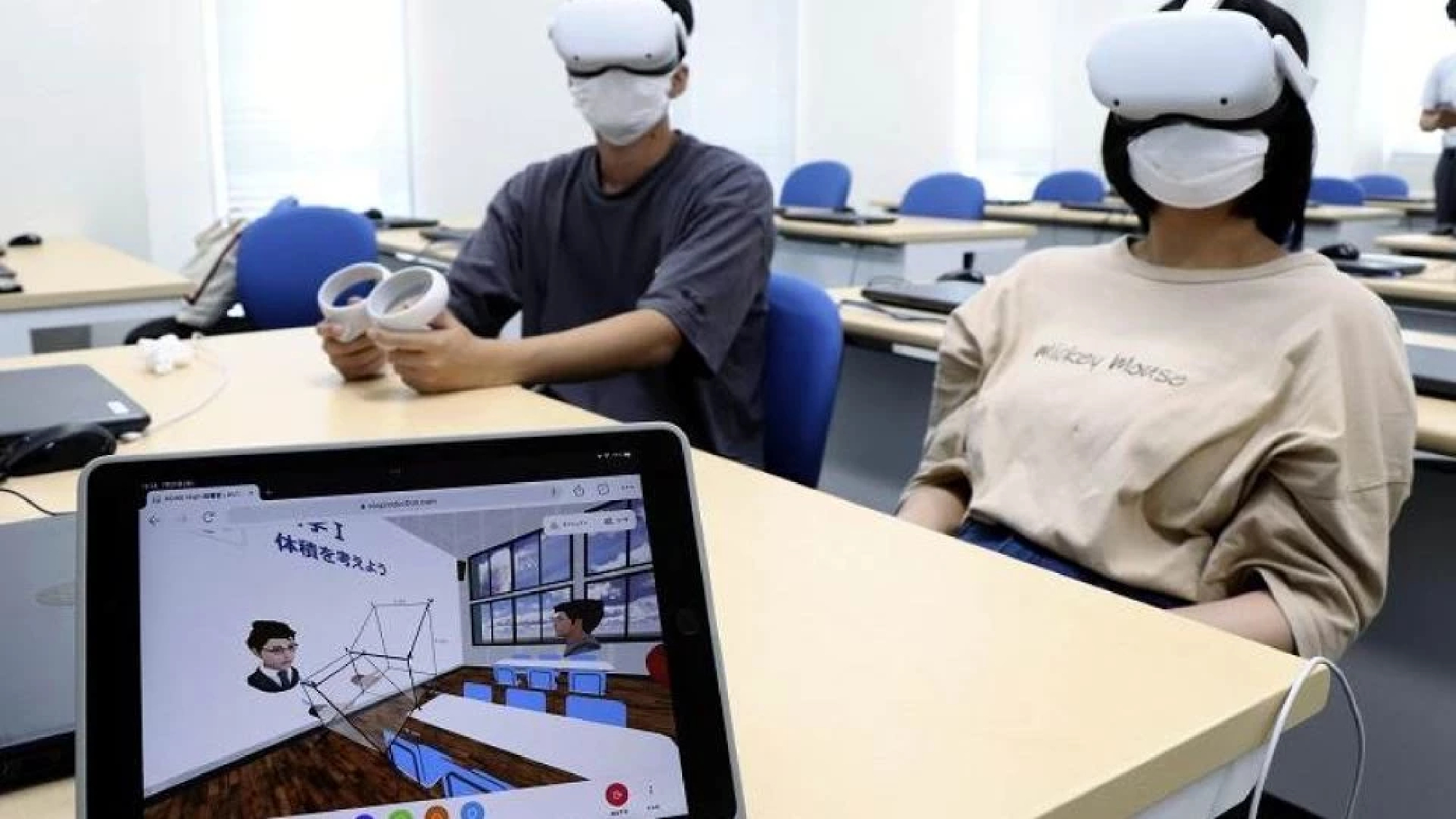
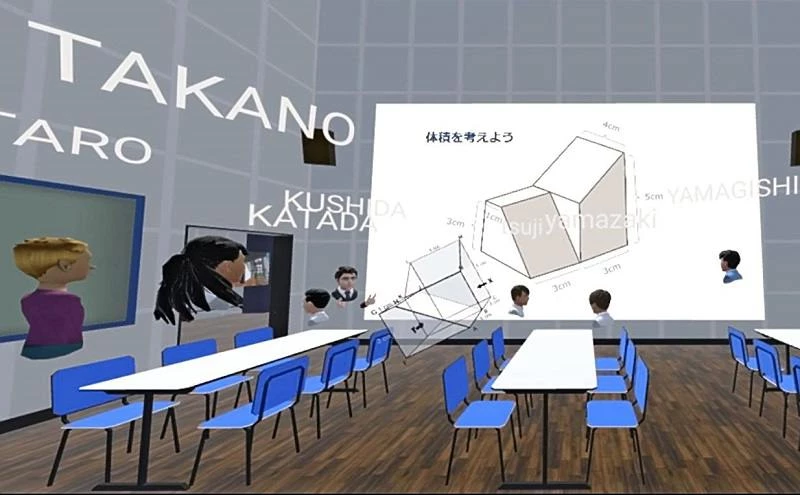
Since spring, Aoike High School students have been able to communicate with their teachers and classmates in the form of avatars, digital depictions of users that appear as bodiless heads in the metaverse platform utilized by the school.
On July 21, first-year students were taking a math lesson in a virtual classroom. The users’ names were displayed above the head of each avatar.
“This solid is in a shape like this. Let’s confirm it with a three-dimensional model,” the teacher said, after which the students manipulated virtual models in the metaverse to understand the shape of the object.
Back in the real world, the teacher and some students were wearing virtual reality googles, controlling their respective avatars while seated in a classroom at Aoike High School’s Toyama campus.
According to officials of the school, about 30 students attend classes in the metaverse up to three times a week, studying subjects including mathematics and biology.
“In the metaverse, you don’t feel far from the other participants,” said first-year student Ruiji Takashima, 18. “It was easier to visualize and understand three-dimensional shapes than it would’ve been in a face-to-face class.”
The school used to have a catchment area that only covered the six prefectures in the Hokuriku region, but since April it has accepted students from across Japan, which prompted the move into the metaverse.
Although one of the goals is to make classes available throughout Japan, another is to help students attend face-to-face classes without feeling pressure. About half of the school’s students have had problems with school attendance in the past. Aoike High School hopes that holding classes in the metaverse improves the school experience for such students.
The design of each user’s avatar is based on a headshot taken at the school, but it’s possible for the students to modify their avatars with different hairstyle options and the possibility of adding eyeglasses, among other things.
Naoki Yamagishi of Aoike Gakuen, which operates the school, said students can also interact with students in the metaverse outside of class hours. “Even students who can’t go to school are able to have conversations with classmates and enjoy an experience similar to that of attending a conventional school,” Yamagishi said.
Takanobu Fuji, chief analyst of the Hokuriku Economic Research Institute, thinks metaverse schooling will change the way students communicate in the future.
“Videoconference tools have proliferated amid the coronavirus pandemic, and many schools and offices have shifted online. But it’s easier to have casual chats in the metaverse than on videoconference calls,” Fuji said.
Metaverse platforms offer virtual environments in which users can socialize, study, work, and perhaps even shop in the future, by controlling their respective avatars. Concerts, museums and tourist spots are among some of the applications that have taken advantage of the new technology.
Asaki Ogawa
The Japan News
Asia News Network
Asia News Network: The Nation (Thailand), The Korea Herald, The Straits Times (Singapore), China Daily, Jakarta Post, The Star and Sin Chew Daily (Malaysia), The Statesman (India), Philippine Daily Inquirer, Yomiuri Shimbun and The Japan News, Gogo Mongolia, Dawn (Pakistan), The Island (Sri Lanka), Kuensel (Bhutan), Kathmandu Post (Nepal), Daily Star (Bangladesh), Eleven Media (Myanmar), The Phnom Penh Post and Rasmei Kampuchea (Cambodia), The Borneo Bulletin (Brunei), Vietnam News, and Vientiane Times (Laos).
Malaysia’s former prime minister Najib Razak on Tuesday failed in his bid to nullify the 1Malaysia Development Berhad (1MDB)-linked graft trial that resulted in his conviction.
Malaysia’s highest court ruled to push ahead with hearing the 69-year-old’s final appeal against his conviction and 12-year jail sentence.
Najib had wanted to push for a retrial by regarding an alleged conflict of interest involving High Court Judge Nazlan Ghazali. Nazlan had convicted the former premier of misappropriating 42 million ringgit (95.1 million baht) from SRC International, a former subsidiary of 1MDB.
The defence sought to cast doubt on Justice Nazlan’s credibility, saying that the verdict was compromised by his prior employment at Maybank, one of Malaysia’s largest lenders.
The judge was Maybank’s general counsel and company secretary during the time the bank advised 1MDB on the formation of SRC, and Najib’s lawyers have said that the judge should have recused himself as he is “too close for comfort to be the judge trying the SRC case”.
But on Tuesday, a five-member bench at the Federal Court led by Malaysia’s Chief Justice Tengku Maimun Tuan Mat unanimously threw out the motion to introduce new evidence, forcing Najib and his newly appointed defence lawyers to proceed with arguing his final appeal.
Should Najib fail in his appeal, he faces 12 years in jail and 210 million ringgit in fines.
Failing to overturn his conviction would also disqualify him as a candidate in Malaysia’s next general election, which must be held by September next year.
While Najib’s appeal is scheduled to run until August 26, the outcome is expected to be made known only at a later date, as the court usually sets another date to deliver a decision.
The Straits Times
Asia News Network
Asia News Network: The Nation (Thailand), The Korea Herald, The Straits Times (Singapore), China Daily, Jakarta Post, The Star and Sin Chew Daily (Malaysia), The Statesman (India), Philippine Daily Inquirer, Yomiuri Shimbun and The Japan News, Gogo Mongolia, Dawn (Pakistan), The Island (Sri Lanka), Kuensel (Bhutan), Kathmandu Post (Nepal), Daily Star (Bangladesh), Eleven Media (Myanmar), The Phnom Penh Post and Rasmei Kampuchea (Cambodia), The Borneo Bulletin (Brunei), Vietnam News, and Vientiane Times (Laos).
Prime Minister Pham Minh Chinh on Sunday attended a conference reviewing the cooperation between the President Ho Chi Minh Mausoleum Management Board and the All-Russian Scientific Research Institute of Medicinal and Aromatic Plants (VILAR) in preserving the body of the late leader.
In 1992, when the agreement between Vietnam and the former Soviet Union became invalid, with permission from the Vietnamese and Russian Governments, the Mausoleum Management Board and VILAR switched to direct cooperation in preserving the body of the President.
Addressing the conference, PM Chinh said when President Ho Chi Minh passed away in 1969 at the age of 79, with the endless love and gratitude for the leader and to realise the strong aspirations of the entire Party, army and people, the Politburo and the Party Central Committee decided to preserve his body and build a mausoleum so that his reputation, great career, and enormous devotion would exist forever in the hearts and minds of every Vietnamese person and become an everlasting symbol of national solidarity and unity.
Braving the fierce war, experts from the Soviet Union worked side by side with Vietnam’s military officers and soldiers to make tireless efforts to preserve the body in the best possible condition.
The PM described the achievements so far as a vivid illustration of Vietnam’s close cooperation and friendship with the Soviet Union in the past and Russia at present.
On behalf of the Vietnamese Party and State leaders, he appreciated the cooperation and assistance from the Soviet Union, now Russia, especially the VILAR scientists and medical experts, for this “particularly sacred and noble” task.
PM Chinh also spoke highly of the dedications and contributions of Vietnamese scientists, ministries, sectors, localities, and the Mausoleum Management Board and High Command.
The long-term preservation of President Ho Chi Minh’s body, along with the promotion of the mausoleum’s political and cultural values, is a special political task holding great significance to the building and protection of socialist Vietnam, he said, adding that since its inauguration, the mausoleum has served more than 60 million visitors, including over 10 million international guests from most countries around the world and international organisations.
The Government leader expressed his hope that the Mausoleum Management Board and VILAR will keep exerting efforts to overcome difficulties and challenges and effectively coordinate to fulfil the tasks.
At the conference, he presented the third-class Labour Order to VILAR, the Friendship Order to the chief trade representative of Russia in Vietnam, and certificates of merit to 12 collectives and individuals from the Mausoleum Management Board in recognition of their contributions.
Prior to the event, PM Chính and a VILAR delegation led by Director Sidelnikov Nikolai Ivanovich paid tribute to President Ho Chi Minh at the mausoleum. He also hosted a reception for the delegation.
Preliminary results of the family income and expenditure survey for 2021 released by the Philippine Statistics Authority (PSA) on Monday showed that the poverty rate had worsened to 18.8 per cent from 16.7 per cent in 2018.
Rosalyn (not her real name) is a 34-year-old mother of three who works as a domestic helper in Parañaque City. She has been with her current employer since 2005 and has seen her monthly wage increase from P3,500 to P12,000 a month. Still, Rosalyn complains that her earnings are never enough.
Her common-law husband Jerry (not his real name) works as a night watchman in a public school in Pangasinan, but is paid by the local government “only when there are surplus funds from the municipal budget.”
For months when most of Luzon was on lockdown, Jerry did not get paid as the school he worked in was closed, forcing Rosalyn to advance portions of her future wages to send to her partner who is caring for their three children—now age 10 to 14.
Rosalyn said that a few days ago, Jerry called to tell her to borrow P12,000 from her employer as their kids still did not have school uniforms, books and other supplies.
An argument ensued, Rosalyn recalled, saying she was already tired of borrowing money and blamed Jerry for being unable to make ends meet with the cash she sends every month.
“But deep inside, I know he tells the truth. The price of everything has gone up. And because he lost his job during the pandemic, Jerry stays at home to take care of the children. I know he feels ashamed. But my borrowings are now at P40,000. And I can never send enough back home,” Rosalyn said, her voice breaking.
Rosalyn and her family are among the 2.3 million Filipinos who joined the ranks of the poor because of the lingering COVID-19 pandemic.
Preliminary results of the family income and expenditure survey for 2021 released by the Philippine Statistics Authority (PSA) on Monday showed that the poverty rate had worsened to 18.8 per cent from 16.7 per cent in 2018.
This translates to 19.99 million Filipinos who are living below the poverty line, or those making less than P12,030 a month for a family of five. In 2018, the last time the survey was made, there were 17.67 million Filipinos living below the poverty threshold of P10,481 a month. The poverty rate was worse in 2015 at 23.5 per cent or the equivalent of 23.68 million poor Filipinos.
Unemployment The poverty threshold is the minimum income needed to meet the basic food and nonfood needs such as clothing, fuel, light and water, housing, transportation and communication, and health and education expenses.
“The effects of the COVID-19 pandemic, including income and employment losses, caused the poverty incidence to rise. Restrictions on mobility and low earning capacity of poor households due to limited access to regular and productive jobs made the lives of Filipinos difficult,” said Socioeconomic Planning Secretary Arsenio Balisacan, who heads the state planning agency National Economic and Development Authority (Neda).
“We do know that we have a tough road ahead, but we are already prepared to face these challenges head-on. Our poverty reduction efforts will focus on three main areas: the full reopening of the economy; more investments in human capital, social development, and social protection, and transformation of the production sectors to generate more quality jobs and competitive products,” Balisacan said.
“Social protection programs and services must effectively reach and empower them,” Sen. Grace Poe added on Monday.
The senator said improving employment opportunities for Filipinos would be critical, particularly in the agriculture sector, as the pandemic forced many companies to close down.
She said the passage of the Public Service Act, which allowed foreign ownership of companies in telecommunication, airlines and railways, would definitely help in generating jobs.
She also noted that the government should let drivers of public utility vehicles return to their routes “as they have waited for too long without income.”
“The commuters need them, especially the millions of students who will return to schools next week,” she stressed.
Despite recent employment gains due to the reopening of more economic sectors, the Philippines’ latest jobless rate in June of 6 per cent, equivalent to 2.99 million Filipinos, was still the second-worst in emerging Asia.
“The unemployment rate in the Philippines remains one of the highest among major Asian economies, though much lower than that of India,” Neda noted in a report issued on Monday. India’s jobless rate in June was 7.8 per cent.
The unemployment rate in Vietnam was 2.5 per cent in June; Malaysia, 3.9 per cent in May; China, 5.6 per cent in March; and Indonesia, 5.8 per cent in February, Neda’s report showed.
Economic reopening Among families, poverty incidence inched up to 13.2 per cent of households in 2021 from 12.1 per cent in 2018, although still below the 18 per cent in 2015. This meant the number of poor Filipino households increased to 3.5 million last year from 2018’s three million.
While the PSA has yet to release sectoral poverty statistics, National Statistician Dennis Mapa told a press briefing that farmers and fisherfolk were historically among the poorest of the poor in the country.
Mapa said it did not help that entrepreneurial activity and cash receipts from abroad—among the top sources of Filipino families’ incomes—were the most badly hit by the hard times caused by the pandemic.
Thousands of small local businesses had been shuttered by the most stringent lockdowns at the onset of the pandemic in 2020. The COVID-19 crisis also temporarily stopped the deployment of overseas Filipino workers, while hundreds of thousands of them lost their jobs and returned home due to a global recession.
Hyundai Motor Group said on Monday that it ranked third globally in car sales in the first half of this year – a first for South Korea’s largest carmaker.
According to its sales data, Hyundai Motor Co, its luxury Genesis brand and its smaller affiliate Kia Corp sold a total of 3.299 million vehicles globally from January to June this year.
The sales figure is the third-largest after Toyota Motor Group’s 5.138 million units and Volkswagen Group’s 4.006 million units.
Hyundai’s ranking jumped from No 5 a year ago, outpacing the Renault-Nissan-Mitsubishi Alliance and Stellantis Group which sold 3.14 million units and 3.019 million units in the first half, respectively.
While its global rivals were hit hard by chip shortages, Hyundai is said to have pulled through the crisis as it was able to secure enough chip supplies.
Adding to that, the robust sales of its luxury Genesis cars and new electric vehicle launches also helped drive overall sales.
Genesis sold a total of 25,668 units in the US alone during the first six months, the brand’s best-ever sales in the all-important market.
Its EV models, including Hyundai Ioniq 5 and Kia EV6, performed well. Hyundai became the second-largest EV maker in the US with 27,000 units sold in the January-May period after Tesla, the world’s bestselling EV brand.
Despite its stellar performance, Hyundai’s first-half sales dropped 5.1 per cent compared to a year ago, possibly due to supply chain disruptions and weaker consumer demands.
Still, the drop was less severe considering its bigger rivals. Toyota and Volkswagen saw 6 per cent and 14 per cent drops in sales during the same period. The Renault-Nissan alliance and GM also suffered 17.3 per cent and 18.6 per cent on-year losses in sales.













 SootinClaimon.Com