Linda Zhang, chief engineer of Fords new electric F-150 pickup, steers a 3-ton rig onto a test track at the automakers suburban Detroit proving grounds and mashes the accelerator. In about four seconds, she says, “Were at 60” miles per hour. Then, a heartbeat later as the G-forces bear down, “Were at 100.”
No wonder Ford calls its newest model the Lightning. Two electric motors give the pickup 563 horsepower capable of propeling its 6,500 pounds at sports-car speed. That’s what President Joe Biden discovered Tuesday as he took it for a spin during a visit to Ford’s Dearborn, Michigan, test track and declared: “This sucker’s quick!”
Yet it can still tow up to 10,000 pounds and jounce through the mud and ruts of an off-road course just like its conventional gas-powered counterpart.
Those speedy and sturdy attributes are the formula Ford is hoping will stand out in a soon-to-be crowded field of electric pickups. By the time the truck goes on sale in the middle of next year, it may already trail the arrival of Tesla’s Cybertruck, General Motor’s GMC Hummer pickup and Rivian Automotive Inc.’s R1T.
Electrifying the F-150, Ford’s golden goose, is critical to the company, which introduced the vehicle during a splashy ceremony at its headquarters on Wednesday, a day after Biden toured the plant that will build it. The gasoline-powered F-Series truck line generates $42 billion in revenue a year — more than McDonald’s, Nike and Starbucks — and hauls in most of Ford’s profit.
“It is incredibly important that this vehicle be a success for us,” Kumar Galhotra, Ford’s president of the Americas and international markets, said in an interview.
Ford Chief Executive Officer Jim Farley said the electric F-150 could serve as a proxy for how mainstream buyers will accept battery power.
“I am looking at this vehicle as a test for adoption for electric vehicles,” Farley told reporters at the flashy introduction. “We should all watch very carefully how this does in the market.”
The F-Series has been the best-selling vehicle line in America for four decades, but Ford isn’t taking that brand loyalty for granted. It remains to be seen if electric pickups from an automotive incumbent will be as attractive to traditional truckers as early EVs have been to tech bros.
“Will they buy from Ford — that’s been a truck-making expert for decades — or will they buy from an upstart because they’re attracted to a new brand?” asks Michelle Krebs, executive analyst for AutoTrader, a unit of researcher Cox Automotive. “We just don’t know.”
Ford is looking to improve the odds of making the Lightning a hit. It has set the starting price at just under $40,000 — about the same as a gas-powered F-150 — and created a cavernous “frunk,” or front truck. At the touch of a button on the key fob, the hood and grille lift to reveal more than 14 cubic feet of space that can handle 400 pounds of cargo. It features a deep well with a drain for iced beverages.
“I was surprised that it’s going to start at $40,000, which is actually $2,500 cheaper than a base XL crew cab with four-wheel drive,” said Sam Abuelsamid, principal analyst with researcher Guidehouse Insights, who was briefed on the truck. “And what they’re calling the mega-power frunk seems to have been very well-executed.”
Ford also will bill the Lightning as having competitive driving range of 230 miles on the base model and 300 miles for buyers who pay extra for an extended-range battery. That’s more than Ford is offering in its electric Transit commercial van but less than the 400 miles of range GM is promising in its electric Silverado pickup, which is expected to debut in early 2024.
Ford’s truck uses a lithium-ion battery supplied by South Korea’s SK Innovation Co. The two companies have signed a memorandum of understanding to jointly manufacture batteries in the U.S., according to people familiar with the deal who asked not to be identified.
Scoring a win with an electric F-150 would go a long way toward helping Ford overcome its image as an EV laggard playing catchup to Tesla and GM, which has set a goal of going all-electric by 2035. Farley recently doubled the company’s spending on EVs to $22 billion, but he has yet to detail how many models Ford will roll out or when it will ditch internal combustion engines.
He’s expected to provide some of those answers at an investor meeting on May 26.
“At this stage, GM is still ahead because they’ve committed to 20 EVs for the North American market and 30 globally,” Abuelsamid said. “So far, Ford has shown us three vehicles and they’ve said there’s more coming.”
Ford is taking a different path by converting its best-selling model to an electric vehicle, rather than designing something new from the ground up, as Tesla and GM have done. Ford engineers overhauled the F-150’s frame to accommodate a 1,300-pound battery and two electric motors between the front and rear wheels. But they left intact much of the truck’s design, including its aluminum body and the cab, with the exception of the 15.5-inch touchscreen borrowed from the dashboard of the electric Mustang Mach-E.
By re-purposing so much of the F-150, Ford says it will make money on every Lightning it sells. That also is the secret to its low starting price.
The gas and electric versions of the truck are sharing “a lot of expensive, important parts,” Ted Cannis, general manager of Ford’s North American commercial business, said in an interview. “We could reuse the whole cab. Why do I need to invent all-new seats and door handles?”
That has enabled Cannis to make a price pitch to his commercial customers who manage vast business and government fleets. Those cost-conscious customers — who visited Ford’s proving grounds last week for a private preview of the Lightning — are expected to be big buyers of the vehicle, especially if gasoline prices rise and battery power gains an edge.
“Ford’s strategy is very focused on fleets,” Krebs said. “That’s a smart approach because Biden’s plan is to have government fleets more electrified.”
For individual consumers, Ford has added optional features such as a hands-free driving technology and electronic scales to weigh the cargo in the truck bed. There’s even a power-backup option that can divert electricity from the truck to keep juice flowing to a home for as long as three days in a blackout.
Ford didn’t provide prices for those options, but they will drive sticker prices up to $90,000 for the top-end Platinum Lightning.
“That $40,000 price is just the starting point,” Abuelsamid said. “Average transaction prices are going to be a lot higher.”
Published : May 21, 2021
By : Syndication Washington Post, Bloomberg · Keith Naughton
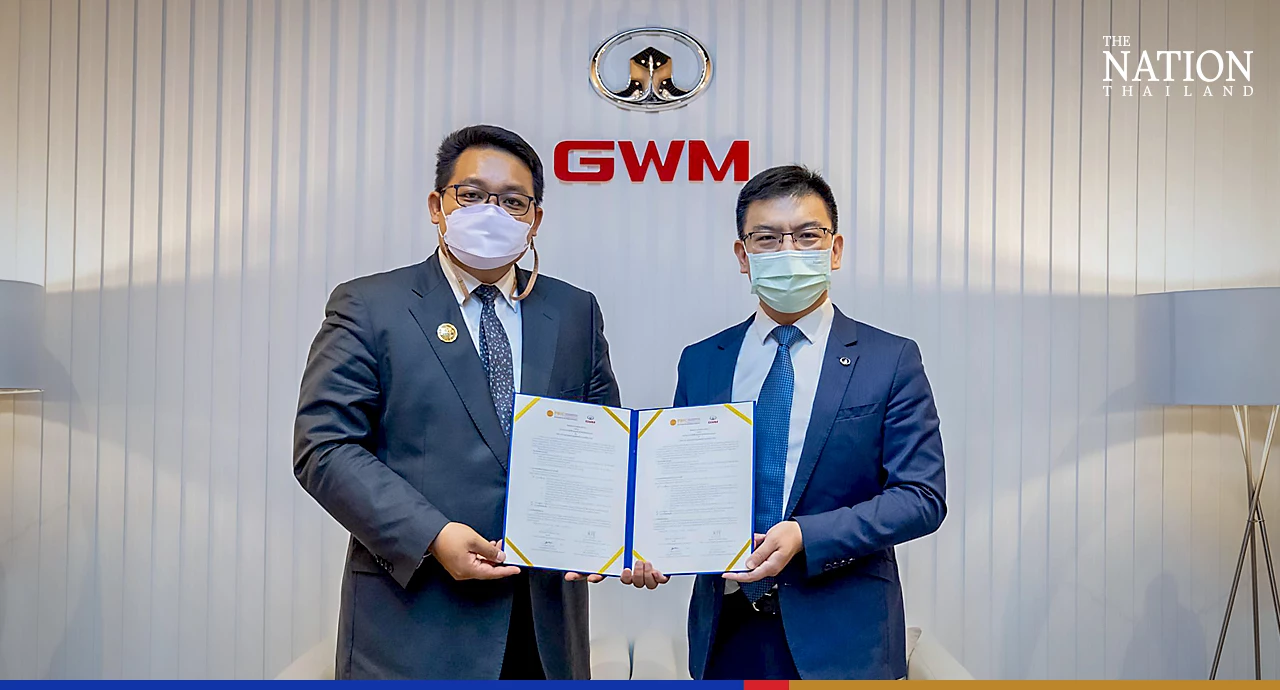
Bangkok – 18 April 2022: Great Wall Motor (GWM) and Pridi Banomyong International College, Thammasat University, have signed an educational memorandum of understanding (MOU) to offer opportunities and practical experience in the electric vehicle industry to undergraduate students before entering to the real business world, and to further conduct joint activities in the future.
The partnership reinforces the mission of a ‘Global Intelligent Technology Company’ committed to becoming Thailand’s xEV leader, ready to collaborate with all sectors and advance its business alongside with a sustainable society.
Held at GWM’s booth at the 43rd Bangkok International Motor Show, the MOU signing ceremony was attended by Michael Chong, General Manager; and Michael Zhang, Brand Communication Director of Great Wall Motor (Thailand), together with Dean Asst. Prof. Akkharaphong Khamkhun; Asst. Prof. Monthinee Rattanaprichavej, Deputy Dean for Research and International Relations; and Chaiyaporn Pinngam, Acting Head of Student Affairs at Pridi Banomyong International College, Thammasat University.
On this occasion, GWM announced that the company would sponsor the world’s second biggest business case competition – the Thammasat Undergraduate Business Challenge (TUBC), which will bring together undergraduate students from leading universities around the globe to utilize their knowledge, capabilities, and analytical skills.
Michael Chong, General Manager of Great Wall Motor (Thailand), said: “From GWM’s first step in Thailand to our second year of business operations, we have witnessed potentials among the younger generations, especially from university students, who will play a significant role in strengthening the country in many dimensions – which includes the development of EV industry to transform Thailand into a central hub of EV manufacturing in ASEAN. We are pleased to partner with Pridi Banomyong International College, Thammasat University, in many aspects. Our alliance marks a significant milestone for personnel development in Thailand’s EV industry and the education sector.
“Everyone will be able to share knowledge and expertise as well as create different activities together, helping Thai students expand their learning horizons and cultivating invaluable experience to raise their competency for post-graduate life amidst the present-day competition without boundaries. This endeavor also resonates with our CSR direction, which follows the ‘GWM Together’ concept, focusing on co-creation between the company and our partners in all sectors, leading to societal and environmental development, cultural diversity, and empowering innovation capability in a sustainable way.”
“The collaboration between GWM and Pridi Banomyong International College, Thammasat University, will significantly benefit both sides on working experience while also establishing a strong partnership foundation between a global organization and a renowned university with long standing in Thai society. The alliance will further expand into many co-activities in the future and bring qualified students an internship with GWM. Employment opportunities will be offered to interns with suitable capabilities and attitude after graduation,” added Mr. Chong.
GWM is officially sponsoring the Thammasat Undergraduate Business Challenge (TUBC) this year, hosting ‘The Challenger’ round, which allows Thai undergraduate students to compete and win a national competition in business case analysis.
The winning team will represent Thailand in the next round on the international stage among competitors from renowned universities across the world. GWM will provide special cases to the challengers in both rounds, allowing them to give analysis on realistic solutions and develop practical business plans under given conditions, resources, and timeframes. Subsequently, challengers present their ideas to the committee for their final judgement.
As the ‘Global Intelligent Technology Company’, GWM is committed to driving Thailand’s technology and electric vehicle industry forward. By passing on knowledge of technology and innovation in conjunction with developing professional skills and experience in a real working environment for Thai students via collaboration with partners from various segments, GWM places importance on hiring and preparing Thai people for the needs of the labor market while contributing to the development of new industries in line with national economic development guidelines.
GPI gears up for mega auto show, expects industry to accelerate 4.5% this year
Feb 10. 2021
By The Nation
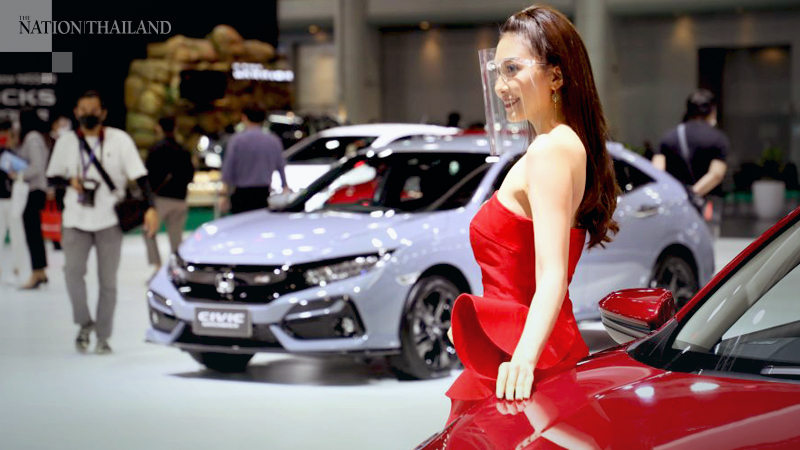
Grand Prix International (GPI) expects the auto industry to recover by 4.5 per cent this year amid hopes of a Covid-19 vaccine.
GPI chairman Prajin Aiemlumnao expected sales, both domestic and overseas, to increase to more than 800,000 vehicles compared to 790,000 last year.
He said the company is currently organising the 42nd Bangkok International Motor Show, scheduled from March 22 to April 4, at Nonthaburi’s Impact Arena in Muang Thong Thani.
Prajin said the exhibition will have in place measures to contain the spread of Covid-19, same as the previous year.
“The exhibition’s occupancy rate is already more than 95 per cent. We expect leading automakers to launch new models and campaigns to stimulate sales,” he said.
He added that GPI is seeking opportunities to expand its business, expecting its revenue to increase by 20 per cent this year.
Ford Thailand launches ‘Ask Ford’ tool to help customers
Jan 25. 2021
By The Nation
As part of automaker Ford’s moves to enhance its customer experience, Ford Thailand is launching “Ask Ford” – an intuitive global online knowledge tool for customers.
The service is available via www.ford.co.th in both Thai and English.
Ask Ford allows customers to ask questions and receive immediate answers retrieved directly from the automaker’s systems, Ford vehicle manuals or other Ford websites.
It uses artificial intelligence technology to search for the best responses, going far beyond the reach of standard search engines.
Ask Ford can be accessed by pressing the magnifying glass icon and will use Artificial Narrow Intelligence to determine the language of communication.
Apart from helping current or prospective Ford buyers, Ask Ford also provides up-to-date and precise information for Ford dealers and customer service staff.
“Ask Ford has proven to be a global knowledge tool for customers, dealers and Ford staff, and is already used in over 25 Ford markets in several languages,” Ford Thailand’s managing director Wichit Wongwatthanakan said.
Renault CEO lays out plan to slowly improve profitability
Jan 14. 2021The wheel hub of a Renault Megane eVision electric automobile in Paris on Oct. 16, 2020. MUST CREDIT: Bloomberg photo by Benjamin Girette. Photo by: Benjamin Girette — Bloomberg Location: Paris, France
By Syndication The Washington Post, Bloomberg · Tara Patel
Renault set conservative goals to gradually return to pre-pandemic levels of profitability, reflecting the challenges Chief Executive Officer Luca de Meo will have turning around the struggling French carmaker.
The company is targeting an operating margin of more than 3% by 2023 and at least 5% by mid-decade, according to a statement Thursday. This compares with a 4.8% return in 2019, before the manufacturer racked up record losses in the midst of the health crisis.
De Meo, 53, faces the difficult task of rationalizing a bloated cost structure and excess production capacity while pacifying the French state, Renault’s largest shareholder. The CEO said the expense reductions the company laid out just before he joined from Volkswagen in July will be achieved ahead of schedule and set fresh objectives for four years from now while avoiding any new job cuts.
The plans “may seem to lack ambition” but are “rock-solid” and can be achieved even in the worst conditions, de Meo told analysts. Renault shares erased initial declines and were little changed as of 12:20 p.m. in Paris.
“We see the 2025 financial targets as conservative,” Jose Asumendi, a JPMorgan Chase analyst who rates Renault the equivalent of a buy, said in an email. He estimates the objectives could be achieved by 2022.
Renault’s margins will be constrained by high levels of depreciation, Deputy CEO Clotilde Delbos told analysts on a conference call. While the company was an early mover with regard to electrification, the bulk of its industrial assets are tied to internal combustion engine-powered vehicles.
Of the 24 models Renault plans to launch by mid-decade, half will be in larger-vehicle segments that tend to be more lucrative and at least 10 will be fully electric. Its CEO turned around Volkswagen’s Spanish brand Seat before taking the top job at Renault following its ouster of Thierry Bollore, a protege of long-time chief Carlos Ghosn.
While de Meo has coveted the turnaround achieved by Renault’s French peer PSA Group, his targets for profitability fall short of the levels his company’s archrival achieved before covid-19 ravaged the industry. The maker of Peugeot and Citroen cars is now on the cusp of merging with Fiat Chrysler Automobiles after the French government scuttled the Italian-American company’s attempt to combine with Renault.
De Meo’s strategic plan is the first Renault has delivered since the departure of Ghosn, whose arrest in Japan in 2018 triggered an unprecedented crisis within the French company and its partner Nissan Motor Co. The more than two decade-long alliance nearly unraveled after factions within Nissan waged a campaign to unseat the chairman and cooperated with prosecutors in Japan.
In a bid to demonstrate cohesion within the alliance, the heads of Nissan and Mitsubishi spoke at Renault’s presentation about backing the turnaround plan and closer ties between the companies.
Nissan and Renault made plans last year to each cut more than 14,000 jobs worldwide, though de Meo and Chairman Dominique Senard have had to tread carefully. They’ve come under considerable pressure from the state after Renault took out a 5 billion-euro government-backed loan to weather the Covid-19 crisis.
Three-quarters of Thai drivers open to electric vehicles: survey
Jan 08. 2021
By The Nation
More than three-quarters of Thai consumers are open to purchasing an electric vehicle (EV), according to a survey conducted by Chinese carmaker Great Wall Motor (GWM) and NIDA Poll.
The nationwide survey of 1,000 drivers found that 77.68 per cent can see themselves behind the wheel of an EV. Of these, 28.97 per cent said electric vehicles are energy-saving and environmentally friendly, 26.88 per cent said they were equipped with modern technologies, and 16.96 per cent thought they were more cost-efficient in the long run.
The top three EV types that Thai consumers are interested in are Battery Electric Vehicles (BEV) at 38.69 per cent, Hybrid Electric Vehicles (HEVs) at 30.95 per cent, and Plug-In Hybrid Electric Vehicles (PHEVs), 30.36 per cent.
The survey also showed the key factors behind Thai drivers’ switch from internal combustion engine (ICE) vehicles to EVs. Environmental friendliness ranked top with 22.02 per cent, indicating Thai consumers’ concern over PM2.5 effects from ICE vehicles.
Second came higher cost efficiency and innovative technologies (19.05 per cent).
The top three factors motivating EV purchase are value for money, safety, and the car’s performance.
However, 34.13 per cent complained of insufficient information to make EV purchasing decisions, while 27.08 per cent identified limited choice in the market.
The survey was conducted as part of GWM’s “Get to Know Thai Consumers” campaign in November and December.
GWM last month vowed to help the government make Thailand a regional hub of EV development and manufacturing.
The automakers that have won big or lost ground going into 2021
Dec 25. 2020Hyundai cars are displayed at the company’s Motorstudio showroom in Goyang, South Korea, on Oct. 22, 2020. MUST CREDIT: Bloomberg photo by SeongJoon Cho
By Syndication Washington Post, Bloomberg · Hannah Elliott
If you asked automakers in April or May about the outlook for the rest of 2020, answers would have been grim.
Plants around the world were shut down, production stalled, workers were furloughed, sales plummeted, and billions of dollars were lost. Early estimates from IHS Markit had year-end U.S. sales barely cresting 12 million new vehicles.
By December, many automakers had bounced back-and then some. IHS now predicts 14.5 million new-vehicle units will be sold in the U.S. this year, down roughly 3 million units from 2019. Cox Automotive puts the number at 14.4 million, down 15.3% year-over-year.
“It’s still a pretty big drop,” says Stephanie Brinley, an automotive analyst for IHS Markit, “but better than we thought was going to happen in March when we shut the country down.”
Americans, it turns out, still want to buy new cars. They’re also buying homes, classic cars, and, in general, a lot of fancy things.
Credit the federal stimulus, says Brinley, plus improved online sales and configurators and pent-up consumers with time on their hands and a yearning to get out: “People who were already interested in buying a new car went and did it anyway, despite the covid situation.”
Some automakers have responded better to the shifting markets than others. The pandemic has enabled them to stop producing cars that didn’t make money, rein in incentives, trim budgets for efficiency, and become more disciplined regarding supply and demand. Some could even come out of the pandemic stronger, says Kevin Tynan, the senior automotive analyst for Bloomberg Intelligence.
“Our headline sales number may not be 17 [million], but it’s a lot healthier than when it was 17.5 million, and 30% of that was from unprofitable cars,” Tynan says. “We have spent decades trying to get to this.”
Final reports will come in early January, but from this nearly year-end vantage point, it’s easy to see which automakers and brands in the U.S. came out looking stronger, given the circumstances-and which did not.
To compile this list, we considered all different aspects of what makes a car manufacturer and specific brands healthy: sales rates, market share, the depth and variety of portfolio offerings, a brand’s position within its holding company, the quality and performance of its products, and additional analysis from Bloomberg Intelligence, IHS Markit, and Cox Automotive.
WINNERS
Hyundai
Hyundai Hyundai Motor Co. has been one of the biggest gainers of U.S. market share in 2020, according to a Dec. 14 report by Cox Automotive analyst Vanessa Ton.
Hyundai succeeded by reaching younger, more affluent customers who had higher credit scores, Ton says. Nearly 45% of Hyundai buyers have $100,000-plus household incomes, compared with 33% in 2015; and 30% are aged 18-44, compared with 24% in 2015.
“Hyundai has been strengthening its affordability and fuel efficiency imageries for years, while putting a history of mediocre quality in the rearview mirror,” Ton wrote in her year-end analysis. “In times of economic uncertainty, the value proposition is essential.”
Tesla
The best-performing automotive stocks this year have been electric start-ups such as Nio, Li Auto, and for a time, Nikola. But they all still pale against the 17-year-old incumbent, Tesla Inc., whose shares have soared by as much as 700% in 2020, minting millionaires out of its most loyal fans. On Dec. 21, the company was added to the S&P 500 Index. (It was such a big addition that S&P Dow Jones Indices debated whether Tesla should be added all at once or in two separate pieces.)
With a value that reached as high as $649 billion-that’s more than the collective value of the world’s seven largest carmakers at the start of 2020, by the way-Tesla is the most valuable car company in the world.
Tesla has said it expects to deliver a half-million of its sufficiently-executed-to-achieve-cult status cars and SUVs this year. (Some 180,000 cars of those cars need to come in the final quarter to hit that figure.) Much of that demand is driven by China, where it sells more EVs than anywhere else. Still to come: That Blade Runner-esque Cybertruck we’ve been hearing about for more than a year.
General Motors and Ford
General Motors Co. is the nation’s largest legacy automaker. It had a $4 billion third-quarter profit and has used 2020 to set itself up for a bold future, announcing plans to produce 30 electric vehicle models by 2025, starting with the gold standards for Detroit car lovers: Cadillac and Hummer. All told, GM has already started on spending what it says will be a total of $27 billion in an effort to remake 40% of its lineup.
Ford Motor Co., meanwhile, reported a healthy $2.4 billion in net income in the third quarter of this year. It has already shown signs of a potential upswing in earnings growth, thanks to its “global redesign” initiative (which streamlines overseas operations and eliminates poorly performing products) and an upcoming lineup of model debuts and announcements that includes an electric pickup (due in 2022), a modern Bronco and Bronco SUV, and Mustang Mach-E electric SUV.
It helps both Ford and GM that full-size pickup trucks in particular represent a $125 billion industry, according to research compiled by Bloomberg Intelligence’s Tynan, with compact pickup trucks representing an additional $22.4 billion: “Trucks are going to be near 80% of [the U.S. automotive segment] by the end of this year. It’s going to be 90% in the future.”
The pickup segment will be the key to recovery for automakers and dealerships in 2021, Tynan continues. No other group can generate profit as quickly. “The automakers that are falling behind are the ones that don’t get that.”
While Tesla may be out “conquering hamlets, fighting these little battles with EVs, and the [compact car] Model 3,” he says, “Ford and GM are rolling out the big artillery to the battlegrounds of pickup trucks-they’re ready for those EVs.”
Porsche
Porsche AG unveiled a whopping 17 new model iterations this year, including the next-generation Porsche 911 and additional versions of its electric Taycan sedan. That number rises to 33 new models if you include such mid-cycle refreshes as 16 Panamera variants on top of other new Panamera models like the Panamera 4S E-Hybrid in sedan, Executive, and Sport Turismo variants, and the Panamera Turbo S.
It’s a very confusing rundown-but very effective. Aside from having its Porsche 911 Turbo S named the best new car of the year, Porsche generated revenue of €19.4 billion ($23.7 billion) and a 10.4% return on sales in the first nine months of 2020, a feat that Porsche executives are rightly calling a success. To wit: More than 25,400 911s were delivered-a 1% increase over 2019.
Rivian
Although it has yet to make and sell cars, Michigan-based Rivian positioned itself perfectly in 2020 to capitalize on the coming wave of electric pickups. It received $6 billion in infusions from the likes of Amazon and Ford itself since 2019. By July, Rivian had nearly doubled the $2.85 billion it raised in all of 2019 with a $2.5 billion round of investment led by T. Rowe Price Associates Inc.
Whether this translates into success when the Rivian R1T truck arrives in summer 2021, one thing is certain: Tesla is on the offense. In July it sued Rivian for allegedly poaching employees and stealing trade secrets; soon after, former Tesla employee Nick Kalayjian joined Rivian to oversee engineering and product.
LOST GROUND
Nissan
In May, Nissan reported its first fiscal year loss in a decade and its biggest loss in the past 20 years; by Nov. 12, Nissan had started to flatten out its decline but still expects to see an operating loss of $3.2 billion for the fiscal year to March, likely to be the largest blow to any major automaker.
Chalk it up to the company’s being in the early stages of a massive cost-cutting and turnaround plan.
And a lack of exciting product: Even the line-topping Nissan GTR fared poorly in its most recent Bloomberg review. Despite the fact there are rumored talks of a possible Nissan electric truck, so far it can’t compete in the essential truck space: U.S. sales of the Nissan Titan full-size pickup were down 24%, to 19,403, for the first three quarters of this year, compared with more than 589,000 deliveries of the winning Ford F-series pickup, which fell just 11% over the same period.
“They’re in every segment, but they’re not the model in any segment-there’s always some other thing that’s always a little bit better,” Bloomberg Intelligence’s Tynan says. “There’s an identity crisis of what exactly is Nissan and why would I buy them. I don’t know the answer to that any more. I think they have a lot of stuff that is just ‘also ran.'”
Charlie Chesbrough, the senior economist and senior director of Industry Insights for Cox Automotive, has a similar outlook.
“Nissan, besides ongoing management issues, is being plagued by old products and big drops in fleet sales,” he said via email, noting that the situation should improve in 2021. “New Rogue, Frontier, Pathfinder are scheduled to rollout in coming months, so more consumer interest should follow. Fleet activity should pickup in 2021, so this may help Nissan’s overall sales numbers as well.”
A representative from Nissan said that the brand is “fully committed” to Nissan Next, the plan launched in 2020 to build a more sustainable business.
“New models launched this year such as the all-new Sentra and Rogue demonstrate our focus on giving customers what they want, with safety, technology, design and value that exceeds their expectations,” the spokesperson said in an emailed statement. “You will see this continued shift in Nissan showrooms in 2021 with five additional new models, along with a continued emphasis on putting the customer first in everything we do.”
Maserati and Alfa Romeo
While parent company Fiat Chrysler Automobiles NV has popular pickups such the Ram to help it tap the lucrative truck market, its overlooked, under-loved Alfa Romeo and Maserati brands don’t have anything to pull up to that tailgate party. In fact, brands that have fallen behind in transitioning to the next era of the industry (autonomous driving and electric mobility on an accessible level) have lagged in the stock market, and FCA-owned Maserati and Alfa Romeo fall into that category.
Despite public comments by FCA about its commitment to those brands, Tynan expects they could be soon packaged and sold. “I don’t know that they necessarily want them, I don’t know where they necessarily fit in the [FCA] portfolio.” Maserati, he continues, “is not the brand-just not it, either performance-wise or luxury-wise, in its segment.” Alfa presents a similar story: “It’s good for what it is … but what is it?”
Chesbrough said much the same: “The [FCA] portfolio is old and too small for the current market where trucks are in favor and gasoline prices are low. Fiat sales are down significantly in 2020, and their days’ supply continues to grow.”
Maria Conti, chief communications officer at Maserati, responded that Maserati is moving past the dark days of 2020, poised for 2021. She points to its first electrified model, a refreshed lineup, and expanded V8 Trofeo range, as well as a “foundation for a new era” with a new product offensive pegged to the “100% made-in-Modena” MC20 Supercar announced in September. “Our future is bright.”
Alfa Romeo reps also “respectfully disagree” with their place on this list, pointing to new connected infotainment systems with standard 8.8-inch touch screens in all 2020 models. “Last quarter our sales were up by 17%,” said Bob Broderdorf, the director of Alfa Romeo Sales for FCA North America, in an emailed statement. He added that from January to October 2020, sales of Alfa Romeo were down 6% while the relevant premium segment decreased by 16%. “This clearly indicates that we are capturing net market share and we have been increasing our market share each month of this year.”
On Dec 14., the company announced the Alfa Romeo 4C Tributo edition, which pays homage to the legendary 33 Stradale and is a nod to all the passionate Alfa Romeo fans in the U.S. Next year, Broderdorf said, the company will start production in Italy of the all-new Alfa Romeo Tonale, the brand’s first-ever plug-in hybrid. Time will tell if it helps.
Jaguar Land Rover
Once a bastion of stylish saloons, powerful roadsters, and iconic off-roaders, Tata Motors-owned Jaguar has suffered in 2020, though its troubles have long been gestating following over-investment in manufacturing capacity, especially for now-unpopular sedans. It has fallen far from making memorable vehicles in favor of chasing market trends. Meanwhile, demand for Land Rover’s diesel vehicles has stalled, sales in China have plummeted, and Brexit will make everything worse.
Its new electric products like the Jaguar I-Pace are, so far, forgettable. And as great as the F-Type was when it debuted, it needs a refresh. “Jag is just … I don’t think anybody cares,” Tynan says. “It is a brand with heritage that totally got away from the heritage, which was cars-sedans and saloons-and now it’s nondescript, strangely named, crossover, weird stuff.” The problem isn’t that Jaguar has added SUVs to its lineup, it’s that it hasn’t done a very good job of it.
Land Rover suffers from a non-diverse portfolio that will hurt it in years to come, even with the 2020 advent of the new Defender. “With such a limited product portfolio on the Land Rover side, what else can they do to grow?” asks Tynan. “You can have your Hamptons market share, but what other white space do you have anymore to add new products?”
Not a lot, it seems. Especially when much of the U.S. market is going to pickups.
Representatives at Jaguar Land Rover, for their part, remain optimistic, noting that 2021 will bring “an exciting new range” including significant refreshes of the Jaguar F-Pace and E-Pace, Range Rover Velar, and Land Rover Discovery, with electrified options extended to 12 of the 13 models in their product lineup.
“In the quarter ended Sept. 30, the company saw sales increase over 50% from the prior quarter, and generated a profit with strong cash flow of £463 million ($620.8 million),” spokesman Jeffrey Jablansky said in an email. “We have said we expect the recovery in sales, revenue, and profitability to continue in the second half of our financial year ended March 31, 2021.”
SSC Automotive
In October, the Richland, Wash.-based supercar maker wowed the world with its reports of a new world record for speed. But subsequent video analysis revealed inconsistencies with details surrounding SSC’s record run.
Now the race is on, with Texas-based Hennessey announcing it will run its new Venom F5 for a high-speed test at NASA Kennedy Space Center Shuttle Landing Facility in Florida in 2021.
SSC founder Jerrod Shelby has said he intends to redo his run-but stands to lose millions of dollars in early orders on the SSC Tuatara in the meantime. And while SSC waits to correct the errors in reporting and plans another attempt, Hennessey may just swoop in and claim the record for itself. Talk about tension. SSC did not respond to a request for comment before this story was published.
The car I’m most excited to drive in 2021 is a truck – and it could change everything
Dec 20. 2020Rivian’s electric pickup iat AutoMobility LA, ahead of the Los Angeles Auto Show, on Nov. 27, 2018. MUST CREDIT: Bloomberg photo by Patrick T. Fallon.
By Syndication Washington Post, Bloomberg · Hannah Elliott · BUSINESS, TECHNOLOGY, US-GLOBAL-MARKETS
Even the pandemic didn’t stop automakers from unveiling cars in 2020. From the achingly beautiful Ferrari Roma to the electric Polestar 2, and from the Mercedes-Maybach GLS to three track-worthy wagons, the new products provided some optimism about the future of driving while many other diversions (concerts, shopping, travel) stalled.
But that’s old news.
What I’m really looking forward to driving in 2021 is not a car at all. It’s a truck: the Rivian R1T.
The company announced it in 2018, long before Tesla’s Cybertruck and General Motors’s Hummer EV, so it’s about time. (Last year, I wrote about wanting to drive the Cybertruck … and I’m still waiting for that test drive.)
With a 754 horsepower and all-wheel drive, the R1T is not the most practical construction-site hauler, though potential buyers will certainly include a few hardworking ranchers, builders, and outdoor types. The truck bed alone is dwarfed by that of the Cybertruck, which is 6½ feet long and 57 inches wide. The R1T’s bed is reportedly just 4¼ feet by 50 inches. It will, however, go from zero to 60 mph in the same time as a Porsche 911.
But more than the $75,000 truck’s considerable capabilities-it promises up to 400 miles of driving range-I’m also fascinated by the company behind it.
Founded in 2009 and now headquartered in Plymouth, Mich., Rivian Automotive Inc. has garnered wide praise for bringing to market what myriad others (Bollinger, Fisker, Lordstown Motors, Atlis, and Nikola, among others) have yet to produce: an actual, for-sale, road-legal, live-in-living-color electric truck.
If Rivian executives hold true to their promise that the R1T will hit customers’ driveways in June, it will beat the Cybertruck (slated for the end of 2021), Ford’s electric F-150 (on sale by 2022), and the Hummer to become America’s first battery-powered pickup (the full range will premiere in 2023). Whichever company gets its out first, and does it well, will land a huge coup from a branding perspective, as well as immense profits. The electrified truck represents an astoundingly lucrative market: Last year, 2.5 million Americans bought a pickup truck. They’re on track to outpace the sales of SUVs, which, when combined with truck sales, constitute 70% of the U.S. market for new vehicles.
“We’re seeing customers come out of just about everything,” RJ Scaringe, Rivian’s founder and chief executive officer, told Bloomberg on Dec. 10. “Of course, [they’re] coming out of pickups, but often-more likely-coming out of SUVs, out of other electric vehicles.”
The big question is what makes, or will make, Rivian exceptional among its set. Plenty of people do believe it’s special: T. Rowe Price, BlackRock, Fidelity, Soros Fund Management, and Cox Automotive, among others, have invested a cumulative total of more than $6 billion into the company. Last year, Ford paid $500 million for access to Rivian’s electric “skateboard” truck platform, a few months before Amazon.com Inc.’s Jeff Bezos ordered 100,000 Rivian-made delivery vans.
Last week, former Aston Martin President Laura Schwab announced she had left the legacy British auto brand to become Rivian’s vice president for sales and marketing. “It is sooooooo exciting!” is how she put it.
What’s more, Rivian has ambitions far beyond an electric pickup (and subsequent SUV, called the R1S). It wants to go global, with lower-priced, smaller models planned for Europe and China. It wants to build 41 service centers across the U.S. by next year. (Company execs say 80% of servicing will be done at an owner’s home or workplace via a fleet of customized Ford Transit vans and Rivian’s own electrified service fleet.) And it wants to open a nationwide network of fast-charging stations capable of adding 140 miles of range in 20 minutes.
It’s wild ambition that will look either delusional or prescient in the future. Only time will tell, which is why I can’t wait to see for myself what all the fuss is about. For me, the proof is in the pudding … or the pickup, as the case may be.
The quest to replicate Tesla’s success keeps EV mania alive
Dec 20. 2020Tesla vehicles charge at a charging station in San Mateo, Calif., on Sept. 22, 2020. MUST CREDIT: Bloomberg photo by David Paul Morris.
By Syndication Washington Post, Bloomberg · Craig Trudell · BUSINESS, TECHNOLOGY, US-GLOBAL-MARKETS
Tesla has thrilled some investors and jarred others by soaring to a valuation of as much as $649 billion, more than what the world’s seven largest carmakers were collectively worth at the beginning of this year. The company is now comfortably in a category by itself, defying even Chief Executive Officer Elon Musk’s warnings. “I
actually said the stock is too high a long time ago,” Musk said at the start of December. “But they didn’t listen to me.”
For startups aiming to mimic Musk’s success and for traditional carmakers struggling to disrupt themselves, most lingering doubts about future demand for electric vehicles have dissipated. Thanks in large part to the Tesla phenomenon, a consensus has emerged that they are undeniably the future.
“What you’ve had is a greater realization of the inevitability” of EVs, said Michael Pye, an investment manager at Baillie Gifford, which oversees about $370 billion and is one of the biggest shareholders of both Tesla and China-based EV maker Nio. Ten years from now, “it’s likely we’ll look back on this as the electric decade.”
Tesla alone has not brought the world to this point. A mix of stricter regulations against internal-combustion cars, increased support for plug-in vehicle purchases, improvements in technology and benefits of scale have led more consumers to embrace electrics. Still, two big questions remain: Can any other startup meaningfully replicate Tesla’s success? And will the EV market grow quickly enough to support both incumbents and startups?
The dramatic rise and fall of Nikola over just a few months was this year’s cautionary tale. The company founded by entrepreneur Trevor Milton set out to transform the trucking industry by replacing the diesels in big rigs with batteries and fuel cells. It also said it would build a hydrogen-station network and charge customers upfront for refueling.
In June, Nikola went public by merging with a special purpose acquisition company, or SPAC, led by a former vice chairman of General Motors. Optimism that the infusion of cash would help the startup begin to produce trucks briefly sent its valuation soaring past Ford’s. The stock collapsed by September after a short seller claimed Nikola had deceived investors about its technology; the company has denied this. Regulators opened investigations, and Milton left the company.
Nikola’s breakdown hasn’t deterred other SPACs. The so-called blank-check firms have raised $70 billion in 2020 – a fivefold increase from 2019 – and at least 15 EV companies have been taken public or have listings pending. Those that already made their debut include Lordstown Motors, which has said it will begin producing its Endurance electric pickup in September 2021, and Fisker, whose Ocean SUV is planned for 2022.
“I have had very credible people, with very large sums of money, DM me on Twitter to see if we’d be interested in working with their SPAC,” said Gene Berdichevsky, CEO of Sila Nanotechnologies, a California-based battery company, and ex-Tesla engineer. The blank-check company board member who messaged him reached out in early October, after Nikola’s implosion.
Tesla shares started their meteoric rise in late 2019, when Musk proved he could not only dominate the nascent EV market but also make a small amount of money in the process. The company got on a roll by accelerating production of Model 3 sedans in China and Model Y crossovers in California and has now recorded five consecutive quarterly profits.
Companies getting in on the coinciding EV stock-buying bonanza include XPeng, the Guangzhou-based company co-founded by He Xiaopeng, the billionaire behind one of China’s most popular mobile browsers. Within three months after its U.S. listing in August, the stock almost quintupled.
“We have been talking about our goals of penetration and growth for the past five years,” said Brian Gu, the vice chairman and president of XPeng. “Yet we hadn’t seen the real explosion until this year. There’s an increased confidence in the industry’s long-term growth.”
Even so, XPeng won’t appear high up on global sales charts anytime soon. Bloomberg Intelligence analysts estimate the company will deliver about 25,000 P7 sedans and G3 SUVs this year. Its market cap still managed to reach $53 billion last month, a valuation Ford hasn’t seen in several years. Entering December, investors were awarding the company about $1.7 million of market cap per vehicle it’s expected to sell this year. If the same multiple were applied to Volkswagen, the German giant would be worth about $15.5 trillion. Instead, it’s being valued at about $10,000 per vehicle.
VW wasn’t alone in watching its valuation take a hit from the biggest disruption to auto-industry output since World War II. Vehicle sales in some markets were almost completely wiped out for the month of April. By June, the industry had taken on $72 billion of new debt to cope.
But amid all the carnage, EVs outperformed. It hasn’t mattered that the price of oil crashed and remains depressed. China stepped in with a series of measures that supported plug-in car purchases, while Germany and France started offering subsidies to help boost automakers out of their slump.
“If historically low oil prices, a major economic downturn, a plunge in auto sales and all these other factors didn’t derail the growth, it gets harder to see what does,” said Colin McKerracher, head of advanced transport for BloombergNEF. “The trajectory is getting clearer and clearer, and all these factors that might have derailed things are sort of bouncing off and not landing a blow.”
The current quarter may well be the first ever in which automakers sell 1 million fully electric and plug-in hybrid vehicles worldwide. It took the industry until 2015 to get its first million on the road. The global fleet is now about to cross the 10 million mark. “Each order of magnitude, a different number of people become aware that this shift is happening,” McKerracher said. “EVs have become part of the general consciousness instead of the consciousness of a small number of people who care about them.”
Conventional carmakers are benefiting somewhat from the bump in EV demand, too, but only a handful have seen their shares rise meaningfully this year. Companies including GM and Daimler are getting credit for undergoing metamorphoses, though they have spent more than a century basing manufacturing, labor and retailing practices on the internal-combustion engine.
GM’s stock got a boost when it told investors in November that it would spend $27 billion introducing 30 battery-powered models by 2025, increasing its budget by more than a third. But it’s going through an awkward process of buying out some Cadillac dealers that aren’t on board with the shift.
Daimler, which envisions more than half of its global sales being electrified by the end of the decade, will have to overcome labor-union opposition to shrinking its variations of combustion engines by 70%. Workers protested last month after the leader of a powertrain plant Daimler is retooling for EVs left the company for Tesla.
Musk may have ambitions to dominate Daimler’s home market of Germany and the rest of Europe, but the growth that has the region rivaling China for the first time this year has been driven by incumbents. In the U.S., GM and Ford have electric pickups in the works and have successfully defended that segment – far and away their most lucrative – from Toyota and others.
“I would not underestimate traditional OEMs in this area,” said Christina Woon, a Singapore-based investment manager at Aberdeen Standard Investments, which manages about $563 billion in global assets, including Toyota shares. “Having an existing business that’s profitable and that has cash flows that you can use to invest in a new or emerging business – that does help to balance out that risk.”
No automotive CEO has been as supportive and openly admiring of Musk and Tesla as VW’s Herbert Diess. He joined the company just before its 2015 diesel-emissions scandal and has remained consistent in his message about and moves toward electrification. During a two-hour briefing last month on the massive spending VW has planned for the next half-decade, Tesla’s name came up 31 times.
“We think it’s a very important competitor” because Musk is “really pulling the industry,” Diess said in an interview last month. “Coming from a software background, he has capabilities which we still have to build up. He’s a reference for us.”
But VW unintentionally echoed a troubling time for Tesla when launching a crucial new electric model this year. When software issues plagued the launch of the German carmaker’s ID.3, it hired a contractor to fix thousands of the electric hatchbacks in a tent, then rushed them to sale before some features were ready. The episode was reminiscent of when Tesla erected a structure in its parking lot two years ago during its struggle to get Model 3 sedans out the factory door.
As rough as the ID.3 launch was, Diess is starting to see some payoff. The car outsold all other EVs across Europe in November. Analysts at Evercore ISI predict that VW and Tesla will form a global EV duopoly for the foreseeable future. Baillie Gifford’s Pye credits VW for grasping where the industry is headed. In his view, too many of its peers still don’t.
“If you’re about to be run over by a 40-ton semi, don’t lie down in the middle of the road and smile,” Pye said. Even for those who “have got the gist of that,” like VW, “whether they’re able to act on it or not within the required time frame is more challenging.”
Thai auto production soars for first time in 19 months
Dec 18. 2020
By The Nation
Thai automotive production last month rose to 172,455 units, up 11.92 per cent year on year and up 15.46 per cent from October, the Federation of Thai Industries (FTI) said on Thursday.
The first rise in the past 19 months comes after a trade war broke out in 2019 and Covid-19 spread across the globe early this year.
Demand is rising as lockdown restrictions ease in many countries, pushing up car sales.
Cars produced for export rose 4.25 per cent year on year to 75,014, representing 43.5 per cent of total car production in November. Between January and November, car production for export plummeted by 33 per cent year on year to 649,893 units, representing 50.62 per cent of total production.
Cars produced for the domestic market in November jumped 18.64 per cent year on year to 97,441units, representing 56.50 per cent of total production.
However, January-November car production for the domestic market dropped by 30.24 per cent year on year to 634,070 units, representing 49.38 per cent of total production.
Meanwhile car sales in Thailand last month rose 2.7 per cent year on year to 79,177 units. The 6.83 per cent increase from October’s sales was also the first rise in 19 months.
Supporting the increase were sales of light-trucks, which rose for the third consecutive month.
The rise in car sales indicates economic recovery driven by government stimulus measures and car producers offering attractive packages for buyers, said the FTI.





 The wheel hub of a Renault Megane eVision electric automobile in Paris on Oct. 16, 2020. MUST CREDIT: Bloomberg photo by Benjamin Girette. Photo by: Benjamin Girette — Bloomberg Location: Paris, France
 Hyundai cars are displayed at the company’s Motorstudio showroom in Goyang, South Korea, on Oct. 22, 2020. MUST CREDIT: Bloomberg photo by SeongJoon Cho
 Rivian’s electric pickup iat AutoMobility LA, ahead of the Los Angeles Auto Show, on Nov. 27, 2018. MUST CREDIT: Bloomberg photo by Patrick T. Fallon.
  Tesla vehicles charge at a charging station in San Mateo, Calif., on Sept. 22, 2020. MUST CREDIT: Bloomberg photo by David Paul Morris.
 SootinClaimon.Com