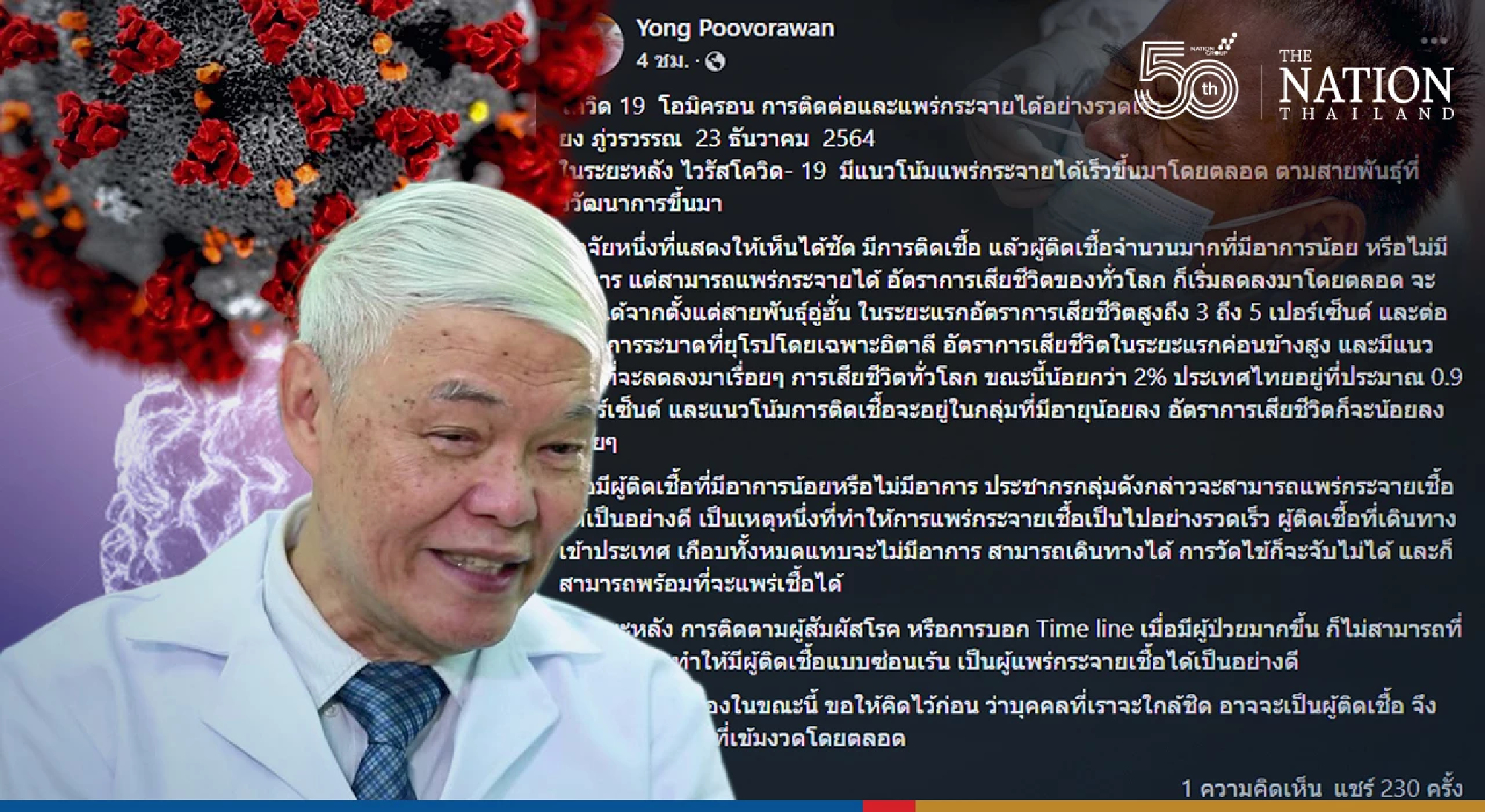
Covid-19 is likely to spread quickly as the virus mutates, expert virologist Dr Yong Poovorawan wrote on his Facebook page on Thursday.
He said a factor proving the virus is spreading quickly is that most patients are young people who develop mild or no symptoms.
He went on to say that the death rate due to Covid-19 has dropped from 5 per cent to less than 2 per cent. The death rate in Thailand is about 0.9 per cent, he wrote.
“As Covid-19 patients develop mild or no symptoms, they can spread the virus quickly,” he said. “Foreign travellers [who are infected and] who enter the kingdom may not show any symptoms, so they are ready to spread the virus anytime,” he warned.
Yong wrote that temperature screening, tracking people who were in contact with Covid-19 patients and checking patients’ timelines are not enough to detect the virus.
He advised people to strictly comply with preventive measures as others close to them may be infected with Covid-19.
Three Sinovac Covid-19 vaccine jabs is another interesting option to deal with Omicron as it gives around 94 per cent protection against the virus, Public Health Commission vice chairman Dr Chalermchai Boonyaleephan claimed on Wednesday, citing a study.
He said Omicron has spread across 100 countries less than a month after the World Health Organisation’s variant of concern announcement on November 26, faster than the Delta variant by up to three months.
He also cited data from Pfizer, saying two Pfizer jabs provided just 33 per cent immunity against Omicron, but this immunity would increase to around 90 per cent after the third Pfizer jab.
“A recent study showed that two Sinovac jabs gave 35 per cent immunity against Omicron, but the immunity increases to around 94 per cent after receiving the third Sinovac jab. The immunity generated from three Sinovac jabs is equal to three Pfizer jabs,” he said.
“Therefore, the Sinovac vaccine is another interesting option to deal with Omicron when the development of new vaccines is not yet completed.”
Chalermchai said that apart from 1 billion Sinovac doses administered to people in China, another 800 million doses have been given to people in 44 countries, including 54 per cent of people in the Asia Pacific, 28 per cent in South America, 13 per cent in Europe and 5 per cent in Africa.
“Thailand should consider and follow studies on inactivated, viral vector and mRNA vaccines closely to be ready to deal with Omicron,” he advised.
Expert virologist Dr Yong Poovorawan took to Facebook on Wednesday to warn that the Covid-19 Omicron variant will spread in Thailand, but he would like it to be as slowly as possible.
Yong said he wants public health authorities to administer the third dose of vaccine to as many people as possible because two doses are just not enough to prevent Omicron.
He said Omicron came into Thailand quickly because foreign travellers, especially those under the Test & Go scheme, did not undergo quarantine. It was difficult to keep Omicron at bay because the variant could be in the incubation period or travellers might be infected mid-way.
Yong said Thailand must use quarantine for 7, 10, or 14 days again to prevent Omicron from spreading.
He advised the government to also suspend some activities or reduce the number of people travelling during the New Year.
He said the Omicron situation will affect the economy if it is widespread.
Yong also wrote that Thailand must realise, just like Europe and America, that it cannot fully control the variant and some countries have had to close.
The decision will be up to administrators to find a balance between safety and the economy, the virologist wrote. They must decide as quickly as possible before Omicron spreads across Thailand, he advised.
Covid-19 is not a weak virus as it has infected more than 200 million people and killed over 5 million, Assoc Prof Dr Thira Woratanarat from Chulalongkorn Universitys Faculty of Medicine said in a Facebook post on Saturday.
He added that the Omicron variant is particularly worrisome because it is easily transmissible, escapes immunity and resists treatment.
“Even though Omicron infections are less severe, the number of Covid-19 cases can be expected to surge quickly,” he said.
He said many countries, including those that had decided to “co-exist” with Covid-19, have launched strict measures to curb the spread of the disease.
He is advising people to wear two face masks (a surgical mask with a cloth mask on top), maintain social distancing, avoid gatherings especially in poorly ventilated places and celebrate Christmas and New Year at home.
Thailand’s expert virologist Dr Yong Poovorawan explained the administration of vaccine combos in a Facebook post on Saturday.
He said there is scientific evidence proving the effectiveness of combined vaccines and it will soon be published in international medical journals.
He said he was worried that Thais were wasting their time arguing while researchers in the rest of the world are working on setting a standard.
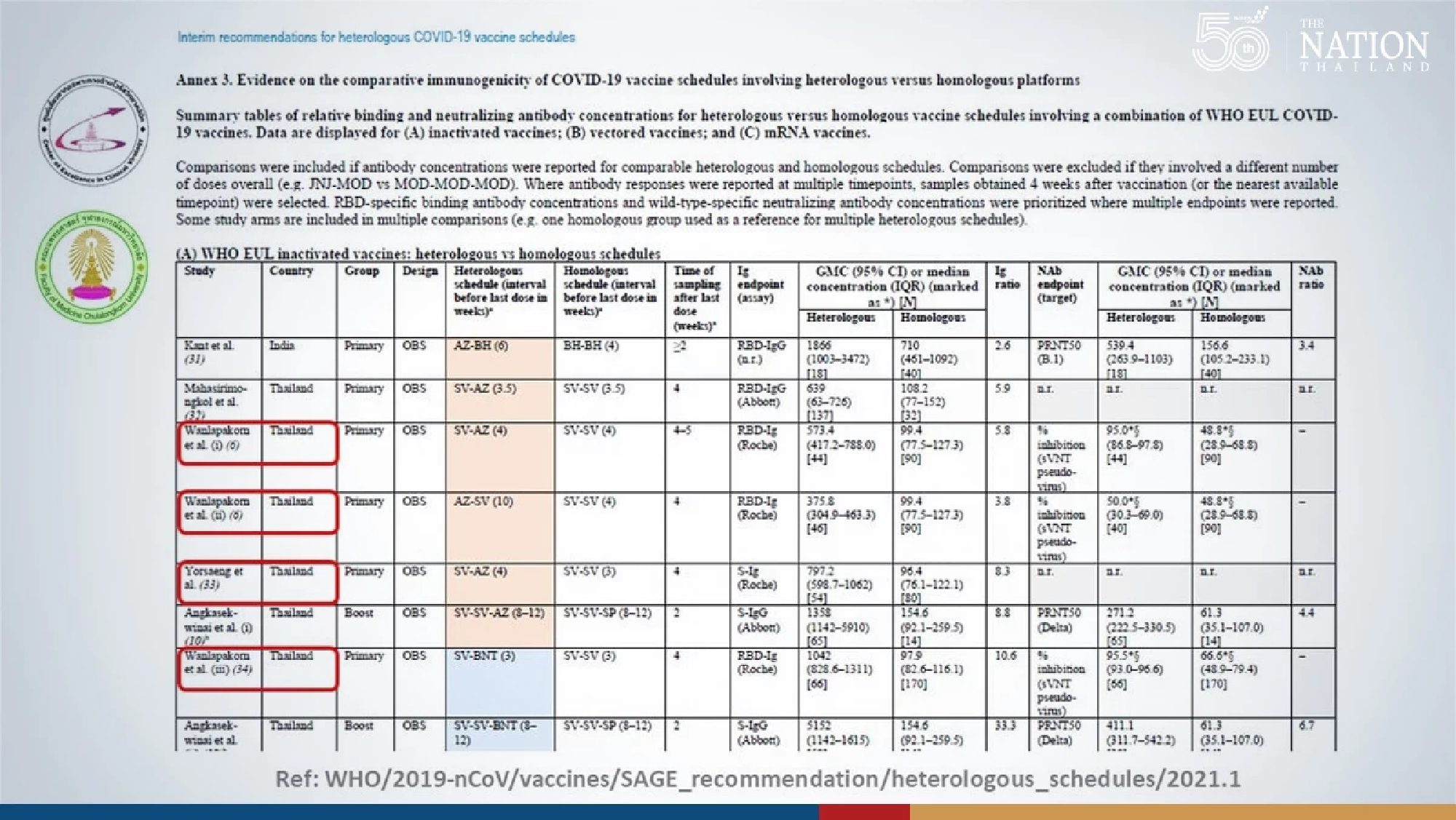
He cited the World Health Organisation (WHO)’s paper “Interim recommendations for heterologous COVID-19 vaccine schedules” published as an “Interim guidance” on Thursday.
In the paper, WHO recommends the administration of combined vaccines and cites the inactivated-viral vector or inactivated-mRNA vaccine combinations used in Thailand.
WHO has recommended that countries adjust their vaccine rollout based on the availability of vaccines.
Yong said the Public Health Ministry has studied the efficacy of the Sinovac-AstraZeneca combination and has learned that this mixture offers as much protection against Covid-19 as two doses of AstraZeneca.
Consuming turmeric, ginger, leafy vegetables and grains can help ease the side-effects of Covid-19 vaccines, the Department of Health suggested on Thursday.
Dr Suwanchai Wattana Yingcharoenchai, the department’s director-general, said the most common side effects include soreness at the vaccination site, headache, fever, body ache or fatigue.
He said the symptoms can last for up to three days and suggested that consumption of the following herbs and plants can help ease symptoms. They are:
Turmeric: Contains anti-inflammatory properties and can help ease the pain.
Ginger: Helps reduce inflammation.
Leafy vegetables and fruit: Contain vitamins that can boost immunity, dietary fibre to help flush toxins and high water content, which helps refresh the body.
Every country will be infected with the Covid-19 Omicron variant, expert virologist Dr Yong Poovorawan wrote on his Facebook page on Thursday, advising people to wash their hands regularly, always wear a mask, keep a distance from others and get vaccinated.
Yong said Omicron can spread more easily than other variants including Delta. He speculated that it would replace Delta soon once it spreads worldwide.
Meanwhile, another virologist, Anan Jongkaewwattana, wrote on his Facebook page that Hong Kong researchers, who conducted tests with bronchial and lung tissue samples, found that Omicron grows faster in the upper bronchus.
However, the virus grew slower in the lungs, which supported reports that Omicron will not be as severe as other variants.
The omicron variant dented the protection afforded by two doses of Pfizers and AstraZenecas covid vaccines as feared, researchers found, increasing the risk of infection.
Blood samples collected from people vaccinated with the two different shots and tested against the new strain showed a substantial drop in neutralizing antibodies, a proxy for protection, particularly compared with the delta variant, researchers from the University of Oxford said Monday in a paper.
The results echo other recent findings that emphasize the need for booster shots, especially amid evidence of omicron’s ability to drive a tidal wave of infections. The scientists couldn’t yet answer another key question, about the vaccines’ ability to ward off severe disease. The new mutation has sparked concern around the globe, but reports from South Africa — where it was first discovered — suggest so far cases appear to be milder than during earlier surges.
Omicron’s impact should become better documented in a few more weeks, making clear whether new vaccines are needed, according to Teresa Lambe, one of the creators of the shot that Astra developed with Oxford.
“We’re hopeful that the current vaccine will protect against severe disease and hospitalization and that’s certainly what we’ve seen before with other variants of concern,” Lambe told reporters. “We and other vaccine manufacturers are in a position that if a new variant vaccine is needed, we can go fast.”
In the meantime, the rise in infections alone could strain hospitals in places like the U.K. Gavin Screaton, head of Oxford’s medical-sciences division and lead author of the paper, called for remaining “cautious, as greater case numbers will still place a considerable burden on health-care systems.”
The researchers saw a roughly 30-fold drop in neutralizing antibodies against omicron after two doses of the Pfizer vaccine compared with the delta strain. The impact on the Astra shot was similar. The authors also found evidence of some participants failing to neutralize the virus at all.
Neutralizing antibodies are just one arm of the immune system’s defence, and the scientists are now looking at how T cells respond to the variant, with data expected in the coming weeks.
The blood samples were taken from the Oxford-led Com-Cov2 study looking at how mixing and matching vaccines with different intervals impacts the immune response to covid-19. The findings on omicron were mainly based on those volunteers that had two shots of the same vaccine, the researchers said at a press briefing Monday.
The data was published on the pre-print server medRxiv and has been submitted for peer review.
A third vaccination drive is necessary to deal with the Omicron Covid-19 variant, expert virologist Dr Yong Poovorawan said in a Facebook post on Sunday.
Comparing the battle against Covid-19 to a long marathon, Dr Yong said people should be given inactivated vaccines like Sinopharm or Sinovac for their first two jabs as they have few side effects.
However, he said, all three jabs of a viral-vector vaccine like AstraZeneca and Johnson & Johnson is not suitable because recipients’ immunity drops over a short period.
He added that though mRNA vaccines like Pfizer and Moderna provide high immunity, they also have high side effects.
“Swollen lymph nodes were found in some people who received an mRNA vaccine as their third jab, while heart muscle inflammation was found in some whose second shot was an mRNA vaccine,” he said.
Dr Yong said boosters can be provided in the following combinations:
• Two jabs of inactivated vaccine: The third jab can be a viral-vector or mRNA vaccine and delivered one month after the second jab. Both viral-vector and mRNA vaccines can be delivered as fourth shots to deal with new Covid-19 variants.
• Inactivated and viral-vector cocktail: A booster of a viral-vector or mRNA vaccine can be administered three months after the second jab. If the third jab is a viral-vector vaccine, then the fourth jab should be an mRNA one.
• Two viral-vector jabs: The third jab should be an mRNA vaccine administered three to six months after the second jab. If people prefer a viral-vector booster, then the interval must be longer than six months to ensure high immunity.
• Two mRNA jabs: The third jab can be an mRNA vaccine depending on the Covid-19 situation.
Expert virologist Dr Yong Poovorawan offered advice on tackling the Omicron variant in a Facebook post on Saturday.
He said initial studies show that Omicron is easily transmissible and that vaccines do not provide enough protection. This means even fully vaccinated people will need to build more immunity to fight against the variant even if they have mild or no symptoms, he said.
He said the only way people can build their immunity is if they get at least two jabs of the Covid-19 vaccine and a booster shot three months later.
Dr Yong also said that the government and the private sector have enough vaccine doses for citizens who need their jabs.
The Food and Drug Administration will also authorise vaccines for young children as soon as possible.
The virologist said people who have developed an immunity to Covid-19 or have been double jabbed will likely have very mild or no symptoms if infected by Omicron, adding that the virus will eventually become a regular respiratory infection.








 SootinClaimon.Com