Dhipaya wins top honour in Prime Minister’s Insurance Awards
Oct 16. 2020
By The Nation
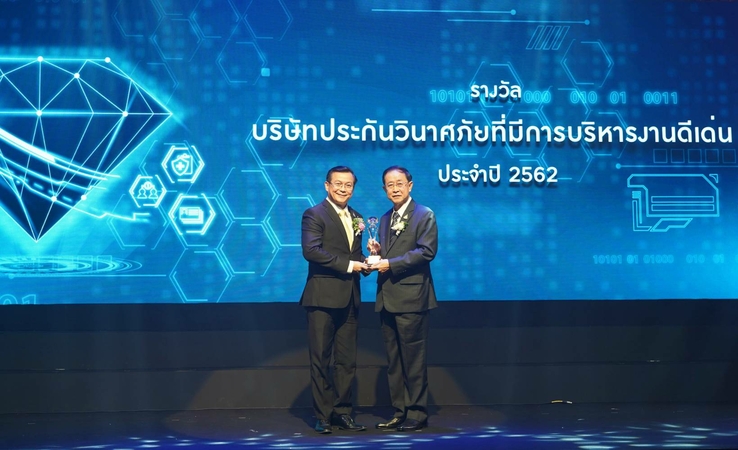
Dhipaya Insurance was awarded the first prize for “Best Administration in Non-Life Insurance 2019” in the Prime Minister’s Insurance Awards 2020.
Somporn Suebthawilkul
Dhipaya managing director Somporn Suebthawilkul received the award from Finance Minister Arkhom Termpittayapaisith. The winners were selected by the Office of Insurance Commission, based on professional administration by insurance companies, performing at full capacity, having stable financial status and excellent corporate governance. The awards aim to encourage the companies to maintain their standards in conducting business and serving the people.
The awards ceremony, which Dhipaya Insurance said was an event of great pride and satisfaction for its executives and employees, was held at Centara Grand at Central Plaza Ladprao Bangkok.
CP Foods strikes public-private pact to preserve forests
Oct 15. 2020
By The Nation
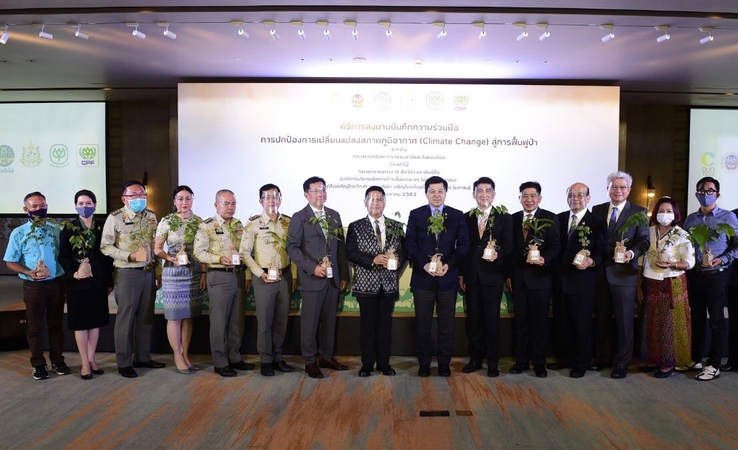
The government has signed a cooperation pact on “Climate change prevention through Forest Rehabilitation” with Charoen Pokphand Foods (CP Foods) to preserve and rehabilitate 26,000 rai of terrestrial and mangrove forest.
The pact’s signing was presided over by Natural Resources and Environment Minister Varawut Silpa-archa and CP’s CEO Suphachai Chearavanont.
Under the agreement, the ministry’s Royal Forest Department and the Thailand Greenhouse Gas Management Organisation (TGO) will join with CP Foods to rehabilitate three areas: 7,000 rai under CP Foods’ “Rak Ni-Ves Project” at the Pasak watershed, Khao Phraya Doen Tong in Lop Buri province, from 2021 to 2025; 14,000 rai under CP Foods’ “Grow-Share-Protect Mangrove Forestation Project” in the Gulf of Thailand, Samut Sakhon province, from 2019 to 2023; and 5,000 rai of green areas at CP Foods’ premises.
Varawut said the pact would support Thailand’s development in the long term by helping the country meet international efforts to reduce greenhouse gases (GHGs) for sustainable growth of the economy, society and the environment.
“Climate change is closer than we think. To effectively mitigate the impacts demands collaboration from all parties,” Varawut said.
He added that CPF’s forest rehabilitation in the Pasak watershed and Gulf of Thailand in Samut Sakhon will help restore the balance of nature, since mangrove forests act as natural carbon dioxide sinks, erosion barriers and marine habitats. The projects would serve as an example for forest rehab in other parts of the country, he said.
WHA Group launches e-commerce park in boost to industrial tech
Oct 14. 2020Chairwoman and Group CEO Jareeporn Jarukornsakul, centre
By The Nation
WHA Corporation PCL, or WHA Group, a company offering fully integrated logistics and industrial facilities solutions, recently launched the country’s first WHA E-Commerce Park.
With a building area spanning more than 200,000 square metres, the new facility is located along Bang Na-Trad Road in Chachoengsao’s Bang Pakong district.
The park offers advanced features, such as loading doors, truck yards, automation technology, robotics and smart logistics to facilitate all forms of e-commerce activities and operations. It is expected to enhance the country’s role in cutting-edge distribution system and online trade services.
“The opening of our first WHA E-Commerce Park represents a significant milestone for our group,” said chairwoman and Group CEO Jareeporn Jarukornsakul.
“It reaffirms the strategic role we play in the logistics industry in the EEC [Eastern Economic Corridor], as well as our commitment to support and enhance the development of Thailand’s industrial technologies in the near future,” she added.
With the addition of this park, WHA will control 2.56 million square metres by the year-end in various logistics facilities in the country, including built-to-suit facilities, ready-built factories and warehouses.
10 changing roles of internal audit after Covid-19 outbreak
Oct 13. 2020Kaysarin Angkanurakbun
By Kaysarin Angkanurakbun
Special to The Nation
As organisations adapt to dealing with the coronavirus outbreak and impact, internal audit (IA) functions have an important role to play to continue to provide critical assurance; help advise management and the board on the shifting risk and controls landscape; and help anticipate emerging risks.
The plans that organisations are putting in place to contain and respond to the outbreak are likely to be in place for a period of time. IA should be prepared to adjust to this period in a sustainable way and adapt to this ‘new normal’. It is important that IA is proactive and prepared, while remaining pragmatic, as the situation continues to evolve.
As such, IA functions should consider 10 changes in the role of IA. However, contents in this paper should not be considered comprehensive or definitive as the pandemic is evolving.
1. Re-calibrate its approach to cyclical audit planning and coverage of risk .
IA should consider adopting an agile portfolio management approach, eg agile audit planning in time-boxed sprints and continually updating backlog of the audit to be undertaken when goals are clear and resources are in place.
2. Adjust its coverage to ensure that it takes a pragmatic and balanced consideration of risk.
Due to the changing risk landscape, it is imperative that IA collaborate with key stakeholders to understand any new and/or elevated risks, and to assess how best to support with the provision of assurance.
3. Continue to deliver its ongoing assurance activities without disrupting critical operational areas at a time of crisis, for example:
▪︎Remote working to perform the audit, and what, if any, impact remote-working has on the assessment of the control environment being considered, and practicalities of how the audit will be undertaken with all key stakeholders;
▪︎Adopt and/or increase the use of new technologies to deliver work, such as Microsoft Teams, Skype or Zoom for virtual meetings/workshops;
▪︎Accelerate the deployment of analytics to deliver IA work remotely, increase coverage, focus on outliers, and reduce business interruption, whilst still providing valuable insights and assurance.
4. Work more closely with other assurance providers to reduce disruption to the business.
In these times of reduced management and organisational bandwidth, IA functions should seek opportunities to reduce overlap with other assurance providers including external audit, compliance, and enterprise risk management.
5. Avoid having to deliver a large part of the IA plan later in the year when capacity will be under pressure and get more involved now whilst they have time, for example:
▪︎Whether work can be performed remotely, leveraging technology available to them, and, if necessary, agree on amended or reduced scopes of work and have face-to-face meetings later when social distancing allows;
▪︎Prioritise providing assurance over emerging risk areas;
▪︎Where it is necessary to cancel and/or defer work, discuss with the board and formally agree with the audit committee if IA resources can be re-purposed to support with projects, critical activities or initiatives in response to Covid-19.
6. Provide an objective voice and real-time assurance to teams who need to make decisions quickly for the organisation to look forward, for example,
▪︎Attending project-steering groups and providing an independent, objective voice to help challenge management’s thinking on risk;
▪︎Critiquing the design of new and/or amended controls prior to implementation as a result of a changing work environment;
▪︎The need for long and time-consuming reports should be challenged, as IA functions can embrace agile reporting mechanisms to deliver points of view and insights sooner in order to maximise impacts to the organisation.
7. Engage with broader stakeholders, including regulators and audit committees to be clear on how IA can best add value/agree changes to the IA plan.
Early discussions will help teams understand any critical work required, and whether there are any new and/or elevated risks that need incorporating into the annual IA plan. Revised IA areas of focus should be agreed.
8. Function meeting of its regulatory/statutory requirements and the ability of CAEs to comment on control environments following impact of non-essential IA work is deferred or re-shaped to IA.
It is important to be clear on what has and has not been considered across the year (or indeed within a specific IA review) and to adopt a limitation of scope approach where needed.
9. Address a gap in coverage to impact the ability for audit committees to meet annual reporting requirements on controls.
In certain sectors, an annual opinion on controls or the control environment might be required. In such circumstances where IA work may be reduced, it will be important to be clear on what has and has not been considered across the year and to adopt a limitation of scope approach.
10. Form part of/or support crisis response teams.
Whilst in many organisations it would not be expected for IA functions to form part of the immediate response, IA should play a key role within the “Looking Ahead” team.
In summary, plans that organisations are putting in place to contain and respond to the Covid-19 outbreak are likely to be in place for a period of time, and IA should be prepared to adjust to this period in a sustainable way and adapt to this ‘new normal’. It is important that IA is proactive and prepared, while remaining pragmatic, as the situation continues to evolve.
(Contents in this article should not be considered comprehensive or definitive as the pandemic is evolving.)
The writer is director, risk advisory services, Deloitte Thailand
Thai Union expands adoption of sustainable feed for shrimp farms
Oct 12. 2020
By The Nation
Thai Union Group, the world’s largest seafood company, and feed-ingredient giant Corbion have expanded adoption of AlgaPrime DHA, an omega-3 rich algae feed ingredient, in Thai Union shrimp feed following a successful large-scale trial in 2019.
Thai Union said the expanded partnership marks a pivotal moment for shrimp farmers and other seafood producers as it validates success in using alternative, sustainable feed ingredients at scale.
As one of the fastest growing species within the aquaculture industry, farmed shrimp currently account for 55 per cent of global shrimp production, presenting an unprecedented opportunity to drive sustainable growth.
Thai Union said the wider adoption of AlgaPrime DHA by Thai Union Feedmill Plc reflects a priority to utilise ingredients that are traceable, reliable and sustainably produced.
AIS signs 5G deal with Bangkadi Industrial Park in Pathum Thani
Oct 12. 2020AIS CEO Somchai Lertsutiwong, left, and Kobkarn Wattanavrangkul, chairperson of Bangkadi Industrial Park, pose after signing an MoU on providing 5G solutions to factories based at the park.
By The Nation
Advanced Info Service (AIS) has signed a memorandum of understanding (MoU) with Pathum Thani’s Bangkadi Industrial Park to provide 5G solutions.
This partnership reflects AIS’s commitment to bringing technological infrastructure to support the management of the Thai industrial sector, the company said.
The pact will help factories at the park keep abreast of changes and give them a competitive edge in manufacturing. It should also generate confidence among foreign investors, AIS said.
“We hope to build a robust digital infrastructure to benefit the country, especially in the industrial sector, which will serve as a crucial mechanism to revive Thailand,” Somchai Lertsutiwong, chief executive officer for AIS, said.
Flash Express gets Bt3-billion capital injection from new partners to tap e-commerce potenntial
Oct 12. 2020
By The Nation
Flash Express, a full service provider of delivery and e-commerce in Thailand, has added over Bt3 billion in investment capital, backed by a group of business giants in Thailand to pave its way into Asean. It hopes to begin operations in three Asean countries within this year.
The investment capital injection is a result of Flash Express’s Series D fundraising round. Later, other Thai business groupings will prepare to announce an alliance with Flash Express, which at the moment is under negotiation and whose results will become clearer in the first quarter of 2021, the company said.
Komsan Lee, CEO of Thai full shipping service provider Flash Express, stated that Flash Express’s business has grown exponentially over the last two years and because of Covid-19, new business opportunities have fuelled growth in e-commerce, making shipping and delivery very popular in the market.
“Moreover, we’ve also opened more branches and have an average of 100 new hires each day. Thus, at the moment, we have more than 23,000 employees. Recently, business titans in Thailand, who appreciate the corporate potential of Flash Express, expressed interest and have decided to invest more than Bt3 billion, or around US$100 million with us,” he said.
“The main goal of this investment is combining the potential and strengths of each of our businesses to develop new business models that can support e-commerce expansion,” Lee added.
“This joint investment is in fact strategic expansion into new S-Curve businesses, namely energy and logistics as well as consumer products and finance to ultimately create market strength. We are also building and expanding into new businesses, whether it’s in the form of financial platforms or merging e-payment into the delivery system for a more complete e-commerce experience.”
He added that in the last quarter or 2020, the company is focusing on expansion into Asean Economic Community (AEC) countries by creating new delivery platforms that can connect the AEC and Thailand into one.
Taiwan looks to closer cooperation with Thailand as it celebrates 109th National Day
Oct 12. 2020
By The Nation
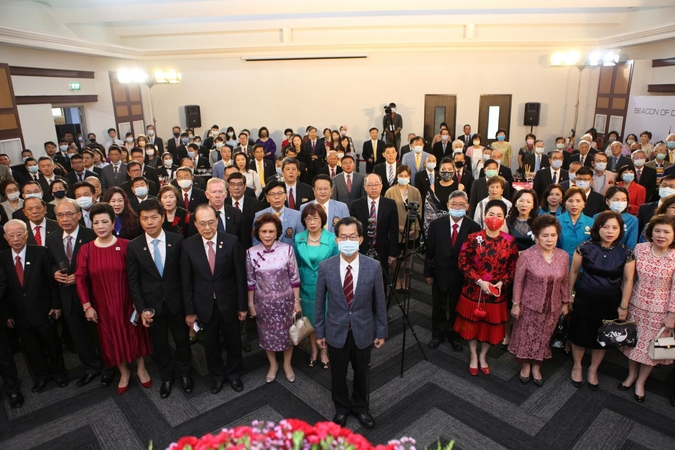
Taiwan celebrated its 109th National Day on Saturday at the Taipei Economic and Cultural Office in Thailand (Office).
Lee Ying-yuan
Lee Ying-yuan, director-general of the Office, presided over the opening ceremony.
More than 150 politicians, executives from various media, overseas Chinese, and Taiwanese businessmen in Thailand attended.
Lee said that in accordance with the Thai government’s preventive measures, the office had to downsize this year’s National Day event.
Lee praised both Taiwan and Thailand for their successful epidemic prevention policies, which can minimise the impact on people’s lives and property.
He said that Taiwan President Tsai Ing-wen had assigned him to serve as a representative of the Taiwanese government in Thailand.
He said more than 5,000 Taiwanese companies operated in Thailand and there are 150,000 overseas Chinese in Thailand. “The investment of Taiwanese businessmen in Thailand is very high. All of them have contributed to the continued growth of Thailand’s economy,” Lee said, adding he intended to continue to join forces with overseas Chinese in building cooperation between Taiwan and Thailand in the post-epidemic era.
Talking about their success in fighting the epidemic, he said Taiwan realised that preventing Covid-19 was a team battle and both the public and private sectors are working together in unity. As a result, Taiwan’s daily mask production is the second highest in the world. He said the government’s effective planning and implementation, along with the cooperation of all people and entrepreneurs, made Taiwan safer today. He said 51 million masks labelled “MIT” had been sent to more than 80 countries, and Taiwan had donated 1.2 million masks to Thailand.
Lee thanked Taiwanese and overseas Chinese businessmen in Thailand for generously donating items for disease prevention, worth up to Bt8 million to various agencies in Thailand under the motto “Taiwan Can Help”, encouraging strong friendship between Taiwan and Thailand.
This year’s Taiwan National Day celebration had three main themes: highlighting the achievements of the Taiwanese government in 2020 in combating the epidemic and international cooperation; democratic governance and Taiwanese unity in passing all obstacles. He said that Taiwan had shown great courage and potential to help other countries and move forward alongside the world.
BGRIM puts B40bn industrial power projects on launch pad
Oct 09. 2020
By The Nation
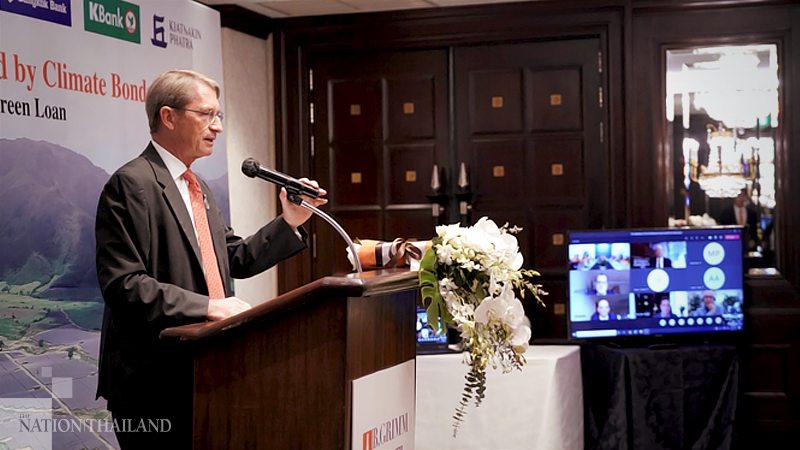
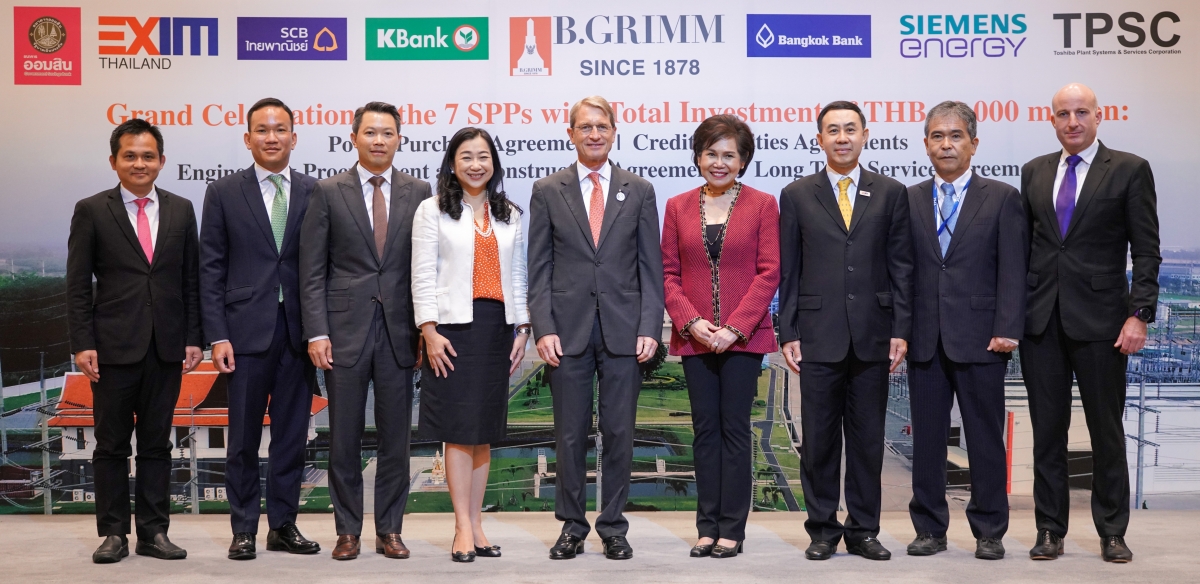
BGrimm Power Plc (BGRIM) is pumping Bt40 billion into seven new power projects with the aim of cementing its status as Thailand’s leading private power producer.
The seven Industrial Power Producer schemes with combined capacity of 980 megawatts have secured financial support from five major banks and will be built by two international constructors.
BGrimm chairman Harald Link said everything was in place to complete the projects, which form part of the company’s plan to build capacity to 7,200MW in the next few years.
The five lenders to the BGrimm projects are Bangkok Bank, Siam Commercial Bank, EXIM Thailand, Kasikornbank and Government Savings Bank.
Construction will be carried out by Siemens Energy Co Thailand and Toshiba Plant Systems and Services Corporation.
Preeyanart Soontornwata, CEO of BGrimm, said that five of the seven power plant projects are replacement facilities under renewed power sale accords.
The two other schemes are new undertakings under the 25-year power sale contracts (PPA) signed with the Electricity Generating Authority of Thailand (EGAT) in August this year.
These projects are primarily aimed at generating quality electricity and steam supplies to promote and attract industrial investment for Thailand’s sustainable economic growth, she said.
Meanwhile, BGrimm said its financial position remains strong with Bt19 billion in cash on hand and robust cash flows derived from operations.
The company said it is exploring new energy investment opportunities at home and abroad to raise its total generation capacity to the targeted 7,200MW.
Krungsri launches cross-border QR payment for Thais in Japan
Oct 09. 2020
By THE NATION
Krungsri (Bank of Ayudhya) has teamed up with Japanese tech giant NTT DATA to launch MyPromptQR – a cross-border QR code payment platform for Thai consumers in Japan.
The collaboration marks another milestone in Krungsri’s “Digital First” strategy, after it last year became the first Thai bank launch a cross-border QR payment system in Japan.
“We are very pleased to work with NTT DATA which facilitates the largest card settlement network in Japan through its established business platform. The Krungsri- NTT DATA synergy has contributed to the success of Krungsri’s journey to capture business opportunities in Japan,” said Sayam Prasitsirigul, acting head of Digital Banking and Innovation Division.
“Equipped with innovative financial know-how together with NTT DATA’s collaboration and by leveraging comprehensive expertise and extensive networks of Krungsri’s parent company, Mitsubishi UFJ Financial Group [MUFG], which is Japan’s largest financial institution and one of the world’s leading financial groups, Krungsri is in a solid position to offer MyPromptQR, a state-of-the-art financial innovation, to better meet diverse demands of its customers internationally and to set a strong foothold in the QR payment in Japan.”
MyPromptQR, Thailand’s first business-scan-consumer cross-border QR code platform in Japan, can be accessed through the Krungsri Mobile App and other banks’ apps. It is designed to make payments faster, more secure and more convenient for both consumers and businesses, cutting out the need to handle cash. Users present their one-time QR code generated on a mobile banking app to merchants to scan for payment, without the need to enter the amount.


 Chairwoman and Group CEO Jareeporn Jarukornsakul, centre
  Kaysarin Angkanurakbun
 AIS CEO Somchai Lertsutiwong, left, and Kobkarn Wattanavrangkul, chairperson of Bangkadi Industrial Park, pose after signing an MoU on providing 5G solutions to factories based at the park.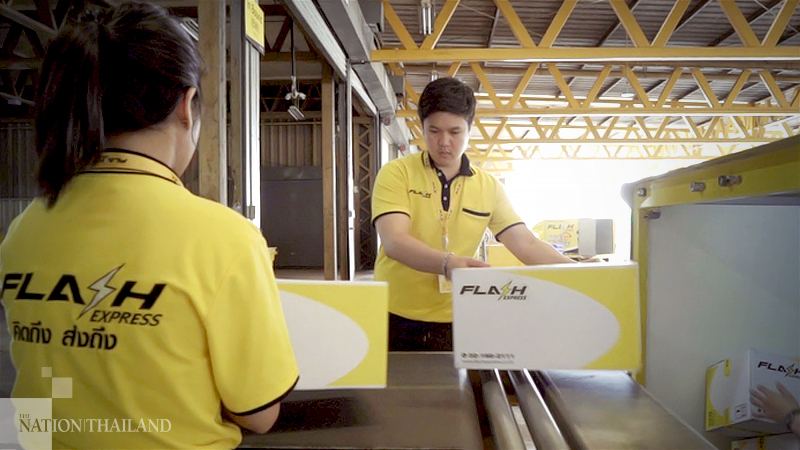


 SootinClaimon.Com