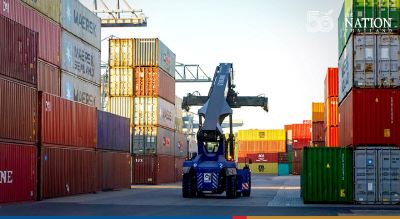
With the economies of most major trading partners like the US, China, European Union and Japan showing signs of recovery, the Thai National Shippers’ Council (TNSC) believes exports will grow by 12 per cent in the last quarter.
TNSC chairman Chaichan Charoensuk said if the Covid-19 outbreak can be controlled then Thailand can expect to earn up to US$22 billion from exports in the last three months of the year.
However, he warned export growth may be affected if the authorities are unable to contain the virus and fully inoculate at least 50 million people by yearend.
Another obstacle is the rising freight rate, which may remain high until the end of 2022 especially for shipments to the EU and US. Also, additional costs such as peak season surcharge (PSS) may affect the cost of goods, as will the shortage of containers and storage space.
The Stock Exchange of Thailand (SET) Index closed at 1,624.24 on Tuesday, up 9.76 points or 0.60 per cent. Transactions totalled 88.96 billion baht with an index high of 1,626.44 and a low of 1,611.42.
The index rose for the second day running after rising almost 1 per cent on Monday.
In the morning session, Krungsri Securities predicted the day’s index would fluctuate between 1,605 and 1,625 points despite rising oil price after the Opec+ panel recommended proceeding with gradual supply hikes.
ADVERTISEMENT
It added that the index also gained positive sentiment from rising coal price and hopes over Thailand reopening after the domestic Covid-19 cases continued to decline.
“However, uncertainty over higher inflation that would trigger the US Federal Reserve to taper its quantitative easing and raise the interest rate sooner than expected would pressure the index’s fund flow,” Krungsri Securities said.
The 10 stocks with the highest trade value today were SVT, KBANK, AOT, TRUE, GULF, BANPU, GUNKUL, CPALL, PTTEP and PTT.
Other Asian indices were mixed: Japan’s Nikkei Index closed at 27,822.12, down 622.77 points or 2.19 per cent. Hong Kong’s Hang Seng Index closed at 24,104.15, up 67.78 points or 0.28 per cent. South Korea’s KOSPI Index closed at 2,962.17, down 57.01 points or 1.89 per cent. Taiwan’s TAIEX Index closed at 16,460.75, up 52.40 points or 0.32 per cent.
China’s Shanghai SE Composite and Shenzhen SE Component Indices were closed for National Day.
The Thailand Privilege Card Co is launching a new “Elite Flexible One” campaign, which will make it easier for foreigners to buy property in the country. A separate “Welcome Back to Amazing Paradise” campaign has been launched to bring back existing elite cardholders, so they can contribute to the revival of the economy.
Thailand Privilege Card Company Limited under the supervision of the Tourism Authority of Thailand (TAT), launched the “Elite Flexible One” project and “Welcome back to Amazing Paradise” campaign on Monday in a bid to respond to the government’s policy to build confidence in the eyes of foreigners amid the Covid-19 pandemic.
The elite card programme offers the opportunity to obtain a long-term multiple entry visa and affords members the right to live in Thailand for up to 20 years with selections of additional complementary services and benefits. The company revealed that there are currently 14,476 cardmembers, as of the data collected until August 31.
The company said that the “Elite Flexible One” project has been set up to help support the real estate business to attract foreign investors, including foreigners who have purchasing power and are interested in a long-term stay in the kingdom.
The company also launched the campaign “Welcome back to Amazing Paradise” to encourage foreign members to travel to the country and stay for a long time through the Phuket Sandbox programme. The campaign is aimed to boost the tourism sector in line with the TAT strategy.
The baht opened at 33.79 to the US dollar on Tuesday, unchanged from the previous closing rate.
The Thai currency is likely to move between 33.70 and 33.90 during the day, Krungthai Bank market strategist Poon Panichpibool predicted.
Poon said that investors started to worry about inflation more due to the price increasing of crude oil or natural gas, which pressured the baht to weaken. The cost and transportation of goods will be high if the energy prices stay high with the supply chain problem. It will also cause a trade balance deficit and current account deficit.
ADVERTISEMENT
The baht is also supported by the gold price increasing which causes investors to sell.
However, the baht will not strengthen clearly soon in the short term.
Poon added that the baht might test the key resistance level of 34.00 to the dollar if the dollar strengthens. The dollar might strengthen if the employment data from NFP on Friday is great.
The price of gold surged by THB250 in morning trade on Tuesday.
AGold Traders Association report at 9.31am said the buying price of a gold bar was THB28,150 per baht weight and selling price THB28,250, while the buying and selling price of gold ornaments is THB27,636.68 and THB28,750, respectively.
At close on Monday, the buying price of a gold bar was THB27,900 per baht weight and selling price THB28,000, while gold ornaments were THB27,394.12 and THB28,500, respectively.
ADVERTISEMENT
The spot gold price on Tuesday morning hovered around US$1,764 (THB59,640) per ounce after Comex gold at close on Monday rose by $9.2 to $1,767.6 per ounce due to support from the depreciation of the US dollar, including buying gold as a safe-haven asset after the fall of the US stock market.
The Stock Exchange of Thailand (SET) Index rose by 0.44 points or 0.03 per cent to 1,614.92 on Tuesday morning, witnessing a high of 1,617.09 and a low of 1,611.42 in opening trade.
Krungsri Securities predicted the day’s index would fluctuate between 1,605 and 1,625 points despite rising oil price after the Opec+ panel recommended proceeding with gradual supply hikes.
It added that the index also gained positive sentiment from rising coal price and hopes over Thailand reopening after the domestic Covid-19 cases continued to decline.
ADVERTISEMENT
“However, uncertainty over higher inflation that would trigger the US Federal Reserve to taper its quantitative easing and raise the interest rate sooner than expected would pressure the index’s fund flow,” Krungsri Securities said.
It also recommended buying of the following companies’ shares as an investment strategy:
▪︎ PTT, PTTEP, TOP, PTTGC, SPRC and IVL, which benefit from rising oil price.
▪︎ Banpu and Lanna, which benefit from rising coal price.
▪︎ AOT, KBank, SCB, BBL, CPN, CRC, HMPro, AAV, BA, MINT, Amata and WHA, which benefit from the country reopening.
The SET Index closed at 1,614.48 on Monday, up 9.31 points or 0.58 per cent. Transactions totalled 78.69 billion baht with an index high of 1,619.62 and a low of 1,610.96.
The Oil Fuel Fund is currently in deficit for over Bt17 billion due to liquefied petroleum gas (LPG) subsidy scheme that will last until December this year, said Energy Minister Supattanapong Punmeechaow on Monday after a meeting with the Energy Policy Administration Committee that he chairs.
The scheme has been using a budget of Bt1.4 billion per month to fix the LPG price at Bt318 per 15kg. canister since March 2020 in a bid to help alleviate people’s financial burden. Only LPG for household use will be subsidised.
“The committee has agreed to separate the LPG’s and oil fuel’s accounts from each other to efficiently manage the Oil Fuel Fund,” he said. “It is also planning to propose to the National Economic and Social Development Council (NESDC) to approved additional budget from the government’s Bt500 billion emergency loan, which should help the scheme to continue from October 2021 up to January 2022.”
Supattanapong further added that he has tasked EGAT (Electricity Generating Authority of Thailand) and PTT Plc to find an alternative for liquefied natural gas (LNG) that has been used as a fuel for domestic electricity generating after the price of LNG in global spot market has increased by $32-34 per million BTUs. “The Ministry will try to keep the cost of electricity generating low as much as possible to avoid creating burden to electricity users,” he added.
The World Trade Organization raised its projection for global trade growth in 2021 and 2022 to 10.8% and 4.7%, respectively, citing the resurgence of economic activity in the first half of the year.
This year’s increase in merchandise trade would mark the biggest year-over-year jump since 2010. In March, the WTO projected that trade would increase by 8% in 2021 and 4% in 2022.
“Trade has been a critical tool in combating the pandemic, and this strong growth underscores how important trade will be in underpinning the global economic recovery,” WTO Director-General Ngozi Okonjo-Iweala said in a report released on Monday.
ADVERTISEMENT
The report warned, however, that uneven access to vaccines could exacerbate economic divergence.
“The longer vaccine inequity is allowed to persist, the greater the chance that even more dangerous variants of covid-19 will emerge, setting back the health and economic progress we have made to date,” Okonjo-Iweala said.
The WTO said the pandemic continues to present the biggest risk to the recovery in global trade and output.
To date, more than 4.7 million people worldwide have died of covid-19 and the number of global infections has passed 233 million, according to the World Health Organization.
The WTO also warned about the risks of an inflationary spike, which could persuade central banks to taper their expansive monetary policy early. “This could create negative spillovers, which would eventually hit trade flows,” according to the report.
The report added that the recent rise in inflation is “probably temporary, driven by supply-side shocks affecting certain sectors in specific economies balanced against the unexpectedly strong recovery in demand.”
The WTO’s optimistic projections could also be hampered by “longer port delays, higher shipping rates, and extended shortages of semiconductors, with supply side disruptions being exacerbated by the rapid and unexpectedly strong recovery of demand in advanced and many emerging economies.”
Gross domestic product fell 3.8% in 2020 and may expand by 5.3% this year and 4.1% in 2022, the WTO said. GDP growth has been “spurred on by strong monetary and fiscal policy support, and by the resumption of economic activity in countries that have been able to deploy coronavirus vaccines at scale,” according to the report.
U.S. stocks declined Monday as a sell-off in technology stocks resumed on the threat of persistently high inflation.
The S&P 500 fell 1.3% — dipping below its 100-day moving average — while the Nasdaq 100 shed 2.2% and the Dow Jones industrial average slid 0.9%.
The losses were led by high-growth technology companies — including Amazon.com Inc. and Facebook Inc. — while vaccine makers also fell on Merck & Co.’s announcement about an effective Covid-19 drug. Energy stocks, meanwhile, rose along with oil prices.
ADVERTISEMENT
“There’s a wall of worry that markets are trying to climb at the moment,” said Deutsche Bank strategist Jim Reid in a note. “We have an energy crisis, supply chain issues, higher inflation, signs of weaker growth, and lots of talk about stagflation.”
Global markets have taken a risk-off turn amid a growing list of worries, just as investors have been bracing for the Federal Reserve to begin tapering stimulus as early as next month. Higher inflation and Treasury yields make the premium investors pay for high-growth stocks less attractive. The risk to earnings may also be higher for some tech companies.
“Technology stocks are most likely getting hit the hardest because higher interest rates means higher discount rates for future earnings,” said Brian Price, head of investment management for Commonwealth Financial Network. “I would expect this dynamic to continue as long as inflation expectations remain at the higher end.”
Fears of a spreading energy crisis also added to concerns about inflation Monday with European power and gas prices surging before the onset of winter. The power contract for November in Germany hit a record while natural-gas futures extended a rally. Meanwhile, crude oil in New York surged to the highest since 2014 as OPEC+ agreed to an output hike for November.
“The post-pandemic recovery appears to be stumbling,” said Fiona Cincotta, senior financial markets analyst at City Index. “Supply shortages and a worsening energy crunch mean prices are rising and elevated inflation may not be as transitory as the Fed initially thought.”
President Joe Biden warned Monday that the U.S. government was also at risk of breaking its legal debt limit, describing the risk as a “meteor” headed for the economy.
The yield on the U.S. 10-year Treasury rose to 1.48%, paring back earlier gains. The dollar slid for a third day. And equities in Europe, Japan and Hong Kong fell.
Some of the main moves in markets:
Stocks
– The S&P 500 fell 1.3% as of 4 p.m. EDT
– The Nasdaq 100 fell 2.2%
– The Dow Jones industrial average fell 0.9%
– The MSCI World index fell 1%
Currencies
– The Bloomberg Dollar Spot Index fell 0.2%
– The euro rose 0.2% to $1.1621
– The British pound rose 0.5% to $1.3613
– The Japanese yen rose 0.1% to 110.93 per dollar
Bonds
– The yield on 10-year Treasurys advanced two basis points to 1.48%
– Germany’s 10-year yield advanced one basis point to -0.21%
– Britain’s 10-year yield was little changed at 1.01%
Commodities
– West Texas Intermediate crude rose 2.2% to $77.54 a barrel
Oil in New York rose to the highest since 2014 as an OPEC+ panel recommended proceeding with gradual supply hikes amid a rapidly tightening market.
Futures jumped as much as 1.8% after the Joint Ministerial Monitoring Committee advised a 400,000-barrel-a-day increase in November, several delegates said. The meeting will be followed by a full ministerial gathering to review the recommendation.
The market has tightened significantly following the economic recovery from the pandemic and supply disruption in the Gulf of Mexico due to Hurricane Ida. Surging natural gas prices have also raised the prospect of increased demand for oil products for power generation and are boosting inflationary pressures on the global economy.
ADVERTISEMENT
Modeling from the Organization of Petroleum Exporting Countries and its allies shows oil demand will outstrip supply over the next two months. Yet the alliance is unlikely to add more than the planned 400,000 barrels a day of output in November, Amrita Sen, chief oil analyst and co-founder of consultant Energy Aspects, said earlier.
“I’m not saying they won’t add more than 400,000 barrels a day down the line, but for today we think that’s unlikely,” Sen said in an interview with Bloomberg Television. “Saudi Arabia is very, very keen to reduce volatility, both on the upside and the downside. That’s the key. If suddenly prices spiked, then they’ll be very quick to react.”
OPEC+ production policy will be the main factor influencing oil prices over the coming months, according to Vitol Group. There’s little chance of Iranian barrels returning this year and U.S. shale producers aren’t investing enough to raise output quickly, Mike Muller, head of Asia for the oil trading house, said Sunday in a webinar hosted by Dubai-based consultant Gulf Intelligence.
Fuel switching due to high coal and gas prices is likely to drive up oil demand by 500,000 barrels a day this winter, Sri Paravaikkarasu, head of Asia oil at consultant FGE, told Bloomberg Television. A cold winter could see consumption climb by a further 200,000 to 300,000 barrels a day, she added.