Gold price continues to plunge as investors turn to risk assets #SootinClaimon.Com

#SootinClaimon.Com : ขอบคุณแหล่งข้อมูล : หนังสือพิมพ์ The Nation.

Gold price continues to plunge as investors turn to risk assets (nationthailand.com)

Gold price continues to plunge as investors turn to risk assets

EconNov 30. 2020

By The Nation

The price of gold dropped by Bt100 per baht weight in morning trade on Monday after falling by Bt250 per baht weight at close on Saturday, the Gold Traders Association reported.

Thailand’s gold price dropped sharply by Bt1,150 per baht weight last week, the lowest in over five months.

As of 9.21am, the buying price of a gold bar was Bt25,500 per baht weight and selling price Bt25,600, while gold ornaments were priced at Bt25,044.32 and Bt26,100, respectively.

At close on Saturday, the buying price of a gold bar was Bt25,600 per baht weight and selling price Bt25,700, while gold ornaments cost Bt25,135.28 and Bt26,200, respectively.

Spot gold price moved to US$1,781 (Bt53,930) per ounce in the morning, while the Comex (Commodity Exchange) gold price to be delivered in February next year dropped by $23.1 to $1,788.1 per ounce on Friday as investors turned from safe-haven assets to risk assets that generate higher returns, such as stocks that benefit from positive news of a Covid-19 vaccine.

Hong Kong gold price meanwhile dropped by HK$230 to $16,490 (Bt64,424) per tael, the Chinese Gold and Silver Exchange Society reported.

Number of firms seeking BoI benefits for improving production processes jumps 23% this year #SootinClaimon.Com

#SootinClaimon.Com : ขอบคุณแหล่งข้อมูล : หนังสือพิมพ์ The Nation.

Number of firms seeking BoI benefits for improving production processes jumps 23% this year (nationthailand.com)

Number of firms seeking BoI benefits for improving production processes jumps 23% this year

EconNov 30. 2020

By The Nation

The number of companies seeking tax incentives offered by the Board of Investment (BoI) for improving their production efficiency rose 23 per cent to 138 applications in the first nine months of this year, BoI deputy secretary-general Narit Therdsteerasukdi said.

The companies’ investment in boosting their production efficiency has jumped 18 per cent to Bt15.19 billion. The changes range from the adoption of renewable energy to the use of new machinery and automated processes.

This shows that investors have placed importance in boosting their production capacity to enhance their competitive edge, he added.

The total number of projects applying for BoI tax privileges in the same period edged up 1 per cent year-on-year to 1,098. While the total value of projects applying for tax benefits dropped 15 per cent to Bt223.7 billion, Narit still considers the number high.

From the time when the US-China trade war began in 2018 up until September this year, there have been 190 foreign projects worth a total of Bt100 billion applying to relocate to Thailand.

Most of these projects are in the industries of auto parts, car tyres, electric and electronic home appliances, furniture and luggage.

Number of mobile food entrepreneurs doubles in 10 months #SootinClaimon.Com

#SootinClaimon.Com : ขอบคุณแหล่งข้อมูล : หนังสือพิมพ์ The Nation.

Number of mobile food entrepreneurs doubles in 10 months (nationthailand.com)

Number of mobile food entrepreneurs doubles in 10 months

EconNov 30. 2020

By The Nation

The number of new mobile food operators, including stalls and food trucks, doubled during the first 10 months of this year, according to the Department of Business Development.

Their total registered capital was Bt10 million, up 236.67 per cent year on year, said deputy director general Sorada Lertarpachit.

Most of the operators are Thais but more foreigners are now entering the business.

Govt mulling property fund to raise loan money for tourism operators #SootinClaimon.Com

#SootinClaimon.Com : ขอบคุณแหล่งข้อมูล : หนังสือพิมพ์ The Nation.

Govt mulling property fund to raise loan money for tourism operators (nationthailand.com)

Govt mulling property fund to raise loan money for tourism operators

EconNov 30. 2020

By The Nation

The Finance Ministry and state agencies are discussing the possibility of setting up a property fund to support loans for tourism and airline operators to combat the impact of Covid-19, said a Government House source.

The discussion concerns the size of the fund and related regulations as well as potential demand from investors, the source added.

Business operators may be allowed to use their assets, such as hotels, as collateral to back their loans from the fund, said the source.

Thai tourism operators are struggling with the Covid-19 fallout and absence of foreign tourists, with some finding it difficult to access bank loans.

To attract investors, the fund should offer a higher interest rate than banks’ deposit rate, the source said.

Limited upside room for SET in December this year, experts say #SootinClaimon.Com

#SootinClaimon.Com : ขอบคุณแหล่งข้อมูล : หนังสือพิมพ์ The Nation.

Limited upside room for SET in December this year, experts say (nationthailand.com)

Limited upside room for SET in December this year, experts say

EconNov 30. 2020

By The Nation

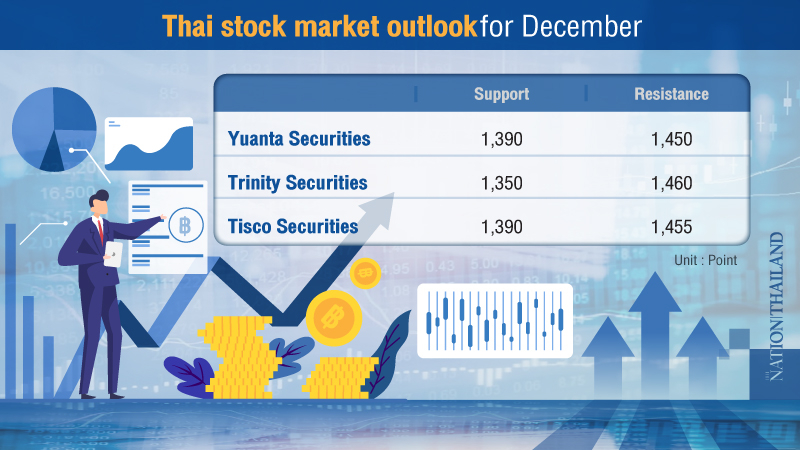
Brokerage firms expect the Stock Exchange of Thailand (SET) to move in a narrow range in December this year.

Yuanta Securities (Thailand) strategist Natapon Khamthakrue expected the SET to move between 1,390 and 1,450 points amid hopes of foreign funds inflows, recovery in SET-listed companies’ performance, progress in developing a Covid-19 vaccine, rising oil price and the government’s economic stimulus measures.

He advised investors to buy stocks in laggard groups that pay high dividends, such as KKP and BBL, stocks that benefit from the Covid-19 vaccine development such as SHR and III, and stocks that will benefit from the government’s move to promote electric vehicles next year, such as CWT and NYT.

“The SET would face volatility after skyrocketing from positive news of a Covid-19 vaccine, so investors can buy stocks when the index falls to 1,370 points,” he said.

“If the political situation doesn’t escalate, we expect foreign funds to flow into the SET, as the index is still underperforming compared to other Asian indices.”

Trinity Securities research analyst Nuttachart Mekmasin expected the SET to move between 1,350 and 1,460 points amid mass buy-ups in value stocks.

He added that there was limited upside room for the SET due to high valuation, while foreign investors would sell risk assets to hold bonds at the end of this year.

“Investors should follow international factors, such as central banks’ meetings on December 15-16, as the stock market expects an additional quantitative easing programme, and the Opec+ move to not extend the cut in oil production would impact Thai stocks,” he said. He added that domestic political turmoil would pressure the index periodically.

For short-term investors, he advised speculating profits from value stocks, such as PTTGC, PTTEP and IVL, while warning that they should stop loss when the stock market faces a correction.

“For long-term investors, we advise monitoring the situation because the index may fall below 1,400 points and that would be an opportunity to buy stocks in the laggard group and those that benefit from the Covid-19 outbreak, such as STGT, KCE and XO,” he said.

Senior Tisco Securities strategist Apichat Poobunjirdkul expected the SET to fluctuate between 1,390 and 1,455 in December this year, as foreign investors would slow down their investment during the long holiday.

“Meanwhile, we have to follow the central banks’ meeting on whether they will maintain their monetary policies or not, and news of a Covid-19 vaccine on whether it would be approved by the middle of next month or not,” he said, adding that he didn’t expect the domestic political situation to cause an impact on the index.

He advised investors to make selective buys of stocks in laggard groups that pay 3-4 per cent dividend annually, as well as energy stocks such as KKP, EGCO and RATCH.

“However, the index would face correction due to the tight share prices until next year, so buying stocks when the index falls below 1,400 points would be a good option as well,” he added.

Tony Hsieh, entrepreneur who made Zappos an online retail giant, dies at 46 #SootinClaimon.Com

#SootinClaimon.Com : ขอบคุณแหล่งข้อมูล : หนังสือพิมพ์ The Nation.

Tony Hsieh, entrepreneur who made Zappos an online retail giant, dies at 46 (nationthailand.com)

Tony Hsieh, entrepreneur who made Zappos an online retail giant, dies at 46

CorporateNov 29. 2020Tony Hsieh, chief executive officer of Zappos, speaks at the Skybridge Alternatives conference in Las Vegas, Nevada, on May 18, 2017. MUST CREDIT: Bloomberg photo by David Paul MorrisTony Hsieh, chief executive officer of Zappos, speaks at the Skybridge Alternatives conference in Las Vegas, Nevada, on May 18, 2017. MUST CREDIT: Bloomberg photo by David Paul Morris 

By The Washington Post · Matt Schudel · NATIONAL, BUSINESS, WORLD, FEATURES, OBITUARIES, FASHION 
Tony Hsieh, an e-commerce entrepreneur who built Zappos into an online shoe and clothing retail giant and became an influential figure in technology and management circles, before stepping down as chief executive in August, died Nov. 27. He was 46.

His death was announced in a statement by Zappos chief executive Kedar Deshpande. 

Hsieh was reported injured in a house fire on Nov. 18 while visiting family members in New London, Conn. New London Fire Chief Thomas Curcio told the Day newspaper in Connecticut that firefighters rescued a victim trapped in a waterfront house. The victim, not specifically identified as Hsieh, was flown by helicopter to the burn unit of a hospital in Bridgeport, Conn.

In 1995, Hsieh (pronounced “shay”) was a recent Harvard graduate when he and a college friend, Alfred Lin, founded Link Exchange, an online advertising company. They sold the business to Microsoft in 1998 for $265 million. 

Hsieh, then 24, launched a venture capital firm with Lin and became an early investor in OpenTable, the online restaurant reservation company. In 1999, he invested in a San Francisco online retailer called ShoeSite.com, founded by Nick Swinmurn. Hsieh took over as chief executive, with Lin becoming chief operating officer. 

They changed the company name to Zappos – derived from the Spanish word for shoes, “zapatos” – and made it into an innovative and far-reaching company. Zappos became the country’s largest online shoe store before expanding into clothing, jewelry and other items. 

Hsieh overcame customer skepticism about buying shoes online by offering free shipping and returns. Drawing on a sense of idealism and community spirit, he adopted an approach built on exceptional customer service while attempting to make Zappos an inviting place to work. 

Salaries were often less than those at other tech companies, but employees enjoyed generous benefits, including full health-care coverage, free lunches and on-site chiropractors and life coaches, ready to dispense a hug.

“It was about: What kind of company can we create where we all want to be there, including me?” Hsieh told the New Yorker in 2009. “How can we create such a great environment, where employees get so much out of it that they would do it for free?”

He put considerable emphasis on building a corporate culture that put people first, with one of the company’s core values being to “create fun and a little weirdness.” One of Hsieh’s greatest talents, colleagues said, was his ability to observe human behavior and judge character. Zappos was often cited as one of the country’s best places to work.

“We believe that a company’s culture and a company’s brand are really just two sides of the same coin,” Hsieh told the Las Vegas Review-Journal in 2009. “If you get the culture right, then most of the other stuff will happen on its own.”

Zappos grew quickly but was not immediately profitable. At one point, Hsieh paid himself a monthly salary of $2. In 2004, he moved the Zappos headquarters from San Francisco to Henderson, Nev. He sold his house to help finance an 800,000-square-foot warehouse in Kentucky, equipped with robots and high-tech equipment to ship packages to customers. 

The quickly growing company did not reach profitability until 2006, but by 2008 it recorded $1 billion in sales, two years ahead of schedule. In 2009, Zappos was bought by Amazon (whose founder and CEO, Jeff Bezos, owns The Washington Post) for $1.2 billion. Hsieh had stayed on as chief executive until August.

“Your curiosity, vision, and relentless focus on customers leave an indelible mark,” Bezos wrote on Instagram. “You will be missed by so many, Tony.”

In 2009, Hsieh launched a $350 million program called the Downtown Project, in an effort to transform Las Vegas into a vibrant hub for technological innovation and an enjoyable place to live. His company moved its headquarters into the old Las Vegas city hall.

“It’s the Downtown Project’s big bet that a focus on collisions, community, and colearning will lead to happiness, luckiness, innovation, and productivity,” Hsieh told Wired magazine in 2014. “It’s not even so big a bet. Research has been done about this on the office level. It’s just never really been applied in a consolidated way to a city revitalization project.”

To Hsieh, Zappos was more than an online store. He often used the term “movement” to describe the company and its non-hierarchical organizational structure. 

He became one of the country’s most popular speakers at corporate conferences, delivering a message that was part business executive, part self-help and part canvas-tent revival preacher.

“What would you be passionate about doing, even if you never made a dime?” he told one group in 2009. “What is your goal in life? For almost everyone, it comes down to happiness.” Then, with a yellow smiley face depicted on the screen behind him, he asked, “What if you could go straight to the happiness?”

His supporters and co-workers sometimes called themselves Zapponians, but as with any idealistic society, there was inevitably some grit and disillusionment clouding the golden fantasy. Swinmurn, who founded the forerunner of Zappos, left the company in 2006, saying he was fed up with “meetings about meetings.” 

Lin, Hsieh’s friend who was the chief operating officer, departed soon after the company was bought by Amazon. Others noted that the Zappos culture was dominated by young men and revolved around trips to local bars – where Hsieh joined the crowd in knocking back shots of whiskey or vodka.

The company did not hire its first top female executive, a chief financial officer, until 2016.

In 2014, Hsieh dispensed with managers in a new organizational structure called “holacracy,” in which employees defined their own jobs and worked in corporate “circles.” Employees who didn’t buy in to the new system were told to take a buyout. Almost 20 percent of them did just that and left the company. 

The Downtown Project in Las Vegas also began to struggle, and Hsieh relinquished his role as leader. Several of the high-tech firms he had helped lure to Las Vegas shut down when the venture capital ran out. 

Nonetheless, Hsieh hoped that the Zappos business and “movement” he had created would survive after he left the company. 

“For any company or movement or religion or whatever, if there’s one person that personifies it then that puts that company or vision at risk, if the person, say, dies,” he said in 2009. “What’s going to happen to Apple if something happens with Steve Jobs? That’s why it needs to be about a movement, not about a person or even a specific company.”

Anthony Chia-Hua Hsieh was born Dec. 12, 1973, in Urbana, Ill. He was 5 when his family moved to Marin County, Calif. His father was a chemical engineer, his mother a neuropsychologist. 

As a child, Hsieh skipped practicing the piano and violin by recording himself, then playing the tapes to deceive his parents. As a student at Harvard, he started his first company, delivering late-night pizzas to students. He later learned that Lin, his future business partner, resold the pizzas by the slice to other students.

“That’s why he’s our CFO and COO today at Zappos,” Hsieh later said.

Hsieh had two brothers, but a complete list of survivors could not be confirmed. 

After receiving a bachelor’s degree in computer science in 1995, Hsieh moved to San Francisco, working briefly for Oracle before launching Link Exchange. When the company grew too large, Hsieh said he lost interest, vowing that his next business would be a place where people would love working.

It was just happenstance that Zappos sold shoes. 

“I’ve never been into shoes – and I’m still not,” he told the New Yorker in 2009. When what kind of shoes he was wearing, he looked at his feet and said, “Just . . . sneakers.”


Slew of factors to impact stocks, baht and gold next week #SootinClaimon.Com

#SootinClaimon.Com : ขอบคุณแหล่งข้อมูล : หนังสือพิมพ์ The Nation.

Slew of factors to impact stocks, baht and gold next week (nationthailand.com)

Slew of factors to impact stocks, baht and gold next week

EconNov 28. 2020

By The Nation

Investors have been advised to follow key domestic and international developments as a mix of these would impact the Stock Exchange of Thailand (SET) Index, the baht and gold price next week.

The SET Index on Friday closed at 1,437.78, up 4.22 points or 0.29 per cent, with transactions amounting to Bt77.32 billion, buoyed by positive news of a Covid-19 vaccine.

Institutional investors and securities accounts made net buys of Bt1.66 billion and Bt1.43 billion respectively, while foreign and individual investors made net sales of Bt498.52 million and Bt2.60 billion respectively.

An analyst at Kasikorn Securities expected the SET next week to move between 1,430 and 1,470, advising investors to follow the Thai government’s economic stimulus measures and the political situation, as well as the Covid-19 crisis, Brexit and the Opec+ meeting.

The baht closed at 30.29 to the US dollar on Friday.

A strategist at Kasikorn Research Centre expected the baht next week to move between 30.00 and 30.40 to the dollar. He advised investors to follow the Fed’s statement, the currency market’s response to president-elect Joe Biden’s economic team, the Covid-19 crisis, China and the euro-zone’s manufacturing and service purchasing managers’ index.

Gold price on Friday closed at US$1,810.13 per ounce, while in Thailand it closed at Bt25,950 per baht weight.

An analyst at YLG Bullion International said there was limited upside for the price to rise amid hopes of AstraZeneca’s Covid-19 vaccine.

He said if gold price cannot rise above the resistance line between $1,818 and $1,821 per ounce, the price would fall to the support line between $1,794 and $1,800 per ounce.

“However, the price would rise to $1,833 per ounce if it can rise through the current resistance line, so we advise investors to buy the precious metal when the price falls and sell some of it when the price rises,” he said.

ESG playing bigger role in rating debt issuers in emerging markets: Moody’s #SootinClaimon.Com

#SootinClaimon.Com : ขอบคุณแหล่งข้อมูล : หนังสือพิมพ์ The Nation.

ESG playing bigger role in rating debt issuers in emerging markets: Moody’s (nationthailand.com)

ESG playing bigger role in rating debt issuers in emerging markets: Moody’s

Nov 27. 2020

By The Nation

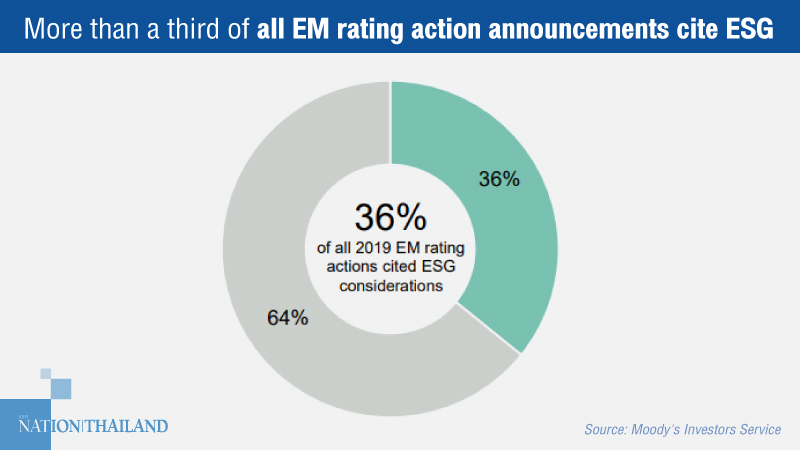
Moody’s Investors Service reports that 36 per cent of its nearly 1,800 ratings of debt issuers in emerging markets in 2019 involved material environmental, social and governance (ESG) considerations, dominated by governance considerations. “

ESG risks are often higher in emerging markets [EMs] than they are in developed markets, while issuers’ capacity to respond to these risks is often also weaker,” said Nishad Majmudar, a Moody’s analyst.

“We expect ESG considerations to become even more material to debt issuers’ credit quality globally – and particular in EMs – given the range and rise of ESG risks such as climate change and public health,” added Majmudar.

Of the nearly 1,800 rating action announcements Moody’s published in 2019 for both private- and public-sector debt issuers in emerging markets (EMs), 36 per cent contained references to material ESG considerations, with many containing multiple references. Cited most often by far was governance, followed by social and then environmental considerations. For public-sector rating actions, environmental and social considerations became more prevalent in 2020 and will continue to rise, said Moody’s.

It added that ESG is more often cited in emerging market public-sector rating actions (65 per cent). This reflected generally weaker institutions and thinner buffers against environmental and social risks in EMs than in developed markets, said the ratings agency. Meanwhile about one-third of private-sector EM announcements cited ESG considerations. Moody’s cited governance four times as often as environmental considerations and nearly six times as often as social considerations. The ESG citations spanned a range of sectors, indicating ESG’s importance and pervasiveness as a credit consideration. Asia-Pacific, and specifically China, account for most citations.

The company said most rating actions citing ESG are directionally neutral. About 65 per cent were affirmations of an existing rating or issuance of a new rating. About 21 per cent were negative rating or outlook actions and 14 per cent were positive. Nearly half of the negative actions were downgrades and about 75 per cent of the negative actions cited environmental considerations.

Dtac and WHA Group leading Thai industry’s 5G drive #SootinClaimon.Com

#SootinClaimon.Com : ขอบคุณแหล่งข้อมูล : หนังสือพิมพ์ The Nation.

Dtac and WHA Group leading Thai industry’s 5G drive (nationthailand.com)

Dtac and WHA Group leading Thai industry’s 5G drive

Nov 27. 2020

By THE NATION

Dtac and WHA Group are showcasing 5G smart water and smart energy management solutions at “5G WHA Smart Ecosystem” exhibitions in Thailand and Southeast Asia.

The 5G solutions support industrial businesses in WHA industrial estates to drive growth through efficient management of infrastructure, energy and resources.

Meanwhile dtac is highlighting 5G Smart Water Management that enables remote and real-time monitoring of pH levels and chemical residues in wastewater. It also facilitates timely management of wastewater levels in ponds to mitigate overflow in the industrial estate. The system is currently being tested in the WHA Eastern Industrial Estate (Map Ta Phut).

The 5G Smart Energy Management enables real-time monitoring and control via live video streaming, contributing to increased safety and lowered costs.

Pictured at dtac’s booth at the 5G WHA Smart Ecosystem exhibition are: Rajiv Bawa (fifth left), chief business officer of Total Access Communication (dtac); Narit Duangkruaratichote (second left), dtac head of IoT and B2B Solutions; Jareeporn Jarukornsakul (centre), chairman and Group CEO, WHA Corporation; David Nardone (sixth left); group executive Industrial and International, WHA Industrial Development; and Kraitos Ongchaisak (third left), CEO, WHA Infonite Co Ltd.

Markets wrap: U.S. stocks rise to record; Treasuries advance #SootinClaimon.Com

#SootinClaimon.Com : ขอบคุณแหล่งข้อมูล : หนังสือพิมพ์ The Nation.

Markets wrap: U.S. stocks rise to record; Treasuries advance (nationthailand.com)

Markets wrap: U.S. stocks rise to record; Treasuries advance

EconNov 28. 2020

By Syndication Washington Post, Bloomberg · Vildana Hajric · NATIONAL, BUSINESS, US-GLOBAL-MARKETS

U.S. stocks rose in to a record in thin post-holiday volume as investors assessed valuations with pandemic still raging in parts of Europe and the U.S. Oil retreated amid rising tensions among OPEC+ members.

The S&P 500 closed at an all-time high after rallying 11% in November. Trading volume was only 60% of the average over the past year. The Nasdaq 100 index jumped 0.8%. The stock market closed at 1 p.m. in New York, while bond trading ends an hour later. Treasuries advanced and the dollar headed for a second weekly decline.

“If you start looking out over the horizon, there are a lot of things that have lined up incredibly well,” said Mark Stoeckle, a Boston-based fund manager at Adams Funds with $2.5 billion of assets. “You have the vaccines, you have a plan to get them out, you’ve got incredibly low interest rates for likely a very long time.”

The Stoxx Europe 600 index edged higher. The dollar weakened versus major peers. The 10-year Treasury yield slipped below 0.84%.

Global stocks are on track for the best month on record, up 13%, and that’s lifted valuations to near the highest in about 20 years. Still, sentiment remains fragile as the virus toll continues to rise in Europe and the U.S., while economic recoveries wobble. Investors are pinning their hopes on a swift rollout of vaccines, but the logistical challenges are considerable.

“To see whether the market will continue to have legs we will have to have confirmation of those vaccine hopes,” Nannette Hechler-Fayd’Herbe, Credit Suisse’s chief investment officer for international wealth management and global head of economics and research, said in an interview with Bloomberg TV. “So very quickly now we want to see approvals, we want to see production outlooks as far as the vaccines’ broader distribution is concerned.”

Political clarity has also driven risk assets this month, as President-elect Joe Biden continues his transition to power. President Donald Trump said he’ll relinquish power if the Electoral College affirms Biden’s win, but he signaled he may never formally concede defeat, and may skip the Democrat’s inauguration.

In China, data showed profits at industrial enterprises surged at the fastest pace in a single month in almost nine years in October, a further sign the country’s economic recovery is gathering pace.

Here are the main moves in markets:

– – –

– The S&P 500 climbed 0.3% at 1 p.m. in New York.

– The Stoxx Europe 600 index added 0.4%.

– The MSCI Asia Pacific index rose 0.2%.

– The MSCI Emerging Markets index rose 0.1%.

– – –

– The Bloomberg Dollar Spot index fell 0.2%.

– The euro rose 0.3% to $1.1955.

– The British pound lost 0.3% to $1.3313.

– The yen was at 104.24 per dollar, up 0.2%.

– – –

– The yield on 10-year Treasuries four basis points to 0.84%.

– Germany’s 10-year yield was little changed at -0.59%.

– – –

– West Texas Intermediate crude decreased 0.7% to $45.38 a barrel.

– Gold futures fell 1.2% to $1,790 an ounce.