Solar-power company SPCG projects its revenue from sales and services will hit Bt5 billion this year and Bt5.5 billion next year.
SPCG finance director Pipat Viriyataranon expects profits to rise thanks to the company’s cost management policy, adding that it has repaid bonds on time without the need for additional borrowing.
“In the first nine months, SPCG’s net profit was Bt2.09 billion, up 9 per cent year on year, with revenue from sales and services at Bt3.81 billion, up 1 per cent,” he said.
He said SPCG will continue expanding its solar rooftop business via its subsidiary Solar Power Roof (SPR), which will focus on residences and an MSEK joint venture with Mitsubishi UFJ Lease & Finance Co (MUL) for Japanese factories in Thailand.
Pipat said SPCG had a budget of Bt10 billion to invest in new solar projects both at home and abroad, especially Japanese solar farms.
The company has already pumped B1.3 billion into the 480-megawatt Ukujima Mega Solar Project in Japan and expects to invest another Bt1.4 billion to complete the project in 2023.
“We expect the project to generate returns of at least 8 per cent of total investment,” he said.
SPCG is targeting capacity of 390MW – 260 megawatts from its 36 solar farms in Thailand and 30MW from Tottori Yonago Mega Solar Farm in Japan, he added.
Biz insightsNov 13. 2020A person wearing a protective mask passes in front of the New York Stock Exchange in New York on Nov. 9, 2020. MUST CREDIT: Bloomberg photo by Michael Nagle.
By Syndication Washington Post, Bloomberg Opinion · Nir Kaissar · BUSINESS, PERSONAL-FINANCE, US-GLOBAL-MARKETS Money managers cherish the role of contrarian, trendsetter and freethinker — even if it’s in words more than deeds. Ask 10 managers an investment question and you’re likely to get 10 different answers.
So during the rare moments when they agree, it’s worth paying attention. And right now there’s widespread agreement on this question: Which investment will perform better over the next several years, U.S. or foreign stocks? The answer isn’t in dispute, and it’s not the U.S.
Big asset managers such as BlackRock Inc., Vanguard Group and JPMorgan Asset Management, and even some smaller ones, spend a lot of time trying to estimate future returns from stocks, bonds and other investments. Those estimates – capital market assumptions in industry jargon – are crucial inputs in the financial plans and investment portfolios they deliver to clients. They’re also handy for managing investors’ expectations.
Coming up with those estimates isn’t easy. As investors are constantly warned, when it comes to markets it’s not safe merely to assume that the past is a roadmap to the future. Instead, capital market assumptions require thoughtful, detailed judgments about the variables that drive investment returns. For stocks, that means at a minimum, estimates around future dividend yields, corporate earnings growth and changes in stock valuations.
Given the guesswork involved, there’s often lots of disagreement about which investments are likely to be the best performers, which is why the current consensus that foreign stocks will outpace those in the U.S. is so unusual. BlackRock, for example, estimates that U.S. stocks will produce a return of 5.8% a year over the next 10 years, compared with 7.1% for European stocks and 7.3% for emerging markets. Vanguard estimates that U.S. stocks will deliver a return in the range of 3.9% to 5.9% a year over the next 10 years, while foreign stocks will generate a return closer to 7.4% to 9.4%. JPMorgan and UBS, to name two others, agree that more value lies overseas. In fact, it’s hard to find publicly available capital market assumptions that favor the U.S.
That consensus makes sense when you unpack the three main drivers of stock returns. First, dividend yields are generally higher outside the U.S. Second, covid-19 has dampened business prospects around the world, so the jaw-dropping earnings growth generated by U.S. companies in recent years – and which propelled U.S. stocks past foreign markets during the last decade – is unlikely to return anytime soon. Third, and probably most important, valuations are considerably lower outside the U.S. By any measure, the U.S. stock market is as richly valued as it has ever been, or close to it, so valuations are unlikely to rise meaningfully from current levels. Meanwhile, many foreign stock markets are trading near or below their historical average valuations so there is considerable room for them to rise and boost future returns.
And that may even be understating the potential impact of valuations. When they move from low to high and vice versa, they often overshoot. There are lots of historical examples. In the early 2000s, for instance, emerging-market stocks traded at depressed valuations; just a few years later in 2007, they were the priciest on record. More recently, the U.S. stock market traded well above its historical average valuation just before the 2008 financial crisis; by early 2009, U.S. equities had tumbled well below that average.
That tendency for wild swings in valuation is one reason some managers anticipate even starker outcomes for U.S. and foreign stocks. Boston-based money manager GMO, whose forecasts are widely followed, expects U.S. stocks to lag those in other developed countries by roughly 5 percentage points a year over the next seven years after taking inflation into account. And it estimates the margin could be as high as 15 percentage points a year relative to emerging-market stocks.
All of which raises another question: Given the widespread agreement that foreign stocks are the place to be, why isn’t more money invested outside the U.S.? Of the assets in stock funds favored by ordinary investors, which includes exchange-traded funds and mutual fund share classes sold directly to individuals, roughly 74% are in U.S. stocks, according to Morningstar data. That’s a big bias given that the U.S. accounts for about 58% of global stocks by market value and just 15% of global gross domestic product. It’s even bigger considering the opportunity foreign markets present in this moment. Perhaps individual investors overestimate the importance of U.S. companies in the global context. Most have almost certainly never heard of capital market assumptions.
What’s more surprising, though, is that professional investors favor the U.S. just as much. Of the assets in stock mutual funds favored by institutional investors and money managers, roughly 76% are in U.S. stocks. Some of the pros undoubtedly suffer from the same biases that afflict ordinary investors, but there’s a more powerful force driving them: career risk. As any seasoned money manager will tell you, the quickest way to get fired is to fall behind a runaway U.S. stock market. And the best way to avoid that ruinous outcome is to cozy up to U.S. stocks.
Indeed, managers who have cut back on U.S. stocks in recent years have paid a price. GMO is one of them. In a recent note, it acknowledged that, “our underweight to U.S. equities, and our overweight to EM equities have not worked as we had hoped, as expensive assets have gotten more expensive and cheap assets have gotten cheaper.” The result: “clients are losing patience.” GMO likens the experience to 1999, when it was “fired, ridiculed, and pilloried in the financial press” for its faithful adherence to value investing during the height of the dot-com mania.
That doesn’t mean foreign stocks are a surefire bet. And even if the consensus proves to be right, there’s no way to know when fortune will begin to favor foreign stocks. So it’s not smart to abandon the U.S. and move everything overseas. But for those still clinging to the comforts of home or chasing a hot U.S. stock market, there’s no better time to sprinkle some money abroad.
WASHINGTON – The White House on Thursday issued an executive order banning U.S. investment in a few dozen Chinese companies that it said have ties to the People’s Liberation Army, underscoring the administration’s drive to continue severing China links before President Donald Trump’s term ends in January.
Beginning Jan. 11, the order prohibits any U.S. citizens or funds from investing in companies deemed by the Pentagon and other federal agencies to support China’s military. China “is increasingly exploiting United States capital to resource and to enable the development and modernization of its military, intelligence, and other security apparatuses, which continues to allow the PRC to directly threaten the United States homeland and United States forces overseas,” the Trump order said.
But the impact of the order is unclear. The affected companies do not appear to include China’s major, publicly traded tech firms, and several of the companies said to be affected by the prohibition, including Huawei, don’t trade on stock markets. Others are large state-owned defense contractors, such as China Electronics Technology Group Corp., that don’t have foreign stockholders.
Some of the firms do have foreign investors, including China Mobile Communications Group and China Telecommunications Corp.
The Pentagon didn’t respond to a request for comment. Nor did China’s embassy in the United States.
In a post on his Senate website, Sen. Marco Rubio, R-Fla., said the ban will affect roughly 30 companies, including those on a list the Pentagon released this summer. Rubio applauded the order, saying it resembled legislation he introduced last month.
Andy Rothman, a San Francisco-based investment strategist for the fund manager Matthews Asia, called the impact of the order underwhelming.
U.S. investors own about 2% of the value of the companies traded on China’s stock market, he said.
“Only a small fraction of publicly-listed Chinese companies are associated with that country’s military-industrial complex,” he said in an email. “So it is not apparent that U.S. investors play a role in financing China’s military, or that American investments in China’s stock market provide Washington with much political or economic leverage.”
Martin Chorzempa, a research fellow at the Peterson Institute for International Economics, called the move “symbolic.”
The order is “not going to be a problem for China’s military and intelligence upgrading. Those do not depend on U.S. investors at all, as far as I can tell,” he said.
“It reads to me like the last attempts of an outgoing administration to do as much as they can to push a decoupling between the U.S. and China without being willing to really rattle U.S. investors” by including bigger Chinese firms on the list, he said.
Chorzempa did not, however, rule out that the Trump administration could expand the list in the coming months.
The order is one of a flurry of bans the Trump administration has issued in recent months to try to cut trade and investment ties with China. Those have included orders to ban the Chinese mobile apps TikTok and WeChat from U.S. app stores – bans that U.S. courts have temporarily halted – and a growing number of export restrictions aimed at cutting the sale of U.S. semiconductors and other technology to Chinese companies.
National security adviser Robert O’Brien said the order would “protect American investors from unintentionally providing capital that goes to enhancing the capabilities of the People’s Liberation Army and People’s Republic of China intelligence services, which routinely target American citizens and businesses through cyber operations, and directly threaten the critical infrastructure, economy, and military of America and its allies and partners around the world.”
Biden, top congressional Democrats demand new economic relief bill before year’s end
EconNov 13. 2020Senate Minority Leader Charles Schumer, D-N..Y. MUST CREDIT: Washington Post photo by Jahi Chikwendiu Photo by: Jahi Chikwendiu — The Washington Post
By The Washington Post · Erica Werner · NATIONAL, POLITICS, CONGRESS
WASHINGTON – Congressional Democratic leaders accused Republicans on Thursday of refusing to confront the dramatically worsening coronavirus pandemic and instead acquiescing to President Donald Trump’s false insistence that he won last week’s presidential election.
Republicans dismissed the attacks and Trump didn’t weigh in at all, with his only public comments coming through a series of Twitter posts that falsely claimed he won last week’s presidential election. As Washington has become paralyzed over the past 10 days, 1 million new people have tested positive for the virus as death numbers are climbing rapidly.
President-elect Joe Biden joined congressional Democratic leaders on Thursday and demanded a new economic relief package to address the dramatically worsening coronavirus pandemic before the end of the year.
Senate Majority Leader Mitch McConnell, R-Ky., flatly rejected such a proposal, while Sen. Susan Collins, R-Maine, implored both sides to begin negotiating as the virus appeared to be sending a new shudder through the U.S. economy.
There have been more than 100,000 new cases each day for the past nine days and the crush is leading a number of state and local leaders to pause or reverse reopening plans. Chicago Mayor Lori Lightfoot issued a stay-at-home advisory for the nation’s third-largest city Thursday and asked residents to cancel Thanksgiving plans. Maryland has recently issued its own new restrictions, and other jurisdictions have signaled they could invoke similar moves. Biden campaigned on much more stringent policy measures to stop the spread of the coronavirus, but Trump has not weighed in at all.
After rallying earlier in the week amid optimism about a new vaccine, the Dow Jones industrial average fell 317 points, or 1%, amid new worries.
Federal Reserve Chair Jerome Powell on Thursday said Congress could need to provide more economic relief to help sustain growth, though he didn’t endorse any specific proposal.
“The path forward is going to be challenging for a number of reasons,” he said, speaking on a virtual panel hosted by the European Central Bank. “My sense is that we will need to do more and that Congress may need to do more as well.”
And Trump’s refusal to acknowledge Biden’s presidential win and participate in a normal transition process seemed likely to stall the federal response even more, depriving Biden and his team of some of the resources they could use to put a quick response in place.
Democrats have pushed for a stimulus package that would exceed $2 trillion since this summer, and before the election Trump said he would support something even more substantial. The president tweeted incessantly about the need for a giant economic relief bill before the Nov. 3 election but he has been silent on the matter since.
Biden discussed the matter Thursday on a phone call with House Speaker Nancy Pelosi, D-Calif., and Senate Minority Leader Charles Schumer, D-N.Y. In a joint readout following the call, the Democrats said they had talked about “the urgent need for the Congress to come together in the lame duck session on a bipartisan basis to pass a bill that provides resources to fight the COVID-19 pandemic,” including relief for families and businesses and support for state and local governments.
At a separate news conference, Pelosi and Schumer insisted that Biden’s election win constitutes a mandate for their demands for an enormous new relief bill, particularly given how coronavirus case numbers are skyrocketing.
“They’re engaged in an absurd circus right now refusing to accept reality . . . making it even harder to address the massive health and economic crisis that we are facing,” Pelosi said at a joint news conference with Schumer at the Capitol.
The economy contracted sharply earlier this year when the coronavirus struck the United States, particularly in March and April. The U.S. economy has partially recovered, though millions of Americans remain unemployed. But this new spike in cases and deaths has caught Washington mostly flat-footed, particularly as Trump has soured on many of his health advisers and he continues to refuse to accept the results of last week’s election.
Nor has Trump acknowledged the recent surge in cases on his Twitter feed, which is his primary method of communicating at the present time. On Oct. 28, he predicted that after the election the “talk will be how low the death rate is, plenty of hospital rooms, & many tests of young people.”
In fact, the death rate is climbing rapidly, and hospitals are nearing capacity in a number of places, with parts of Iowa, Wisconsin, Illinois, Michigan, Pennsylvania, and multiple other states scrambling to deal with the surge.
Democrats have called for a wide-ranging bill that would extend new unemployment benefits, send another round of $1,200 checks to American households, provide more small business aid, money for states and cities, and expand access to testing, among other things. Cases are rising so rapidly in some parts of the country that some local leaders are reinstating or weighing whether to reinstate business restrictions.
“The longer Senate Republicans are playing this sad game is the longer they are denying families much needed relief from the covid health and economic crisis,” Schumer said.
Senate Majority Leader Mitch McConnell, R-Ky., and other top GOP leaders have declined to acknowledge Biden won the election, instead arguing that Trump has the right to pursue the legal avenues available to him.
The election also has not changed the GOP’s views on economic relief. Congressional Republicans have long rejected a relief bill along the lines of the $2 trillion package Pelosi and Schumer are seeking.
Instead, McConnell has said that third-quarter economic news showing the unemployment rate has dropped makes a case for a smaller relief package.
In response to Pelosi and Schumer’s remarks, McConnell on Thursday flatly rejected their call for a big economic relief bill.
“My view is the level at which the economy is improving further underscores that we need to do something at about the amount that we put on the floor in September and October,” he said, referring to a roughly $500 billion package Democrats blocked. “I gather [Pelosi and Schumer] are looking at something dramatically larger. That’s not a place I think we’re wiling to go. But I do think there needs to be another package.”
Behind the scenes, no negotiations are happening whatsoever, according to aides in both parties. That means it’s highly unlikely that an economic relief deal will come together during the lame duck session, and it would become the first order of business for Biden once he takes office on Jan. 20.
Congress has not acted to provide any relief since approving $3 trillion in aid in the spring. It appears that Americans will have to continue to wait. The economy continues to strain. Another 709,000 Americans filed new unemployment claims last week, a level that remains elevated and higher than any period before the pandemic began.
Congress is confronting a Dec. 11 deadline when government funding will expire, and lawmakers are at work on a spending package to forestall a government shutdown. Senate Appropriations Chairman Richard Shelby, R-Ala., said Thursday he would like to see some covid relief measures attached to the spending bill – but that seems unlikely if Republicans and Democrats remain far apart.
Shelby said he spoke with Pelosi on Wednesday about spending bills, “And I also mentioned a smaller targeted stimulus bill. Well she’s got, her view is a bigger one, you know, so I don’t know,” Shelby said.
“As far as the big package for everything like that Democrats were doing over in the House, that’s not going anywhere,” Shelby said.
House Minority Leader Kevin McCarthy, R-Calif., blamed the stalemate on Pelosi, accusing her of playing politics in refusing to agree to modest relief measures such as repurposing unspent small business funds.
“The only thing that’s standing in the way in my view is Speaker Pelosi,” McCarthy said at a news conference. “People need some relief and we can provide it.”
By Syndication Washington Post, Bloomberg · Rita Nazareth, Claire Ballentine · BUSINESS, US-GLOBAL-MARKETS Stocks slumped and Treasurys rallied as a resurgence in coronavirus cases added to concern about tougher restrictions that could slow down the economic recovery without further stimulus.
The S&P 500 sank as much as 1.5% as New York City — the early epicenter of the pandemic in the U.S. — prepared for the possibility of closing its schools while Chicago issued an advisory urging residents to avoid leaving home except for work and other essential activities. The Trump administration is stepping back from talks on a relief package and leaving it up to Congress to revive negotiations with House Speaker Nancy Pelosi, according to people familiar with the situation. All major groups in the American equity benchmark fell, led by energy companies, commodity producers and banks. Benchmark 10-year Treasury yields moved away from the cusp of 1%.
Three of the world’s top central bankers warned that the prospect of a covid-19 vaccine isn’t enough to put an end to the economic challenges created by the pandemic. Coronavirus infections and hospitalizations are rising in 49 U.S. states, compared with a week ago, according to Covid Tracking Project data. Deaths, a lagging indicator, are climbing in 35. And the velocity at which records are being shattered suggests any decline may yet be far off. New York State saw nearly 10,000 new coronavirus cases over two days, as Gov. Andrew Cuomo, D, urged people to “buckle down.”
“We’re experiencing a bit of exhaustion for the market as we focus on the troubling near-term covid trends and the potential for a few tough months ahead,” said Yousef Abbasi, global market strategist at StoneX.
JPMorgan Asset Management is cutting its projections for cross-asset returns over the next decade and signaling more pain for 60/40 allocations that have long formed the bedrock of traditional portfolios. Strategists at the firm reduced their estimate for global equities by 1.4 percentage point to 5.1% a year in the next decade, citing elevated valuations in U.S. large caps. They forecast negative inflation-adjusted returns across almost all sovereign bonds over the next 10 to 15 years, with yields remaining low even after rates normalize.
On the trade front, President Donald Trump signed an order prohibiting U.S. investments in Chinese firms determined to be owned or controlled by the country’s military. Relations between the U.S. and China have deteriorated following the signing of a deal early in the year. Trump also repeatedly vowed to punish Beijing over the coronavirus pandemic, its treatment of Muslim minorities and the crackdown on protesters in Hong Kong.
These are some of the main moves in markets:
Stocks
– The S&P 500 dipped 1% as of 4 p.m. EST.
– The Stoxx Europe 600 Index dipped 0.9%.
– The MSCI Asia Pacific Index rose 0.2%.
Currencies
– The Bloomberg Dollar Spot Index climbed 0.2%.
– The euro climbed 0.2% to $1.1803.
– The Japanese yen strengthened 0.3% to 105.10 per dollar.
Bonds
– The yield on 10-year Treasurys declined 10 basis points to 0.88%.
– Germany’s 10-year yield sank three basis points to -0.54%.
– Britain’s 10-year yield sank seven basis points to 0.348%.
Commodities
– The Bloomberg Commodity Index fell 0.4%.
– West Texas Intermediate crude dipped 1% to $41.03 a barrel.
Consumer confidence edges up as govt stimulus fuels fragile recovery
EconNov 12. 2020Thanawat Polvichai, chief adviser to the UTCC’s Centre for Economic and Business Forecasting
By The Nation
The consumer confidence index rose only slightly in October to 50.9, from 50.2 the month before, the University of the Thai Chamber of Commerce (UTCC) reported on Thursday.
Meanwhile confidence in the economy increased from 42.9 43.9, with public sentiment on jobs rising from 48.2 to 49 and on future income from 59.4 to 59.9.
The economic indicators underlined the fragile nature of Thailand’s recovery from the Covid-19 crisis, said Thanawat Polvichai, chief adviser to the UTCC’s Centre for Economic and Business Forecasting.
He credited government financial aid plus new stimulus packages for contributing to the rise in confidence.
The rising price of farm products – namely rice, rubber, and palm oil – had also boosted consumer spending, despite concerns over political unrest, he said.
However, the centre predicted that most consumers would delay their spending until the fourth quarter this year as they wait to see the Covid-19 infection rate and how government stimulus will boost the economy.
Thanawat expects government measures to stimulate consumption and domestic travel will inject about Bt100 billion into the economy for the rest of this year.
On external factors, he said Joe Biden winning the US presidential election would boost Thai exports as well as oil prices.
The centre forecast that the Thai economy will contract 7 to 7.5 per cent this year, better than its previous projection of a 7.8 per cent contraction. It expects to see the economy begin growing again by the second quarter of next year, or the first quarter if the government launches more stimulus packages.
The recovery remains fragile, with the absence of foreign tourists sapping about Bt600 billion per month from the economy while government stimulus injects only between Bt150 billion and Bt200 billion.
Risk factors being closely monitored by consumers include political unrest, Covid-19, the strengthening baht, rising cost of living, and the US decision to cut trade privileges under the Generalised System of Preferences, Thanawat added.
U.S. initial jobless claims decline by the most in five weeks
EconNov 12. 2020A holiday shop in Bryant Park in New York on Nov. 10, 2020. MUST CREDIT: Bloomberg photo by Gabriela Bhaskar.
By Syndication Washington Post, Bloomberg · Olivia Rockeman · BUSINESS, US-GLOBAL-MARKETS Applications for U.S. state unemployment benefits fell by the most in five weeks, signaling the gradual recovery in the labor market is continuing despite a record surge in covid-19 infections.
Initial jobless claims in regular state programs totaled 709,000 in the week ended Nov. 7, down 48,000 from the prior week, Labor Department data showed Thursday. On an unadjusted basis, the figure decreased by about 21,000.
Continuing claims — the total number of Americans claiming state unemployment assistance — fell by 436,000 to 6.79 million in the week ended Oct. 31. But the number of people claiming support in programs offering extended assistance continued to increase as more Americans exhausted their regular state benefits.
The main figures were below economists’ projections for 731,000 initial claims and 6.83 million continuing claims, according to the median estimates in Bloomberg surveys.
While initial claims remain more than triple pre-pandemic levels, the data suggest the labor-market rebound is holding up after a stronger-than-forecast jobs report for October. Gains could prove more challenging in coming months, amid signs that colder weather and the coronavirus’s uncontrolled spread are further discouraging activities like indoor dining and travel, while the lack of fresh government stimulus challenges many households and businesses.
U.S. stock futures pared losses following the report, while Treasury yields remained lower and the dollar was little changed.
The number of Americans receiving Pandemic Emergency Unemployment Compensation, the 13-week program for those who have exhausted state benefits, increased about 160,000 to 4.14 million in the week ended Oct. 24.
Continuing claims for Pandemic Unemployment Assistance, which provides benefits to self-employed and gig workers, increased about 101,000 to 9.43 million. In total, 21.2 million Americans were claiming some kind of unemployment benefit — which includes state programs, extended benefits, work-sharing and PUA — during the week ended Oct. 24, down slightly from the prior week.
A separate report Thursday showed that the consumer price index was unchanged in October, below forecasts that called for a modest gain, reflecting cheaper gasoline, declining medical-care costs and lower clothing prices.
For initial jobless claims, the biggest declines last week were in Georgia, Kentucky and Texas. States reporting increases included California, Washington and Massachusetts.
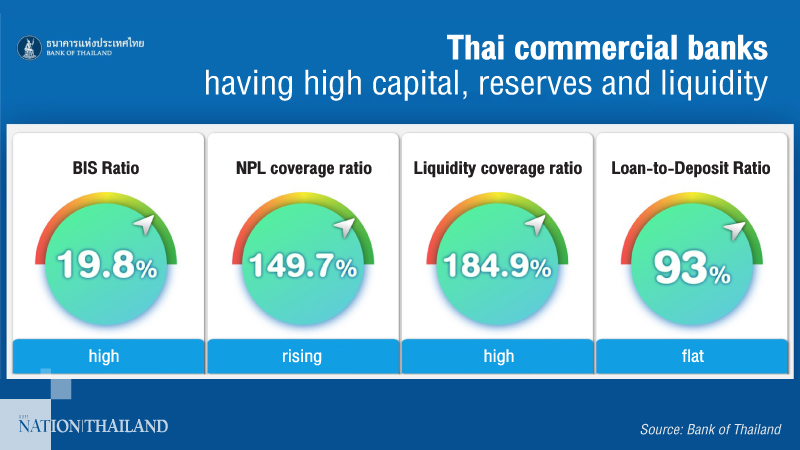
The Bank of Thailand’s deputy governor Ronadol Numnonda said on Thursday that the central bank has come up with guidelines for 2020 dividend payments, which takes into account financial institutions’ capital plans and stress test results for 2020-2022.
He said results show that financial institutions have adequate levels of capital and loan-loss provisions to withstand the impact of Covid-19.
Furthermore, financial institutions have enhanced their awareness and readiness to deal with uncertainty by continuously increasing their loan-loss provisions.
According to data, the coverage ratio for non-performing loans (NPL) and bank for international settlements (BIS) ratio for the Thai banking system in the third quarter of this year are 150 per cent and 19.8 per cent respectively.
However, owing to high uncertainty in the near future, the BOT is supporting preventive measures by allowing financial institutions to pay dividends for 2020 that do not exceed last year’s pay-out ratio and are at 50 per cent of this year’s net profit.
This is in line with the guidelines of many overseas regulators and will benefit financial institutions’ shareholders, depositors and debtors in the long run.
This policy will also help ensure the Thai financial system’s resilience as well as maintain a high level of capital to safeguard against uncertainties and serve as an important mechanism to support economic recovery as the Covid-19 situation improves.
The central bank had previously issued an order asking banks to suspend interim dividend payment in the fallout of the Covid-19 outbreak.
The Stock Exchange of Thailand (SET) Index closed at 1,336.31 on Thursday, down 9.03 points or 0.67 per cent. Total transactions amounted to Bt97.24 billion with an index high of 1,341.57 and a low of 1,327.17.
In the morning session, an analyst at Krungsri Securities expected the day’s index to fluctuate between 1,335 points and 1,357 despite news that a Covid-19 vaccine was almost ready, which helped attract foreign funds into the market.
“Uncertainty over the US lockdown to contain Covid-19, and signs of overbought stocks will pressure the index,” he said.
He added that foreign stock and oil markets were currently facing corrections following sharp rises, as investors waited for fresh positive sentiment.
The 10 stocks with the highest trade value today were SCGP, KBANK, AOT, PTT, MINT, CPALL, ADVANC, STGT, TASCO and BDMS.
As of 4.30pm, the price of oil dropped by US$0.32 or 0.77 per cent to $41.13 per barrel, while gold rose by $2.90 or 0.16 per cent, to $1,864.50 per ounce.
Other Asian indices were mixed:
Japan’s Nikkei Index closed at 25,520.88, up 171.28 points or 0.68 per cent.
China’s Shang Hai SE Composite Index closed at 3,338.68, down 3.52 points or 0.11 per cent, while the Shenzhen SE Component Index closed at 13,792.07, up 71.90 points or 0.52 per cent.
Hong Kong’s Hang Seng Index closed at 26,169.38, down 57.60 points or 0.22 per cent.
South Korea’s KOSPI Index closed at 2,475.62, down 10.25 points or 0.41 per cent.
Taiwan’s TAIEX Index closed at 13,221.78, down 40.41 points or 0.30 per cent.
At a meeting last week chaired by Prime Minister Prayut Chan-o-cha, the Board of Investment (BoI) agreed to a new round of investment promotion for electric vehicles (EV) in a bid to lure Chinese automakers as well as woo world-famous EV manufacturer Tesla with an eight-year corporate income tax exemption.
The previous BoI plan (2017-2019) supported the manufacture of EV and hybrid EVs in the form of passenger cars, trucks and buses, while the new plan covers more vehicles, including motorbikes, motor tricycles and boats.
Under the new promotion, tax exemption will be granted under the following criteria:
• Manufacturers of battery operated or hybrid electric vehicles that have invested more than Bt5 billion will be entitled to corporate income tax exemption for eight years.
• Manufacturers with an investment of less Bt5 billion will be granted corporate income tax waiver for three years, provided they manufacture at least three types of parts for electric vehicles.
• Manufacturers of electric motorcycles with batteries will get a three-year waiver on corporate income tax.
• Manufacturers of electric buses and electric trucks with batteries get a three-year corporate income tax exemption.
In addition to tax exemptions, every EV-related business will get additional benefits based on specific conditions, such as the production of key vehicle parts or investment in research and development.
“The promotion of electric vehicle production will help make Thailand a hub for trade and investment as well as a global production base. Also, businesses will be given a chance to efficiently adapt to developments, so they are in line with the competition,” said BoI secretary-general Duangjai Asawachintachit.
Under the new plan, BoI hopes to attract new investors such as the Chinese automaker Great Wall Motor. It is also planning to encourage Tesla to set up a production base in Thailand.
Tesla currently has production bases in the United States, Germany and China, but has provided no clear indications on whether it plans to invest in the ASEAN region. It recently sent a team to study investment conditions in different countries.
BoI’s first investment promotion was quite successful with 26 automakers showing interest in the projects, worth an investment of more than Bt78 billion.


 A person wearing a protective mask passes in front of the New York Stock Exchange in New York on Nov. 9, 2020. MUST CREDIT: Bloomberg photo by Michael Nagle.
 Senate Minority Leader Charles Schumer, D-N..Y. MUST CREDIT: Washington Post photo by Jahi Chikwendiu Photo by: Jahi Chikwendiu — The Washington Post
 Thanawat Polvichai, chief adviser to the UTCC’s Centre for Economic and Business Forecasting
  A holiday shop in Bryant Park in New York on Nov. 10, 2020. MUST CREDIT: Bloomberg photo by Gabriela Bhaskar.