Thai private sector wants progress on EU free trade deal #ศาสตร์เกษตรดินปุ๋ย

#ศาสตร์เกษตรดินปุ๋ย : ขอบคุณแหล่งข้อมูล : หนังสือพิมพ์ The Nation.

Thai private sector wants progress on EU free trade deal

EconSep 23. 2020Trade Negotiations Department director general Auramon SupthaweethumTrade Negotiations Department director general Auramon Supthaweethum 

By The Nation

The private sector has urged the government to resume talks on a free trade agreement (FTA) with the European Union (EU).

Thai Chamber of Commerce vice chairman Chusak Chuenprayoth said that members supported resumption of the talks and did not want to see any further delays to the FTA, which would benefit the country.

He admitted the FTA would impact some Thai businesses, but said they should hurry to adjust their operations to comply with export requirements and standards under the planned agreement.

Waiving trade tariffs under the EU FTA would boost Thailand’s economy by 1.28 per cent or Bt200 billion, said Trade Negotiations Department director general Auramon Supthaweethum, citing a study by the Institute of Future Studies for Development.

Findings from a public hearing on the FTA, including concerns at its impact and proposed remedial measures, will be put to Commerce Minister Jurin Laksanawisit in mid-October, Auramon said.

It should be clear by the end of this year whether Thailand is ready to resume talks with EU, she added.

The EU has already signed free trade deals with Singapore and Vietnam and is in talks for a deal with Indonesia. It has suspended talks with Thailand, Malaysia and the Philippines. Talks with Thailand that began in 2013 were suspended in 2014 following the military coup.

Thailand has so far signed 13 free trade accords with 18 countries – Asean partner countries, China, Japan, South Korea, India, Australia, New Zealand, Chile and Peru.

Trade with these 18 partners last year accounted for 62.8 per cent of Thailand’s total global trade.

The EU is currently Thailand’s fifth largest trading partner, after Asean, China, Japan and the US. It is the fifth largest investor in Thailand after Japan, China, Asean, and Taiwan.

Experts reveal how to manage risk as turmoil hits stock market #ศาสตร์เกษตรดินปุ๋ย

#ศาสตร์เกษตรดินปุ๋ย : ขอบคุณแหล่งข้อมูล : หนังสือพิมพ์ The Nation.

Experts reveal how to manage risk as turmoil hits stock market

EconSep 23. 2020

By The Nation

Experts have advised local investors on how to manage their risk to deal with renewed volatility in global assets.

Signs of a second Covid-19 wave in Europe coupled with delayed rollout of US economic stimulus measures triggered selloffs of stocks, gold and oil on Tuesday, while the dollar suddenly strengthened.

However, experts reckon the low interest rate means volatile assets remain attractive to investors who are seeking good returns in the “new normal” long term, especially if prices fall.

Theeranat Rujimethapass, president of Tisco Asset Management, advised buying stocks during the market correction for long-term investment because the market is still being driven by hopes that a Covid-19 vaccine will be available next year.

He suggested risk-averse investors hold 20 per cent in stocks and gradually increase that investment, while those who could tolerate risk should invest 50 per cent in Thai and foreign stocks.

“Investors should pick not more than 15 Thai stocks in line with Tisco Strategic Fund [TSF]’s strategy, while selecting foreign stocks that benefit from the Covid-19 outbreak, such as biotech, healthcare tech and global tech shares, in line with Tisco Global Technology Equity Fund [TISTECH]’s strategy,” he said.

“The rest of their portfolios should be made up of debt instruments to maintain investment stability and real estate investment trusts [REITs] to generate returns of 4 per cent per year.”

He added that investing 20 per cent in stocks will generate higher returns than bank deposits and debt instruments at approximately 2-3 per cent per year, while investing 50 per cent in stocks will generate a return of about 5 per cent per year.

Navin Intharasombat, first senior vice president for foreign investment management at Kasikorn Asset Management, advised investors to allocate assets in line with K FIT Allocation M Fund (K-FITM) at low to moderate risk to generate returns of 5.5 per cent per year.

“This portfolio invests 29 per cent in short-term debt instruments, 25 per cent in Thai stocks, 25 per cent in foreign stocks (5 per cent in China, 4.5 per cent in Asia, 4.5 per cent in Japan, 4 per cent in the US, 4 per cent in Europe and 3 per cent in India) 10 per cent in other assets (5 per cent in gold, 3 per cent in infrastructure funds and 2 per cent in property funds) and 11 per cent in debt instruments (9 per cent in middle and long-term debt instruments and 2 per cent in foreign debt instruments),” he said.

Somchai Amornthum, CEO’s assistant at Krungthai Asset Management’s Strategic Asset Allocation & Fund Marketing Department, advised investing 54 per cent in stocks (30 per cent in foreign stocks especially China and 24 per cent in Thai stocks), 38 per cent in debt instruments, 3 per cent in gold, and 5 per cent in property funds and REITs.

“This investment portfolio will generate return at 5-7 per cent per year in line with Krung Thai Mee Sup Fund Class A (KTMEE-A), while investors could gain more returns if they take more risks,” he said.

SET, Asian indices pulled down by negative foreign factors #ศาสตร์เกษตรดินปุ๋ย

#ศาสตร์เกษตรดินปุ๋ย : ขอบคุณแหล่งข้อมูล : หนังสือพิมพ์ The Nation.

SET, Asian indices pulled down by negative foreign factors

EconSep 22. 2020

By The Nation

The Stock Exchange of Thailand (SET) Index closed at 1,267.63 today (September 22), down 7.53 points or 0.59 per cent. Total transactions tallied at Bt42.53 billion with an index high of 1,275.27 and a low of 1,262.41.

In the morning session, an analyst at Krungsri Securities said he expected the index to fall between 1,265 and 1,270 due to international factors.

“On Monday night, European and US stock indices fell sharply due to news of a second lockdown in European countries, several banks’ illicit funds flows and a delay in the rollout of US economic stimulus measures, resulting in an impact on the SET,” he said.

The top 10 stocks with the highest trade value today were MINT, PTT, AOT, KBANK, TASCO, BAM, DELTA, SCB, BBL and SCC.

As of 4.30pm, the price of oil rose by US$0.32 or 0.81 per cent to $39.63 per barrel, while gold dropped by $1.80 or 0.09 per cent, to $1,908.80 per ounce.

Other Asian indices also fell:

China’s Shanghai SE Composite Index closed at 3,274.30, down 42.63 points or 1.29 per cent, while Shenzhen SE Component Index closed at 13,023.43, down 126.07 points or 0.96 per cent.

Hong Kong’s Hang Seng Index closed at 23,716.85, down 233.84 points or 0.98 per cent.

South Korea’s KOSPI Index closed at 2,332.59, down 56.80 points or 2.38 per cent.

Taiwan’s TAIEX Index closed at 12,645.51, down 149.61 points or 1.17 per cent.

Japan’s Nikkei Index was closed for Autumnal Equinox Day.

Job seekers nationwide to get access to opportunities offered at job expo #ศาสตร์เกษตรดินปุ๋ย

#ศาสตร์เกษตรดินปุ๋ย : ขอบคุณแหล่งข้อมูล : หนังสือพิมพ์ The Nation.

Job seekers nationwide to get access to opportunities offered at job expo

EconSep 22. 2020Suchart ChomklinSuchart Chomklin 

By The Nation

Labour Minister Suchart Chomklin on Tuesday (September 22) instructed the Department of Employment to set up an online option for job seekers nationwide to access employment opportunities offered at Job Expo Thailand 2020.

The fair, offering more than a million jobs, will be held at the

Bangkok International Trade and Exhibition Centre (Bitec) from Saturday to next Monday.

“Since some people may not be able to attend this fair, we have ordered the Department of Employment to provide online job-search service during the expo period,” he said.

Suchart Pornchaiwisetkul, director general of the Department of Employment, said provincial employment offices have been appointed to help job seekers via the “Thailand has jobs” website.

“People can apply for jobs or training courses via the website or they can call the department’s 1506 hotline and press 2 or visit provincial employment offices for details,” he said.

Cabinet approves Bt51bn stimulus package for low-income workers #ศาสตร์เกษตรดินปุ๋ย

#ศาสตร์เกษตรดินปุ๋ย : ขอบคุณแหล่งข้อมูล : หนังสือพิมพ์ The Nation.

Cabinet approves Bt51bn stimulus package for low-income workers

EconSep 22. 2020

By The Nation

The Cabinet on Tuesday gave the green light to a new Bt51-billion stimulus package to assist low-income workers hit by the Covid-19 crisis. PM Prayut Chan-o-cha said ministers had agreed to two schemes – “Kon La Khreung” (Let’s Go Halves) and a boost to shopping subsidies for state welfare cardholders.

Under the Kon La Khreung scheme, 10 million people will get daily discounts on their shopping of up to Bt100, capped at Bt3,000. The scheme will open for merchants to register through the website from October 1.

Read also: Bt51bn consumption stimulus package gets green light

Under the second scheme, 14 million welfare cardholders will receive an extra monthly discount of Bt500 on their shopping from October to December.

Progress revealed on U-Tapao Airport and Aviation City project #ศาสตร์เกษตรดินปุ๋ย

#ศาสตร์เกษตรดินปุ๋ย : ขอบคุณแหล่งข้อมูล : หนังสือพิมพ์ The Nation.

Progress revealed on U-Tapao Airport and Aviation City project

EconSep 22. 2020

By The Nation

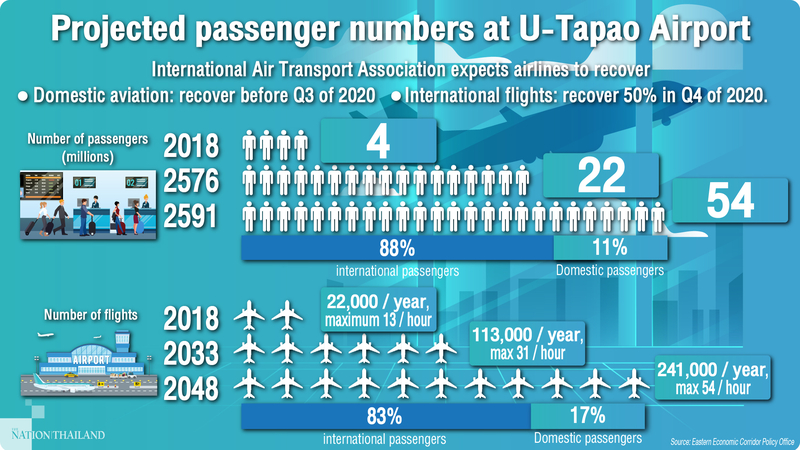
The Eastern Economic Corridor (EEC) Policy Committee has revealed progress on the Bt290-billion U-Tapao Airport and Eastern Aviation City scheme after signing a joint-investment deal to construct the megaproject in June.

The Aviation City will radiate 30 kilometres from U-Tapao Airport and house aviation businesses, logistics, tourism facilities and more, said EEC Committee secretary-general, Kanit Sangsuphan.

U-Tapao Airport would serve at least 15 million passengers per year, bringing three million tourists and an additional Bt75 billion to Bt100 billion annually to Rayong province, he added, speaking at a recent seminar titled “U-Tapao Airport: Aiming to be the third international airport of Bangkok”.

The airport would also create about 230,000 new jobs, more than half of the 475,000-strong EEC workforce.

U-Tapao International Aviation Co Ltd won bidding for the project’s construction and 50-year concession with a bid of just over Bt272 billion, or 90 per cent of the total Bt290 billion budget. The Bt272 billion will be used to construct the terminal, ground transportation centre, warehouse, free trade area, apron for 102 aircraft, and commercial areas.

The government is investing the remaining 10 per cent, or Bt17.768 billion, to construct the second runway.

Since the airport is deemed security infrastructure, the state will own the project.

U-Tapao Airport is expected to generate economic benefits of Bt189 billion.

The project’s master plan, including environmental and health impact assessments, will take 18 months to complete.

Construction is scheduled to begin at the end of 2021 and the first phase to open in 2024, with completion of the high-speed rail project connecting U-Tapao with Bangkok’s Don Mueang and Suvarnabhumi airports and the aircraft repair centre.

U-Tapao’s Aircraft Maintenance, Repair and Operating centres (MRO) project has procured 500 rai for construction – 200 rai for Thai Airways International and 300 rai for other airlines with total investment of at least Bt30 billion.

The MRO centres are included in Thai Airways’ business rehabilitation plan. One of three investment options will be chosen and finalised in January-February 2021: Continue to invest with Airbus, invest without Airbus but use Airbus technology, and co-invest with other aviation companies.

Anawat Leelawatwattana, director of U-Tapao International Aviation Co, also revealed more about the management of U-Tapao airport.

“We are in talks with Narita Airport executives to manage U-Tapao airport as the two airports share similar characteristics, such as being international airports serving capitals from outside the capital. Public transportation is required to transport passengers between the capital and the airport. Narita Airport also has modern passenger technology such as passport-free face-scanning systems to maintain distancing and prevent the spread of Covid-19,” he said.

Meanwhile, overall investment in the EEC is on target to meet its five-year (2017-2022) goal of Bt1.7 trillion, with Bt900 billion recently registered or applied for at the Board of Investment (BOI).

The investment is split into Bt240 billion for the high-speed rail link between three airports, Bt55 billion for phase 3 development of Map Ta Phut Port, Bt290 billion for the U-Tapao Airport Project, and the rest private investment in various industries.

The remaining two years of the EEC target will see large-scale investments in infrastructure, namely phase 3 development of Laem Chabang port and the Aircraft MRO Project, with total value of Bt150 billion. Private investment in 2020 will total about Bt120 billion, about Bt250 billion in 2021 and about Bt350 billion in 2022.

GSB to back NHA bonds to fund affordable housing project #ศาสตร์เกษตรดินปุ๋ย

#ศาสตร์เกษตรดินปุ๋ย : ขอบคุณแหล่งข้อมูล : หนังสือพิมพ์ The Nation.

GSB to back NHA bonds to fund affordable housing project

Sep 21. 2020

By The Nation

Government Savings Bank (GSB) announced on Monday (September 21) that it will underwrite National Housing Authority (NHA)’s social bonds worth Bt6.8 billion, which will be issued on Wednesday to raise funds for building homes for low- and middle-income earners.

The planned bonds will be supported by the Asian Development Bank and Public Debt Management Office (PDMO).

GSB and NHA signed a pact at an event chaired by Social Development and Human Security’s permanent-secretary Porametee Vimolsiri.

Also present were PDMO’s public debt adviser Ace Vibooncharern, NHA chairman Nattapong Punthakeirtpaisarn, NHA governor Taweepong Wichaidit, ADB Thailand country director Hideaki Iwasaki and GSB president Vitai Ratanakorn.

Taweepong said this is the first time that social bonds are being issued by a state enterprise to raise funds in the capital market so the business sector can play a part in social development. This is in line with Social Development and Human Security Minister Chuti Krairiksh’s policy.

This issuance is also in response to the Finance Ministry’s policy of helping state enterprises issue

environmental, social and governance bonds to raise funds for state development projects.

The NHA bonds will refinance the development of a housing project to serve low and middle-income people, who will be able to either buy or lease these housing units. The bond issuance is expected to benefit 13,569 households or 54,000 people.

The bonds will be divided into three tranches – 5-year maturity totalling Bt1 billion, 10-year maturity totalling Bt2.8 billion and 15-year maturity totalling Bt3 billion.

The 5-year bonds carry a coupon rate of 1.02 per cent per annum, the 10-year bonds carry 1.64 per cent per annum and 15-year bonds 1.90 per cent per annum, GSB’s Vitai said.

The Finance Ministry guarantees both the principle and interest. Investors have already registered their interest in the bonds and subscription will open on Tuesday.

Krungsri appoints head of SME Banking Group #ศาสตร์เกษตรดินปุ๋ย

#ศาสตร์เกษตรดินปุ๋ย : ขอบคุณแหล่งข้อมูล : หนังสือพิมพ์ The Nation.

Krungsri appoints head of SME Banking Group

Sep 21. 2020Duangkamol LimpuangthipDuangkamol Limpuangthip 

By The Nation

Krungsri (Bank of Ayudhya) has appointed Duangkamol Limpuangthip as head of its SME Banking Group, succeeding Sayam Prasitsirigul who takes over as senior executive of the Information Technology Group and Digital Banking and Innovation Division.

Krungsri said Duangkamol has more than 28 years of experience in banking and finance, particularly in strategic planning, analysis and development of SME banking business, as well as client relationship management.

The bank said she will leverage her experience and expertise to strengthen Krungsri’s SME banking services covering funding resources, financial solutions and advice. Duangkamol graduated with a Master’s in Business Administration from the University of Wisconsin.

Soft loans planned for struggling airlines, tax break on jet-fuel extended #ศาสตร์เกษตรดินปุ๋ย

#ศาสตร์เกษตรดินปุ๋ย : ขอบคุณแหล่งข้อมูล : หนังสือพิมพ์ The Nation.

Soft loans planned for struggling airlines, tax break on jet-fuel extended

CorporateSep 22. 2020

By The Nation

The Government Savings Bank (GSB) is planning to offer soft loans with annual interest of 2 per cent to airlines hit by the Covid-19 fallout. The loan term will be 60 months.

The package will be sent to the Cabinet for approval soon, said GSB chairman Patchara Anuntasilpa. The move would help revive Thailand’s tourism industry, seen as vital for economic recovery, he added.

The loans will be offered via the Export-Import Bank of Thailand.

Meanwhile the airline industry is getting more support after the Excise Department decided to extend the jet-fuel tax cut for low cost airlines. The tax cut of 20 satang per litre will be extended for another six months from the end of September. The department is also considering whether to waive the tax entirely, said Patchara, who is also director general of the Excise Department.

Airlines have reduced their number of flights by 20 per cent from pre-Covid levels. Previously, excise tax revenue from aviation fuel was about Bt1 billion per year. A tax exemption would not cost much in lost revenue, Patchara assured.

Excise tax collected in the first 11 months (October 2019 to August 2020) of fiscal 2020 totalled Bt503 billion, down 6.53 per cent on last year. The top five tax revenue earners were oil and oil products (Bt206 billion), cars (Bt77.7 billion), beer (Bt73.3 billion), liquor (Bt56.6 billion), and cigarettes (Bt58.1 billion).

The department estimates total tax collected for fiscal year 2020 will be Bt520 billion, higher than the revised target of Bt501 billion following the virus fallout, but lower than the original target of Bt585 billion.

For the next fiscal year, the department expects to collect a total of Bt534 billion.

SET falls in reaction to negative foreign news #ศาสตร์เกษตรดินปุ๋ย

#ศาสตร์เกษตรดินปุ๋ย : ขอบคุณแหล่งข้อมูล : หนังสือพิมพ์ The Nation.

SET falls in reaction to negative foreign news

EconSep 22. 2020

By The Nation

The Stock Exchange of Thailand (SET) Index fell by 4.11 points, or 0.32 per cent, to 1,271.05 in the morning session on Tuesday.

An analyst at Krungsri Securities expected the index to fall between 1,265 and 1,270 due to international factors.

“On Monday night, European and US stock indices fell sharply due to news of European countries’ second lockdown, several banks’ illicit funds flows and delay in the rollout of US economic stimulus measures, resulting in an impact on the SET,” he said.

He recommended that investors buy:

▪︎ Stocks whose third-quarter performance will improve, such as TU, ASIAN, COM7, CHG, PTG and PLANB.

▪︎ Stocks that benefit from the weakening baht, such as DELTA, HANA, KCE and SMT.

The SET Index closed at 1,275.16 on Monday, down 13.23 points or 1.03 per cent. The volume of total transactions was Bt40.18 billion with an index high of 1,295.35 and a low of 1,273.44.