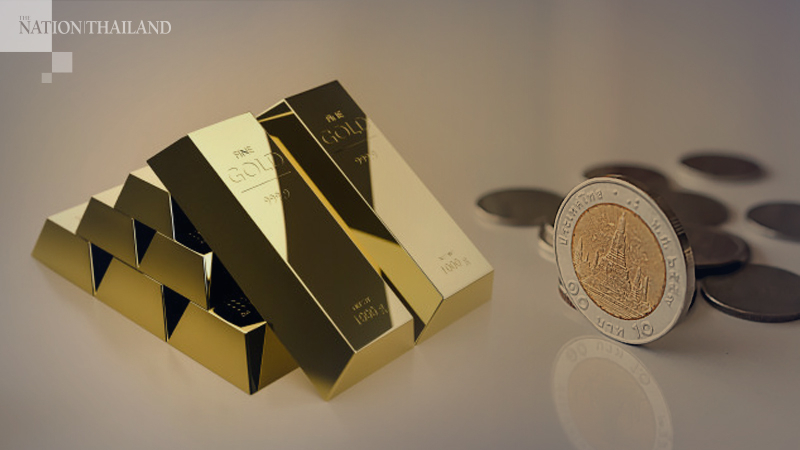
The price of gold was unchanged in morning trade on Monday, the Gold Traders Association reported.
As of 9.19am, the buying price of a gold bar was Bt28,550 per baht weight and selling price Bt28,650, while gold ornaments were priced at Bt28,030.84 and Bt29,150, respectively.
Gold price on Saturday rose by Bt50 per baht weight as the association announced a change in the precious metal’s price for one time.
Spot gold price moved to US$1,951 (Bt60,451.04) per ounce Monday morning after the price rose by $12.2 to $1,962.1 per ounce at Friday’s close.
Gold price closed in positive territory on Friday, as investors were buying gold as a safe-haven asset amid uncertainty over economic recovery and the weakening dollar.
Hong Kong gold price dropped by HK$30, opening at $18,040 (Bt72,121.86) per tael Monday morning, the Chinese Gold and Silver Exchange Society reported.
By The Japan NewsAiming to raise Japan’s status as a global financial center, the government and ruling parties plan to study a system to encourage the entry of overseas financial institutions and the hiring of foreign finance professionals.
The main pillars of this system would be reducing corporate and inheritance taxes, as well as beefing up English-language support for business licensing procedures.
With Prime Minister Yoshihide Suga eager to expand the hiring of financial specialists, the government is hurrying to prepare the necessary environment.
■ Taxing overseas assets
The opaqueness of the tax system is considered a major barrier for foreign financial institutions looking to expand into Japan. For example, performance-based executive compensation paid by asset management companies may not be deductible in Japan, due to reasons such as large fluctuations in the amounts. This leaves companies unable to reduce their taxable income, which raises their corporate tax burden.
Faced with pressure from financial institutions to revise the system, the government and ruling parties plan to study how to clarify the inclusion rules. This would make it easier for foreign asset management companies to do business in Japan.
Foreign professionals are also extremely wary of Japan’s inheritance tax. When a foreigner who has lived in Japan for a certain period of time dies, his or her overseas assets are also subject to inheritance tax, so it is commonly said among wealthy foreigners that one should “never die in Japan,” and many balk at coming here to live.
Among the issues to be studied is whether to make assets held overseas before someone comes to Japan exempt from inheritance taxes.
The Liberal Democratic Party’s special committee on foreign workers plans to compile proposals on hiring financial professionals to submit to the government within the month. The Financial Services Agency plans to call for revisions to the corporate and inheritance tax systems in its tax reform requests for fiscal 2021.
The government also plans to improve English-language support for administrative procedures.
In principle, procedures for licensing asset management companies and other businesses are carried out in Japanese, which is an obstacle to companies seeking to enter Japan. The agency’s budget request for fiscal 2021 is expected to include funding to hire lawyers who speak English and have experience in financial law. The supervision and inspection of foreign financial institutions could switch from Japanese to English by the end of the year.
In addition, the Hong Kong national security law has raised the possibility of an outflow of professionals from what has been Asia’s leading financial hub.
On Wednesday, Suga ordered Finance Minister Taro Aso, who holds the finance portfolio in the Cabinet, to accelerate the study of how to raise Japan’s status as a financial center.
Domestically, the Tokyo metropolitan and Fukuoka city governments have policies for attracting foreign financial institutions.
Entering a free trade agreement (FTA) with the European Union would boost revenue from some Thai exports but at the cost of Thailand having to import more products from the EU, according to a study.
The findings of the study, conducted by the Institute of Future Studies for Development, will be presented at a Department of Trade Negotiations’ seminar in Bangkok next Tuesday, said the department’s director general Auramon Supthaweethum.
The preliminary study on the pros and cons of a Thai-EU free trade pact found it would expand Thai exports of auto parts, electronic equipment, food, rubber and plastic to the EU.
But in exchange, Thailand would have to import more dairy products, oil seeds and technology products from the EU.
The EU has already forged free trade deals with Singapore and Vietnam and is in talks for a deal with Indonesia. It has suspended talks with Thailand, Malaysia and the Philippines. Talks with Thailand that began in 2013 were suspended in 2014.
Thailand has so far signed 13 free trade accords with 18 countries. These consist of Asean partner countries, China, Japan, South Korea, India, Australia, New Zealand, Chile and Peru.
Trade with these 18 countries last year accounted for 62.8 per cent of Thailand’s total trade with global partners. That figure would rise to 70.7 per cent if Thailand forged a free-trade deal with the EU, Auramon added.
The EU is currently Thailand’s fifth largest trading partner, after Asean, China, Japan and the US. It is the fifth largest investor in Thailand after Japan, China, Asean, and Taiwan.
The government’s subcommittee tasked with examining medium and long-term economic measures has reportedly suggested expediting mega-projects to the Centre for Economic Situation Administration.
The total value of the projects is estimated at around Bt1.2 trillion. Investment in these projects should be accerelated, the panel has recommended.
Among them are the Bang Sue-Rangsit and Bang Sue-Taling Chan Red Line mass-transit system worth Bt1.07 billion. The project is slated to be trialled on July 1, 2021.
Another project is the Phase-1 Thailand-China high-speed train project. All its civil work contracts are expected to be signed next year and construction is expected to be finished in 2025.
Another one is the Kae Rai-Lam Sali Brown Line mass-transit system costing Bt48.5 billion. Construction will begin in 2024 with operations commencing in 2027.
They also include the Phase-1 Phuket mass-transit system worth Bt35.2 billion, the Red Line mass-transit system in Chiang Mai worth Bt27.3 billion, and Phase 3 of the Laem Chabang deep seaport development worth Bt114 billion.
Vietnamese company shares have become attractive to investors, as the country’s economy is seen as recovering rapidly.
Vietnam is one of the Southeast Asian countries that has been able to contain the spread of Covid-19, enabling a quick turnaround of its economy.
The General Statistics Office of Vietnam expected economic growth this year to be at 3.6 per cent, down from 7 per cent in the previous year.
Vietnam was able to draw investments from several countries, such as Singapore, South Korea and China, while the country’s foreign trade performed well.
Vietnam’s stock market is also a good choice for investment, as its price-to-earnings was 14 times, higher than that of neighbouring countries. As of August 31, the country’s VN30 Index year-to-date returns contracted 2.16 per cent, performing better than other regional indices.
The VN30 Index is made up of 11 industries, enabling the index to diversify investment.
One Vietnamese equity fund that is able to generate high returns is the Principal Vietnam Equity Fund (Principal VNEQ). The fund’s year-to-date returns as of September 17 contracted 1.36 per cent, 6.25 per cent in the past three months, 19.79 per cent in the past six months, contracted 8.08 in the previous year and 6.02 per cent yearly since inception.
The fund’s year-to-date return was higher than other equity funds. Its year-to date-return was 4.93 per cent in the past three months, 18.61 per cent in the past six months and contracted 10.01 in the previous year.
Also, the fund’s year-to-date returns as of July 31 was similar to the VN30 Total Return Index that contracted 12 per cent, while its year-to-date return compared to the total return index in the past three months was 2.62 per cent and 0.92 per cent, respectively.
Principal VNEQ’s outstanding point is the bottom-up strategy and fund manager’s risk management, picking up middle- and large-cap shares with good fundamentals, high growth, sufficient liquidity and appropriate prices.
As of July 31, Principal VNEQ invested 98.5 per cent in Vietnam Dairy Products JSC, 7.34 per cent in Vinhomes JSC, 7.02 per cent in Hoa Phat Group JSC, 6.42 per cent in Vincom Retail Joint Stock Co and 6.39 per cent in Housing Development Bank.
Principal VNEQ is suitable for investors who invest in foreign shares because it has risks from liquidity, concentration, currency exchange and volatility. Also, the fund collects fees higher than other foreign funds at 2.31 per cent yearly, while the front-end fee is 1.50 per cent per annum.
Principal VNEQ’s net asset value per share was Bt7.9478 per share, while net asset value was Bt1.30 billion. The fund does not have a policy to pay dividends.
Considering the investment trends in the rest of this year, Principal VNEQ is another interesting choice for investment, but investors should gradually buy stocks when the market falls to diversify risks and increase the chance to get returns from Vietnam’s economic recovery, which is likely to be rapid.
Experts are predicting mass sell-offs of gold next week due to the current economic climate.
The baht weakened against the dollar this week (September 14-18), as investors were disappointed with the US Federal Reserve’s recent moves.
The Fed recently indicated it would maintain the interest rate at a low level for three years, but it did not unveil any measures to stimulate the economy.
An analyst at CIMB Thai Bank expected the baht next week to move between Bt31.00 and Bt31.40 against the dollar.
“Next week, the People’s Bank of China would announce the loan prime rate for September, while the US IHS Market would announce the Flash Manufacturing and Service Purchasing Managers’ Indices for September,” he said.
He advised investors to follow the US-China conflict after the World Trade Organisation reported that the US had violated international trade rules regarding tariffs on Chinese imported goods.
The Stock Exchange of Thailand Index on Friday closed at 1,288.39, up 3.99 points or 0.31 per cent, while total transactions stood at Bt49.97 billion. The index moved in a narrow range this week.
An analyst at Asia Plus Securities expected the index next week to react to students’ political rally on Saturday (September 19).
“Meanwhile, we expect the Monetary Policy Committee to maintain the interest rate at 0.5 per cent in line with the one-year Thai bond yield of 0.51 per cent at the meeting on September 23,” he said. “The index is expected to move between 1,270 and 1,300.”
Gold price on Saturday was US$1,950.50 per ounce while the price in Thailand was Bt28,650 per baht weight.
An analyst at YLG Bullion International advised sale of gold if the price does not rise above the resistance line between $1,960 and $1,973 per ounce, and buying back when the price drops to the support line between $1,936 and $1,931 per ounce.
The price of gold dropped by Bt100 per baht weight in morning trade on Saturday (September 19), the Gold Traders Association reported.
As of 9.10am, the buying price of a gold bar was Bt28,550 per baht weight and selling price Bt28,650, while gold ornaments were priced at Bt28,030.84 and Bt29,150, respectively.
At close on Friday, the buying price of a gold bar was Bt28,650 per baht weight and selling price Bt28,750, while gold ornaments were priced at Bt28,136.96 and Bt29,250, respectively.
Comex (Commodity Exchange) gold to be delivered in December rose by US$12.2, or 0.63 per cent, closing at $1,962.1 (Bt60,978.25) per ounce on Friday.
Gold price closed in positive territory on Friday as investors were buying gold as a safe-haven asset amid uncertainty following the economic recovery, while the weakening dollar also boosted the precious metal’s price.
MEA keeps personnel ready to tackle disruptions from storm Noul
Sep 19. 2020
By THE NATION
The Metropolitan Electricity Authority (MEA) has advised people to stay safe from electrical hazards as tropical storm Noul hits the country this weekend.
MEA public relations director Phasuk Sampunnachote said the Thai Meteorological Department had forecast that tropical storm Noul was expected to hit the North and Northeast of Thailand over the weekend, and warned people in risky areas to beware of strong winds, flash floods and water runoffs.
“People who live in flood-prone areas should move their power outlets up to safer positions to avoid electrical hazards. Also check and make sure that electrical appliances and wires in your house are in good condition,” she said. “When you are outdoor during thundershowers, please keep away from large trees or billboards for your safety. Owners of billboards should also make sure that they are secured and located in a safe distance from power lines in case the wind knocks them over.”
Phasuk also advised homeowners to trim their tree branches that grow near power lines, as they pose risk of electrical shock and could cause power blackouts during strong winds.
“The MEA has prepared staff to perform emergency repairs to damaged power lines 24 hours a day during this weekend. We have also installed backup power systems in key areas to make sure that all MEA customers have uninterrupted power in all situations,” she added.
To report damaged or unsafe power lines and other electrical equipment, contact MEA Call Centre at 1130, Twitter: @MEA_news, Line: @meathailand, Facebook: @Metropolitan.Electricity.Authority or download the “MEA Smart Life” mobile app, available for both Android and iOS users at http://onelink.to/measmartlife
BGRIM CEO Preeyanart named among Asia’s top businesswoman
Sep 18. 2020
By THE NATION
Preeyanart Soontornwata, CEO of BGrimm Power Plc (BGRIM), has been named among 25 outstanding female business leaders on Forbes Asia’s Power Businesswomen List 2020. Preeyanart is credited with turning BGRIM into one of the top private power producers in Thailand, achieving strong recognition from local and foreign investors.
Under her leadership, BGRIM has become one of the prime businesses generating highest revenue for the B Grimm Group.
Preeyanart graduated from Chulalongkorn University with a Bachelor’s in banking and finance and a Master’s in Business Administration, before studying Advanced Management at Harvard School of Business in the US.
Since 2016, she has chaired the Association of Private Power Producers while also helming the Federation of Thai Industries Energy Group.
BGRIM supplies electricity to the Electricity Generating Authority of Thailand (EGAT) and a host of factories located in various industrial estates.
MEA posts advice on what to do if powerline falls on your car
Sep 17. 2020
By THE NATION
The Metropolitan Electricity Authority (MEA) posted on Facebook a series of steps motorists should take in case a powerline snaps and falls on their car.
“You need to remain calm and not immediately get out of the car. First check the surrounding area and see if the powerline is touching the car or the ground and see if the ground is wet or dry,” it said.
MEA advises the following steps if the car can move:
• Do not leave the car until you are sure the powerline is not touching the vehicle and the ground is not wet;
• Notify passersby and tell them not to approach the car;
• If possible, move the car at least 10 metres from the powerline before getting out of the vehicle. Take care not to drive over the powerline as it can entangle with the car’s lower body or suspension.
If the car cannot move or has caught fire, the motorist is advised to:
• Avoid stepping out of the car and instead jump out with both feet and ensure no part of your body is touching the car;
• When you have made your way out, hop away as far as possible with both feet. Avoid walking or running as you may step on live wire;
• Do not return to the car for valuables or try to put out the fire until the authorities cut off the power in that area.
Call MEA hotline 1130 for accidents in Bangkok, Nonthaburi or Samut Prakan, and the Provincial Electricity Authority hotline 1129 for other provinces.

 Prime Minister Yoshihide Suga
 Director-general Auramon Supthaweethum


