The price of gold rose by Bt100 per baht weight in morning trade on Friday (September 4), the Gold Traders Association reported.
As of 9.29am, the buying price of a gold bar was Bt28,750 per baht weight and selling price Bt28,850, while gold ornaments were priced at Bt28,227.92 and Bt29,350, respectively.
At close on Thursday (September 3), the buying price of a gold bar was Bt28,650 per baht weight and selling price Bt28,750 while gold ornaments were priced at Bt28,136.96 and Bt29,250, respectively.
The Comex (Commodity Exchange) gold price to be delivered in December dropped by US$6.9, or 0.35 per cent, closing at $1,937.8 (Bt60,841.28) per ounce yesterday.
Gold price closed in negative territory due to mass sell-offs of the precious metal after the US showed strong economic data and Wall Street saw a sharp fall.
By Syndication Washington Post, Bloomberg · Claire Ballentine · BUSINESS
U.S. equities tumbled by the most in almost three months as the rotation away from highflying tech stocks gained steam, with investors questioning the sustainability of lofty valuations.
The S&P 500 Index retreated from a record high and fell more than 3.5%, its biggest drop since early June, amid declines in Apple, Microsoft, Amazon and Facebook. The Nasdaq 100 sank 5%, its largest decline since March. European stocks erased gains and finished more than 1% lower.
Treasury yields dipped and the dollar rose.
Global equities are pulling back hard from unprecedented highs as investors question the justification for steep valuations as the pandemic rages on. While data Thursday showed applications for jobless claims fell last week, U.S. investors may need evidence of a fuller economic recovery after a 60% run-up in the S&P 500 since its March lows.
“What we’re seeing here just a little bit of a reckoning,” said Nancy Prial, co-chief executive officer at Essex Investment Management. “It’s too soon to say whether this is a pause that refreshes or whether this is the beginning of a more meaningful downturn in big tech. Most of these are great companies with really robust growth opportunities, but the stocks are very richly valued.”
The Cboe Volatility Index — a measure of expected price swings for the S&P 500 Index known as Wall Street’s “fear gauge” — rose to the highest level since June. Bitcoin fell as much as 7.6%.
Elsewhere, oil slumped. Major equity gauges in Asia were mixed.
Here are the main market moves:
Stocks
– The S&P 500 Index sank 3.5% as of 4 p.m. EDT.
– The Stoxx Europe 600 Index fell 1.4%.
– The MSCI Asia Pacific Index fell 0.3%.
– The MSCI Emerging Market Index dipped 1%.
Currencies
– The Bloomberg Dollar Spot Index climbed 0.2%.
– The euro was little changed at $1.1853.
– The Japanese yen rose less than 0.1% to 106.13 per dollar.
Bonds
– The yield on 10-year Treasurys fell two basis points to 0.63%.
– Germany’s 10-year yield fell one basis point to -0.49%.
– Britain’s 10-year yield rose less than one basis point to 0.23%.
Commodities
– West Texas Intermediate crude declined 0.5% to $41.29 a barrel.
The Stock Exchange of Thailand (SET) Index closed at 1,311.95 today (September 3), down 3.93 points or 0.30 per cent. Total transactions amounted to Bt50.337 billion with an index high of 1,322.66 and a low of 1,308.84.
In the morning session, an analyst at Krungsri Securities expected the index to rise to between 1,323 and 1,330 points in response to new domestic economic stimulus and hopes of US Covid-19 relief measures, before falling back. The new Thai stimulus measure will offer a 50 per cent subsidy on products purchased from participating retailers and street vendors, at no more than Bt3,000 per person.
However, the analyst said the index will come under pressure from the falling oil price and mass stock sell-offs to reduce risks before the upcoming four-day holiday.
The 10 stocks with the highest trade value today were STGT, AOT, MINT, BAM, CPALL, PTT, NER, SCC, PTTEP and KBANK.
As of 4.50pm, the price of oil dropped by US$0.59 or 1.42 per cent to $40.92 per barrel, while gold dropped by $4.70 or 0.24 per cent, to $1,940 per ounce.
Other Asian indices were mixed:
Japan’s Nikkei Index closed at 23,465.53, up 218.38 points or 0.94 per cent.
China’s Shang Hai SE Composite Index closed at 3,384.98, down 19.82 points or 0.58 per cent, while the Shenzhen SE Component Index closed at 13,772.37, down 115.05 points or 0.83 per cent.
Hong Kong’s Hang Seng Index closed at 25,007.60, down 112.49 points or 0.45 per cent.
South Korea’s KOSPI Index closed at 2,395.90, up 31.53 points or 1.33 per cent.
Taiwan’s TAIEX Index closed at 12,757.97, up 58.47 points or 0.46 per cent.
Kasikorn Asset Management is encouraging investment in property funds, Real Estate Investment Trusts (REITs) and infrastructure funds as it believes they will generate returns in the long term.
Over the past eight months, foreign investors pulled out of these mutual funds as they were affected by the Covid-19 fallout.
Thidasiri Srisamith, Kasikorn Asset Management’s chief investment officer, said property funds, REITs and infrastructure funds are a good choice at this time, except funds that invest in hotels and convention centres, because those are still affected by the Covid-19 fallout.
“Kasikorn is still positive about investing in property funds and REITs in Thailand and Singapore despite the high volatility and 8.81 per cent drop in REITs’ returns as of July 31,” she said. “However, returns over the past three years rose by 6.71 per cent, and 7.83 per cent over the past five years.”
She said the K Property Sector Fund (K-Prop) has boosted its investments from 50 per cent to 70 per cent in Singapore REITs and reduced its investment to 30 per cent in Thai REITs, because though the Thai real-estate funds can add more assets, the state of the fund depends very much on asset owners and market conditions.
“Kasikorn Asset Management is planning on establishing new funds to boost investment, while asset companies that our REITs have invested in are still able to pay dividends. This shows that these companies are still able to manage well during this crisis,” she said.
She added that two REITs had been established after the government eased lockdown measures, namely Prospect Logistics and Industrial Leasehold Real Estate Investment Trust (PROSPECT) worth Bt3.5 billion, which has generated returns worth 11.1 per cent in the first year, and Khonburi Sugar Power Plant Infrastructure Fund (KBSPIF) worth Bt2.8 billion, which has generated 8.95 per cent worth returns in the first year.
“Since the market is facing volatility and interest rates will remain low for the next two years, this is a good opportunity to invest in REITs to generate consistent returns in the long term,” she added.
Meanwhile, Chayanee Juengmanon, a senior research analyst at Morningstar Research, said over the past eight years, property funds’ assets under management had dropped by 18.8 per cent to Bt150 billion due to a drop in returns and having to come up with about Bt11 billion for redemption, adding that even though some asset companies are performing better than they did in the first quarter, the situation has not returned to normal yet.
“Over the past two years, up to Bt100 billion flowed into these funds because they were attractive to investors as they generate returns,” she said.
“However, the Covid-19 outbreak has made its returns since March to contract up to 18 per cent as some assets, such as department stores, hotels, office buildings and factories have been badly affected by lockdown measures.”
The government is getting ready to launch a new three-month economic stimulus package called “Kon La Khreung” (Let’s Go Halves), which like its previous “eat, shop, spend” scheme, will be operated online.
Danucha Pichayanan, deputy secretary-general of the National Economic and Social Development Council (NESDC), said the Cabinet has agreed to earmark Bt45 billion for this scheme, in which the government will provide a 50-per-cent subsidy for products purchased from participating retailers and street vendors from October to December. However, the subsidy is capped at Bt3,000 per consumer.
The scheme aims to provide subsidies to 15 million consumers aged 18 and above and expects at least 80,000 retailers and street vendors to participate. Retailers of alcoholic beverages and cigarettes will not be eligible.
Danucha said payments for purchases must be made via Krungthai Bank’s online wallet Pao Tang. The government will cover 50 per cent of the money spent on purchases, but initially consumers are allowed to spend no more than Bt100 to Bt250 daily of their Bt3,000 credit.
Shoppers will only pay 50 per cent for products, while participating stores will receive the rest of the money the following day.
NESDC believes this package will inject Bt9 billion in the economy and stimulate the GDP by 0.25 per cent.
The Finance Ministry is preparing a detailed proposal for the government’s Centre for Economic Situation Administration so the scheme can kick off in October.
The Stock Exchange of Thailand (SET) Index rose by 2.18 points, or 0.17 per cent, to 1,318.06 in the morning session today (September 3).
An analyst at Krungsri Securities expected the index to rise between 1,323 and 1,330 points before falling in response to the Thailand Centre for Economic Situation Administration’s (Cesa) new economic stimulus measures and hopes of new US Covid-19 relief measures.
Under the Cesa scheme, the government will provide a 50 per cent subsidy for products purchased from participating retailers and street vendors, at no more than Bt3,000 per person.
The scheme aims to provide subsidies to 15 million people and expects 80,000 retailers and street vendors to participate.
However, the analyst said the decline in the oil price and mass stock sell-offs to reduce risks before the upcoming four-day holiday will pressure the index.
He recommended that investors buy stocks whose third-quarter performance would improve, such as CPF, GFPT, TU, Asian, KCE, Hana, Delta, HMPro, Global, DoHome, Com7, JMT, CHG, BCH, PTG, PlanB, CBG and Tasco.
The SET Index closed at 1,315.88 points yesterday (September 2), up 10.31 points, or 0.79 per cent. The volume of total transactions stood at Bt43.68 billion, with an index high of 1,316.08 points and a low of 1,301.78.
The price of gold dropped by Bt250 per baht weight in morning trade today (September 3), the Gold Traders Association reported.
As of 9.23am, the buying price of a gold bar was Bt28,750 per baht weight and selling price Bt28,850, while gold ornaments cost Bt28,227.92 and Bt29,350, respectively.
At close yesterday (September 2), the buying price of a gold bar was Bt29,000 per baht weight and selling price Bt29,100, while gold ornaments cost Bt28,470.48 and Bt29,600, respectively.
The Hong Kong gold price dropped by HK$220, opening at $18,180 (Bt73,464.45) per tael this morning, the Chinese Gold and Silver Exchange Society reported.
The Comex (Commodity Exchange) gold price to be delivered in December dropped by US$34.20, or 1.73 per cent, closing at $1,944.70 (Bt60,908.74) per ounce yesterday.
The gold price closed in negative territory due to a strengthening dollar and a rise in the US stock market, causing investors to turn to risk assets instead of safe-haven assets.
By Syndication Washington Post, Bloomberg · Claire Ballentine, Sarah Ponczek · BUSINESS
U.S. equities rose alongside European stocks as the nearly relentless rally in risk assets continued, but with a twist as tech shares underperformed.
The S&P 500 jumped the most in almost two months to an all-time high, with some of this year’s least-loved shares helping fuel the rally. The Russell 1000 Value Index rose 1.7%, beating its growth counterpart. Utilities and financial stocks — two of the three worst performing sectors in 2020 — each rose more than 1.4%. The Stoxx Europe 600 Index added the most in three weeks.
The dollar rose the most in almost two weeks as the euro slid further below $1.20, a level it breached for the first time in more than two years Tuesday. Oil fell with precious metals and Treasury yields dipped.
The rally in global stocks has pushed major indexes to record highs as traders bet that a flood of liquidity unleashed by central banks will make its way to equity markets. The rotation away from the tech titans that have led gains this year — with Apple, Tesla and Zoom Video all slumping Wednesday — could signal confidence in a broader economic recovery from the pandemic and a possible vaccine.
“We’ve seen all the major central banks stay very accommodative,” said Chris Gaffney, president of world markets at TIAA Bank. “Negative real yields across the globe are almost forcing people into finding investments that have a potential for gain.”
Amid the risk-on rally, key U.S. markets now appear to be pricing in chances of a delayed or inconclusive result from the November presidential election, JPMorgan Chase & Co. analysts said.
Elsewhere, 10-year bunds rose along with most of their sovereign peers across Europe, benefiting Germany, which took in $39 billion (33 billion euros) of orders for its first green bonds.
Here are the main market moves:
Stocks
– The S&P 500 Index gained 1.5% as of 4 p.m. EDT.
– The Stoxx Europe 600 Index jumped 1.7%.
– The MSCI AC Asia Pacific Index increased 0.2%.
Currencies
– The Bloomberg Dollar Spot Index gained 0.3%.
– The euro fell 0.6% to $1.1842.
– The Japanese yen fell 0.2% to 106.21 per dollar.
Bonds
– The yield on 10-year Treasurys fell two basis points to 0.65%.
– Germany’s 10-year yield sank six basis points to -0.48%.
– Britain’s 10-year yield decreased six basis points to 0.23%.
Commodities
– West Texas Intermediate crude fell 2.8% to $41.56 a barrel.
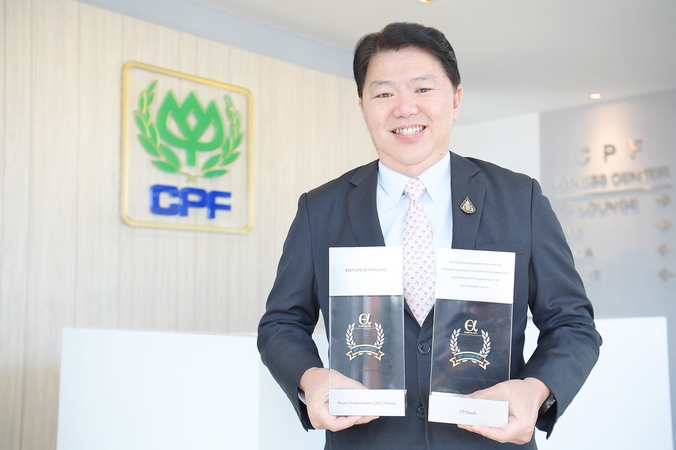
Paisan Chirakitcharern, chief finance officer of Charoen Pokphand Foods (CPF), has been named “Best CFO in Thailand 2020” at the Alpha Southeast Asia Magazine’s 10th Annual Institutional Investor Awards for Corporates.
The award was based on the magazine’s “Southeast Asia’s Institutional Investor Corporate Poll”.
“I’m delighted, not for myself but for the organisation,” said Paisan, attributing his award to support from “all CPF people around the world”.
He identified finance and human resources as the two keys to successful business operations.
A company could only succeed if it had both money and the right workforce, he added, giving credit to CPF management for emphasising these two in tandem.
“We need to know the business we are in and its key success factors. The finance department’s duty is to provide funding to help the organisation reach its targets. Meanwhile, as operational details change on a daily basis, we must stand ready for changes and dare to change.
He said it was also crucial to bridge the generation gap at work.
“Working with new generations, we must be their role models and understand them. Young people today perceive things differently from people my age. People my age find it very difficult to quit as they fret about criticisms. But young people are ready to change jobs. We must realise the difference and there must be a stage where they can show their capabilities. This is the most important.”
The poll saw CPF win four more awards: Best Senior Management IR Support, Strongest Adherence to Corporate Governance, Most Consistent Dividend Policy, and Best Strategic CSR.
Households urged to install solar panels, sell power back to MEA
Sep 02. 2020
By THE NATION
The Metropolitan Electricity Authority (MEA) is inviting households in Bangkok, Nonthaburi and Samut Prakan to install solar panels on their roofs to generate electricity for personal use or to sell back to the MEA.
“Users who wish to install solar panels for personal use should integrate their solar generators into MEA’s power grid, and the MEA will send out technicians to ensure their equipment is safe and the current is stable,” MEA public relations director Phasuk Sampunnachote said. Interested users can study the MEA’s power integration guidelines and register at https://www.mea.or.th/minisite/vspp/about/846 with no deadline.
“MEA has also created the Community Solar Power programme, which is available to type 1 customers [residential users] who installed solar panels for domestic use and have left over electricity to sell,” she added. “MEA will buy the electricity from users at Bt1.68 per unit, under a 10-year contract. Applicants can register at the website https://spv.mea.or.th before December 2020.”
For more information customers can contact the MEA at its call centre on 1130, via Twitter at @MEA_news, Line at @meathailand, and Facebook การไฟฟ้านครหลวง MEA.