By Syndication Washington Post, Bloomberg · Claire Ballentine, Katherine Greifeld · BUSINESS, US-GLOBAL-MARKETS U.S. stocks turned sharply lower in the final hour of trading as investors sold some of the rally’s biggest winners amid concern a spending package from Washington is not imminent.
The S&P 500 fell for the first time in eight trading sessions, with some traders citing comments from Senate Majority Leader Mitch McConnell saying stimulus talks are at a stalemate as a catalyst. The Nasdaq 100 fell for a third day. Treasury yields jumped before this week’s debt auctions and gold tumbled the most in seven years.
“There’s some profit taking going on, they’re looking to rotate into some of the stuff that hasn’t performed as well,” said Keith Gangl, portfolio manager for Gradient Investments.
A broad rally from industrial goods to health-care shares sent the Stoxx Europe 600 Index to its best increase in a week. Adding to the earlier optimism was President Donald Trump announcement Monday that he’s considering a tax cut on capital gains, as well as rising hopes for an effective Covid-19 vaccine.
“It seems like a market in the final stages of a rally where investors try and play catch up in the highest beta/most cyclical areas, such as small caps, energy, financials, industrials,” said Sameer Samana, Wells Fargo Investment’s senior global market strategist. “It is a risk-on market, but with a slightly different flavor than the one we saw while real rates and the dollar were declining.”
Elsewhere, the resignation of Lebanon’s government after the devastating explosion in Beirut threatened to upend prospects of a debt restructuring deal in the next few months.
These are the main moves in markets:
Stocks
The S&P 500 Index dipped 0.8% to 3,333.76 as of 4:01 p.m. EDT, the first retreat in more than a week and the largest decrease in more than two weeks.
The Dow Jones industrial average dipped 0.4% to 27,688.29, the first retreat in more than a week.
The Nasdaq Composite Index dipped 1.7% to 10,782.82, the lowest in more than a week on the largest decrease in more than two weeks.
The MSCI All-Country World Index decreased 0.1% to 563.77.
Currencies
The Bloomberg Dollar Spot Index increased 0.1% to 1,181.46, the highest in a week.
The euro was little changed at $1.1733, the weakest in almost two weeks.
The Japanese yen depreciated 0.5% to 106.54 per dollar, the weakest in more than two weeks on the largest fall in more than a week.
Bonds
The yield on 10-year Treasurys climbed four basis points to 0.63%, the highest in more than three weeks on the biggest surge in more than two months.
Germany’s 10-year yield jumped five basis points to -0.48%, the highest in more than two weeks on the largest surge in almost six weeks.
Britain’s 10-year yield jumped seven basis points to 0.2%, the highest in five weeks on the biggest surge in more than four months.
Commodities
West Texas Intermediate crude dipped 1% to $41.49 a barrel.
Gold depreciated 5.4% to $1,916.58 an ounce, the weakest in more than two weeks on the biggest tumble in more than seven years.
The Thai National Shippers’ Council yesterday asked the Bank of Thailand to seek ways of relieving pressure on exports from the rising baht.
Council vice chairman Visit Limluecha said he had discussed the matter with central bank governor Veerathai Santiprabhob, adding that the strengthening baht is hurting the competitiveness of Thai exports.
He said the council did not specify an appropriate level for the baht value and did not ask the central bank to interfere with its value.
He also asked the bank to relax conditions for its soft loan programme so as to widen access to credit for small business operators.
The Stock Exchange of Thailand (SET) Index closed at 1,336.84 today (August 11), up 14.83 points or 1.12 per cent. Total transactions amounted to Bt71.983 billion with an index high of 1,343.16 and a low of 1,332.24.
In the morning session, a stock analyst at Krungsri Securities expected the index to rise between 1,330 and 1,335, before falling, in response to hopes US Congress will agree on a $1-trillion economic stimulus package this week.
“Also, the market gained positive sentiment from a rise in the oil price which climbed back above US$42 per barrel,” he said.
However, the analyst said the index would be under pressure from escalating US-China tensions after Beijing imposed sanctions on US lawmakers in retaliation for Washington slapping sanctions on 11 Hong Kong and Chinese officials.
“Meanwhile, we expect investors to hold off making deals while they follow US-China trade negotiations on August 15 and assess the progress of the first phase of their trade agreement, while the SET will be closed on Wednesday for Mother’s Day,” he said.
The 10 stocks with the highest trade value today were AOT, MINT, PTT, KBANK, NER, ADVANC, TU, STGT, PTTEP and SCB.
As of 4.30pm, the price of crude oil rose by US$0.54 or 1.29 per cent to $42.48 per barrel, while gold dropped by $36.10 or 1.77 per cent, to $2,003.60 per ounce.
Other Asian indices were mixed:
Japan’s Nikkei Index closed at 22,750.24, up 420.30 points, or 1.88 per cent.
China’s Shang Hai SE Composite Index closed at 3,340.29, down 38.96 points, or 1.15 per cent, while the Shenzhen SE Component Index closed at 13,466.27, down 191.05 points, or 1.40 per cent.
Hong Kong’s Hang Seng Index closed at 24,890.68, up 513.25 points, or 2.11 per cent.
South Korea’s KOSPI Index closed at 2,418.67, up 32.29 points, or 1.35 per cent.
Taiwan’s TAIEX Index closed at 12,780.19, down 113.81 points, or 0.88 per cent.
MEA aims to convert Wat Liab branch building into Thailand Electricity Museum
Aug 11. 2020
By THE NATION
The Metropolitan Electricity Authority (MEA) on Monday (August 10) launched the survey and restoration project of Building 1 at MEA Wat Liab branch in Bangkok’s Phra Nakhon district together with officials from the Department of Fine Arts and Engineering Institute of Thailand with the aim to use it as the location for Thailand Electricity Museum.
“The head office of MEA Wat Liab branch is an old building aged over 100 years,” said Thepsakdi Thitaraksa, MEA deputy governor. “It was the location of the first power plant in Thailand owned by the Siam Electricity Ltd, who produced and distributed electricity, as well as sold electrical appliances and operated tram services in Bangkok.
The company was taken over by the government in 1950 and changed its named to Bangkok Electricity Authority, and then to Metropolitan Electricity Authority on August 1, 1958,” Thepsakdi added.
He revealed that the building was built in the reign of King Rama V and is among the first reinforced concrete buildings in Thailand. “The three-storey building features beautiful architecture of Thai-Western classic style that carries historical significance regarding the modernisation of the country,” he said. “The MEA is planning to restore it into Thailand Electricity Museum to provide knowledge on the history of electrical technology in Thailand to interested people as well as serve as a new landmark in Bangkok’s Phra Nakhon district.”
The MEA Wat Liab branch is also surrounded by historical landmarks and tourist attractions such as Phra Phuttayotfa Bridge, Wat Prayurawongsawat, Santa Cruz Church, the Temple of Dawn, the Praisaniyakarn (Thailand’s first postal office), and Chao Phraya Sky Park.
AIA Thailand launches new investment management entity
Aug 10. 2020
By The Nation
AIA Thailand, a leader in life assurance and unit-linked market in Thailand, has launched AIA Investment Management (Thailand) (AIAIMT) to manage funds under AIA-unit linked policies.
The company will leverage its over 30 years of portfolio management expertise, connect investors with opportunities through its global network, and upgrade sustainable investment and business operations with ESG (environmental, social and governance) principles.
AIAIMT comes with a lower fee for active funds offering better returns to customers.
Dr Mark Konyn, chief investment officer for AIA Group, said AIA is the world’s largest insurance group with a strong investment experience in 18 countries in the Asia-Pacific and over 150 investment management experts across all regions in the world.
AIA Group realises the potential of managing the large amount of assets of AIA Thailand that have been invested in the bond, equity and property markets supported by extensive resources across AIA Group.
The opening of AIAIMT marks another major milestone for AIA in Thailand.
“AIAIMT will be one of the country’s largest investment management companies with investment experts offering more than three decades of experience and successfully managing financial investment. AIAIMT will focus on a sustainable investment policy and operate its business by addressing ESG principles. This is aligned with AIA Group’s policy of operating with integrity to build opportunities to create solid and sustainable returns,” Konyn said.
Sukkawat Prasurtying, chief executive officer for AIAIMT, said the new operation was established with Bt100 million in registered capital to manage the assets and investments of AIA Thailand’s unit-linked plans.
Currently, AIAIMT is the third largest investment management firm in Thailand with Bt847 billion in assets under management. The company has an experienced team of fund managers accustomed to investing in both Thai and international markets. AIAIMT will connect with AIA Group’s investment network across the world, together with other business partners to effectively manage investments.
AIAIMT has set up nine new funds, five of which are local and four foreign, focusing on long-term gains, covering industries with consistent growth and managed with careful risk management. AIAIMT has started off by launching the five local funds initially and will launch the foreign ones soon.
In a bleak economy, these companies are flourishing
CorporateAug 11. 2020Tim Linch, store manager at Tractor Supply Co., straightens merchandise in Leesburg, Va., on July 30. The company is thriving either despite or because of the pandemic. CREDIT: Washington Post photo by Katherine Frey.
By The Washington Post · David J. Lynch · BUSINESS, US-GLOBAL-MARKETS, RETAIL
LEESBURG, Va. – Tucked into a suburban shopping center about two miles from a Civil War battlefield, this Tractor Supply Co. outlet has become a rare hot spot in an economy that has gone ice cold.
Since the first days of the coronavirus pandemic, the retailer for farmers, ranchers and suburbanites who fancy themselves farmers or ranchers has enjoyed what its chief executive calls an “unprecedented” sales surge. Fencing, bird feed, plumbing supplies, pet food, outdoor apparel, live chickens, lawn tractors – just about anything in stock has been flying out of its 1,881 stores nationwide.
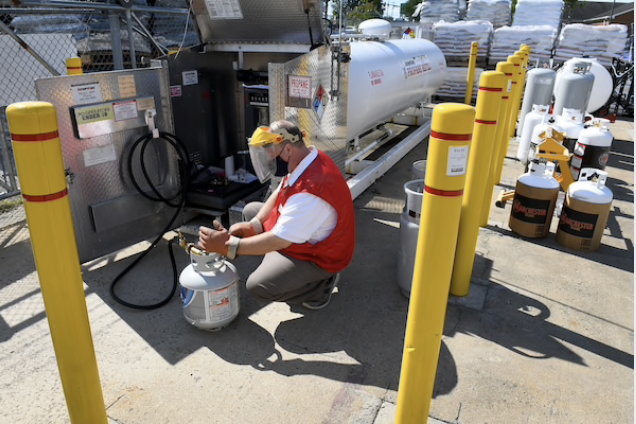
Tim Linch fills a propane tank for a customer at Tractor Supply. CREDIT: Washington Post photo by Katherine Frey.
“It’s been very steady,” said Tim Linch, 51, the store’s manager. “Early on, when everybody else was closed, people were coming in just because we were open. I’ve never seen so many people thank me.”
Tractor Supply’s good fortune – second-quarter profits jumped more than 50% – not only seems at odds with the overall collapse in business activity across the country, but also reflects the economic remodeling that the pandemic has unleashed. With record sales and earnings, the rural-oriented retailer is among a select group of companies that are prospering despite – or in some cases because of – the pandemic.
Microsoft says its Azure cloud-computing business booked record revenue in the quarter ended June 30. Consumer goods maker Church & Dwight expanded manufacturing capacity for its Arm & Hammer laundry detergent to keep pace with demand, even though sales of its Trojan-brand condoms slumped in an extreme example of social distancing. And Albertsons, the nation’s second-largest supermarket chain, reported that same-store sales leaped by more than 26% compared with the same period last year.
The rise of some companies, and the fall of others, comes as the economy struggles to recover from the record 9.5% quarterly decline in economic activity over the spring.
But rather than a temporary interruption of normal commerce, the global health scare and subsequent recession is altering spending, saving and investing patterns across the $19.4 trillion economy.
“The longer it goes on, the more lasting the ramifications will be,” said Bill McMahon, chief investment officer for active equity strategies at Charles Schwab Investment Management.
Investors are struggling to distinguish between fleeting and permanent changes. Already, clothiers specializing in attire for offices that people no longer frequent such as Brooks Brothers are sliding into bankruptcy while producers of more casual garb like Lululemon prosper.
In the days ahead, Americans may leave the cities for suburban and rural areas, denting prospects for commercial real estate and boosting the residential market. Cashless payments could finally eclipse traditional currency.
Not all of the changes have solidified. But the emerging new normal will mean less money spent on air travel and more on stay-at-home comforts, which explains disappointing earnings from commercial airline maker Boeing and General Electric, which makes aircraft engines.
When nonessential businesses began shutting down in March, many economists anticipated a brief interlude that would allow the United States to “flatten the curve” of the pandemic before resuming normal life.
In a March 11 Oval Office address, President Donald Trump called the shutdown “just a temporary moment of time.” His administration three weeks later introduced a Paycheck Protection Program designed to provide small businesses an eight-week financial bridge to see them through the maelstrom.
Now, what initially seemed like an economic pause is becoming a more-thorough makeover. Amid the second-quarter carnage that included gross private investment plunging by nearly one-half and consumption expenditures falling by more than one-third, Americans increased spending on just a few categories, including motor vehicles, recreational goods and housing.
David Kotok, chairman of Cumberland Advisors, likens the ongoing transformation to the difference between the Grand Canyon’s northern and southern rims. Much of the view is the same in each place, but the plant and animal life, even the weather, is distinct.
“In January, Macy’s was in the S&P 500. In July, it is not,” he said.
Last month, Procter & Gamble reported strong quarterly earnings, including a 14% sales gain in detergents and household cleaners, as Americans scrubbed and cleaned to ward off the coronavirus.
The reshaping of consumption also is leaving a mark on media and entertainment provider Comcast. As consumers hunkered down, revenue for the company’s theme parks evaporated. Attractions such Universal Studios Hollywood remain closed and the company collected just $87 million at its theme park turnstiles, down 94% from $1.5 billion in the same period last year.
At the same time, Comcast reported a record second-quarter net gain in cable customers and its highest increase in high-speed internet hookups in 13 years.
“I am confident in our ability to continue to successfully navigate the impact of covid-19, and emerge from the crisis even stronger,” chief executive Brian Roberts said in a news release.
Work-from-home may be starting to feel like a form of house arrest for millions of American workers, but for some companies it’s become a bonanza. At Tractor Supply, business has been remarkably good throughout the pandemic, said Rose Hernandez, 35, a company veteran who is helping train newcomer Linch.
“Our hips are constantly buzzing,” she said, gesturing to the cordless phone that employees carry on their belts. “The flow is a lot faster.”
Tractor Supply has its roots in the Great Depression, when Charles Schmidt, a 26-year-old floor-sweeper at a Chicago brokerage, launched a mail-order parts business from his home. Eighty-two years later, the companies that are managing to surmount a contemporary landscape of double-digit employment and business closures share a few traits.
They are in the right position to capitalize on shifting consumption patterns, as the pandemic obliterates demand for goods or services that require sustained face-to-face contact. Their balance sheets are armored against sudden financial damage. And their management teams demonstrate agility in adapting to a reshaped marketplace.
“It’s very Darwinian,” said Beth Ann Bovino, chief U.S. economist for S&P Global. “It’s survival of the fittest and, oftentimes, the survival of the biggest.”
Tractor Supply ticked all three boxes. Its outdoor focus – offering kayaks, hiking boots and farm equipment – is in sync with consumers’ desire to escape their homes without coming too close to others.
A nascent population shift out of cities as commuting patterns dissolve is bringing the retailer new customers at the fastest rate in company history. These new shoppers are younger, more affluent and disproportionately female. Trying to ride out the pandemic at home, they purchased steel tanks meant for watering livestock and transformed them into makeshift swimming pools while using horse-stall mats for yoga routines.
“People have left the cities where we don’t have stores,” Harry Lawton, the company’s chief executive, told investors during a July 23 earnings call. “They’re moving into suburbans [or] they’re moving out of the suburbs. So they’re moving out to the rural communities.”
Tractor Supply boasts a cash reserve of $1.2 billion along with an untapped $500 million credit line. And the company has introduced a new mobile app, website and marketing strategy while hiring more than 5,000 new employees.
Tractor Supply’s stock price is up more than 100% since its mid-March low. Its second-quarter sales of $3.2 billion rose 35% from the same period last year.
The 13,700-square foot Leesburg store opened in 1997, when surrounding Loudon County was home to less than half of its current 414,000 residents. What was once farmland has rapidly suburbanized in recent years.
When the pandemic hit, the company increased wages by $1 an hour and accelerated an e-commerce push.
Just inside the Leesburg store, a wire rack holds tarpaulins, bungee cords and other items customers have ordered online for pickup. Contactless payment was installed for Apple and Android users, part of a broader information technology overhaul that will roll out expanded WiFi services.
Even as jobs were melting by the millions elsewhere, Tractor Supply added more than 5,000 new employees in the second quarter. In Leesburg, five spots were filled as people who’d seen their jobs eliminated by the pandemic scrambled to regain a foothold in the labor market.
“A lot of the companies they worked for previously aren’t there any more,” Hernandez said.
Skytrain operator BTS Group Holdings will conduct a feasibility study with King Mongkut’s Institute of Technology Ladkrabang on an electric tram-bus service to link its main campus with the transport network. Also signing the memorandum of understanding (MoU) for the study today was Bangkok Smartcard System.
The collaboration is seeking to forge a mass transit connection from the campus to the Airport Rail Link’s Lat Krabang Station, explained BTS Group Holdings chief executive officer Kavin Kanjanapas. The campus is located just to the east of Suvarnabhumi Airport.
The partnership will also pave the way for knowledge exchange between BTS and the institute.
BTS Group Holdings executive director Surapong Laoha-Unya said two possible routes were being studied – Hua Takhe to Lat Krabang Station (4 kilometres) and a link directly from the campus to Lat Krabang Station.
Each tram-bus will have three carriages and capacity for 250 passengers. The study will take two to three years to complete.
The price of Carabao Group (CBG) shares rose more than 5 per cent in morning trading today (August 10) as the energy drink company’s second-quarter profit increased by 20.1 per cent year on year, driven by a 27 per cent rise in foreign income.
CBG’s share price hit a high of Bt134.50 in the morning session, up 6.76 per cent from the previous close, before falling to Bt131.
CBG’s shares gained positive sentiment from a strong second-quarter performance that generated revenue of Bt4.508 billion, up 20.1 per cent year on year. Income from the company’s products rose by 13.6 per cent year on year.
On the domestic front, CBG’s income dropped slightly by 1.7 per cent as sales in the energy drink market fell 13.4 per cent.
However, CBG’s foreign sales rose by 27 per cent to Bt2.219 billion, 81 per cent or Bt1.8 billion of which came from Cambodia, Laos, Myanmar and Vietnam (CLMV) and 7 per cent from China. Increasing sales in CLMV countries, especially Myanmar, boosted the company’s profit to Bt890 million, up 69.7 per cent year on year.
A stock analyst at Yuanta Securities expected CBG’s net profit to hit a new high in the remaining quarters of this year as the income from sales of its C+Lock drink and exports to CLMV countries were not included in the company’s forecast.
“In this year’s fourth quarter, production at CBG’s bottling plants will increase by 40 per cent to 4.2 million bottles per day, while production at its canning plants will increase by 30 per cent to 5.7 million cans per day. This will enable the company to boost income from foreign countries,” the analyst said. “Meanwhile, CBG’s paper packaging costs will fall due to the company’s new packaging factory.”
The analyst added that his securities company has increased CBG’s stock target price to Bt130-Bt140 per share, advising investors to buy this stock as the upside gain was around 3 to 10 per cent.
We expect the company’s stocks to gain positive sentiment from its positive performance,” the analyst added. “Investors will sell stocks to take profit when the price moves to around Bt135 per share,” he forecast.
The Stock Exchange of Thailand (SET) Index rose by 11.74 points, or 0.89 per cent, to 1,333.75 on Tuesday morning (August 11).
A stock analyst at Krungsri Securities expected the index to rise between 1,330 and 1,335, before falling, in response to hopes of a $1-trillion US economic stimulus package as investors expected US lawmakers to reach an agreement by this week.
“Also, the market gained positive sentiment from the rising oil price as the price climbed to over US$42 per barrel again,” he said.
However, the analyst said the index would be under pressure from the escalating US-China conflict after China imposed sanctions on US lawmakers in response to the US imposition of sanctions on 11 Hong Kong and Chinese officials.
“Meanwhile, we expect investors to delay trading to follow US-China trade negotiations on August 15 to assess the progress of the first phase of the trade agreement, while the SET will be closed on Wednesday for Mother’s Day,” he said.
The SET Index dropped 2.39 points, or 0.18 per cent, closing at 1,322.01 on Monday. The total transactions amounted to Bt37.417 billion with an index high of 1,330.17 and a low of 1,321.90.
He recommended that investors buy:
▪︎ Stocks whose second-quarter performance will improve, such as SPRC, BGRIM, CPF, TU, STA, STGT, AP, PRM, PTL, AJ, JMT, CHAYO, PTG and BCH.
▪︎ Electronic stocks that benefit from work from home, 5G trends and weaken baht, such as KCE, DELTA, HANA and SVI.
The price of gold dropped by Bt200 per baht weight in the morning trade on Tuesday (August 11), the Gold Traders Association reported.
As of 9.30am, the buying price of a gold bar was Bt29,600 per baht weight and selling price Bt29,700, while gold ornaments cost Bt29,061.72 and Bt30,200, respectively.
At close on Monday (August 10), the buying price of a gold bar was Bt29,800 per baht weight and selling price Bt29,900, while gold ornaments cost Bt29,258.80 and Bt30,400, respectively.
The Comex (Commodity Exchange) gold price to be delivered in December rose by US$11.7 or 0.58 per cent to $2,039.7 (Bt63,475.84) per ounce at yesterday’s close.
Gold price, however, closed positive due to investors buying gold as a safe-haven asset due to uncertainty following the US-China tensions.
Meanwhile, gold contracts gained positive sentiment from hopes of the US Congress and the White House reaching an agreement on a US$1-trillion stimulus package within this week.
The Chinese Gold and Silver Exchange Society has revealed that the Hong Kong gold price dropped by HK$140, opening at $18,650 (Bt74,893.72) per tael this morning.



 Tim Linch, store manager at Tractor Supply Co., straightens merchandise in Leesburg, Va., on July 30. The company is thriving either despite or because of the pandemic. CREDIT: Washington Post photo by Katherine Frey.