Thai AirAsia aims to push non-air-ticket income to a quarter of its total earnings, Tassapon Bijleveld, executive chairman of Asia Aviation Plc (AAV) and Thai AirAsia Co Ltd (TAA), said.
Thai AirAsia is planning to generate additional income to keep the airline business afloat during the Covid-19 crisis, Tassapon said.
“Currently our food delivery business generates around Bt150,000 per month, while our latest “Unlimited Pass” campaign has generated around Bt100 million,” he said.
“We are expanding into the non-air-ticket market by promoting Thai AirAsia to be a travel digital platform that sells hotel reservation, concert tickets, European train tickets as well as car rental services to travellers worldwide.
“In the future, we aim to become the community digital platform that sells agricultural produce from farms as well as other local products directly to customers with 48 hours delivery,” he added.
Tassapon added that currently non-air-ticket income is responsible for 18 per cent of the airline’s total income. “We are pushing to make non-air-ticket 25 per cent of our total income,” he said. “Currently the profit ratio of non-air-ticket income is at 50-80 per cent, while that of the air ticket is only 2-5 per cent. In the future we might sell air tickets at a loss only to expand customer base and then focus on promoting other services that have higher ratio of profit to revenue.”
Thai AirAsia predicted that the airline industry will take until mid-2020 to fully recover from the impact of Covid-19.
“It had been earlier estimated that this year Thailand would have 8 million foreign tourists, while so far we have only seen around 6.2 million,” added Tassapon. “With the current outbreak situation, we can only rely on the travel bubble policy, which is estimated to bring only around 500,000 foreign visitors until the year-end, meaning the industry will miss its target by a lot.”
Energy Absolute (EA) has said it has no plans at the moment to increase capital as it has sufficient liquidity, but the company may reduce shareholding by approximately 40 per cent to seek more partners.
Amorn Sapthaweekul, the company’s deputy chief executive officer, said the company recently cooperated with partners to invest in two Laos mega-projects to construct hydro-electric dams, namely Saravan Downsteam Hydropower Project and Phamong Hydropower Project.
“These projects can generate about 3,000 megawatts of electricity, while the investment capital is expected to be around Bt100 billion. The company will hold 50 per cent of total shares, while another 50 per cent will be held by partners,” he said.
“The company has cooperated with three partners from both Laos and Thailand, namely Chaleun Sekong Energy Co Ltd, Vega Digital Co Ltd and PSL Service Sole Co Ltd.”
He said these projects will enable the company to sell electricity to Vietnam, which faces power shortage, adding that Thailand has an agreement with Laos to trade up to 9,000MW of electricity.
“These projects need a lot of investment, but it will generate sustainable returns in the long term,” he said. “The company and partners are currently studying the possibility under the Laos government’s criteria, expecting to be completed within two years.”
He believed that the company is still able to manage investment because these projects would take about seven years to be completed, while the company may reduce shareholding to 40 per cent from 50 per cent to seek more partners.
“Although the company has a lot of projects that are waiting for investment, we believe that we can manage investment because the company’s cash flow was over Bt100 billion per year,” he said. “If the first phase of 1-gigawatt battery factory construction is completed, the company will be able to generate more income.”
He expected the first phase of the 1-gigawatt battery factory to be completed by this year and begin production at the beginning of next year, adding that batteries produced during the first phase will be used in the company’s electric buses and boats.
“We will consider suitability before beginning the second phase of the project. If the business grows within three to four years, it will help compensate for adder from the company’s 600MW solar and wind power plants that will expire between 2022 and 2025,” he said.
He said the company is ready to look for business partners to develop phase change material (PCM) to penetrate textile and garment markets.
“After the company sent PCM to foreign companies in India and China to test its properties for producing heat and cold resistant clothes, we expect to see the testing results in two to three months,” he said.
“Currently, the company exports this product to Japan for use in the construction industry, but the demand for this material is still low, while Thailand still does not have rules regarding zero-energy houses.”
He added that PCM will help preserve temperature and reduce electricity usage by air-conditioners, adding that this material was still not popular in Thailand because the cost is high.
“The company’s ECM production capacity was 130 tonnes per day, but the demand for this product is only 30 to 40 per cent of total production,” he added. “However, the PCM business is still performing well,” he said.
The Stock Exchange of Thailand expects initial public offering (IPO) by companies this year to raise Bt500 billion, as large companies have requested to be listed in the market this year.
Manpong Senanarong, SET senior executive vice president and head of issuer and listing division, said large companies that requested to be listed on the market this year include PTT Oil and Retail Business (OR) and SCG Packaging (SCGP).
“From January 1 to August 7 this year, five companies launched IPOs, accounting for IPO market capitalisation of over Bt303.922 billion, while the fundraising value was approximately Bt71.334 billion,” he said.
“Meanwhile, there were approximately 10 companies that were approved to launch IPOs and list on the market.”
According to SET data, if the IPO market capitalisation hits Bt500 billion, it will be the highest in history compared to the previous year’s Bt383.749 billion, while the data in the past 17 years (from 2003 to 2019) shows IPO market capitalisation had hit the ceiling in 2017 at Bt426.349 billion from 42 listed companies.
Meanwhile, SET president Pakorn Peetathawatchai said the IPO market capitalisation was already higher than the average of Bt250 billion to Bt300 billion per year, adding that the SET has set the target for number of companies listing on the market at 30-40 companies per year.
“We expect more large companies to request IPOs in the rest of this year,” he said.
According to a source, SCGP, a subsidiary of SCG, is currently filing its application with the Securities and Exchange Commission, while IPO day will depend on the company and market conditions.
“Investors would be interested in SCGP shares because the integrated packaging business is performing well, while the company has gained positive sentiment from Covid-19 that boosted e-commerce and online businesses’ demand for packaging,” the news source said.
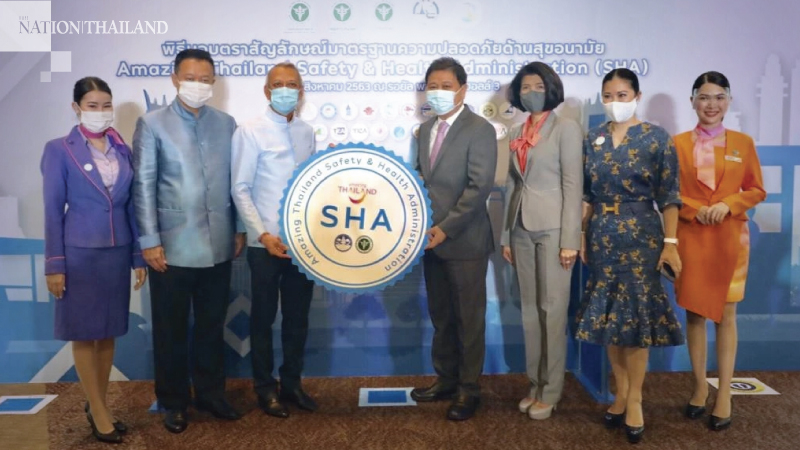
Thai Airways (THAI) and THAI Smile have become the first Thai carriers to receive the Amazing Thailand SHA logo.
Wiwat Piyawiroj, executive vice president, Commercial, of Thai Airways International Pcl, and Netnapang Thirawas, chief executive officer, customer services, of THAI Smile Airways, received the Amazing Thailand Safety and Health Administration (SHA) logo from Phiphat Ratchakitprakarn, Tourism and Sport Minister, at Royal Paragon Hall, Siam Paragon.
Tourism Authority of Thailand Governor Yuthasak Supasorn also attended the ceremony.
Wiwat said THAI and THAI Smile are honoured to be the first carriers to be presented with the logo. During the Covid-19 outbreak, THAI and THAI Smile provided services with health safety of passengers and employees as their top priority. Physical distancing is applied in every aspect of service provision: check-in, passenger boarding, seat arrangement, inflight box meals to avoid physical contact, and disembarkation. The cabin crew were required to wear protective suits, medical masks, and gloves while providing services and observed passengers with possible symptoms. Cabin rooms and cockpits were also sterilised and deep cleaned.
The Amazing Thailand SHA project is a partnership between the Ministry of Public Health, the Ministry of Tourism and Sport, the Tourism Authority of Thailand, and the private sector to develop the Thai tourism industry by combining public health safety measures with hospitality service standards to ensure a favourable travel experience and hygienic safety.
The SHA standards are used to evaluate 10 categories of service in the tourism industry, such as accommodation, restaurants, tour agents, department stores, and vehicles.
By The Washington Post · Heather Long · NATIONAL, BUSINESS, WHITEHOUSE STIMULUS-ANALYSIS
President Donald Trump took the unusual – and controversial – step Saturday of attempting to provide additional economic relief to millions of Americans on his own, without the approval of Congress.
At his golf club in Bedminster, N.J., Trump announced he was postponing payroll taxes through the end of the year, extending the unemployment “bonus” at $400 a week (down from $600), helping people “stay in their homes” and waiving student debt payments through the end of 2020. The details, however, are not as generous as he made them sound.
He is ordering a payroll tax deferral, not a cut, meaning the taxes won’t be collected for a while but they will still be due at a later date. On housing, he instructs key officials to “consider” whether there should be a ban on evictions. He also insists that state governments pick up the tab for some of the unemployment aid.
It is likely Trump will face a legal challenge over these actions. The U.S. Constitution gives Congress the power of the purse. Any changes to taxes or spending are supposed to come from Congress.
Here’s a rundown of what Trump actually did. He says he signed four “executive orders,” but in reality, only the one on housing is an actual executive order. The other three actions are marked as “memorandum,” which carries less heft.
1. He delays payroll tax collection for those making under $104,000
Trump instructs the U.S. Treasury to halt collection of payroll taxes from Sept. 1 through Dec. 31 for workers who earn under less than $4,000 every two weeks (that’s people earning under about $104,000 a year).
This will feel like a tax cut for a few weeks because workers will end up with larger paychecks while the tax is not collected. But it is technically a tax deferral, meaning the taxes will still be due at a later date.
The president called on Congress (and presumptive Democratic presidential nominee Joe Biden) to make the tax deferral a permanent tax cut, but Trump is acknowledging he does not have the power to cut taxes on his own. That would take action from Congress.
Payroll taxes help pay for Social Security and Medicare. Trump is attempting to postpone the 6.2 percent tax that employees pay in every paycheck for Social Security. Employers are also required to kick in another 6.2 percent that comes out of the company’s pocket for each employee.
Congress already deferred most employer payroll taxes for the rest of 2020, so Trump is now attempting to defer workers’ payroll taxes. This relief only applies to people who are working and collecting a paycheck, and it is only temporary since the taxes must still be paid. If the taxes were not repaid, it would lower the funds in the Social Security Trust Fund.
2. Unemployment aid is (sorta) extended at $400
The United States currently has more than 30 million people on unemployment aid. They had been receiving an extra $600 a week from the federal government on top of their state aid (which averaged $330 a week), but Congress set the federal funding expire at the end of July. Democrats want to continue at the $600 a week level. Republicans proposed $200. They have yet to agree.
Trump’s memo calls for federal aid to restart at a level of $400 a week. But there’s a catch: The federal government is only paying for $300 of that. States have to kick in the other $100. Many states are currently cash-strapped as they fight the coronavirus, and there’s concern governors won’t sign on to do this.
There are also a lot of legal questions about the money Trump is attempting to use to pay for this. He calls for $44 billion of funding from the Department of Homeland Security’s Disaster Relief Fund that is normally used for hurricanes, tornadoes and massive fires to be shifted over to unemployment.
“The basic notion here is the president is rejecting Congress’s power of the purse,” said David Super, a constitutional law expert at Georgetown Law. “That is something nobody who cares about separation of powers can let slide, even if they like what the money is being spent on.”
Trump’s memo orders the aid to last through Dec. 6 or until funding runs out. But on top of legal questions, $44 billion would cover less than five weeks of payments for 30 million unemployed Americans. That isn’t enough money to make it to October, unless the number of people on unemployment falls dramatically.
3. Top officials can “consider” halting evictions
The United States has about 110 million renters, and many have been hit hard by the layoffs in retail, restaurants and hospitality during the pandemic. Trump’s executive order does little to help them.
Trump has said many times in recent days he wants to prevent evictions, but his latest executive order does not ban evictions. Instead, Trump calls for Health and Human Services Secretary Alex Azar and Centers for Disease Control and Prevention Director Robert Redfield to “consider” whether an eviction ban is needed.
Trump also didn’t provide any more money to help renters. The executive order calls only for Treasury Secretary Steven Mnuchin and Housing and Urban Development Secretary Ben Carson to see if they can find any more funds to help out. It doesn’t promise more aid.
Many housing advocates and landlords were surprised Trump didn’t do more to help renters. The federal government owns the vast majority of mortgages in the nation through Fannie Mae, Freddie Mac and other entities. Back in March, Congress passed a federal moratorium preventing many evictions, but it expired on July 24. That moratorium covered all renters living in places that had a federally owned mortgage. Many thought Trump likely did have the authority to extend at least that eviction ban, but he did chose not to do so.
There could be 30 million to 40 million renters at risk of eviction in the coming months, according to report last week by a group of housing advocates and researchers. That compares with an average of 3.6 million evictions a year before the coronavirus pandemic.
4. Student loan payments are deferred until Dec. 31
Trump’s final memo waives all interest on student loans held by the federal government through the end of 2020 and allows people to delay payments until Dec. 31.
The Education Department does have the authority to defer or even cancel student loan payments to the federal government, says Alexis Goldstein of Americans for Financial Reform.
Trump used this authority to temporarily cancel interest payments, which helps relieve the financial burden on millions of Americans. But the debt is not canceled forever. Principal payments are due on Dec. 31 and full payments are slated to restart Jan. 1.
5. What happens next
There will likely be court challenges to Trump’s actions this weekend, making it unclear how quickly any money would reach the unemployed. On top of that, it’s unclear how many states will want to participate in this enhanced unemployment program or how many companies will want to suspend payroll taxes for employees only to have to pay them in 2021.
Overall, this a limited action. It still would take a deal between Republicans and Democrats to pass a broad economic aid package that would substantially address the needs of small businesses, renters, unemployed workers and more.
—
Heather Long is an economics correspondent. Before joining The Washington Post, she was a senior economics reporter at CNN and a columnist and deputy editor at the Patriot-News in Harrisburg, Pa. She also worked at an investment firm in London.
Supant Mongkolsuthree, chairman of the Federation of Thai Industries
By The Nation
The Joint Standing Committee on Commerce, Industry and Banking (JSCCIB) will ask new Finance Minister Predee Daochai to lower barriers to doing business in Thailand, said Supant Mongkolsuthree, chairman of the Federation of Thai Industries.
The JSCCIB wants the government to set up a public-private committee to boost ease of doing business. It will also ask the minister to revise arcane rules deemed to be obstacles to doing business in Thailand, he added.
The moves would boost Thailand’s World Bank ranking for ease of doing business from its current 21st
place, Supant said.
The joint standing committee will also ask the government to extend the relief measures beyond their original end dates to mitigate impacts of the Covid-19 outbreak, he said.
He said the government should also boost the property market by reducing mortgage fees and transfer fees for residences worth up to Bt50 million. This would increase demand for upscale real estate asset, which would help lift the economy, he added.
Investment in corporate bonds has improved over the past two months as investors appear to be less worried about the Covid-19 fallout, said Ariya Tiranaprakij, senior executive vice president of The Thai Bond Market Association.
The other contributing factor is that investors are looking for investments that yield high returns now that deposits are getting low interest.
She added that many firms have started raising funds by issuing bonds after having to postpone their planned bond issuance earlier.
In the first week of August, the value of issued bonds stood at Bt9.580 billion.
If the Covid-19 situation continues to improve, the association expects to see between Bt80 billion and Bt90 billion worth of bonds to be issued monthly for the rest of the year. Total bond issuance this year is expected to hit at least Bt800 billion.
Japan push to cut China reliance may be boost for Southeast Asia
EconAug 09. 2020File photo: Vietnamese authorities conduct temperature checks in an effort to contain the covid-19 outbreak.
By Syndication Washington Post, Bloomberg · Yuko Takeo, Michelle Jamrisko · BUSINESS, WORLD, US-GLOBAL-MARKETS, ASIA-PACIFIC Japan’s quiet push to protect its supply chains in the era of covid-19 may prove a boon for Southeast Asian nations looking to gain from the growing backlash against China.
The Japanese government is paying about 12 billion yen ($114 million) to 30 companies to increase production in Southeast Asia, in the first round of a multi-billion dollar program to diversify supply chains after covid-19 and worsening relations between the U.S. and China.
Japan wants to cut its reliance on China or any other individual nation and the money will hasten the trend of firms moving out of China and into cheaper neighbors like Vietnam or Thailand.
Fujikin Inc. makes parts used in semiconductor manufacturing and is one firm benefiting from the incentives. The Osaka-based manufacturer will receive subsidies worth two-thirds of its costs to shift production out of China and into Vietnam.
“We’d been thinking about increasing our capacity in Vietnam before the subsidy was announced, and it fit right in,” said company President Shinya Nojima.
When the virus shut down Fujikin’s suppliers in China earlier this year, their customers became worried about shipments of parts. “Our customers were asking us: Is the China procurement happening? Are we going to be able to meet the deadline?” Nojima said Monday.
The coronavirus outbreak, and the lockdowns that followed, have forced businesses and government officials around the world to rethink their supply chains in order to reduce reliance on China as a manufacturing source.
Japan had already been a key player in Southeast Asia, home to some of Asia’s fastest-expanding economies before the pandemic and a growing and youthful population. Japanese investment into five of the region’s economies — Vietnam, the Philippines, Malaysia, Indonesia and Thailand — rose at nearly double the pace into China over the past decade.
Infrastructure development formed a big chunk of that investment, with Japanese firms vying with Chinese ones to build railways and hospitals in countries like Indonesia, the Philippines and Vietnam.
The U.S.-China trade war and worries about China’s growing dominance in Southeast Asia have fostered stronger economic ties between Japan and the region.
Japan is considered the most trusted major power among Southeast Asian nations, according to an annual survey by the Singapore-based ISEAS-Yusof Ishak Institute, released in January. Of 1,308 people surveyed across five professional sectors, 61.2% said they had confidence Japan would “do theright thing” to provide public goods.
That trust goes both ways, with Japan putting a net $139 billion into Vietnam, Thailand, Indonesia, Malaysia and the Philippines over the past decade.
“Even before coronavirus and the U.S.-China trade war struck, there was a shift away from production in China,” said Satoshi Kitashima, a deputy director at the Japan External Trade Organization.
Vietnam has emerged as the clear favorite for many manufacturers over the years, given its proximity to China, relatively low labor and power costs, and its openness to foreign investment. Kitashima, who had previously spent nine years in Vietnam facilitating business between the two countries, said there’s been a clear upward swing in Japanese direct investment into Vietnam since the global financial crisis more than a decade ago.
Fujikin’s Nojima says Vietnam’s wages are a 10th of Japan’s and lower than in China, while Kitashima says many firms are now moving to Vietnam with their focus on the nation’s young and rapidly growing domestic market. Investors also credit Vietnam for its stable political leadership and ability to contain the coronavirus outbreak, although the nation has recently seen a spike in cases again.
Of the 30 firms that secured Japanese government subsidies to expand production abroad to protect their supply chains, half of them will be using that money in Vietnam.
One of them is Showa International Co., a Tokyo-based business that’s been making clothes in Vietnam for 25 years. The pandemic has seen it ramp up production of medical gowns and masks, with Kazuo Nishizawa, head of the company, projecting it should be able to produce up to 150,000 gowns a month.
“There’s still a large shortage of gowns and masks,” he said. With demand surging across the world, “we have a mission to first be able to provide stable supplies to Japan,” he said.
In the first round of the new subsidy program, 57 companies shared 57.4 billion yen to boost output in Japan, and the 30 companies shared about 12 billion yen to increase output in other nations. That leaves around 174 billion yen that firms can apply for in the next round.
Indonesia, Southeast Asia’s largest economy and the world’s fourth most-populous nation, is another country that’s benefited from a surge in Japanese investment, including in Jakarta’s first underground rail network.
Japan was the biggest Asian investor in Indonesia in the first quarter, according to data from the central bank. In June, authorities announced that seven foreign companies will relocate their plants from China to Indonesia with a total investment value of $850 million. Three of them were from Japan, including electronics giant Panasonic Corp. and auto parts maker Denso Corp.
“FDI from Japan will remain high or even higher, especially because the second phase of the mass rapid transit construction project in Jakarta will soon begin,” said Yuliot, a deputy chairman at the Indonesian Investment Coordinating Board, who goes by one name. Another reason is “the relocation trend of Japanese plants from China to Indonesia,” he said.
Within Japan, pressure is growing to secure supply chains.
“In the past supply chains were put together solely from the perspective of economic rationale,” Akira Amari, a confidante of Prime Minister Shinzo Abe and a senior ruling party official, said in an interview last month. “Amid the coronavirus crisis, the thinking is shifting toward diversifying risk from the perspective of national economic security.”
In a worst-case scenario, the Thai tourism sector is expected to generate revenue of Bt676.7 billion next year due to the impact of the Covid-19 outbreak, Tourism Authority of Thailand Governor Yuthasak Supasorn said.
This represents a drop of 9 per cent from the previous worst-case scenario forecast for this year of Bt742.5 billion, a sharp decline of 75 per cent from around Bt3 trillion last year.
In the best-case scenario, the sector is expected to generate Bt1.52 trillion revenue next year, far lower than the Bt3.93 trillion predicted before the outbreak began.
If the sector quickly recovers early next year or in the second quarter next year, it will have revenue of Bt1.525 trillion of which Bt977 billion will be contributed by foreign tourists. The number of tourist arrivals is expected to reach 20.5 million next year.
If the sector recovers to a medium level during middle of next year or late in the third quarter, it is expected to generate revenue of Bt1.108 trillion of which Bt617.5 billion will be from foreign tourists. The number of foreign tourists is expected to reach 12.5 million.
If recovery happens late next year, the sector is estimated to post revenue of between Bt675.7 billion to Bt754.8 billion of which Bt296 billion will be contributed by foreign tourists. The number of foreign tourists is estimated at 6.14 million.
Investors were advised to beware of volatility amid the rise in gold price.
Gold price in Thailand was expected to hit Bt31,000 per baht weight, an expert said.
MTS Gold chief executive Nattapong Hirunyasiri said gold price in Thailand continued to rise, reflecting the uncertainty following the Covid-19 pandemic and unrest in many regions.
“People believe gold is worthy of investment, while there are various types of investments, such as gold bars, gold ornaments, gold contracts, and gold funds that meet the needs of people of all ages,” he said.
“However, investors must manage their investment portfolio carefully because the gold market still faces volatility, while they should study thoroughly before investing in this precious metal to prevent risks and create opportunity to take profits.”
He expected gold price to hit Bt31,000 per baht weight as the spot gold price continues to hit a new high due to the weakening dollar.
“Gold’s next resistance level is US$2,100 per ounce,” he said.
“Factors that are boosting the gold price are the Covid-19 pandemic, governments and central banks’ efforts to stimulate the economy due to uncertainty following the global economic slowdown, the US-China trade war, and blasts in Iraq and Lebanon,” he added.






 File photo: Vietnamese authorities conduct temperature checks in an effort to contain the covid-19 outbreak.