Dow Unveils Future of Sustainable Packaging: INNATE™ TF Polyethylene Resins for Tenter Frame Biaxial Orientation #ศาสตร์เกษตรดินปุ๋ย

#ศาสตร์เกษตรดินปุ๋ย : ขอบคุณแหล่งข้อมูล : หนังสือพิมพ์ The Nation.

Dow Unveils Future of Sustainable Packaging: INNATE™ TF Polyethylene Resins for Tenter Frame Biaxial Orientation

Aug 08. 2020

By The Nation

Answering industry demand for high performance, consumer convenience, and recyclability, Dow is excited to announce an innovative and revolutionary brand extension to the family of INNATE™ Precision Packaging Resins. INNATE™ TF Polyethylene Resins for Tenter Frame Biaxial Orientation are bringing commercial viability to a long-desired packaging goal: tenter frame biaxially oriented polyethene (TF-BOPE) films.

Compared to traditional polyethene (PE) films, the TF-BOPE film made with INNATE™ TF Polyethylene Resins for Tenter Frame Biaxial Orientation has higher mechanical properties and material rigidity, better optical and printing performance, and offers considerable sustainability advantages, including the potential for all-PE structures for recyclability.

Many valuable benefits

TF-BOPE films made using INNATE™ TF resins demonstrate many impressive properties prized across the value chain:

• Excellent optical properties such as transparency and glossiness

• up to 80% less haze compared to traditional PE films

• twice the impact strength and tensile modulus

• three times the puncture resistance and tensile strength of traditional blown PE films

• excellent flex crack resistance, even under low temperature

• good tearability for convenience-in-use

A more sustainable packaging solution

INNATE™ TF Polyethylene Resins for Tenter Frame Biaxial Orientation offer distinctive physical properties which can enable material substitution, film layer elimination, and/or downgauging, to reduce overall packaging materials.

The TF-BOPE film can be used directly as the printed layer of the packaging, allowing a combination of PE functional layers to achieve an all-PE structure, making it more convenient for recycling and increasing the sustainability quotient.

Applications are already on the shelf

Collaborating with a variety of value chain members, such as Guangdong Decro Film New Materials Co Ltd, CaiHua, NanCheng and KAIDA Group, commercial applications – including all-PE pillow pouches, recyclable SUP packaging, and liquid product SUPs – are now in the marketplace. Applications include rice bags, pet food bags, heavy-duty shipping sacks, liquid detergent pouches, and others. Case studies regarding some of these applications are available for review at www.dow.com/InnateTF.

More is to come through ongoing collaboration. Asia Pacific marketing director for Food & Specialty Packaging, Dow Packaging and Specialty Plastics, Kodak Xiao, stated: “As one of the leading materials solutions providers to the packaging industry, Dow hopes to collaborate with key stakeholders across the value chain to promote innovative and sustainable packaging solutions and promote the healthy and dynamic development of the industry. With its downgauging and recyclability potential, INNATE™ TF resins already offer answers to the plastic waste issue, and we believe more advantages can be found together.”

These successes come after more than a decade of efforts. According to Wu Chang, Asia Pacific director for Technical Services and Development (TS&D), Dow Packaging and Specialty Plastics: “Our Asia-Pacific regional R&D team engaged in intensive research into the future trends of the packaging market. This revolutionary product breaks through the limits of traditional PE products and showcases Dow’s futuristic and cutting-edge insights, as well as our strong R&D capacity.”

Since the initial release in 2017, Dow’s TF-BOPE resins have earned three prestigious awards: an Edison Awards Gold, an R&D 100 Award, and the Ringier Technology Innovation Award.
Digital transformation a necessity for corporates, says WHA chief #ศาสตร์เกษตรดินปุ๋ย

#ศาสตร์เกษตรดินปุ๋ย : ขอบคุณแหล่งข้อมูล : หนังสือพิมพ์ The Nation.

Digital transformation a necessity for corporates, says WHA chief

CorporateAug 08. 2020

Jareeporn Jarukornsakul (Nation Photo by Tanachai Pramarnpanich)

Jareeporn Jarukornsakul (Nation Photo by Tanachai Pramarnpanich)

Jareeporn JarukornsakulJareeporn Jarukornsakul

By THE NATION

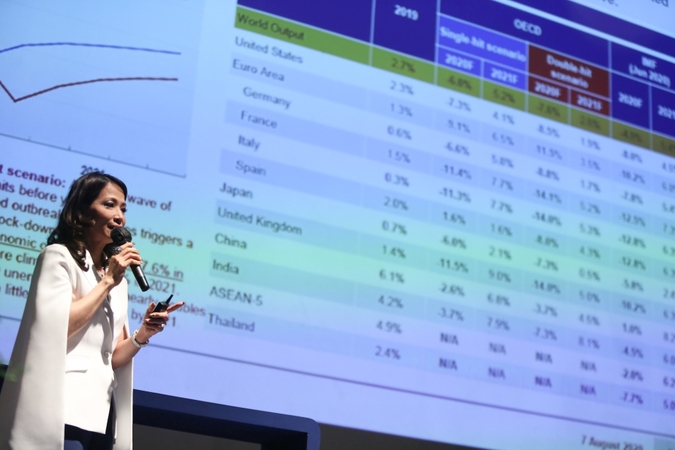
WHA Corporation Pcl is preparing to apply digital technology to its business operations to cope with the changing normal standards and the uncertainty of the Thai economy, the company’s CEO and chairwoman, Jareeporn Jarukornsakul, said.

During the seminar “Turning Crisis into Opportunities: Digital Transformation for CEOs” held recently, Jareeporn said: “Digital transformation is a necessity that must be employed along with the business and people development. As an operator of industrial estates and a logistics provider, WHA is planning to use 5G technology and artificial intelligence in our data centre to serve customer needs as increasing numbers of customers are switching to remote operations to overcome geographical limitations.”

“AI technology will also help improve the efficiency of the company’s smart logistics platform that will help boost Thailand’s e-commerce industry, which is now responsible for 19.6 per cent of GDP, even further,” she added.

Jareeporn added that WHA is also planning to deploy a smart grid system in 100 per cent of industrial estates under its administration, which will be the first operator in Thailand to do so. “We have recently signed an MoU [memorandum of understanding] with the Provincial Electricity Authority [PEA], which will enable our industrial estate customers to buy electricity at lower price and sell excessive electricity directly to PEA’s grid for additional income,” she added.

When asked about the new Cabinet members announced recently, Jareeporn said that WHA is confident the new ministers will help strengthen the government’s effort in developing the Eastern Economic Corridor, which is the company’s target area.

“The new Finance Minister, Predee Daochai, and the new Industry Minister, Supattanapong Punmeechaow, both have extensive experience in their fields and have been working on EEC projects before, therefore key projects should be able to continue seamlessly,” she added.

Jareeporn added that the EEC was currently the strongest selling point of Thailand as an alternative to China where many companies are migrating out of to avoid the impact of the trade war with the US. “We need to push forward with the development of EEC projects as much as possible, or risk being surpassed by Vietnam as a better alternative in the next five years,” she warned.

Kiatnakin Bank shifts loan strategy as virus takes business toll #ศาสตร์เกษตรดินปุ๋ย

#ศาสตร์เกษตรดินปุ๋ย : ขอบคุณแหล่งข้อมูล : หนังสือพิมพ์ The Nation.

Kiatnakin Bank shifts loan strategy as virus takes business toll

CorporateAug 08. 2020

By The Nation

Kiatnakin Bank (KKP) is cutting the number of unsecured loans it grants so as to reduce risks from the economic slowdown amid the Covid-19 pandemic.

CEO Aphinant Klewpatinond said the bank was more able to control risks from secured loans than from unsecured ones.

“About 3 per cent of our customers have unsecured loans and some have taken up the offer to suspend their repayments. Our focus on granting more secured loans should see the proportion of unsecured loans decrease automatically,” he said.

However, he said granting secured loans was not without risk amid high volatility in the economy due to the Covid-19 pandemic.

“We have to consider granting loans carefully because it won’t be worth it if [debt defaults] lead to collateral seizures and an oversupply of collateral assets that results in their value dropping,” he said.

“We will consider borrowers’ means, such as their income. If their business has risks, we may have to reduce their loan.”

He added that the bank has changed strategy to attract more customers with stronger dependability by, for instance, granting loans for buying cars that are popular in the market.

“This is not a time to cut interest to win the competition with other banks, because there are lots of risks at present,” he said.

“The bank will consider adjusting interest in line with the market,” he added.”

Consumers remain sunk in worry over Covid-19, politics #ศาสตร์เกษตรดินปุ๋ย

#ศาสตร์เกษตรดินปุ๋ย : ขอบคุณแหล่งข้อมูล : หนังสือพิมพ์ The Nation.

Consumers remain sunk in worry over Covid-19, politics

EconAug 08. 2020Pro-democracy activists launch a petition for 50,000 signatures needed for a motion to rewrite the Constitution at Thammasat University on Friday (August 7). Meanwhile consumers are worried about emerging political instability and the persisting impact of Covid-19.Pro-democracy activists launch a petition for 50,000 signatures needed for a motion to rewrite the Constitution at Thammasat University on Friday (August 7). Meanwhile consumers are worried about emerging political instability and the persisting impact of Covid-19.

By The Nation

Consumer confidence rose for a third consecutive month in July, but the index remains at a record low.

The Consumer Confidence Index moved to 50.1 in July, up from 49.2 in June, the University of the Thai Chamber of Commerce (UTCC) said.

 “This is the third monthly increase in a row, but the index remains at a historic low since being launched 21 years and 10 months ago, Thanawat Polvichai, rector of UTCC and chief adviser to UTCC’s Centre for Economic and Business Forecasting, said on Friday (August 7).

The index rated the state of economy at 42.6, job opportunities at 48.4 and outlook for future income at 59.3 – far below the threshold of 100 and the lowest level in 21 years, he said.

Consumers lack confidence because they are worried about the threat of a second wave of virus infections, which will continue to drag down the economy and wipe away job opportunities.

On the positive side, the economy had bottomed out in the second quarter, Thanawat said.

However, consumers were delaying spending on durable goods such as cars and large household items over worry about their future income.

Consumers are also worried about political stability following the Cabinet reshuffle and almost daily student-led protests.

More political gatherings are expected after universities open next week, he said.

The Consumer Confidence Index was released on the same day that police issued a batch of arrest warrants for protest leaders. Pro-democracy groups have vowed to intensify their political activities in response to what they say is legal suppression of free speech by authorities.

Thanawat said newly appointed Finance Minister Predee Daochai and Energy Minister Supattanapong Punmeechaow are thought to have a strong understanding of the current economic situation. The government may need another stimulus injection of Bt200 billion to Bt300 billion and spend another Bt300 billion to rescue small and medium-sized enterprises (SMEs) with soft loans, he said.

Should the economy not continue improving this year, 1-2 million workers may lose their jobs, he warned.

The government could boost the jobs situation by allowing private companies to hire workers on an hourly basis, he suggested.

A survey showed consumers are expected to spend Bt9.98 billion on Mother’s Day (August 12) – down by 28 per cent on last year’s holiday.

“Facing high debt burdens and uncertain futures, more and more consumers are borrowing money from pawn shops, underground lenders and their relatives,” he added.

Thai e-commerce goes global as CP’s Ascend acquires Chinese auction site #ศาสตร์เกษตรดินปุ๋ย

#ศาสตร์เกษตรดินปุ๋ย : ขอบคุณแหล่งข้อมูล : หนังสือพิมพ์ The Nation.

Thai e-commerce goes global as CP’s Ascend acquires Chinese auction site

CorporateAug 07. 2020

By The Nation

Charoen Pokphand Group (CP Group) has announced its subsidiary Ascend Commerce is paying Bt558 million to acquire Chilindo, a foreign e-commerce business headquartered in Hong Kong.

E-commerce has become a mainstream channel in the Covid-19 “new normal” era and represented another way to stimulate and revitalise the Thai economy, said CP Group CEO Suphachai Chearavanont, explaining the move.

Most importantly, e-commerce was the business of the future in the 4.0 era, he added.

Ascend Commerce is buying 100 per cent of shares in Chilindo in order to upgrade its Thai online shopping platform WeMall.

Investment in Chilindo will act as a pilot for the establishment of a Thai e-commerce platform that will help raise Thai e-commerce to an international level, Suphachai said. At present, the e-commerce market in Thailand is mostly operated by transnational businesses.

“To strengthen Thailand’s e-commerce, priority must be given to Thai SMEs, especially during this Covid-19 pandemic that has changed the behaviour of consumers. Through the acquisition of Chilindo, Thailand will have its own e-commerce platform, which can be regarded as turning a crisis into an opportunity, accelerating the development of Thailand’s digital economy as well as stimulating the country’s economy in time for the arrival of 5G technology,” said Suphachai. 

He said the platform would provide a marketing channel for SMEs and Thai farmers to sell their products overseas. 

Thailand’s Bt3 trillion e-commerce market is expected to grow by up to 19 per cent this year, with domestic online trading accounting for 1.5 per cent of private consumption or 0.8 per cent of full-year GDP, according to CP.

The Chilindo platform uses an auction model, with the minimum bid price set at Bt1 and all purchases traceable to guarantee sellers are genuine.

SET dips again due to lack of new upbeat factors #ศาสตร์เกษตรดินปุ๋ย

#ศาสตร์เกษตรดินปุ๋ย : ขอบคุณแหล่งข้อมูล : หนังสือพิมพ์ The Nation.

SET dips again due to lack of new upbeat factors

EconAug 07. 2020

By The Nation

The Stock Exchange of Thailand (SET) Index fell for a second day today (August 7) closing at 1,324.40, down 8.82 points or 0.66 per cent. Total transactions stood at Bt44.367 billion with an index high of 1,333.21 and a low of 1,321.16.

During the morning session, a stock analyst at Krungsri Securities said he expected the index to fluctuate between 1,325 and 1,340 due to the lack of new positive sentiment to boost investment.

“The market had initially been positive about ongoing progress in the $1-trillion US economic stimulus package, an agreement for which is expected to be reached soon, and from the price of crude oil rising to more than $41 per barrel,” he said.

“However, mass sell-offs after listed companies announce their second-quarter performance will pressure the index.”

The top 10 stocks with the highest trade value today were PTT, ADVANC, AOT, PTTEP, STGT, STA, CPALL, CPF, GPSC and PTTGC.

As of 4.30pm, the price of crude oil dropped by US$0.37 or 0.88 per cent to $41.58 per barrel, while gold rose by $0.80 or 0.04 per cent, to $2,070.20 per ounce.

Other Asian indices were mixed:

Japan’s Nikkei Index closed at 22,329.94, down 88.21 points, or 0.39 per cent.

China’s Shanghai SE Composite Index closed at 3,354.04, down 32.43 points, or 0.96 per cent, while Shenzhen SE Component Index closed at 13,648.50, down 214.63 points, or 1.55 per cent.

Hong Kong’s Hang Seng Index closed at 24,531.62, down 398.96 points, or 1.60 per cent.

South Korea’s KOSPI Index closed at 2,351.67, up 9.06 points, or 0.39 per cent.

Taiwan’s TAIEX Index closed at 12,828.87, down 84.63 points, or 0.66 per cent.

BH Q2 slump rings alarm bells for hospital stocks #ศาสตร์เกษตรดินปุ๋ย

#ศาสตร์เกษตรดินปุ๋ย : ขอบคุณแหล่งข้อมูล : หนังสือพิมพ์ The Nation.

BH Q2 slump rings alarm bells for hospital stocks

EconAug 07. 2020

By The Nation

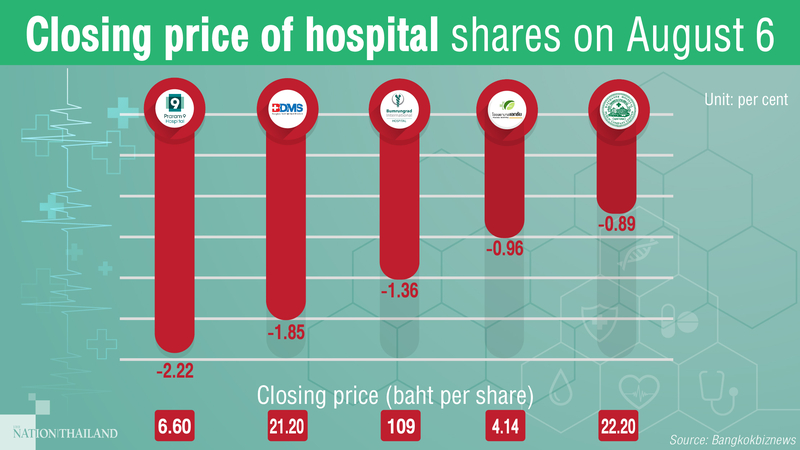
The price of hospital shares dropped sharply due to uncertainty among investors over weak second-quarter performance after Bumrungrad Hospital’s profit dropped by 93.9 per cent to Bt44.42 million from the same period of the previous year at Bt724 million.

Hospitals’ share price on Thursday (August 6) fell by 50.30 points, or 1.07 per cent, to 4,635.04 points. The price of Praram 9 Hospital (PR9)’s shares closed at Bt6.60 per share, down Bt0.15 or 2.22 per cent, Bangkok Dusit Medical Services (BDMS) closed at Bt21.20 per share, down Bt0.40 or 1.85 per cent, and Bumrungrad Hospital (BH) closed at Bt109 per share, down Bt1.50 or 1.36 per cent.

Suwat Wattanapornprom, director of Asia Plus Securities’s research department, expected the profit of other hospitals to take as big a hit as BH, especially hospitals that get a lot of foreign patients because the number of these patients have dropped significantly due to the Covid-19 fallout that has resulted in countries’ lockdowns and travel restrictions.

“We expect hospitals’ second-quarter performance to be the worst this year because the Covid-19 situation in the country began to ease, while some countries began to lift lockdown measures,” he said.

“However, hospitals that have a lot of foreign patients would recover slower than hospitals that have domestic patients because foreign patients still face a lot of difficulties.”

He added that the securities company had cut BH’s profit forecast for this year by approximately 30 per cent to Bt1.6 billion from the previous forecast of Bt2.3 billion because the hospital’s second-quarter profit was worse than expected.

“We weighted investment in hospital shares same as the market,” he added.

Meanwhile, Piyachat Ratanasuvan, senior director at Kasikorn Securities, said investors were concerned about weak hospital performance as BH’s second-quarter profit was worse than expected.

“We expect hospitals’ performance to recover by the third quarter of this year because the number of domestic and foreign patients is expected to increase,” she said.

Slow sales by foreign investors keeps Thai stocks stable #ศาสตร์เกษตรดินปุ๋ย

#ศาสตร์เกษตรดินปุ๋ย : ขอบคุณแหล่งข้อมูล : หนังสือพิมพ์ The Nation.

Slow sales by foreign investors keeps Thai stocks stable

EconAug 07. 2020

By The Nation

Thai stock market in July this year was stable as foreign investors delayed net sales, the Stock Exchange of Thailand (SET) said.

Soraphol Tulayasathien, SET senior executive vice president and head of corporate strategy division, said the SET Index in July this year closed at 1,328.53, down 0.8 per cent month on month due to uncertainty following US-China tensions, the second Covid-19 wave, countries’ economic data, and listed companies’ performance in the first half of this year, causing the index to move in a narrow range.

“The SET Index at the end of the previous year fell by 15.9 per cent, but still higher than MSCI Asean that fell by 19.4 per cent,” he said.

“However, some industries, such as agro-food and consumer products industries in July this year rose more than the SET at the end of the previous year.”

He said some businesses had benefited from the government’s move to ease lockdown measures, such as electronic components, food and beverage, and personal items and medical supplies businesses, adding that July was the first month to see signs of recovery outside the SET100 Index.

“In July this year, average daily transactions on the SET and Market for Alternative Investment amounted to Bt64.010 billion, same as the previous year, while average daily transactions in the first seven months amounted to Bt67.972 billion, up 31.3 per cent year on year,” he said.

“Investors in the country made the highest transaction for five consecutive months at 48.03 per cent of total transactions, while foreign investors made net sales of only Bt9.938 billion, the lowest in seven months.”

He said two companies had launched initial public offerings (IPO) in July this year, namely Sri Trang Gloves and Silicon Craft Technology.

“The IPO value totalled Bt15.043 billion, while transactions amounted to Bt81.441 billion, accounting for 6.46 per cent of transactions in July,” he said.

The Thai stock market’s forward and historical price to earnings (P/E) at the end of July was 21.4 and 19.1 times respectively, higher than the average forward and historical price to earnings of Asian stock markets at 16.3 and 17.5 times respectively.

“Meanwhile, the market dividend yield at the end of July was 3.66, higher than the average dividend yield of Asian stock markets at 3.03 per cent,” he said.

He added that the Thai futures market’s average daily transaction in July was 397,340 contracts, down 20.3 per cent month on month, especially from Single Stock Future and SET50 Index Futures.

“In the first seven months, Thai futures market’s average daily transactions were 484,269 contracts, up 21.75 per cent year on year,” he added.

Limited upside room for SET due to lack of positive factors #ศาสตร์เกษตรดินปุ๋ย

#ศาสตร์เกษตรดินปุ๋ย : ขอบคุณแหล่งข้อมูล : หนังสือพิมพ์ The Nation.

Limited upside room for SET due to lack of positive factors

EconAug 07. 2020

By The Nation

The Stock Exchange of Thailand (SET) Index fell by 0.98 points, or 0.07 per cent, to 1,332.24 on Friday morning (August 7).

A stock analyst at Krungsri Securities expected the index to fluctuate between 1,325 and 1,340 due to lack of new positive sentiment to boost the investment.

“The market gained positive sentiment from ongoing progress in the $1-trillion US economic stimulus package on which an agreement is expected to be reached soon, and from the rising price of crude oil to over $41 per barrel,” he said.

“However, mass sell-offs in stocks after listed companies announced their second-quarter performance will pressure the index.”

He recommended that investors buy:

▪︎ Energy stocks that benefit from rising crude oil price, such as PTT, PTTEP, TOP, PTTGC, SPRC and IVL.

▪︎ Stocks whose second-quarter performance will improve, such as TOP, PTTGC, SPRC, BGRIM, CPF, TU, ASIAN, TASCO, STA, STGT, AP, PRM, PTL, AJ, CBG, TQM, JMT, CHAYO, PTG and BCH.

The SET index fell by 4.13 points, or 0.31 per cent, closing at 1,333 at close on Thursday.

Total transactions amounted to Bt55 billion due to mass sell-offs in small and medium stocks before listed companies announce their second-quarter performance by next week.

The market also was pressured by the fall in the European stock market due to weak economic data in several countries.

Foreign investors made net buys in stocks worth Bt608 million and net sales in bonds worth Bt2.626 billion. There were 11,587 net TFEX SET50 contracts.

MEA’s solar-energy project in Bangkok community proves successful #ศาสตร์เกษตรดินปุ๋ย

#ศาสตร์เกษตรดินปุ๋ย : ขอบคุณแหล่งข้อมูล : หนังสือพิมพ์ The Nation.

MEA’s solar-energy project in Bangkok community proves successful

Aug 06. 2020

By THE NATION

Officials from the Metropolitan Electricity Authority (MEA) visited the Koiruttukwa community in Bangkok’s Nong Chok district to follow up on a solar-energy project the agency had initiated in 2016.

The MEA had installed solar panels on the roofs of 189 houses in the community and installed solar-powered streetlights to promote the use of clean energy. Electricity generated from solar panels is also used to power the catfish farming business along the Lam Sai canal that runs through the community.

“This project has helped reduce residents’ power bills by around Bt12,000 per year and has boosted the profit from selling catfish by around Bt7,000 per year,” one of the residents said.

An MEA survey showed that the Koiruttukwa community used 40 per cent less power from the main grid per year, which works out to a reduction of more than 2.5 tonnes of carbon dioxide emissions.

MEA is also using the solar rooftops, which have a capacity of 5.4 kilowatts, as a case study for nearby communities who may be interested. Students from other provinces have also been invited to study the installation of solar panels as well as other sufficiency economy models implemented in the Koiruttukwa community.

The agency is also providing courses for people interested in pursuing a career in the electrical field or those who want to use their professional skills to maintain infrastructure in their community.