Building a safer and stronger normal in Thailand with 5G #ศาสตร์เกษตรดินปุ๋ย

#ศาสตร์เกษตรดินปุ๋ย : ขอบคุณแหล่งข้อมูล : หนังสือพิมพ์ The Nation.

Building a safer and stronger normal in Thailand with 5G

Biz insights

Jun 27. 2020David Oxford,  Country Director, Nokia Thailand David Oxford, Country Director, Nokia Thailand 

By David Oxford
Special to The Nation
The Covid-19 pandemic is the biggest health emergency the world has faced in generations. The unprecedented magnitude of this crisis means everyone is making a concerted effort to improve safety while trying to keep social and economic activities running – from governments and businesses to communities and individuals.

As Thailand is gradually easing movement and business restrictions, the question now is: where does the nation go from here? Talk of a ‘new normal’ is commonplace now, but how exactly will Thailand transition towards it, and how can the nation harness new technologies such as 5G to create a smarter and safer society?

Why Thailand’s technological ambitions are not derailed

Before the pandemic, countries around the world were moving full steam ahead with digital transformation to bring societies to the future and unlock new economic possibilities.

From the outset, it may seem that the Covid-19 outbreak dampened Thailand’s digitalisation ambitions, but the pandemic is, instead, accelerating them. This includes the creation of mobile apps that can identify Covid-19 hotspots and allow people to self-assess their health, in addition to the development of chatbots that the public can communicate with to find out information on the coronavirus and steps to prevent its spread.

These efforts are solidifying the robustness of Thailand’s national healthcare system, which is ranked sixth in the 2019 Global Health Security Index and has been vital to the country’s readiness to weather the pandemic.

Thailand is already working towards building a smarter world. Yet, the challenge now – as the country gears up for its ‘new normal’ – is jumpstarting digital transformation across other key sectors, especially enterprises, although that may require more radical changes.

Adapting for efficiency

Going the radical route is often precipitated by critical periods such as the current pandemic. We have seen drastic changes by global enterprises to support relief efforts, such as scent manufacturers reworking operations to make sanitisers and luxury automakers retooling production lines to create respirators. These may be novel, unprecedented circumstances borne by the Covid-19 spread, but it highlights how important it is for manufacturing and supply chain actors to adapt their resources quickly to solve pressing societal problems.

We need to double down on what these enterprises are already doing, yet at speeds which can help improve their adaptability and supplying solutions to society more quickly. This requires communication service providers (CSPs) – and the enterprises they work with – to harness the move to 5G.

This is – as 5G can give connected enterprises the flexibility and adaptability that provides the gift of time – a valuable commodity under normal circumstances, but an extremely vital one in times like now. With 5G, the digitalisation of industries will reduce the time taken to design and build solutions.

A ‘connected’ enterprise gives it flexibility to quickly retool and change systems on demand. That ‘on-demand change’ can mean leveraging automation and remote operations to rapidly increase output, improve employee safety, and ensure the business continuity that is crucial to the production and distribution of essential products and services.

Network slicing – the essential ingredient to 5G transformation

‘Time to market’ is just as important as ‘time to manufacture’, and the key to 5G enabling rapid deployment of solutions is network slicing. Slicing is not a new concept. Virtual network capabilities have been part of packet networking for decades. However, 5G deployments will extend this virtualisation to an end-to-end and top-to-bottom functional scope, and then embed slicing as a core function of the network. The benefits include the ability to differentiate broad classes of services that require certain characteristics or resource parameters with performance characteristics that fit the needs of new segments – something that conventional one-size-fits-all networks cannot achieve.

With network slicing, 5G can support diverse and extreme requirements for latency, throughput, capacity, and availability. It will enable services that were impractical with previous wireless technologies.

For instance, 5G networks will connect ‘factories of the future’ by creating fully automated and flexible production systems – something that Thailand’s automotive manufacturing sector can leverage to improve its competitive regional position. In healthcare, hospitals can arrange greater telemedicine distribution and even arrange robotic surgeries whereas city governments can use 5G to transform urban transport management via real-time traffic management.

All of this will be possible with 5G – with network slicing support – as it helps aggregate vast amounts of data from multiple, dispersed sources for better insight into operational status. It also allows for new levels of supply chain visibility and transparency, an attribute that could prove highly valuable in pandemic tracing.

Coming out better, faster, and stronger

Fortunately, CSPs in Thailand are taking advantage of 5G’s potential to support efforts to flatten the curve and provide relief to those impacted by lockdown measures.

Such efforts should be lauded, and we are doing our own part to help CSPs and their enterprise customers stay prepared amid the pandemic. Through our Covid-19 network traffic dashboard, we are analysing global network traffic to help them anticipate capacity requirements and optimise resources.

Right now, we must all remain steadfast in enduring Covid-19, but I am confident that we will come out stronger. When we do, 5G is there to help us create a world that is smarter, safer, and – most importantly – prepared to weather this sort of challenge more effectively in the future.

The writer is country director, Nokia Thailand 

CIMB Thai to focus on quality of loans instead of expansion #ศาสตร์เกษตรดินปุ๋ย

#ศาสตร์เกษตรดินปุ๋ย : ขอบคุณแหล่งข้อมูล : หนังสือพิมพ์ The Nation.

CIMB Thai to focus on quality of loans instead of expansion

Biz insights

Jun 27. 2020

By THE NATION

CIMB Thai Plc will adjust its loan expansion target due to the Covid-19 situation that has had a significant impact on Thai economy, the bank’s president and chief executive officer Adisorn Sermchaiwong said.

“We had set this year’s loan growth target at 12 per cent over last year, but due to the current situation the bank might see no expansion in loans at all,” he said.

“Our mission for this year therefore has to shift from increasing the amount of loans granted to maintaining the quality of loans and focusing on granting loans to target groups that have higher potential,” he said.

“CIMBT also estimates that non-performing loans [NPLs] this year will be at the same level as the previous year despite the Covid-19 outbreak, thanks to the supportive policies of the Bank of Thailand,” added Adisorn. “We aim to maintain NPLs at 4 per cent until the end of 2020 and are planning to sell NPLs of around Bt1 billion to Bt2 billion to achieve the goal.”

Adisorn added that in the past five months the bank has seen over 80 per cent increase in banking transactions on digital platform. “This year we have added more services on digital platform including mobile banking, mutual fund digital buying and digital lending in response to changing customers behaviour in the new normal era,” he said.

“The bank estimates that until the year-end the bank’s transactions via digital platform could rise to 90 per cent of overall transactions.”

“As for the investment budget for 2020, we still maintain the original target of Bt500 million to Bt600 million, with main focus on IT infrastructure,” he added. “Although in the past few months the bank did not invest much in IT due to lockdown measures, towards the end of the year we may invest in other aspects to prepare for the post Covid-19 era.”

CIMBT’s shareholder meeting on Friday (June 26) approved the payment of 2019 interim dividends to shareholders at Bt0.005 per share, amounting to Bt174.11 million.

Key economic data for June may hold key to SET direction #ศาสตร์เกษตรดินปุ๋ย

#ศาสตร์เกษตรดินปุ๋ย : ขอบคุณแหล่งข้อมูล : หนังสือพิมพ์ The Nation.

Key economic data for June may hold key to SET direction

Econ

Jun 27. 2020

By The Nation

The Stock Exchange of Thailand (SET) Index next week is expected to fluctuate between 1,300 and 1,365, a stock analyst at Krungsri Securities said.

He said that the index’s support line is between 1,320 and 1,300, while the index’s resistance line is between 1,350 and 1,365.

“We advise investors to monitor the Centre for Covid-19 Situation Administration’s consideration of the fifth phase of lockdown easing, and the Covid-19 situation,” he said.

“Among international factors, we advise following tensions between the US and their trading partners, the US, China, Japan, and the euro-zone’s Purchasing Managers’ Index in manufacturing and services in June, the US nonfarm payrolls and unemployment rate in June, Japan’s retail sales and industrial production in May, and the euro-zone’s Consumer Price Index in June.”

On Friday (June 26), the SET Index closed at 1,330.34, down 2.95 per cent compared to the previous week’s close. The index’s average daily transaction was Bt56.755 billion, down 20.51 per cent compared to the previous week’s close.

Meanwhile, the Market for Alternative Investment (mai) Index closed at 295.96, down 2.08 per cent compared to the previous week’s close.

Empire Tower granted MEA’s ‘Energy Saving Building’ award #ศาสตร์เกษตรดินปุ๋ย

#ศาสตร์เกษตรดินปุ๋ย : ขอบคุณแหล่งข้อมูล : หนังสือพิมพ์ The Nation.

Empire Tower granted MEA’s ‘Energy Saving Building’ award

Jun 26. 2020

By THE NATION

Metropolitan Electricity Authority (MEA) has granted an “Energy Saving Building” badge to Empire Tower as part of its energy saving campaign.

On Thursday (June 25), MEA deputy director-general Santi Namsinwichetchai presided over the ceremony to award the Energy Saving Building badge to Jatuphong Jaturawong, general manager of Empire Tower, at its Sathorn Room.

Located in Bangkok’s Sathorn district on the corner of South Sathorn and Narathiwat roads, Empire Tower won the MEA Energy Saving Building 2019 award for office buildings.

“MEA has organised the MEA Energy Saving Building campaign every year since 2012 to reward buildings in MEA’s jurisdiction [Bangkok, Nonthaburi and Samut Prakan] for demonstrating effective usage and conservation of energy,” said Santi. “The winner of each category can display the badge on their building as proof of their efforts and to assure customers of efficient energy management within the facilities.”

“Empire Tower passes the MEA Index standards in terms of energy usage, lighting quality and air quality,” he added.

Since the start of the campaign, 366 buildings have entered the competition and 203 have met MEA Index standards.

“The campaign has helped reduce energy usage by 39.46 million units or Bt154 million, as well as reducing emissions of carbon dioxide by over 23,000 tonnes,” he added.

Next year MEA is planning to add another tier of awards to the campaign, called MEA Energy Saving Building Plus, in which winners must demonstrate both efficient energy usage and efforts to reduce PM2.5 dust particles within the building.

More information is available at www.meaenergysavingbuilding.net and Facebook: MEAaward.

Siriraj Hospital trials 5G driverless vehicle for new medical era #ศาสตร์เกษตรดินปุ๋ย

#ศาสตร์เกษตรดินปุ๋ย : ขอบคุณแหล่งข้อมูล : หนังสือพิมพ์ The Nation.

Siriraj Hospital trials 5G driverless vehicle for new medical era

Jun 25. 2020Takorn Tantasith, third left, secretary-general of the National Broadcasting and Telecommunications Commission, together with Abel Deng, fourth left, CEO of Huawei Technologies (Thailand), hand over a 5G unmanned vehicle to Siriraj Hospital under the “Unmanned Vehicle Pilot Project Driving Thai Healthcare to 5G Era” project. Receiving the donation on behalf of the hospital are Prof Dr Prasit Watanapa, second left, Dean of Faculty of Medicine, and Assoc Prof Visit Vamvanij, first left, hospital director of Siriraj Hospital.Takorn Tantasith, third left, secretary-general of the National Broadcasting and Telecommunications Commission, together with Abel Deng, fourth left, CEO of Huawei Technologies (Thailand), hand over a 5G unmanned vehicle to Siriraj Hospital under the “Unmanned Vehicle Pilot Project Driving Thai Healthcare to 5G Era” project. Receiving the donation on behalf of the hospital are Prof Dr Prasit Watanapa, second left, Dean of Faculty of Medicine, and Assoc Prof Visit Vamvanij, first left, hospital director of Siriraj Hospital.

By THE NATION

The National Broadcasting and Telecommunications Commission (NBTC) today (June 25) announced it had joined with Siriraj Hospital and Huawei Technologies (Thailand) to pioneer the use of 5G-powered unmanned vehicles in Thai healthcare.

NBTC secretary-general Takorn Tantasith said the self-driving vehicle takes advantage of Huawei’s 5G technology to offer contactless delivery of medical supplies.

The “Unmanned Vehicle Pilot Project Driving Thai Healthcare to the 5G Era” will enable the NBTC to evaluate the benefits and efficiency of the vehicle before putting it to different uses in other hospitals across Thailand.

The pilot project is designed to push the Thai medical system into the 5G era by applying world-class technology and innovation to drive medical services and the healthcare industry.

Such technology can replace manpower in logistics since it operates in complex environments within Siriraj Hospital. The autonomous car offers safe, convenient and cost-effective solutions while reducing the workload of healthcare workers and improving patient safety. 5G technology will be progressively applied in the national health system to boost the transition to “smart hospitals” in the near future.

“The NBTC has been utilising 5G technology at community hospitals and large local hospitals to pilot remote treatment of four health conditions – eye diseases, skin diseases, blood pressure abnormalities and diabetes,” Takorn added.

“Moreover, remote medical care has also expanded to local prisons, namely Khao Bin Central Prison and Ratchaburi Central Prison in Ratchaburi province, to give easier medical access to people and prisoners in remote areas. The ongoing NBTC projects aim to drive greater benefits from 5G innovation into different aspects of life across the country.

“Thailand has the advantages of a successful 5G auction and of being a 5G leader in Asean. The NBTC recognises these competitive advantages and is promoting integration of 5G technology in different sectors to close the digital divide in the country. This will prepare Thailand for a digital transformation that drives our daily life, work and manufacturing forward,” said Takorn.

Prof Dr Prasit Watanapa, dean of Siriraj Hospital’s Faculty of Medicine, Mahidol University, said: “As a result of the Covid-19 situation, the safety of patients and medical workers must be prioritised, including effective use of resources.

“Siriraj Hospital places importance on taking full advantage of digital technology in order to holistically increase the efficiency of medical services and operations. The 5G vehicle pilot project will enhance the central logistics system within the hospital.

“At the initial stage, it will be used to transport and distribute medicines for contactless delivery which will help reduce workload and infection risks of frontline workers. This is another important step to improve the quality of healthcare services for long-term development and sustainability.”

Abel Deng, CEO of Huawei Technologies (Thailand), added: “As a global leading company in technology, Huawei is honoured and delighted to continuously take part in assisting Thai medical staff. The pilot project … will operate under Huawei’s 5G technology to help transport medical supplies within the hospital.”

It exemplifies the accelerated digitalisation of Thailand’s medical services, as 5G will play a key role in the next generation of healthcare, he added.

5G applications in the domain of public health could also inspire businesses in other sectors to leverage 5G’s popularity and explore new applications of the technology, he said.

Most significantly, 5G technology will be the key driving force in the Thai economy’s recovery and power new economic and societal growth for the country in every aspect, he added.

AIS taps 5G tech to boost economic recovery #ศาสตร์เกษตรดินปุ๋ย

#ศาสตร์เกษตรดินปุ๋ย : ขอบคุณแหล่งข้อมูล : หนังสือพิมพ์ The Nation.

AIS taps 5G tech to boost economic recovery

Jun 25. 2020 AIS chief executive officer Somchai LertsutiwongAIS chief executive officer Somchai Lertsutiwong
By THE NATION

Advanced Info Service (AIS) is joining forces with partners in various industries to use its 5G network and solutions to enhance their competitiveness and revive the virus-battered economy.

The Covid-19 pandemic had caused greater impact worldwide than almost any other crisis, noted AIS chief executive officer Somchai Lertsutiwong. He identified three phases of the pandemic phenomenon: the fall into crisis, the fight to overcome the crisis, and struggle to create a sustainable future.

“We need digital infrastructure as a strong foundation to support and enhance our capabilities, especially technology like AIS 5G, which acts like a new vessel infusing the country with lifeblood for the journey ahead.”

Related story: 5G subscriptions to hit 190 million this year

AIS has invested more than Bt1.1 trillion in rolling out telecom infrastructure over the past 30 years and has set aside a budget of Bt35 billion-Bt45 billion to develop digital infrastructure this year.

AIS 5G technology was capable of boosting all major industrial sectors to help the country’s economic engines recover, said Somchai.

In the public health sector, AIS 5G solutions are supporting medics and helping them handle the pandemic.

In the industries of the Eastern Economic Corridor (EEC), AIS has provided 5G network service and solutions to leading firms to enhance their operations.

In the retail sector, AIS is developing 5G Smart Retail with Central Retail Group.

On February 21 this year, AIS became the first operator to launch 5G services in Thailand, before expanding the network to all 77 provinces in last May.

Related Story: Krabi Airport to get 5G facility through Huawei in pilot project

BSR ready to invest on Yellow Line extension, but will not pay for MRT’s loss of commuters #ศาสตร์เกษตรดินปุ๋ย

#ศาสตร์เกษตรดินปุ๋ย : ขอบคุณแหล่งข้อมูล : หนังสือพิมพ์ The Nation.

BSR ready to invest on Yellow Line extension, but will not pay for MRT’s loss of commuters

Corporate

Jun 27. 2020

By The Nation

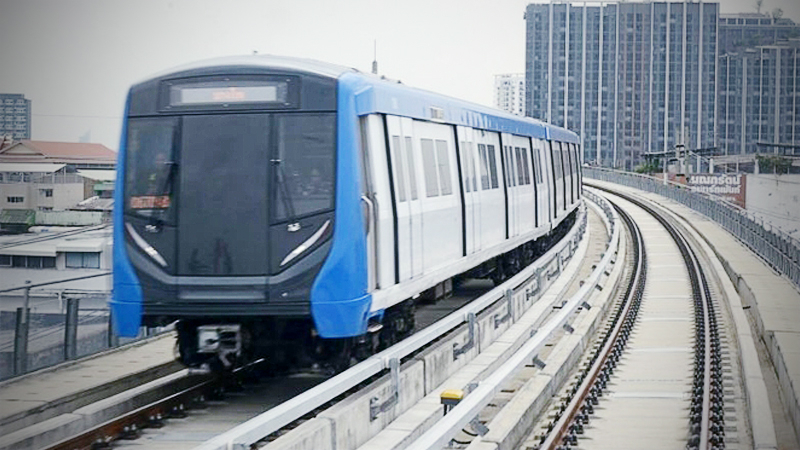
BTS Group Holdings (BTS) has written to the Mass Rapid Transit Authority (MRTA) to state that the BSR Joint Venture is ready to invest in the construction of the 2.6-kilometre Ratchada-Lat Phrao extension to the elevated Yellow Line.

Surapong Laoha-Unya, executive director of BTS Group Holdings, said BSR will also spend approximately Bt3 billion to link the Yellow and Green MRTA lines.

“BSR is ready to invest in this project because the study results were approved by the committee for land-traffic system management and already added in the rail-transport system development master plan,” he said.

“BSR still maintains the offer to share revenue with MRTA if the number of commuters using the Yellow Line rises.”

Surapong said the Bangkok Expressway and Metro (BEM) has complained that the MRTA Yellow Line extension will take commuters away from the MRT.

“However, we cannot compensate BEM if the MRT loses commuters. Hence, we have decided to invest in this project on our own and are ready to share revenue with the MRTA. So, it depends on MRTA if it wants to accept this offer,” he said.

He added that the plan to extend the MRTA Yellow Line should be studied before the service opens in 2021. “If the construction is not completed in time, we may have to cancel the offer,” he said.

Meanwhile, Pakapong Sirikantaramas, MRTA governor, said the agency was still waiting for BSR and BEM to decide on whether the Yellow Line extension will go ahead.

“According to our study, the number of commuters using the MRT Blue Line will drop by approximately 6,000 people per day once the MRTA Yellow Line starts running,” he said.

BGrimm leases land to generate power, chill water for U-Tapao, airport city #ศาสตร์เกษตรดินปุ๋ย

#ศาสตร์เกษตรดินปุ๋ย : ขอบคุณแหล่งข้อมูล : หนังสือพิมพ์ The Nation.

BGrimm leases land to generate power, chill water for U-Tapao, airport city

Corporate

Jun 26. 2020

By THE NATION

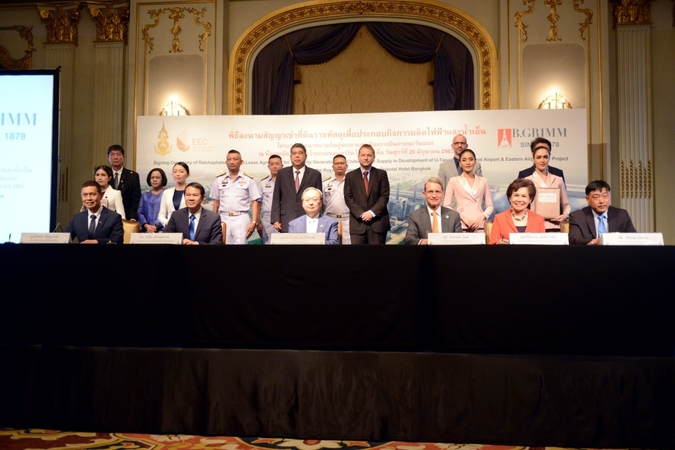
The Eastern Economic Corridor Office (EECO) and BGrimm Power Public Co Ltd signed a lease for 100 rai of state land on Friday (June 26) for the production of electricity and chilled water for U-Tapao Airport and the Eastern Airport City’s cooling system.

The development of the utilities system will prepare the area for expansion in passenger, logistics and aviation businesses, in line with the vision of EEC becoming a centre for e-commerce and technological hub for aviation.

The electricity will be produced using a hybrid system from a co-generation power plant using natural gas and solar farm in line with EEC’s key guiding concept of clean energy sources.

The system’s capacity will be 95 megawatts with a smart energy storage system of 50MW, and an option for expansion if the airport needs more electricity.

Meanwhile, heat resulting from the generation of electricity will be used to produce chilled water, which will be used to cool the airport.

Harald Link, chairman of BGrimm, said the company was delighted to sign the lease to carry out the electricity and chilled water production projects for the airport and the airport city, both of which are immensely important for the development of the EEC.

U-Tapao is set to become Thailand’s new commercial international airport, contributing significantly to the country’s economic growth.

Preeyanart Soontornwata, president of BGRIM, said the company was more than ready to start work on the projects immediately, adding that the hybrid electricity generation system should be ready for operation in 2024. This will be one of the largest hybrid power plants in the world that efficiently uses three systems to generate power, she added.

Thaicom, CAT go into joint venture to strengthen nation’s telecommunications structure #ศาสตร์เกษตรดินปุ๋ย

#ศาสตร์เกษตรดินปุ๋ย : ขอบคุณแหล่งข้อมูล : หนังสือพิมพ์ The Nation.

Thaicom, CAT go into joint venture to strengthen nation’s telecommunications structure

Corporate

Jun 26. 2020

By THE NATION

Satellite operator Thaicom Plc and state telecom agency CAT Telecom Plc on Friday (June 26) announced they have gone into a joint venture to help strengthen the country’s telecommunications infrastructure as well as boost the growth of the digital economy and satellite industries.

The new partnership has resulted in a joint venture firm called “Nation Space and Technology Co Ltd”, with a registered capital of Bt10 million. Thaicom will hold a 75 per cent stake, and CAT the rest.

Thaicom’s chief executive officer Anant Kaewruamvongs said the joint venture will enhance a strategic partnership between the two companies. Thaicom’s long experience and expertise in the satellite industry, with CAT’s extensive know-how in providing digital solutions will help them leverage advanced solutions and services for various applications and industries.

“We believe this strategic alliance between Thaicom and CAT will lay the foundation for a long-term partnership and sustainable growth of the country’s telecommunication services,” he added.

CAT president Colonel Sanpachai Huvanandana said the new company will help boost the opportunity to develop telecom services via low-Earth orbit systems in order to meet Thailand’s communication needs in the future.

Also, with the new normal brought on by the Covid-19 pandemic, the development of technological services via low-Earth orbit satellites will benefit everyone by giving them high-speed 5G internet services, IoT (internet of things), M2M (machine to machine) technology as well as drone technology as well as applications in areas that need high levels of accuracy such as remote surgery.

Dow tumbles 730 points as covid-19 flare-ups force states to push back reopening #ศาสตร์เกษตรดินปุ๋ย

#ศาสตร์เกษตรดินปุ๋ย : ขอบคุณแหล่งข้อมูล : หนังสือพิมพ์ The Nation.

Dow tumbles 730 points as covid-19 flare-ups force states to push back reopening

Econ

Jun 27. 2020

By The Washington Post · Thomas Heath, Hannah Denham · BUSINESS, US-GLOBAL-MARKETS 
Rising coronavirus infections roiled investors on Friday, sending stocks into a sharp decline as big-economy states like Texas and Florida put a pause on reopening to stop the disease’s spread.

The Dow Jones industrial average slid 730 points, about 2.8 percent, to close at 25,015.55. The Standard & Poor’s 500 fell 2.4 percent, to 3,009.005, while the Nasdaq composite dropped 2.6 percent, to 9.757.22

All three indexes ended the week at a loss, with the Dow erasing 3.3 percent and the S&P 500 down 2.9 percent. The Nasdaq shed 2 percent over the five-day run but remains positive for June and 2020.

All 11 sectors of the S&P were in the red, weighed down by financials, energy and communication services. Facebook shares plunged 8.3 percent on news that Unilever – the maker of Dove, Lipton and other well-known brands – would suspend advertising on the social media site through year’s end due to the “polarized atmosphere” on the platform. Unilever joins Patagonia, The North Face and others in boycotting Facebook over its handling of hate speech online.

The Nasdaq technology powerhouses – Apple, Alphabet, Microsoft, Netflix and Amazon – were all down sharply. (Amazon founder Jeff Bezos owns The Washington Post.) Airline stocks took a hit as the spreading virus is expected to crimp travel. Oil prices were down but are still floating near $40 per barrel. 

Goldman Sachs was the biggest drag on the Dow, its shares sliding 8.6 percent, after the Federal Reserve said it will cap dividends and restrict stock buybacks of the big banks as part of a “stress test” and analysis of the impact of covid-19.

“While I expect banks will continue to manage their capital actions and liquidity risk prudently, and in support of the real economy, there is material uncertainty about the trajectory for the economic recovery,” Fed Vice Chair Randall Quarles said in a statement.

Dow component Nike saw shares tumble 7 percent after the sportswear and shoe giant reported a surprisingly big earnings loss. Some analysts believe Nike’s poor showing could be a preview of next month’s corporate earnings season as companies officially announce the financial effects of the coronavirus lockdown.

“June’s stock markets have been dominated by the coronavirus,” said Howard Silverblatt of S&P Dow Jones Indices. “July will be the earnings story. And August will be the election season. Call a chiropractor, and hold on. It will be whiplash time.” 

The sell-off came after Texas and Florida ordered bars to close and imposed new restrictions to mitigate a surge in cases. Arizona, South Carolina, Idaho and other states also are reporting spikes.

Nationwide, more than 122,000 Americans have died of covid-19. And the 2.4 million confirmed cases represents a severe undercount; the head of the U.S. Centers for Disease Control and Prevention estimated Thursday that more than 24 million Americans have been infected.

The decline in stocks comes amid a mixed economic package and political upheaval following last month’s death of George Floyd, a black man who was killed in police custody in Minneapolis. Unemployment is stubbornly high, but consumer spending and orders for durable goods – both key indicators – show signs of a rebound. The Commerce Department on Friday also said personal incomes declined less than feared.

There is sentiment among some financial and political analysts that polls showing a fall in President Donald Trump’s support in key battleground states has narrowed his prospects for reelection. Trump is viewed by many on Wall Street as more friendly to business and the stock market than former vice president Joe Biden, his presumed Democratic rival.

“Two things are driving this sell-off,” said Ivan Feinseth of Tigress Financial Partners. “There’s a dramatic resurgence of covid-19 infections, and secondly, Joe Biden is leading in the polls. People may be willing to accept the idea that four years of a soft economy and mediocre stock market are worth the price of political stability.” 

Stocks are still in the midst of one of their best quarters in decades, helped by slowly reviving economy and a Federal Reserve that has said it is willing to spend trillions of dollars to boost the rebound.

“If the circumstances warrant, we will not hesitate to take additional policy actions to support the U.S. economy and banking system,” Quarles said.