The Stock Exchange of Thailand Index dropped by 8.00 points, or 0.59 per cent, to 1,359.13 on Wednesday morning (June 17).
A stock analyst at Krungsri Securities expected the index to fluctuate between 1,360 and 1,380 before falling.
“The market gained positive sentiment from the US retail sales in May increasing by 17.7 per cent, while the US government prepared to spend US$1 trillion on infrastructure to stimulate the economy,” he said.
“In addition, energy stocks gained positive sentiment from rising crude oil price after the International Energy Agency raised its oil demand forecast for this year to 91.7 million barrels per day in response to several countries easing lockdowns.”
The analyst said that the index, however, would be under pressure from tight SET valuations and uncertainty following the second wave of Covid-19 caaes in many countries, such as US, China, and Japan.
He recommended investors to buy:
▪ Energy stocks that benefit from the rising crude oil price, such as PTT, PTTEP, TOP, PTTGC, IRPC, SPRC, and IVL.
▪ Stocks whose second-quarter performance will improve, such as CKP, TASCO, STA and RS.
▪ Stocks that benefit from the Cabinet’s three tourism stimulus packages, such as MINT, CENTEL, ERW and AOT.
The SET Index rose sharply by 25 points on Tuesday, or 1.87 per cent, closing at 1,367. Total transactions were worth Bt68 billion.
Net buy by foreign investors amounted to Bt423 million in stocks, while net sale of bonds was Bt626 million. There were 9,109 net short TFEX SET50 contracts.
The baht opened at 31.12 to the US dollar this morning (June 17), unchanged from its previous close.
The Thai currency is expected to move between 31.00 and 31.20 today, said Jitipol Puksamatanan, head of Markets Strategy at SCB Securities.
The US foreign exchange market gained positive sentiment from the US economic recovery after retail sales in May recovered by 17.7 per cent month on month.
The S&P 500 rose for three consecutive days by 1.9 per cent, while Euro Stoxx 50 increased by 2.9 per cent. US Ten-Year Treasury bonds, meanwhile, rose by three basis points to 0.75 per cent.
The Asian foreign exchange market is currently under pressure from uncertainty following the fresh wave of Covid-19 cases in Beijing and Tokyo, causing the dollar to strengthen compared to other currencies by approximately 0.2 per cent, Jitipol said.
The baht also weakened due to uncertainty among foreign investors about the impact on their Asian operations from the new Covid-19 outbreak.
In addition, problems between countries in the Asian region may slow the recovery of the baht, Jitipol added.
By The Washington Post · Abha Bhattarai, Rachel Siegel · BUSINESS, RETAIL
Shoppers bought clothing, furniture and sports equipment fueling a record spike in retail sales up 17.7% in May, in the latest sign that the economy could be beginning to recover from the worst economic crisis since the Great Depression.
The strong retail report out Tuesday sent stocks surging and earned praise from President Donald Trump on Twitter: “Wow! May retail sales show biggest one-month increase of ALL TIME, up 17.7%. Far bigger than projected. Looks like a BIG DAY FOR THE STOCK MARKET, AND JOBS!”
Yet, Federal Reserve Chair Jerome Powell warned on Tuesday that the economic road ahead remains long and uncertain with 20 million jobs lost since February, a reported unemployment rate at 13.3%, the highest level since the Great Depression, and $6.5 trillion in household wealth gone in the first quarter. Even with improved retail numbers, overall levels are still down nearly 8% compared with February.
“Significant uncertainty remains about the timing and strength of the recovery,” Powell told a Senate banking panel. “Until the public is confident that the disease is contained, a full recovery is unlikely,” he added.
The speed and degree to which the economy recovers portends high political stakes this fall. Trump plans to make these signs of an economic recovery front and center in his political campaign, while Joe Biden plans to sharpen attacks on Trump’s handling of the crisis, emphasizing the heavy toll on workers.
Spending rose across all categories in May, the Commerce Department reported Tuesday. Sales at clothing stores nearly tripled from a month earlier. Some of the largest gains were at furniture stores, where sales rose 90%, and at sporting goods, musical instrument and book stores where they grew 88%. Sales in electronics and appliance retailers were up 51%. Restaurants and bars, meanwhile, notched a 29% increase in sales, while online sales rose 9%.
The monthly jump in retail sales sent markets soaring. The Dow Jones industrial average surged more than 3% at its open, but scaled back its gains to 2%, as investors cheered the retail sales, as well as news of a possible medical treatment for covid-19. The Standard & Poor’s 500 index closed up 1.9%, and the tech-heavy Nasdaq composite closed up 1.75%.
Yet, economists continue to warn that the economy remains on shaky ground. Powell on Tuesday emphasized that both the public health crisis and recession have unevenly targeted the country’s lowest-income households, noting that some of the jobs lost to this economic crisis could be gone forever.
“The longer the downturn lasts, the greater the potential for longer-term damage from permanent job loss and business closures,” he said to the Senate Banking, Housing and Urban Affairs Committee Tuesday morning. “Long periods of unemployment can erode workers’ skills and hurt their future job prospects.”
Service-sector jobs in retail and hospitality were among the first to go when the pandemic hit. But the impact has cascaded into white-collar industries in recent weeks, with major airlines and professional services firms announcing fresh rounds of layoffs. Economists say it could take years for retailers and shoppers to bounce back from the economic devastation of the ongoing pandemic.
“It is too early to celebrate,” economist Diane Swonk, wrote in a note to clients on Tuesday. “Stimulus checks, along with enhanced unemployment benefits, helped many to weather the shutdowns, but food lines lengthened as only about half of renters were confident they could pay rent in May. High-end consumers were much more confident as their stock portfolios rallied. They also may be feeling a false sense of security in their jobs.”
The May bounce in retail sales follows two months of record-breaking declines, as Americans abruptly pulled back on discretionary spending. Retail sales fell 8.3% in March, and 14.7% in April, which is a revised figure.
“We’re seeing some rebound, but overall these are still … low numbers,” said Andrew Lipsman, a retail analyst for market research firm eMarketer. “The reality is, we still have high unemployment numbers, and despite the feel-good momentum of the last month, the consumer economy is still not on very strong footing.”
A number of national chains – including Nordstrom, Gap and Macy’s – reopened their stores last month with new safety measures and curbside pickup options. Retailers say shoppers have begun trickling back, albeit cautiously. Although spending at clothing stores jumped 188% in May, overall sales are still down 63% from a year ago.
At Adeline, a women’s clothing boutique in Dallas, sales have been steadily rising since reopening the first week of May, with shoppers stocking up on summer clothing and dresses for graduation parties.
“The first couple of weeks after we reopened were slow, but it keeps picking up as the weeks go by,” said owner Graeme Gehring. “Now we’re super busy every day. People are excited to buy cute clothes.”
Consumer spending, which typically drives 70% of the nation’s economy, has dropped sharply in recent months. Americans spent nearly 14% less in April than they did in March, one of the steepest declines on record, according to Commerce Department data.
The pandemic has also hastened a wave of retail bankruptcies, with iconic chains such as J. Crew, Neiman Marcus and J.C. Penney filing for Chapter 11 protection in May.
“The disruption caused by the pandemic has done strange things to our perception of numbers,” Neil Saunders, managing director of GlobalData Retail, wrote in a note to clients. “Usually, a 7.7% year-over-year decline in retail sales would be an unmitigated disaster – but in the context of everything that is going on, the outcome is palatable.”
Some 20 million Americans are still without jobs. Even though U.S. employers added 2.5 million jobs in May, economists say ongoing uncertainties about the public health crisis and the economy have made it difficult to know when consumers and businesses might return to spending levels more common in the past few years.
Pool company American Sale shuttered all eight of its Chicago-area locations in late March. By the time it reopened in early May, demand for pools, hot tubs, trampolines and swing sets was booming. Sales are up about 30% from a year ago.
“Business has jumped considerably,” said Bob Jones, the company’s president. “During the lockdown, you had all of these people at home, saying ‘I’m not traveling or taking vacations. What can I do instead?'”
He said stimulus checks helped prop up many households, at least temporarily. But the looming uncertainty also has many business owners worried about how the coming months could play out.
“The numbers are improving because of staged reopenings around the country, but the economy will remain soft for some period of time,” said Brian Marks, an economist and senior lecturer at the University of New Haven. “People need to have trust, confidence and faith – both in the economy and in monitoring and testing (of the coronavirus), social distancing and, ultimately, a vaccine. But we’re not there yet.”
In all, consumers spent $485.5 billion in May on retail goods, groceries and gas. And 17% of sales -$86.4 billion – were purchased online.
E-commerce, which is up 31% from a year ago, has emerged as a bright spot during the pandemic, as homebound Americans turn to the internet for groceries, books, furniture and other discretionary goods. Although online shopping has been on the rise for years, analysts say the recent lockdown orders have sped up the process, resulting in long-term shifts in how and where people shop. Online sales at Target have more than doubled during the pandemic, with e-commerce growing 282% in April alone.
“We’ve just seen Cyber Monday occur almost every day except the volume is twice the size,” Target chief executive Brian Cornell told investors last month.
Local businesses in Phuket are being offered a financial kick-start as the holiday province prepares to welcome back tourists after months of Covid-19 lockdown.
City Hall on Tuesday (June 16) hosted a meet-and-greet between local entrepreneurs and providers of loans and other financial services, in a bid to get businesses back on their feet after the long shutdown.
Phuket governor Pakkapong Taweepat said 85 per cent of the province’s GDP came from the services and tourism sectors, which had been battered by the pandemic. The absence of visitors for the past two and half months had left tourism businesses with no revenue and huge debts, he added. Local authorities had therefore liaised with 15 financial institutes to bring support measures for residents and entrepreneurs.
Boonchod Kittisitto, president of the Phuket Bank Club, expressed thanks to Phuket City Hall for coordinating the financial meet-and-greet with the club. Entrepreneurs who attended the event were offered help on a case-by-case basis.
Authorities insist that a Bt24.5-billion project to build a floating storage and regasification unit (FSRU) is going ahead.
Wattanapong Kurovat, director general of the Energy Policy and Planning Office, said work was progressing on its study of the project, which will supply liquefied natural gas (LNG) to the Electricity Generating Authority of Thailand (Egat).
The FSRU, anchored in the upper Gulf of Thailand, will receive shipments of LNG before processing and pumping it to Egat’s South Bangkok power plant in Samut Prakan.
The project is part of infrastructure to support the importation of natural gas, in line with National Energy Policy Committee directives.
Meanwhile, the Energy Regulatory Commission has submitted findings on the impact on electricity prices of Egat’s recent importation of 130,000 tonnes of LNG, to the Energy Policy Administration Committee.
The information will be used to help draw up a plan to promote competitiveness in the natural gas sector. The office is expected to present the plan to the Energy Policy Administration Committee next month.
A source at the Energy Ministry said the office has already proposed options for the new competition structure to the subcommittee tasked with opening up the LNG sector. The options range from a full opening of the market, to allowing PTT to remain the country’s sole importer of LNG.
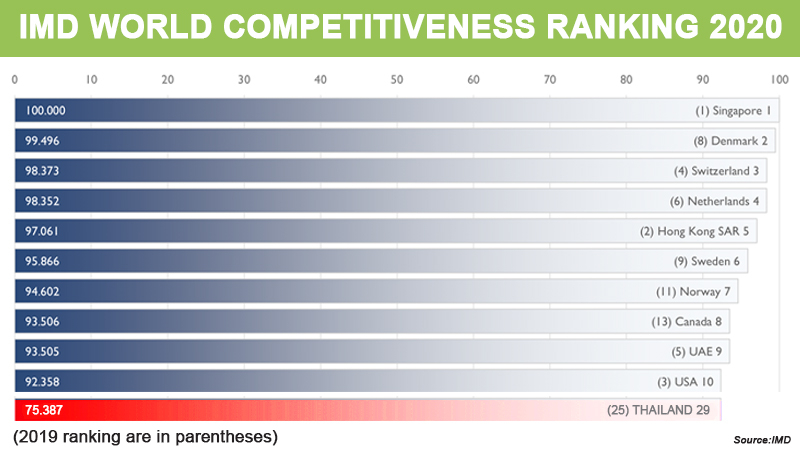
Poor economic performance and an inefficient government has brought Thailand’s global competitiveness ranking down by four places this year. Thailand now stands 29 out of 63 economies, down from last year’s ranking of 25, according to the IMD World Competitiveness Ranking 2020 hosted by Switzerland-based International Institute for Management Development.
The report released on Tuesday (June 16) also showed that Thailand’s scores had dropped to 75.387 from 77.233 last year.
The Kingdom’s ranking in competitiveness had been further weighed down by its economic performance, which fell six places and government efficiency, which dropped three slots.
“Thailand’s place in the list has been affected by a sluggish economy, no longer being attractive to foreign investor and concerns about labour shortage in the long run,” said Teeranun Srihong, chairman Thailand Management Association (TMA).
“Another key factor is poor government efficiency, taking into account a weakening rule of law, poorly run key national institutions and a deterioration of financial stability.”
However, the country did better in business efficiency and showed slight improvement in infrastructure development.
“Thailand’s overall of competitiveness scores, however, remain low as it has many challenges to overcome such as education, public health, environment as well as science and technology infrastructure,” Teeranun said.
The IMD this year also added new indicators to its ranking methodology, namely sustainable development goals, democracy index and total early-stage entrepreneurial activity.
“Thailand’s ranking was up five places last year, but down four places this year, suggesting that the country’s ability to efficiently respond to fast-changing environments remains the biggest challenge in the long run,” he added.
The top three countries in this year’s competitiveness ranking are Singapore, Denmark and Switzerland in that order.
The Stock Exchange of Thailand (SET) Index rose by 25.14 points or 1.87, closing at 1,367.13 today (June 16), while transactions totalled Bt68.455 billion with an index high of 1,376.99 and a low of 1,362.38.
During the morning session, a stock analyst at Krungsri Securities said he expected the index to rebound to between 1,365 and 1,370 points in response to the US Federal Reserve’s move to buy corporate bonds worth US$750 billion (Bt23.24 trillion) to increase liquidity and support employment.
The analyst, however, advised investors to beware of short-term mass sell-offs due to uncertainty after a second wave of Covid-19 infections hit many countries including the US, China and Japan.
“The index also gained positive sentiment from the rising price of crude oil, while there were mass purchases of stocks added to the SET50 and SET100,” he said.
“We also advise investors to follow the Cabinet meeting on tourism stimulus measures,” he added.
The Cabinet recently earmarked a whopping Bt22 billion to fund three packages aimed at stimulating domestic tourism after the lockdown.
The top 10 stocks with the highest trade values today were SUPER, KTC, PTTEP, KBANK, PTT, BAM, PTTGC, MINT, TOP and CPF.
As of 4.30pm, crude oil rose by US$0.57 or 1.54 per cent to $37.69 per barrel, while gold rose by $11.20 or 0.65 per cent to $1,738.40 per ounce.
Global indices were on the rise:
Japan’s Nikkei Index closed at 22,582.21, up 1,051.26 points, or 4.88 per cent.
China’s Shanghai SE Composite Index closed at 2,931.75, up 41.72 points, or 1.44 per cent, while Shenzhen SE Component Index closed at 11,398.97, up 206.69 points, or 1.85 per cent.
Hong Kong’s Hang Seng Index closed at 24,344.09, up 567.14 points, or 2.39 per cent.
South Korea’s KOSPI Index closed at 2,138.05, up 107.23 points, or 5.28 per cent.
Taiwan’s TAIEX Index closed at 11,511.64, up 205.38 points, or 1.82 per cent.
Jun 16. 2020Energy Minister Sontirat Sontijirawong
By THE NATION
Oil and gas conglomerate PTT Plc will sign a contract with the Electricity Generating Authority of Thailand (Egat) on June 19 to sell natural gas to the state agency for 10 years, Energy Minister Sontirat Sontijirawong said.
Under the pact, PTT will procure natural gas for Egat’s power plants. The contract also allows Egat to import a million tonnes of liquefied natural gas for use in its plants.
Separately, the Energy Policy Administration Committee has decided to change the calculation formula of the ex-refinery price of oil effective from Wednesday. The revision will see 50 satang per litre on average drop in the price of all fuel types.
The committee also resolved to extend the subsidy on cooking gas to September 30 from the original expiration date of June 24.
Under the existing subsidy, a 15-kilogram gas canister goes for Bt318, which is Bt45 cheaper than normal.
Jun 15. 2020Bottles of Unilever’s Dove products are displayed for sale at a mall in Jakarta, Indonesia, on Nov. 14, 2012. MUST CREDIT: Bloomberg photo by Dadang Tri
By Syndication Washington Post, Bloomberg · Akshat Rathi · NATIONAL, BUSINESS, SCIENCE-ENVIRONMENT, US-GLOBAL-MARKETS Unilever is releasing a new set of climate goals that make it the most ambitious of any consumer goods company tackling carbon emissions. The maker of Dove skincare, Colman’s mustard, and Q-tips cotton swabs now aims to zero out all emissions from its own operations and those of its suppliers by 2039.
More than that, it’s going to show its work: Each of the company’s 70,000 products will show on their labels how much greenhouse gas was emitted in the process of manufacturing and shipping them to consumers. The company is also committing to invest 1 billion euros ($1.1 billion) in climate-friendly initiatives over the next decade.
The global carbon disclosure nonprofit CDP already ranks Unilever highly for climate-friendly corporate governance and prioritizing emissions reduction in its supply chain. The conglomerate set its first science-based climate target back in 2010, when it committed to cutting all the emissions associated with its products by half by 2030. Unilever’s emissions continued to rise until 2016, but they’ve been falling ever since. The company’s biggest rivals, Kraft Heinz and Procter & Gamble, fare far worse on CDP’s scale.
“While the world is dealing with the devastating effects of the covid-19 pandemic, and grappling with serious issues of inequality, we can’t let ourselves forget that the climate crisis is still a threat to all of us,” said Alan Jope, Unilever’s chief executive officer, in a statement.
To accomplish its new goals, Unilever will aim to reduce greenhouse-gas emissions as far as possible before leaning on carbon offsets. While in theory these offsets balance out emissions by funding activities such as tree planting, landscape restoration, and regenerative farming — all of which can suck carbon out of the air and put it back in the ground — in practice serious questions remain about the carbon accounting used by many companies offering offsets.
“We could announce that we are carbon neutral today by just spending money on offsets,” says Marc Engel, Unilever’s global head of supply chain. “But we have deliberately decided not to do that.”
The company emits about 100 million metric tons of carbon dioxide annually, Engel says. About 3 million metric tons of those emissions fall under Scope 1 and Scope 2, meaning the emissions are produced by Unilever burning fossil fuels to heat its offices and power its factories. Those emissions will be cut to zero by 2039 under the new plan.
Unilever is further committing to eliminate 30 million metric tons of emissions produced on its behalf in the furnishing of raw materials or shipping finished products to supermarket shelves. The suppliers who create these emissions, known as Scope 3, will have nine months to adopt science-based climate targets that lead to cuts. The company’s remaining 65 million metric tons of emissions under Scope 3 are produced in the use of Unilever products-whenever someone boils water, say, for a cup of Lipton tea. Unilever will try to cut these in half by 2030.
“That’s the part we least control,” Engel says. Cuts “will rely on governments greening the grid, replacing natural gas with hydrogen, etc.” But product innovation can help, such as producing detergents that can be used in washing machines with water at room temperature, rather than at high temperatures as is typical today.
As part of the same climate plan, Unilever is committing to go “deforestation-free” throughout the supply chains for the five raw ingredients most associated with tree loss: palm oil, soybeans, tea, paper, and cocoa. For now the company relies on certification done by third parties, but it’s moving to a verification process that will use satellite imagery and blockchain technology.
“It makes certification obsolete because you literally have real-time verification,” says Engel. That data will be made available for anyone to verify for themselves.
The most challenging task will be carbon labeling all its products. Some companies, such as oat milk-maker Oatly, have started to print on their packaging how many kilograms of carbon dioxide were released in the making of products. Engel is aiming to do that for Unilever’s entire inventory, from shampoo to coffee to mayonnaise to deodorants.
Currently there are no standards or third-party verification available, which means that consumers will have to take the company’s word for it. But Engel says he hopes Unilever’s competitors will follow suit, and that soon there will be an independent standard for carbon labeling just as there is for nutritional labels on foodstuffs.
“It’s a very big commitment,” he says. “But we are clearly seeing that consumers want to know how the products they buy contribute to their own carbon footprint.”
The Stock Exchange of Thailand Index rose by 30.41 points, or 2.27 per cent, to 1,372.40 this morning (June 16).
A stock analyst at Krungsri Securities expected the index to rebound to between 1,365 and 1,370 points in response to the US Federal Reserve move to buy corporate bonds worth US$750 billion (Bt23.24 trillion) to increase liquidity and support employment.
“In addition, the index gained positive sentiment from the rising crude oil price while a mass buy-offs in stocks added to the SET50 and SET100,” he said.
The analyst, however, advised investors to beware of short-term mass sell-offs in shares due to uncertainty following the second wave of Covid-19 after an increase in the number of new virus cases in many countries including the US, China and Japan.
“Also, we advise investors to follow the Cabinet meeting on tourism stimulus measures,” he added.
He recommended investors buy:
▪ Stocks added to the SET50–BPP and TTW, and SET100–AAV, Ace, DoHome, RBF, SIRI, TVO and WHAUP.
▪ Stocks whose second-quarter performance will improve, such as CKP, Tasco, STA and RS.
▪ Stocks that would benefit from the Cabinet’s move to issue tourism stimulus measures, such as Mint, Centel, ERW and AOT.
The SET Index dropped sharply by 41 points yesterday, or 2.93 per cent, closing at 1,342. Total transactions were worth Bt8.3 billion.
Foreign investors made a net sell of Bt4.014 billion in stocks, but purchased Bt2.194 billion in bonds. There were 4,311 net short TFEX SET50 contracts.

 Federal Reserve Chair Jerome Powell



 Energy Minister Sontirat Sontijirawong
 Bottles of Unilever’s Dove products are displayed for sale at a mall in Jakarta, Indonesia, on Nov. 14, 2012. MUST CREDIT: Bloomberg photo by Dadang Tri