The amount of cash circulated in the economy was far higher than expected during the height of Covid-19 outbreak because many consumers had a lot of cash in hand due to the unpredictable situation wrought by the virus and lockdown restrictions.
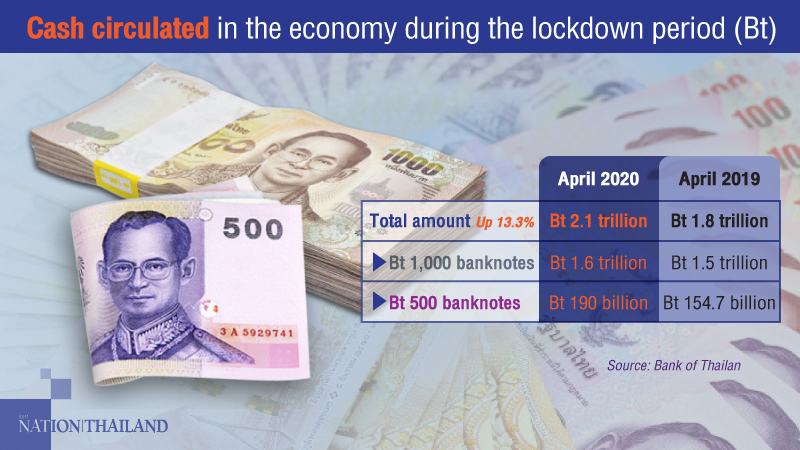
Cash circulation in April surged to an all-time high at Bt2.1 trillion or up 13.3 per cent, even though conditions were tough in March and April as the government told businesses to stop operating temporarily and closed the country to foreigners.
In response to these changes, consumers decided to hold more cash than usual, resulting in Bt1.6 trillion worth of Bt1,000 banknotes being used or 8.4 per cent more than the Bt1.5 trillion worth used in April last year. They also used 23.3 per cent more Bt500 banknotes worth Bt190.5 billion, up from Bt154.7 billion in April 2019.
Somboon Chitphentom, the Bank of Thailand’s assistant governor, said people withdrew large amounts of money in April as the crisis hit acute levels and the government put the country under state of emergency. Many venues were closed, and Thailand’s borders were sealed off.
These factors created uncertainty, leading consumers to hold more cash, he noted. They began withdrawing large amounts in the last week of March and continued to do so until mid-April, he said.
The government’s financial aid for affected people also contributed an increase in the circulation of cash in the economy, as the first batch of cash was distributed in April, leading to Bt64.5 billion being withdrawn from banks.
Now that the government has lifted most lockdown restrictions, the withdrawal of cash has returned to normal, Somboon said.
He also believes that people will use more digital money in the post-Covid new normal, especially since online transactions have become so easy and more widespread.
The Stock Exchange of Thailand (SET) Index rose 9.05 points or 0.66 per cent to close at 1,376.18 today (June 17). Transactions, meanwhile, totalled to Bt71.554 billion with an index high of 1,381.00 and a low of 1,358.27.
In the morning session, a stock analyst at Krungsri Securities said he expected the index to fluctuate between 1,360 and 1,380 before falling.
“Positive sentiment was gained from the fact that US retail sales have risen by 17.7 per cent, and that the US government is preparing to spend US$1 trillion on infrastructure to stimulate the economy,” he said.
“Energy stocks also gained a boost from rising crude oil price after the International Energy Agency raised its oil demand forecast for this year to 91.7 million barrels per day in response to several countries easing lockdown measures.”
However, he said, the index will be under pressure from tight SET valuations and uncertainty following the second wave of Covid-19 cases in many countries, including the US, China and Japan.
The top 10 stocks with the highest trade values today were MINT, PTT, STA, KTC, PTTEP, BAM, SUPER, CPF, KBANK and ADVANC.
As of 4.30pm, crude oil dropped by $0.37 or 0.96 per cent to $38.01 per barrel, while gold dropped by $12.80 or 0.74 per cent to $1,723.70 per ounce.
Other Asian indices were mixed:
Japan’s Nikkei Index closed at 22,455.76, down 126.45 points, or 0.56 per cent.
China’s Shanghai SE Composite Index closed at 2,935.87, up 4.12 points, or 0.14 per cent, while Shenzhen SE Component Index closed at 11,420.84, up 21.87 points, or 0.19 per cent.
Hong Kong’s Hang Seng Index closed at 24,481.41, up 137.32 points, or 0.56 per cent.
South Korea’s KOSPI Index closed at 2,141.05, up 3.00 points, or 0.14 per cent.
Taiwan’s TAIEX Index closed at 11,534.59, up 22.95 points, or 0.20 per cent.
The Board of Investment (BoI) has approved investment privileges for five mega projects worth over Bt41.83 billion, in a bid to kick-start Thailand’s economic engines as the country emerges from lockdown.
BoI secretary-general Duangjai Asawachintachit announced the move – expected to include exemptions on corporate tax and import duties – on Wednesday (June 17) after a BoI board meeting chaired by Prime Minister Gen Prayut Chan-o-cha.
The five operators and projects chosen to receive privileges are:
1. Sammitr Motors Group, which is investing Bt5.5 billion to manufacture battery electric vehicles (BEV) in Phetburi province with a capacity of 30,000 units annually. The project expects to use domestic materials worth Bt8.5 billion annually and will sell mostly to domestic markets.
2. Thai Oil Public Co Ltd, which is investing Bt24.11 billion to generate 250 megawatts of electricity annually from 80,300 tonnes of pitch and sulphuric acid. The project is located in Sriracha district, Chonburi province.
3. Envicco Ltd, which is investing Bt2.47 billion to manufacture recycled PET plastic beads for food and beverage packaging and recycled HDPE plastic beads for personal care and consumer product packaging. The project is located in the Asia Industrial Estate, Rayong province.
4. B Grimm Power (Laem Chabang) Ltd, which will invest Bt6 billion to generate electricity from natural gas and steam with a capacity of 157 megawatts, to be sold to the Electricity Generating Authority of Thailand and factories in Chonburi’s Laem Chabang Industrial Estate.
5. Bangkok Arena Ltd, which is investing Bt3.74 billion in the construction of convention halls for the MICE (Meetings, Incentive Travel, Conventions, Exhibitions) business, a target industry for Thailand in the 4.0 era. The project is located in the Bangkok Mall complex on Bangna-Trat Road.
Three stimulus packages are expected to generate about Bt70 billion in spending by in-country tourists, said Tourism Council of Thailand president Chairat Trirattanajarasporn.
The packages to stimulate domestic tourism, which are being rolled out with a whopping budget of Bt22.4 billion, were approved by the Cabinet on June 16. They will run for four months between July and October.
The Tiew Pan Suk (Trips to share happiness) package is designed to help transport businesses, from airlines to car rental firms. It will subsidise at least 2 million travellers by paying 40 per cent of their travel fares, not exceeding Bt1,000. The project will cost Bt2 billion.
The Rao Pai Tiew Gun (Let’s travel together) package will offer a 40-per-cent discount on accommodation costing up to Bt3,000 per night for a maximum of five nights. Recipients are required to travel outside their hometowns.
This package will also fill tourists’ e-wallets with Bt600 per night for a maximum of five nights, to be used to pay for tourism activities such as spa services, souvenirs and restaurants. The scheme, which will subsidise up to 5 million nights of stay, will cost Bt18 billion.
The Kum Lang Jai (Encouragement) package will reward about 1.2 million village health volunteers and subdistrict hospital staff for their work during the Covid-19 outbreak. It will offer a subsidy of Bt2,000 per person on travel costs for a minimum of two days. This scheme will cost the government Bt2.4 billion.
Tourism Council chief Chairat added that he wants the government to provide financial aid to small and medium-sized tourism operators, who are short of liquidity.
Thai Hotels Association president Supawan Tanomkietipume expects the travel mood to return in August following the launch of the three packages. She predicts this would boost the hotel occupancy rate nationwide to around 40 per cent from July to October – enough to keep hoteliers in business while they wait for the return of foreign travellers early next year.
Foreign tourists account for 60 per cent of the country’s tourism income.
The price of gold was unchanged in morning trade on Wednesday (June 17), the Gold Traders Association reported.
As of 9.25am, buying price of a gold bar was Bt25,350 per baht weight and selling price Bt25,450, while gold ornaments were priced at Bt24,892.72 and Bt25,950, respectively.
The Gold Spot Index price on Wednesday morning moved to around US$1,724 (Bt53,704) per ounce after the price rose by $9.3 to $1736.5 per ounce at close on Tuesday (June 16).
Investors bought gold as a safe haven asset after the US Federal Reserve chairman Jerome Powell warned that the US economy was still facing uncertainty from the Covid-19 outbreak. However, tensions in Korean peninsula would pressure the gold price.
The price in the Hong Kong gold market dropped by HK$40 to $15,970 (Bt64,191) per tael this morning.
MEA urges customers to use its e-bill services to cut Covid-19 risk and paper waste
Jun 17. 2020
By THE NATION
The Metropolitan Electricity Authority (MEA) is urging customers to use its e-bill service to receive electronic documents via either mobile phone or e-mail.
“The e-bill enables fast notification with no paper documents, reducing the need to come down to the MEA branch offices as well as the risk of contracting Covid-19 virus via touching papers,” the MEA posted on Tuesday (June 16) on its Facebook page @Metropolitan.Electricity.Authority.
The MEA e-bill will cover the following services: e-invoice for monthly power bill; e-receipt/e-tax invoice; e-notification (reminder to pay power bill)
“Furthermore, using e-paper will help save the environment by reducing the use of paper,” said the post. “For every customer that registers for e-bill services, the MEA will donate for the planting of one tree in mangrove forests in Samut Prakarn province under the Pluk Pa Chalerm Phra Kiat [forest planting in honour of King Rama X] campaign.”
For more information on MEA services, contact call centre 1130, twitter: @MEA_news, Line: @meathailand, facebook: @Metropolitan.Electricity.Authority or download the mobile application “MEA Smart Life”, available for both Android and iOS users.
Index Living Mall refreshes Ekamai branch to cater to new urban lifestyle
Jun 16. 2020
By THE NATION
Introduces new zones and new items in ‘Fresh-up Ekamai, Lift-up Your Life’ concept to attract Thai and expat customers living in city center.
Index Living Mall Public Company Limited has renovated its Ekamai branch in recognition of the potential of its location and to fulfill the lifestyle demand of the urbanites. The Company added new zones and new items under the “Fresh-up Ekamai, Lift-up Your Life” concept with the aim to create a new experience to fulfill the desire of both Thai and foreign customers who were shopping for furniture and decorations for homes and condominium units both for own domicile and for rent – with sets of items such as the ‘Condo Complete Set’ in Hi-end or Urban styles.
Miss Kridchanok Patamasatayasonthi, Managing Director of Index Living Mall Public Company Limited (ILM), Thailand’s leading integrated retailer of home furnishings, revealed that the Company has renovated and redecorated the Index Living Mall Ekamai branch to better cater to the demand of the consumers living in the area. This is because the Ekamai neighborhood is considered to be a business district as well as a mid-city residential area where many real estate developers have jumped in to develop a large variety of real estate projects such as condominiums, hotels, and office buildings for rent. Also, this zone is surrounded by international schools, hospitals, shopping malls as well as convenient transportation routes linking Sukhumvit Road and Soi Thong Lo, and adjacent to the BTS commuter train line. Therefore, Ekamai has become a popular residential neighborhood especially in regard to condominium units for rent to Thais and foreigners. And that in turn has spurred the growth of needs to shop for furniture, household items, home decoration, as well as electrical appliances.
A survey carried out on the behavior and interests of Index Living Mall customers in Ekamai area showed 80 percent of Joy Card members are Thai and 20 percent foreigners. While walk-in customers who are not members are also interested to purchase home decorations and decorative sets for condominium that included furniture, home decoration and electrical appliances. The clientele can be divided into two groups – one is the high-end group who would choose luxurious, stylish, and high quality items to decorate their own homes or condominium units. The other group is the economy shoppers who would look for items to decorate the condominium units to be rented out. So, they would look for complete sets of merchandise that will satisfy their tenants who can start their lives in these condominium units with just a suitcase-full of clothes. This group of customers would need items that are well within their specific budget to decorate studio and 1-bedroom units that can earn them rent of about 20,000-50,000 baht per month.
Index Living Mall Ekamai branch has been freshened under the “Fresh-up Ekamai, Lift-up Your Life” concept with new zones and new items, particularly furniture and decorative items designed specifically for condominium living, including furniture sets for bedroom, living room and dining room that are compact in size suitable for limited spaces but with complete functionality. Index Living Mall also have an in-house team of designer-specialists who can provide consultation in choosing the right furniture that suits the customers’ needs while offering free interior design service. Furniture items are available both as built-in and stand-alone.
The ‘new zone, new items’ feature the newest innovative “ITAL Smart” wardrobes that are much more just wardrobes, with fully adaptable functions either with racks for clothes or cabinets and equipped with LED lights, sensors and soft-touch drawers. Also available is premium “Italiving”furniture imported from Italy. “The Condo Collection” zone features furniture designed specifically for condominiums with perfect combination of design and function for storage in which every nook and cranny is fully utilized. Feel free to peruse show units with sizes starting from 20 square meters. In “Younique” zone, you may order customized furniture exactly the way you like it. In the “Sofa & Recliner Exhibition” zone, sofas in a large variety of designs are on view. The “Outdoor Life” zone offers decorative trees and plants in varying designs to add green to your house. Last but not least, the “Storage Solutions & Home Organization”zone houses a collection of storage solutions that will help to keep your houses tidy and orderly.
In addition, there are the popular mainstay brands such as Index Furniture, Winner Furniture, Logica office furniture, Power One modern home electrical appliances and many other household items and home decorations. Fulfill your lives to perfection with “Lift-up Your Life” in the modern atmosphere in the branch that provides pleasant shade, warmth and friendliness to enhance the inspiration for home decoration with a display of merchandise such as tableware, cutlery and kitchenware to match up with the dining room furniture, etc. Also new is the co-working space corner designed to cater for the lifestyle the new generation of urbanites who can work anywhere.
Visit the new-look Index Living Mall Ekamai branch to choose items that you have always dreamt of (2nd floor BigC Ekamai).
By Syndication Washington Post, Bloomberg · Brendan Murray · BUSINESS
Corporate executives surveying the damage from their bruised supply chains are hearing lessons from the past about the risks of waiting too long to change.
In the Great Recession of 2007-09, banks and other financial institutions became the Achilles’ heel of a global economy that needed immediate reinforcements from bailouts to capital injections, eventually requiring thicker buffers of government regulation and supervision.
Now, in the early months of the covid-19 pandemic, global supply chains are drawing parallels to the financial companies of 12 years ago — crippled by an unexpected shock, exposed by flaws in their sophisticated instruments, second-guessed for pushing the public close to panic, diagnosed for a once-in-a-generation overhaul.
Some of the first advice on repairs comes from Michigan State University, the nation’s top school for supply-chain management. In a new discussion paper co-written by MSU Professor Steven Melnyk and Simon Knowles, chief marketing officer at the global supply-chain and operations consultancy Maine Pointe, the authors argue corporate boards that postpone dealing with weak supplier links will be the losers.
“The winners will be those firms who are willing to make investments now — when demand is down — in preparation for future growth,” Melnyk said in a response to emailed questions about the paper. “Once the economy recovers, firms will not be able to make these changes because they will be too busy meeting demand.
Just how quickly should corporate boards act to identify problems and come up with a plan to fix them?
By October, the authors recommend.
That’s because the pandemic highlighted how little flexibility most companies had to deal with large variations in demand — a sudden surge in the need for consumer products like antibacterial soap and toilet paper, or an abrupt end to purchases of goods like cars or furniture.
“The current problems do not mean supply-chain management is dead and must be replaced” and “nor should it be interpreted as a condemnation of globalization,” according to the paper. “Supply-chain management is right, but whether or not we have the right model in place with the right balance between global and domestic and the right emphasis — cost versus responsiveness and sustainability — these are the critical questions.”
Some other things the authors suggest to keep in mind:
– Whether it’s Brexit or the U.S.-China tariff war, politics has become the driving force over economics, and according to the paper, “free trade will likely shift to managed free trade.”
– Pure economics – where speed and low costs reign, and safety is a given – is no longer the main consideration. Safety, durability and sustainability rise in importance.
– Technology will advance at an even faster pace, with 3-D printing and advanced data helping to bring production closer to home.
– Many small suppliers won’t survive, requiring new relationships and a rebalancing of risks. In that environment, “cost is not king anymore.”
In the meantime, Knowles says that once companies stabilize their supply chains and recover from the disruptions, a rebalancing stage should follow. The speed at which companies get through each phase “will determine how well prepared they are for the winter and beyond,” he said.
One big difference between the global financial crisis and the current one: Governments aren’t rushing in with handouts for private-sector supply chains. Countries from Japan to India to the U.S. and Germany are, however, talking about introducing incentives like tax breaks and subsidies to encourage firms move production closer to home, particularly for medical supplies and drugs.
In Washington, U.S. Trade Representative Robert Lighthizer has railed against decades of globalization in which companies had a “fixation on efficiency” and expanded their networks of overseas suppliers on the advice of consulting firms.
Now he and the consultants sound a little closer to agreeing about the risks the coronavirus has introduced.
“Overextended supply chains increase the risk of economic contagion when a single link in the chain is broken. Even before the crisis reached American shores, many U.S. companies were feeling the effects of China’s economic shutdown,” Lighthizer wrote in an article in the latest edition Foreign Affairs magazine. “As companies prepare to reopen their U.S. operations, many still can’t produce what they want, since their overseas suppliers do not yet have government permission to reopen.”
By Syndication Washington Post, Bloomberg · Manuel Baigorri · BUSINESS, US-GLOBAL-MARKETS
Chinese companies are ditching their U.S. listings at the fastest pace since 2015 as they grapple with rising tensions between Beijing and Washington.
The latest is China’s biggest online classified firm 58.com, which on Monday agreed to a buyout deal led by private equity firms Warburg Pincus and General Atlantic. An investor group backed by Chinese tech tycoon Pony Ma’s Tencent Holdings said last week it will take Bitauto Holdings private in a deal valuing the car-listing website at $1.1 billion.
So far this year, U.S.-listed Chinese companies have announced four go-private deals with a combined value of $8.1 billion including debt, according to data compiled by Bloomberg. That’s up from zero during the same period last year. It’s also the highest value for any full year since 2015, when $29.8 billion of such buyouts were announced.
The uptick comes as President Donald Trump weighs tighter scrutiny on Chinese companies after a string of accounting scandals including Luckin Coffee that have burned some of Wall Street’s biggest names. Nasdaq is planning new rules that would make initial public offerings more difficult for some Chinese firms, potentially curtailing their access to the world’s biggest capital market.
The covid-19 pandemic has also made some U.S.-listed Chinese companies look relatively undervalued, according to Steven Tran, a Hong Kong-based partner at law firm Mayer Brown.
“Add in the generally negative sentiment in the U.S. on all things China-related and you have the perfect recipe for an increase in take-private transactions,” he said.
A consortium including buyout firm Centurium Capital in September made a non-binding offer to take China Biologic Products private. A deal could value the U.S.-listed biotech company at about $4.6 billion. Negotiations on a potential transaction have reached their final stages, people with knowledge of the matter have said.
New York-listed China Distance Education said earlier this month it received a preliminary take-private proposal from its senior management.
“The accelerated traction of Chinese companies listed in the U.S. looking to go private relates to their outlook in weighing the advantages and disadvantages of maintaining a U.S. listing status, particularly compliance costs and legal risks,” said Christopher Ma, a consultant at law firm Simmons & Simmons in Hong Kong.
Growing tensions between Beijing and Washington are also prompting increasing numbers of U.S.-listed Chinese firms to consider alternative venues to sell shares. So far Hong Kong is the favored destination for secondary listings, with NetEase and JD.com being the latest to raise money there. In China, the securities regulator is accelerating a shake-up that could streamline applications process for initial public offerings.
58.com may eventually seek a listing in China after completing the privatization later this year, according to Bloomberg Intelligence analysts Vey-Sern Ling and Tiffany Tam. Such a move could see the company follow the footsteps of firms that had returned to mainland China after delisting in the U.S., such as Focus Media Information Technology.
“Once privatized, these Chinese companies and their new owners will no doubt be pivoting towards Hong Kong and the mainland if a future relisting is ever on the cards again,” said Mayer Brown’s Tran.
The shares of Com7 Plc, a leading supplier of IT products, have rebounded significantly at Bt29.75 per share from the lowest point of Bt13.20 per cent.
Com7 shares dropped sharply in April as most of its shops had to be temporarily closed in line with the government’s lockdown measures imposed to curb the spread of Covid-19.
Chief executive officer Sura Kanittaweekul said the company’s overall situation improved as soon as the government allowed shops to reopen, and the demand for its products also rose.
“Hence, we expect the company’s situation to return to normal by the end of July,” he said. “The company has gained positive sentiment from a rising demand for IT products as many consumers have to work from home during this time.”
He added that Com7 will also focus on expanding sale via online channels, adding that online sales had risen by 400 per cent, especially for laptops and tablets, as most people have had to work from home.
“Though the profit margin is no different from sales via stores, online channels do help expand the customer base and enable the company to manage inventory effectively,” he said.
“Meanwhile, the company will also allow corporate customers to take notebooks on lease.”
Sura added that the company will also monitor sales in the second half to see if it will help compensate for the losses made in the first quarter.
Com7 has experienced continuous growth from 2016 to 2019.
Its revenue and net profit in 2016 were Bt17.2 billion and Bt406.55 million respectively, in 2017 Bt22.5 billion and Bt608.77 million, in 2018 Bt27.9 billion and Bt891.06 million, in 2019 Bt33.4 billion and Bt1.21 billion, and in the first quarter of this year, Bt8.19 billion and Bt287.88 million.


 Duangjai Asawachintachit



 File photo