
DKSH positions Thailand as R&D hub in Asia with opening of new demonstration lab and calibration center

#SootinClaimon.Com : ขอบคุณแหล่งข้อมูล : หนังสือพิมพ์ The Nation.

https://www.nationthailand.com/business/corporate/40024489

DKSH positions Thailand as R&D hub in Asia with opening of new demonstration lab and calibration center

DKSH positions Thailand as R&D hub in Asia with opening of new demonstration lab and calibration center

TUESDAY, JANUARY 31, 2023

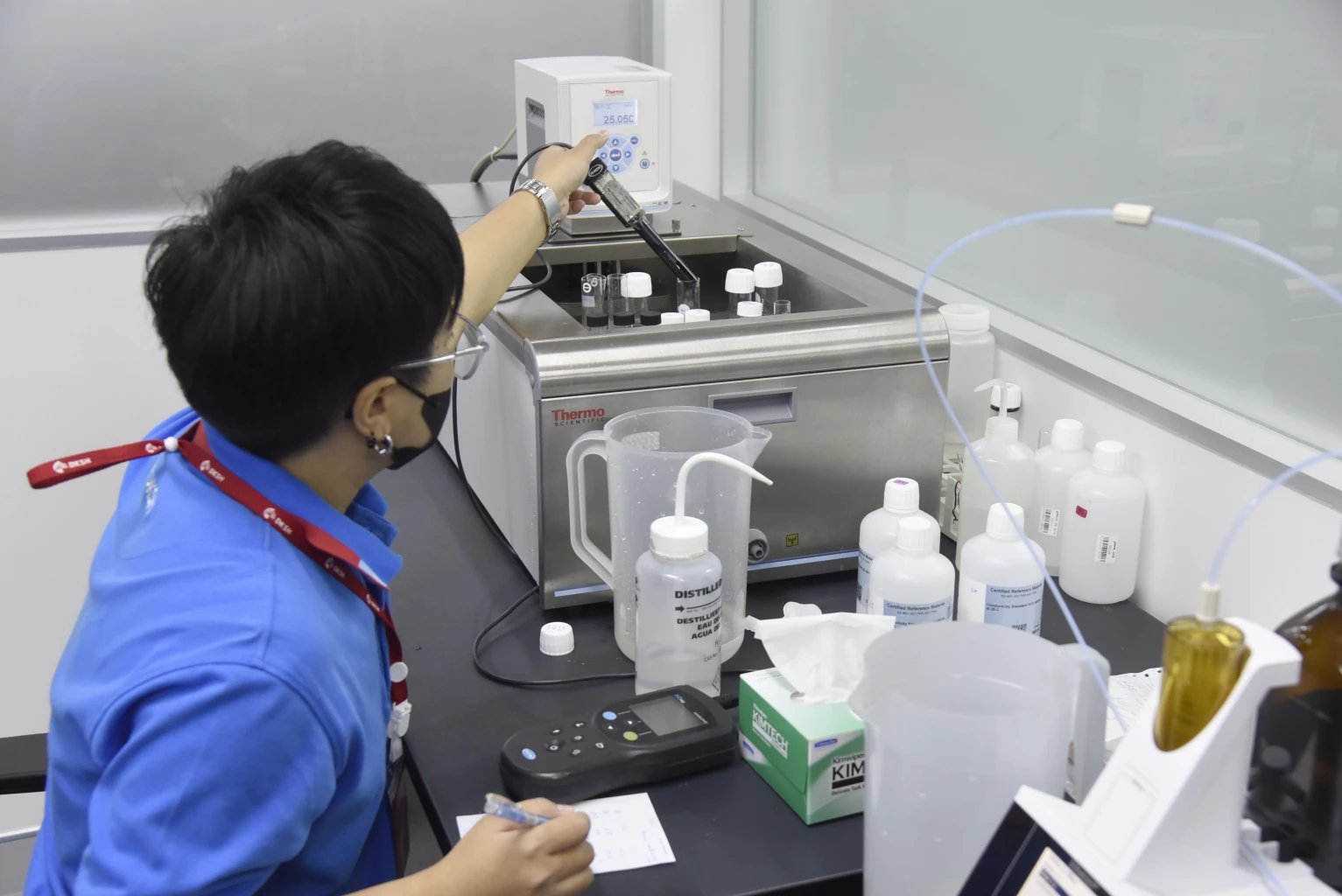
DKSH Business Unit Technology has opened a sizeable, fully-fitted demonstration lab and calibration center in Thailand, elevating the market to a distinguished research and development (R&D) hub in the region.

Bangkok, January 27, 2023 – DKSH Business Unit Technology, a leading Market Expansion Services provider for technology companies seeking to grow their business in Asia and beyond, has invested in one of the largest fully-fitted demonstration laboratories and calibration centers in Thailand. This move not only solidifies the Business Unit’s position as one of the leading scientific instrumentation providers in Thailand but also strengthens the market’s reputation as a leading R&D hub in Asia.

The 2,270 square meter lab accommodates over 50 machines as well as equipment for demonstrations and 190 professionals offering consultancy and services in four areas: general laboratory equipment, analytical instrumentation, life sciences, and microbiology. 

The calibration center offers ISO/IEC 17025 calibration services, after-sales and workshop services, as well as application development programs for its customers.

In addition, the lab aims at synergizing the close collaboration between academia and industries to ultimately increase research and innovation output. In the demonstration lab, university students will have the opportunity to gain hands-on experience. DKSH Technology plans to host regular seminars featuring renowned experts from domestic and international domains.

DKSH positions Thailand as R&D hub in Asia with opening of new demonstration lab and calibration center

Oliver Hammel, Vice President, Business Unit Technology, DKSH Thailand, stated: In the past three years, Thailand has shown great potential in R&D for vaccination, propelled by the pandemic. DKSH Technology contributed to combat the pandemic in Thailand, whether by developing COVID-19 mobile testing, providing surface disinfection solutions, or offering innovative instruments for research, development, and production for public and private sectors. With this new lab, we are even better positioned to advance Thailand’s potential to be a center for R&D in various fields, including pharmaceutical, food, beverage, cosmetic, chemical, agricultural product, and FMCG industries.

Somchai Chakornsiri, General Manager, Scientific Instrumentation, DKSH Technology, added: “DKSH Business Unit Technology  drives the success of many brands in Thailand. Reputable Thai firms entrust us, as their trusted partner, with their R&D processes for food, medicine, cosmetics, chemical, and agricultural products, among many others. The newly launched lab enables us to provide manufacturers with cutting-edge analytical tools and equipment to advance their innovations and help them succeed.
DKSH positions Thailand as R&D hub in Asia with opening of new demonstration lab and calibration center

About DKSH 

DKSH’s purpose is to enrich people’s lives. For more than 150 years, we have been delivering growth for companies in Asia and beyond across our Business Units Healthcare, Consumer Goods, Performance Materials, and Technology. As a leading Market Expansion Services provider, we offer sourcing, market insights, marketing and sales, eCommerce, distribution and logistics as well as after-sales services. DKSH is a participant of the United Nations Global Compact and adheres to its principles-based approach to responsible business. Listed on the SIX Swiss Exchange, DKSH operates in 36 markets with 33,100 specialists, generating net sales of CHF 11.1 billion in 2021. The DKSH Business Unit Technology offers complete solutions for specialized industrial applications. With around 1,600 specialists, the Business Unit generated net sales of CHF 430.3 million in 2021. www.dksh.com/tec

DKSH positions Thailand as R&D hub in Asia with opening of new demonstration lab and calibration center

10 more Japanese companies offering Thailand solutions for carbon neutral businesses

#SootinClaimon.Com : ขอบคุณแหล่งข้อมูล : หนังสือพิมพ์ The Nation.

https://www.nationthailand.com/blogs/business/corporate/40024466

10 more Japanese companies offering Thailand solutions for carbon neutral businesses

10 more Japanese companies offering Thailand solutions for carbon neutral businesses

MONDAY, JANUARY 30, 2023

The Japan External Trade Organisation has introduced the “Virtuous cycle of environment and growth Vol 2” as part of the Thailand-Japan Sustainable Business Seminar and Business Matching for Carbon Neutrality project.

It lists 37 Japanese companies with solutionsinnovations and technologies in sustainable business for carbon neutrality, including 10 more companies from the previous volume.

In January 2022, Jetro Bangkok had renewed and signed the cooperation Memorandum of Intent with the Eastern Economic Corridor Office (EECO) and Thailand Board of Investment (BOI).

These companies also participated in the project organised twice last year with the EECO and BOI to help deepen the existing close partnership with the two state organisations and build a more resilient supply chain between Japan and Thailand, making contributions to the policies of both countries including the Bio-Circular-Green (BCG) policy of Thailand.

In the pursuit of realising a virtuous cycle of environment and growth, both countries are working on achieving carbon neutrality, with the former promoting the “BCG Economic Model” as its national strategy and the latter formulating the “Green Growth Strategy”.

The businesses are categorised into nine fields: carbon recyclinghydrogenrenewable energyenergy sufficiencyagritechbiomassupcyclingwaste reduction, and water treatment.

10 more Japanese companies offering Thailand solutions for carbon neutral businesses

Peel Lab KK is the first plant-based leather business in Asia. Based in Osaka, Japan, the upcycling fruit peel manufacturer uses pineapple leaves, coconuts and bamboo as alternatives to leather.

It is inexpensive, light-weight, waterproof and durable, and is used in the interior of automobiles, furniture, and fashion items promoting eco-friendly and contributing to minimising food loss and prevention of animal abuse.

10 more Japanese companies offering Thailand solutions for carbon neutral businesses

Shizen International Inc provides solar energy power purchase agreements for the manufacturing industry and is working towards promoting a lifestyle with safe and sustainable energy by building natural power plants across the world.

Aiming to engage in 10GW worth of power generation businesses across the world by 2030, they currently have solar power and wind power businesses in Malaysia, Thailand, Vietnam, Indonesia, the Philippines, and Brazil.

10 more Japanese companies offering Thailand solutions for carbon neutral businesses

TBM Co Ltd uses scraped plastics and “Limes”, a new material with limestone and “CirculeX”, which contains more than 50% recycled materials.

It can be processed into Limes sheets instead of paper, packing material, containers, and daily products with existing moulding machines. This contributes to recycling and the preservation of resources with a high risk of depletion such as petroleum, water, and forest resources.

The catalogue is in Japanese. Thai, and English version are available at https://www.jetro.go.jp/thailand/topics/_496955.html

Cabinet approves adjustments to basic daily wages for 17 professions

#SootinClaimon.Com : ขอบคุณแหล่งข้อมูล : หนังสือพิมพ์ The Nation.

https://www.nationthailand.com/thailand/economy/40024506

Cabinet approves adjustments to basic daily wages for 17 professions

Cabinet approves adjustments to basic daily wages for 17 professions

TUESDAY, JANUARY 31, 2023

The Cabinet on Tuesday approved the Labour Ministry’s proposal to adjust the wages for skilled workers in 17 fields, which would see them earning between 465 and 700 baht daily.

Labour Minister Suchart Chomklin said the Cabinet agreed to adjust the minimum daily rate for the 17 professions, provided they receive a certificate from the Skill Development Department.

The professions to be covered are divided into three groups, namely the industrial sector, technicians and workers in the service sector. Suchart said there is a big demand for people in these fields.

In 2014, the Labour Ministry’s proposal to set a minimum wage rate for 112 professions was approved by the Cabinet, and now with 17 more, the number of professions under the radar has risen to 129.

The new minimum daily wages for some of the 17 professions are:

• Pump and valves technicians: 515 baht

• Mechatronics and industrial robot controllers:

Level 1: 545 baht

Level 2: 635 baht

Level 3: 715 bahtCabinet approves adjustments to basic daily wages for 17 professions

• Mechanics

Tractor repairs:

Level 1: 465 baht

Level 2: 535 baht

Level 3: 620 baht

Excavator controllers: 585 baht

Cabinet approves adjustments to basic daily wages for 17 professions• Service sector

Holistic food therapist, aqua therapist, aromatherapist

Level 1: 500 baht

Level 2: 600 baht

Bartenders

Level 1: 475 baht

Level 2: 525 baht

Level 3: 600 baht

Thai rice export target set at 7.5 million tonnes this year, down from 2022

#SootinClaimon.Com : ขอบคุณแหล่งข้อมูล : หนังสือพิมพ์ The Nation.

https://www.nationthailand.com/thailand/economy/40024505

Thai rice export target set at 7.5 tonnes this year, down from 2022

Thai rice export target set at 7.5 tonnes this year, down from 2022

TUESDAY, JANUARY 31, 2023

Thailand expects to export about 7.5 million tonnes of rice this year, down from 7.9 million tonnes last year, the Foreign Trade Department said on Tuesday.

The department’s director-general, Narong Poolpipat, said rice exports last year had exceeded the target of 7.5 million tonnes, mainly because of the depreciation of baht, which dropped to around 38 baht to the US dollar.

Last year’s rice export was 22.06% higher year on year in terms of volume, while rice export value was US$3.971 billion, up 14.67% year on year, Narong said.

He said the top five markets for Thai rice exports last year were:

– Iraq, 1.6 million tonnes, up 458%

– South Africa, 775,000 tonnes, down 2.26%

– China, 745,200 tonnes, up 18.81%

– United States, 653,000 tonnes, up 13.21%

– Benin, 320,000 tonnes, down 15.38%

Thai rice export target set at 7.5 tonnes this year, down from 2022Although the department eyes 7.5 tonnes of rice exports this year, it cannot not yet estimate the export value due to fluctuations in the value of the baht, Narong said.
He explained that the baht had appreciated to about 32.50-33.00 baht against the US dollar, but it was expected to depreciate to 35-40 baht by the middle of the year and appreciate again later this year.

Narong added that his department would hold several activities this year to promote rice exports, including holding the Thailand Rice Convention 2023 and sending delegations of state officials and private firms to visit trading partner nations, such as Germany, China, United Arab Emirates and Australia.

Academics call for more diversified global currency basket, less dependent on US dollar

#SootinClaimon.Com : ขอบคุณแหล่งข้อมูล : หนังสือพิมพ์ The Nation.

https://www.nationthailand.com/thailand/economy/40024491

Academics call for more diversified global currency basket, less dependent on US dollar

Academics call for more diversified global currency basket, less dependent on US dollar

TUESDAY, JANUARY 31, 2023

Nongluck Ajanapanya

Asian emerging markets and developing economies should deepen regional financial market integration in order to mitigate the risk resulted from the US dollar’s dominance, experts and economists have suggested.

The remarks were part of the statement released on Monday by the Asian Shadow Financial Regulatory Committee (ASFRC) at their 35th annual meeting on “What can Asian Economies do about the USD Global Financial Cycle?” hosted by NIDA Business School in Thailand and its MSc in Corporate Finance, Investment, and Risk Management (CIFRM) program.

ASFRC members are all academics in finance and economics from the Asia Pacific. The statement aimed to persuade governments throughout Asia Pacific of the significance of diversifying the global currency basket.

Such a step will make countries in the region more resilient to external factors. They referenced the current impact on countries across the world from the US Federal Reserve raising policy rates to tame its own inflation.

“Tightening of monetary policy may be appropriate for the United States, but this exerts a recessionary tendency in the world as the United States’ tightening raises yields on US treasuries and induces capital outflows from other countries,” the statement explained.

One of the committee members, Martin Young, a professor at Massey University in New Zealand, said that the dollar remains powerful because the United States has the largest global economy.

However, in terms of cross-border trade and investment, reliance on a single currency threatens the financial market’s stability.

According to Obstfeld and Zhou’s 2022 study, despite the switch to a floating exchange rate system 50 years ago, the world remains largely on the dollar standard.

The majority of trade and invoicing is done in US dollars. The US dollar is used approximately 50% of the time in global trade invoicing, and around 90% of the time in global foreign exchange transactions where one side is in US dollars.

Martin YoungMartin Young

Young emphasised that the ASFRC committee has no intention of toppling the dollar. They simply require a greater balance in the global currency basket.

He declared that the dollar’s dominance in the global financial market should be reduced.


According to Maria Socorro Gochoco-Bautista of the University of the Philippines, allowing one currency to dominate the global market would inevitably have an impact on others, particularly small and open market Asian countries like Thailand and the Philippines.

Each country has its own economic cycle and development, she explained. Because countries all over the world are involved in the global supply chain and demand, the global economy may have some effects. However, the impact should not be so severe that a single government’s monetary policy deprives the others of financial stability and the ability to control their economies.

Jian-Xin Wang from the University of Technology Sydney, Australia, stated that the committee’s recommendations are a long-term process for each country to collaborate together to find a better system of global financial currency which the committee dubbed as a multi-polar currency system.

According to the committee statement, a multi-polar currency system will be better because it will be less reliant on the actions of a single monetary authority and reduce the risk of negative externalities on the rest of the world.

“The dominance of US monetary policy limits the ability of authorities elsewhere to respond to external shocks more independently under the current dominant US dollar standard,” the committee explained.

Academics call for more diversified global currency basket, less dependent on US dollar

Besides encouraging Asean and other Asian economies to enhance and expand regional economic integration, the committee’s recommendations include:


● Establish a regional corporate bond market, such as the Asian Bond Market Initiative, with common issuance standards.
● Create an inter-dealer regional trading platform to provide liquidity in exchange for certain benefits such as preferential access to a regional repo market.
● Have a regional centralised counter-party for Asean names in credit default swaps.
● Create an Asean+3 zone of free capital mobility, including mutual recognition of funds and instruments from different jurisdictions.
● Remove withholding taxes on intraregional flows.
● Harmonise macro-prudential rules for managing external capital flows.
● Expand the Chiang Mai Initiative Multilateralisation into a regional repo market to provide additional liquidity on a daily basis rather than just during a crisis.
● Central banks could agree to accept cross-border collateral in the form of Asean+3 government and corporate bonds.
● With the help of multilateral institutions such as the Asian Development Bank, build regional financial infrastructure to facilitate regional market integration.
● Encourage the use of regional currencies through bilateral agreements.
● Increase local risk management capacity at the firm level, as part of central bank initiatives to encourage the use of fintech in transactions.
● Use digital currencies and distributed ledger technologies to make cross-border payments and settlements easier, faster and more secure.

Young expected that these suggestions would encourage Asia Pacific governments to adopt a multi-polar currency system. He believes that while the system may not be implemented in the next 10 years, Asia Pacific countries will eventually achieve the goal if they begin taking decisive actions.

Other panel members this time included Qian Sun of Fudan University in China, David K. Ding of Singapore Management University, Robin K.Chou of National Chengchi University in Taiwan, Aekkachai Nittayagasetwat of NIDA Business School, Sunti Tirapat of NIDA Business School, and Kridsda Nimmanunta of NIDA Business School in Thailand.

Thai tourism industry ups forecast to 30 million foreign arrivals this year

#SootinClaimon.Com : ขอบคุณแหล่งข้อมูล : หนังสือพิมพ์ The Nation.

https://www.nationthailand.com/thailand/economy/40024484

Thai tourism industry ups forecast to 30 million foreign arrivals this year

Thai tourism industry ups forecast to 30 million foreign arrivals this year

TUESDAY, JANUARY 31, 2023

Thailand’s tourism industry expects foreign arrivals to exceed 30 million this year, significantly higher than government estimates of 25-27.5 million.

Making the forecast on Tuesday, the Tourism Council of Thailand (TCT) predicted foreign and domestic tourists would generate over 3 trillion baht in revenue this year.

However, TCT president Chamnan Srisawat warned the huge volume of customers will pose challenges for the Thai tourism industry, which is still recovering from the ravages of Covid-19.

Most tourism businesses are still suffering liquidity and labour shortages, he explained, while some are missing out on new opportunities.

TCT is tackling the problems by cooperating with the Office of SMEs Promotion to help entrepreneurs tap new trends like wellness- and metaverse-based tourism, he said.

On the liquidity front, it is liaising with the Government Savings Bank and National Credit Bureau for access to soft loans for tourism operators.

Finally, the TCT is collaborating with the Labour Ministry, Vocational Education Commission and Thailand Professional Qualification Institute to fill gaps in the tourism labour market.

Thai tourism industry ups forecast to 30 million foreign arrivals this year

About 86% of workers have now returned to the tourism industry after the Covid downturn, said Pakakrong Theparak, a tourism expert at Rajamangala University of Technology Srivijaya.

Only 13% of tourism-related businesses plan to recruit employees in the first quarter of this year, with demand for workers strongest among spa/massage operators, followed by entertainment venues.

Many businesses had been forced to increase employee hours, allow more overtime and offer higher wages, she added.

Most operators plan to hike the price of their products and services in the first quarter, especially restaurants, Pakakrong said.

Thai tourism industry ups forecast to 30 million foreign arrivals this year

Sisdivachr Cheewarattanaporn, president of Association of Thai Travel Agents, agreed that foreign arrivals this year could exceed 30 million.

He cited the return of Chinese tour groups from February 6.

“However, China’s economy has suffered from a prolonged Covid-19 crisis, so the number of Chinese visitors must be monitored quarterly,” he said, adding that he expected foreign arrivals from China to jump in the third quarter.

However, Sisdivachr said recent scandals involving Thai police had damaged confidence in Thailand’s tourism industry. He cited police extortion of a Taiwanese actress and a police VIP siren service for a Chinese tourist, urging the government to tackle such abuses urgently. He also asked authorities to reduce queues at immigration checkpoints.

Related stories:

Chinese yearning for overseas trips in 2023: Report

Head inland to enjoy Thailand

Korn pledges to create Thai spiritual tourism industry with THB1bn per province

Duopoly warning for Thai e-commerce market after JD Central pulls out 

#SootinClaimon.Com : ขอบคุณแหล่งข้อมูล : หนังสือพิมพ์ The Nation.

https://www.nationthailand.com/thailand/economy/40024478

Duopoly warning for Thai e-commerce market after JD Central pulls out 

Duopoly warning for Thai e-commerce market after JD Central pulls out 

TUESDAY, JANUARY 31, 2023

The founder of Tarad.com has urged the competition regulator to investigate whether Thailand’s e-commerce market will become a duopoly when JD Central bows out in March, leaving Lazada and Shopee to dominate the scene.

JD Central announced on Monday it will stop operating in Thailand from March 3, though customer deals will be honoured until March 31.

Pawoot Pongvitayapanu, who founded e-commerce website Tarad.com in 2001, said on Monday that the Trade Competition Commission of Thailand (TCCT) must guard against unfair market conditions that damage consumer interests.

Duopoly warning for Thai e-commerce market after JD Central pulls out 

A duopoly in e-commerce would likely have a more severe effect on sellers and customers than retail channels, he said. 

“Having only two major players will limit the choices for sellers and customers, while platform operators can pressure sellers into following their policy.”

Lazada raised the fee for sellers on its platform only last year, Pawoot pointed out.

Shopee and Lazada are Thailand’s top two online shopping platforms, dominating the market with an average of 63.1 and 50.3 million visitors per month, respectively. JD Central ranks 8th with around 2 million visitors per month.

JD Central was launched in 2018 by Thailand’s Central Group and Chinese e-commerce operator JD.com. A source said that Central, which had invested 17.5 billion in the platform, has decided to pull out.

Fierce competition between giant players in Thailand’s e-commerce market also saw Japan’s Rakuten and South Korea’s 11Street withdraw in 2016 and 2018 respectively.

Related Stories

JD Central discontinues operations in Thailand on March 3

JD Central officially launches

JD Central marks first year’s success with shopping fest

JD Central discontinues operations in Thailand on March 3

#SootinClaimon.Com : ขอบคุณแหล่งข้อมูล : หนังสือพิมพ์ The Nation.

https://www.nationthailand.com/business/corporate/40024456

JD Central discontinues operations in Thailand on March 3

JD Central discontinues operations in Thailand on March 3

MONDAY, JANUARY 30, 2023

Online shopping platform JD Central (www.jd.co.th) announced on Monday that it was discontinuing its operations in Thailand from March 3, though customer service will be available until March 31.

In a Facebook announcement, the company said the JD Central Official Store will stop accepting orders from 11.59pm on February 15, while the JD Central platform with other vendors will stop accepting orders from 11.59pm on March 3.

The company has promised to fulfil all orders placed on or before March 3. The time taken for deliveries will be determined by the third-party logistics provider and seller.

JD Central’s customer service centre will continue providing after-sales services for completed orders until March 31, from 9am to 6pm, via live chat, phone (02) 030 4599 and e-mail cs@jd.co.th.

JD points and discount coupons can be used until March 3, while product warranty will not be affected by the discontinuation of the platform.

JD Central is an e-commerce platform set up in 2018 by Thailand’s Central Group and China’s e-commerce operator JD.com. It was named the Best e-Commerce Solution and Best e-Commerce Campaign – B2B in the Marketing Asia e-Commerce Awards 2020 hosted by Singapore’s “Marketing” magazine.

Related Stories

JD Central officially launches

JD Central marks first year’s success with shopping fest

JD Central, JD.com forge e-commerce partnership with govt agencies, UTCC

PPT’s life-science arm Innobic reaches profitability, targets THB7bn revenue this year

#SootinClaimon.Com : ขอบคุณแหล่งข้อมูล : หนังสือพิมพ์ The Nation.

https://www.nationthailand.com/business/corporate/40024448

PPT’s life-science arm Innobic reaches profitability, targets THB7bn revenue this year

PPT’s life-science arm Innobic reaches profitability, targets THB7bn revenue this year

MONDAY, JANUARY 30, 2023

Innobic (Asia) Co Ltd, the biotechnology arm of national oil and gas conglomerate PTT, generated profit for the first time in 2022 after being established in 2020 with a mission to develop life science products.

Innobic’s profit last year was driven by the sales performance of Lotus Pharmaceutical Ltd, in which it holds a 37% stake worth 6 billion baht, said Innobic chairman Buranin Rattanasombat.

“In 2022, Lotus Pharmaceutical reported 15 billion baht in sales and nearly 2 billion baht profit, which contributed to the positive turnover of Innobic,” said Buranin, who also serves as PTT’s senior executive vice president for innovation and new ventures.

Innobic paid 16.46 billion baht in May last year to acquire Alvogen Emerging Markets Holdings Ltd (AEMH), a major shareholder of Lotus Pharmaceutical Ltd and the sole owner of Adalvo Ltd. As a result, Innobic also has a 60% stake in Adalvo, a leader in patent trading industries.

Innobic has raised its revenue target 15% to 7 billion baht this year, Buranin said.

Sales of Innobic products are expected to generate 480 million baht while the rest is projected from Lotus Pharmaceutical sales.

The company will invest 1.3 billion baht in the first quarter to build a factory producing active pharmaceutical ingredients (API) for anti-cancer drugs for the Government Pharmaceutical Organization.

The factory will be located in either the Eastern Economic Corridor or nearby province such as Bangkok or Ayutthaya. It should be ready to manufacture API by 2027, Buranin said.

So far Innobic has rolled out two food-supplement products, namely Innobic Pro Beta-Glucan+ and Innobic Probiotics GD, developed in collaboration with Chulalongkorn University and Thailand Institute of Scientific and Technological Research, respectively. Both are available at drug stores nationwide, the Shopee platform and the Innobic official shop.

This year, the company plans to launch 10 more products in the Thai food-supplement market, which is worth an estimated 75 billion baht per annum.

It said its existing two products are expected to reach sales of at least 100 million baht this year.

“We are also eyeing the overseas food supplement market, especially in the rapidly expanding Asean region of over 600 million people,” Buranin said. “From 2024 we will open branches in neighbouring countries starting with Vietnam to introduce life science products to local markets.”

Related Stories

Innobic, Aztiq acquire Lotus Pharmaceutical, Adalvo for $475m, eye emerging Asean markets

ATKs go on sale at PTT station

NRF adjusting business, and changing strategy to support future growth

Taiwanese actress who claimed extortion caught in lie on camera

#SootinClaimon.Com : ขอบคุณแหล่งข้อมูล : หนังสือพิมพ์ The Nation.

https://www.nationthailand.com/thailand/general/40024441

Taiwanese actress who claimed extortion caught in lie on camera

Taiwanese actress who claimed extortion caught in lie on camera

SUNDAY, JANUARY 29, 2023

Security camera footage from several locations in Bangkok shows the Taiwanese actress who claims Thai police extorted 27,000 baht from her after placing a vaping device in her hand using one before and after she was stopped at a checkpoint in the early hours of January 5.

The actress, Charlene An, alleged on Taiwanese social media that she was forced to pay 27,000 baht to Thai police officers after they stopped a taxi she and her friends were travelling in at a checkpoint near the Chinese embassy at about 1 am on January 5.

The actress told Taiwanese media that Thai police put a vaping device into her hand and that she did not know what it was.

She alleged that she was charged with having an illegal e-cigarette device in her possession. Police subsequently took her into an alley and extorted 27,000 from her, she claimed. The actress also alleged she and her friends had been detained for two hours.

Nation TV obtained footage from a security camera of a condo building where An stayed in Bangkok. Nation TV said the clip showed the actress smoking on a vaping device near the condo’s swimming pool on January 31 at 1.55 pm.

Footage from a security camera on the 11th floor of the condo building also showed her holding a vaping device while she was using her smartphone.

Nation TV also obtained a clip from a security camera near Huay Kwan market at 3.46am on January 5 – after she and friends were driven by taxi from the police checkpoint.

The clip, taken in front of the market, showed her holding a vaping device in her left hand.

Taiwanese actress who claimed extortion caught in lie on cameraIf police had charged her with having a vaping device in her possession, it would have been seized as evidence, police said. If it was not seized, any police officers who charged her with possession of the illegal device would be in dereliction of duty, police said.

Nation TV also reported clips of security camera footage showing An holding a vaping device in her left hand while she was using an elevator of the condo at 3.59pm on January 4. She was also seen smoking from the device at 4.02pm in front of her room.

Taiwanese actress who claimed extortion caught in lie on cameraShe was also caught on camera holding the device in her left hand when leaving the room at 11.45pm on January 4.

Channel 7 has posted a video clip compiled from security cameras around the Chinese Embassy that shows An and her friends being detained by police at the checkpoint for 47 minutes – not the two hours she claimed.

No footage showed any member of her group being led into an alley by police, Channel 7 added.

An alleged police led her to a spot that was outside of the range of CCTV cameras to extort money from her.

Metropolitan Police Division 1 commander Maj-General Attaporn Wongsiripreeda said he had assigned his subordinate to gather footage to examine from security cameras along the route An travelled before and after being stopped.

Taiwanese actress who claimed extortion caught in lie on cameraPolice cannot stop An from attacking them, but they will gather enough compelling scientific evidence to get to the truth, Attaporn said.

Police are also trying to identify the three men traveling with An in the taxi so that they can be questioned, Attaporn said.