Facebook Financial formed to pursue company’s commerce ambitions
CorporateAug 12. 2020Signage is displayed outside Facebook Inc. headquarters in Menlo Park, Calif., on Oct. 30, 2018. CREDIT: Bloomberg photo by David Paul Morris.
By Syndication Washington Post, Bloomberg · Kurt Wagner · BUSINESS, TECHNOLOGY, US-GLOBAL-MARKETS Facebook unveiled a new group to pursue payments and commerce opportunities and put David Marcus, co-creator of its Libra cryptocurrency project, in charge of the initiative.
Called F2 internally, short for Facebook Financial, the team will run all payments projects, including Facebook Pay, the company’s universal payments feature that it plans to build inside all of its apps.
Marcus will continue running Novi, the division that is building a digital wallet to hold the Libra cryptocurrency. He will also be involved in WhatsApp’s payments efforts in countries like India and Brazil. Facebook has hired former Upwork Inc. Chief Executive Officer Stephane Kasriel to serve as a payments vice president under Marcus.
This is the latest step in a companywide effort to bring Facebook’s individual products and apps closer together. In the past two years, it re-branded Instagram and WhatsApp so people know they are owned by Facebook, and CEO Mark Zuckerberg announced plans to integrate all the company’s messaging services.
“We have a lot of commerce stuff going on across Facebook,” Marcus said. “It felt like it was the right thing to do to rationalize the strategy at a company level around all things payments.”
The belief is that if users can make purchases on Instagram, Messenger and WhatsApp, then Facebook’s advertising will grow more valuable, and users will spend more time inside the company’s apps. On Facebook’s second-quarter earnings call last month, Zuckerberg said he was “quite excited” about commerce inside of messaging apps. “As payments grow across Messenger and WhatsApp, and as we’re able to roll that out in more places, I think that that will only grow as a trend,” he added.
Marcus is a payments veteran, and a trusted executive inside the company. He joined Facebook in 2014 from his role as president of PayPal Holdings Inc., and ran Facebook Messenger for four years before taking on Libra.
One priority will be getting payments running inside WhatsApp in India and Brazil. The company has invested heavily to make WhatsApp a destination for commerce in those markets, but regulation has stalled its payments efforts in both countries.
Marcus was most recently working to get Libra off the ground as a cryptocurrency for cross border payments. That required negotiations with regulators, and the experience could help with Facebook’s other payments initiatives.
“It’s helpful to have specific expertise in financial services regulation to build things the right way from the get-go,” he said. “In the financial services world, it’s very different than traditional technology companies that are not regulated.”
In a bleak economy, these companies are flourishing
CorporateAug 11. 2020Tim Linch, store manager at Tractor Supply Co., straightens merchandise in Leesburg, Va., on July 30. The company is thriving either despite or because of the pandemic. CREDIT: Washington Post photo by Katherine Frey.
By The Washington Post · David J. Lynch · BUSINESS, US-GLOBAL-MARKETS, RETAIL
LEESBURG, Va. – Tucked into a suburban shopping center about two miles from a Civil War battlefield, this Tractor Supply Co. outlet has become a rare hot spot in an economy that has gone ice cold.
Since the first days of the coronavirus pandemic, the retailer for farmers, ranchers and suburbanites who fancy themselves farmers or ranchers has enjoyed what its chief executive calls an “unprecedented” sales surge. Fencing, bird feed, plumbing supplies, pet food, outdoor apparel, live chickens, lawn tractors – just about anything in stock has been flying out of its 1,881 stores nationwide.
Tim Linch fills a propane tank for a customer at Tractor Supply. CREDIT: Washington Post photo by Katherine Frey.
“It’s been very steady,” said Tim Linch, 51, the store’s manager. “Early on, when everybody else was closed, people were coming in just because we were open. I’ve never seen so many people thank me.”
Tractor Supply’s good fortune – second-quarter profits jumped more than 50% – not only seems at odds with the overall collapse in business activity across the country, but also reflects the economic remodeling that the pandemic has unleashed. With record sales and earnings, the rural-oriented retailer is among a select group of companies that are prospering despite – or in some cases because of – the pandemic.
Microsoft says its Azure cloud-computing business booked record revenue in the quarter ended June 30. Consumer goods maker Church & Dwight expanded manufacturing capacity for its Arm & Hammer laundry detergent to keep pace with demand, even though sales of its Trojan-brand condoms slumped in an extreme example of social distancing. And Albertsons, the nation’s second-largest supermarket chain, reported that same-store sales leaped by more than 26% compared with the same period last year.
The rise of some companies, and the fall of others, comes as the economy struggles to recover from the record 9.5% quarterly decline in economic activity over the spring.
But rather than a temporary interruption of normal commerce, the global health scare and subsequent recession is altering spending, saving and investing patterns across the $19.4 trillion economy.
“The longer it goes on, the more lasting the ramifications will be,” said Bill McMahon, chief investment officer for active equity strategies at Charles Schwab Investment Management.
Investors are struggling to distinguish between fleeting and permanent changes. Already, clothiers specializing in attire for offices that people no longer frequent such as Brooks Brothers are sliding into bankruptcy while producers of more casual garb like Lululemon prosper.
In the days ahead, Americans may leave the cities for suburban and rural areas, denting prospects for commercial real estate and boosting the residential market. Cashless payments could finally eclipse traditional currency.
Not all of the changes have solidified. But the emerging new normal will mean less money spent on air travel and more on stay-at-home comforts, which explains disappointing earnings from commercial airline maker Boeing and General Electric, which makes aircraft engines.
When nonessential businesses began shutting down in March, many economists anticipated a brief interlude that would allow the United States to “flatten the curve” of the pandemic before resuming normal life.
In a March 11 Oval Office address, President Donald Trump called the shutdown “just a temporary moment of time.” His administration three weeks later introduced a Paycheck Protection Program designed to provide small businesses an eight-week financial bridge to see them through the maelstrom.
Now, what initially seemed like an economic pause is becoming a more-thorough makeover. Amid the second-quarter carnage that included gross private investment plunging by nearly one-half and consumption expenditures falling by more than one-third, Americans increased spending on just a few categories, including motor vehicles, recreational goods and housing.
David Kotok, chairman of Cumberland Advisors, likens the ongoing transformation to the difference between the Grand Canyon’s northern and southern rims. Much of the view is the same in each place, but the plant and animal life, even the weather, is distinct.
“In January, Macy’s was in the S&P 500. In July, it is not,” he said.
Last month, Procter & Gamble reported strong quarterly earnings, including a 14% sales gain in detergents and household cleaners, as Americans scrubbed and cleaned to ward off the coronavirus.
The reshaping of consumption also is leaving a mark on media and entertainment provider Comcast. As consumers hunkered down, revenue for the company’s theme parks evaporated. Attractions such Universal Studios Hollywood remain closed and the company collected just $87 million at its theme park turnstiles, down 94% from $1.5 billion in the same period last year.
At the same time, Comcast reported a record second-quarter net gain in cable customers and its highest increase in high-speed internet hookups in 13 years.
“I am confident in our ability to continue to successfully navigate the impact of covid-19, and emerge from the crisis even stronger,” chief executive Brian Roberts said in a news release.
Work-from-home may be starting to feel like a form of house arrest for millions of American workers, but for some companies it’s become a bonanza. At Tractor Supply, business has been remarkably good throughout the pandemic, said Rose Hernandez, 35, a company veteran who is helping train newcomer Linch.
“Our hips are constantly buzzing,” she said, gesturing to the cordless phone that employees carry on their belts. “The flow is a lot faster.”
Tractor Supply has its roots in the Great Depression, when Charles Schmidt, a 26-year-old floor-sweeper at a Chicago brokerage, launched a mail-order parts business from his home. Eighty-two years later, the companies that are managing to surmount a contemporary landscape of double-digit employment and business closures share a few traits.
They are in the right position to capitalize on shifting consumption patterns, as the pandemic obliterates demand for goods or services that require sustained face-to-face contact. Their balance sheets are armored against sudden financial damage. And their management teams demonstrate agility in adapting to a reshaped marketplace.
“It’s very Darwinian,” said Beth Ann Bovino, chief U.S. economist for S&P Global. “It’s survival of the fittest and, oftentimes, the survival of the biggest.”
Tractor Supply ticked all three boxes. Its outdoor focus – offering kayaks, hiking boots and farm equipment – is in sync with consumers’ desire to escape their homes without coming too close to others.
A nascent population shift out of cities as commuting patterns dissolve is bringing the retailer new customers at the fastest rate in company history. These new shoppers are younger, more affluent and disproportionately female. Trying to ride out the pandemic at home, they purchased steel tanks meant for watering livestock and transformed them into makeshift swimming pools while using horse-stall mats for yoga routines.
“People have left the cities where we don’t have stores,” Harry Lawton, the company’s chief executive, told investors during a July 23 earnings call. “They’re moving into suburbans [or] they’re moving out of the suburbs. So they’re moving out to the rural communities.”
Tractor Supply boasts a cash reserve of $1.2 billion along with an untapped $500 million credit line. And the company has introduced a new mobile app, website and marketing strategy while hiring more than 5,000 new employees.
Tractor Supply’s stock price is up more than 100% since its mid-March low. Its second-quarter sales of $3.2 billion rose 35% from the same period last year.
The 13,700-square foot Leesburg store opened in 1997, when surrounding Loudon County was home to less than half of its current 414,000 residents. What was once farmland has rapidly suburbanized in recent years.
When the pandemic hit, the company increased wages by $1 an hour and accelerated an e-commerce push.
Just inside the Leesburg store, a wire rack holds tarpaulins, bungee cords and other items customers have ordered online for pickup. Contactless payment was installed for Apple and Android users, part of a broader information technology overhaul that will roll out expanded WiFi services.
Even as jobs were melting by the millions elsewhere, Tractor Supply added more than 5,000 new employees in the second quarter. In Leesburg, five spots were filled as people who’d seen their jobs eliminated by the pandemic scrambled to regain a foothold in the labor market.
“A lot of the companies they worked for previously aren’t there any more,” Hernandez said.
Skytrain operator BTS Group Holdings will conduct a feasibility study with King Mongkut’s Institute of Technology Ladkrabang on an electric tram-bus service to link its main campus with the transport network. Also signing the memorandum of understanding (MoU) for the study today was Bangkok Smartcard System.
The collaboration is seeking to forge a mass transit connection from the campus to the Airport Rail Link’s Lat Krabang Station, explained BTS Group Holdings chief executive officer Kavin Kanjanapas. The campus is located just to the east of Suvarnabhumi Airport.
The partnership will also pave the way for knowledge exchange between BTS and the institute.
BTS Group Holdings executive director Surapong Laoha-Unya said two possible routes were being studied – Hua Takhe to Lat Krabang Station (4 kilometres) and a link directly from the campus to Lat Krabang Station.
Each tram-bus will have three carriages and capacity for 250 passengers. The study will take two to three years to complete.
The price of Carabao Group (CBG) shares rose more than 5 per cent in morning trading today (August 10) as the energy drink company’s second-quarter profit increased by 20.1 per cent year on year, driven by a 27 per cent rise in foreign income.
CBG’s share price hit a high of Bt134.50 in the morning session, up 6.76 per cent from the previous close, before falling to Bt131.
CBG’s shares gained positive sentiment from a strong second-quarter performance that generated revenue of Bt4.508 billion, up 20.1 per cent year on year. Income from the company’s products rose by 13.6 per cent year on year.
On the domestic front, CBG’s income dropped slightly by 1.7 per cent as sales in the energy drink market fell 13.4 per cent.
However, CBG’s foreign sales rose by 27 per cent to Bt2.219 billion, 81 per cent or Bt1.8 billion of which came from Cambodia, Laos, Myanmar and Vietnam (CLMV) and 7 per cent from China. Increasing sales in CLMV countries, especially Myanmar, boosted the company’s profit to Bt890 million, up 69.7 per cent year on year.
A stock analyst at Yuanta Securities expected CBG’s net profit to hit a new high in the remaining quarters of this year as the income from sales of its C+Lock drink and exports to CLMV countries were not included in the company’s forecast.
“In this year’s fourth quarter, production at CBG’s bottling plants will increase by 40 per cent to 4.2 million bottles per day, while production at its canning plants will increase by 30 per cent to 5.7 million cans per day. This will enable the company to boost income from foreign countries,” the analyst said. “Meanwhile, CBG’s paper packaging costs will fall due to the company’s new packaging factory.”
The analyst added that his securities company has increased CBG’s stock target price to Bt130-Bt140 per share, advising investors to buy this stock as the upside gain was around 3 to 10 per cent.
We expect the company’s stocks to gain positive sentiment from its positive performance,” the analyst added. “Investors will sell stocks to take profit when the price moves to around Bt135 per share,” he forecast.
Thai AirAsia aims to push non-air-ticket income to a quarter of its total earnings, Tassapon Bijleveld, executive chairman of Asia Aviation Plc (AAV) and Thai AirAsia Co Ltd (TAA), said.
Thai AirAsia is planning to generate additional income to keep the airline business afloat during the Covid-19 crisis, Tassapon said.
“Currently our food delivery business generates around Bt150,000 per month, while our latest “Unlimited Pass” campaign has generated around Bt100 million,” he said.
“We are expanding into the non-air-ticket market by promoting Thai AirAsia to be a travel digital platform that sells hotel reservation, concert tickets, European train tickets as well as car rental services to travellers worldwide.
“In the future, we aim to become the community digital platform that sells agricultural produce from farms as well as other local products directly to customers with 48 hours delivery,” he added.
Tassapon added that currently non-air-ticket income is responsible for 18 per cent of the airline’s total income. “We are pushing to make non-air-ticket 25 per cent of our total income,” he said. “Currently the profit ratio of non-air-ticket income is at 50-80 per cent, while that of the air ticket is only 2-5 per cent. In the future we might sell air tickets at a loss only to expand customer base and then focus on promoting other services that have higher ratio of profit to revenue.”
Thai AirAsia predicted that the airline industry will take until mid-2020 to fully recover from the impact of Covid-19.
“It had been earlier estimated that this year Thailand would have 8 million foreign tourists, while so far we have only seen around 6.2 million,” added Tassapon. “With the current outbreak situation, we can only rely on the travel bubble policy, which is estimated to bring only around 500,000 foreign visitors until the year-end, meaning the industry will miss its target by a lot.”
Energy Absolute (EA) has said it has no plans at the moment to increase capital as it has sufficient liquidity, but the company may reduce shareholding by approximately 40 per cent to seek more partners.
Amorn Sapthaweekul, the company’s deputy chief executive officer, said the company recently cooperated with partners to invest in two Laos mega-projects to construct hydro-electric dams, namely Saravan Downsteam Hydropower Project and Phamong Hydropower Project.
“These projects can generate about 3,000 megawatts of electricity, while the investment capital is expected to be around Bt100 billion. The company will hold 50 per cent of total shares, while another 50 per cent will be held by partners,” he said.
“The company has cooperated with three partners from both Laos and Thailand, namely Chaleun Sekong Energy Co Ltd, Vega Digital Co Ltd and PSL Service Sole Co Ltd.”
He said these projects will enable the company to sell electricity to Vietnam, which faces power shortage, adding that Thailand has an agreement with Laos to trade up to 9,000MW of electricity.
“These projects need a lot of investment, but it will generate sustainable returns in the long term,” he said. “The company and partners are currently studying the possibility under the Laos government’s criteria, expecting to be completed within two years.”
He believed that the company is still able to manage investment because these projects would take about seven years to be completed, while the company may reduce shareholding to 40 per cent from 50 per cent to seek more partners.
“Although the company has a lot of projects that are waiting for investment, we believe that we can manage investment because the company’s cash flow was over Bt100 billion per year,” he said. “If the first phase of 1-gigawatt battery factory construction is completed, the company will be able to generate more income.”
He expected the first phase of the 1-gigawatt battery factory to be completed by this year and begin production at the beginning of next year, adding that batteries produced during the first phase will be used in the company’s electric buses and boats.
“We will consider suitability before beginning the second phase of the project. If the business grows within three to four years, it will help compensate for adder from the company’s 600MW solar and wind power plants that will expire between 2022 and 2025,” he said.
He said the company is ready to look for business partners to develop phase change material (PCM) to penetrate textile and garment markets.
“After the company sent PCM to foreign companies in India and China to test its properties for producing heat and cold resistant clothes, we expect to see the testing results in two to three months,” he said.
“Currently, the company exports this product to Japan for use in the construction industry, but the demand for this material is still low, while Thailand still does not have rules regarding zero-energy houses.”
He added that PCM will help preserve temperature and reduce electricity usage by air-conditioners, adding that this material was still not popular in Thailand because the cost is high.
“The company’s ECM production capacity was 130 tonnes per day, but the demand for this product is only 30 to 40 per cent of total production,” he added. “However, the PCM business is still performing well,” he said.
The Stock Exchange of Thailand expects initial public offering (IPO) by companies this year to raise Bt500 billion, as large companies have requested to be listed in the market this year.
Manpong Senanarong, SET senior executive vice president and head of issuer and listing division, said large companies that requested to be listed on the market this year include PTT Oil and Retail Business (OR) and SCG Packaging (SCGP).
“From January 1 to August 7 this year, five companies launched IPOs, accounting for IPO market capitalisation of over Bt303.922 billion, while the fundraising value was approximately Bt71.334 billion,” he said.
“Meanwhile, there were approximately 10 companies that were approved to launch IPOs and list on the market.”
According to SET data, if the IPO market capitalisation hits Bt500 billion, it will be the highest in history compared to the previous year’s Bt383.749 billion, while the data in the past 17 years (from 2003 to 2019) shows IPO market capitalisation had hit the ceiling in 2017 at Bt426.349 billion from 42 listed companies.
Meanwhile, SET president Pakorn Peetathawatchai said the IPO market capitalisation was already higher than the average of Bt250 billion to Bt300 billion per year, adding that the SET has set the target for number of companies listing on the market at 30-40 companies per year.
“We expect more large companies to request IPOs in the rest of this year,” he said.
According to a source, SCGP, a subsidiary of SCG, is currently filing its application with the Securities and Exchange Commission, while IPO day will depend on the company and market conditions.
“Investors would be interested in SCGP shares because the integrated packaging business is performing well, while the company has gained positive sentiment from Covid-19 that boosted e-commerce and online businesses’ demand for packaging,” the news source said.
Thai Airways (THAI) and THAI Smile have become the first Thai carriers to receive the Amazing Thailand SHA logo.
Wiwat Piyawiroj, executive vice president, Commercial, of Thai Airways International Pcl, and Netnapang Thirawas, chief executive officer, customer services, of THAI Smile Airways, received the Amazing Thailand Safety and Health Administration (SHA) logo from Phiphat Ratchakitprakarn, Tourism and Sport Minister, at Royal Paragon Hall, Siam Paragon.
Tourism Authority of Thailand Governor Yuthasak Supasorn also attended the ceremony.
Wiwat said THAI and THAI Smile are honoured to be the first carriers to be presented with the logo. During the Covid-19 outbreak, THAI and THAI Smile provided services with health safety of passengers and employees as their top priority. Physical distancing is applied in every aspect of service provision: check-in, passenger boarding, seat arrangement, inflight box meals to avoid physical contact, and disembarkation. The cabin crew were required to wear protective suits, medical masks, and gloves while providing services and observed passengers with possible symptoms. Cabin rooms and cockpits were also sterilised and deep cleaned.
The Amazing Thailand SHA project is a partnership between the Ministry of Public Health, the Ministry of Tourism and Sport, the Tourism Authority of Thailand, and the private sector to develop the Thai tourism industry by combining public health safety measures with hospitality service standards to ensure a favourable travel experience and hygienic safety.
The SHA standards are used to evaluate 10 categories of service in the tourism industry, such as accommodation, restaurants, tour agents, department stores, and vehicles.
Jareeporn Jarukornsakul (Nation Photo by Tanachai Pramarnpanich)
Jareeporn Jarukornsakul
By THE NATION
WHA Corporation Pcl is preparing to apply digital technology to its business operations to cope with the changing normal standards and the uncertainty of the Thai economy, the company’s CEO and chairwoman, Jareeporn Jarukornsakul, said.
During the seminar “Turning Crisis into Opportunities: Digital Transformation for CEOs” held recently, Jareeporn said: “Digital transformation is a necessity that must be employed along with the business and people development. As an operator of industrial estates and a logistics provider, WHA is planning to use 5G technology and artificial intelligence in our data centre to serve customer needs as increasing numbers of customers are switching to remote operations to overcome geographical limitations.”
“AI technology will also help improve the efficiency of the company’s smart logistics platform that will help boost Thailand’s e-commerce industry, which is now responsible for 19.6 per cent of GDP, even further,” she added.
Jareeporn added that WHA is also planning to deploy a smart grid system in 100 per cent of industrial estates under its administration, which will be the first operator in Thailand to do so. “We have recently signed an MoU [memorandum of understanding] with the Provincial Electricity Authority [PEA], which will enable our industrial estate customers to buy electricity at lower price and sell excessive electricity directly to PEA’s grid for additional income,” she added.
When asked about the new Cabinet members announced recently, Jareeporn said that WHA is confident the new ministers will help strengthen the government’s effort in developing the Eastern Economic Corridor, which is the company’s target area.
“The new Finance Minister, Predee Daochai, and the new Industry Minister, Supattanapong Punmeechaow, both have extensive experience in their fields and have been working on EEC projects before, therefore key projects should be able to continue seamlessly,” she added.
Jareeporn added that the EEC was currently the strongest selling point of Thailand as an alternative to China where many companies are migrating out of to avoid the impact of the trade war with the US. “We need to push forward with the development of EEC projects as much as possible, or risk being surpassed by Vietnam as a better alternative in the next five years,” she warned.
Kiatnakin Bank (KKP) is cutting the number of unsecured loans it grants so as to reduce risks from the economic slowdown amid the Covid-19 pandemic.
CEO Aphinant Klewpatinond said the bank was more able to control risks from secured loans than from unsecured ones.
“About 3 per cent of our customers have unsecured loans and some have taken up the offer to suspend their repayments. Our focus on granting more secured loans should see the proportion of unsecured loans decrease automatically,” he said.
However, he said granting secured loans was not without risk amid high volatility in the economy due to the Covid-19 pandemic.
“We have to consider granting loans carefully because it won’t be worth it if [debt defaults] lead to collateral seizures and an oversupply of collateral assets that results in their value dropping,” he said.
“We will consider borrowers’ means, such as their income. If their business has risks, we may have to reduce their loan.”
He added that the bank has changed strategy to attract more customers with stronger dependability by, for instance, granting loans for buying cars that are popular in the market.
“This is not a time to cut interest to win the competition with other banks, because there are lots of risks at present,” he said.
“The bank will consider adjusting interest in line with the market,” he added.”

 Signage is displayed outside Facebook Inc. headquarters in Menlo Park, Calif., on Oct. 30, 2018. CREDIT: Bloomberg photo by David Paul Morris.
 Tim Linch, store manager at Tractor Supply Co., straightens merchandise in Leesburg, Va., on July 30. The company is thriving either despite or because of the pandemic. CREDIT: Washington Post photo by Katherine Frey.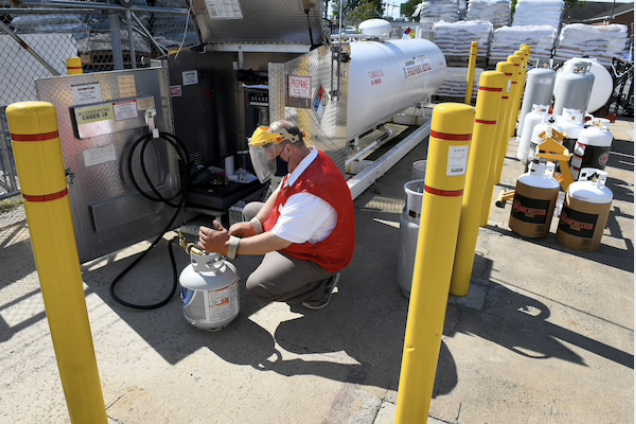







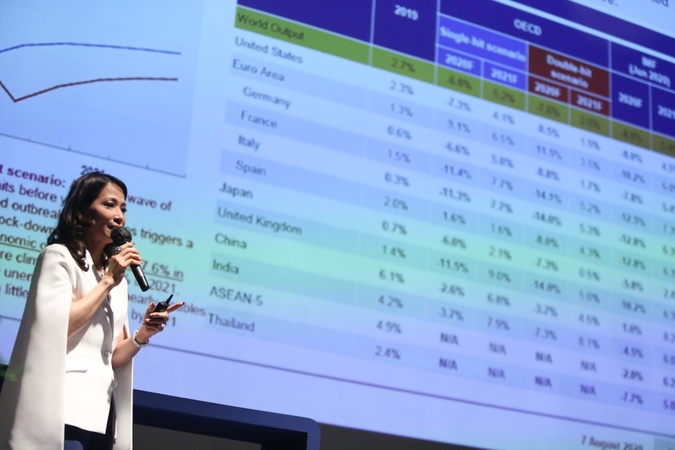
 Jareeporn Jarukornsakul

