CP execs discuss trade, investment with Saudi minister
WEDNESDAY, NOVEMBER 09, 2022
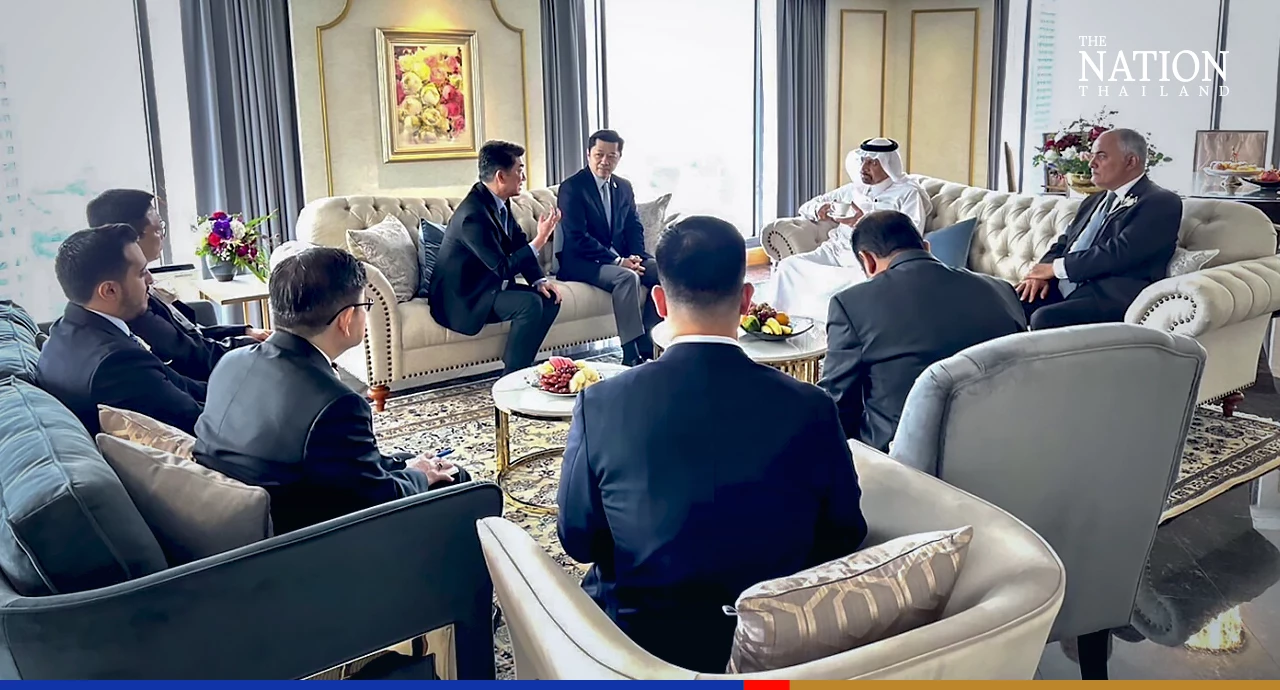
CP Group executives met with the Saudi Arabian investment minister in a bid to seek opportunities for joint investments.
Group CEO Suphachai Chearavanont and Charoen Pokphand Foods CEO Prasit Boondoungprasert met with Saudi Investment Minister Khalid Abdulaziz Al-Falih at Royal Orchid Sheraton Hotel in Bangkok.
They discussed trade and investment opportunities between CP Group and the Middle East nation.
The meeting was part of Al-Falih’s expedition to Thailand to attend a Thai-Saudi Arabian Investment Forum on Monday.
The forum was held jointly by Thailand’s Foreign Ministry and the Eastern Economic Corridor Office of Thailand to present business opportunities for Thai investors in Saudi Arabia and investment opportunities for Saudi investors in the EEC.
The Nation and VGI team up to bring “APEC Updates” to BTS screens
WEDNESDAY, NOVEMBER 09, 2022
The Nation, a leading English-language media, and VGI Public Company Limited, the leader of Offline-To-Online Solutions media, has joined forces to produce news updates in English to support the upcoming Asia-Pacific Economic Cooperation (APEC 2022 Thailand), hosted in Bangkok.
The news service will start on Wednesday 9 via screens on BTS Skytrain. It is considered another crucial step for The Nation and VGI to provide modern news services to meet the needs of city life and to benefit passengers travelling by BTS.
APEC 2022 Thailand has been promoted to educate the public throughout the year 2022. The summit will take place from November 18-19.
Thailand previously hosted Apec in 1992 and 2003. This year the Thai government and related agencies want the public to know the background of the important event and the importance of APEC as being involved in various aspects to influence people’s lives?
The Nation is a major English language media of Thailand, has served to provide information about Thailand to the world community for over five decades.
The media outlet has been well recognized for its quality, the variety of news coverage, and impartiality. The Nation has realized the importance of APEC Summit and believed in the opportunity with VGI in expanding media and news services in English language to multiple channels, said Adisak Limparungpatanakit, consultant of Nation Group (Thailand) Public Company Limited
“This cooperation will help BTS passengers to receive news about the APEC meeting in English language, especially those who mainly speak English and passengers who are interested in the latest news. They will benefit greatly from “APEC Updates“, said Adisak.
VGI, as the country’s leading advertising platform on BTS Skytrain, has a mission to build a sustainable business with concerns about all stakeholders as well as society and related parties.
We recognize the importance of access to information for the public sector. The fact that Thailand hosts the APEC 2022 meeting this time is an important agenda that people should be informed of. The company therefore directly supports the media space for professional media with expertise in this field, such as The Nation, to let the city people receive updated information from the important national agenda this time, said Nelson Leung, CEO of VGI Plc.
“English is another important language of communication for Thai people. Providing a channel for BTS passengers to learn and use English in daily life through various media of VGI with information that is of interest is another channel that helps consumers to learn, and it benefits the society.
This collaboration with The Nation is met with our goal to help push the use of English into their daily lives while providing people with relevant news and information,” added Nelson.
Thailand’s Food Passion looks ‘beyond’ for big profits in restaurants
TUESDAY, NOVEMBER 08, 2022
Nongluck Ajanapanya
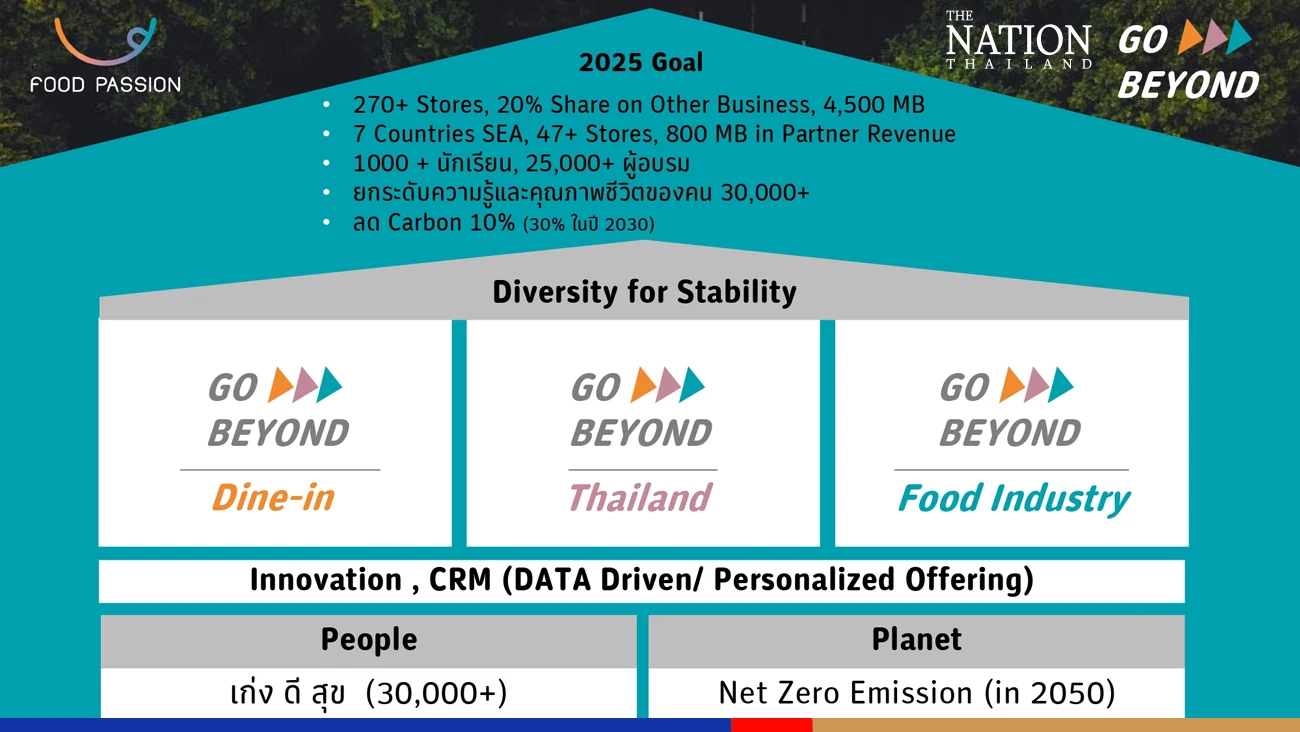
Food Passion, a leading Thai restaurant chain operator, has come up with a brand-new “Go Beyond” strategy to generate revenues upward of 5 billion baht by 2025.
The company oversees Bar-B-Q Plaza, Korean restaurant Red Sun, Chama, which offers healthier options, and fast-food Gon Express outlets.
Chataya Supanpong, Food Passion’s chief engagement officer, told the press on Tuesday that the new strategy will focus on personnel, profit and the planet.
The announcement comes at a time when business is almost back to normal after the Covid-19 pandemic and the firm has made more than 2.7 billion baht in the first nine months of this year.
However, Chataya said that owing to consumer behavioural changes and food industry trends, Food Passion needs to upgrade its operations to provide frictionless service and personal insights.
“We need to go above and beyond our customers’ expectations by offering fine-dining restaurants, hygienic food, digital experiences and eco-friendly hangouts,” she said.
In its three-point plan, she said, the company has established its own learning and training centre to upgrade its personnel’s skills and education credentials.
As for profit, Food Passion plans to strengthen its three brands with digital options like cashless payment, mobile phone ordering and expand its business to neighbouring countries in the next three years.
“We currently have Bar-B-Q Plaza franchisees in Malaysia, Indonesia and Cambodia. Next year, we plan to enter Laos, and in 2024 four more branches will be launched in Singapore, Vietnam and the Philippines,” Chataya said.
As for the planet, she said, the company has redesigned its operations to cut down on food waste. Food Passion is also partnering with a start-up to reduce 30% of its emissions by 2030 and go net zero by 2050.
Chataya added that Food Passion has set its target at 3.5 billion baht for this year and expects it to grow to 3.8 billion baht next year.
She said expanding the fast-food outlets, introducing cashless payment options, opening 40 new Bar-B-Q Plaza outlets and 30 more branches of other brands will all contribute to the growth in Thailand.
“Eating options now extend beyond dine-in restaurants and department store outlets,” she said.
The company has also aligned itself with the new eating-at-home lifestyle by releasing the GON barbeque sauce, which has already generated 11.2 million baht.
Food Passion is also engaging customers via its official LINE account and other online marketing channels to provide personalised promotions.
“The pandemic has taught us many lessons, including opening new doors for Food Passion to do business from all dimensions,” she said.
Chataya concluded that by 2025, Food Passion will have more than 270 outlets in Thailand and be able to generate up to 4.5 billion baht in revenue. The company will also operate 47 sites in seven countries, generating 800 million baht in revenue and employing over 2,500 people.
True, DTAC customers accuse consumer group of bias against the merger
TUESDAY, NOVEMBER 08, 2022
A group of customers of True Corporation and Total Access Communication (DTAC)’s mobile phone networks on Tuesday accused the Thailand Consumers Council (TCC) of being biased against the merger deal of the two operators.
The group went to the council’s head office and submitted an open letter demanding that the non-governmental organisation be unbiased about the deal instead of “acting in favour” of the other mobile phone operator. The group stopped short of mentioning Advanced Info Service (AIS), Thailand’s largest mobile phone operator in terms of subscriber base.
The group was led by Kongchat Kaewsukkho, a representative of DTAC mobile phone users, and Jirawat Pirasakphakdee, a representative of TrueMove H mobile phone users.
The two representatives said they were acting on behalf of a “group of True and DTAC mobile phone network users”.
After a long delay, the National Broadcasting and Telecommunications Commission voted on October 20 to give the green light for True and DTAC, the second and largest operators, to go ahead with their proposed merger with stringent conditions.
The NBTC voted that it had no power to stop the merger but could only issue regulations to protect customers.
But the TCC filed a lawsuit against the deal in the Central Administrative Court, which led to a suspension of the merger pending a ruling by the court.
Kongchat said his group made the move after it suspected “unrighteous” conduct by the TCC and lack of neutrality, after the consumer council launched a campaign on websites to gather signatures of people opposing the merger deal.
Kongchat said the open letter demanded that the TCC take into account the wishes of True and DTAC users who wanted the merger to be done as soon as possible.
“The TCC should listen to the opinions of real customers from all sides,” Kongchat said.
“The TCC should maintain neutrality and should provide comprehensive information and should act to protect all groups of consumers fairly.”
Kongchat said the TCC has never informed the public the benefits for customers from the DTAC-True merger.
For example, he said, DTAC clients would get to use facilities of True network after the merger, such as the True 5G network, which covers the country, and True Online’s comprehensive fibre networks as well as True Visions subscription TV network and online content of True ID TV network.
Kongchat added that DTAC users would also benefit from the numerous True service centres and several other affiliated services, such as True Health and True Money.
“A clear benefit is that our network’s signal will improve because after the merger, there will be more signal cells and the mobile signal will become faster and stronger and cover more areas,” Kongchat said.
“True and DTAC users will get to use better phone services and better Internet connection.”
Kongchat added his group believed the merger would intensify the competition between the large operators, and both True and DTAC would not stop offering privileges as they would have to try and maintain subscribers and win new ones.
“There is no reason for the merged firm to raise service prices because it would prompt customers to switch to the other network,” Kongchat argued.
He said his group also believed that the merged firm would have the capability to invest more to expand the network and develop technologies for coping with the growth of digital businesses.
“We customers see a lot of benefits for us and we clearly see that this merger will let True and DTAC clients receive only benefits without any disadvantage,” Kongchat said.
He added that the group also believed in the capability of the NBTC to control service prices to protect the customers in the future.
How Rajadamnern Stadium regained its Muay Thai glory
FRIDAY, NOVEMBER 04, 2022
Opal Varunsuda
The first and oldest boxing stadium in Thailand is Rajadamnern Stadium in Bangkok. This arena was constructed 77 years ago in 1945 but had gradually fallen out of fashion in recent years. Rajadamnern then suffered a further blow when the Covid-19 pandemic arrived.
Varunsuda Karunayadhaj, Host,The Nation and Thienchai Phisitwuttinan, CEO of Global Sport Ventures (GSV) in Business Story ProgramHowever, the famous old boxing arena roared back to life in 2021 at the hands of Thienchai Phisitwuttinan, CEO of Global Sport Ventures (GSV).
He led Rajadamnern Boxing Stadium’s development as a sporting venue that appeals to all ages and genders. The result is a world tourism destination showcasing Muay Thai as Thailand’s soft power.
Thienchai Phisitwuttinan, CEO of Global Sport Ventures (GSV).
Why are you interested in boxing?
I was raised in a Nakhon Luang boxing family. This camp has produced several world-class fighters, including Weeraphon Nakhon Luang Promotion and Phi Laem or Sisaket Nakhon Luang Promotion [Srisaket Sor Rungvisai, two-time WBC flyweight world champion]. Every morning, I woke up in this world.
Why did you transform Rajadamnern Stadium?
This is a historic boxing ring. It’s the first Muay Thai arena. Muay Thai was developed by the Army to defend the nation. It is a treasure, and we can turn Muay Thai into a world-class sporting spectacle. We worked with Rajadamnern Stadium to make Muay Thai a world-class sport.
But in 2022, we also want Rajadamnern Stadium to be a bridge for all generations, groups, and ages to visit, so we need to add a lot of things to be entertaining. RWS Rajadamnern World Series, Buakaw faced an old foe in Yoshihiro Sato at Rajadamnern Boxing Stadium.
What are your expectations for the Muay Thai industry?
We think Muay Thai can develop into something even greater. People from other countries all agree that this is the pinnacle of standing combat sports. This is Thailand’s “soft power” and it’s impressive. Rajadamnern Stadium and the Muay Thai competitions held there is the sporting entertainment I want to see.
In a world where NBA basketball and European football are two of the most popular forms of sports entertainment, I hope to increase Muay Thai’s profile by showing all people that it can be enjoyed as a spectator sport without fear. And everyone has the option to participate. We need to create a connection among Muay Thai communities around the globe.
What is the most difficult aspect of this industry?
If you ask me what is difficult, I would say that change is always challenging. However, we are fortunate to have dependable partners. Both Rajadamnern Stadium and the promoters share the same goal – the globalisation of Muay Thai. Everyone is pushing towards this objective. The arena or stage is the first step.
The stadium has undergone modernization so that it resembles a New York City Broadway theatre in the front. Despite being traditional, it is contemporary. The interior lighting and greater accessibility allow us to present a world-class sport for people who have never seen this sport, creating new viewing experiences for Muay Thai.
For the full interview, check out the Business Story: Rajadamnern Boxing Stadium.
Average 4.5% salary hike expected for Thai staffers for next two years: Mercer survey
THURSDAY, NOVEMBER 03, 2022
Nongluck Ajanapanya
Thai employees can anticipate an increase in their salary this year and the following year as a result of better economic growth, the latest survey by Mercer shows.
The world’s leading risk and people management consultancy released its annual Total Remuneration Survey (TRS) 2022 on Wednesday, which revealed that Thailand’s projected salary increase was a median of 4.5%. Across all industries surveyed, no one predicted a decrease in salary increment.
According to the survey, the chemical, high tech, and life sciences sectors are expected to grow the most, by 4.9%, 4.8%, and 4.8%, respectively.
With the exception of the automotive and life insurance industries, forecast of increases in most industries have been the closest to pre-pandemic levels of 5% since the pandemic hit.
Their projected increases of 4.5% and 4% are still one point lower than their 2019 figures. Demand for automobile and life insurance is increasing, but it has not yet reached pre-pandemic levels.
Mella Daracan, Mercer’s Career Products Business Leader for Thailand, said that these salary increases are keeping up with inflation. When combined with Thailand’s recent 5% increase in minimum wage, lower-wage workers may be able to alleviate some of their concerns about rising living costs.
“While this minimum wage increase may increase inflation due to more money changing hands and put additional pressure on businesses,” Daracan noted, “Thailand’s overall economic outlook remains favourable, compared to the last couple of years.”
Furthermore, in terms of variable incentives, employees in Thailand can expect bonus payouts ranging from 1.3 to 2.5 months, with the life sciences industry providing the highest median payout of 2.4 months.
According to the survey, employers in Thailand are keeping the status quo on recruitment efforts. More than half (53%) of survey respondents stated that their headcount will remain unchanged in 2023. One-fifth of businesses (22%) plan to increase headcount, while only 4% plan to reduce headcount, down from 7% last year.
At the same time, voluntary attrition is expected to reach pre-pandemic levels of more than 10% in 2022, up from 9.4% last year. Consumer goods and life sciences are expected to have the highest turnover, as these industries are on the mend, with more business opportunities and job openings.
Overall, Thailand’s projected salary increase is slightly higher than the Asia Pacific average (excluding India, as of November 3) of 4.4%. Overall median salary increases in Asia reflect a disparity in pay progression between emerging and developed economies, with estimates ranging from 7.1% in Vietnam to 2.2% in Japan, the region’s lowest.
Juckchai Boonyawat, Mercer’s CEO for Thailand, said that as the Thai economy recovers from the pandemic, the country is naturally seeing an increase in voluntary attrition, as businesses re-hire and expand their talent pool to meet market demands.
He noted that there is fierce competition for skilled talent in the country right now.
“To attract talent, companies are offering higher wages and better benefits. Employees have also reported burnout and exhaustion in recent years and a desire for change,” stated Jackchai.
However, he stated that competing solely on wages is unsustainable; hence, employers may want to focus more on their employees’ value proposition in areas such as pay transparency, a clearer career path, and improved well-being through flexible work arrangements and wellness programmes.
He predicted that the next payment trend would be based on skilled base pay, which means that employees would be paid more or less depending on how many skills they have and whether or not the skills they have meet the needs of employers.
Employees must develop multiple skills, soft skills, and adaptability skills in addition to their technical and digital expertise, according to Juckchai.
Mercer conducted the survey between April and June of this year, sending a questionnaire to 636 organisations in Thailand across 15 industries. The branch of an international company makes up the majority (85%) of the organisations that participated in the survey.
Huawei to use 5G tech to develop smart ports in Thailand
THURSDAY, NOVEMBER 03, 2022
Huawei Technologies (Thailand) has signed a memorandum of understanding with the Port Authority of Thailand (PAT) to use 5G technology to develop smart ports.
The MoU was signed by Kevin Cheng, president of Huawei’s Thailand Enterprise Business Group, and PAT director-general Kriengkrai Chaisiriwongsuk in a ceremony on Wednesday.
After the signing, Cheng said it was the first time Huawei had the opportunity to work with the Port Authority.
He said Huawei would provide technology to help PAT transform its ports into “smart” and “green” ones during the three-year transitional period of the ports’ digitalisation.
Huawei would also provide knowledge and training to PAT staff to command its digital port facilities, he added.
Kriengkrai said the cooperation would allow the Port Authority to use the strong points of Huawei technology to develop solutions that would benefit marine transportation.
The MoU was aimed at having the two organisations seek advanced technologies to develop world-class smart ports and the two are determined to cooperate in research on how to use 5G and other advanced technologies for sustainable development of the logistics business and port operations, Kriengkrai added.
AIS: Autonomous Networks form the basis of the journey towards Cognitive Tech-Co
THURSDAY, NOVEMBER 03, 2022
TM Forum hosted the annual Autonomous Networks Summit 2022 on 28th Oct in Bangkok. In which industry KOLs, global leading CSPs and vendor leaders have come together, shared thoughts and discussed the latest development and the future of Autonomous Networks (AN).
During the summit, TM Forum advocated partners from the industry to release the latest Autonomous Networks White Paper R4.0 together, and the CTO of TM Forum George Glass presented a “Autonomous Network White Paper Contribution Recognition” to AIS.
Mr Wasit Wattanasap, the Head of Nationwide Operation & Support Business Unit from AIS, delivered a keynote speech titled “Autonomous Networks Form the Basis of the Journey towards Cognitive Tech-Co” during the AN Summit.
• Strategy
As a digital life service provider, AIS has variety of businesses across different fields including mobile, fixed-broadband, enterprise business and digital services. Mr Wasit introduced that as the network complexity and number of connectivity increases exponentially after the deployment of 5G. Traditional telecom providers will encounter difficulties such as slow revenue growth, ARPU pressure, and profit challenges. In order to overcome all these challenges, the network needs to become real-time and interactive while personalized services and autonomous network operations are also highly demanded. Therefore, AIS proposed the digital strategy “Cognitive Tech-Co”, aiming to transform from a traditional communications service provider to a cognitive technology company to deliver distinctive user experience for every customer. Along this digital transformation journey, Mr Wasit emphasized that AN has been playing a significant role and become the cornerstone of this journey.
• AIS AN Objectives and Approach
Mr Wasit stated that referring to TM Forum’s and other industry standard organizations’ standards and assets, AIS has been collaborating with leading vendors to implement AN. He also mentioned that the short-term objective of AIS is to reach L3 by the end of 2023 across all network domains including RAN, Transport, Core, IT, Service Operations, etc. In order to fully achieve this goal, AIS has been making efforts in four dimensions: Defining AN target architecture, evaluating AN Level, implementing high-value use cases and collaborating with industry partners.
• Achievements and Outlook
Based on TM Forum’s AN evolution loop, AIS has completed a full cycle of AN practice which covers 4 major pillars including AN Level evaluation, gap analysis, solution design and AN implementation. So far, Mr Wasit introduced that AIS has already completed a comprehensive evaluation of Autonomous Networks levels (ANLs) and business values of AN across multiple network domains. In particular, AIS finished end-to-end ANL evaluation for two typical scenarios including Customer Complaint Handling Process and Incident Management Process. According to the AN level evaluation results, Customer Complaint Handling has reached L2.2 and Incident Management has reached L2.1.
Mr Wasit shared the achievements of 4 high-value use cases during his speech, which are E2E Enhanced Radio CP Handling Process, E2E Intelligent Incident Management, 5GC Automatic Upgrade and Core Network Automatic Test. Which all successfully help AIS reduce 10%+ workload, improve 20%+ network efficiency, optimize 10% customer experience and enhance network intelligence and automation level.
Facing 2023, AIS will keep discovering and innovating along the AN journey towards L3 and beyond. AIS is open to collaborate with vendors to output more AN practices so as to co-create and contribute more high value assets including business and technical architectures. Eventually, AIS is aiming to move towards L4 by 2025 for the long-term objective.
AIS is the largest mobile operator in Thailand, subscriber market share of 46% with over 44 million subscribers and the 5G service covers 76% population nationwide. Positioning itself as a digital life service provider, AIS aims to become a Cognitive Tech-Co to deliver distinctive customer experience.
We believe that many people recently learning about blockchain technology or investing in cryptocurrency are getting confused with a numerous number of coins to choose from.
One reason that can be explained with such a large number of coins is the use of blockchain technology, which has a continuous development. The development allows them to solve any problem that exists in previous networks, leading to numerous blockchain generations.
Hence, this article will get you to know more about each generation of blockchain, to understand what is the purpose of it being created and what is the problem of each generation following the solution itself.
1st Generation – Bitcoin
(Source: esri.com)
The first time blockchain used in finance was Bitcoin. In this use case, the purpose was to use Bitcoin to remove intermediaries from transaction, to avoid a problem occurring from this system such as a delay in international payment or a fee charged by the intermediaries.
Bitcoin was also created to have a characteristic of “Good Money” in that it was created to have a limited number of coins, 21 million, and to have a mechanism that reduces the number of coins launched every four years. This gimmick is called “Bitcoin Halving” making Bitcoin similar to gold in the digital world.
After Bitcoin was being well-known, there were many networks emerged such as Litecoin which was solved to have a faster transactions than Bitcoin. However, overall, both of them have a relative fundamental.
Apart from that, in October 2022, Guinness World Records just record Bitcoin for being the world’s first decentralized digital currency and for having a total value higher than any other digital currency.
2nd Generation – Ethereum
(Source: imbstudent.donau-uni.ac.at)
The blockchain that has been accepted as a generation 2 is Ethereum. This is because Ethereum was the first network that introduce the use of smart contracts in the blockchain.
The idea of smart contract is an agreement that can be executed automatically if conditions are met.
Smart Contract is similar to programming on blockchain but more transparent as everyone can examine its work process. This is why blockchain can do more than just transferring money.
When having a smart contract, developers can create applications on the blockchain, leading to new use cases such as the Decentralized Exchange used in Uniswap or the Decentralized Lending service used in AAVE.
Furthermore, for NFT, an asset having a unique feature that cannot be interchaged, when people hear this word, they probably think of digital art such as Bored Ape Yacht club or CryptoPucks. However, NFT can be used in various specific assets like real estate, collectibles, vehicles, or even game items.
With smart contracts and NFT, the blockchain has been expanded apart from just transferring money like in the Bitcoin era. However, a problem still exists in this generation such as scalability, which is an expansion of network to be suitable for a large number of users. Therefore, such a problem leads to the development of new blockchain generation.
3rd Generation
(Source: weforum.com)
A major weakness of both Bitcoin and Ethereum is the issue of scalability, or expanding the network to handle higher transaction volumes, which causes a bottleneck leading to transaction delays and higher gas fees.
In order to fix this problem, third-generation blockchains like Cardano, Avalanche, TRON, etc. have been developed. Each network employs a unique set of technologies, such as sharding or sidechain. Some networks have been overhauled by switching from blockchain to a DAG (Directed Acyclic Graph) data structure.
The Ethereum side did not just sit around, as Ethereum 2.0 is being developed to improve speed, smart contracts functions, along with other features, which were partly completed in the September 2022 update of The Merge. This is an update that changed the consensus algorithm from Proof-of-Work to Proof-of-Stake. However, the date for the next update has not been announced, and therefore, we will have to keep an eye out for it.
Nevertheless, the majority of third-generation blockchains are still very new and are not as widely known or used as Bitcoin and Ethereum. Thus, it remains to be seen whether these networks will prove themselves capable of handling massive transactions effectively in the future.
4th Generation
(Source: cloudhm.co.th)
At present, it is still uncertain how the fourth-generation blockchains will develop since the third-generation blockchains are still relatively new, with most of them trying to fix the issues that arose in the second generation.
Some believe the fourth generation will integrate blockchain with AI (Artificial intelligence) technology, while others believe it will focus on mass adoption, making blockchain more accessible to the general public, educational institutions, or small businesses.
However, it is highly likely that the fourth-generation blockchain may arrive sooner than expected due to the leap forward in technological advancement nowadays. In particular, the advent of the metaverse has caused all industries to turn their attention to key infrastructure such as blockchain technology.
Conclusion
Blockchain is constantly evolving like any other technology. Currently, blockchain can be divided into 3 generations:
First generation: solves the problem of making transactions through an intermediary (Bitcoin)
Second generation: smart contracts were added to support new use cases (Ethereum)
Third generation: solves scalability issues and enables massive transactions in blockchain (Cardano, Avalanche, TRON)
Fourth generation: is expected to be about integrating AI technologies or perhaps focusing on mass adoption that will allow blockchain to infiltrate everyday life better.
Citi completes sale of Malaysia, Thailand consumer banking to UOB
TUESDAY, NOVEMBER 01, 2022
Citi announced on Tuesday that it has completed the sale of its Malaysia and Thailand retail banking and consumer credit card businesses to United Overseas Bank Limited (UOB) subsidiaries, which includes the transfer of over 3,000 related staff.
The move marks the completion and closing of the third and fourth divestitures of Citi’s restructuring.
The transaction is expected to result in a capital benefit to Citi of over US$1billion.
Citi and UOB first announced the transaction on January 14, 2022, as part of a broader sale agreement covering consumer banking across Malaysia, Thailand, Vietnam, and Indonesia and excluding the bank’s institutional businesses. As previously disclosed, the sales of the Vietnam and Indonesia consumer businesses are expected to be completed in 2023.
Since announcing as part of its strategic refresh that Citi intends to exit consumer banking across 14 markets in Asia, Europe, the Middle East and Mexico, sales agreements have been signed in nine markets. Transactions have now closed in four markets including Australia, the Philippines, Thailand and Malaysia. Citi is also in the process of winding down consumer banking in South Korea and Russia.
Asia Pacific CEO Peter Babej said, “Today’s announcement is positive for clients, colleagues, and our firm. Citi remains deeply committed to Malaysia and Thailand and we will invest further in both markets across our leading institutional franchise to support clients locally and where they do business across Citi’s network. We thank former employees and customers for their commitment and support and wish them continued success in the future.”
Peter BabejTiti Cole
Citi’s CEO of Legacy Franchises, Titi Cole, said, “With these completed sales, we have now divested four consumer businesses and are making swift and strong headway in delivering on our firm’s strategy refresh. We are confident about the future our former employees and clients will have as part of UOB and look forward to seeing them prosper.”
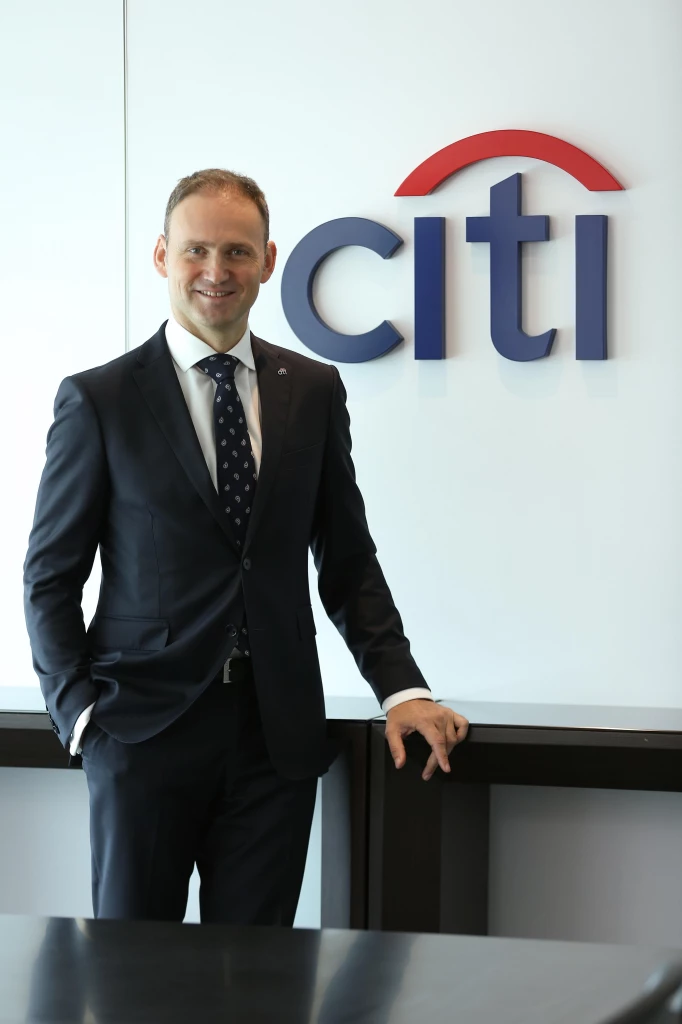
Tibor Pandi
Tibor Pandi, Country Head, Citi Thailand said, “I would like to thank for a strong support and commitments of our former staff to prepare the smooth transition of the services for our clients to UOB, I wish them all the best for their new career path. Citi Thailand remains a key market for Citi globally and we remain committed and focused on serving institutional clients locally, regionally, and globally as we have for over half a century.





 But the TCC filed a lawsuit against the deal in the Central Administrative Court, which led to a suspension of the merger pending a ruling by the court.
 Kongchat said the TCC has never informed the public the benefits for customers from the DTAC-True merger.
 Varunsuda Karunayadhaj, Host,The Nation and Thienchai Phisitwuttinan, CEO of Global Sport Ventures (GSV) in Business Story ProgramHowever, the famous old boxing arena roared back to life in 2021 at the hands of Thienchai Phisitwuttinan, CEO of Global Sport Ventures (GSV).
 Thienchai Phisitwuttinan, CEO of Global Sport Ventures (GSV).
 RWS Rajadamnern World Series, Buakaw faced an old foe in Yoshihiro Sato at Rajadamnern Boxing Stadium.


 Peter Babej
 Titi Cole
 Tibor Pandi
 SootinClaimon.Com