Pizza and beer lose their charm, roiling Yum and Molson Coors

ศาสตร์เกษตรดินปุ๋ย : ขอบคุณแหล่งข้อมูล : หนังสือพิมพ์ The Nation

https://www.nationthailand.com/business/30377912

Pizza and beer lose their charm, roiling Yum and Molson Coors

Oct 31. 2019
A Pizza Hut restaurant in Morris, Ill., on Feb. 5, 2019. MUST CREDIT: Bloomberg photo by Daniel Acker,
Photo by: Daniel Acker — Bloomberg
Location: Morris USA

A Pizza Hut restaurant in Morris, Ill., on Feb. 5, 2019. MUST CREDIT: Bloomberg photo by Daniel Acker, Photo by: Daniel Acker — Bloomberg Location: Morris USA
By Syndication-Washington Post/ Bloomberg · Cécile Daurat, Crayton Harrison · BUSINESS, US-GLOBAL-MARKETS, RETAIL

1,232 Viewed

A piping-hot pepperoni pie, washed down with a sudsy brew: The combo is a staple of macho American culture, a Sunday ritual while enjoying the football game, and the culinary accompaniment to poker night.

But the tradition is fading, as evidenced in the latest disappointing results from the corporate giants behind brands like Pizza Hut, Domino’s, Molson Coors and Budweiser.

Tastes have changed and refined, with fancier local joints and microbreweries crowding in. Some consumers just want to avoid all those carbs, and young people have developed other habits — veggie burgers and hard seltzer such as White Claw. Big companies are trying to adapt to the fast-changing world — Anheuser-Busch InBev has introduced craft beers, while Domino’s Pizza Inc. is testing unmanned pizza delivery — but most are still grasping for a way forward.

On Wednesday, Pizza Hut’s parent Yum Brands posted quarterly sales that trailed Wall Street estimates, sending the shares tumbling. And Molson Coors Brewing disclosed plans to cut as many as 500 jobs and close an office in Denver, where it moved in just a few years ago.

They followed AB InBev, which last week lost about $20 billion in market value on concerns about a slowdown in China, and Heineken NV’s tepid outlook. Among the few bright spot so far this earnings season was Danish brewer Carlsberg A/S.

The beer industry has struggled for years now, with consumption of the classic American adult beverage declining even as craft beer grows. It’s similar to what’s happening to classic food brands that dominated supermarket shelves for decades — think Kraft Heinz — that are now losing sales to upstarts as options proliferate.

Many efforts to stay relevant haven’t panned out. AB InBev’s attempt to broaden its appeal with new products like malt-based beverages and regional craft beer offerings haven’t widely attracted drinkers who are abandoning mainstream beer, according to Bloomberg Intelligence analyst Duncan Fox. And Molson’s latest efforts may not be enough to revive growth, Fox wrote, in spite of initiatives that include an investment in Canadian cannabis-infused soft drinks and hard seltzers.

“Beer drinkers, exposed in recent years to a rising number of competing low-alcohol refreshers like hard teas, lemonade and spiked seltzer, have become less loyal to both the traditional beer category and beer brands within it,” according to Bloomberg Intelligence analyst Ken Shea.

Pizza, the once ubiquitous take-out order, also has a lot of competition in fast-food. From plant-based Whoppers at Burger King to chicken sandwiches that cause a Twitter storm, the fast-casual and convenient options are plentiful.

Even Domino’s, the tech-savvy pioneer in fast delivery, is having a hard time keeping ahead of competition. Same-store sales, a key metric in the industry, will rise 2% to 5% in the U.S. in the next two to three years, the company said earlier this month. That’s a marked slowdown from three years ago, when they were above 10%.

U-Solar to facilitate transition to renewable energy

ศาสตร์เกษตรดินปุ๋ย : ขอบคุณแหล่งข้อมูล : หนังสือพิมพ์ The Nation

https://www.nationthailand.com/business/30377897

U-Solar to facilitate transition to renewable energy

Oct 30. 2019
Photo credit: UOB website

Photo credit: UOB website
By THE NATION

1,866 Viewed

United Overseas Bank (UOB) recently launched U-Solar, the first solar industry ecosystem in the region, designed to power the development and adoption of renewable energy across Southeast Asia.

Through U-Solar, the bank connects businesses and consumers across the entire solar power value chain and helps them play their roles in an collective move towards transition to a low-carbon economy.

Malaysia is the first country in Asean where UOB is rolling out its U-Solar ecosystem.

Through U-Solar, the bank offers a range of financial solutions in support of the solar power value chain: from solar project developers, engineering, procurement and construction (EPC) contractors to the end-users of solar power, including consumers and companies.

In supporting growth of the solar power industry, UOB provides solar project developers with solutions in green financing, such as sukuk, project loans and portfolio financing, as well as cash management services.

For EPC contractors, UOB offers end-to-end contract-based financing solutions, from bid bonds and letters of credit issuance to performance guarantees and working capital facilities.

Through U-Solar’s online portal, the bank also connects these industry players to potential customers seeking solar power solutions for their factories, offices or homes.

To promote the adoption of solar power by the end-users including companies and consumers, U-Solar offers a one-stop shop for them to plug easily into the services offered by UOB’s partners across the region. They can also tap UOB’s financing solutions for the installation, operation and maintenance of solar power systems based on their business or personal needs in making the switch to solar power.

Wee Ee Cheong, Deputy Chairman and Chief Executive Officer, said: “A sustainable energy industry is key to maintaining healthy development of the economy and community. In working together with our ecosystem partners and customers to open up and to tap opportunities in the solar power industry, we can create a positive economic and social impact. It is in keeping with our joint responsibility to help in the region’s long-term economic, social and environmental well-being”.

Acquisitions lead to 39% surge in PTTEP’s nine-month profit

ศาสตร์เกษตรดินปุ๋ย : ขอบคุณแหล่งข้อมูล : หนังสือพิมพ์ The Nation

https://www.nationthailand.com/business/30377894

Acquisitions lead to 39% surge in PTTEP’s nine-month profit

Oct 30. 2019
By THE NATION

1,605 Viewed

PTT Exploration and Production Public Company Limited (PTTEP) reported a strong performance in the first nine months of the year with a 39 per cent surge in net profit year on year to US$1.185 billion (Bt37.182 billion).

The company posted US$ 851 million (Bt27,372 million) in net profit for the same period last year.

In a statement today (October 30), president and chief executive officer Phongsthorn Thavisin, said the company generated total revenue of US$4.572 billion for the first three quarters, increasing by 15 per cent from US$3.960 billion year on year as a result of a 12-per cent rise in average sales volume to 335,696 barrels of oil equivalent per day (BOED), compared to 300,338 BOED for the same period last year.

The increase in average sales volume was attributed to the purchase of additional stake in the Bongkot field in mid-2018 and the acquisition of Murphy Oil Corporation’s business in Malaysia, completed in July 2019.

The average sales price also slightly improved to US$46.83 per barrel of oil equivalent (BOE), from US$46.25 in the same period of 2018.

Meanwhile, unit cost dipped to US$ 30.86 BOE from US$31.28 BOE in the first nine months of 2018.

In the third quarter of 2019, PTTEP reported a net profit of US$358 million (Bt11,019 million), an increase of 14 per cent year on year from US$315 million (Bt10,401 million), partly driven by higher average sales volume through the acquisition of Malaysia Asset.

Phongsthorn said: “The company’s strong performance in the 9-month period reflects the successful acquisition in Malaysia in accordance with company’s strategic investment plan. The result is demonstrated by growing average sales volume towards the year’s target of 345,000 BOED. Furthermore, once the acquisition of Partex Holding, which focuses its investment in the Middle East, is completed, sales volume will further increase. In addition, the acceleration of exploration activities in Malaysia such as Block SK410B will potentially increase the company’s petroleum reserves and production volumes in the future”.

In June this year, PTTEP made its largest gas discovery at the first well in Block SK410B at “Lang Lebah-1RDR2”. It is now preparing an appraisal well to confirm the upside petroleum potential, along with a study for development.

In 2020-2021, PTTEP plans to accelerate exploration activities offshore to assess overall petroleum potential and evaluate appropriate development plan.

Thailand Post handling eight million parcels a day

ศาสตร์เกษตรดินปุ๋ย : ขอบคุณแหล่งข้อมูล : หนังสือพิมพ์ The Nation

https://www.nationthailand.com/business/30377887

Thailand Post handling eight million parcels a day

Oct 30. 2019
By The Nation

1,369 Viewed

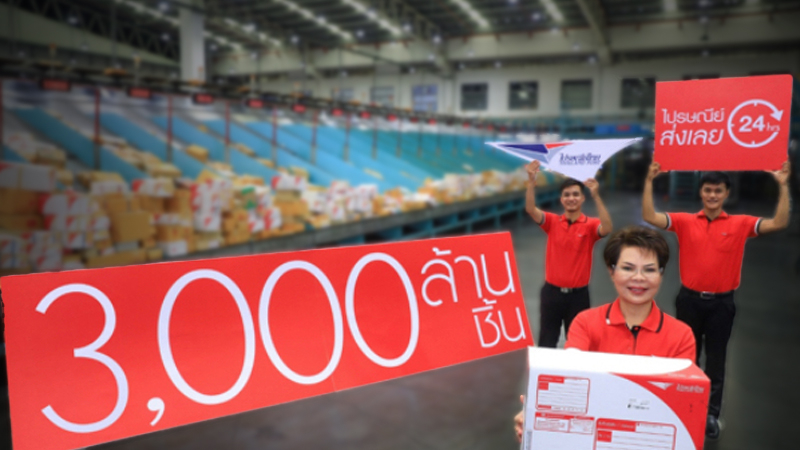
Thailand Post Co Ltd is promoting its EMS delivery service and encouraging customers to ship their goods in the afternoon so they arrive at their destinations the next morning.

The firm said in a press release on Wednesday (October 30) that it handles more than eight million parcels a day and forecasts the total for 2019 to surpass three billion.

Recent improvements at Thailand Post include Cash on Delivery (COD), Express Mail Service (EMS) and 24-hour-365-day service.

President Smorn Terdthampiboon said the firm had remained committed this year to developing its logistics and other services in terms of delivery, safety and speed, and responded to the growth of e-commerce.

The Ministry of Digital Economy and Society’s Electronic Transactions Development Agency (ETDA) has placed the value of e-commerce in Thailand between 8 and 10 per cent and said it is steadily growing from Bt3 trillion in 2018.

With continuing confidence and use of e-payment plus convenient and speedy shipping, consumers are continually turning to online shopping.

The number of parcels shipped through the postal service will continuously increase as a result. There are 8 million parcels shipped through 10,000 postal networks nationwide every day. The number reflects the public’s confidence in the postal services, and that too is likely to increase.

Smorn pointed out that COD allows recipients to make payments directly to the postman upon receiving packages via the Wallet@POST app. Recipients can also use the Mobile Banking app, which improves the quality and ease of use of EMS.

Customers can send parcels before ‪11am‬ in the Bangkok area and the parcels will reach their destination the same day. Parcels sent between Metro Bangkok and Mueang district before ‪5pm will get there the following day.

The 24-hour-365-day postal service allows senders to deliver parcels even on holidays from the post offices at the Street Ratchada, Suvarnabhumi Airport and Laksi EMS centre. This service will gradually be expanded to other areas.

Corporate CFOs, treasurers see potential global recession as top risk: survey

ศาสตร์เกษตรดินปุ๋ย : ขอบคุณแหล่งข้อมูล : หนังสือพิมพ์ The Nation

https://www.nationthailand.com/business/30377886

Corporate CFOs, treasurers see potential global recession as top risk: survey

Oct 30. 2019
Chayotid Kridakon, senior country officer for Thailand, JP Morgan

Chayotid Kridakon, senior country officer for Thailand, JP Morgan
By The Nation

1,213 Viewed

Chief financial officers (CFOs) and group treasurers in Asia Pacific from leading companies across the world have flagged the prospect of a global recession as a top risk for their businesses in the next six to 12 months, according to a survey conducted at the 2019 JP Morgan Asia Pacific CFO and Treasurers Forum in Shanghai earlier this month.

Nearly a third (30 per cent) of the more than 150 respondents from 130 global corporations ranked a potential global recession as the top risk to business, followed by 27 per cent expressing caution over the impact of global trade tariffs and 24 per cent over an emerging markets slowdown. Concerns over cybersecurity (10 per cent) and the outcome of Brexit (9 per cent) rounded out the top five risk concerns.

As for the actions CFOs and group treasurers are taking in response to the global supply chain disruptions, most respondents (34 per cent) said they were exploring pricing options with suppliers, followed closely by other respondents (32 per cent) currently sourcing alternative suppliers. About 15 per cent said they were shifting production from China to other countries.

“Clearly, the concerns over the impact of headwinds in the global macro environment are front and centre in the minds of the top CFOs and treasurers of global corporations. While JP Morgan’s view is not for a recession, growth is expected to slow in the coming quarters, with global growth for 2019 forecast at 2.7 per cent and dipping to 2.5 per cent in 2020. We still see growth opportunities, especially in emerging Asia, but the geopolitical events are somewhat clouding sentiment,” said Oliver Brinkmann, head of corporate banking, Asia Pacific, JP Morgan.

“The Thai economy, like most of emerging Asia, has been impacted by the US-China trade tensions. The country’s recent weakening exports data suggest a slowing investment cycle; private investment, after holding up well in early 2019, has also fallen in tandem, weighed down by capital goods imports. While the Bank of Thailand left policy rates unchanged in September, we are expecting a 25 basis points cut in the fourth quarter to boost domestic demand. JP Morgan expects Thailand’s economic growth to slow to 2.9 per cent in 2019 [ ‪from 4.1‬ per cent in 2018], and growth in 2020 to be 3 per cent,” said Chayotid Kridakon, senior country officer for Thailand, JP Morgan.

Technology and e-commerce

On the disruption by technology in the finance and treasury space, CFOs and treasurers pointed to the inefficient processes (25 per cent), lack of technology (25 per cent) and shortage of resource (24 per cent) as the top three challenges they face in future proofing their organisations, the survey showed.

Half the respondents singled out artificial intelligence (AI) as the emerging technology that would play the biggest role disrupting traditional finance, followed by blockchain (28 per cent), cryptocurrencies (15 per cent) and quantum computing (7 per cent).

“There has been a desire by finance practitioners to better harness data for predictive analytics and the advances in AI technologies in recent years have been a game-changer. AI today has the ability to deliver meaningful insights and prescribe future actions in real time, and has been helpful for CFOs and group treasurers in optimising liquidity, increasing efficiencies and preventing fraud,” said Brinkmann.

Respondents appeared predominantly ready for e-commerce, with 45 per cent stating they have an e-commerce strategy in place and 21 per cent saying they are in planning phase. They cited the multiple collection channels, cybersecurity, incoming reconciliation, and processing chargebacks and disputes, as the key challenges in managing e-commerce transactions.

“There is no question that the ecommerce space continues to grow at a rapid pace. Asia Pacific already comprises more than half of the global ecommerce volume and is expected to increase its share to 70 per cent by 2022. Migrating commerce activities onto electronic platforms is no longer an option; it has become inevitable for most businesses. With our global platforms and regional and local capabilities in payment, JP Morgan is well-positioned to help our clients along this journey,” said Brinkmann.

In its sixth year, the annual JP Morgan Asia Pacific CFO and Treasurers Forum returned to Shanghai for the second time in three years, bringing together top practitioners across 12 Asia Pacific markets who represent a range of industries with a collective market cap in excess of $6.5 trillion as of September 30.

TCAP to remain strong after TBank-TMB merger

ศาสตร์เกษตรดินปุ๋ย : ขอบคุณแหล่งข้อมูล : หนังสือพิมพ์ The Nation

https://www.nationthailand.com/business/30377880

TCAP to remain strong after TBank-TMB merger

Oct 30. 2019
 Somjate Moosirilert, chief executive of TCAP

Somjate Moosirilert, chief executive of TCAP
By The Nation

1,056 Viewed

Thanachart Capital Public Company Limited (TCAP) delivered a solid third-quarter 2019 performance with profit growing 30.17 per cent compared to the previous quarter.

It indicated that after the merger between Thanachart Bank and TMB Bank, it would have good potential for growth as it would hold more than a 20-per-cent equity stake in the merged bank. Additional investments in the subsidiaries that generated consistently good profit were also planned.

“Net profit on the consolidated income statements for the third quarter of fiscal 2019 was Bt4.6 billion. Net profit attributable to the company was Bt2.47 billion, representing an increase of Bt573 million or 30.17 per cent compared to the previous quarter. For the nine months ended September 30 2019, net profit attributable to the Company was Bt6.38 billion. The strong performance was due to the success of Thanachart Bank, a subsidiary of TCAP, in implementing A customer-centric strategy that placed emphasis on becoming a bank of choice with customers. As a result, Thanachart Bank was able to achieve strong performance in a continuous manner. Noteworthy is the fact that the Bank’s third-quarter 2019 net profit also hit a record high,” said Somjate Moosirilert, chief executive of TCAP.

“After the Company underwent business restructuring by purchasing the ordinary shares of the subsidiaries and also the investments from Thanachart Bank and selling to TMB Bank all the ordinary shares held by TCAP in Thanachart Bank, TCAP purchased the newly issued ordinary shares of TMB Bank. The objective was to facilitate the merger between Thanachart Bank and TMB Bank. In this connection, TCAP will have excess liquidity of no less than Bt10 billion and of that excess liquidity, the Company will use not more than Bt5 billion to purchase treasury shares. It will also pay special dividends to shareholders at the rate of Bt4 per share,” he added..

TCAP’s businesses still have strong potential following the merging of Thanachart Bank with TMB Bank, mainly because the assets of the merged bank almost doubled in size. In consequence, the competitiveness and profitability of the merged bank were enhanced. The improvements will, in turn, significantly reflect on TCAP’s performance as TCAP is also a major shareholder holding more than 20 per cent equity stake in the merged bank. In addition, TCAP received healthy dividend returns from its subsidiaries which achieved strong performance in the first nine months of fiscal year 2019. These subsidiaries include Thanachart Securities Public Company Limited, Thanachart Insurance Public Company Limited, Ratchthani Leasing Public Company Limited, TS Asset Management Company Limited, MAX Asset Management Company Limited, and NFS Asset Management Company Limited. TCAP also invested in other listed companies such as MBK Public Company Limited and Patum Rice Mill and Granary Public Company Limited (PRG).

“Taking into account the above, TCAP will be considered as a company with strong growth potential. This is mainly due to several contributing factors including the equity stake it held in the merged bank, more active management of non-performing assets, and strong performance of its subsidiaries as well as its investments in other business areas. As a result, TCAP is expected to continue delivering a healthy performance and is capable of achieving strong and sustainable growth in the future.”

Dtac, Ericsson sign pact for advanced network operations

ศาสตร์เกษตรดินปุ๋ย : ขอบคุณแหล่งข้อมูล : หนังสือพิมพ์ The Nation

https://www.nationthailand.com/business/30377853

Dtac, Ericsson sign pact for advanced network operations

Oct 29. 2019
Ericsson Thailand chief Nadine Allen, left, and DTAC CEO Alexandra Reich

Ericsson Thailand chief Nadine Allen, left, and DTAC CEO Alexandra Reich
By THE NATION

2,036 Viewed

Ericsson and Total Access Communication (dtac) signed a partnership agreement on Tuesday (October 29) to launch an advanced customer-centric network operations model starting from January 2020.

Ericsson will manage dtac’s network operations across the country with the Ericsson Operations Engine, while Dtac will retain strategic planning and ownership of its assets, the mobile phone service provider said in a press statement.

The Operations Engine, a data-driven approach powered by artificial intelligence (AI), will enable dtac to ensure next-generation connectivity and allow its customers to benefit from secure and reliable network performance as well as a constantly improving user experience, dtac said.

According to the company, this agreement involves the transfer of around 400 experienced professionals to Ericsson, who will continue to perform their current responsibilities to ensure a seamless transition.

“Dtac has made significant network improvements in 2019,” said Alexandra Reich, CEO of Total Access Communication. “By partnering with Ericsson, we will be able to deepen our focus on customer needs and behaviour while we remain committed to developing a robust, fit-for-the-future network. We have been partnering with Ericsson for nearly 10 years and we are confident that this brings our network modernisation to the next level as we prepare for 5G.”

With increasing data traffic growth, automated network technology upgrades will boost dtac’s competitiveness via greater efficiency and network capabilities, the company statement said.

“We are truly delighted to extend our partnership with dtac and to accompany them on their network automation journey,” Ericsson Thailand chief Nadine Allen said. “We will leverage our global experience and use the latest tools and technologies in AI, automation and machine learning to leverage data-driven insights, enabling us to deliver enhanced performance focused on end-user experience.”

Dtac and Ericsson have been working together since 2009 on 2G, 3G, 4G as well as the recent live 5G trials.

U.S. companies report greater tariff strains, hiring challenges

ศาสตร์เกษตรดินปุ๋ย : ขอบคุณแหล่งข้อมูล : หนังสือพิมพ์ The Nation

https://www.nationthailand.com/business/30377835

U.S. companies report greater tariff strains, hiring challenges

Oct 28. 2019
By Syndication Washington Post/ Bloomberg · Jeff Kearns · BUSINESS, US-GLOBAL-MARKETS ·919 Viewed

More American companies are reporting negative impacts from tariffs, especially among goods producers, while also seeing persistent difficulties in hiring for high-skill positions.

The share citing negative impacts from recent tariffs rose to 35% in October from 28% in July, though almost one-third of respondents report there’s been no impact, according to a National Association for Business Economics survey released Monday. Among goods producers, two-thirds say tariffs hurt their business conditions, down from more than three quarters in July, according to the survey of 101 members from Sept. 26 to Oct. 14.

“After more than a year since the U.S. first imposed new tariffs on its trading partners, higher tariffs are disrupting business conditions, especially in the goods-producing sector,” NABE President Constance Hunter said in a report on the group’s business conditions survey.

Despite the complications from trade frictions, more than two thirds of firms say they haven’t changed plans for hiring and investing in reaction to actual or potential U.S. policy shifts.

Special questions on the labor market showed employers still grappling with tight conditions with the unemployment rate at a half-century low of 3.5%. Most respondents say their firms have taken one or more steps to address staffing difficulties such as training their staff for promotions. That’s become increasingly common, with 42% doing so versus 36% in July.

High-skill positions remain hardest to staff, with 82% citing challenges versus 89% in July. Some 45% report difficulty filling mid-skill jobs, more than in July, and a sixth struggled with low-skill posts. Goods producers have the hardest time with mid- and low-skill jobs, while services companies had the most difficulty landing high-skill workers.

Raising wages remains the most common remedy for employers trying to fill openings, with more than two thirds of goods producers doing so and 43% among all industries. About a third of companies are investing in labor saving processes, and more than half of producers.

With Federal Reserve policymakers due to meet this week, half of NABE members surveyed said recent interest-rate cuts haven’t changed their expectations of business conditions this year and more than a third said the reductions have made their outlook more favorable.

The central bank lowered rates for the first time in a decade on July 31 and made another reduction on Sept. 18. Analysts and traders expect a third-straight rate reduction to be announced on Wednesday.

Of the 101 survey respondents from private-sector firms or industry trade associations, 41% were from firms with more than 1,000 employees while 15% were from companies with 101-1,000 staff and the remainder from smaller businesses, including some single-person firms.

AIS showcasing 5G tech

ศาสตร์เกษตรดินปุ๋ย : ขอบคุณแหล่งข้อมูล : หนังสือพิมพ์ The Nation

https://www.nationthailand.com/business/30377827

AIS showcasing 5G tech

Oct 28. 2019
PM Prayut Chan-o cha has a go at navigating a driverless car via the 5G network at the AIS booth.

PM Prayut Chan-o cha has a go at navigating a driverless car via the 5G network at the AIS booth.
By THE NATION

1,202 Viewed

Advanced Info Service (AIS), together with its partners, is showcasing 5G wireless broadband technology at the “Digital Thailand Big Bang 2019: Asean Connectivity” event.

The event is being held from Monday until Thursday at Bitec, Bangkok, by the Digital Economy Promotion Agency, which is under the Digital Economy and Society Ministry.

Among the AIS highlights are the use of the 5G network to remotely control a driverless vehicle and the use of 5G in industries.

AIS chief executive Somchai Lertsutiwong shows a 5G speed test on a 5G-enabled mobile phone.

GSP suspension will affect only shrimp wonton noodle soup: CPF

ศาสตร์เกษตรดินปุ๋ย : ขอบคุณแหล่งข้อมูล : หนังสือพิมพ์ The Nation

https://www.nationthailand.com/business/30377824

GSP suspension will affect only shrimp wonton noodle soup: CPF

Oct 28. 2019
By THE NATION

1,763 Viewed

The US decision to suspend trade privileges for Thailand under the Generalised System of Preferences programme will hit only Charoen Pokphand Foods’ shrimp wonton noodle soup, Chief Executive Officer Prasit Boondoungprasert said.

The soup constitutes 0.2 per cent of the company’s sales revenue and will be subjected to 6 per cent import duty when the suspension takes effect in the next six months.

CPF has gradually adjusted its business model, prioritising overseas investment.

New production plants have been established in targeted countries to serve local consumers and these overseas ventures are prospering and contributing about 70 per cent of total sales revenue, Prasit said.

CPF, which has invested in ready-to-eat food production in the US, has achieved its growth targets and anticipates bright business prospects in the years ahead, the CEO said.

Meanwhile, pork prices have been on the increase as concerns about African Swine Fever subside. In Vietnam, for example, the price of 1kg of pork has hit 55,000-57,000 Vietnamese dong (Bt71-Bt73.50), which is the highest this year. A similar improvement is taking place in Thailand.

Prasit stressed that CPF expects to achieve its business targets in 2019 and anticipates continued growth in 2020.