Next Capital (NCAP) shares rose by 45.45 per cent to Bt3.20 from its initial public offering (IPO) of Bt2.20 in the first day of trading on Monday.
NCAP provides loans to motorcycle buyers and does not come under the central bank’s supervision. It has 24 outlets nationwide.
The company released 300 million shares in an IPO on October 30, of which 225 million were offered to the public and 75 million to company patrons, directors, executives and employees. The company raised Bt660 million in capital.
The market capital at IPO price was Bt1.98 billion with Finnex Advisory as a financial advisor and Thanachart Securities as underwriter.
The IPO launch won NCAP three major shareholders, namely Com7 which holds 33.93 per cent, Synnex (Thailand) 26.67 per cent and Vista Investments Limited 5 per cent. The company’s IPO price is determined by a price to earnings ratio (P/E ratio) of 9.30 times compared to its net profit in the past four quarters from July 1, 2019 to June 30, 2020. NCAP has a policy to pay dividends no less than 40 per cent of its net profit after tax deduction capital reserve allocation under the law.
The Office of Trade Competition Commission (OTCC) on Friday gave the green light to Charoen Pokphand (CP) Group’s deal to buy Tesco Stores (Thailand).
A majority of commissioners agreed the merger would not lead to a monopoly, but acknowledged it will increase CP’s dominance in the consumer goods retail segment.
They also said the merger could significantly reduce market competition but would not cause severe damage to the economy. They added it would not affect the benefits of consumers.
CP Group already operates 7-Eleven stores and the Siam Makro chain.
The commission set conditions and remedial measures for the purchaser to mitigate possible market impacts post-merger.
One of the conditions is that CP Group is banned from doing merger deals with other players in the consumer goods retail sector for three years. This rule does not apply to the e-commerce sector.
CP acquired Tesco Thailand and Tesco Malaysia in a deal worth US$10.6 billion early this year.
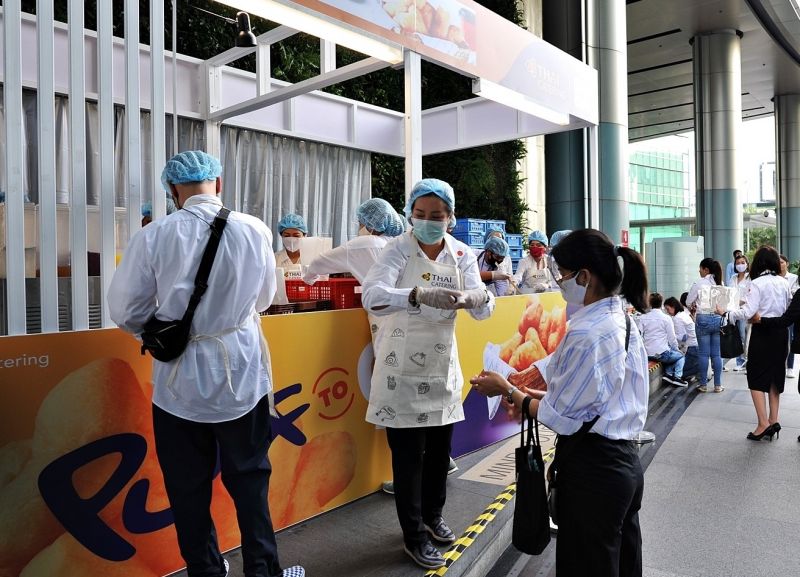
Thai Airways International (THAI) on Friday opened its first kiosk selling dough sticks or “pa tong go” at the EnCo Building C in Bangkok’s Energy Complex.
THAI began frying up the dough sticks outside the airline’s headquarters on Silom Road since September, attracting long queues of customers from 5am daily.
This kiosk serves up the fritters with a side of taro custard, as well as baked goods from its Puff & Pie catering outlets and signature beverages.
The treats will be sold Monday to Friday until January 31. The kiosk opens from 6.30am onwards.
BTS Group Holdings Pcl (BTSG) is a major player in four businesses: mass transit, media, property, and services.
The Green Bond offering targeted institutional and high net worth investors.
The total demand on the bookbuilding date was 3.3 times greater than the company’s initial target issue size, the company said.
BTSG chief financial officer Surayut Thavikulwat said the offering from November 3-5 aimed to raise Bt5 billion. Due to the oversubscription, the greenshoe option was exercised, which allows the underwriter to increase the size of the issue. The additional Bt3.6 billion greenshoe option boosted the total issue size to Bt8.6 billion. They comprise Bt500 million two-year series with a fixed interest rate of 2.10 per cent per annum, Bt4 billion three-year series with a fixed interest rate of 2.44 per cent per annum, Bt1.5 billion five-year series with a fixed interest rate of 2.86 per cent per annum, Bt2 billion seven-year series with a fixed interest rate of 3.11 per cent per annum and Bt600 million 10-year series with a fixed interest rate of 3.41 per cent per annum.
TRIS Rating assigned “A” to the Green Bond on September 29. The Green Bond’s proceeds will be used for investment and debt repayment of the two monorail mass transit projects — the Pink Line Khae Rai-Min Buri section, and the Yellow Line Lad Prao-Sam Rong section. Both are the anchored projects that will elevate Bangkok’s electric mass transit network to lessen the use of fossil-fuel vehicles, resulting in the reduction of carbon emission and fine dust particles in the Bangkok metropolitan area.
The Pink Line Khae Rai-Min Buri section and the Yellow Line Lad Prao-Sam Rong section are under construction. Overall construction progress of both lines are more than 60 per cent complete and expect to commence full operation in 2022.
“BTSG would like to thank investors for their trust and interest in subscribing to the BTSG Green Bond and we would also like to thank Bangkok Bank, Siam Commercial Bank, and Krungthai Bank as the lead arrangers for their support and contribution to this achievement. This Green Bond is the second series of Green Bonds issued by BTSG following the success of its first Green Bond in 2019.
“The consecutive Green Bond issuance shows our commitment towards continuous investments in green projects and sustainable business growth,” said Surayut.
BTSG Green Bond complies with International Green Bond Standards, including the Green Bond Principles 2018 issued by the International Capital Market Association as well as the Asean Green Bond Standards 2018 issued by the Asean Capital Markets Forum, Surayut said.
Visa to face U.S. antitrust suit over Plaid acquisition
CorporateNov 06. 2020Visa credit cards are arranged for a photograph in 2019. CREDIT: Bloomberg photo by Andrew Harrer
By Syndication Washington Post, Bloomberg · David McLaughlin, Jenny Surane · BUSINESS The U.S. Justice Department sued to block Visa Inc.’s $5.3 billion acquisition of Plaid Inc., accusing Visa of trying to buy the financial-technology firm to eliminate an emerging threat to its online debit business.
The Justice Department said in an antitrust complaint filed Thursday in federal court in San Francisco that the deal for Plaid would illegally extend Visa’s dominant position and should be stopped.
“By acquiring Plaid, Visa would eliminate a nascent competitive threat that would likely result in substantial savings and more innovative online debit services for merchants and consumers,” the government said.
The Justice Department’s case hinges on the fact that Visa handles the lion’s share of debit transactions in the U.S., with a market share that dwarfs even that of rival Mastercard Inc. The payments network earned $4 billion from the business last year, according to the complaint.
Visa’s dominance in debit comes from its massive network: Banks have slapped Visa’s logo on half a billion debit cards in the U.S. and those cards are then accepted at millions of merchant locations around the world. Few companies have been able to replicate Visa’s success.
Plaid is a potential threat to that business, according to the government. Its technology allows apps like PayPal Holdings Inc.’s Venmo to connect to some 200 million consumer bank accounts. While it doesn’t compete with Visa today, Plaid had been planning a new online debit service that Visa feared would threaten its monopoly, the U.S. said.
When Visa was considering a deal for Plaid in March 2019, a Visa executive compared Plaid to an island “volcano” in the ocean and warned that beneath the surface “is a massive opportunity — one that threatens Visa,” according to the complaint.
Months later, as Visa was conducting its due diligence on Plaid, Visa learned the company planned to create a “meaningful” money movement business by the end of 2021. Plaid was seeking to offer the service at a 50% discount to Visa’s fees, saving merchants millions of dollars — a plan it was upfront with Visa’s executives about. Visa Chief Executive Officer Al Kelly told Chief Financial Officer Vasant Prabhu that the acquisition would be an “insurance policy” to protect the business, according to the complaint.
Those fears culminated in January’s surprise announcement: Visa would pay a whopping $5.3 billion for Plaid, a multiple of 50 times the data company’s revenue and Visa’s second-largest acquisition ever. Visa on Thursday reiterated its argument that Plaid complements its business.
“As we explained to the DOJ, Plaid is not a payments company,” Visa said in a statement. “Visa’s business faces intense competition from a variety of players — but Plaid is not one of them. Plaid is a data network that enables individuals to connect their financial accounts to the apps and services they use to manage their financial lives, and its capabilities complement Visa’s.”
Visa shares rose 2.4% to $198.52 at 1:23 p.m. after earlier rising as much as 3.6%. The stock has advanced 5.4% this year, compared with the 32% gain of the S&P 500 Information Technology Index.
The Justice Department said Plaid is uniquely positioned to offer a “pay-by-bank” service that would compete with Visa’s online debit service. Instead of providing their debit card credentials when paying for goods online, consumers give their bank account information. Banks typically charge a flat fee between 2 cents and 25 cents for such transactions, whereas a $60 debit card transaction can carry a fee of as much as 39 cents, the Department of Justice found.
The Justice Department argued Plaid’s connections to consumer bank accounts means the company could be an attractive partner to merchants looking for an alternative to accepting Visa’s debit cards. Retailers have long complained about the fees associated with accepting debit cards, even after the U.S. capped the rates Visa and Mastercard can charge on such transactions roughly a decade ago.
Retailers spend more than $100 billion a year on accepting electronic card payments. While Visa and Mastercard are responsible for setting the fees that merchants are charged, most of it goes to the banks that issue the cards, with the networks taking a much smaller percentage of the fee.
“Ultimately, Visa recognized that the best course of action for its business was to eliminate Plaid as a competitive threat by purchasing Plaid itself,” the department said.
As part of its acquisition of Plaid, Visa recognized that it was also protecting the revenues of the banks it works with, the complaint said. One executive observed in an internal document quoted in the filing that banks would have “a lot to lose if [pay-by-bank transactions] accelerate as the result of Plaid landing in the wrong hands.”
“It is in our collective interest to manage the evolution of these payment forms in a way that protects the commercial results we mutually realize through card-based payments,” the Visa executive said, according to the complaint.
The Justice Department accused Visa of a “long history” of entering into agreements to quash nascent competition. The department said Visa convinced an unamed major technology company not to build or support technologies that would disrupt its business in exchange for substantial fee reductions.
Visa is currently in negotiations to renew this ongoing agreement, the complaint says, and the network is demanding that the technology company continue to abide by these practices, “including not encouraging customers to use less expensive payment methods and prohibiting marketing to non Visa options during payment checkout.”
By Syndication Washington Post, Bloomberg · Crystal Tse, Olivia Carville · BUSINESS
Airbnb is opening its books as soon as next Thursday ahead of a much-anticipated initial public offering, according to people with knowledge of the matter.
The home-rental startup, which said in August it filed confidentially for a listing with the U.S. Securities and Exchange Commission, will show the public the listing documents and its financial information for the first time as it seeks to woo investors. Airbnb is aiming to raise as much as $3 billion in an IPO before year end, Bloomberg has reported. Timing of the IPO filing could still change, said the people, who declined to be named discussing private information.
Airbnb’s listing will come in a tight window for public debuts during an eventful year. Covid-19 and the uncertain outcome of the U.S. presidential election had led companies to think twice before tapping the market, while the holiday calendar in the remainder of the year means there is a shorter time frame to get deals done.
A representative for Airbnb declined to comment. Reuters earlier reported on the filing coming next week.
While Airbnb had been sending incremental updates to the market signaling its debut is on the way, such as announcing that it has chosen Nasdaq Global Select Market to host its listing, the public filing will serve as the key milestone. It will be allowed to start taking orders for shares from investors 15 days after the documents are available.
The San Francisco-based company was valued at $18 billion in April when it raised $2 billion in debt from investors at the depth of the pandemic. That was a significant drop from its earlier peak valuation of $31 billion in a 2017 fundraising round.
A quicker-than-expected rebound from the pandemic has brought the company’s valuation back to $22 billion at end of September, based on the value of its common shares at a recent stock split, Bloomberg News reported.
New York Times slides after warning of subscriber slowdown
CorporateNov 06. 2020Copies of the New York Times at a newsstand in New York on Feb. 3, 2019. MUST CREDIT: Bloomberg photo by Tiffany Hagler-Geard.
By Syndication Washington Post, Bloomberg · Gerry Smith · BUSINESS, MEDIA
The New York Times fell the most since April after warning that it doesn’t expect an encore to its dramatic 2020 subscriber gains.
The Times added 393,000 online subscribers in the third quarter, thanks partly to a heavy news cycle, the company said in a statement Thursday. And digital-only subscription revenue exceeded print subscription revenue for the first time.
But on an earnings call, Chief Executive Officer Meredith Kopit Levien warned that the Times was unlikely to continue adding subscribers at the same pace next year. She called 2020 “an unprecedented year” for digital subscription growth, adding, “We don’t expect to repeat its results.”
Also, the Times warned that its advertising business, which contributes about one-third of its overall revenue, will continue to struggle as marketers pull back during the pandemic and readers move online. Total advertising revenue is expected to decline 30% next quarter, the same percentage it fell last quarter.
Though the online business is now the Times’ main focus, internet ads typically don’t command the kind of prices that print ones do.
Times shares fell as much as 6.3% to $38.84 in New York trading. They had gained 29% this year through Wednesday, compared with a 6.6% rise in the S&P 500.
The Times is trying to get more of its revenue from paying readers to make up for the shaky advertising market. Investors are watching closely to see if the publisher can continue its growth in digital subscribers if President Donald Trump loses the election and a breakneck news cycle slows down. The publisher has found other ways to attract new subscribers, including a popular $1-a-week promotional offer.
“The big question for the company is the outlook following a potential U.S. presidential victory by Joe Biden. While subscriber growth could slow following the elections, the company has substantial pricing power given its newsroom investments and customer-analytics data,” Bloomberg Intelligence media analyst wrote.
The Times has set a goal of hitting 10 million total subscribers by 2025. It crossed 7 million subscribers in the month of October.
Profit was 20 cents a share in the third quarter, beating analysts’ projection of 11 cents a share. Revenue was $426.9 million, surpassing Wall Street’s expectations of $411.8 million.
Charoen Pokphand Foods (CPF) is ready to penetrate Malaysia’s retail market despite not yet receiving approval from Thailand’s Trade Competition Commission for its acquisition of Tesco-Lotus’s businesses in Thailand and Malaysia.
CP already operates the 7-Eleven chain and Makro stores in Thailand, which has triggered worries of a retail monopoly.
In March, Charoen Pokphand (CP) informed the Stock Exchange of Thailand it had acquired shares in Tesco Stores in both countries.
The share purchases, which allow CP to acquire assets worth Bt338.445 billion, are subject to approval by Thailand’s TCC and Malaysia’s Domestic Trade and Consumers Affairs Ministry, respectively.
Prasit Boondoungprasert, CEO of CPF, said the company’s strategy next year will focus on expanding market channels via Tesco Lotus in Thailand and Malaysia. He expects the TCC to conclude this issue soon.
“CPF is ready to penetrate the Malaysian market … because the company does not have suppliers in Malaysia,” he said.
He added that the opening of Singapore’s market was also dependent on the TCC’s decision.
“Singapore has had to order chicken from Thailand instead of Malaysia because the Covid-19 outbreak has disrupted the transportation system,” he explained.
He said the company’s online systems to cope with the Covid-19 impact had also helped boost internet sales and reduce operating costs.
“However, the company will pay attention to producing healthy food as the Covid-19 outbreak has triggered public concern about health,” he said.
He expected CPF business turnover this year to hit Bt540 billion, up 8 per cent year on year, boosted by overseas operations.
“Most of the revenue came from our companies in China and Vietnam after the African Swine Fever outbreak helped boost the price of pork,” he said.
He added that the revenue from CP’s Vietnam operation is expected to rise further as it exports chicken to Japan with tariff privileges under the two countries’ trade deal.
By Syndication Washington Post, Bloomberg · Matthew Martin, Anthony Di Paola · BUSINESS Saudi Aramco failed to generate enough cash to cover its dividend, yet left the payout unchanged at $18.75 billion for the third quarter even as profit fell 45% and debt continued to rise.
The Saudi Arabian state energy firm’s free cash flow was $12.4 billion between July and September, compared with $20.6 billion a year earlier. Gearing climbed to 21.8% from 20% in June and from minus 5% in March, when Aramco had more cash than debt.
Aramco’s dividends are a vital source of cash for the Saudi government, whose budget deficit is expected to widen to 12% of gross domestic product this year amid a coronavirus-triggered crash in crude prices and a severe economic contraction.
Yet the company, 98% owned by the government, probably won’t be able to continue paying out such high dividends unless oil prices, down 40% in 2020, rise, Moody’s Investors Service said last month. Aramco’s total payments to the kingdom, including dividends, taxes and royalties, fell 30% in the three months to the end of September to $24.6 billion.
“Aramco covered the lion’s share of its dividend this quarter, which, given the macro environment at $42 a barrel and abysmal refining margins, is quite an accomplishment,” Royal Bank of Canada analyst Biraj Borkhataria said in a research note.
Net income at the world’s biggest oil company was 44.2 billion riyals ($11.8 billion), slightly ahead of analysts’ expectations.
Aramco’s shares rose 1.3% to 34.60 riyals by 12.37 p.m. in Riyadh, paring this year’s drop to 1.8%. The stock has been bolstered by management’s pledge to pay a $75 billion dividend annually for five years after the completion of last December’s initial public offering.
That promise, combined with a $69 billion acquisition of chemicals maker Saudi Basic Industries Corp., has seen debt levels balloon even with Aramco cutting capital expenditure and laying-off hundreds of foreign workers. Net debt rose $6 billion to $83 billion by the end of the third quarter, putting the company even further from its gearing target of between 5% and 15%.
The company may have to take on more debt to fund the dividend payments given its slumping cash flow. It drew down a $10 billion loan in late July. That revolving credit facility matures in May 2021, but Aramco can extend it for another year.
Income still increased for the first time in five quarters as oil prices steadied following their battering earlier in the year as the coronavirus spread globally and demand for energy cratered.
“We saw early signs of a recovery in the third quarter due to improved economic activity, despite the headwinds facing global energy markets,” Chief Executive Officer Amin Nasser said. “We continue to adopt a disciplined and flexible approach to capital allocation in the face of market volatility.”
Although the results suggest the worst of the pandemic’s impact on energy demand may have passed, Aramco still faces a brittle market. Oil prices fell to a five-month low this week amid fresh travel restrictions in Europe aimed at stemming a surge in virus cases.
OPEC and allied producers — who agreed to slash crude exports in April — are weighing whether to delay an easing of those curbs to buttress crude prices.
In addition to crushing demand for fuel, the pandemic has also hit Aramco’s refining and chemicals businesses. The downstream unit swung to a $795 million loss before interest and taxes in the third quarter from an $801 million profit a year earlier.
Aramco had gross refining capacity of 6.4 million barrels a day at the end of September. It’s seeking to cement its position as one of the world’s biggest crude processors by having the capacity to turn some 8 million to 10 million barrels a day into fuels such as gasoline and diesel.
BTS Group Holdings (BTS) is seeking to raise Bt8.6 billion by offering five sets of green bonds to institutional and large investors until November 5 (Thursday).
The five sets are divided by length of maturity.
The two-year bonds (maximum Bt500 million) carry fixed annual interest of 2.10 per cent and reach maturity in 2022.
The three-year bonds (Bt4 billion) carry 2.44 per cent interest and reach maturity in 2023.
The five-year bonds (Bt1.5 billion) offer 2.86 per cent interest and mature in 2025.
The seven-year bonds (Bt2 billion) offer 3.11 per cent interest and mature in 2027.
The 10-year bonds (Bt600 million) carry 3.41 per cent and mature in 2030.
Bangkok Bank, Siam Commercial Bank, and Krungthai Bank are underwriting the issue. Tris Rating on September 29 rated the company and its bond credibility at “A” with a “Negative” outlook.
BTS said funds from the offering would be used for investment and repaying debt from investment in the Pink and Yellow Lines.
“This move is in line with the Climate Bond Initiative’s low-carbon transport criteria, as trains on these lines use only electricity,” BTS said.





 Visa credit cards are arranged for a photograph in 2019. CREDIT: Bloomberg photo by Andrew Harrer
 Copies of the New York Times at a newsstand in New York on Feb. 3, 2019. MUST CREDIT: Bloomberg photo by Tiffany Hagler-Geard.


