U.S. stocks hit record highs this week. Analysts call it a ‘nervous’ rally

ศาสตร์เกษตรดินปุ๋ย : ขอบคุณแหล่งข้อมูล : หนังสือพิมพ์ The Nation

https://www.nationthailand.com/business/30378651?utm_source=category&utm_medium=internal_referral

U.S. stocks hit record highs this week. Analysts call it a ‘nervous’ rally

Nov 22. 2019
Photo by: The Washington Post — The Washington Post

Photo by: The Washington Post — The Washington Post
By The Washington Post · Heather Long

726 Viewed

The U.S. stock market hit record highs this week as a stunning surge of optimism has flooded Wall Street and fears of an imminent recession have all but disappeared.

The market “melt up” is driven by three main factors: Belief that the trade war has peaked, belief there won’t be a U.S. – or global – recession in 2020, and belief that the Federal Reserve has the market’s back. Investors are making a bet that corporate profits will be a bit better next year than this year. They see a future where American consumers keep spending and businesses start investing again as the economy stabilizes and President Trump hits pause on any more tariffs.

The three main stock indexes hit their peaks early in the week, retreated slightly, but regained momentum Friday morning. The stock market is effectively at its highest level in U.S. history, a phenomenon that the White House has openly cheered.

“I am of the opinion that neither the U.S., nor the global, economy are facing a recession through the end of 2020,” said Ed Yardeni, head of Yardeni Research. “The market rightly anticipates Trump wants another term as president and he’s got enough going on with impeachment issues that he wants to put trade on the back burner for awhile.”

But there are a lot of “ifs” in the bullish scenario for next year, especially around trade, which is why markets has already pulled back slightly from its highs. This remains a tip-toe higher market, many analysts say. They point out that while the Dow Jones industrial average is up nearly 20% this year, it is only about 4% higher than it was on October 3, 2018, an indication of the hesitancy that remains among investors.

“It’s a nervous market,” said Howard Silverblatt, senior analyst at S&P Dow Jones Indices. “Everyone is talking a great ball game, but when you come down to it, everyone has their finger just over the sell button. You are one tweet away from concern.”

Goldman Sachs sent a note to clients on November 3 declaring that “tariffs have peaked” and Trump was unlikely to implement any more taxes on China. In a sign of how quickly momentum can shift, the prominent investment bank sent another note on November 19 saying risks of a tariff increase have risen again.

Trump largely credits himself for the recent record highs. The stock market is “through the roof” since election day, he said as cameras recorded his cabinet meeting Tuesday. “That’s something nobody would have thought possible.” Trump adviser Peter Navarro has predicted that the Dow, which broke 28,000 for the first time on Friday, will soon surpass 30,000.

Most market analysts praise the Fed, not Trump, for the rebound in the stock market this year. The Fed has cut interest rates three times, a move that is likely to stimulate the economy well into next year. The housing market is already showing signs of an uptick.

“I believe the stock rally is justifiable because of what Fed Chair Jay Powell said a few weeks ago when he made it clear there is a high bar for raising rates,” said Kristina Hooper, chief global market strategist at Invesco. “This is an environment in which monetary policy is going to be an important support for equities.”

Stocks rallied after Trump enacted the largest corporate tax cut in U.S. history, but his trade war has caused business investment to contract for the past two quarters, a drag on the economy and an indication of how concerned business leaders are. In a new report out this week, researchers at the Federal Reserve Bank of Dallas found that policy uncertainty triggered most of the downturns in the stock market since Trump took office.

“In the absence of such uncertainty, the Standard & Poor’s’ 500 Index would have been about 12% higher over the past two years,” wrote Pavel Kapinos and Alex Musatov from the Dallas Fed.
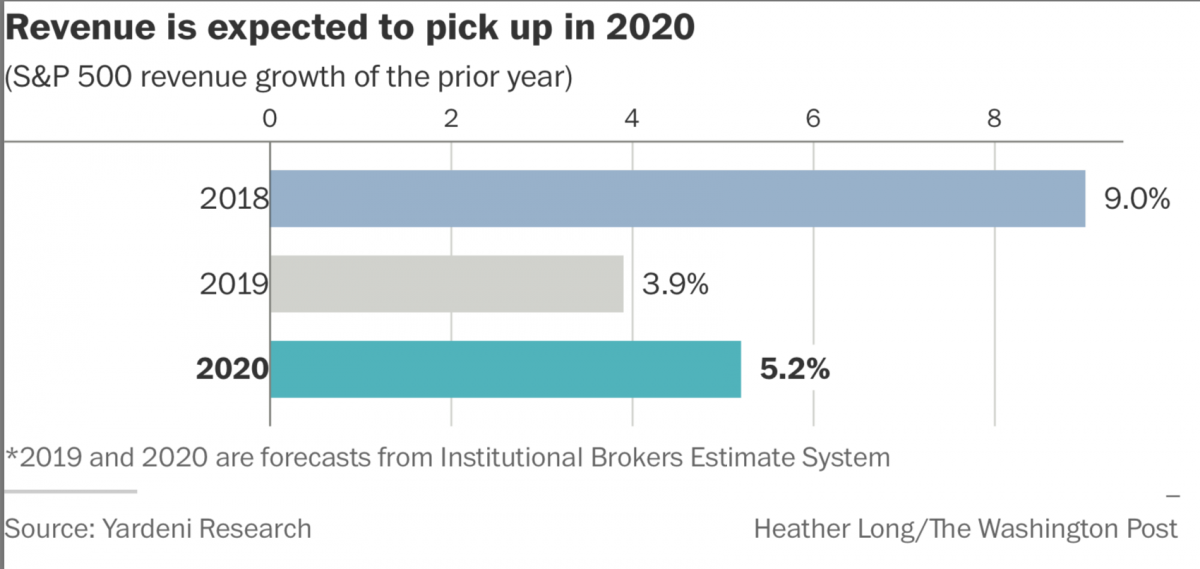
Photo by: The Washington Post — The Washington Post

Photo by: The Washington Post — The Washington Post

What’s changed in recent weeks is that experts see less risk of a recession — or near-recession – in 2020. Few outside the White House are predicting an economic surge, but the growing consensus is that the economy will continue to chug along at around 2% growth, enough to keep profits healthy and jobs fairly plentiful.

Yardeni and his research team describe it like this: Corporate revenues were flying high at 9% last year as economic growth ticked up in the wake of the big tax cuts. This year revenues for S&P 500 companies are widely expected to fall under 4%, a weak year but not the bloodbath some feared over the summer. The prediction for next year is revenue growth over 5% — a slight pickup and part of the reason the market has been rallying.

There are a number of factors playing into the market momentum. Historically, the stock market has risen by more than 10% in the six months following the Fed’s first rate cut, said Sam Stovall, chief investment strategist at CFRA Research. The third and fourth years of a president’s term have also had strong market performance, according to Bespoke Research.

A number of key economic indicators have also come in better-than-expected: Businesses in most industries continue to add jobs, consumers keep spending, and even the manufacturing slump appears to be plateauing instead of getting worse. The yield curve, which flashed a major warning sign in August when it inverted, is now back to a normal shape.

Corporate earnings have also outperformed with 75% beating expectations, according to the latest data from S&P Dow Jones Indices. But long-time market analyst Silverblatt remains cautious. He has been pointing out to readers of his popular market emails that most companies cut their earnings expectations a lot this year. They are beating this much lower bar, not the initial bar they set heading into 2019.

Despite the fresh market highs, many investors continue to take money out of stocks and pour it into ultra-conservative money market funds, another sign of unease. In a new report out this week, Morningstar said investors have removed more than $36 billion from U.S. equity funds so far this year, including pulling nearly $15 billion out in October alone. In contrast, money market funds are sitting on the largest pile of cash in a decade.

There’s growing belief the markets and the economy are unlikely to tank in 2020, but debate remains over how much upside is left in a bull market that has been running for more than a decade.

GDP growth target for 2020 set at 2.7 to 3.7 per cent

ศาสตร์เกษตรดินปุ๋ย : ขอบคุณแหล่งข้อมูล : หนังสือพิมพ์ The Nation

https://www.nationthailand.com/business/30378640?utm_source=category&utm_medium=internal_referral

GDP growth target for 2020 set at 2.7 to 3.7 per cent

Nov 22. 2019
Kobsak Pootrakool

Kobsak Pootrakool
By THE NATION

1,302 Viewed

The Council of the Economic Ministers on Friday (November 22) approved the government’s economic target of 2.7 per cent to 3.7 per cent gross domestic product (GDP) growth next year.

Kobsak Pootrakool, deputy secretary-general to the prime minister for political affairs, said the government also targeted budget disbursement of 92.3 per cent of total budget next year in order to achieve the 2020 GDP growth target.

The council also set export growth target of at least 3 per cent next year and total 41.8 million tourist arrivals. It also aims for private local and foreign investment of at least Bt3.3 trillion next year.

The council urged all state agencies to accelerate budget disbursement of Bt110 billion in this quarter.

The meeting was also briefed on projects faced with slow disbursement, including the the Thai-China high-speed train project.

TBank puts its ThanachartDrive message on BTS carriages

ศาสตร์เกษตรดินปุ๋ย : ขอบคุณแหล่งข้อมูล : หนังสือพิมพ์ The Nation

https://www.nationthailand.com/business/30378615?utm_source=category&utm_medium=internal_referral

TBank puts its ThanachartDrive message on BTS carriages

Nov 21. 2019
Thanachart Bank will promote its auto hire-purchase brand ThanachartDrive by wrapping seven BTS trains in new vinyl livery bearing the brand’s name.

Thanachart Bank will promote its auto hire-purchase brand ThanachartDrive by wrapping seven BTS trains in new vinyl livery bearing the brand’s name.
By The Nation

1,054 Viewed

Thanachart Bank will promote its auto hire-purchase brand ThanachartDrive by wrapping seven BTS trains in new vinyl livery bearing the brand’s name and formally launching them from the Mo Chit BTS station.

The “Drive Spirit” event will also see the platforms painted orange and decorated with 200-metre banners.

“The objective is to show that the bank’s services are in line with today’s consumer lifestyles, build brand awareness and reaffirm our commitment to the ‘Drive-Your-Progress’ mission,” said Pompet Rasanon, executive vice president of sales network, automotive lending.

“TBank stands ready to help customers achieve every target in all areas. It is confident it can help everyone reach their goals. If life is a journey, each individual will have a different finish line in their dream. It might be family happiness, self-actualisation or a business that helps a lot of people,” he said.

“ThanachartDrive believes a vehicle is not just a thing used for transporting people from one place to another, but it also represents the progress achieved on the journey. We chose the word ‘Drive’ since, apart from meaning ‘going in a particular direction’, it means ‘a motivation that prompts us to achieve desired results’.

“We want to send consumers a message that the Drive Spirit represents our determination to help all customer groups reach their targets. Regardless of whether the ones who see and are aware of the event are planning to purchase a car or are already TBank customers or would like to expand business by using the cars they are driving as capital for the expansion, we’re prepared to help them get the best experience possible from using a comprehensive range of loans.”

ThanachartDrive makes available products and services that meet all types of needs. These include New Car Hire Purchase, Used Car Hire Purchase and Cash Your Car.

The strengths lie in ThanachartDrive Privileges for car hire-purchase customers, the Web-based Bluebook of information about median prices for used cars, and the Academy established for training sales teams.

The objective of the academy is to produce strong sales teams that can help customers reach their targets. Training courses are also available for enhancing competitiveness among TBank’s trading partners.

TBank further has a digital platform as well as an Automotive Lending Digital Experience system to ensure customer convenience from the beginning to the end, including the loan application, approval-status monitoring, account detail checking and easy submission of supporting documents.

KBank, Line forge joint venture for financial services

ศาสตร์เกษตรดินปุ๋ย : ขอบคุณแหล่งข้อมูล : หนังสือพิมพ์ The Nation

https://www.nationthailand.com/business/30378609?utm_source=category&utm_medium=internal_referral

KBank, Line forge joint venture for financial services

Nov 21. 2019
Kasikorn Line chief executive officer Tana Pothikamjorn introduces 'Line BK' to reporters on Thursday (November 21).

Kasikorn Line chief executive officer Tana Pothikamjorn introduces ‘Line BK’ to reporters on Thursday (November 21).
By The Nation

1,872 Viewed

Kasikornbank (KBank) and Line Corporation will jointly launch financial services next year via Line App.

The two have created a joint venture — Kasikorn Line Company.

KBank  holds a 50 per cent stake in the joint venture through its subsidiary Kasikorn Vision, while Line Corporation via Line Financial Asia  holds the other half. The joint venture has a registered capital of Bt2.2 billion.

Newly appointed Kasikorn Line CEO Tana Pothikamjorn said the company will launch financial services in the middle of next year, targeting a million customers.

Thais are big fans of Line social chat application with 44 million users out of the 70 million population.

“Line is an easy channel for chat that everyone can access while Kasikornbank wants to reach wider customers,” he told a press conference on Wednesday (November 21).

Currently KBank has a 16.9 million customer base.

Line BK aims to leverage on the robust banking experience of KBank combined with the 44 million user scale and social reach of Line to provide innovative financial services on the Line platform.

Line BK plans to offer a full range of financial services covering transactions, lending, insurance and investments. The focus is to provide a consumer-friendly service on the channel of their choices and better manage risk through advanced analytics to reach out to more consumers. Customers will be able to transact seamlessly and access credit easily using the messaging app, he said.

He said the cost of providing financial services will be much lower than that of banks operating physical branches.

He said ‘Line BK’ will use rich data about consumer behaviour as a tool for lending while ensuring the privacy of individuals.

The company said the partnership is part of the Line Bank initiative by Line, which is launching financial services in Japan, Chinese Taipei and Indonesia.

Tana has led digital banking at Siam Commercial Bank for seven years. In 2018, Tana received “Digital Banker of the Year” award from The Asset. Prior to returning to Thailand, Tana had extensive experience working for leading technology firms in Silicon Valley, according to the company 0press release.

What companies need to recruit top talent in 2020

ศาสตร์เกษตรดินปุ๋ย : ขอบคุณแหล่งข้อมูล : หนังสือพิมพ์ The Nation

https://www.nationthailand.com/business/30378608?utm_source=category&utm_medium=internal_referral

What companies need to recruit top talent in 2020

Nov 21. 2019
Photo provided to The Nation Thailand by  Robert Walters Thailand

Photo provided to The Nation Thailand by Robert Walters Thailand
By THE NATION

1,090 Viewed

Hiring managers in Thailand will be pressured next year to meet expectations of 15-per-cent-plus annual bonuses from employees, along with a clear career path and a positive working environment.

Those are the findings of the Salary Survey 2020 undertaken by Robert Walters, a global recruitment specialist group.

The survey focused on Southeast Asia and was released on Wednesday (November 20).

The Thai business climate and economy are robust, it found, with the digital revolution honing in on the country’s mobile-first focus to drive growth and expansion.

With the Eastern Seaboard acting as a magnet for foreign investment and more export activities, Thailand’s recruitment status enters 2020 in a positive way.

The key issue is likely to be that demand for talent outweighs supply, putting pressure on hiring managers to meet employee expectations.

Punyanuch Sirisawadwattana, Robert Walters Thailand country manager, points out how employers need to be competitive to capture the best talent.

Robert Walters Thailand's Country Manager, Punyanuch  Sirisawadwattana

Robert Walters Thailand’s Country Manager, Punyanuch Sirisawadwattana

“It’s absolutely vital that company directors understand the details and implications of the Salary Survey,” she said. “What employee expectations are, what factors lead to them switching jobs and what elements are important within a role are key to not only recruiting the right talent but also maintaining a sustainable workforce.”

Key takeaways from the Salary Survey:

• Accounting & Finance: Stakeholder management and SAP/system implementation skills are in demand, while 49 per cent of professionals staying in their roles can expect an annual salary increment of between 7-15 per cent.

Those changing jobs can expect an average of 15-25 per cent. At present, 21 per cent of those hired in this field stay in a role for less than two years.

• Banking & Financial Services: Foreign investment relationship managers, private bankers and risk & compliance experts are in demand, with 30 per cent of professionals in this sector staying in a role for less than two years. Expectations from candidates changing jobs is, on average, to receive salary increments of between 20-25 per cent.

• Engineering & Manufacturing: Top jobs in demand include managerial roles in quality control, project engineering and continuous/process improvement. With a quest for better compensation and benefits the biggest motivator for moving jobs, and an average expectation of salary increments of between 15-30 per cent on changing jobs.

• Human Resources: Of the top four motivators to move jobs, the most popular reason, at 36 per cent, was career progression, while skills in demand include business partnerships, a strategic mindset and logical as well as critical thinking.

• Legal: A good command of English, a commercial mindset and well-rounded expertise are the top skills in demand, with 61 per cent listing better compensation and benefits as the top motivator for moving jobs. Meanwhile, salary expectations to stay in a role for 56 per cent are a 7-15 per cent salary increment, with 27 per cent expecting a 15+ per cent rise.

• Sales & Marketing: High turnover is revealed with 36 per cent of professionals staying less than two years in a role, with career progression listed as a top motivator for switching jobs for 34 per cent. Expectations of salary increases for those moving jobs is between 15-30 per cent, with regional sales, key account and digital marketing managers in demand.

• Supply Chain & Procurement: Some 62 per cent staying in their current roles expect an annual salary increment of between 7-15 per cent, with career progression (29 per cent) the main reason for changing jobs followed by 20 per cent seeking better compensation and benefits as well as opportunities to work internationally. Procurement/purchasing, demand/supply planning and logistics managerial skills are in demand.

• Tech & Transformation: Career progression as well as better compensation and benefits (27 per cent) were joint top reasons for moving jobs, while 10 per cent listed seeking better company culture as a reason. With 32 per cent of professionals staying less than two years in a role, the top jobs in demand are full stack/mobile developers, data scientists and UI/UX engineers.

For the overall picture, the survey points out that the momentum of ever-increasing digitalisation is set to continue to be a major trend across the region, with demand for tech-savvy professionals increasing, including managers with hybrid skills.

Meanwhile, so-called “glocal” talent with an understanding of global references as well as local know-how is becoming more prescient as economies rise and businesses become more internationalised.

With change and digital evolution comes regulatory shifts too, with a greater need for key risk and compliance experts.

At the same time, with 2019 showing growth in manufacturing regionally, opportunities across many sectors are opening out to would-be employees from supply chain, procurement and logistics to engineering, finance and human resources.

In Thailand, this upswing is being boosted by many factors, including the development of the Eastern Economic Corridor.

A definite trend that will gain traction in 2020 and beyond is employers adopting a wider perspective regarding applicants; hiring potential and embracing transferable skills rather than fixating solely on direct experience.

Quake close to Ratch power plant, but no damage

ศาสตร์เกษตรดินปุ๋ย : ขอบคุณแหล่งข้อมูล : หนังสือพิมพ์ The Nation

https://www.nationthailand.com/business/30378602?utm_source=category&utm_medium=internal_referral

Quake close to Ratch power plant, but no damage

Nov 21. 2019
By THE NATION

1,097 Viewed

Ratch Group has assured the Stock Exchange of Thailand that the earthquake in Laos on Thursday (November 21) caused no serious damage to the Hongsa Thermal Power Plant it co-owns close to the quake’s epicentre.

The 6.1-magnitude earthquake that struck at 4.03am, followed by repeated aftershocks, had its epicentre in Hongsa district of Xayaboury province.

A damage-prevention system at the plant was automatically triggered and power generation temporarily halted.

The coal-fired power plant has total installed capacity of 1,878 megawatts.

An initial investigation by Hongsa Power Company Limited found no one injured and no significant damage. The main structure was not affected.

The company – a joint venture of RH International (Singapore) Corp, an indirect subsidiary of Ratch; Banpu Power; and Lao Holding State Enterprise – continues to closely monitor the situation, Ratch said.

No plans to raise equity, True says

ศาสตร์เกษตรดินปุ๋ย : ขอบคุณแหล่งข้อมูล : หนังสือพิมพ์ The Nation

https://www.nationthailand.com/business/30378589?utm_source=category&utm_medium=internal_referral

No plans to raise equity, True says

Nov 21. 2019
By THE NATION

971 Viewed

True Corporation has denied rumours that it is planning to raise equity for Bt3 per share.

According to its filing to the Stock Exchange of Thailand on November 20, as of September 30, 2019, the company had Bt23 billion cash on hand and 3.2 billion units of Digital Telecommunications Infrastructure Fund worth approximately Bt54 billion, calculated from November 20 closing price. Therefore, the company has no need to raise capital.

New Trump administration plan could boost oil drilling on remote Alaska reserve

ศาสตร์เกษตรดินปุ๋ย : ขอบคุณแหล่งข้อมูล : หนังสือพิมพ์ The Nation

https://www.nationthailand.com/business/30378621?utm_source=category&utm_medium=internal_referral

New Trump administration plan could boost oil drilling on remote Alaska reserve

Nov 22. 2019
By The Washington Post234 Viewed

WASHINGTON – The Trump administration announced a plan Thursday that could allow oil drilling on over three-quarters of the nation’s largest piece of unprotected wilderness, overhauling a 2013 plan that limited development on the Alaskan reserve.

The 23-million acre National Petroleum Reserve-Alaska, which is roughly the size of Indiana, has attracted relatively little public attention compared with the neighboring Arctic National Wildlife Refuge. But it ranks as one of the most ecologically valuable and promising oil prospects in the country.

The Interior Department’s Bureau of Land Management announced it is considering four possible options for the reserve, from slightly scaling back the 11.7 million acres eligible for development to expanding the leasing area to 18.3 million acres.

The Obama administration had put half of the reserve off limits to development six years ago, on the grounds that specific areas provided crucial habitat for hundreds of thousands of migrating birds and tens of thousands of caribou. But it is also the site of significant oil deposits, and recent discoveries suggest that it could hold as much as 8.7 billion barrels in undiscovered oil.

The bureau did not pick a “preferred alternative” in its new proposal. But its Alaska state director Chad Padgett said the plan, which will be subject to a 60-day comment period, reflects the administration’s emphasis on energy development.

“With advancements in technology and increased knowledge of the area, it was prudent to develop a new plan that provides greater economic development of our resources while still providing protections for important resources and subsistence access,” he said.

The agency’s draft Environmental Impact Statement is required to include an alternative of keeping the existing protections for the reserve in place. Under one scenario, BLM would cut the amount of area eligible for drilling from 11.8 million acres to 11.4 million. But the other two plans would expand energy development significantly, to either 17.1 million acres or 18.3 million acres, which amounts to 80 percent of the reserve.

Under this last scenario, federal officials would allow drilling around Teshekpuk Lake, a 22-mile-wide reservoir created by the thawing of ice-rich permafrost. The lake hosts hundreds of thousands of breeding shorebirds, along with denning polar bears and tens of thousands of molting geese and caribou.

Nicole Whittington-Evans, Alaska program director at the advocacy group Defenders of Wildlife, said her organization would fight any move to expand fossil fuel development in the remote region.

David Krause, Alaska assistant director for the Wilderness Society, questioned why the administration would upend the existing plan when it includes more than 10 million acres yet to be leased. “Clearly the only reason to scrap the existing, science-based management is to pander to oil companies who will drill anywhere, regardless of the social and ecological impacts,” he said.

Designated a naval reserve in 1923, the area has been the subject of energy exploration for years. But in 1976, the Navy transferred control of the area to Interior under a law that required any oil exploration conducted in areas with “significant subsistence, recreational, fish and wildlife, or historical or scenic value” be conducted in a way that provides “maximum protection.”

Commercial companies became interested in the area in the 1990s, and have been producing oil in the reserve for two decades. But operations there are subject to strict rules, and each new project has spurred significant controversy.

“It is arguably the most special place for birds in the Arctic,” said David Yarnold, president of the National Audubon Society, in an interview. “If you were to try to find a place to do more damage in the Arctic, you couldn’t.”

But Kara Moriarty, president of the Alaska Oil and Gas Association, said in a phone interview earlier this year that her members were committed to minimizing their operations’ environmental impact.

“Nobody cares about the backyard more than than we do,” she said, adding that Alaska remains a critical component to fulfilling President Donald Trump’s vision of expanding fossil fuel production at home. “The only way you can do that is through Alaska. There’s a recognition that this administration is very focused on energy security and this is their words, energy dominance.”

The federal government’s fluctuating estimates of the reserve’s energy potential has influenced what sort of limits previous administrations have imposed there. In 2010 the USGS downgraded its estimate of the area’s undiscovered oil from 10 billion to 896 million barrels. The Obama administration developed a master plan for the reserve that allowed leasing in half the reserve, and put the other half off limits.

But just a few years later, federal experts were forced to reassess their projections. After 150 exploration wells produced only modest finds, Armstrong Oil and Gas discovered the Pikka oil pool in 2015 on nearby state lands. The field, now known as Pikka/Horseshoe, alone could hold more than 1 billion barrels. Two years later, the third-biggest U.S. oil company ConocoPhillips tapped Willow, an oil reservoir on federal land that could hold more than 300 million barrels.

The latest oil boom holds out economic promise for the state of Alaska, which is heavily reliant on income from the petroleum industry. Drilling in the reserve is particularly lucrative for Alaska due to a special deal crafted by the late senator Ted Stevens (R-Alaska), which gives the state half of the reserve’s federal royalties.

And it has split the Alaska Native community on the North Slope, which funds much of its local government operations with taxes on oil and gas companies. A year ago North Borough Mayor Harry K. Brower Jr., joined Alaska’s Director of Resources at the time, Andy Mack, in asking Trump officials to expand leasing in the reserve.

“While always mindful of the need to protect the environment and critical subsistence opportunities, our residents also recognize that our ability to continue to provide even the most basic services to our communities depends largely upon a revenue stream generated by taxes on land-based oil and gas facilities,” he wrote.

However some village leaders in Nuiqsut, a town of just under 500 people at the edge of the federal reserve, have begun to push for limit drilling in the region.

U.S. stocks slide amid conflicting signs on trade

ศาสตร์เกษตรดินปุ๋ย : ขอบคุณแหล่งข้อมูล : หนังสือพิมพ์ The Nation

https://www.nationthailand.com/business/30378620?utm_source=category&utm_medium=internal_referral

U.S. stocks slide amid conflicting signs on trade

Nov 22. 2019
By Syndication Washington Post,Bloomberg · Vildana Hajric ·277 Viewed

U.S. equities edged lower following losses in Europe and Asia as traders weighed conflicting signals about the outlook for a trade deal between Beijing and Washington.

Declines slightly outnumbered gains among members of the S&P 500 index. The dollar held steady and Treasuries dipped as China’s chief trade negotiator reportedly said he was “cautiously optimistic” about reaching a phase-one accord. Pessimists focused on speculation Donald Trump may sign legislation backing Hong Kong protesters, setting up further conflict between the nations. TD Ameritrade soared on reports that Charles Schwab Corp. is in talks to buy the brokerage.

Hong Kong’s deteriorating situation may prove crucial to the trade talks, and on Thursday a commentary from China’s state-run news agency accused the U.S. of applying a double standard. China has threatened to retaliate for the passage of the American bill and said supporting the protesters was a “gross” interference in Hong Kong affairs. With stocks still within 1% of a record high, traders will be watching for signs of progress ahead of a Dec. 15 deadline for further tariffs.

“Investors now are starting to worry again that we may not see that phase one in 2019,” said Chris Gaffney, president of world markets at TIAA. “It’s going to be tough to have the next leg up without a trade deal.”

Elsewhere, oil futures rose. European bonds tracked Treasuries lower and emerging-market stocks slid.

Here are some key events coming up this week:

–Economic indicators due for release include U.S. and European PMI data for November on Friday.

These are the main moves in markets:

Stocks

–The S&P 500 index fell 0.1% as of 2:39 p.m. New York time.

–The Stoxx Europe 600 index dipped 0.4%.

–The MSCI Asia Pacific index declined 0.7%.

–The MSCI Emerging Market index fell 0.8%.

Currencies

–The Bloomberg Dollar Spot index was little changed.

–The euro slipped 0.1% to $1.1059.

–The British pound slid 0.2% to $1.2899.

–The Japanese yen was little changed at 108.64 per dollar.

Bonds

–The yield on 10-year Treasuries increased three basis points to 1.78%.

–Germany’s 10-year yield increased two basis points to -0.33%.

–Britain’s 10-year yield jumped two basis points to 0.75%.

Commodities

–West Texas Intermediate crude gained 2.4% to $58.46 a barrel.

–Gold decreased 0.5% to $1,463.81 an ounce.

Export forecast for 2019 goes sub-zero

ศาสตร์เกษตรดินปุ๋ย : ขอบคุณแหล่งข้อมูล : หนังสือพิมพ์ The Nation

https://www.nationthailand.com/business/30378614?utm_source=category&utm_medium=internal_referral

Export forecast for 2019 goes sub-zero

Nov 22. 2019
By THE NATION

806 Viewed

Thai exports are expected to contract between 1.5 and 2 per cent for the full year, the Commerce Ministry announced on Thursday (November 21).

Pimchanok Vonkorpon, director-general of the ministry’s Trade Policy and Strategy Office, was downgrading a prior prediction of zero growth in 2019.

But the situation is expected to improve next year, she said.

Contraction this year might not reach 2 per cent if the baht does not further strengthen in value against foreign currencies and there is no further steep plunge in global oil prices.

She said exports to shrink this month, then expand next month.

The department announced on Thursday (November 21) that the overall Thai export sector shrank in October by 4.57 per cent, leaving total trade value at US$20.8 billion.

Pimchanok said a 25-per-cent-plus decrease in the price of oil and lower demand for commodities including rice and rubber were chiefly to blame.

The effects of international trade wars are improving, as can be seen in a rise in Thailand’s electronics exports, she said.

But there are other harmful contributing factors, such as the baht’s appreciation and Brexit worries, that can affect Thai exports in the long term.

Total exports for the first 10 months of 2019 were valued at $207 billion, a 2.4-per-cent decrease from the same period last year.

Pimchanok expects exports next year to expand by at least 2 per cent since exporters have already adjusted to the trade-war situation and are seeking out new markets.