Cabinet okays Bt894 bn worth of public debt for 2020

ศาสตร์เกษตรดินปุ๋ย : ขอบคุณแหล่งข้อมูล : หนังสือพิมพ์ The Nation

https://www.nationthailand.com/business/30376678

Cabinet okays Bt894 bn worth of public debt for 2020

Sep 25. 2019
By The Nation

1,428 Viewed

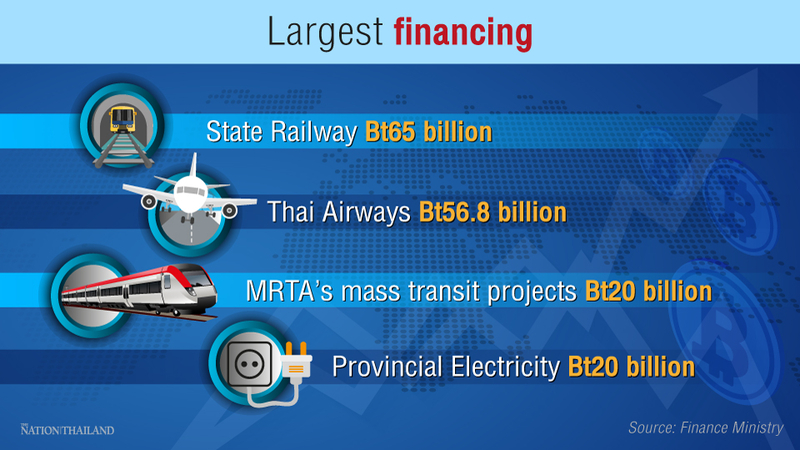
The Cabinet on Tuesday (September 24) approved a planned public debt worth Bt894 billion for fiscal 2020, with the largest sums being injected into the State Railway of Thailand, which will be getting Bt65 billion, and Bt56.8 billion earmarked for cash-strapped Thai Airways International.

Ratchada Thanadirek, deputy government spokesperson, said the Cabinet also approved plans for the management of existing debts worth Bt831.2 billion and debt-repayment plan of Bt398.4 billion. The plans were proposed by Finance Minister Uttama Savanayana.

The new public debt will help push the public debt to gross domestic product ratio slightly up to 42.76 per cent from 41.45 per cent in fiscal 2019. Debt to revenue ratio is projected to be 18.48 per cent, well below the limited target of 35 per cent.

Meanwhile, foreign debt is 2.86 per cent of total debt, well below the limited target of 10 per cent thanks to prudent management. As of July, public debt was worth Bt6.9 trillion or 41.45 per cent of the GDP.

Of the new debts, Bt748.88 billion will be owed by the government, while state enterprises will owe a total of Bt145.1 billion.

The government has had to borrow to boost its liquidity and finance its economic stimulus packages as well as cover investment in infrastructure. The government will borrow Bt570 billion domestically to finance budget deficits in fiscal 2020 and will borrow foreign funds equivalent to Bt3.5 billion to finance development projects.

In order to help state enterprises get cheap funding, the government will lend money it has borrowed to key state agencies. For instance, the State Railway of Thailand will get loans from the government to finance its nine investment projects worth Bt65 billion, while the Mass Rapid Transit Authority of Thailand will get loans worth Bt20 billion from the government to finance its mass-transit projects in Bangkok.

Of the 13 state enterprises that will borrow a combined Bt145.1 billion, Thai Airways is taking a large chunk of Bt56.8 billion to purchase new airplanes and to boost its liquidity, while the Provincial Electricity Authority is borrowing Bt20 billion to finance its investments, the National Housing Authority is taking Bt4 billion and the Provincial Waterworks Authority Bt6 billion.

The Bt3.2-trillion budget bill for fiscal 2020 is scheduled to be deliberated in Parliament on October 17 for the first reading, with the second and third readings are scheduled to be held between January 18 and 29. The funds are expected to be disbursed in late January. In Thailand, the fiscal year usually starts in October.

Company registrations drop 8 % in August

ศาสตร์เกษตรดินปุ๋ย : ขอบคุณแหล่งข้อมูล : หนังสือพิมพ์ The Nation

https://www.nationthailand.com/business/30376672

Company registrations drop 8 % in August

Sep 24. 2019
 Sorada Lertharpachit, Deputy Director-General of  the Department of Business Development

Sorada Lertharpachit, Deputy Director-General of the Department of Business Development
By THE NATION

658 Viewed

A total of 5,973 companies were registered in August, down 8 per cent from July and 7 per cent year-on-year, said Sorada Lertharpachit, Deputy Director-General of the Department of Business Development.

Of the newly registered businesses, companies in the fields of  construction, real estate, and restaurant top the list while their combined capital stood at Bt17.172 billion, falling 25 per cent from July  and 26 per cent year on year.

Meanwhile, 1,755 companies with Bt28.933 billion in total registered capital went out of businesses in August, an increase of 10 per cent from July but a decrease of 1 per cent year on year. They were again led by companies in the construction, real estate, and restaurant businesses.

The total number of new businesses registered from January to August of 2019 sat at  50,654, up 1 per cent year on year. They had Bt157.794 billion in total capital, down 18 per cent year on year.

Businesses that had collapsed during the eight-month period stood at 10,016, up 3 per cent year on year. They had a total capital of Bt59.548 billion, up 7 per cent year on year.

Sorada said the number of  new registrations tends to grow, encouraged by the government’s economic stimulus and continued promotion of the tourism sector and private investment.

Experts sum up keys to branding success, sustainability

ศาสตร์เกษตรดินปุ๋ย : ขอบคุณแหล่งข้อมูล : หนังสือพิมพ์ The Nation

https://www.nationthailand.com/business/30376656

Experts sum up keys to branding success, sustainability

Sep 24. 2019
By THE NATION

659 Viewed

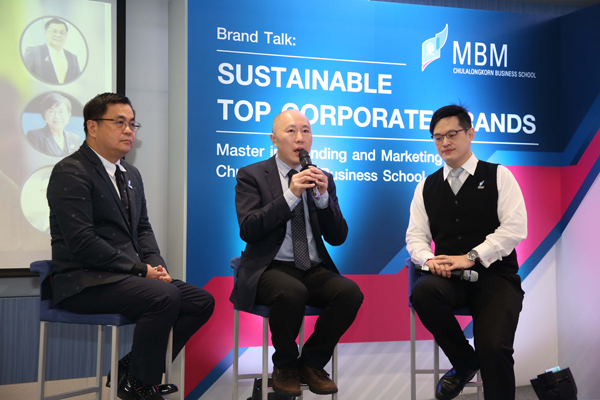
The Master in Branding and Marketing (MBM) programme of Chulalongkorn University’s Chulalongkorn Business School (CBS) recently organised a talk on Sustainable Top Corporate Brands by Dr Vincent Mak of Cambridge Judge Business School of the University of Cambridge and Asst Prof Dr Wilert Puriwat, Dean of Chulalongkorn Business School, at the university’s premises.

Dr Vincent Mak described a company’s brand as a kind of ‘nudge’ for consumer purchasing behaviours. “Whereas in the past, brands were like the consumer’s master, but today they must act as a servant. They should allow customers to create their own experiences and lives”.

Mak argued that it is, in fact, the customers who “own” the brand, and who decide what it is in terms of its image. Therefore, companies should “…establish their brand characters by not establishing them.”

Meanwhile, Dr Wilert of Chulalongkorn Business School advised executives to develop an insight of customers by focusing on their future needs and fulfilling those needs even before the customers realise them.

“It is important to continue changing the brand dynamically… people are addicted to seeing new things,” he said. He also pointed out that engaging the new generation is key, and that executives need to “change the methodology to grab them”. He added that “the world still belongs to humans” and “the human touch is still needed to effectively engage coming-of-age customers. So emotional and social values are keys to success and sustainability.”

As for the key challenges brands and organisations face in achieving sustainability, Mak advised  maintaining “moral intelligence” through CSR activities which, despite being an expense for companies, would help build emotional and moral values.

Puriwat concluded that companies not only need IQ and EQ to survive beyond the digital era but DQ (Digital Quotient) and SQ (Social Quotient) as well.

From now,  he added: “We should disrupt the disruptor … fight back and not wait to be disrupted. Setting the goal first… keeping the brand dynamic… reaching people both on-and offline… and keeping the brand unique are all crucial to achieving brand success and sustainability. The world is continually evolving, and brands must keep up with the changes in order to achieve success”.

Property Perfect convinced it will meet Bt25 bn revenue target this year

ศาสตร์เกษตรดินปุ๋ย : ขอบคุณแหล่งข้อมูล : หนังสือพิมพ์ The Nation

https://www.nationthailand.com/property/30376619

Property Perfect convinced it will meet Bt25 bn revenue target this year

Sep 23. 2019
By The Nation

642 Viewed

Listed property firm Property Perfect Plc is confident it will meet its revenue target of Bt25 billion by the end of this year from the sale of residential projects and other assets, the company’s chief financial officer Sirirat Wongwattana said in a press release on Monday (September 23). 

She added that the firm has reported a total revenue of Bt10 billion in the first half of the year, adding that the remaining Bt15 billion will be made in the second half from the sale of single-detached homes and townhouses worth Bt6 billion, while another Bt6 billion will come from condominium projects in both Bangkok and Japan. The remaining Bt1 billion will come from the sale of land, and Bt2 billion from its hotel and hospitality business, she added.

The company also plans to issue debentures worth Bt2 billion between September 23 and 25 to pay back some of its loans, she said.

Asia-Pacific Housing Forum discusses innovative, sustainable solutions to affordable homes

ศาสตร์เกษตรดินปุ๋ย : ขอบคุณแหล่งข้อมูล : หนังสือพิมพ์ The Nation

https://www.nationthailand.com/property/30376612

Asia-Pacific Housing Forum discusses innovative, sustainable solutions to affordable homes

Sep 23. 2019
By THE NATION

293 Viewed

With the theme “Powering collaboration for housing impact”, industry leaders and a host of others in the sector gathered at the Asia-Pacific Housing Forum in Bangkok last week to find innovative and sustainable solutions to the massive issues confronting millions of low-income families and communities in the climate-vulnerable Asia-Pacific region.

“The reality is housing is far too complex,” Habitat for Humanity CEO Jonathan Reckford said in the opening speech. “Confronted by the housing crisis, we have a collective responsibility to raise awareness that there are solutions and to engage people in many ways. We need to raise the bar and make connections between housing and health, housing and education, housing and livelihoods. Housing is not the only need for families, but a requisite and a foundation that allows a child to stay healthy, get educated, and become self-sufficient over time.”

The Asia-Pacific Housing Forum has served as a platform to amplify why housing matters.

“We need a strong community of organisations and individuals from across the region in order to initiate solutions for the housing shortage in the Asia Pacific,” Hilti Foundation president Egbert Appel said. “Networks represent the power of collaboration.

“Working in networks might be challenging because you have to coordinate organisations, different cultures, different ideas, different objectives and people. In this approach, everyone contributes their own strength, excellence, and competence,” he added.

Ananda Development CEO Chanond Ruangkritya recognised the importance of understanding the link between solving the construction and land equation by having conversations on the use of exponential technology, and using platforms for innovators at the local level.

“When we talk about urban solutions, we look at urbanisation in the next decades when two-thirds of humanity will be living in cities. It is the biggest migration of humanity that we will see in the next 30 years, and most of that will be around Asia. This problem is also the world’s biggest opportunity. We look at how we solve this problem with organisations such as Habitat for Humanity, looking at demand and supply, scarcity of these resources, and see how you turn scarcity into abundance,” Chanond said.

Forum participants discussed key issues around the housing ecosystem – impact investing, market systems, social inclusion, disaster resilience, people-centered innovation and technology – with experts, industry leaders and other stakeholders in the region and around the world.

The four-day forum, held from September 16 to 19, included the Innovation Awards, a training course on Strengthening Land Tenure Security for Disaster Resilience, and two Urban Thinkers Campus events – the Youth Congress and the Urban Housing Practitioners Hub. These are in support of the World Urban Campaign that promotes the New Urban Agenda and United Nations 2030 Sustainable Development Goals.

Organised by global housing non-profit Habitat for Humanity, the forum taps into the extensive network of expertise brought by partners from the private, public and social sectors.

The forum had the strong support of Ananda Development, Hilti Foundation, Aditya Birla Group, HMTX Industries, Cities Alliance, Global Land Tool Network, USG Boral and Ayala Corporation. It had a host of partners including UN-Habitat as a strategic partner, ITC-University of Twente as a knowledge partner and media partners Devex, Asian NGO and Place of Thomson Reuters Foundation.

High-quality homes for sustainable growth

ศาสตร์เกษตรดินปุ๋ย : ขอบคุณแหล่งข้อมูล : หนังสือพิมพ์ The Nation

https://www.nationthailand.com/property/30376578

High-quality homes for sustainable growth

Sep 23. 2019
A pedestrian walks past a residential enclave in Huaian, Jiangsu province, on July 28, 2019. (ZHOU CHANGGUO / FOR CHINA DAILY)

A pedestrian walks past a residential enclave in Huaian, Jiangsu province, on July 28, 2019. (ZHOU CHANGGUO / FOR CHINA DAILY)
By China Daily
Asia News Network

150 Viewed

China’s residential property market, which is still considered a key economic indicator, may appear down and out at the moment, but unexpected good tidings are adding to the buoyant mood generated by the celebrations of 70 years of the founding of the People’s Republic of China.


Like the economy, China’s residential property industry is transitioning from high growth to high quality. And that is a game-changer with potential long-term implications for the whole economy, experts said.

“China’s property market will shift from extensive and rapid growth to more sustainable growth in the following years,” said Yao Yao, head of research for JLL China, a real estate agency.

Despite factors like many top realty players missing first-half revenue targets, the government’s stringent rules continuing to keep a lid on runaway prices, and financially strained investors turning cautious on new developments, the industry is all excited about the future.

It’s a future that experts said will be marked by innovation. Technological advances, accelerating urbanization and rising environmental awareness among people are expected to lead to smarter and greener buildings everywhere, sparking a new long-term property revolution that would help tide over the current short – and medium-term concerns.

The future of properties will be in line with the central government’s emphasis that homes are for living, not for speculative investments.

“After decades of rapid residential property development, the demand-supply situation has reached a new stage of quality development. We think the central government, property developers and Chinese people are all at a turning point as the function of real estate is being redefined,” said Chen Sheng, president of the China Real Estate Data Academy.

Part of that optimism stems from the Chinese government’s resolve to establish a long-term mechanism for the stability of the hitherto volatile real estate sector. The tendency to treat property as a short-term economic stimulus tool, or as a key source of local government income, or as an avenue for speculative investments is already a thing of the past, said Chen.

“To boost the economy, other tools such as tax reform, regional development, promotion of innovation, and financial opening-up are being used,” said Yao.

Xie Chen, head of research with CBRE China, said, “It is a good opportunity for developers with strong credit credentials to go on an M&A (mergers and acquisitions) spree. It is also a good time to think about diversifying investments.”

Such views started gaining circulation after 12 leading real estate developers, including China Vanke, Country Garden, and Evergrande, reported first-half revenues of over 100 billion yuan (US$14.13 billion) each. But some among the top 10 developers failed to reach their half-year targets.

“Developers need to pay more attention to their financial resilience. Considering that the lending environment is still tight and the debt repayment peak is nearing, developers need to formulate a more selective strategy when making investments,” said Xie.

Big-ticket realty investments may resume on the back of urbanization. In fact, experts expect significant growth in demand for even commercial real estate.

The current scene is enthusing not just industry insiders and external experts but consumers such as Li Shuqi, 41, a Shanghai-based white collar worker at a multinational company. She believes ordinary people have a decent chance now to buy or change homes.


Li was born in 1978 when China embarked on reform and opening-up. She is part of the lucky generation that got to witness the rapid development of China’s home market.

In a shantytown in Changning district of Shanghai, Li was raised in a cubbyhole of a home that sheltered not just herself and her parents but her aunt.

“Those days, two homes were separated by a thin shelf. We could hear the neighbors if they spoke a little louder,” Li recalled.

When Li turned 5, her parents moved into a 15-square-meter room in a nongtang (narrow alley). Their kitchen was outside the room. “The room was multi-functional – it was the bedroom at night, living room by day, a shower area and bathroom whenever it had to be,” Li recalled.

In 1988, one of Li’s happiest days arrived when she had her own bedroom and no longer had to clean the wooden toilet anymore – the new house had a flush toilet.

That apartment became Li’s own after the family paid about 20,000 yuan in 1999, a year after the start of housing reform that ended the welfare housing system, creating a free market in its stead.

“The year 1998 was a milestone. Since then, real estate development has seen exponential growth and has become a pillar of the country’s economy, driving economic development and enhancing residents ‘quality of life,” said Yao of JLL China.

“Market forces in the housing sector were a significant breakthrough and built the foundation for the fast-growing market in the coming decades,” said Robert McKellar, executive chairman of Savills Asia-Pacific, a global real estate consultancy.

Agreed Li. “Over the past decade or so, my friends and relatives have been able to buy their dream homes one after another. My cousin who slept on a sofa at night for more than 20 years, finally got to move into a three-bedroom apartment in downtown Shanghai in 2009, and some even own more than one flat as they got married and have children.”

After two decades of development, the average living space almost tripled from 9.7 sq m per capita in 1998 to 36.7 sq m last year, said Lu Wenxi, a researcher with Centaline Shanghai, a property consultancy. The corresponding figure was 3.8 sq m in 1950 and 4.5 sq m in 1978.

Vincent Lo, chairman of Shui On Group, said even as Chinese households benefited greatly from the housing market reform, many large-scale developers emerged. “The number of developers with total turnover of above 100 billion yuan reached 30 in 2018,” said Lo during the Urban Land Institute Asia-Pacific Summit in Shanghai earlier this year.

Chen Sheng of the CREDA said that alongside improved living conditions, many Chinese developers and construction companies are growing amid global competitiveness, thanks to unprecedented urbanization.

Yang Yuechen, head of research and consultancy in Shanghai and Beijing with Knight Frank, a real estate consultancy, agreed that the real estate sector had made great contribution to efforts to improve Chinese people’s living standards and toward economic development.

“However, with prices stabilizing, the sector maturing, and demand softening, the property market may gradually cease to be a key pillar of the Chinese economy in the next one or two decades,” said Yang.


Some experts said the change in status has already happened. “The year 2016 was another important milestone as the central government embarked on a major shift in housing policy to ‘focus on both the rental and sales housing markets’.The government’s goal to build a long-term mechanism means it will promote a more sustainable development in real estate in the future,” said Yao of JLL.

Agreed McKellar with Savills. “The market has been witnessing another significant change in recent years as economical housing developments, including multifamily apartments and affordable housing, are increasingly encouraged by the government. This is addressing the affordability issues that have been causing concern to lower-income families and migrants.”

Li concurs with that view. “To be honest, a couple of years ago, I felt anxious to see home prices soaring so rapidly that I felt people like me may not be able to afford homes through hard-earned incomes.”

She said she had dissuaded her parents from buying a new home for several years as she thought their existing flat was “good enough”. But, she changed her mind after realizing the quality of life would decrease with a large sum of mortgage.

“Home ownership is one of the key milestones for many families in China, providing a sense of security and stability as well as serving as a store of wealth. Inefficient allocations of these resources and rising home prices are undesirable as such factors could limit the ability of many families to own a home, which could have socio-economic implications for the community,” said McKellar of Savills.

Experts said government policy will likely ensure residential property prices plateau instead of becoming volatile again. So, homebuyers should buy within their means and not overstretch themselves. Mortgage payments should not exceed between 40 percent and 50 percent of household incomes, suggested McKellar.

“Homebuyers should be more cautious in making their decisions. They should first make a detailed plan for future 10 years or so, and choose their home accordingly,” said Yang.

Given the domestic and external environments, home price rises in China will be well contained for the rest of this year and in the foreseeable future, while first – and second-tier cities, as well as other lower-tier cities, might continue to witness diverging market trends, said experts.

Rental apartments will continue to grow and become a new lifestyle for young people. “We anticipate a long-term mechanism such as property tax to be gradually in place. In addition, a more diversified financing system is expected to take shape with vehicles like REITs (real estate investment trusts), to further increase the proportion of direct financing in the real estate industry,” said Xie.

He said foreign capital has been very active in investments in prime commercial real estate in major first-and second-tier cities this year. CBRE’s 2019 Investors Intention Survey shows that China has become the top destination for cross-border real estate investment, and Shanghai tops the city-wise list.

Date set for contract-signing on high speed train project

ศาสตร์เกษตรดินปุ๋ย : ขอบคุณแหล่งข้อมูล : หนังสือพิมพ์ The Nation

https://www.nationthailand.com/business/30376616

Date set for contract-signing on high speed train project

Sep 23. 2019
Anutin

Anutin
By THE NATION

1,148 Viewed

The committee tasked with overseeing bidding for the high speed train project, linking three major international airports, will ask the bid winner, a consortium led by Charoen Pokphand (CP) group, to sign off on the contract on October 15.

This follows an agreement reached today (September 23) between Deputy Prime Minister Anutin Charnvirakul and the Eastern Special Development Zone Committee on the development of the high speed train project linking Don Mueang airport in Bangkok with Suvarnabhumi Airport in Samut Prakan and U-Tapao airport in Rayong.

The CP-led consortium proposed the lowest bidding price. If it fails to sign the contract with the State Railway of Thailand on that date, it might risk being considered as abandoning the project.

SCG launches strategies to transform cement and construction industry

ศาสตร์เกษตรดินปุ๋ย : ขอบคุณแหล่งข้อมูล : หนังสือพิมพ์ The Nation

https://www.nationthailand.com/business/30376601

SCG launches strategies to transform cement and construction industry

Sep 23. 2019
Chana

Chana
By The Nation

1,133 Viewed

Cement and building material company SCG has unveiled strategies to transform the cement business and construction industry in joining forces with partners to introduce the “CPAC Construction Solution”.

The measures aim to provide quality, speedy, cost-effective and worry-free construction work with the ability to minimise waste generation powered by the integration of digital technology based on the Circular Economy concept.

“SCG aims to establish 20 branches of the CPAC Solution Centre nationwide and expand the network of local technicians and contractors from 2,000 to 20,000 by 2020, elevating the entire ecosystem with sustainable growth,” Chana Poomee, vice president for cement and construction solution business for SCG Cement-building Materials business, said in a Monday release.

He added that SCG Cement–building Materials, has been a regionally recognised cement and concrete manufacturer for more than a century, and invariably adapts to improve competitive capabilities to meet evolving challenges. This time, the company has taken a further step to elevate the work process of their cement and construction solution business by leveraging collaboration at the local and national level to meet the ambition of the construction industry to become a “wealth community” where stakeholders along the value chain can enjoy benefits and sustainable growth.

It will also aim to build a “Green Society” to establish an efficient management of resources – the raw materials, human resources, budget and time – to create a tangible economic benefit by employing three strategies. They are: Construction Solution Technology to address needs and solutions, Digital Technology such as BIM to maximise resources, and the CPAC Solution Centre to deliver inclusive expertise services.

Over the years, SCG has been entrusted vital tasks of several construction types, allowing the company to realise customer demands and constraints such as the need for on-time delivery of quality products that fit the construction types, as well as technology to effectively manage cost and improve safety at work along with the availability of experts for specific troubleshooting assistance.

The first strategy, Construction Solution Technology, is to enhance the work process to address needs and solutions to provide a holistic service with highest efficiency and standards to a broad range of customers from government, businesses, technicians, contractors, large-scale and small-scale real estate development companies to other related parties. CPAC, a subsidiary of Cement-building Materials, SCG, has worked with network partners to combine advanced and internationally recognised technology and service tools such as design technology, construction inspector, logistics with high-quality products and its longstanding expertise to develop a new comprehensive solution under “CPAC Construction Solution”.

Solutions for homeowners, technicians, and small-scale contractors are offered with top-quality CPAC professional team service along with the CCTV system to allow customers to track the project’s progress around the clock. Examples of the solutions include the floor solution, pile and beam column solution for structural strengthening with post-tension and precast, wall solution for plastering services as well as customising solutions such as farm solutions offering design and consultation services to build standard barns with speedy construction within controlled budget with precast materials.

Solutions for large-scale contractors and real estate development companies include the infrastructure solution such as post-tensioned slab system for the Skytrain system or beam bridge construction with inclusive services of design, material procurement, production control and installation. As well the lifetime solution offers service coverage for building, factory, bridge or dock. The earthwork solution offers underground design work and a drainage system to minimise construction time along with other customisation solutions tailored to meet customer needs, and a unique service for high soil subsidence area, especially in the central region.

As well, construction waste generation has become a significant concern, especially the reserve of excess construction material, resulting in unnecessary loss of raw material, human resources, time and budget. SCG has incorporated the “Circular Economy” concept into the construction approach through its second strategy, the implementation of digital technology to deliver a more cost-effective solution with the technique called Building Information Modelling (BIM). BIM is a 3D model-based process that combines architectural practices, structural design, and a system to more efficiently plan and construct buildings. The process improves design precision and can detect design errors prior to construction, eliminating waste from the construction process, while speeding up construction management with a better cost-effective method. The generated construction waste such as concrete scraps will be recycled into construction materials for the next project, aligning with the approach “From Waste to Wealth”.

To truly establish a robust collaboration, the company has introduces the third strategy, the CPAC Solution Centre to serve as a provincial centre for the exchange of knowledge, construction techniques and solutions for construction network. CPAC will provide innovations or technologies garnered from relevant parties to effectively and comprehensively help solve the construction constraints with the CPAC Construction Solution. The first construction solution branch was officially launched in Chiang Mai province in early 2019 with a plan to open nine additional branches in Chiang Mai, Khon Kaen, Phitsanulok, Phuket, Surat Thani, Ubon Ratchathani, Pattaya, Nonthaburi and Nakhon Pathom by the end of 2019, with a total 20 branches in place by 2020. The provincial centre aims to contribute toward sustainable growth for the Thai construction industry, said Chana.

Rush for tourism cash causes digital registration to crash

ศาสตร์เกษตรดินปุ๋ย : ขอบคุณแหล่งข้อมูล : หนังสือพิมพ์ The Nation

https://www.nationthailand.com/business/30376584

Rush for tourism cash causes digital registration to crash

Sep 23. 2019
Credit: Krungthai Bank

Credit: Krungthai Bank
By The Nation

960 Viewed

Krungthai Bank’s registration site for the tourism cash subsidy package crashed with hours of opening as Thais rushed to sign up.

On the first day of registration, many applicants have complained they could not access the registration for “Eat, Shop, Spend” package backed by the government via http://www.ชิมช้อปใช้.com.

One of the applicants told The Nation that he had tried to register at Krungthai Bank’s http://www.ชิมช้อปใช้.com just after midnight but the system fail to accommodate him.

Lavaron Sangsnit, director general of the Fiscal Policy Office at the Finance Ministry, said the registration is expected to proceed smoothly after 12pm. Technicians are working to resolve the problem and put the system right, he added.

He also urged people who are not planning to travel until late October or early November not to rush to sign up.

Those who have completed the registration will get a confirmatory SMS within three days and must to travel within 14 days after receiving the SMS and downloading the e-wallet app, which the government refers to as the “g-wallet”, he said.

Once the app is downloaded, those eligible for the package will get Bt1,000 credit for spending and when they use their own money via the app, they will get back 15 per cent of their total expenses up to the limit of Bt4,500 per person.

The first 10 million applicants will get the subsidy package.

Lavaron said that people should not worry too much about not getting the package but stressed that they needed to make solid travel plans before registering.

The system will automatically shut down each day when one million people have completed registration.

As of 9.30am today (September 23) 340,000 had successfully registered, he added.

SET, Clearstream join to ease international investor access to Thai fund market

ศาสตร์เกษตรดินปุ๋ย : ขอบคุณแหล่งข้อมูล : หนังสือพิมพ์ The Nation

https://www.nationthailand.com/business/30376627

SET, Clearstream join to ease international investor access to Thai fund market

Sep 24. 2019
By The Nation

278 Viewed

The Stock Exchange of Thailand (SET) and Clearstream Banking SA, an international central securities depository, have joined to enable cross-border funds transactions. 

The new linkage between SET’s mutual fund platform FundConnext and Clearstream’s global fund processing platform Vestima enables international investors to access the Thai fund market. As of August 2019, the Thai mutual fund market encloses assets under management at Bt4.01 trillion. In return, Thai investors have access to more than 190,000 investment funds from close to 50 jurisdictions worldwide via Vestima.

The linkage of the two platforms is operated via SWIFT’s standard messaging format ISO 20022. Cash will flow through Standard Chartered Bank (Thai) Plc.

Pakorn Peetathawatchai, SET’s President, said: “The linkage enhances fully automated capabilities for cross-border investment fund distribution between Thailand and the world. As the first implementations of ISO 20022 in Thailand, FundConnext is committed to providing the world and Thailand’s investment communities with lower cost, ease of access and more efficient services.”

Bernard Tancré, the head of investment funds services at Clearstream, said, “Adding order routing, asset servicing and settlement services for Thai domestic investment funds to our portfolio perfectly fits our Asia funds strategy. The connection between Clearstream’s Vestima and SET’s FundConnext will enhance access to Thai and international funds for domestic and global market participants.”

Lisa O’Connor, the managing director of capital markets and standards, APAC, SWIFT, said, “For more than 10 years, ISO 20022 has been widely adopted as a standard for funds distribution and processing as it allows for interoperability, richer data and straight-through processing. We are delighted that Clearstream and The Stock Exchange of Thailand decided to leverage ISO 20022 and SWIFTNet capabilities to design their link and we strongly believe it will bring benefits to all their investors.”

Plakorn Wanglee, the president and CEO for Thailand and representative offices at Standard Chartered Bank (Thai) said: “We are pleased to partner with SET and Clearstream in further developing the FundConnext platform, which will enhance the cross-border mutual fund subscription and redemption flow. With our global innovation and network and the strength of all partners, the synergy will pave way for the meaningful growth of Thailand’s mutual fund industry.”