Recent trends in the digital economy: global internet traffic has grown dramatically

ศาสตร์เกษตรดินปุ๋ย : ขอบคุณแหล่งข้อมูล : หนังสือพิมพ์ The Nation

https://www.nationthailand.com/business/30375847

Recent trends in the digital economy: global internet traffic has grown dramatically

Sep 05. 2019
By The Nation

704 Viewed

The Nation presents infographics of UNCTAD’s Digital Economy Report 2019, which highlights value creation and capture: implications for developing countries.

+++

+++

+++

+++

+++

UN calls for wider share of digital benefits dominated by US, China

ศาสตร์เกษตรดินปุ๋ย : ขอบคุณแหล่งข้อมูล : หนังสือพิมพ์ The Nation

https://www.nationthailand.com/business/30375840

UN calls for wider share of digital benefits dominated by US, China

Sep 05. 2019
By Wichit Chaitrong
The Nation

628 Viewed

A United Nations agency says concerted global effort will be required to ensure that the benefits of the rapidly expanding digital economy are shared with the millions otherwise destined to miss out.

In its first Digital Economy Report, the UN Conference on Trade and Development (Unctad) maps the global flow of data and funds and outlines the enormous potential gains and possible development costs as more people connect and make purchases online.

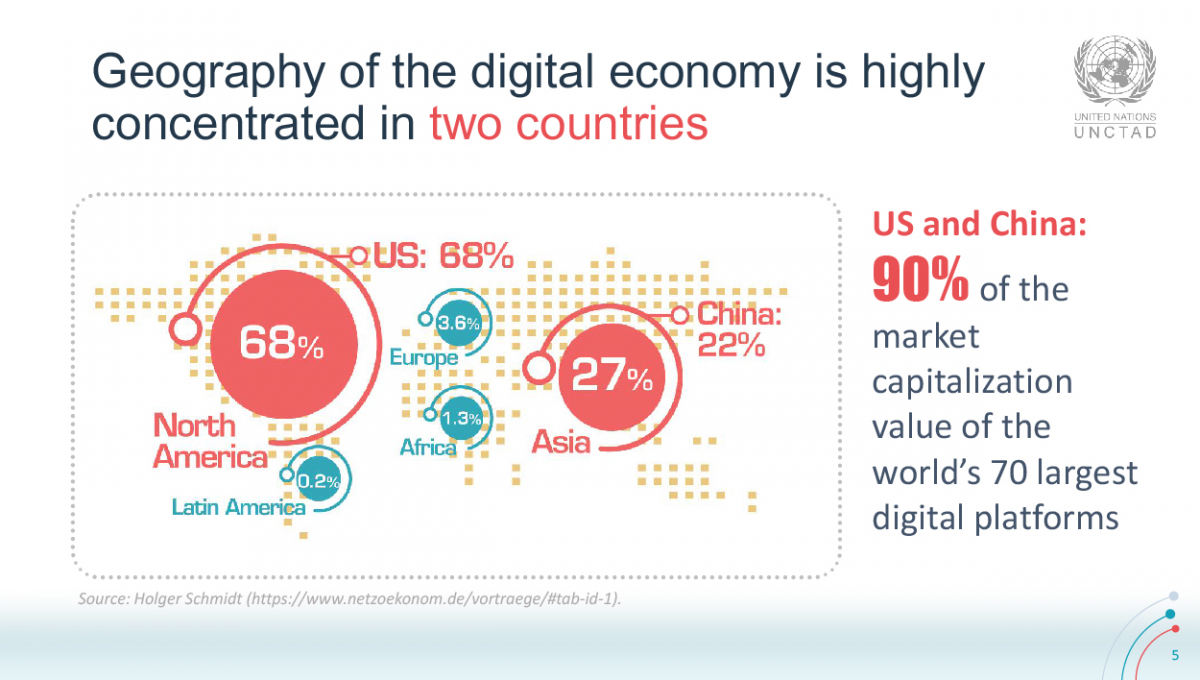
Wealth creation is highly concentrated in the United States and China, it notes, with the rest of the world trailing considerably far behind, especially countries in Africa and Latin America.
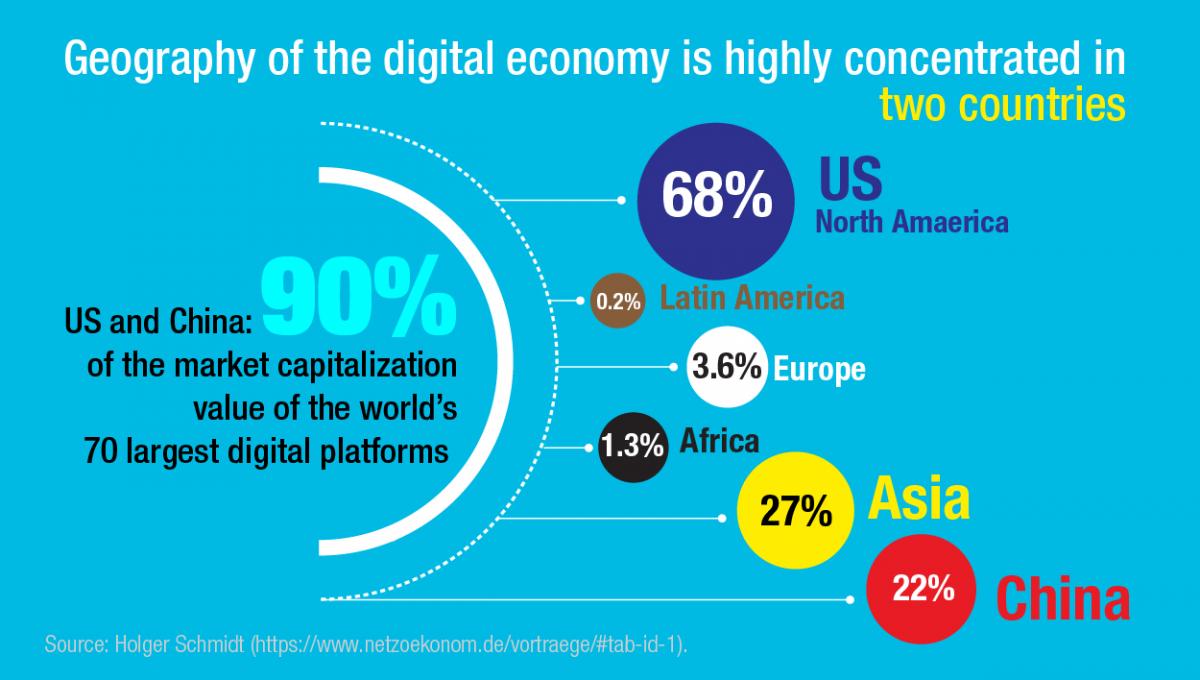
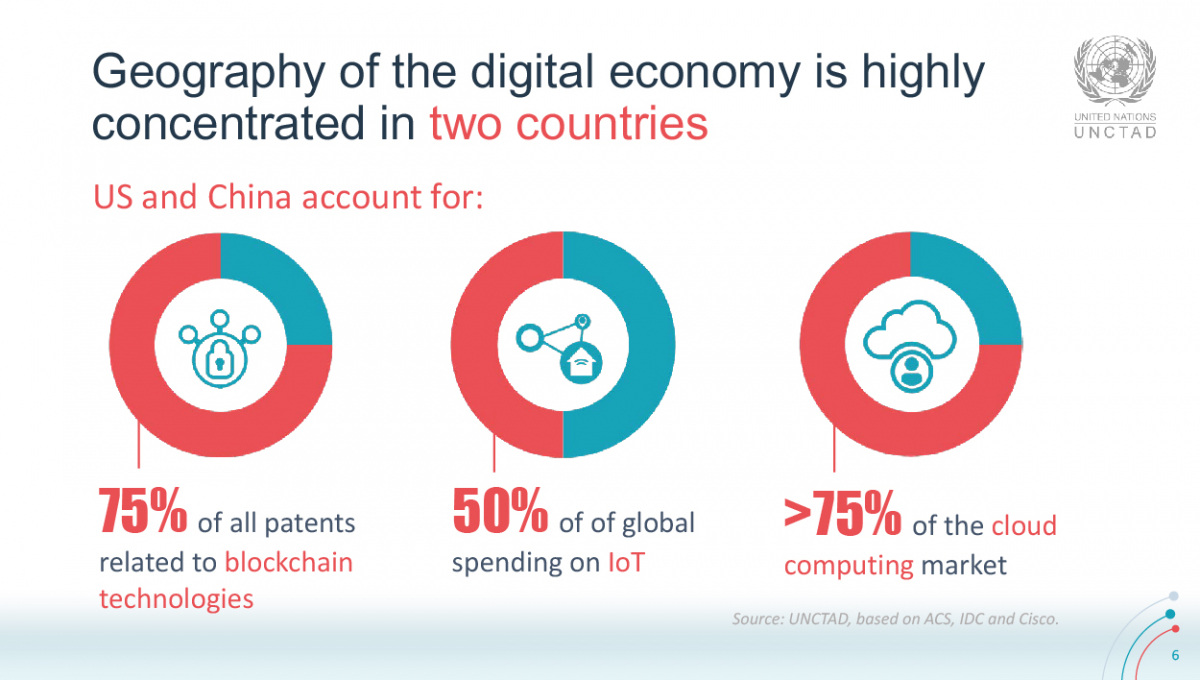
The US and China account for 75 per cent of all patents related to blockchain technologies, 50 per cent of global spending on the internet of things, more than 75 per cent of the cloud-computing market and as much as 90 per cent per cent of the market capitalisation value of the world’s 70 largest digital-platform companies.

Under current policies and regulations, this trajectory is likely to continue, further contributing to rising inequality, warned UN Secretary-General António Guterres.

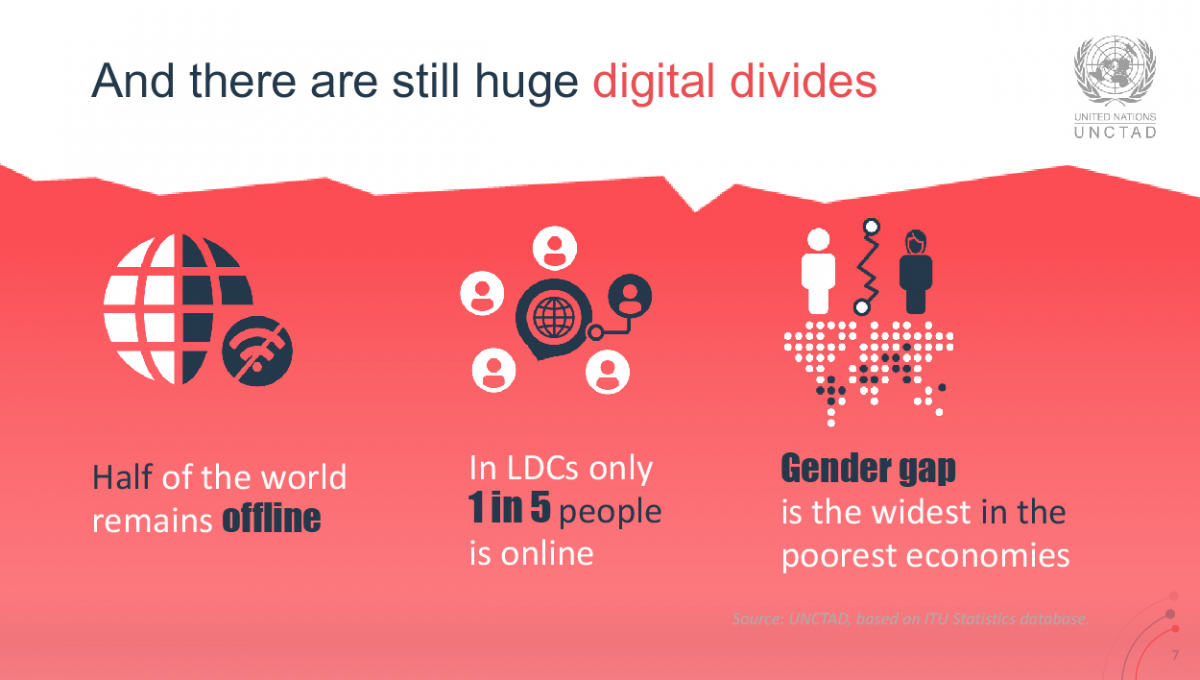
“We must work to close the digital divide, where more than half the world has limited or no access to the Internet. Inclusivity is essential to building a digital economy that delivers for all,” Guterres writes in the report.

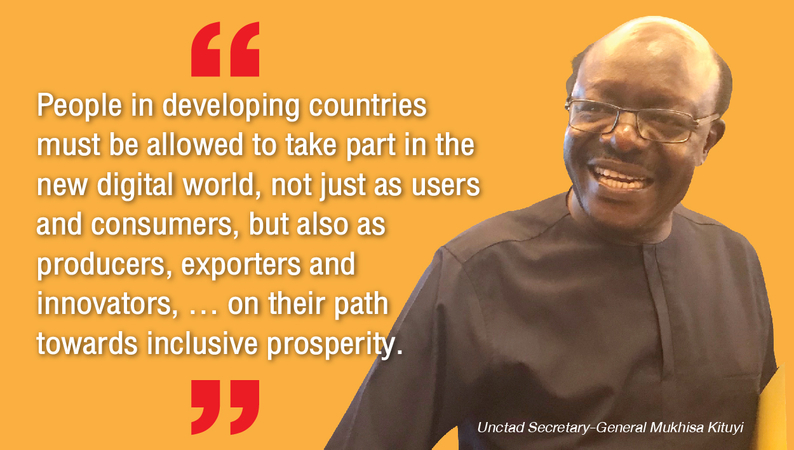
Unctad Secretary-General Mukhisa Kituyi said people in developing countries must be allowed “to take part in the new digital world, not just as users and consumers, but also as producers, exporters and innovators, … on their path towards inclusive prosperity”.

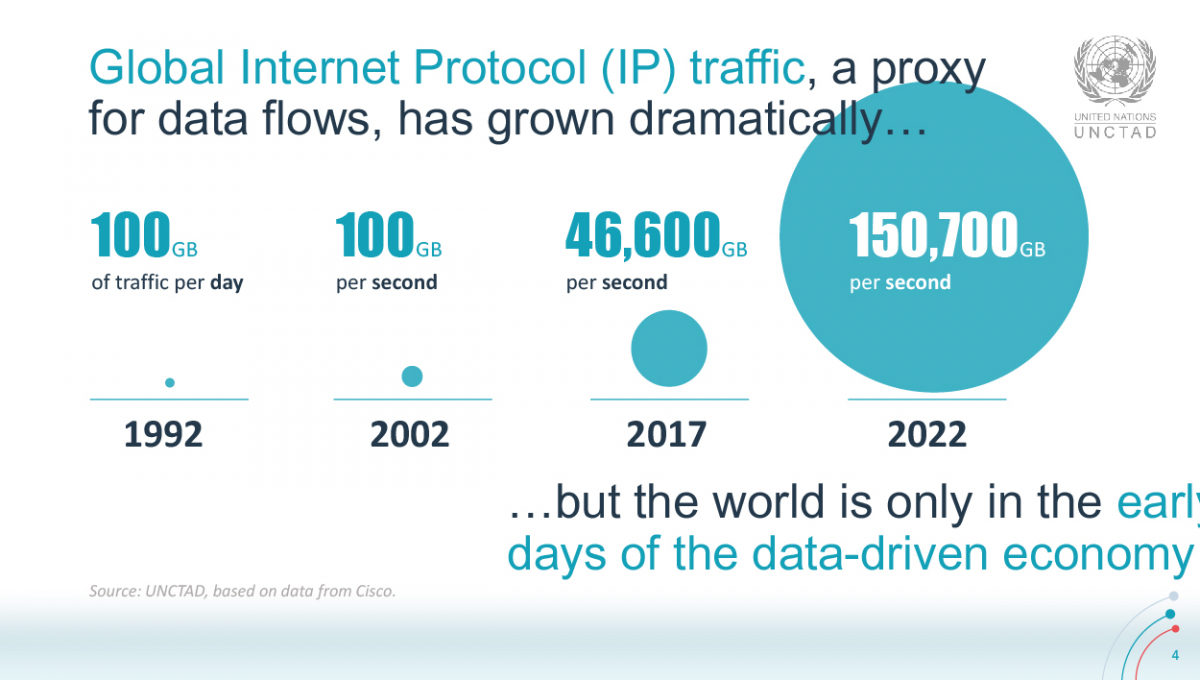
Global internet protocol (IP) traffic has seen dramatic growth, the report says, from 100 gigabytes of traffic per day in 1992 to more than 45,000 per second in 2017. And yet the world is only in the early stages of the data-driven economy. By 2022, global IP traffic is projected to reach 150,700GB per second.
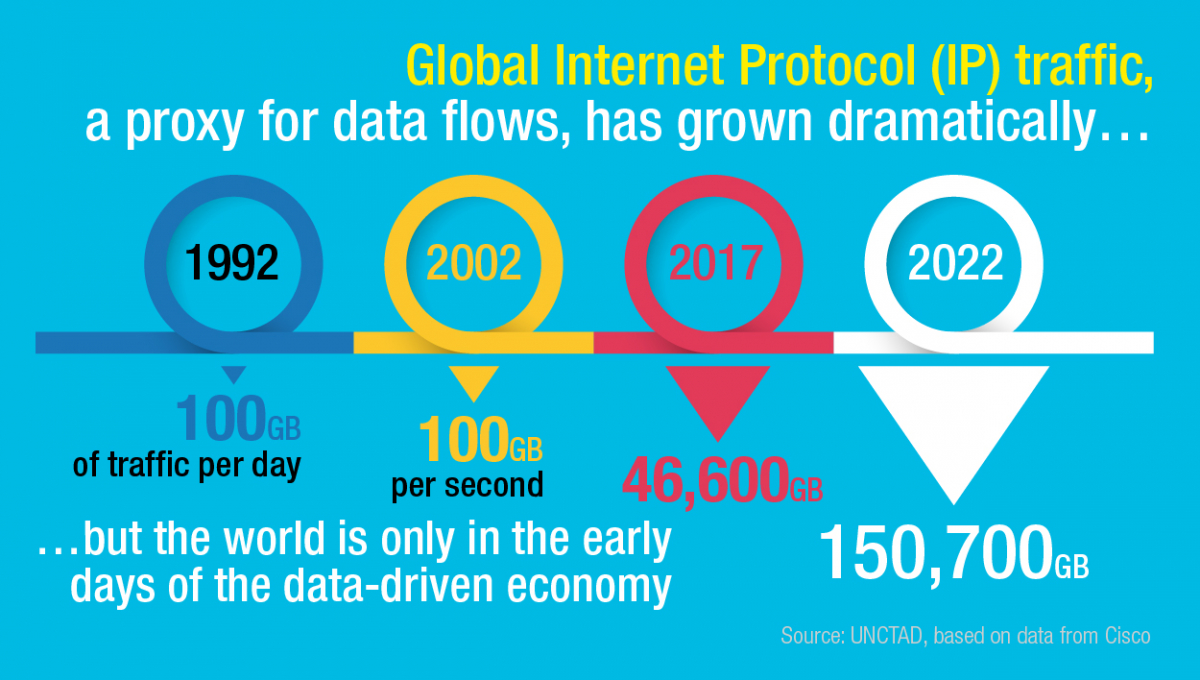
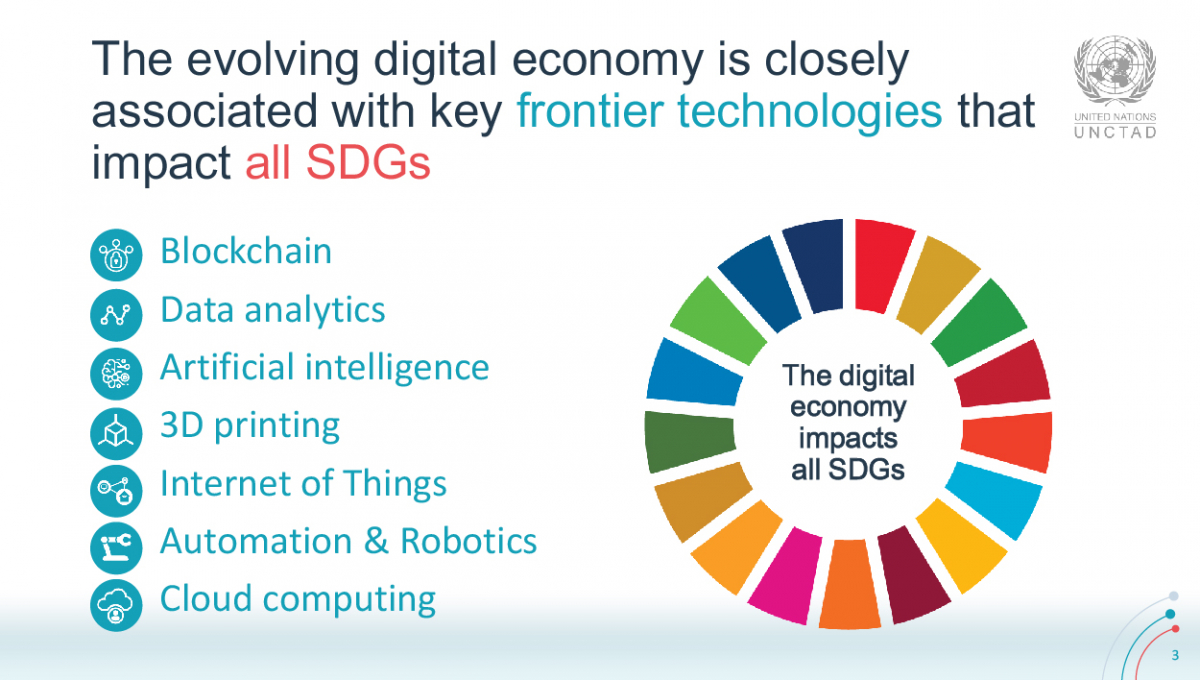
The surge reflects growth in the sheer number of people using the internet and the uptake of frontier technologies such as blockchain, data analytics, artificial intelligence, 3D printing, automation, robotics, cloud computing and the internet of things.
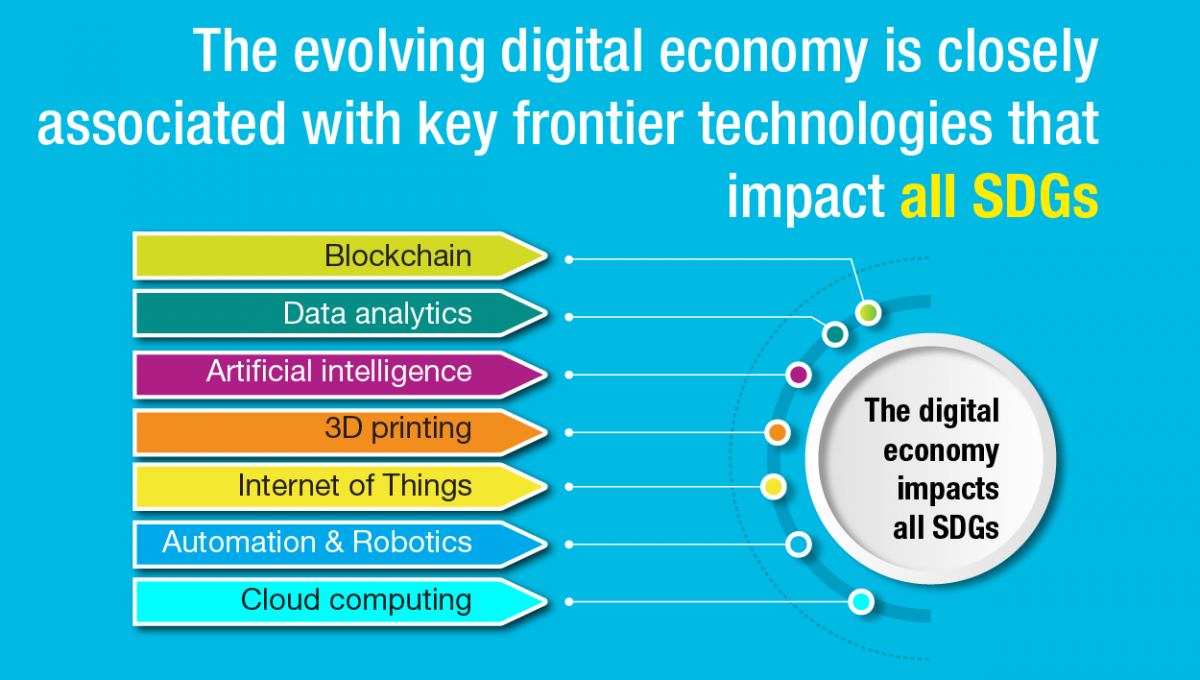
An entirely new “data value chain” has evolved among firms that support data collection, the production of insights from data and data storage.

Businesses that build digital platforms have a major advantage by acting as both intermediary and infrastructure. They are positioned to record and extract data related to online interactions and transactions.

The report notes that 40 per cent of the world’s 20 largest companies by market capitalisation have a platform-based business model.

Seven “super-platforms” – Microsoft, Apple, Amazon, Google, Facebook, Tencent and Alibaba − account for two-thirds of the total market value of the top 70 platforms.

The combined value of the platform companies with market capitalisation of more than US$100 million was estimated at more than $7 trillion in 2017 – 67 per cent higher than in 2015, according to the report.

Some digital platforms have grown to dominate key niches. Google has some 90 per cent of the market for internet searches, while Facebook accounts for two-thirds of the global social-media market and is the top social network in more than 90 per cent of countries.

In China, WeChat, owned by Tencent, has more than one billion active users. Its payment solution and Alipay, owned by Alibaba, have captured virtually the entire Chinese market for mobile payments. Meanwhile, Alibaba is estimated to have close to 60 per cent of the Chinese e-commerce market.

These companies are aggressively consolidating their competitive positions, including by acquiring potential competitors and expanding into complementary products or services, lobbying in domestic and international policymaking circles and establishing strategic partnerships with leading multinationals in traditional sectors, such as automotive, semiconductor and retail industries.

The dominance of global digital platforms and their control of data, as well as their capacity to create and capture the ensuing value, accentuates concentration and consolidation rather than reducing inequalities between and within countries, the report notes.

It warns that developing countries risk becoming mere providers of raw data, while having to pay for the digital intelligence generated using their data.

If left unaddressed, the yawning gap between the under-connected and the hyper-digitalised countries will widen, and inequalities be exacerbated.

The report suggests finding an alternative configuration of the digital economy that leads to more balanced results and a fairer distribution of the gains from data and digital intelligence.

Governments have a critical role in shaping the new economy by defining the rules, it says. This involves the adaptation of existing policies, laws and regulations, and the adoption of new ones in many areas.

“A smart embrace of new technologies, enhanced partnerships and greater intellectual leadership are needed to redefine digital development strategies and the future contours of globalisation,” Kituyi said.

Policy responses need to consider increased difficulties of enforcing national laws and regulations with respect to cross-border trade in digital services and products, the report recommends.

Further, they should explore new pathways for local value creation and capture, and structural transformation through digitalisation.

National development strategies should also seek to promote digital upgrading (value addition) in data value chains, and to enhance domestic capacities to “refine” the data.

“Digitalisation affects different countries in different ways, and individual governments require policy space to regulate the digital economy to meet various legitimate public policy objectives,” the report states.

At the same time, several policy challenges associated with value creation and capture in the digital economy can only be effectively addressed at the regional or international level, with the full involvement of developing countries. This includes competition, taxation, cross-border data flows, intellectual property, trade and employment policies.

To secure a digital future for the many, rather than the few, domestic and international policies should go beyond enlisting more developing-country users and consumers online; they should also enable the building of domestic capabilities to create and capture value.

According to the report, the development community needs to find more comprehensive ways to support countries that are trailing in the digital economy.

It recommends that more assistance should aim at reducing the digital divides, strengthening the enabling environment for value creation and building capacities in the private and public sectors.

Further, policy actions should seek to enhance trust by supporting the adoption and enforcement of relevant laws and regulations to promote value creation and capture in the data-driven digital economy, says the report.

Finance Ministry eases concern on household debts

ศาสตร์เกษตรดินปุ๋ย : ขอบคุณแหล่งข้อมูล : หนังสือพิมพ์ The Nation

https://www.nationthailand.com/business/30375844

Finance Ministry eases concern on household debts

Sep 04. 2019
Lavaron

Lavaron
By THE NATION

286 Viewed

The Finance Ministry on Wednesday (September 9) moved to ease public concern on high household debt in the first quarter of the year.

Lavaron Sangsnit, director-general of the Fiscal Policy Office and the ministry’s spokesperson, said the level of household debt in the first three months was still lower than the peak in 2015 when it accounted for 81.2 per cent of the gross domestic product (GDP).

The ministry said it has yet to become a pressing issue as most of the borrowings were backed by collateral and that they should be deemed as part of the process in building up one’s wealth or as investment to generate income.

Total household debt as of the end of the first quarter stood at Bt12.97 trillion or 78.7 per cent of GDP, of which 42.8 per cent were loans from commercial banks. Most of the loans were backed with assets of the borrowers, for the purpose of acquiring assets such as properties and vehicles or used as operating expenses of their businesses.

When excluding loans for businesses, total household debt in the first quarter would have fallen to Bt10.84 trillion or 65.8 per cent of GDP, Lavan said.

At the same time, the level of loans for personal consumption or personal loan remained low at 6.3 per cent of the total debt while non-performing loans among households accounted for just 3.3 per cent in the quarter.

The office, he said, will continue to monitor the situation.

Earlier this week, the National Economic and Social Development Council (NESDC) and the Bank of Thailand both raised concern on the high level of household debt.

According to the NESDC, total household debt nationwide in the first quarter amounted to Bt13 trillion, rising by 6.3 per cent year-on-year and accounting for 78.7 per cent of GDP – the highest since the first quarter of 2017.

The state think-tank warned that household debt has been rising continuously since mid-2017, adding that the debt level would likely be higher in the second quarter, given the 9.2 per cent increase in personal loans from commercial banks during the period.

SET, Egat team up in study for wholesale power trading platform

ศาสตร์เกษตรดินปุ๋ย : ขอบคุณแหล่งข้อมูล : หนังสือพิมพ์ The Nation

https://www.nationthailand.com/business/30375829

SET, Egat team up in study for wholesale power trading platform

Sep 04. 2019
By The Nation

446 Viewed

The Stock Exchange of Thailand (SET) today signed a Memorandum of Understanding (MoU) with the state-owned Electricity Generating Authority of Thailand (Egat) on a joint study for a energy trading platform and related issues in preparation of the country being the electricity trading hub in Asean.

SET’s Senior Executive Vice President Soraphol Tulayasathien said under MoU, the two parties would jointly conduct a study for a reliable platform, catering to the wholesale electricity market. SET has realised that a mechanism to maximise electricity management efficiency is important for both power producers and consumers, she added.

“The cooperation is also in line with SET’s vision “To Make the Capital Market ‘Work’ for Everyone”. SET has been joining up with various sectors to develop the capital market’s basic infrastructure, products and services to keep pace with global standards while creating new business opportunities. Nowadays, all businesses worldwide, including utility which is part of Thailand’s basic infrastructure, must embrace changes amid competition,” Soraphol said .

Bhawana Aungkananuwat, Egat’s Deputy Governor/Administration said the purpose of this cooperation was to prepare for a new trading platform for the wholesale electricity market or Capacity market for advance trading of 3 – 5 years and the Energy market for daily energy trading, in support of the country being the regional centre of electricity trading.

Moreover, it will help prepare for market liberalisation and promote competition in the energy industry. The cooperation covers the study on the development of a wholesale electricity market trading platform, energy industry model, energy trading mechanism, and wholesale power purchase agreement (both in advance and during the day).

The cooperation between the two organisations is the start of energy industry development, using market mechanism to increase energy management efficiency, ability to compete, and the overall Thai economy.

The MoU covers a one-year period, starting from September 4, 2019 to September 3, 2020. Both parties will study readiness and develop business model for the wholesale electricity market, support information, and exchange knowledge.

EXIM to support Thai businesses targeting India

ศาสตร์เกษตรดินปุ๋ย : ขอบคุณแหล่งข้อมูล : หนังสือพิมพ์ The Nation

https://www.nationthailand.com/business/30375821

EXIM to support Thai businesses targeting India

Sep 04. 2019
 Adul Chotinisakorn, director-general of the Department of Foreign Trade

Adul Chotinisakorn, director-general of the Department of Foreign Trade
By THE NATION

615 Viewed

The Export-Import Bank of Thailand (EXIM Thailand) stands ready to support Thai entrepreneurs’ penetration of Indian market, Adul Chotinisakorn, director-general of the Department of Foreign Trade, Ministry of Commerce, and the director of Export-Import Bank of Thailand (EXIM Thailand), said on Wednesday (September 4).

He added that amidst the global economic uncertainties as a result of the trade war between the US and China, Thai entrepreneurs needed to manage international trade risks in conjunction with exploring new business opportunities.

One of the options is to expand trade and investment to new markets with high potential, such as India, the seventh largest country in the world with the world’s second largest population as well as tremendous cultural diversity, hence a demand for a large variety of products..

Adul was speaking at a seminar titled :India: The Window of Opportunities” organized by EXIM Thailand in collaboration with the Ministry of Commerce in Bangkok.

He added that to successfully enter the Indian market, Thai entrepreneurs need to understand the diversity among Indian states and devise a market strategy that can respond to demand of consumers in each state.

For example, the state of Maharashtra with Mumbai as the capital plays the most significant role in Indian economy. Entrepreneurs should approach middle-class consumers and build linkage to Indian supply chains.

Meanwhile, Tamil Nadu state with Chennai as the capital is the production hub of India and home to the country’s largest number of special economic zones. They number around 40 and have the largest pool of skilled labour force, particularly engineers.

Prospective industries for Thai entrepreneurs include textiles, processed foods, automobile and information technology. Moreover, Gujarat state with Gandhinagar as the capital is well equipped with industrial clusters, infrastructures and rules and regulations conducive to business operation as well as large seaports ranking among the top of the country, making the state a prime location for setting up a production base for both domestic distribution and export.

The EXIM Thailand director added that the Indian states with high potential are mostly situated in the western and the southern regions of the country.

Each state has remarkable features of its own and different business environments in respect of availability of infrastructures, industrial clusters, rules and regulations, and market size. Each state should be viewed and treated as one single country so that its specific characteristics are understood before business engagement.

He said that EXIM Thailand stands ready to support Thai entrepreneurs aspiring to start up or expand business in India through the provision of financial tools comprising working capital as well as medium- and long-term financing, export credit insurance and investment insurance.

India is Thailand’s tenth largest export market. Thai-Indian trade reached US$ 12.463.75 billion in value, comprising Thai exports to India worth $7.632 billion and Thai import from India of $4.863 billion.

Major export goods from Thailand include chemicals, plastic resin and air-conditioners and parts, while main import goods from India are gems, silver and gold, and mechanical machinery and parts.”

“EXIM Thailand is ready to support Thai entrepreneurs in their penetration of new frontier markets such as India by, among others, offering of knowledge and information on cultural diversity among Indian states. This will facilitate their selection of the right location which is one of the top priorities for business establishments. Credit and insurance facilities are also available to enhance access to new business opportunities in the forms of both trade and investment finance and risk management tools to ensure their competitiveness on a stable and sustainable basis,” Adul added.

The Thai National Shippers’ Council (TNSC) urged the Commerce Ministry and related agencies this week to break into India’s booming market.

The Indian market offers big opportunities amid demand for rubber, rubber wood, food, jewellery and repairing chemical spray, and Thailand has the potential to compete there while benefiting from the FTA agreement between the two countries, TNSC president Kanyapak Tantipipatpong said.

She added the government should hasten Thai-Sri Lankan FTA negotiations.

TCEB’s India Road Show drums up delegates to Thailand

ศาสตร์เกษตรดินปุ๋ย : ขอบคุณแหล่งข้อมูล : หนังสือพิมพ์ The Nation

https://www.nationthailand.com/business/30375818

TCEB’s India Road Show drums up delegates to Thailand

Sep 04. 2019
By THE NATION

589 Viewed

The Thailand Convention and Exhibition Bureau (TCEB) is reporting positive results from its recent India Road Show, which substantiated sales leads with a potential of 3,500 meeting and incentive delegates from New Delhi and 4,500 delegates from Mumbai for events to be held in the Kingdom in the next couple of months.

Nooch Homrossukhon, director of TCEB’s Meetings and Incentives Department, said the road show was staged in July with the aim of strengthening Thailand’s existing meetings and incentives business from Indiaw while at the same time generating new opportunities.

“In line with TCEB’s role under its ‘Thailand Redefine Your Business Events’ branding, we are creating business opportunities that generate promising sales leads for the Thai MICE sector. In this context, the India Road Show yielded productive results,” said Nooch.

The activity involved corporate networking events and media meet-up sessions in New Delhi and Mumbai, and was led by Nooch, along with Nitin Sachdeva, TCEB’s Representative in India.

The events in New Delhi and Mumbai attracted significant interest within India’s outbound meetings and incentives market, providing a positive indication of Thailand’s continued status as a leading MICE destination in Asia, Nooch added.

In New Delhi, TCEB’s corporate networking event was attended by 48 corporate delegates, while the media meet-up session saw nine media companies participating. The Mumbai event was attended by 55 corporate delegates, and the media meet-up session drew five media companies.

A major component of TCEB’s marketing activity in the Indian market involves the “Meet by Design – Redefined” support campaign, comprising three packages with a tailored menu of privileges and subsidies for event groups coming to Thailand. “Meet NOW” is for meeting and incentive groups starting from 100 delegates and offers a choice of exclusive in-kind services, including a Thai welcome gift for all delegates; VIP fast-track immigration at Suvarnabhumi Airport or a cultural performance. For groups of more than 500 delegates, a financial subsidy is also included. “Meet SMART” is for corporate meeting groups of 100 from the 10 targeted industries under the Thailand 4.0 policy, while “Meet MEGA” is aimed at larger groups of more than 3,000 delegates.

“The India Road Show also gathered vital feedback on the requirements and wishes of the Indian meetings and incentives market towards Thailand. Key factors are the demand for new and competitively priced products, and added value private sector offerings such as discount vouchers, Nooch said.

SC Asset hikes unit prices amid soaring land cost on Chidlom

ศาสตร์เกษตรดินปุ๋ย : ขอบคุณแหล่งข้อมูล : หนังสือพิมพ์ The Nation

https://www.nationthailand.com/property/30375794

SC Asset hikes unit prices amid soaring land cost on Chidlom

Sep 03. 2019
By Somluck Srimalee
The Nation

520 Viewed

Land price on Chidlom has surged to Bt3.5 million per square wah this year from Bt1.9 million in 2015 due to the shortage of vacant plots in the location, said Prayongyut Itthiratchai, first vice president of SC Asset Corporation Plc, after the opening of the company’s 28 Chidlom project at a press conference today.

Meanwhile, unit prices of the new condominium have risen by 10 per cent from 2016 when the      luxury project was launched in the market, he said.

SC Asset Corporation Plc introduced  28 Chidlom in 2016 at a starting price of  Bt320,000 per square metre but it has since soared to an average of Bt351,000 per square metre, he said.

The demand for condominium units among foreign investors has seen  slight growth as the baht strengthens, Prayongyut added.

Thais accounted  for  91 per cent of  buyers in the project  with overseas customers  from Hong Kong, China and Singapore making up the balance.

“Most foreigners have delayed making a decision to purchase this year whereas overseas buyers of   28 Chidlom had to settle a down payment equivalent to  more than 20 per cent of the unit’s price,” he said.

28 Chidlom comprises two buildings, worth a total of  Bt8 billion. The first, the Villa,  consists of  20 floors, of which 40 per cent of  the 182 units have been sold. Unit types in the building range from one to three bedrooms with  usable space from 37-132 square meters.

The other building, the Tower, houses 47 floors and 243 units. Unit types range from one to three bedrooms and penthouses with the usable space from 40-200 square meters. 80 per cent of all units in the building have been taken up. .

The company has started the transfer of units to buyers and expects to hand over properties worth a total of Bt3.5 billion by end of this year.

The company will transfer condominium units worth a total of Bt6.5 billion this year.  Units with Bt3 billion in value were handed over to buyers in the first half,  he said.

According to a survey by Colliers International (Thailand) Co Ltd,  the new supply of condominiums in the second quarter of this year totalled 26 projects,offering  9,632 units worth  Bt74.87 billion. An average 38 per cent of these projects have been sold since booking started.

However, demand to buy luxury residential units for investment has continued to grow, given the  capital gain from investment in posh condominium units averages five per cent and 6.5 per cent per year –   higher than the interest rate on a bank deposit. With the rental yield at an average of 4.5 per cent and 5.5 per cent per year, it remains attractive for investors  looking for high gains from rental, the research said.

Tesco increases efforts to ensure sustainability

ศาสตร์เกษตรดินปุ๋ย : ขอบคุณแหล่งข้อมูล : หนังสือพิมพ์ The Nation

https://www.nationthailand.com/business/30375817

Tesco increases efforts to ensure sustainability

Sep 04. 2019
By THE NATION

39 Viewed

Tesco Lotus is celebrating 25 years of operation in Thailand by turning its attention to driving sustainability through its “Little Helps Plan”, which sets out how the retailer will make a difference to the social and environmental challenges that matter most to customers.

The aim is to ensure that Thai consumers have access to high-quality products that are sourced sustainably, healthy, and affordable. It will also enhance measures to protect the environment and support local communities.

“Throughout our operations in Thailand, we have remained committed to making positive contributions to all of our stakeholders and to the environment. We recognise that there is a role we can play in making a bigger impact in a positive way and are implementing the Little Helps Plan across our businesses. Clear targets and KPIs have been set, with progress being reported transparently and regularly,” Sompong Rungnirattisai, the company’s chief executive, said.

“As a retailer, we believe that we should do more than just sourcing products and passing them on to customers. Our customers in Thailand must have access to high quality products that come from sustainable sources, are good for their health, and still have affordable prices. As such, Tesco Lotus has prioritised sustainable sourcing of products, with respect to ethics, human rights, animal welfare, and environmental impact. Food products must be of high quality, made from good ingredients, be tasty and affordable and also healthy.”

“Our sustainability plan also focuses on an integral part of our business – our colleagues. As an employer of nearly 50,000 colleagues, Tesco Lotus is committed to helping our colleagues to get on, with opportunities to grow and develop their skills and capabilities, beyond having an income and other benefits. Currently, 80-90 per cent of our store colleagues are from surrounding communities. We also extend employment opportunities to others such as retirees and students to work within the business.”

“In terms of the support we provide for communities, as a food retailer, we focus on ensuring that children in impoverished schools around Thailand have access to nutritious and healthy food. Our food donation programme provides lunches for students in 77 schools in all provinces of Thailand. Our edible surplus food is also donated from 40 hypermarkets in Bangkok and major cities.”

“Due to mounting concerns on the environment and waste, Tesco Lotus has focused our effort on reducing plastic and food waste. We encourage customers to refuse plastic bags and we don’t giving plastic bags for purchases of two items or less across our 1,800 small format stores. By the end of 2019, we will also stop using plastic straws in our operations and offer more environmentally friendly alternatives for our customers. Since July 1, 2019, we have eliminated all foam trays from our operations.”

Salinla Seehaphan, Corporate Affairs Director at Tesco Lotus, said that Tesco Lotus began campaigning for customers to say no to plastic bags since 2015, the first retailer in Thailand to introduce the reward system to incentivize customers to change behaviors.

“Every time customers refuse plastic bags, they receive Clubcard points which can be redeemed for discounts and other privileges. Since the start of the programme, we have awarded nearly 6 billion points and saved more than 190 million plastic bags,” she said.

The chain has also turned all express checkout lanes in 200 hypermarkets will be turned into Green Lanes that do not give plastic bags effective this month.

Wunderman Thompson Thailand set to inspire brands’ growth

ศาสตร์เกษตรดินปุ๋ย : ขอบคุณแหล่งข้อมูล : หนังสือพิมพ์ The Nation

https://www.nationthailand.com/business/30375796

Wunderman Thompson Thailand set to inspire brands’ growth

Sep 03. 2019
By THE NATION

745 Viewed

Wunderman Thompson Thailand launched its rebranded Bangkok office at FYI Center today, marking its official start as a creative, data and technology agency that inspires growth for ambitious brands.

Wunderman Thompson Thailand is getting off to a flying start as one of the strongest agencies in Thailand’s communication industry, bringing together two leading agencies, boasting a full-fledged, multi-talented team of 400 people and a robust client portfolio that currently counts more than 100 brands.

The official launch followed WPP’s announcement late last year to globally merge the capabilities and scale of Wunderman and J Walter Thompson, creating the world’s youngest agency network with more than 20,000 people in 212 locations across 93 markets worldwide.

Wunderman Thompson, the company produced by the union of history’s first creative agency and the digital agency that pioneered direct marketing, is distinctively positioned as a provider of end-to-end solutions through creative, data, commerce, consulting and technology services at a global scale by combining the best of J. Walter Thompson and Wunderman.

“Being one of the earliest offices to complete the transition, all of us at Wunderman Thompson Thailand are really excited to deliver the newly combined capabilities to our clients under one roof,” said Maureen Tan, Chief Executive Officer of Wunderman Thompson Thailand. “Now as a creative, data and technology agency with a mission of ‘Inspiring Growth for Ambitious Brands’, we have brought together the capabilities our clients are demanding- award-winning creativity alongside deep expertise in technology, data and commerce – in a single agency.”

Last month, Wunderman Thailand’s staff moved into FYI Center that has served as the home of J Walter Thompson Bangkok for the past few years, and is now the location of Wunderman Thompson Thailand.

“Our office today houses 400 talented people in Wunderman Thompson’s main team and various specialised divisions with a healthy client portfolio of 100-plus brands who are inspired to grow with us. It is the place for quality deliverables and impactful campaigns that are shaped around the needs of each client, both through individual creation and effective collaboration across all the disciplines, including Mirum in digital transformation and digital marketing, Verve in public, media, influencer management and content creation, and Degree in branding consultancy and design,” she added.

Earlier this year, Wunderman Thompson Thailand introduced its new content-creation unit to help clients create, produce and amplify creative and quality contents in the social and digital space, which added a new forte to the top-five award-winning agency in Thailand. That was soon followed by the launch of ‘Experience Design’ by Mirum as a new approach for brands to tackle fundamental challenges in navigating innovation process and go beyond conventional business thinking. Besides, the Thai integration also brought digital marketing to the family of in-house units, and thus beefed up its digital capabilities with a full range of technology and digital marketing solutions.

“We are confident that, with our creative excellence that have bagged awards from across the globe combined with our strategic, data analytics and tech capabilities, we are ready provide the most comprehensive solutions to our existing and new clients as the best one-stop agency,” continued Maureen.

Wunderman Thompson Thailand now provides an all-encompassing range of world-class services including Branding and Creative, Digital and Mobile, CRM, Data Management and Analytics, E-commerce, Customer Experience, Technology, Content, Design, Public Relations, Production, Event, Promotions and Shopper Marketing.

“The rate and scale of change is greater than at any time in our living memory. This is how the world is today and will continue to be in the future. Wunderman Thompson’s extensive capabilities will further distinguish us in the Thai market and effectively position Wunderman Thompson Thailand as the best future-facing agency in Thailand,” she concluded.

CLSA enhances research platform with senior hires

ศาสตร์เกษตรดินปุ๋ย : ขอบคุณแหล่งข้อมูล : หนังสือพิมพ์ The Nation

https://www.nationthailand.com/business/30375789

CLSA enhances research platform with senior hires

Sep 03. 2019
By THE NATION

495 Viewed

CLSA Limited (CLSA) has announced a number of senior research appointments to strengthen its equity advisory business in Asia and Australia. It is a leading capital markets and investment group in the region.

Adrian Mowat, an  investment industry veteran with 30 years of experience,  joined the company as chief strategist from JP Morgan. Alvin Wong is now head of China Property Research while Tony Ren takes charge of  North Asia Healthcare Research.  Hans Fan is appointed head of China Financial Research. All new appointees are based in Hong Kong.

In Australia, CLSA has reinforced its domestic research team with the appointments of Ben Brownette and Lee Power as industrial research analysts. Both joined from Deutsche Bank.

Shaun Cochran, Group Head of Research, commented on Adrian’s appointment: “Adrian is a world-class strategist. His vision is closely aligned to ours; together we aim to create a differentiated strategy research offering with timely actionable ideas for investors. I am genuinely excited to undertake this journey with him and look forward to releasing the first new strategy product soon.”

Commenting on CLSA’s commitment to Institutional Equities, Rick Gould, CEO of CLSA Group, said: “These senior research appointments reaffirm our undivided commitment to the institutional equities’ business and the continued growth of CLSA’s unique research brand. Today, our strong platform provides differentiated research products tailored to the demands of our fast evolving client base.”

The appointments were made ahead of CLSA’s 26th Investors’ Forum opening in Hong Kong next week. “The ongoing popularity of our CLSA Investors’ Forums speaks volumes to the loyalty of institutional investors to the CLSA brand. This year we are expecting a record number of corporates to deliver unrivalled Asia corporate access to international investors,” Gould said.

The 26th CLSA Investors’ Forum will be held on  September 9-13  at the Grand Hyatt in Hong Kong. It brings together 1,800 global institutional investors, 800 corporate executives, CLSA’s economists, strategists and analysts, and 40 world-leading experts in economics, finance, geopolitics, technology, health, energy and the environment to share thought-provoking insights and delve into the issues and themes driving global investment mandates.