Thais vulnerable to income shock from economic slowdown, says central bank

ศาสตร์เกษตรดินปุ๋ย : ขอบคุณแหล่งข้อมูล : หนังสือพิมพ์ The Nation

https://www.nationthailand.com/business/30375738

Thais vulnerable to income shock from economic slowdown, says central bank

Sep 03. 2019
Titanun

Titanun
By The Nation

872 Viewed

The central bank is concerned about the rising household debts, Titanun Mallikamas, assistant Bank of Thailand governor responsible for monetary policy, said on September 2.

His comment came after the National Economic and Social Development Council raised an alarm about rising household debts at a press conference the same day.

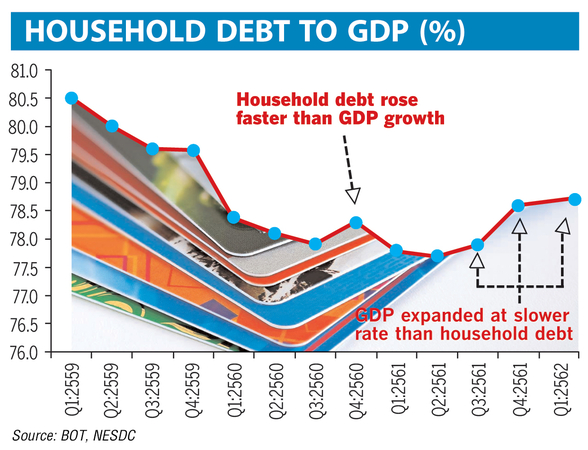
Household debt nationwide stood at Bt13 trillion, rising by 6.3 per cent and accounting for 78.7 per cent of the total GDP – which has been the highest level since the first quarter of 2017.

“We are closely monitoring household debts, as Thai families are vulnerable to an income shock during the economic slowdown,” he said.

As for the low inflation rate of 0.52 per cent in August, which raising concerns about the risk of economic deflation, he said that inflation in the recent months was lower than the 1-per-cent target for the entire year.

He noted that at its last meeting, the central bank’s monetary policy committee expressed worries about low inflation and slower economic growth, leading to a decision to cut the rate by 25 basis points to 1.5 per cent.

He further said that the central bank’s move will help boost economic growth and inflation rate could return to the target of 1 per cent. The central bank and Finance Minister Uttama Savanayana will discuss the inflation target and subsequent monetary policy later, he said.

However, Titinun did not indicate that the central bank will lower its interest rate again.

Household debts rise, as consumers default on loans: NESDC

ศาสตร์เกษตรดินปุ๋ย : ขอบคุณแหล่งข้อมูล : หนังสือพิมพ์ The Nation

https://www.nationthailand.com/business/30375728

Household debts rise, as consumers default on loans: NESDC

Sep 02. 2019
By THE NATION

1,348 Viewed

In the first quarter of this year, household debt nationwide stood at Bt13 trillion, rising by 6.3 per cent and accounting for 78.7 per cent of the total GDP – the highest since the first quarter of 2017, the latest report on Thailand’s Social Situation and Outlook in the second quarter of 2019 from the National Economic and Social Development Council (NESDC) showed.

The report was released on September 2.

The state think-tank warned that household debt has been rising continuously since mid-2017, and in the second quarter of this year, it is likely to continue rising, as commercial banks have granted 9.2 per cent more personal loans.

The outstanding balance of personal loans granted by commercial banks has expanded by 11.3 per cent, the highest since the fourth quarter of 2015. Outstanding loans for homes and automobiles rose by 7.8 and 10.2 per cent respectively, decelerating from 9.1 and 11.4 per cent in the previous quarter.

Non-performing loans (NPLs) to individuals in the second quarter rose 10 per cent from the same period last year with an outstanding balance of Bt127.4 billion. This accounts for 2.74 per cent of total loans and 2.75 per cent of total NPLs. Outstanding non-performing loans for cars and credit cards accelerated at the rate of 32.3 and 12.5 per cent respectively, while personal loans under watch are still at a high level and credit cards with an outstanding balance of more than three months and over has started expanding.

Judging from the trend of household debt in the second half of 2019, housing loans are expected to slow from the first half because the demand for new homes is expected to slow down from the first half as demand for homes is likely to drop and financial institutions are likely to impose restrictions. However, the quality of credit will possibly drop because the government and the central bank have taken measures to give low-income people easier access to loans.

In a move to supervise credit expansion, the Bank of Thailand has revised several regulations for household debts, such as introducing a loan-to-value ratio for home, credit-card and car loans and is also driving the concept of sustainable business finance through the emphasis on corporate governance at an organisational level and in the broader sense.

The authorities have also created opportunities for people or small entrepreneurs who cannot get loans from commercial banks by using mechanisms from state-owned specialised financial institutions, such as promoting Krung Thai Bank to provide more informal loans under the concepts of pico and nano finance as well as launching the People Financial Institution Act, NESDC said.

Expect more job loses as exports contract, tourism slows: NESDC

ศาสตร์เกษตรดินปุ๋ย : ขอบคุณแหล่งข้อมูล : หนังสือพิมพ์ The Nation

https://www.nationthailand.com/business/30375724

Expect more job loses as exports contract, tourism slows: NESDC

Sep 02. 2019
NESDC secretary-general Thosaporn Sirisumphand

NESDC secretary-general Thosaporn Sirisumphand
By Wichit Chaitrong
The Nation

1,078 Viewed

Unemployment is set to rise amid a contraction in exports and a tourism slowdown, warned the National Economic and Social Development Council (NESDC) on Monday.

The state think tank said that despite the unemployment rate remaining low and incomes increasing, the labour market must be closely monitored due to a slowing economy.

There were 37.8 million people employed in the second quarter this year, a decline of 0.3 per cent from the same period last year, according to the report, “Thailand’s Social Situation and Outlook in Q2/2019”, released on Monday.

Employment in the agricultural sector has decreased by 4.0 per cent caused by inclement weather and insufficient water for agriculture, while employment in non-agricultural sectors expanded by 1.5 per cent. The sectors that witnessed higher employment included transportation and storage, construction, education, and hotel and restaurant – an increase of 7.2, 6.2, 3.1, and 1.1 per cent, respectively, NESDC secretary-general Thosaporn Sirisumphand said.

The wholesale/retail and manufacturing sectors saw reduced employment of 0.4 and 0.5 per cent, respectively, which was consistent with the slowdown in exports.
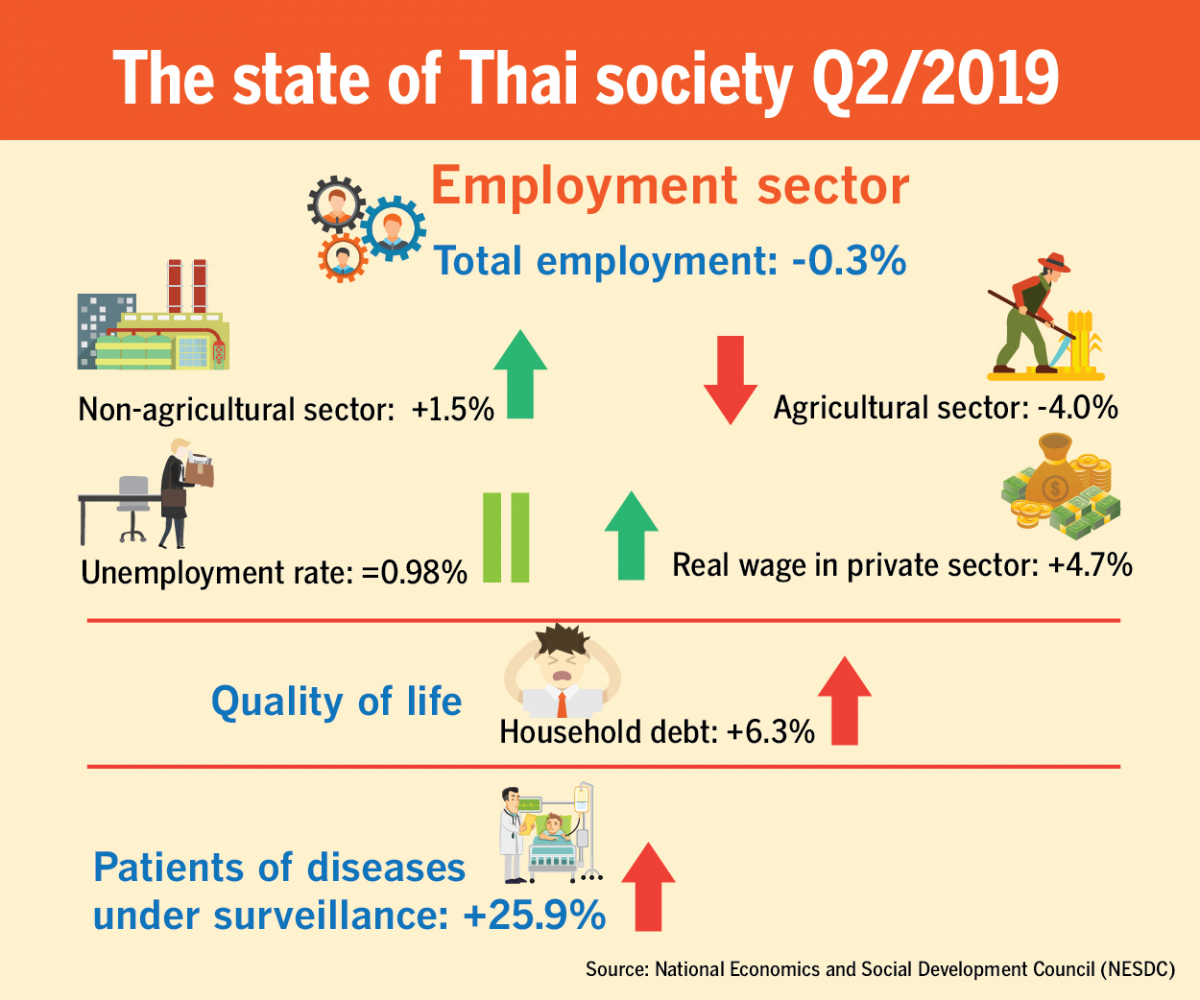
The unemployment rate was 0.98, a slight increased from 0.92 in the previous quarter, but it was lower than the rate of 1.07 per cent in the second quarter last year.

“Real wages in the private sector increased by 4.7 per cent, and saw an increase of 5.4 per cent in the agricultural industry, while salaries in the non-agricultural sector increased by 3.7 per cent. Overall labour productivity increased by 2.6 per cent,” Thosaporn said.

Anusorn Tamajai, an economist at Rangsit University, said the low inflation rate contributed to the rise in incomes. “We may need to review the method for calculating inflation so that it accurately reflects economic conditions, as people are complaining about the rising costs of living,” he suggested.

The state think tank is worried about the labour market outlook.

The exported products that witnessed a significant contraction in the first half of the year included rice, rubber, cassava, and sugar, rubber products, computer equipment parts, integrated circuits, passenger car parts, machinery equipment, chemicals, and petroleum products. This contraction was expected to affect approximately 5.1 million people in total. At the same time, the number of tourists was likely to decrease, which could affect the service sector and related industries.

However, the Cabinet has already approved measures to alleviate the effects of the economic slowdown. One of them is to support new business models that are growing rapidly, for instance express delivery services such as Lineman, Grab, Foodpanda, Get, and Skootar, which are part of the transportation/storage sector. Employment in this sector has gradually increased, especially this quarter, by 7.2 per cent and is likely to continue growing in line with e-commerce business growth.

Government agencies need to review regulations to cover employment in this job scenario with new working patterns so that employees of businesses on online platforms are protected the same as those in other sectors, the NESDC said.

Moreover, this should be linked with consumer protection for customers who use online platform services so that they receive standardised service and are not deceived, the council added.

SME D Bank rolls out relief measures for flood-hit clients

ศาสตร์เกษตรดินปุ๋ย : ขอบคุณแหล่งข้อมูล : หนังสือพิมพ์ The Nation

https://www.nationthailand.com/business/30375721

SME D Bank rolls out relief measures for flood-hit clients

Sep 02. 2019
Phongcharn

Phongcharn
By The Nation

555 Viewed

The Small and Medium Enterprise Development Bank of Thailand (SME D Bank) has implemented two emergency relief measures for its SME clients affected by flooding in the wake of tropical storm Podul in the northern, northeast and the central regions of Thailand, said Phongcharn Samphaongern, senior executive vice president acting in the capacity of the bank’s president.

The floodwaters have seriously damaged their operations, he added.

Under the measures, the bank will:

1) Suspend debt repayment for term loan on both principal and interest for 6 months. For promissory note, interest repayment will be suspended for six months.

2) The bank will provide emergency loans for rehabilitation with a maximum repayment period of five years and a one-year grace period. It will charge an interest rate of 0.415 per cent per month. The criteria for the maximum loan amount are specified below:

1) A customer with a maximum credit limit of Bt1 million will able to ask for a loan that doesn’t exceed Bt500,000.

2) A customer who has a credit limit of more than Bt1 million but not exceeding Bt5 million is eligible for a loan that doesn’t exceed Bt1 million.

3) A customer with a credit limit of more than Bt5 million can ask for a loan that doesn’t exceed Bt2 million. The new loan will be combined with previous lending and not exceeding a total of Bt15 million.

For SMEs seeking help on rehabilitation, the bank has prepared a package with a special interest rate for investment and improvement as well as a local economy loan aimed at providing operation expenses for businesses in the fields of agro-industrial, tourism, retail, local products and farm produce.

The bank will personal loans with a special interest rate of 0.417 per cent per month for the first three years or an average of 5 per cent per year. Corporate loans are also on offer, at 0.25 per cent per month or an annual average of 3 per cent in the first three years.

Customers could apply for the loans on ‘SME D Bank’ application. The bank may ask for additional documents that will hasten the approval process.

The bank’s staff in flood-hit areas will offer prompt support. For further inquiries, call 1357.

Thailand, South Korea sign six MOUs as Moon visits

ศาสตร์เกษตรดินปุ๋ย : ขอบคุณแหล่งข้อมูล : หนังสือพิมพ์ The Nation

https://www.nationthailand.com/business/30375716

Thailand, South Korea sign six MOUs as Moon visits

Sep 02. 2019
South Korean President Moon Jae-in, left, and Prime Minister Prayut Cha-o-cha 
(Photo credit: Royal Thai Government website)

South Korean President Moon Jae-in, left, and Prime Minister Prayut Cha-o-cha (Photo credit: Royal Thai Government website)
By THE NATION

996 Viewed

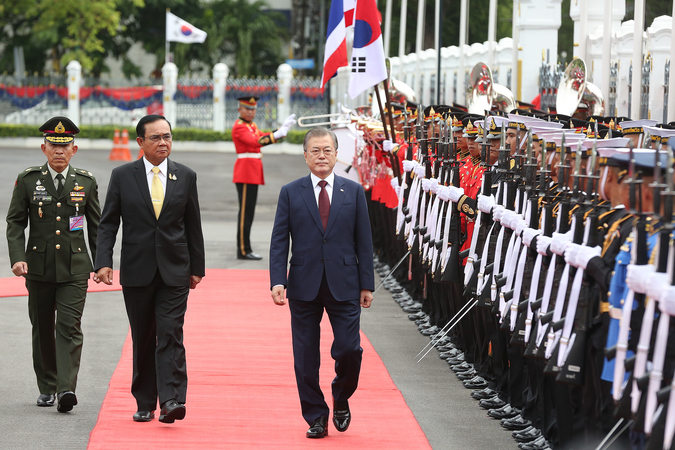
Prime Minister Prayut Cha-o-cha and South Korean President Moon Jae-in witnessed the signing of six memoranda of understanding (MOU) at Government House on Monday on the occasion of Moon’s official visit to Thailand.

The Cabinet and ambassadors of both countries, as well as executives of the private sector, attended the event.

Prayut, who is also the defence minister, and Moon held discussions before the signing.

The six MOUs are:

1. Cooperation in water resources administration, which will promote the sustainable development and management of water resources in Thailand and South Korea with a focus on equality and shared profits, as well as preparedness for climate change. This MOU was signed by Deputy Prime Minister Prawit Wongsuwan and South Korean Foreign Minister Kang Kyung-wha.

2. Cooperation in education, which will promote the study of the Korean language for Thai students at the primary and secondary levels. The agreement was inked by Education Minister Nataphol Teepsuwan and his South Korean counterpart Yoo Eun-hae.

3. Cooperation in classified military intelligence, which will promote the exchange of information between both countries and set the criteria for information and intelligence protection. The pact was signed by Foreign Minister Don Pramudwinai and his South Korean counterpart Kang Kyung-wha.

4. Agreement between Thailand’s Industry Ministry and South Korea’s Trade, Industry and Energy Ministry with an emphasis on Industry 4.0 cooperation, promotion of selected industries, industrial investment, manpower development and assisting SMEs to become more competitive. This MOU was signed by Industry Minister Suriya Juangroonruangkit and South Korean Trade Minister Yoo Myung-hee.

5. Extension of the rail-system cooperation between Thailand’s Transport Ministry and South Korea’s Land, Infrastructure and Transport Ministry, which was valid for two years. The agreement extends the validity of this MOU for another two years, and was signed by Transport Minister Saksayam Chidchob and South Korean Ambassador to Thailand ‎Lee Wook-heon.

6. Cooperation in smart city development between Thailand’s Digital Economy and Society Ministry and South Korea’s Land, Infrastructure and Transport Ministry, which will promote the exchange of policies, technology, information and human resources to develop smart cities in both countries. The MOU was signed by Digital Economy Minister Buddhipongse Punakanta and Ambassador ‎Lee.

Moon’s official visit kicks off a strategic partnership between Thailand and South Korea that will help strengthen their relationship and cooperation under bilateral, sub-regional and regional frameworks.

Both countries also agreed to set up a joint working panel between their boards of investment to promote South Korean investment in Thailand.

Consumer price index rises 0.52 per cent

ศาสตร์เกษตรดินปุ๋ย : ขอบคุณแหล่งข้อมูล : หนังสือพิมพ์ The Nation

https://www.nationthailand.com/business/30375707

Consumer price index rises 0.52 per cent

Sep 02. 2019
By The Nation

430 Viewed

The consumer price index, or inflation, in August increased 0.52 per cent compared to the same month last year but was lower than the 0.98 per cent witnessed in July this year, according to the Commerce Ministry on Monday.

Inflation in the first eight months of this year increased 0.87 per cent compared to the same period last year, the ministry said.

A price increase of 5.15 per cent for fresh food – mainly sticky rice, pork, egg, fruit and vegetables – is the main reason inflation rose in August.

However, energy costs decreased 5.16 per cent following a drop in global prices, the ministry said.

With the global economy, including the country’s, witnessing slight growth, the ministry maintains that inflation this year will be between 0.7 per cent and 1.3 per cent.

S Korea’s Moon welcomed at Govt House

ศาสตร์เกษตรดินปุ๋ย : ขอบคุณแหล่งข้อมูล : หนังสือพิมพ์ The Nation

https://www.nationthailand.com/business/30375706

S Korea’s Moon welcomed at Govt House

Sep 02. 2019
By THE NATION

629 Viewed

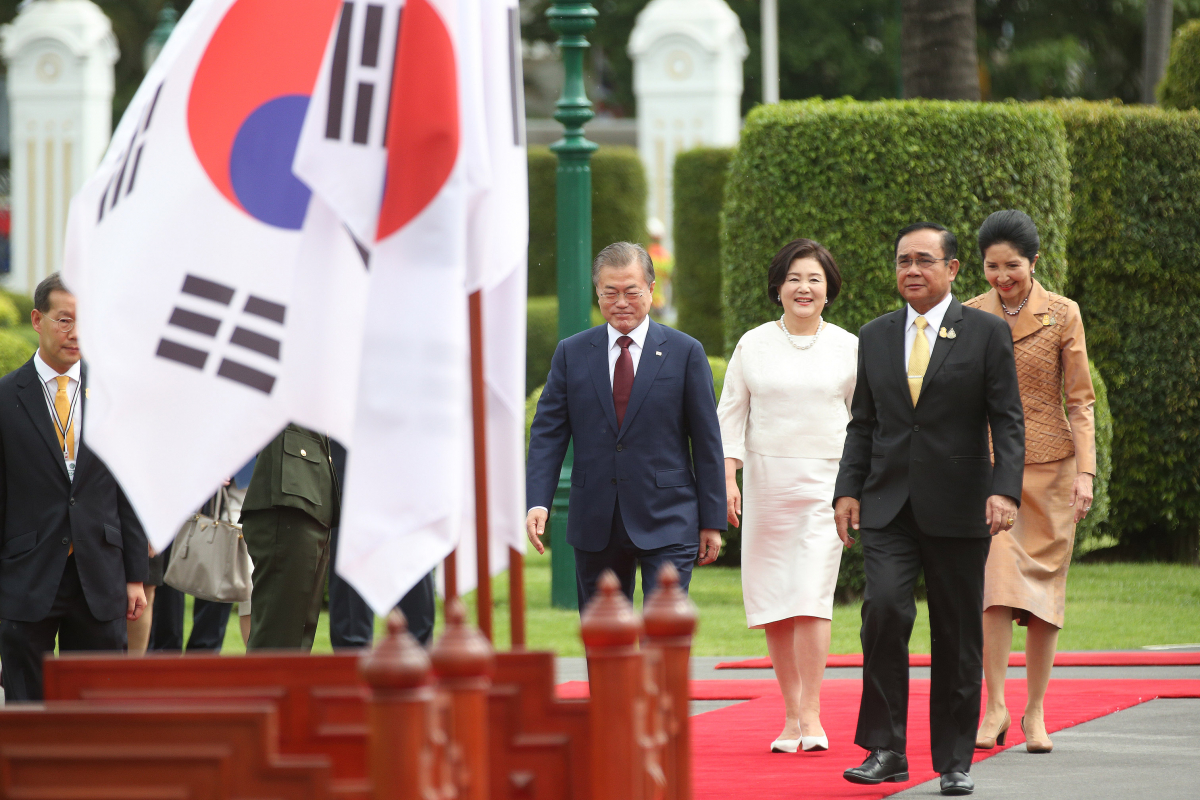
Prime Minister Prayut Chan-o-cha and his spouse welcomed South Korean President Moon Jae-in and his wife Kim Jung-sook to Government House on Monday (September 2) in the midst of an official state visit that continues into Tuesday.

A government spokesperson Narumon Pinyosinwat said this was President Moon’s first official visit to Thailand since assuming his post in May 2017 and the first visit by any South Korean president in seven years.

The aim of the visit is to strengthen the strategic partnership with Thailand in accord with Seoul’s New Southern Policy, by which it is seeking more interaction with all counties in Southeast Asia and cooperation with the Association of Southeast Asian Nations (Asean).

The two leaders will witness the signing of six agreements and memoranda during Moon’s stay.

Voice TV leaves the air, receives compensation

ศาสตร์เกษตรดินปุ๋ย : ขอบคุณแหล่งข้อมูล : หนังสือพิมพ์ The Nation

https://www.nationthailand.com/business/30375701

Voice TV leaves the air, receives compensation

Sep 02. 2019
By THE NATION

262 Viewed

The National Broacasting and Telecommunications Commission (NBTC) on Monday (September 2) handed net compensation of Bt372.64 million to Voice TV for its return of a terrestrial digital TV broadcasting licence to the watchdog.

The channel was switched off at midnight on August 31.

In May this year, six broadcasters informed the regulator of their intention to hand back the seven licences they had secured from the NBTC. May 10 was the deadline for broadcasters to declare their intention.

They are Spring News Television Co Ltd (for Spring News Channel 19) and Nation Multimedia Group (for Spring 26, formerly NOW26). The others are Bright TV (for Channel 20), Voice TV (Channel 21), MCOT (Family Channel 14) and BEC Multimedia (Family Channel 13 and 3SD Channel 28).

Spring 26, Spring News and Bright TV shut down their channels at midnight on August 15. Spring 26 received net compensation of more than Bt341.191 million, Spring News more than Bt405.837 million, and Bright TV above Bt273.419 million.

MCOT Channel 14 will exit at midnight of September 15. BEC Channel 28 and Channel 13 leave the airwaves at midnight of September 30. After these final exits, there will be 15 channels left in the crowded market.

The NBTC awarded 24 commercial digital TV licences via auction in December 2013, amassing around Bt50.862 billion in bid payments. Their 15-year licences were good from April 25, 2014.

However, the broadcasters found it difficult to survive due to unfavourable market conditions, coupled with brutal competition from formidable online media channels.

Dividends coming despite drop in profits

ศาสตร์เกษตรดินปุ๋ย : ขอบคุณแหล่งข้อมูล : หนังสือพิมพ์ The Nation

https://www.nationthailand.com/business/30375658

Dividends coming despite drop in profits

Sep 02. 2019
By The Nation

634 Viewed

The Stock Exchange of Thailand has been informed by 154 listed companies that they plan to pay interim dividends totalling a combined Bt115 billion, even though most saw a decline in net profits in the first half of the year.

The top five companies paying dividends are Advance Info Service Plc (dividends worth Bt11.23 billion), PTT Exploration and Production (Bt8.93 billion), Siam Cement Plc (Bt8.4 billion), Siam Commercial Bank Plc (Bt5.09 billion) and Thanachart Capital Plc (Bt4.58 billion).

Kasikorn Securities Plc calculated that the dividend payments for the first half topped net profit, which dropped 17 per cent from the same period last year.

“Most of the listed companies have decided to pay the dividend because they’ve delayed their investment plans due to slower national economic growth,” the firm said in a statement. “Paying a dividend to their shareholders is better than keeping cash in reserve.”

Terdsak Taweethiratham, vice president of Asia Plus Securities Co Ltd, said the dividend represented about 54 per cent of net profits from the first half of the year.

5G concept stocks top picks by major securities houses in Taiwan

ศาสตร์เกษตรดินปุ๋ย : ขอบคุณแหล่งข้อมูล : หนังสือพิมพ์ The Nation

https://www.nationthailand.com/business/30375671

5G concept stocks top picks by major securities houses in Taiwan

Sep 01. 2019
Photo: The company says MediaTek ready to rollout 5G with technology for sub-6GHz and mmWave for a new era of super-fast connectivity to make great technology available to everyone.

Photo: The company says MediaTek ready to rollout 5G with technology for sub-6GHz and mmWave for a new era of super-fast connectivity to make great technology available to everyone.
By The China Post/ANN

689 Viewed

TAIPEI (CNA) — A survey of the investment strategies among five major securities houses in Taiwan showed Saturday that their top picks for September are among the companies that are devoted to developing 5G technology.

The survey, which has compiled the survey results among Capital Securities, Fubon Securities, President Securities, KGI Securities and Cathay Securities, found that 5G concept stocks would be the top picks for them, followed by Apple concept stocks and auto stocks.

As one of the analysts who favors 5G-related stocks, Li Fang-kuo (黎方國), chairman of Uni-President Investment Consulting, said he recommended Taiwanese suppliers to Chinese smartphone brand Huawei Technologies Co., which has been gearing up to grasp a large share of the 5G market.

Among the 5G concept stocks, the local media reported recently that Hsinchu-based integrated circuit designer MediaTek Inc. is expected to receive orders from Huawei to supply 5G chips in the first quarter of next year, and the new business is expected to serve as a driver to the Taiwanese firm’s shipment growth for 2020.

Li said that while trade tension between the United States and China has sent ripples through the global financial markets, investors had better take a close look at those stocks that have a niche market, such as 5G technology.

Li said he also has hopes that the launch of the next-generation iPhones will allow Apple suppliers in Taiwan to enjoy growing sales momentum for the rest of this year.

Earlier this week, Apple issued an invitation to the press to a “special event” Sept. 10. While the U.S. consumer electronics giant did not release more details about the event, the market has widely anticipated that the company will unveil three new iPhone models.

Among the major suppliers in Taiwan for iPhones are assembler Hon Hai Precision Industry Co. and smartphone camera lens maker Largan Precision Co. Apple accounts for more than 40 percent of the two companies’ total sales a year, according to market estimates.

In addition to 5G and iPhone-related stocks, Capital Marathon Fund’s Shen Wan-chun (沈萬鈞) said he also favored stocks related to the development of electric cars at a time when more and more consumers are putting emphasis on an eco-friendly environment.

Shen said he also has faith in companies that have devoted themselves to artificial intelligence and the Internet of Things.

In August, the weighted index on the Taiwan Stock Exchange, or Taiex, fell 205.76 points, or 1.90 percent, from July, as the U.S. and China increased trade tariffs on each other’s goods with no signs that the trade dispute will be resolved any time soon. On Friday, the Taiex ended at 10,618.05 points.

Li said the U.S. Federal Reserve is likely to cut its key interest rates again in a policymaking meeting in September after a reduction in July, to assuage the impact resulting from the trade war, so that the stock market could ride the wave of rising liquidity in the month.

The debut of the new iPhones and a back-to-school buying spree, Li said, is expected to lend more support to the local main board next month.

The analyst said the Taiex could move between 10,460 and 10,920 points during the month.

https://chinapost.nownews.com/20190901-720631