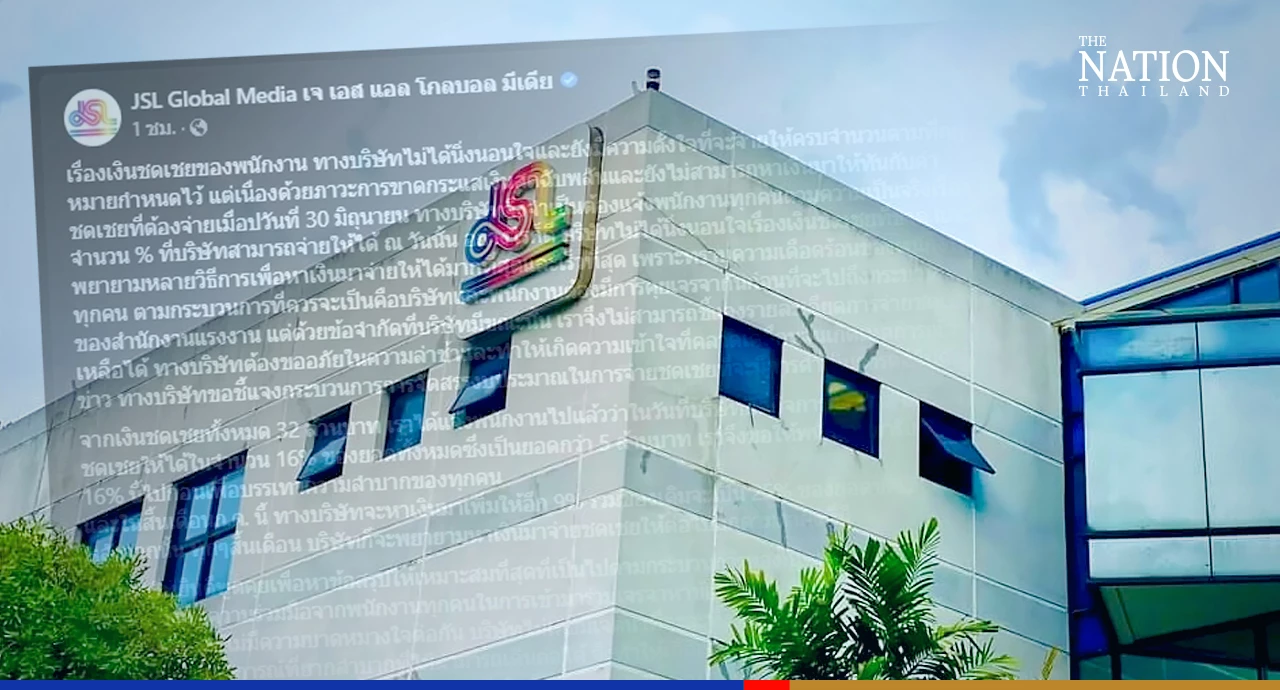
JSL Global Media has sold its building so that it can pay 32 million baht as compensation to laid-off employees in one lump sum instead of disbursing the amount in instalments as announced earlier.
Decha Kittiwitthayanun, a celebrity lawyer who has stepped in to help the employees fight the case, announced on his Facebook wall that he would lead the workers to receive the compensation at the Area 4 Employment Office at 9.30am on Wednesday.
Decha announced that Labour Minister Suchart Chomklin would be present to witness the compensation payout.
“Please spread this news. I did this job for workers. And the Labour Ministry should be credited for stepping up pressure on JSL until it agreed to pay every satang of the compensation of over 30 million baht to the workers. It has sold the head office building to raise the money,” Decha said in his post.
JSL Global Media announced at the end of June that it was immediately ceasing operations and had to lay off all staff mainly because of losses.
The company announced on its Facebook wall on July 5 that it owed 32 million baht in compensation to the staff but due to its liquidity crunch, it could pay only 16 per cent of the compensation amount at the end of June and another 9 per cent at the end of July. It said it would pay the rest of the compensation in monthly instalments as per the company’s ability to earn money.
But Decha led 79 former JSL employees to file complaints against the firm at the Area 4 Employment Office, alleging that JSL was violating the labour protection act of BE 2541.
The planned merger of telecom giants sparked more public opposition on Monday as a civil society group petitioned the National Broadcasting and Telecommunications Commission not to accept the deal.
Promsorn “Fah” Weerathamcharee, representing a civil group for communication freedom, submitted a letter opposing the merger of True Corporation and Total Access Communication (Dtac) at NBTC headquarters in Bangkok.
NBTC Office acting secretary-general Trairat Wiriyasirikul came out to receive the letter.
In the letter, the group called on the NBTC to exercise its power to reject the merger deal on grounds that it would damage consumer interests by creating a near monopoly of telecom services.
The letter also expressed disagreement with the NBTC petitioning the Council of State, the government’s legal advisers, to decide on whether the commission has the authority to consider the merger.
The Council of State replied on July 27 that it would not accept the request for deliberation, prompting the NBTC to ask the prime minister on August 25 to order the Council of State to accept the request.
The civil group argued that the NBTC is an independent organisation under the Constitution and so should not bow down to the government.
It noted that Section 60 of the charter requires the NBTC to supervise telecom businesses to ensure free and fair competition by taking the public and national interests into account.
If the merger is approved, different service costs would rise in a range from 2.03 to 244 per cent as competition would be reduced from three major telecom players to two, the group added.
It also voiced concern that a merger would victimise small retailers, as the merged firm would use its own retail channels to sell SIM cards. CP Group, the parent firm of True Corp, also owns 7-Eleven and the Lotus retail chain.
On August 24, the NBTC voted 3:2 to ask the Council of State via the PM’s Office to consider whether the NBTC has the power to stop the merger.
A month earlier, True and Dtac executives held a joint press conference to declare that the NBTC had no power to stop the merger, saying the telecom law allowed the deal to go ahead without permission from the telecom watchdog. The two firms said the NBTC only had power to regulate the merged firm via consumer-protection measures.
The NBTC’s August 24 meeting also considered a joint letter from True and Dtac asking the telecom watchdog to speed up its decision.
True Corp has launched a public campaign on its TrueVisions network, saying the public would stand to gain from the new technology firm that would be set up after the merger.
The NBTC responded by publishing “five facts about True-Dtac merger” on its website on Thursday. The “five facts” indicated negative impacts from the merger.
The next day, True and Dtac complained that the “five facts” post had caused public misunderstanding, damaging their reputations and business.
The NBTC then hastily removed the post from its website.
Establishing confidence in the “Mothership” strategy to become a regional financial technology group
Bangkok, August 29 – SCB X Public Company Limited (SCBX) has had its credit rating published for the first time by international rating agencies Moody’s Investors Service and Fitch Ratings. Moody’s has issued SCBX a “Baa2” Foreign and Local Currency Long-Term Issuer Rating, while Fitch has assigned SCBX a “BBB” Long-Term Issuer Default Rating. SCBX is the first financial holding company in Thailand to be rated “Investment Grade”, which reflects SCBX’s solid financial position and prudent risk management framework by global standards. It also bolsters confidence in SCBX’s plan to transform the company into a regional financial technology group creating long-term value and sustainable growth.
Both Moody’s and Fitch regard SCBX as an “Investment Grade” issuer. SCBX’s ascent to become the ultimate parent of the group is reflected in its solid governance framework, robust capital and liquidity management, and resilience in the face of adverse conditions, all of which contribute to its strong credit ratings.
SCBX has established a solid financial foundation with a vision to be a regional financial technology group. The company’s long-term objectives include amassing a client base of over 200 million, operating as a platform that connects the ecosystem at home and abroad, joining the high-growth consumer loan market, and integrating the digital asset business into the group to generate value rapidly.
Manop Sangiambut, Chief Finance and Strategy Officer of SCBX, said “We are delighted to have received solid “Investment Grade” credit ratings from reputable international rating agencies. This rating will be crucial for our fundraising in the future. We are confident that this development will broaden investor confidence in the company. SCBX will continue to build financial strength in order to invest and create shareholder value in the foreseeable future.”
The baht opened at 36.46 to the US dollar on Wednesday, weakening from Tuesday’s close of 36.38.
The currency is expected to move between 36.30 and 36.55 during the day, Krungthai Bank market strategist Poon Panichpibool predicted.
He said the baht is likely to fluctuate across a wide range and could weaken as the dollar is strengthening.
Poon however speculated that the baht would not weaken past its key resistance level of 36.50 as exporters are waiting to offload the dollar at that level.
Moreover, foreign investors do not appear to be in a hurry to sell their Thai assets and Poon believes they will in fact purchase more Thai stocks as prices head down while investors are wary of taking risks in the US and European stock markets.
However, he noted the baht could be volatile today, Wednesday, especially as China announces various economic results.
If the Chinese economic data is much worse than expected, it might pressure Emerging Asia assets or cause currencies to weaken, he said.
Meanwhile, the baht might fluctuate as the dollar and euro might come under pressure if investors are certain the European Central Bank would decide to increase the interest rate, Poon pointed out.
The strategist advised investors to use hedging tools such as options to manage risks in a highly volatile currency market.
Thai investors could pick up more equities and bonds, as the two asset classes are available at attractive prices amid global clues of peak inflation and recession, said Eastspring Investments, a leading Asia-based asset manager.
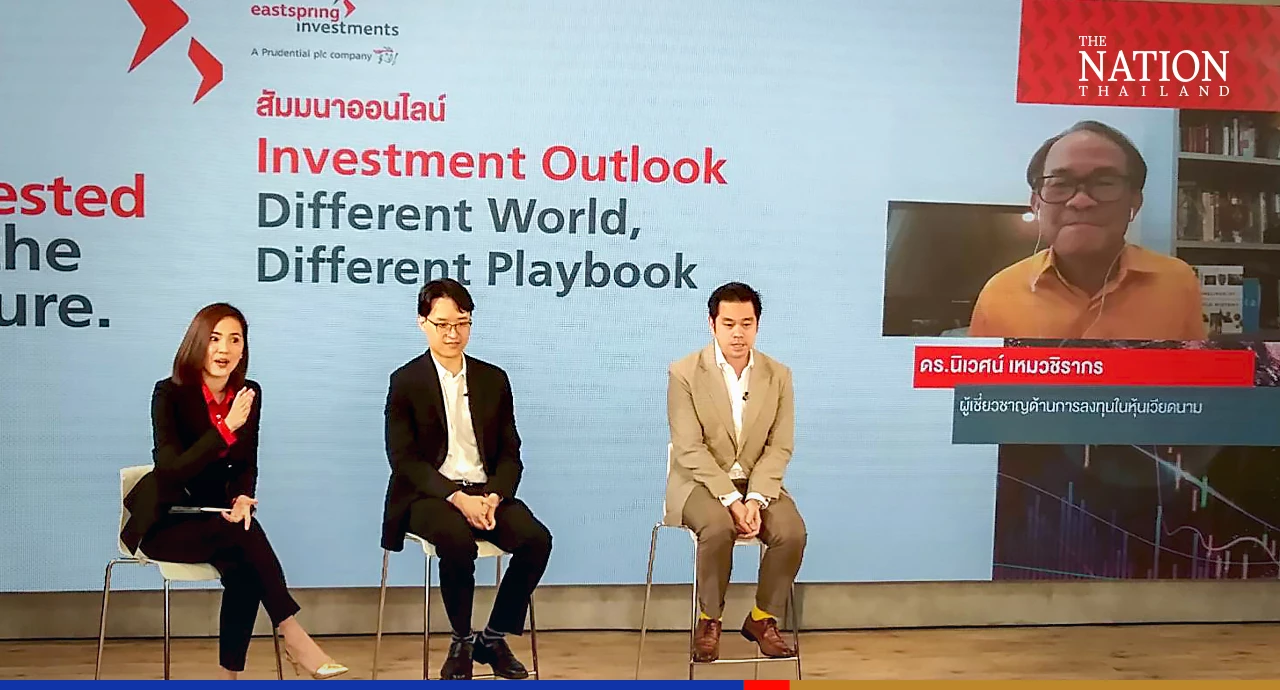
Speaking at a seminar titled “Investment Outlook: Different World, Different Playbook” on Tuesday, the chief investment officer of Eastspring Asset Management (Thailand), Yingyong Chiravutthi, said that economic and investment outlooks are related but not on the same page.
It means that even though the situation of the current global economy appears quite dim, there is always some path to profit from the market, said Yingyong.
He said that equities and bonds are beginning to trade at attractive prices. During this time, investors are advised to diversify and invest more in equities, whether in the US, China, Vietnam or Thailand, as opposed to bonds.
“Regarding equities, we retain a positive view of US shares, particularly growth stocks. We believe that peaking inflation and interest rates present opportunities to buy longer-duration bonds. After the interest rates were raised 2-3 times, the market has started to recover and generate good returns,” said Yingyong.
He added that when inflation and interest rates start to decrease, growth stocks tend to perform better.
In Chinese equities, the company believes that investors will continue to benefit from low-interest rates and the Chinese government’s supportive measures.
Still, concerns may loom over China’s real estate debt over the next 3-6 months.
“Vietnamese equities are suitable for long-term investment while we are quite positive on Thai equities, especially low-volatility and high-dividend stocks, since they will be less affected by the global economic slowdown as well as global political issues,” Yingyong noted.
Niwet Hemavachirawarakorn, a leading investment expert in Thailand who spoke at the seminar, concurs with the advice to invest in Vietnamese equities. He described Vietnam as one of the most promising markets for long-term investment due to the fast-growing economy, low-cost skilled labour, and high consumption market.
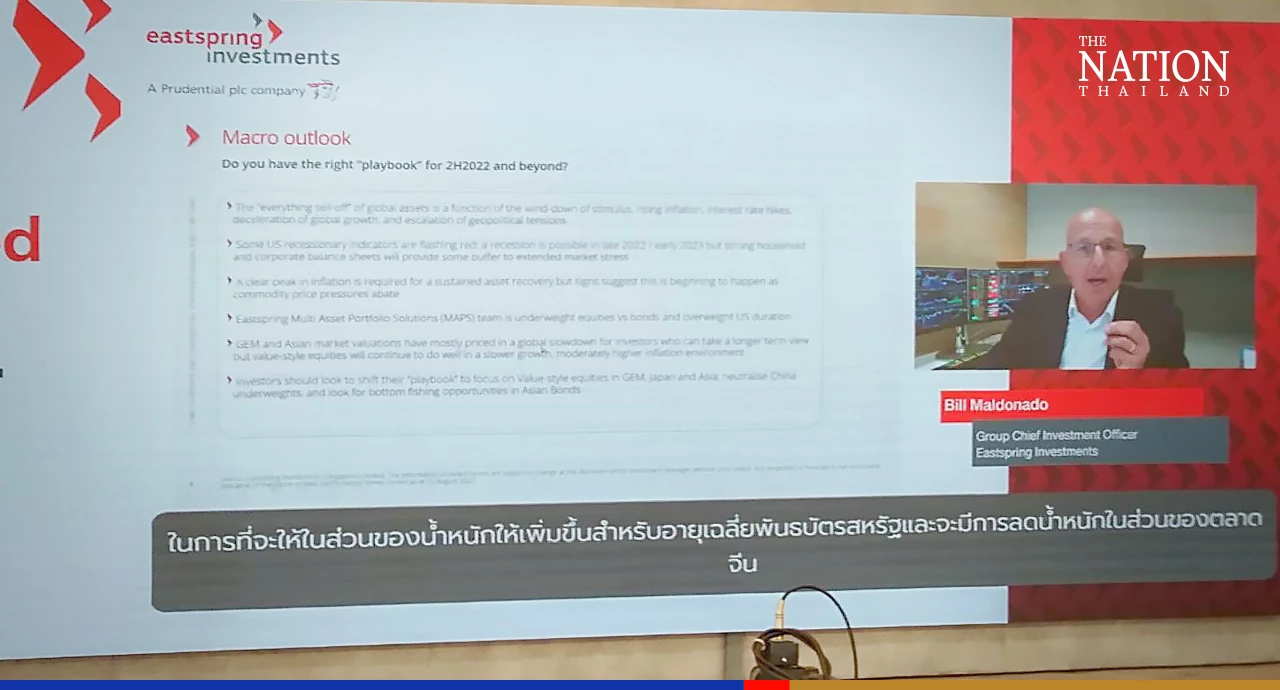
Eastspring Investments chief investment officer Bill Maldonado noted that inflation had started to decline, a little accomplishment for the US Federal Reserve which jacked up interest rates to curb high inflation.
In this scenario, Maldonado suggested that investors consider low volatility, value and dividend-paying stocks, while the peaking inflation presents opportunities to buy longer-duration bonds.
Regarding Chinese equities, he predicted more aggressive fiscal and monetary policies in the second half of 2022, which will benefit China’s A-share market.
As for the overall Asian economic outlook, Maldonado said that consumption is likely to continue to shift from goods to services as Covid restrictions are eased.
He pointed out that Asean economies should benefit from the reopening boost which is especially positive for Thailand whose economy is highly reliant on tourism. Commodity-based economies like Malaysia and Indonesia should also see good GDP growth in 2022.
Meanwhile, during times of high market volatility and high inflation, real assets, such as gold, are attractive havens.
He warned that the major risk over the next 6 to 12 months would be geopolitical tensions continuing to cause market volatility.
Meanwhile, global economic growth will also continue to be affected by supply chain disruptions and interest rate hikes.
Arm Tungnirun, director of the Chinese Studies Centre, Chulalongkorn University, and Wit Sittivaekin, an economics expert, shared their perspectives, providing broader information about the global economy in the years ahead.
Arm said investors should keep their eyes on the annual meeting of the Communist Party of China in October, which will give investors a hint of China’s policy and economic direction.
Meanwhile, Wit suggested that investors monitor the United States’ mid-term elections to the House and Senate in November.
Yingyong concluded that investors should not only keep track of global movements, but also diversify portfolios by not putting too much weight on a single asset. This is a good investment strategy that will reduce volatility in any situation.
Business leaders are worried that electricity-price rises will see costs surge in Thailand’s industrial sector, according to a Federation of Thai Industries (FTI) survey.
The Energy Regulatory Commission (ERC) has announced it will hike the fuel tariff from next month until December, resulting in a record high of 4.72 baht per unit of electricity.
The FTI survey asked 215 executives how the increase in electricity costs will affect their Thai industry. Most worried that the hike was too high, said FTI vice-chairman Montri Mahaplerkpong, revealing the survey results on Tuesday.
Survey respondents said the higher electricity cost would cause the price of products to rise, driving up the cost of living even further. It would also hit Thailand’s ability to compete with Vietnam, which has kept its electricity cost to 2.8 baht per unit for 2022, they said.
Montri forecast the price of products and services in Thailand would rise by 10 per cent by the end of this year.
Most executives surveyed want the government to limit the fuel tariff hike to 5 per cent while also issuing relief measures for SMEs and people on low income.
So far, the Electricity Generating Authority of Thailand (EGAT) has shouldered increased production costs amounting to about 83 billion baht. But this burden will be shared by consumers via the tariff hike from next month.
However, Montri urged the government to review its electricity pricing structure for every sector and also open up the market for private companies to invest in power plants. He also wants authorities to reduce the time it takes for companies to get permission to use renewable energy equipment.
He explained that the private sector is preparing for the electricity hike by investing in renewable energy sources such as solar rooftops in a bid to remain competitive.
The Energy Business Department announced on Tuesday that the rise in oil and gas consumption during the first seven months of this year showed that the country’s economy was recovering.
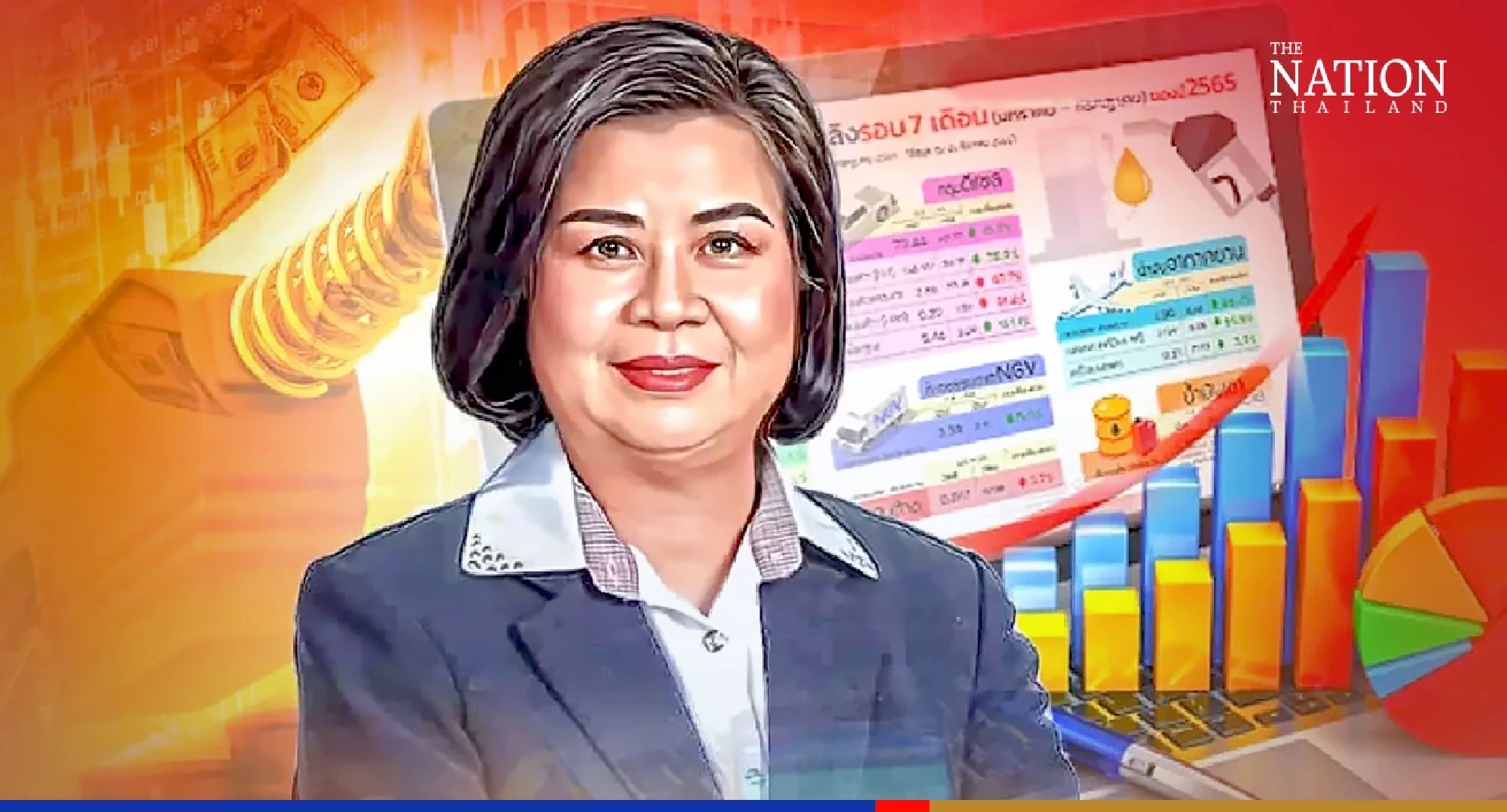
Nunthika Thungsupanich, director-general of the department, said an average of 151.04 million litres of oil were consumed daily from January to July, an increase of 13.5 per cent from the same period of last year.
The average daily consumption comprised 29.80 million litres of petrol (up 2.4 per cent); 73.44 million litres of diesel (up 16.2 per cent); 6.32 million litres of bunker oil (up 18.9 per cent); and 7.8 million litres of aircraft petrol (up 66.7 per cent).
She said the consumption of LPG rose to 18.17 million kilograms per day, a 9.4 per cent increase, and NGV rose to 3.39 million kg per day, a 5.6 per cent increase.
Nunthika added that the import of oil rose to about 1.031 million barrels per day — 963,155 barrels of crude oil and 68,427 barrels of refined petroleum — from January to July, an increase of 14.5 per cent from the same period last year.
She said the oil consumption rose mainly because of the government’s measures to stimulate the economy.
The government believes the tourism industry is on the path to recovery and expects a 1,800-per-cent surge in foreign arrivals in the second half of this year.
Deputy government spokesperson Ratchada Thanadirek said on Tuesday that several figures clearly point to a recovery in the tourism industry.
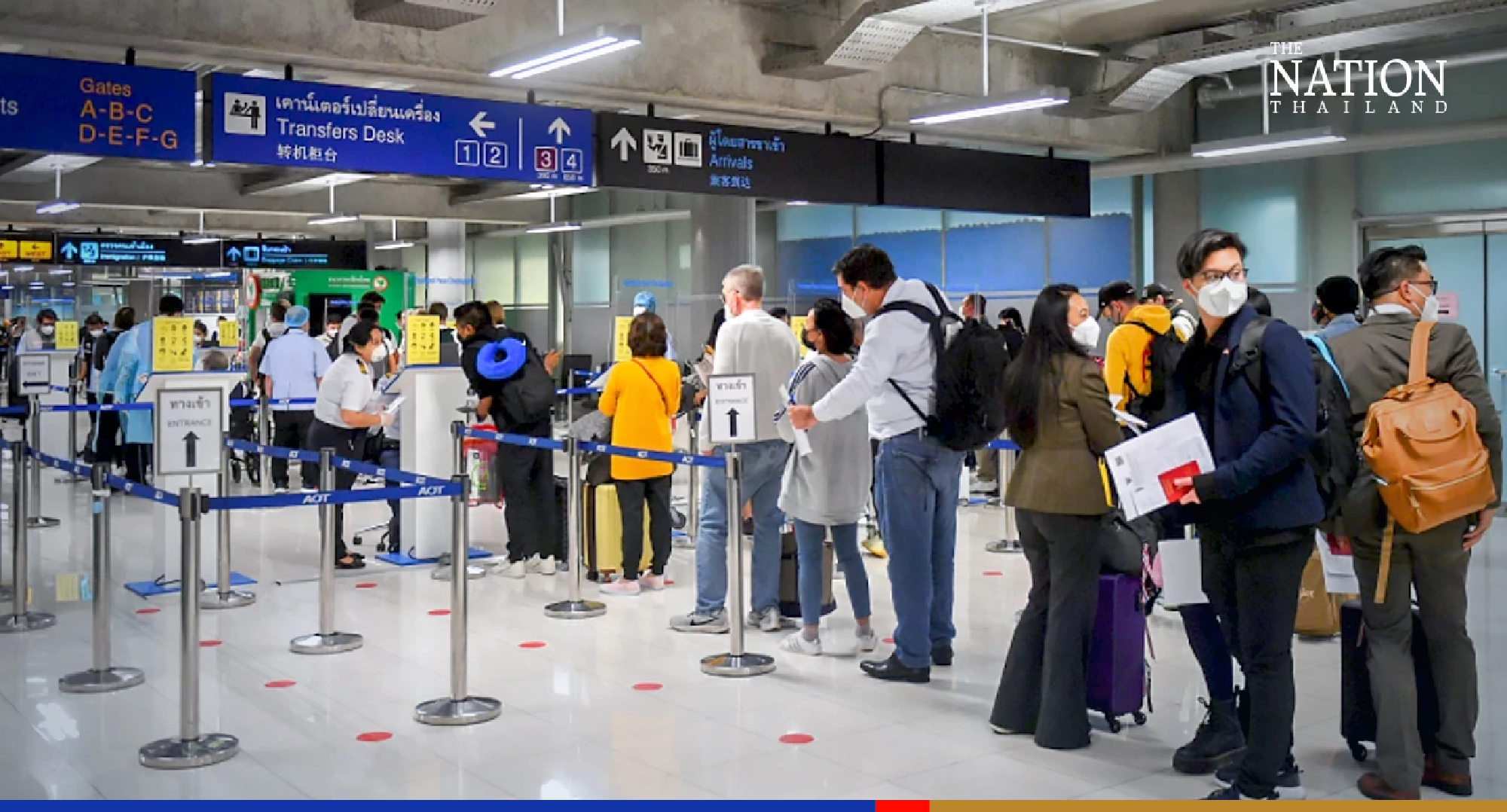
She said more than 4 million foreign tourists have landed in Thailand over the first eight months of the year, and the government expects to log 7.5 million arrivals from July to December. This will mark a 1,840 per cent increase from the same period last year.
Ratchada added that the country can expect to earn 400 million baht from tourist spending in the second half.
She also cited four factors that will promote tourism, namely:
• Airlines resuming flights and launching new routes
• Many countries easing entry and departure restrictions making it easier to travel
• China allowing the resumption of some international flights
• Thailand has reopened border checkpoints to welcome tourists from neighbouring countries
Ratchada added that figures from the Commerce Ministry’s Business Development Department also indicate a tourism recovery.
The department reported that 549 new tour-guide and hotel-booking businesses with a capital of 989 million baht were registered in the first seven months of this year. This marked a 169 per cent and 226 per cent increase in the two business streams, respectively.
As of the end of July, there were 11,891 tourism and hotel-booking operators worth about 43 billion baht.
If the investment in tourism businesses is broken down by the nationality of owners, then 37 billion baht was invested by Thais (87.2 per cent), 1.1 billion baht by Chinese (2.6 per cent), 528 million baht by South Koreans (1.2 per cent), 445 million baht by Indians (1 per cent) and 3.4 billion baht by other nationalities (8 per cent).
The spokesperson said the recovery can be attributed to the cooperation from all sectors and several government measures introduced to stimulate the tourism industry.
For instance, she said, the government has extended the period covered by visa-on-arrival and has launched several campaigns to promote popular destinations.
She added that though the government expects some 10 million foreign arrivals, it is concerned that new viruses, the Russia-Ukraine war and global inflation will affect people’s decision to travel.
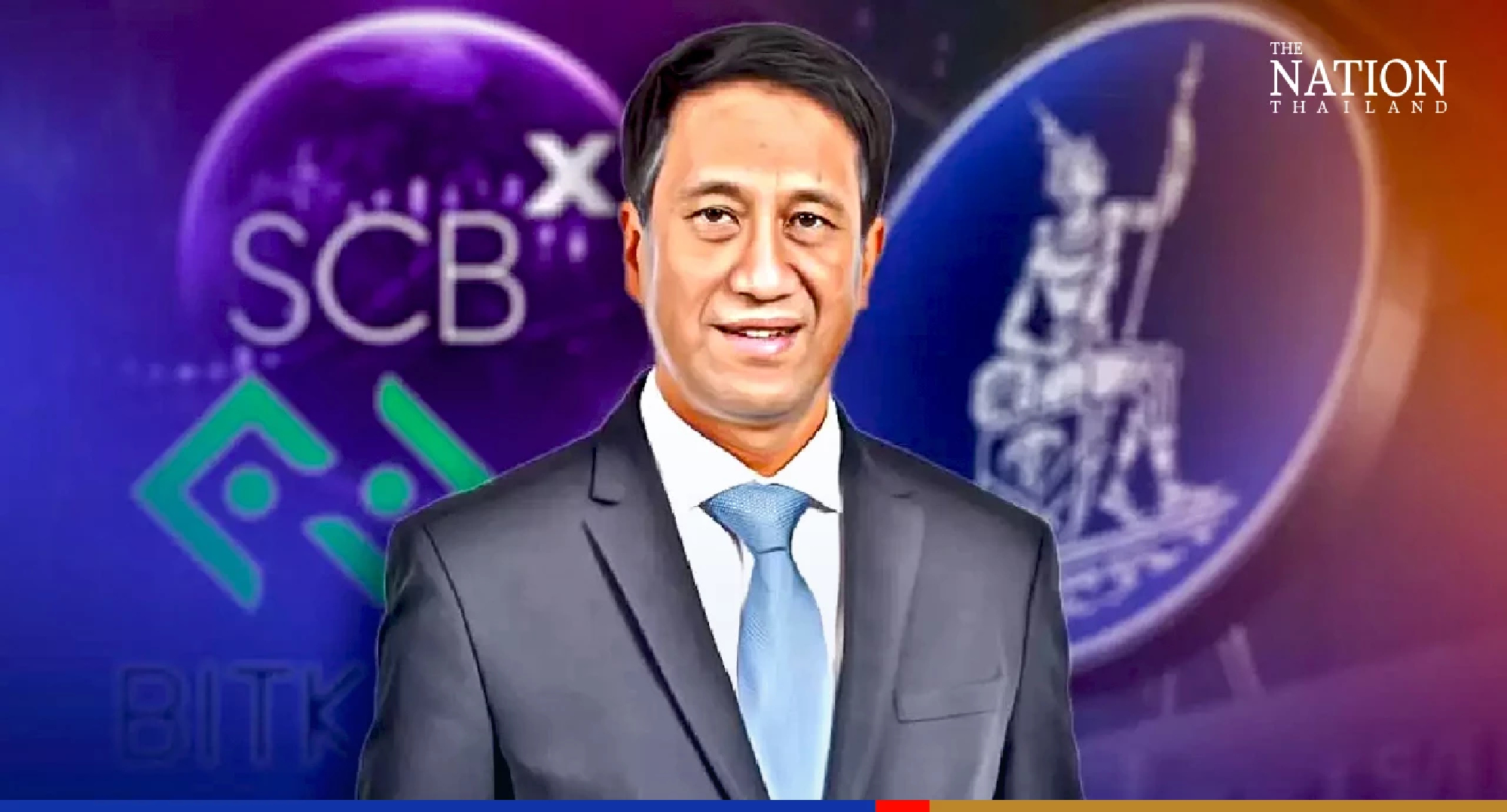
SCBX Pcl, the “mothership” company of SCB Group, never officially sought permission to buy a 51 per cent stake in BitKub Online, the Bank of Thailand (BOT) has said.
The BOT deputy governor for stability of financial institutions, Ronadol Numnonda, said on Monday that the central bank had been officially informed about the cancellation of the deal.
He said that both companies mutually terminated the deal due to business reasons.
Ronadol said that BOT focuses on developing financial innovations while also regulating the overall stability and security of commercial banks in their governance, sufficiency of capital, risk management and its effects, and protection of customers .
Speaking about the BOT regulation that allows commercial banks to invest only up to 3 per cent of their capital in digital assets, he explained that the objective was:
Allowing commercial banks to have flexibility to invest in bringing innovations to provide service to customers with more efficiency
Allowing digital asset businesses in the country to grow gradually, and to restrict risks that might affect trust in commercial banks
Allowing commercial banks to invest or manage their resources carefully
The BOT believes these objectives will eventually be beneficial to users and the development of innovation in the Thai financial sector, he said.
He said that commercial banks that want to establish a subsidiary related to digital assets must first seek permission from the BOT.
Ronadol added that the regulations were not aimed at any specific deal but to regulate the risks to the overall financial system.
SCBX last Thursday announced that the group and Bitkub Capital Group Holdings had reached a mutual agreement to terminate their proposed investment of 17.85 billion baht for a 51 per cent stake in Bitkub Online.


 The company announced on its Facebook wall on July 5 that it owed 32 million baht in compensation to the staff but due to its liquidity crunch, it could pay only 16 per cent of the compensation amount at the end of June and another 9 per cent at the end of July. It said it would pay the rest of the compensation in monthly instalments as per the company’s ability to earn money.

 It noted that Section 60 of the charter requires the NBTC to supervise telecom businesses to ensure free and fair competition by taking the public and national interests into account.




 She also cited four factors that will promote tourism, namely:
 Ratchada added that figures from the Commerce Ministry’s Business Development Department also indicate a tourism recovery.
 If the investment in tourism businesses is broken down by the nationality of owners, then 37 billion baht was invested by Thais (87.2 per cent), 1.1 billion baht by Chinese (2.6 per cent), 528 million baht by South Koreans (1.2 per cent), 445 million baht by Indians (1 per cent) and 3.4 billion baht by other nationalities (8 per cent).
 For instance, she said, the government has extended the period covered by visa-on-arrival and has launched several campaigns to promote popular destinations.