UOB boosts net earnings 8% for first half of year

ศาสตร์เกษตรดินปุ๋ย : ขอบคุณแหล่งข้อมูล : หนังสือพิมพ์ The Nation

https://www.nationthailand.com/business/30374410

UOB boosts net earnings 8% for first half of year

Aug 07. 2019
By THE NATION188 Viewed

UOB Group posted net earnings of S$2.22 billion (Bt49.4 billion) for the first half of 2019, up 8 per cent compared with a year ago.

Total income rose 9 per cent to a new high of S$4.99 billion, lifted by strong loan growth and higher trading and investment income. Return on equity rose to 12 per cent, up 0.4 per cent from a year ago.

Net earnings for the second quarter of 2019 rose to S$1.17 billion, which was 11 per cent and 8 per cent higher than the first quarter of 2019 and the second quarter of 2018, respectively. The record second-quarter earnings were driven by improvement in both interest and non-interest income.

The group’s funding position and capital base stayed strong. The loan-to-deposit ratio was stable at 88.5 per cent as at 30 June 2019. Gross loans and deposits grew 9 per cent and 6 per cent year on year to S$273 billion and S$305 billion respectively. The group’s common equity tier 1 capital adequacy ratio (CAR) remained robust at 13.9 per cent.

On the back of the strong earnings performance, the board declared an interim dividend of 55 Singapore cents per ordinary share. This reflects UOB’s commitment to reward shareholders while retaining adequate resources for capital and growth needs.

TOT ‘confident’ of meeting yearly profit target

ศาสตร์เกษตรดินปุ๋ย : ขอบคุณแหล่งข้อมูล : หนังสือพิมพ์ The Nation

https://www.nationthailand.com/business/30374398

TOT ‘confident’ of meeting yearly profit target

Aug 07. 2019

Montchai

Montchai
By THE NATION241 Viewed

TOT is confident it will achieve its 2019 net profit target of Bt2.490 billion, up from Bt2.170 billion last year, the state agency president Montchai Noosong said.

Of the projected yearly figure, Bt1 billion was achieved in the first half.

The total revenue target is Bt56.5 billion, of which Bt25.3 billion will come from its own operations  with the remainder from business partners.

Currently, TOT has 1.4 million broadband internet subscribers.

TOT has also upgraded its digital infrastructure to provide digital solutions, including Cloud services and cybersecurity services.

Tesco Lotus joins hand with Shopee in boost to omni-channel retailing

ศาสตร์เกษตรดินปุ๋ย : ขอบคุณแหล่งข้อมูล : หนังสือพิมพ์ The Nation

https://www.nationthailand.com/business/30374397

Tesco Lotus joins hand with Shopee in boost to omni-channel retailing

Aug 07. 2019
By The Nation315 Viewed

Tesco Lotus has partnered with Shopee, an e-commerce platform in Southeast Asia and Taiwan, to launch its shop on the online shopping platform. With over 30 million Shopee app downloads,

Tesco Lotus will leverage Shopee’s extensive consumer base to serve millions of shoppers across Thailand. The partnership reflects the Tesco Lotus strategic priority to serve customers better through expanded online channels.

Yutana Jitcharoongphorn, head of the online grocery shopping business at Tesco Lotus, said: “As an omni-channel retailer, Tesco Lotus is committed to providing our customers great quality products at affordable prices and a seamless shopping experience wherever they shop with us, be it in our hypermarket, Express store, or online platforms.

“We were the first retailer in Thailand to launch our own online shopping channel – Tesco Lotus Shop Online – which now offers a wide range of fresh food and grocery products. With the urbanisation and digitalisation trends in Thailand, we see opportunities to serve customers better through expanded online platforms.”

The supermarket chain is “delighted” to launch the Tesco Lotus shop on Shopee Mall, said Yutana. Starting from August 8, Shopee customers will be able to buy more than 10,000 items, including electrical appliances, health and beauty products, and mother and baby products at “fantastic prices”, Yutana said.

“To celebrate the launch during August 8-10th, we will be running flash sales offering as much as 70-per-cent discounts throughout the day, with free deliveries available for selected items.” Clubcard members be able to collect their points as normal, similar to when they shop in the brick-and-mortar stores, Tesco Lotus Shop Online, and their shop on another online marketplace, to provide a seamless shopping experience.

Siwagorn Siriwongpanupong, the head of business development for Shopee Thailand, said, “With this partnership, Shopee users can enjoy a wide variety of Tesco Lotus products on Shopee and provide them greater convenience to purchase their daily essentials easily. On this momentous occasion of our partnership, Shopee is honoured to have Tesco Lotus as our official e-commerce partner and we are confident that this partnership will be a great success.”

Ministry of Commerce strengthens technological competency of CLMVT digital trade

ศาสตร์เกษตรดินปุ๋ย : ขอบคุณแหล่งข้อมูล : หนังสือพิมพ์ The Nation

https://www.nationthailand.com/business/30374396

Ministry of Commerce strengthens technological competency of CLMVT digital trade

Aug 07. 2019
By The Nation224 Viewed

The Trade Policy and Strategy Office (TSPO) of the Ministry of Commerce today held the “CLMVT Cross-Border Digital Trade” to promote e-commerce and digital transformation with the aim of digitizing traditional cross-border trade and create business opportunities throughout the CLMVT region.

TPSO’s director general Pimchanok Vonkorpon explained that the seminar was an offshoot of the successful CLMVT Forum 2019 and would provide an excellent opportunity not only for businesses to equip themselves with greater awareness and better understanding of how to apply e-commerce and digital trade tools to enhance their cross-border trade activities, but also allow the relevant government agencies to learn how to construct a digital cross-border trade database. More than 300 participants from CLMVT and Asean attended the seminar, which kicked off with a talk “Open the Door to Opportunities.

The Asia Pacific, including Asean and CLMVT, has the world’s highest share of B2C e-commerce to GDP which currently stands at 4.5 per cent and the value is projected to reach US$38.1 billion in 2019 with a 2014-2020 CAGR of 37 per cent, according to the UN-ESCAP and Asian Development Bank (ADB). The region’s share is higher than that of North America and Western Europe. Within CLMVT, Thailand ranks first in total e-commerce value at Bt2.24, Bt2.5, Bt2.7 and Bt3.1 trillion n 2015-2018, respectively. Thailand’s B2C e-commerce value also grew 14 per cent in 2018 and is expected to increase to 16 per cent in 2019. Moreover, the B2C E-commerce Index 2017 report that examines global e-commerce readiness by the UNCTAD ranks Thailand at the 49th place in the world and first in CLMVT.

Pimchanok said that e-commerce and digital trade have been and will continue to be a crucial tool to exponentially enhance CLMVT’s intra-regional trade both qualitatively and quantitatively. She also added that the seminar would serve as a significant stepping stone for realising the goal of CLMVT to become a new global value chain hub where entrepreneurs can fully utilise digital technologies and where new business collaborations are formed for the better and more sustainable growth and development of the CLMVT economy.

Bt170-bn stimulus to focus on tourism boost as economy slows

ศาสตร์เกษตรดินปุ๋ย : ขอบคุณแหล่งข้อมูล : หนังสือพิมพ์ The Nation

https://www.nationthailand.com/business/30374470

Bt170-bn stimulus to focus on tourism boost as economy slows

Aug 08. 2019

Lavaron

Lavaron
By The Nation147 Viewed

The Bt170 billion government stimulus package will be submitted for Cabinet approval on August 19, say top Finance Ministry officials.

Lavaron Sangsnit, the director general for the fiscal policy office, said today (August 8) that the package aims to boost inbound tourism, and promote travel within the country by both Thais and foreign tourists.

The stimulus will also support farmers, small businesses and middle income earners, he said.

The package comes after a sharp slowdown in economic growth to 2.8 per cent in the first quarter.

The government is also worried that a stronger baht and weaker Chinese yuan would adversely affect the number of Chinese tourists visiting Thailand.

The Bank of Thailand on Wednesday cut its policy rate by 25 basis points to 1.5 per cent, in a move intended to drive the economy, he said.

Improvements still needed in transition to new bank accounting system: Moody’s

ศาสตร์เกษตรดินปุ๋ย : ขอบคุณแหล่งข้อมูล : หนังสือพิมพ์ The Nation

https://www.nationthailand.com/business/30374459

Improvements still needed in transition to new bank accounting system: Moody’s

Aug 08. 2019
By The Nation196 Viewed

Moody’s Investors Service says in a new report that the implementation among Asia Pacific banking systems of the IFRS 9 accounting standard is making good progress, but that not all disclosure standards are being met.

“So far 11 of the 17 APAC banking systems that we cover have made to switch to the new regime, and our analysis of 36 major rated banks in the region confirms our earlier view that the switch has led to a mild increase in credit reserves,” noted Eugene Tarzimanov, a Moody’s VP and Senior Credit Officer. “However, our analysis also unveils significant variations in reporting practices, with some banks not meeting the disclosure object of the standard.”

While all banks in Moody’s sample disclose the three credit stages of loans in their annual reports, as well as the related expected credit losses, most have weak disclosures on the inputs and criteria they use for Stage 2 and Stage 3 classifications and on the rules they use for moving assets across stages, the report noted.

“From a credit perspective, asset movements between Stages 1 and 2 have a significant impact on expected credit losses, while asset movements from Stage 2 to 3 affect problem loan metrics” Senior Accounting Analyst Maria Mazilu explained.

Moody’s says the major banks in Hong Kong are best-in-class because they provide far more granular information on their expected credit loss models, including their sensitivity to different scenarios.

The International Financial Reporting Standard 9 (IFRS, or local equivalent) replaces the previous International Accounting Standard 39, and changes the way banks report the credit quality of debt-like assets, how they create provisions against credit losses, and how they classify and measure financial assets.

‘Trump’s latest tariffs on Chinese goods might have signalled BOT rate cut’

ศาสตร์เกษตรดินปุ๋ย : ขอบคุณแหล่งข้อมูล : หนังสือพิมพ์ The Nation

https://www.nationthailand.com/business/30374445

‘Trump’s latest tariffs on Chinese goods might have signalled BOT rate cut’

Aug 08. 2019

Amornthep Chawla, executive vice president of the Head Research Office of CIMB THAI

Amornthep Chawla, executive vice president of the Head Research Office of CIMB THAI
By THE NATION468 Viewed

Amornthep Chawla, executive vice president of the Head Research Office of CIMB THAI, expressed surprise at the decision of the central bank’s Monetary Policy Committee (MPC) to cut its policy rate from 1.75 per cent to 1.50 per cent.

The board voted five to two to cut the key rate.

“Thailand’s policy rate cut is unexpected as usually the MPC would gradually communicate on the need to ease monetary policy in a previous statement,” he said. “However, in the previous meeting, the BOT stood firm on the issue of financial stability, such as high household debt, search for yield behaviour and underpricing of risk. What led to the change of mind?” he posed.

Amornthep said that the BOT appeared to be firm in its decision to hike the policy rate by 25 basis points in December last year, claiming stable growth, rising inflation rate and building up policy space. “However, since the beginning of the year, there are three factors that could have induced the MPC to reverse its previous position. First, the Thai economy appeared to be deteriorating from weakening global demand, causing Thai exports to shrink. When exports dropped, investors cut down production capacity and lowered overtime payment to staff, deterring purchasing power.

“Second, Thailand’s inflation rate has been falling below the BOT’s lower bound target of 1 per cent. The BOT may claim that the fall of inflation rate was mainly due to declining oil prices, but declining purchasing power may somewhat result in falling inflation rate.

“Third, the baht has been strengthening against the US dollar and regional peers, deterring export competitiveness. The [US] Fed, and other central banks in the region have cut their policy rates and sent signal for more rate cuts to stimulate growth, implying weakening of currencies to boost exports during the time of trade war.”

Amornthep said Thailand has been a victim of both trade and currency wars as exports shrink and the baht strengthens against others.

“At first, I thought that the BOT may be able to tolerate this situation for a couple of months or at least until the end of the year while waiting for third-quarter GDP data. However, Trump’s tariff of 10 per cent on US$300 billion worth of imports from China may have been the signal to prevent further decline in exports and a possible weakening economy in the second half of the year. Trump’s tariffs may have been the last straw for the BOT to say that its tolerance is enough,” he said.

Amornthep said that he would expect more cuts from the BOT. The conditions for a rate cut are, for example, escalating trade war, continual strengthening of the baht against peers, declining inflation rate and weakening economy.

“I do not think that the BOT would cut the rate soon for fear of losing its policy space. It may apply other measures to stimulate growth or weaken the baht for the time being, such as easing measures on loans or encouraging capital outflows,” Amornthep said.

Meanwhile, the BOT may wait for fiscal stimulus from the new government to boost demand among low-income households or provide tax incentive measures for the middle-class to increase their spending, he added, noting that a delayed budget process may leave the new government short of funds to stimulate growth. Thus, the BOT may take a wait-and-see stance for now to evaluate the third quarter GDP data released in November. If there is a sign of improving economy or declining risk from the trade war, the BOT may stay put on the rate. “However, I would think that the economy may not be able to pick up as strongly as expected earlier and may require further cut to stimulate growth. I would expect one more cut in December this year,” he said.

Will the BOT relax on loan supervision?

“I do not think that the BOT would relax its efforts to curb the rise of household debt and mortgage NPLs [non-performing loans]. It may not reverse its policy to lower loan-to-value for housing loans. Going forward, the BOT may continue monitoring loan provision by commercial banks. Further, it may go ahead with a new policy to cap debt-service ratio of borrowers. Despite these regulations, the BOT may be content with financial stability and may apply rate cuts further if necessary with little worry about the side-effects of rate cut that could affect financial stability,” said Amonthep.

He said BOT’s rate cut on Wednesday is an attempt by the central bank to stimulate growth and may aim to further weaken the baht against peers. However, the economy may not accelerate fast enough as weakening global demand will affect Thai exports. The government may have to pursue stimulus measures to raise purchasing power and distribute income to low-income households.

Meanwhile, the BOT may monitor the effectiveness of rate cut whether it could help increase loan growth or not. “The door for rate cuts has just opened. Let’s wait and see how it goes and let’s hope that Thailand does not become a victim of both trade and currency wars.


Thailand, region must work together on digital trade regulations’

ศาสตร์เกษตรดินปุ๋ย : ขอบคุณแหล่งข้อมูล : หนังสือพิมพ์ The Nation

https://www.nationthailand.com/business/30374422

Thailand, region must work together on digital trade regulations’

Aug 07. 2019

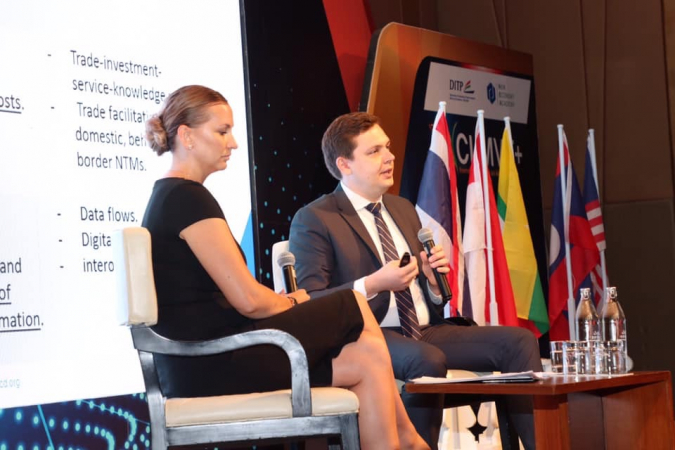
Janos Ferencz, right, trade policy analyst of the Organisation for Economic Cooperation and Development (France). /Photo by The Nation

Janos Ferencz, right, trade policy analyst of the Organisation for Economic Cooperation and Development (France). /Photo by The Nation
By PHUWIT LIMVIPHUWAT
THE NATION
370 Viewed

The Thai government must work with regional leaders to improve digital trade regulations and tighten communication with the private sector when discussing and drafting new digital trade regulations, a trade analyst from the Organisation for Economic Cooperation and Development (OECD) suggested.’

The development of e-commerce and other forms of digital trade has led to the growth of the service sector both in developed and developing economies. Hence, the barriers to trade in services will pose a challenge to the growth of Asean’s digital trade industry, Janos Ferencz, Trade Policy Analyst for OECD (France), said.

Ferencz was speaking on Wednesday (August 7) during the CLMVT (Cambodia, Laos, Myanmar, Vietnam, Thailand) Cross-border Digital Trade seminar organised by the Commerce Ministry’s Trade Strategy and Policy Office.

Cross-border barriers to services trade in regions such as Southeast Asia involve unnecessary regulations between countries restricting the cross-border movement of different types of services, he explained.

To address this issue, he suggested, governments in the region should come together and find ways to deregulate these barriers to enhance the regional service industry.

He added that Thailand needed to have a broader stakeholder engagement when discussing policies and trade regulations so that concerns of the private sector about the regulatory challenges to digital trade could be addressed.

The Commerce Ministry has announced plans to meet with private sector representatives such as the Federation of Thai Industries, the Thai Chamber of Commerce, and the Thai Bankers’ Association on August 14.

Commerce Minister Jurin Laksanawisit said earlier this week that the meetings involve a brainstorming session on the potential solutions to circumvent the negative impacts of the US-China trade war and build a consensus with the private sector on how to mobilise the economy.

Ferencz suggested that trade officials should focus on addressing regulatory challenges stemming from digital trade when negotiating free trade agreements.

Thailand, as the chair of this year’s Asean meetings, has announced that negotiations of the 16-country Regional Comprehensive Economic Partnership (RCEP) will be concluded by the end of this year and will likely be signed in mid-2020.

The RCEP negotiations cover 20 chapters in total, including a chapter on e-commerce. However, the details of the e-commerce chapter are being negotiated and have not been made public.

Ferencz stated that digital trade issues which trade deals should address are electronic authentication and paperless trade as well as cross-border private data protection.

TCEB helps bring largest ever Chinese convention to Thailand

ศาสตร์เกษตรดินปุ๋ย : ขอบคุณแหล่งข้อมูล : หนังสือพิมพ์ The Nation

https://www.nationthailand.com/business/30374415

TCEB helps bring largest ever Chinese convention to Thailand

Aug 07. 2019
By THE NATION352 Viewed

The Thailand Convention and Exhibition Bureau (TCEB) is extending its support to the hosting of the 2019 International Dragon Award (IDA) Annual Congress from August 10 to 13 at Impact Muang Thong Thani.

Some 7,500 international delegates are expected to attend the four-day event, generating revenue of up to Bt640 million (US$20.7 million).

TCEB President Chiruit Isarangkun Na Ayuthaya says the 2019 IDA Annual Congress is the largest-ever Chinese convention to be organised in Thailand.

“TCEB is delighted to welcome the 2019 IDA Annual Congress to Thailand. We won this event in 2017 following an inspection trip to Thailand by the IDA Committee. We then attended the 2018 event in Yunnan last year to extend an invitation to their delegates to attend the 2019 edition in Thailand.

“This highlights the importance of the Chinese market to TCEB and Thailand and helps raise the profile of Thailand as a conference destination. Thailand has a good record for hosting mega-size convention every year and the 2019 IDA Annual Congress will be a trademark of such a large-scale event for the Kingdom, reiterating the country’s readiness and ability to host large and important international MICE events,” he added.

TCEB’s policy of targeting and supporting events has helped make Thailand one of Asia’s top MICE destinations. TCEB helps facilitates the smooth and successful organisation of business events by providing support schemes, introducing and connecting with local suppliers, in addition to providing fast track MICE immigration service to VIP delegates.

The IDA Annual Meeting is held in conjunction with the Worldwide Chinese Life Insurance Congress (WCLIC) biennially. All of the worldwide Chinese insurance and financial professionals and top management join this annual meeting, which has become the signature event of the industry. It has firmly enabled the worldwide Chinese financial and issuance sector to compete with the usually-focused-on-English industry on the international stage. After many years of operation, management and accumulation, IDA is poised to exert its considerable influence in the global insurance field.

Kai Tu, Chairman of the 2019 IDA Annual Meeting, stated: “After an extensive search, we are pleased to select Bangkok as the location for our annual IDA conference, especially as we mark the 20th anniversary since IDA commenced in 1998. In fact, this is the second time that the IDA conference will be taking place in Thailand, and we are grateful for TCEB’s continued support and collaboration in helping us to bring the conference to the lovely city of Bangkok.”

“Nearly 8,000 delegates and 300 senior executives from 17 countries, in addition to more than 200 leading financial services and insurance institutions will attend our annual meeting, which aims to facilitate further learning and discussions about our industry. We hope the four-day intensive meetings, against the backdrop of Thailand’s rich cultural heritage, local attractions and gracious hospitality, will make this a memorable experience for all delegates,” he continued.

China currently ranks as the top short haul MICE market to Thailand for the fiscal years of 2015 to 2018. During 2018 Thailand welcomed a total of 215,098 MICE delegates from China, representing a 95.57 per cent increase over 2015 (at 109,987).

Of the total MICE travellers from China, the convention-specific delegates to Thailand rank in the top three. Since 2015, the number of convention delegates from China has increased from 16,216 to 53,789 delegates in 2018, representing a 231-per-cent growth in just a three-year period.

As well as the 2019 IDA Annual Congress, conventions from China supported by TCEB have included: the New Normalization’ Assisting the New Pattern of Asia Pacific Economic Development-2015 China International Economic and Trade Regionalization Development Summit, from January 19-25, 2015 for 200 delegates; the 3rd Annual World Congress of Smart Materials (WCSM2017), from October 16-18, 2017 for 600 delegates; and the 14th World Congress of Chinese Medicine (WCCM 2017), from March 21-22 2017 for 800 delegates.

Analysts worry about competitive easing as BOT cuts policy rate

ศาสตร์เกษตรดินปุ๋ย : ขอบคุณแหล่งข้อมูล : หนังสือพิมพ์ The Nation

https://www.nationthailand.com/business/30374413

Analysts worry about competitive easing as BOT cuts policy rate

Aug 07. 2019
By Wichit Chaitrong
Phuwit Limviphuwat
The Nation
847 Viewed

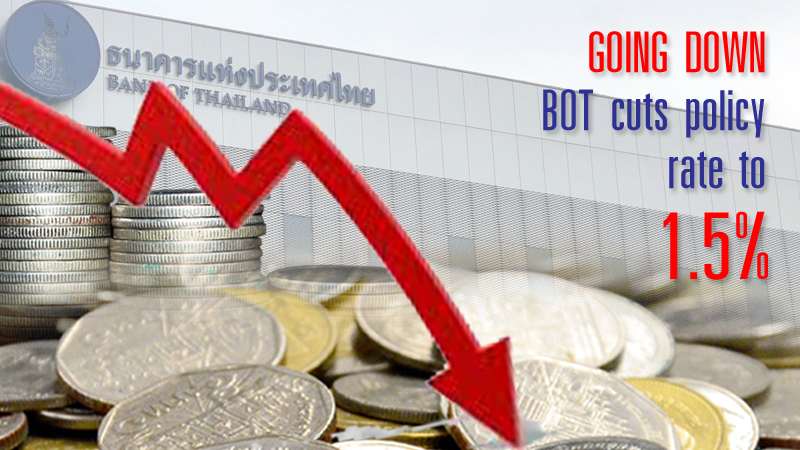
The Bank of Thailand’s Monetary Policy Committee (MPC) on Wednesday (August 7) made a surprise decision to cut the policy interest rate amid an economic slowdown and the heightened trade war between the US and China.

The MPC cut the interest rate by 25 basis points to 1.5 per cent.

Of the seven-member committee, five voted for the cut while two voted to maintain the rate at 1.75 per cent.

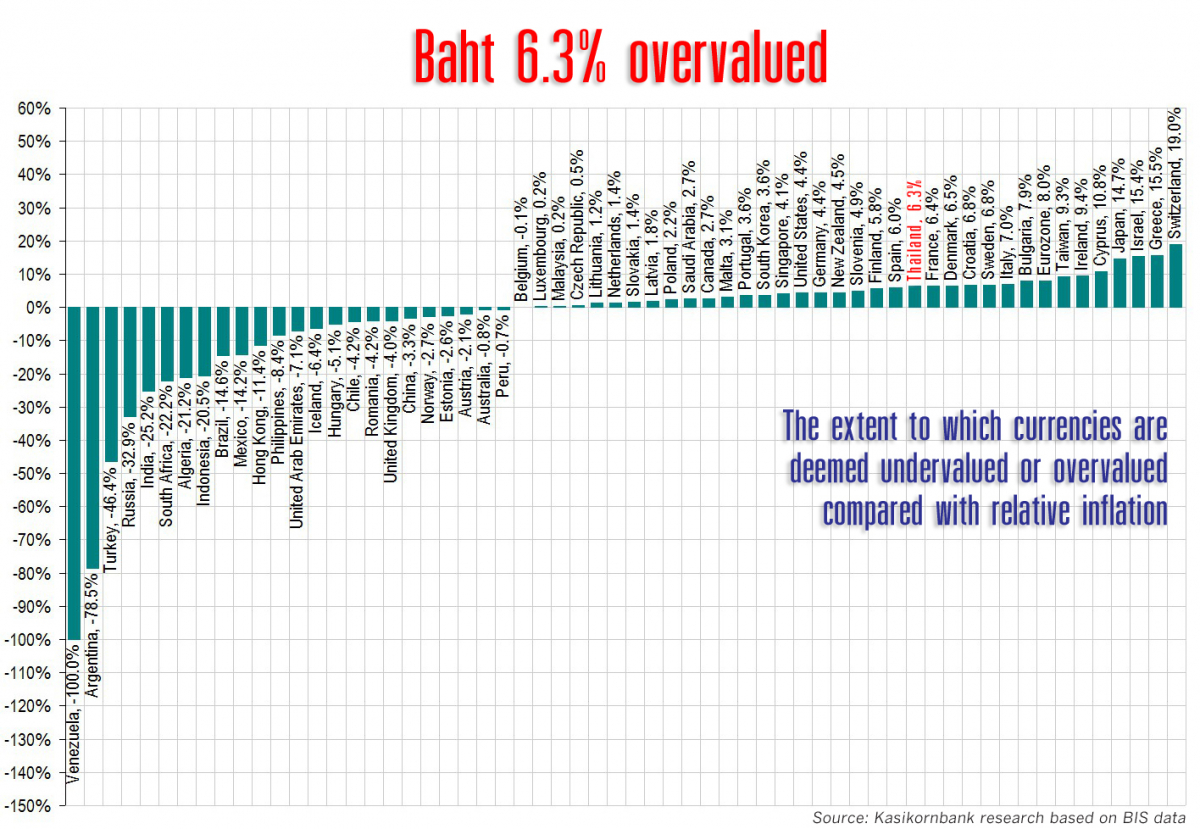
The baht has been one of the strongest currencies in the region while the Chinese yuan has been weakening.

The baht and Thai government bonds are considered by foreign investors as safe-haven. The baht ranks 15th among the strongest currencies.

The Thai currency has appreciated against the US dollar by about 5 per cent since early this year while it has gained 8 per cent against the yuan.

Exporters and even overseas Thai workers have recently expressed worries about the stronger baht.

Economists had expected the MPC to maintain the policy rate at today’s meeting.

Kobsidthi Silpachai, the head of capital markets research at Kasikornbank, said the central bank aims to prevent further appreciation of the baht and shore up the economy.

After the news of a rate cut, the baht immediately weakened to Bt30.89 per dollar from 30.75 before the rate cut, then it rebounded to Bt30.82 at around 3pm.

“It may not help much if other central banks follow suit and it could lead to competitive easing, comparable with the competitive devaluation during the 1997 financial crisis,” Kobsidthi said.

New Zealand’s central bank cut its rate to 1 per cent from 1.5 per cent on Wednesday morning while India’s central bank also cut its rate by 35 basis points from 5.75 per cent to 5.40 per cent.

“We suspect that the central bank’s decision to cut the policy rate to 1.5 per cent today is a result of the strong baht,” said Tim Leelahaphan, an economist with Standard Chartered Bank.

“However, in a similar way to the Bank of Thailand’s past measures to prevent the baht from appreciating further, it may take some time for the lowering of the rate to have an impact on the baht’s strength.”

He pointed out that, also on Wednesday, the New Zealand and Indian central banks cut their interest rates, deepening the trend of global monetary easing after the US Federal Reserve reduced its benchmark rate on July 31.

These actions put further pressure on the baht to appreciate, giving the Bank of Thailand an incentive to lower interest rates in an attempt to keep the baht’s strength in line with that of the currencies of the country’s neighbours, he said.

Furthermore, the central bank’s decision to lower the policy rate may reflect an attempt at policy synchronisation with the government’s efforts to stimulate consumer spending, he said, referring to the speculation that the new government will implement economic stimulus measures to boost such spending before the year’s end.