THAI boss reportedly offer to resign from national carrier

ศาสตร์เกษตรดินปุ๋ย : ขอบคุณแหล่งข้อมูล : หนังสือพิมพ์ The Nation

https://www.nationthailand.com/business/30374170

THAI boss reportedly offer to resign from national carrier

Aug 03. 2019
Ekniti

Ekniti
By THE NATION

547 Viewed

Thai Airways International chairman Ekniti Nitithanprapas has reportedly tendered his resignation from the post, according to a Nation TV report.

The station cited a THAI source as saying that Ekniti’s resignation offer followed the recent signal by Transport Minister Saksayam Chidchob for the board members of departments under the Transport Ministry to resign as they were appointed by the previous government.

He said it was up to the new deputy ministers to decide if these board members should be reappointed.

Saksayam made the remark after assigning his deputies Athirat Rattanaset and Thaworn Senniam to oversee the water transportation and air transportation departments respectively. As of last Friday, there was no statement from THAI to the Stock Exchange of Thailand on this matter.

It was speculated that the ministry’s permanent secretary Chaiwat Thongkamkoon will be nominated to replace Ekniti at THAI.

Ekniti assumed the top job at the national carrier in July last year.

Vietjet lifts revenue 22% in year’s first half

ศาสตร์เกษตรดินปุ๋ย : ขอบคุณแหล่งข้อมูล : หนังสือพิมพ์ The Nation

https://www.nationthailand.com/business/30374135

Vietjet lifts revenue 22% in year’s first half

Aug 02. 2019
By THE NATION

908 Viewed

Vietjet boosted revenue 22 per cent to 20,148 billion dong in the first half of the year compared with the same period last year.

This resulted in profit before tax of 1,563 billion dong, making an increase of 16 per cent year on year. Consolidated revenue including the business results earned from the trade of aircraft, reached more than 26.3 trillion dong, increasing 24 per cent. Profit before tax was nearly 2.4 trillion dong, equal to 11 per cent year on year increase, the company said.

During the last six months, Vietjet operated 68,821 flights, equivalent to 45 per cent of total flights operated by all other Vietnamese airline carriers. Those number of flights meant Vietjet had transported 13.5 million passengers in all routes the carrier is operating. Vietjet maintained its leading position in Vietnamese aviation with 44 per cent market share in the first six months of the year.

Vietnam Airlines arrived at the second place, with 34 per cent. Vietjet finds room for it to grow in international market is still large thanks to good profit margin from ancillary revenue and low fuel cost. Growth in international market earned Vietjet a sound increase of foreign currencies. Number of passengers in international routes operated by Vietjet grew by 35 per cent, with nearly 4 million passengers.

Revenue of international transport service surpassed that of domestic to reach 54 per cent of total Vietjet’s airway transport revenue. Ancillary and cargo revenues were more than 5.5 trillion dong, increasing from 21 per cent last year to 27 per cent this year thanks to the growth of international route operation.

During the year’s first six months, Vietjet has opened nine new international routes to Japan, Hong Kong, Indonesia and three other domestic routes. Those newly-opened routes totalled Vietjets routes around the world to 120; of which, 78 international routes and 42 domestic ones. Vietjet’s flight network now covers number of destinations in Vietnam, Japan, Hong Kong, Singapore, South Korea, Taiwan, Thailand, Myanmar, Malaysia, Cambodia and China. Vietjet has also operated at large to many airports in the world, including in Dubai and Doha.

In that period, Vietjet’s revenue passenger kilometres (RPK) was at 16.3 billion dong, increasing 22 per cent year on year. Its load factor was averagely 88 per cent, technical reliability was 99.64 per cent and on-time performance (OTP) reached 81.5 per cent.

Vietjet’s equity reached 15,622 billion dong, increasing 32 per cent over the same period last year. Vietjet’s total assets are nearly 44.5 trillion dong, an increase of 30 per cent year on year; of which more than 21.9 trillion dong long-term assets, accounting for 49 per cent of total assets. Debt to equity ratio was 0.5, which was positive compared to 0.64 of last year. The airline at the annual general shareholders’ meeting in April decided to pay the 2018 dividend at the rate of 55 per cent.

During the last six months, Vietjet also introduced a new version of Vietjet Air apps which included buying air tickets quickly on smartphones, offering free tickets every Friday and free payment fees.

The Vietjet Aviation Academy at Ho Chi Minh City High-Tech Park is a modern training facility using equipment and training programmes under European Union Aviation Safety Agency (EASA) standards, which organised 250 courses for 5,623 pilots, cabin crew members and engineers.

Airbus shows off A220-300 aircraft in demonstration tour

ศาสตร์เกษตรดินปุ๋ย : ขอบคุณแหล่งข้อมูล : หนังสือพิมพ์ The Nation

https://www.nationthailand.com/business/30374129

Airbus shows off A220-300 aircraft in demonstration tour

Aug 02. 2019
By THE NATION

778 Viewed

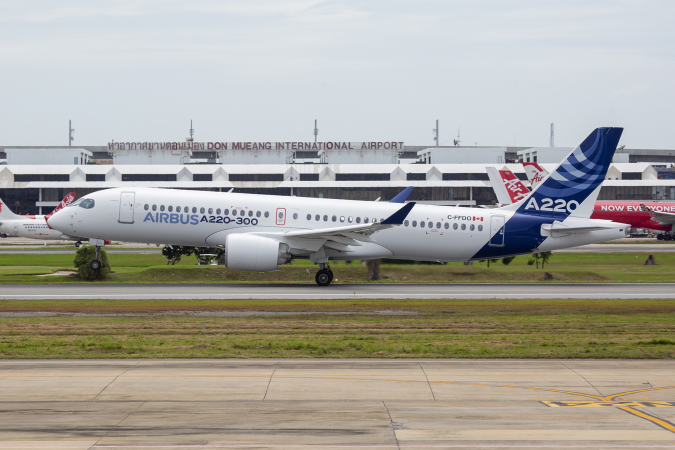
The Airbus A220-300 passenger aircraft has arrived in Bangkok as part of a two-week demonstration tour of the Asia-Pacific region.

The aircraft, on display at Don Mueang International Airport, is a flight test aircraft, featuring a new layout of 143 seats in a single- class passenger cabin.

On Friday, airline executives and members of the media witnessed its capabilities and improved passenger comfort during a one-hour demonstration flight. Airbus representatives also highlighted the suitability of the aircraft for airlines operating in Thailand.

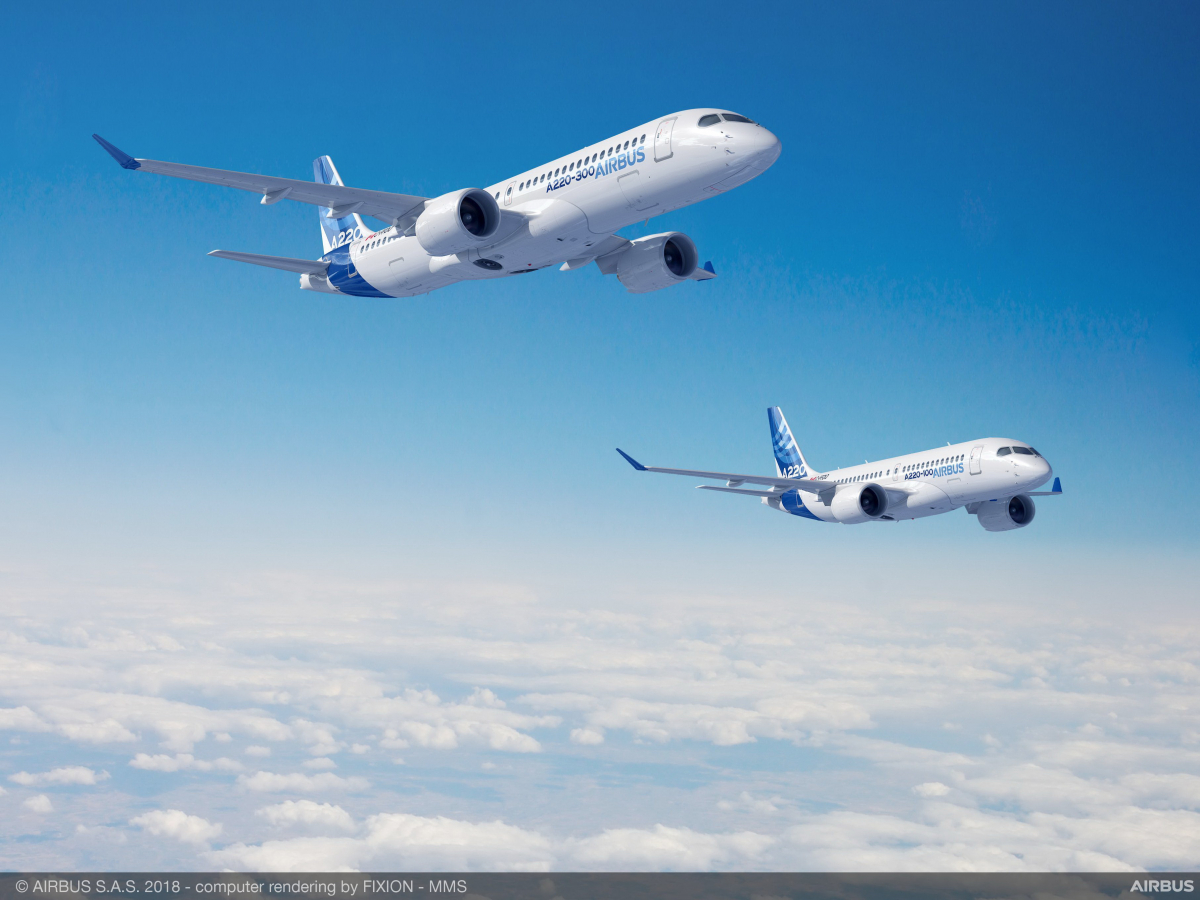
The A220 family comprises the smaller A220-100 and larger A220-300, which are the only passenger aircraft purpose-built for the 100-150 seat market.

In addition, its range and capacity suit airlines that need an aircraft to complement the A320 family airliners that are already in their fleet. It also offers a lower cost per trip compared to previous generation aircraft.

“The A220 is part of Airbus’ modern and comprehensive aircraft family, which covers the market ranging from 100 to more than 400 seats. In the single-aisle category, this comprises the A220 and the A320 family – which includes the A320neo, the best-selling aircraft in aviation history. In the widebody family, Airbus manufactures the A330 family, including the latest A330neo, and the long range leader A350 XWB family,” Airbus said.

“In the region’s single-aisle market Airbus has over 60 per cent market share, with more than 3,000 aircraft in service with 80 airlines, and over 1,500 on order for future delivery.

“Today, the A220-300 is operated successfully in the Asia-Pacific region by Korean Air on both domestic and international services. Air Vanuatu ordered four A220s, comprising two A220-100s and two A220-300s, in February 2019.”

Airbus has had a long-term relationship with Thailand, where more than 150 Airbus aircraft are in service with the country’s major carriers including Thai Airways International, Bangkok Airways, Thai AirAsia and Thai AirAsia X. These include the A320 family, the A330, the A350 XWB and the A380, which operate on services ranging from short domestic hops to medium and long-haul flights within Asia and to Europe.

SCB helps budding entrepreneurs get into hotel business

ศาสตร์เกษตรดินปุ๋ย : ขอบคุณแหล่งข้อมูล : หนังสือพิมพ์ The Nation

https://www.nationthailand.com/business/30374126

SCB helps budding entrepreneurs get into hotel business

Aug 02. 2019
Optimism is expressed for the upcoming start of the SCB The Dots: Hotel training programme.

Optimism is expressed for the upcoming start of the SCB The Dots: Hotel training programme.
By THE NATION

518 Viewed

Siam Commercial Bank (SCB) is preparing to offer a programme for small and medium-sized enterprises (SMEs) that it says will create a hotel ecosystem with participation from the government and private sectors.

The banks said the programme, SCB The Dots: Hotel, will provide a training course for budding business operators in the hotel industry in order to help them overcome new challenges.

“The tourism industry still shows strong growth potential, with Thailand among the top tourist destinations, while local people also enjoy travelling both to major and secondary provinces throughout the year,” the bank said

“Indicators reveal that tourists are willing to pay more for hotel and services offering unique experiences. With a looming price war, entrepreneurs should creatively differentiate accommodations and hospitality, while taking advantage of new technology for new and effective marketing tools. SCB is also introducing its SCB Hotel Solution designed to fully cover all the needs of mid-sized and small hotel management.”

Pikun Srimahunt, senior executive vice president and chief SME banking officer of Siam Commercial Bank, said the tourism industry continues to generate significant income for Thailand.

“The booming industry is critical for the development of economic growth, employment, and revenues, with people at the community level playing increasingly important roles. SCB sees the tourism industry continuing to grow steadily from local people travelling throughout the year in both major and secondary provinces as a result of the Thailand Tourism Authority’s campaign, and from increasing foreign tourist arrivals.

“SCB estimates that foreign tourists should reach 42 million visitors in 2020, representing growth of 4.6 per cent year on year. This growth will come from India, Asean, east Asian countries, and China. The hotel business is an integral part of raising the standards of Thailand’s tourism industry. Having realized the strong business potential for mid-sized and small hotels, SCB has focused on the hotel business, which will receive prioritised access to support to enable businesses to remain strong with sustainable growth. The industry focus links every aspect of the hotel ecosystem, enabling entrepreneurs to operate their businesses efficiently from the start, while preparing them to adapt to a changing business environment and tackle challenges before it is too late.”

Pikun said trends in choosing accommodations have changed.

“One of the most evident observations that will provide opportunities for mid-sized and small business owners is that tourists are willing to pay more for unique and memorable experiences,” Pikun said.

“Sought after hotels and services will be those that are unique and suit guest personalities. This trend will require boutique hotels to raise their standards, improve their environment, and add services to create unique selling points. In addition, entrepreneurs should embrace technology to help develop management systems, marketing programs, and new sales channels.

“Entrepreneurs in mid-sized and small hotel businesses will be required to adapt new ideas and transform traditional practices, such as relying on online travel agents for sales. They should also seek new business models. Competing by cutting price can backfire, as hotels will be forced to lower their service quality and lose revenue, making it difficult to maintain business. Hotel owners should adjust their attitudes and realise that the hotel business should no longer be seasonal. However, they should lay plans and develop their environment to attract Thai tourists to stay longer and engage in more activities throughout the year. It is expected that Thailand’s hotel industry nationwide this year will show an average occupancy rate of 71-73 per cent.”

Pikun added that even with these opportunities, entrepreneurs are still facing competition arising from increasing supply, which has been accelerating.

“Areas seeking permission for hotel and resort construction nationwide expanded by 12 per cent on average during 2016-2018. However, the SCB Hotel Ecosystem Network, comprising Tourism Authority of Thailand, Association of Thai Travel Agent, Thai Hotel Association and The Department of Provincial Administration, the Department of Public Works and Town & Country Planning, are ready to provide full support enabling mid-sized and small hotels to be successful,” Pikun said.

“The SCB The Dots: Hotel training course will strengthen the new generation of hotel owners to help them overcome obstacles to achievement. Moreover, the bank has also prepared an SCB Hotel Solution that can fulfil demands for products and services for entrepreneurs. The solution offers loans for refinancing and renovation, with interest rates starting from 4 per cent to a maximum amount of Bt100 million.

“Loans can be repaid according to season for up to 10 years. Qualified borrowers are required to have a hotel business license and no less than five years’ experience in the hotel business. The solution will also accommodate credit card payments via an Online Payment Gateway with free entry and annual fees. Last but not least, the solution also includes Google My Business service that will enable hotels to increase their presence on search and navigation engines.”

LG Electronics posts record revenue for second quarter

ศาสตร์เกษตรดินปุ๋ย : ขอบคุณแหล่งข้อมูล : หนังสือพิมพ์ The Nation

https://www.nationthailand.com/business/30374121

LG Electronics posts record revenue for second quarter

Aug 02. 2019
By The Nation

348 Viewed

South Korea’s LG Electronics on Friday announced record second-quarter and first-half revenues with consolidated sales of 15.63 trillion won (Bt412 billion) and operating profit of 652.3 billion won for the second quarter of 2019.

Compared to the same period last year, sales were 4.1 per cent higher with operating income down 15.4 per cent. Record home appliance profits and strong business solutions profitability offset smaller operating income for home entertainment products and losses from vehicle components and mobile communications.

The LG Home Appliance & Air Solution Company reported record sales of 6.1 trillion won in the second quarter, the highest for the business unit in the history of LG Electronics. Revenue growth was especially strong in Korea and regions such as North America, Europe and the Middle East, increasing 16.1 per cent from the second quarter of 2018. Operating income of 717.5 billion won was the highest ever for the April-June period. The business unit recorded strong profitability on the back of stable growth, increased sales of high demand products such as air conditioners and continuous cost reduction activities.

The LG Home Entertainment Company generated second-quarter revenues of 3.67 trillion won, a decrease of 4.5 per cent from the same period the previous year due to a decline in demand in regions such as Europe and Latin America where major sporting events in the second quarter of 2018 generated strong sales. Operating income of 205.6 billion won declined from the previous quarter due to higher investments in light of greater competition in key markets and exchange rate depreciation. The business unit expects to see a growth in demand in premium products such as OLED TVs, NanoCell TVs and large-screen Ultra HD TVs next quarter.

The LG Mobile Communications Company recorded second-quarter 2019 sales of 1.61 trillion won, 21.3 per cent lower than the same period last year due to stagnant demand in the smartphone market and continued aggressive pricing by Chinese brands. Sales increased 6.8 per cent from the first quarter but the business united reported an operating loss of 313 billion won as a result of higher marketing investment to support the launch of new models and additional costs related to relocating smartphone production to Vietnam. The introduction of competitive mass-tier smartphones and growing demand for 5G products are expected to contribute to improved performance in the third quarter.

The LG Vehicle Component Solutions Company posted quarterly revenues of 1.42 trillion won, an increase of 63 per cent from the second quarter last year. Strong sales of infotainment products and an increase in demand for electric vehicle components resulted in the stronger sales. An operating loss of 55.8 billion won was primarily due to initial production expenditures related to the ramp up of new projects and delays in setting up manufacturing of new applications such as centre information displays (CID). In the quarters ahead, the company will focus on stabilizing the supply of components to major customers and prioritising cost reductions related to new projects.

The LG Business Solutions Company reported second-quarter sales of 675.5 billion won, 14.8 per cent higher than the same quarter the previous year and 8 per cent higher than the previous quarter due to greater demand for LED and OLED commercial display products and solar panels in Europe and the United States. Operating income of 58.1 billion won was 49 per cent higher year-on-year and 4.7 per cent higher quarter-on-quarter mostly through improved efficiencies in cost and productivity. Growth in both information displays and solar modules are expected to remain strong, the company said.

Public-private sector meeting to suggest way forward for economy: Jurin

ศาสตร์เกษตรดินปุ๋ย : ขอบคุณแหล่งข้อมูล : หนังสือพิมพ์ The Nation

https://www.nationthailand.com/business/30374174

Public-private sector meeting to suggest way forward for economy: Jurin

Aug 03. 2019
Jurin Laksanawisit (Photo: pattayamail.com)

Jurin Laksanawisit (Photo: pattayamail.com)
By THE NATION

575 Viewed

Commerce Minister Jurin Laksanawisit said a meeting organised by the ministry with the public and private sectors on August 14 will seek a common direction for Thailand and its trade partners as well as brainstorm solutions to circumvent the US-China trade war, which has significantly impacted local exports.

The ministry’s permanent secretary, directors-general of related departments, together with the private sector and related associations such as the Federation of Thai Industries, the Thai Chamber of Commerce, local shippers, and the Thai Bankers Association will take part in the first-ever public-private sector meeting.

“We will discuss factors that may be obstructing Thailand’s economic development, so as to find a consensus between the public and private sectors to mobilise our economy,” said Jurin.

More than 50 people are expected to take part in the joint meeting between the public and private sectors. The private associations are in the process of evaluating the current economic situation, especially the export sector. Many industries have revised down their export target from the previous 3-5 per cent growth to minus 2 per cent or zero to 1 per cent. They also would like the new government to manage the strong baht, which has appreciated continuously. They urged the government to offer tax measures to help local exporters as well as to find new markets and revive existing potential markets.

New panel to steer development of Thai logistics sector

ศาสตร์เกษตรดินปุ๋ย : ขอบคุณแหล่งข้อมูล : หนังสือพิมพ์ The Nation

https://www.nationthailand.com/business/30374133

New panel to steer development of Thai logistics sector

Aug 03. 2019
Saksayam Chidchob

Saksayam Chidchob
By THE NATION

1,089 Viewed

Transport Minister Saksayam Chidchob has instructed the Eastern Economic Corridor (EEC) office and his ministry to come up with a joint logistics development policy as part of his move to steer efforts to improve the country’s logistics sector in the same direction.

A joint committee considering the policy will comprise representatives of the EEC office, Transport Ministry officials and members of the Office of Transport and Traffic Policy and Planning. The panel will be chaired by Transport Ministry’s permanent secretary Chaiwat Thongkamkoon.

SET slumps under weight of Bangkok blasts, US-China trade war

ศาสตร์เกษตรดินปุ๋ย : ขอบคุณแหล่งข้อมูล : หนังสือพิมพ์ The Nation

https://www.nationthailand.com/business/30374138

SET slumps under weight of Bangkok blasts, US-China trade war

Aug 02. 2019
By The Nation

1,631 Viewed

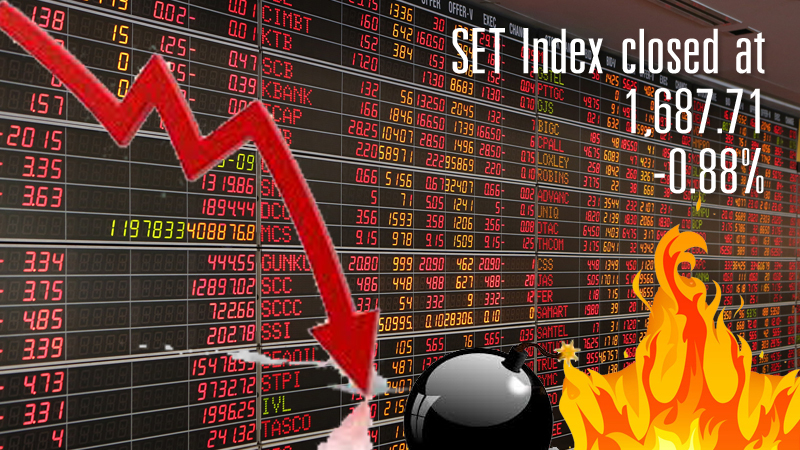
The Stock Exchange of Thailand Index was down almost 1 per cent on Friday (August 2) amid fears of an escalating trade war and a series of small blasts in Bangkok

The SET Index closed on Friday at 1,684.71, shedding 15.04 points or down 0.88 per cent from the previous day.

SET President Pakorn Peetathawatchai on Friday afternoon attributed the 20 points drop, or 1.6 per cent, mostly to external factors such as US imposing more tariffs on US$300 billion worth of imports from China and the Fed lowering its interest rate below market expectation. He said the blasts would have only a short-term effect on the market.

Pakorn said that the current SET Index drop was mainly due to investors being disappointed at the Fed’s rate cut. The Fed cut its policy rate by 25 basis points, half of the market expectation. President Donald Trump on Thursday declared that the US would levy 10 per cent tariff on imports from China valued at $300 billion, which also dented investor confidence, he said.

He said the scale of the SET drop is manageable and relatively small compared with other markets in the region. The SET Index had fallen in afternoon trading by 1.6 per cent when he spoke to the press.

Other Asian markets were also hit hard due to fears of the escalating trade war between the US and China as well as the trade dispute between Japan and South Korea. Japan’s Nikkei closed sharply, sliding 2.1 per cent, Hong Kong’s Hang Seng plunged 2.35 per cent, Shanghai fell by 1.4 per cent and Taiwan’s Taiex dropped by 1.7 per cent.

Pakorn said the market’s slide provided a window of opportunity for investors to buy many stocks which have been underpinned by sound fundamentals. Investors, however, should take risks into account before deciding on an investment. There is also a good chance to buy long term equity funds at this moment, he added.

Finance Minister Uttama Sayanayana also played down the impact of the small explosions in the capital, saying it would have only a short-term impact on the financial markets.

Uttama said he was confident the bombings would not affect investor confidence, as the authorities would be able to control the situation. He added that the one cause of the SET’s decline in morning trade was the ongoing trade war between major countries.

He said the ministry would soon launch stimulus measures for the second half of the year to take care of the farm sector and respond to the volatile global economy.

Trump’s China tariff escalation to further shrink Thai exports

ศาสตร์เกษตรดินปุ๋ย : ขอบคุณแหล่งข้อมูล : หนังสือพิมพ์ The Nation

https://www.nationthailand.com/business/30374134

Trump’s China tariff escalation to further shrink Thai exports

Aug 02. 2019
By PHUWIT LIMVIPHUWAT
THE NATION

1,246 Viewed

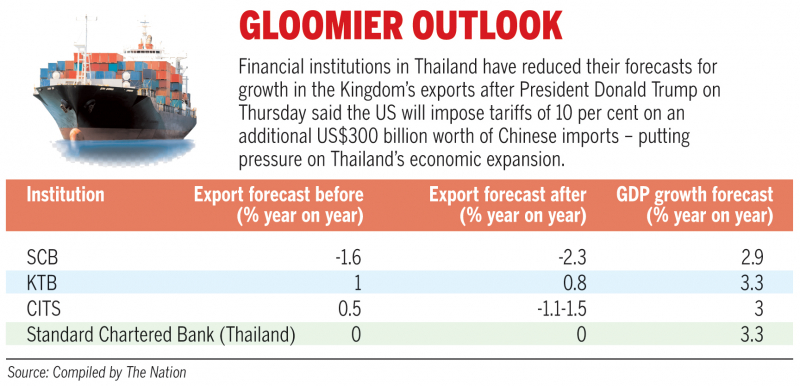
US President Donald Trump’s imposition of a 10 per cent tariff on an additional US$300 billion in Chinese imports will cause Thai exports to contract even further in 2019, economists warn.

“Thailand’s exports have been falling since January. The announcement by President Trump to increase tariffs on Chinese goods in September will cause Thai exports to bottom out even deeper in the fourth quarter of this year,” said Yunyong Thaicharoen, first executive vice president and head of Siam Commercial Bank’s Economic Intelligence Centre (EIC).

On Thursday, Trump announced through Twitter that the US will impose a 10 per cent tariff on the additional $300 billion worth of Chinese goods as China did not follow through on its prior agreement to purchase more US agricultural goods.

Thailand has felt the collateral damage of the superpower trade spat as the Kingdom is located in the supply chain affected by Trump’s tariffs. For instance, Thailand exports electronic parts to China that are developed further before being shipped to the US.

In the first half of 2019, Thai exports declined by 2.9 per cent year on year, dropping by US$4 billion, according to the Commerce Ministry.

The EIC predicted in July that as a result of the trade war, exports will contract by 1.6 per cent year on year in 2019. This marks a significant reduction in exports given last year’s solid 6.7 per cent growth, making it the lowest level since 2016.

However, Yunyong said, the new rounds of tariffs will have both direct and indirect impacts on Thailand’s economy, leading the EIC to reduce its export forecast in 2019 from a 1.6 per cent year-on-year contraction to a 2.3 per cent year-on-year contraction.

This has also led the centre to reducing its GDP forecast from 3.1 per cent year-on-year growth to 2.9 per cent.

Products such as fruits and processed food will be particularly impacted by this round of tariffs, he said. This is because the new round of tariffs will damage consumer sentiment in China, leading to a drop in demand for Thai agricultural products.

In the first six months of this year, exports of agricultural products declined by 2.58 per cent year on year, shedding $3 billion in value, according to the Commerce Ministry.

“Finally, the increase in tariffs will cause the global economy to slow down further, making it likely that the US Federal Reserves will lower interest rates at least once more in 2019,” Yunyong said. “This will lead to more capital inflows to emerging markets which will in turn, put pressure on the baht to strengthen even further as Thailand is seen as a safe haven for global investors.”

The strengthening baht will dampen exports of agricultural products even further as Thai goods will become less competitive in terms of pricing, he said.

Mana Nimitvanich, first vice president of the Krungthai Bank’s Global Business Development and Strategy Group, said: “The global economic slowdown which will result from the tariff hike to be implemented in September will not only cause Thai exports to China to drop, but Thai exports to various countries around the world may also take a hit from this trade tension escalation.”

To cope with the incoming negative impacts of the recent trade war escalation, the Thai government will need to play a more active role in helping exporters maintain their current markets through pricing strategies and set up road shows as well as business matching events to help exporters find new markets, suggested Aat Pisanwanich, director of the University of the Thai Chamber of Commerce’s Centre for International Trade Studies (CITS).

For example, agricultural goods should not be more than 3 to 5 per cent more expensive than their competitors despite their higher quality, he said. This is because pricing is still the key competitive advantage for these types of products especially when being exported.

Meanwhile, Thailand will need to hold more roadshows and business matching events abroad to help exporters find new business partners and start to diversify their markets. This will help mitigate risks from the reduction of Thailand’s shipments to China, he said.

Tim Leelahaphan, an economist from Standard Chartered Bank, said: “The worsening trade war situation and its impacts on Thailand justifies the necessity for the Bt100 billion short-term economic stimulus measures from the government.”

Given the current situation, he said, the best exports can do this year is to keep growth at zero per cent.

Pompeo defends US President’s new tariffs on China

ศาสตร์เกษตรดินปุ๋ย : ขอบคุณแหล่งข้อมูล : หนังสือพิมพ์ The Nation

https://www.nationthailand.com/business/30374108

Pompeo defends US President’s new tariffs on China

Aug 02. 2019
US Secretary of State Mike Pompeo stated:

US Secretary of State Mike Pompeo stated: “The first thing China has to do to avert tariffs is to come back to the agreement we had on the table.” -Photo by The Nation
By PHUWIT LIMVIPHUWAT
THE NATION

919 Viewed

US Secretary of State Mike Pompeo suggested that China should act according to the trade agreement established earlier this year as a first step in preventing President Donald Trump from imposing an additional 10-per-cent tariff on US$300 billion worth of Chinese goods.

During trade talks between the two countries earlier this year, China agreed to increase its purchase of US agricultural produce such as soybeans and pork to offset the trade imbalance between the two countries.

However, President Trump claimed via Twitter that China did not follow through on the agreement to increase purchases of US agricultural products in large quantities and said that as a result, the US will impose an additional 10-per-cent tariff on US$300 billion worth of Chinese goods.

In May, the US imposed a 25-per-cent tariff on US$250 billion worth of Chinese goods. The new round of tariffs will be imposed on a separate group of products including shoes, apparel and electronic gadgets.

Pompeo stated that China should first come back to the agreement they had on the table as a first step to lower the tariffs imposed on their exports, referring to their agreement for China to increase purchases of agricultural products.

He was speaking to the press during his visit in Bangkok earlier today on the US economic engagement in the Indo-Pacific region.

He added that further talks between the two countries would be held in Washington in September and that the US would continue its commitment to promoting free trade in the region.

“China has for decades been taking advantage of trade from the US and that has to stop,” he said. “President Trump’s head-on approach to solve this issue has been effective and we are working hard to make sure that China starts trading freely not only with the US but also with its neighbours in Asia.”

Pompeo also commented on the US sanctions on Iran, stating that the US is ready to impose sanctions on any Asian countries or companies that are importing oil from Iran.

“We must absolutely prevent Iran from acquiring the resources necessary to build their nuclear programme and we are ready to increase sanctions on any countries or companies importing Iran’s oil,” he stated.

Amid the increasing protectionism between the US and various countries, Pompeo stated that the US is committed to promoting free trade in the Indo-Pacific region, stressing that US investments from private businesses in the region have no political agenda.