VGI Global Media dividend approved

ศาสตร์เกษตรดินปุ๋ย : ขอบคุณแหล่งข้อมูล : หนังสือพิมพ์ The Nation

https://www.nationthailand.com/business/30372739

Jul 10. 2019
The senior figures of VGI Global Media come together at the company’s annual general meeting.

The senior figures of VGI Global Media come together at the company’s annual general meeting.
By THE NATION

182 Viewed

VGI Global Media Plc’s proposed dividend payout has been approved at the company’s annual general meeting in Bangkok.

The payment will be by cash at Bt0.054 a share with the total payout not exceeding Bt554.72 million. Payment will be on August 9. It is based on the company’s operating results in the second half of its fiscal year, ending on March 31.

The meeting, on Tuesday, also approved an increase in the company’s registered capital with a general mandate to enable the sale of no more than 428,058,285 shares through a private placement at Bt0.10 each.

The meeting approved a change of company name to VGI Public Company Limited, reflecting its vision of providing “pioneering solutions for tomorrow”.

Asia Green Energy gets Bt342m loan for ships

ศาสตร์เกษตรดินปุ๋ย : ขอบคุณแหล่งข้อมูล : หนังสือพิมพ์ The Nation

https://www.nationthailand.com/business/30372721

Jul 10. 2019
Panom Kuansataporn, executive chairman of Asia Green Energy, is optimistic on revenue growth for the company’s logistics services.

Panom Kuansataporn, executive chairman of Asia Green Energy, is optimistic on revenue growth for the company’s logistics services.
By THE NATION

215 Viewed

Asia Green Energy (AGE), a logistics operator covering sea freight, inland logistics, ports and warehousing services, has ordered 16 ships in a move that will takes its fleet to 40 by next year.

Funding for the order was helped by a Bt342.4 million from the Import-Export Bank of Thailand (Exim Thailand). The company also plans port expansion works.

Panom Kuansataporn, director and executive chairman of the company’s executive committee, expects to see further growth in the coal business, with some 1 million tons of orders on schedule to be delivered The company’s total revenue is expected to reach Bt9 billion.

Panom said AGE distributes what the company calls high-quality bituminous clean coal, which will create value added for the company’s growth.

“The investment expansion plan in the logistics business will generate positive results to the company’s overall business operation,” Panom said. “The plan also helps increase the revenue proportion with financial strength, stability, and sustainability in the future. We aim for 10 per cent growth in the company’s logistics revenue in 2019 – to around Bt800 million to Bt1 billion of this year’s total revenue of Bt9 billion. This will consist of a 20 per cent contribution from overseas coal sales and 70 per cent from domestic coal sales. We expect this year’s coal sales to reach 4 million tons. While the revenue from the logistics business of sea freight and inland logistics, and the port and warehouse services is accounted for at 10 per cent.”

The planned 16 new ships will have a coal transport capacity of 41,600 tons per trip. The ships are expected to be fully delivered in 2020, raising the fleet size from the current 24 ships.

In addition, the company plans to triple its port capacity. A third port is under development and is expected to be completed by end of 2019 to serve the rising numbers of tow boats.

“The reason that the company has placed this emphasis on investment in logistics businesses is that we see the business opportunity from more integrated services on more than 300 rai in Nakhornluang district, Ayutthaya, where there are coal storage areas and ports that can serve the immense investment expansion,” Panom said. “Thailand is in need of tow boats for goods transport, especially the goods from agricultural products such as soybeans, cassava, and fertiliser, besides the coal trade. This year we expect sea freight imports of those products amounting to around 30 million tons.”

New chief for Daimler’s Thai truck unit

ศาสตร์เกษตรดินปุ๋ย : ขอบคุณแหล่งข้อมูล : หนังสือพิมพ์ The Nation

https://www.nationthailand.com/business/30372720

Jul 10. 2019
By THE NATION

285 Viewed

Daimler Commercial Vehicles Thailand Ltd (DCVT), under the umbrella of Daimler Trucks Asia, on Wednesday announced changes in its senior management line-up.

Under the new management structure, Sascha Ricanek, currently chief executive officer of DCVT, will take a new position at the Daimler Trucks Asia headquarters in Kawasaki, Japan, from September 1.

As the CEO of DCVT, he has overseen the growth of its local dealership network, the improved availability of customer service solutions, and the expansion of DCVT’s product portfolio. His expertise in both engineering and business management will support Daimler Trucks Asia’s product line-up strategy in crucial international markets, including Thailand, the company said.

On September 1, Ricanek will be succeeded by Stefano Giordani, currently managing director of Mercedes-Benz Financial Services España (Spain).

Since joining Daimler in 2005, Giordani has developed a solid background in business development, and sales and marketing for financial services as well as trucks and buses in various countries from Europe to Asia. He will bring his keen customer focus to DCVT to further strengthen its presence in Thailand’s fast-growing commercial vehicles sector, the company said.

DCVT was established in August 2016 as the official distributor of Fuso and, since 2018, Mercedes-Benz commercial vehicles. The company is headquartered in the Sathorn area of Bangkok and has a parts distribution centre in the outer Bangkok area.

As an integral part of Daimler Trucks Asia headquartered in Japan and its South East Asia regional centre in Singapore. DCVT offers a product portfolio which includes trucks and buses for the Thailand market.

Kaspersky, Interpol renew cybercrime pact

ศาสตร์เกษตรดินปุ๋ย : ขอบคุณแหล่งข้อมูล : หนังสือพิมพ์ The Nation

https://www.nationthailand.com/business/30372719

Jul 10. 2019
By THE NATION

145 Viewed

Kaspersky, a global cybersecurity company, and Interpol signed a second five-year agreement last week to strengthen their collaboration in the fight against cybercrime around the world, following the first in 2014.

Under the new agreement, signed by Eugene Kaspersky, CEO of Kaspersky and Interpol’s executive director of Police Service Tim Morris, Kaspersky will provide human resources support, training, and threat intelligence data on the latest cybercriminal activities to Interpol, strengthening the organisation’s cyberthreat hunting capabilities. The agreement signing took place at Interpol World 2019 in Singapore.

This cooperation enhances the existing relationship between the two organisations, ensuring information and technology sharing can support Interpol in cybercrime-related investigations. In addition, Kaspersky will share information with Interpol on its cyberthreat research and provide the necessary tools to assist in full digital forensics, aimed at strengthening efforts on the prevention of cyberattacks.

“With the rise of sophisticated threat actors, collaboration across the ecosystem and the sharing of expertise is more crucial than ever. We are excited to continue the partnership with Interpol and to empower law enforcers with the information and technology needed to combat cybercrime across the globe,” said Kaspersky after the signing ceremony.

Kaspersky recognises the borderless nature of cybercrime and regularly participates in joint operations and cyberthreat investigations with the global IT security community, international organisations such as Interpol, law enforcement agencies and CERTs worldwide.

Being the first among cybersecurity vendors, Kaspersky recently announced an advanced free service for law enforcement agencies, aimed at increasing the awareness of how its services operate and how they can help in the fight against cybercrime and sophisticated cyberthreats.

Tesco to open 750 more stores in Thailand

ศาสตร์เกษตรดินปุ๋ย : ขอบคุณแหล่งข้อมูล : หนังสือพิมพ์ The Nation

https://www.nationthailand.com/business/30372714

Jul 10. 2019
Dave Lewis, the chief executive of Tesco, sees plenty of potential for further growth in the Thai supermarket sector.

Dave Lewis, the chief executive of Tesco, sees plenty of potential for further growth in the Thai supermarket sector.
By THE NATION

359 Viewed

Tesco plans to add 750 stores to its retail network in Thailand over the next three years, providing more than 10,000 jobs, a UK report said.

While they have failed in a number of countries, British supermarket operators have made a profit in Thailand. Tesco made £4.1billion in revenue in Thailand last year, making the country the largest market for it outside the UK, the report by Mirror News said.

Tesco has been established Thailand since 1998. It has now more than 1,500 express shops and about 400 bigger stores along with an online shopping service under the brand Tesco Lotus. The company serves more than 15 million customers every week.

Dave Lewis, the chief executive of Tesco, said: “The economics of the country are very attractive. There is a big emerging middle class. We have been making changes over the past two years but now we have a model we are very pleased with.”

Lewis’s plan will create some 10,000 jobs in Thailand. He said he sees big potential for market growth, as half of the Thai food shopping market consists of traditional markets, street stalls and small family-owned shops.

Tesco’s main competitor in Thailand is Japanese-US convenience store business 7-Eleven, which has thousands of stores in Thailand. It is by CP All.

People will shape the future of business

ศาสตร์เกษตรดินปุ๋ย : ขอบคุณแหล่งข้อมูล : หนังสือพิมพ์ The Nation

https://www.nationthailand.com/business/30372727

People will shape the future of business

Jul 10. 2019
By Special to The Nation

164 Viewed

In a future defined by artificial intelligence and automation, businesses have started backing people to set themselves apart.

They see a marriage of talented teams with innovative technology and producing better products at a lower cost as the key to success.

The global business environment is more challenging than it has been for years: economic growth is slowing, international trade expanding at its slowest rate for three years, and companies are facing geostrategic uncertainty at levels not seen since the end of Cold War.

Despite these headwinds though, most of the 2,500 companies across 14 major economies surveyed for HSBC’s Navigator: Made for the Future report said they are more optimistic about their prospects than they were 12 months ago and that they are still investing.

What has changed is their focus. Rather than chasing revenue growth in new markets, companies are now concentrating on the other side of the balance sheet and prioritising the delivery of better quality products and services at lower cost. To make this strategy work, they believe they need to find, train and retain good people while also making innovative use of technology.

The importance of people is a recurring theme in the survey’s findings. Three-quarters of the companies surveyed said they need to improve productivity; more than half said they intend to boost investment in skills and training; and one in every four firms that expects to grow ranked the quality and skills of their workforce as one of the top three factors influencing their expectations.

This return to the fundamentals of human resources is symptomatic of a more cost-conscious age, both in terms of the accounting bottom line and the cost to our planet. A quarter of the companies said one of the reasons they think it’s important to focus on environmental sustainability is because strong green credentials make it easier to recruit and retain the best people.

Perhaps surprisingly, given the media coverage this issue has attracted, only one in six companies ranked skills shortage as a top-three threat to their business plans.

This is important because getting the people part of the equation right will be vital to companies’ ability to realise their plans to use technology and innovation to survive and thrive.

Globally more than four out of five companies said they intend to increase investment, and of these nearly all (97 per cent) plan to spend more on research, innovation and technology. Their motives divide almost evenly between those who see innovation as a defensive necessity – the only way to survive – and those who see it as an offensive strategy – the only way to grow.

Asian and European companies predominantly fall into the first group, while almost 60 per cent of North American companies see innovation as the way to thrive rather than just survive.

This ambivalent sense of technology as both an opportunity and a threat runs through the findings. New technologies are expensive and returns are uncertain. Some 40 per cent of companies cited costs as a barrier to innovation, significantly more than any other factor, and a quarter said they worry they might not see a return on investment. Improving productivity and adopting new technologies were recognised as the top two opportunities for business, but cybersecurity was also among the top three threats.

Companies say the biggest tech opportunities lie in the internet of things, artificial intelligence and 5G technology, all of which share two common traits: a skilled workforce is required to exploit them, underlining the importance of the people element, and they bring companies closer to their customers, emphasising a focus on delivery.

The survey responses were also notable for what they did not show.

Although companies in Asia were generally the most optimistic about their near-term growth prospects at 82 per cent positive, those in North America (78 per cent) and Europe (74 per cent) were not significantly far behind. The regions were similarly balanced when it came to identifying opportunities and threats, plans for increasing investment and targets for that investment spending.

The headlines sometimes tell of little but doom ahead, with jobs being eroded as machines displace workers. But the respondents to this global survey speak of confidence in a brighter future, anchored in a carefully thought-out strategy that focuses on improvements to production and delivery through investments in people as well as in technology.

Noel Quinn is CEO of HSBC Global Commercial Banking

SET up almost 20 pts as Cabinet appointed

ศาสตร์เกษตรดินปุ๋ย : ขอบคุณแหล่งข้อมูล : หนังสือพิมพ์ The Nation

https://www.nationthailand.com/business/30372753

SET up almost 20 pts as Cabinet appointed

Jul 10. 2019
By THE NATION370 Viewed

Buoyed by the appointment of a new Cabinet, Thai stocks rose almost 18 points on Wednesday. The Stock Exchange of Thailand Index closed at 1,739.43, up 17.95 points, a rise of 1.04 per cent on the previous day’s figure.

The SET Index was boosted by a clearer picture of the new government, said analysts, after media reported that the launch of a new Cabinet led by Prime Minister Gen Prayut Chan-o-cha was imminent. The Royal endorsement of the Cabinet list came after the market closed, but the daily Index had already risen more than 20 points. Foreign investors maintained their bullish stance, making a net buy of Bt3.3 billion. Institutional investors and brokerage firms bought Bt861 million and Bt58.8 million respectively. But retail investors sold Bt4.2 billion. Total trade volume was Bt73.6 billion, with rise in value led by retail, communication and energy stocks.

Thai workforce must be readied for digital economy: TDRI

ศาสตร์เกษตรดินปุ๋ย : ขอบคุณแหล่งข้อมูล : หนังสือพิมพ์ The Nation

https://www.nationthailand.com/business/30372752

Thai workforce must be readied for digital economy: TDRI

Jul 10. 2019
By SOMLUCK SRIMALEE,
PHUWIT LIMVIPHUWAT
THE NATION

484 Viewed

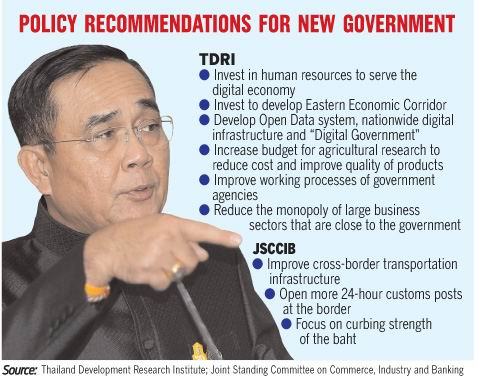
The new government will have no choice but to invest heavily in developing Thailand’s manpower, so it can survive in the fast-moving digital economy, Dr Somkiat Tangkitvanich, president of Thailand Development and Research Institute (TDRI), told the press on Wednesday.

He said the Thai workforce was facing digital disruption, and if skills are not developed in time to serve the new system, the workers will end up having to move out of the labour market. He also said that the new government needs to develop the skills of the national workforce so it is ready to serve the Eastern Economic Corridor (EEC).

From 2015 to 2018, investments in the EEC worth Bt1.014 trillion have been approved and most of them are in the sectors of petrochemical, auto, agriculture, bio technology, robotics and aviation.

Most of these industries require workers who have high expertise and the ability to learn quickly. Hence, it should be the government’s top priority to prepare manpower so it can serve the new economy and help push the country towards digital economy in line with the Thailand 4.0 strategy, he said.

Somkiat added that though the new government will continue to drive the EEC in order to boost aggressive investments from the private sector, it should also seek a way of collaborating with neighbouring communities and addressing concerns, especially those related to the environment.

Though Prime Minister General Prayut Chan-o-cha achieved some success in pushing for a digital economy over the past five years, his government also failed in several categories, such has addressing the inherent problem of corruption. He also had to rely on the special powers granted to him by Article 44.

However, as leader of the new government, Prayut will no longer have Article 44 to rely on, which means he will have to manage the country in line with law and by collaborating and communicating with the people.

“It will not be easy for the new government to run the country like it has in the past five years, but if it listens to the people and does what they want, then I believe the administration will be stable,” he said.

Meanwhile, Preedee Daochai, chairman of the Thailand Bankers’ Association, said at a press conference held by the Joint Standing Committee on Commerce, Industry and Banking (JSCCIB) on Wednesday that the new government will also have to boost the ease of doing business for Thai exporters and that the Bank of Thailand will have to bring down interest rates as soon as possible to make Thai exports more competitive.

“The Bt10-billion economic stimulus that the new government is expected to implement will not be enough to cushion the decline in Thai exports,” Preedee said.

“The government will have to be more proactive in supporting Thai exporters by implementing short-term measures to boost shipments,” added Kalin Sarasin, chairman of the Board of Trade of Thailand. The short-term measures can include things such as improving logistics infrastructure at Thailand’s borders to cut down on the transportation costs for business, he said.

Kalin also suggested that Thai authorities talk to neighbouring countries about making their customs formalities available 24 hours so the flow of goods within the region can be improved. He cited the 24-hour customs facilities already available at Songkhla’s Sadao district.

He also said Thailand should be allowed to trade in the Thai currency with other countries in order to minimise the risks associated with foreign-exchange volatility.

Another factor having a negative impact on Thai exports is the strong baht, said Supant Mongkolsuthree, chairman of the Thai Federation of Industries.

Since January, the baht has appreciated 5.7 per cent, valuing at Bt30.8 against the US dollar on July 8, which marked the highest level of currency appreciation against the greenback in the Asia-Pacific region, according to Kasikorn Research.

“The baht’s strength against the dollar compared to the currencies of its competitors such as Vietnam makes Thai exports a lot less competitive in international markets,” Supant added.

Hence, he said, it is necessary that the Bank of Thailand immediately implement measures like lowering policy interest rates by at least 0.25 per cent to slow the pace of the baht’s appreciation.

He added that the JSCCIB is looking to set up a meeting by the end of next week with the central bank to address this issue.

The committee has predicted that exports this year will contract 1 per cent from 2018. It had earlier this year projected an export growth of 3 to 5 per cent.

The committee has also brought its earlier forecast for GDP growth this year from 3 per cent to 2.9 per cent.

The US-China trade war continues being a key factor damaging exports, especially in the agriculture and manufacturing sectors, the JSCCIB said.

Thai construction and service operators secure Bt500 mn orders from the Middle East

ศาสตร์เกษตรดินปุ๋ย : ขอบคุณแหล่งข้อมูล : หนังสือพิมพ์ The Nation

https://www.nationthailand.com/business/30372750

Thai construction and service operators secure Bt500 mn orders from the Middle East

Jul 10. 2019
By THE NATION

320 Viewed

Thai business operators in the construction and service industries secured orders worth some Bt500 million as a result of the trip organised by the Commerce Ministry’s Department of International Trade Promotion to Muscat and Manama last month.

Banjongjitt Angsusingh, Director-General, revealed that 70 companies in Oman and 67 in Bahrain attended the campaign. Notable attendees included Galfar Engineering & Contracting SAOG, Oman’s largest engineering and construction company, Khimji Ramdas Group (KR), and Nass Commercial, Bahrain’s top distributor of imported products and services.

Thai business operators were able to secure immediate orders of Bt8,58 million and future orders of Bt191.73 million in Oman, while in Bahrain they secured immediate orders of Bt14.52 million and future orders of Bt296.67 million. Product groups that earned the most interest were security equipment, furniture components, building materials, and plants.

“This campaign was a huge success as Thai business operators secured more than Bt500 million in orders from both countries,” she said.

Myanmar to allow in more foreign banks

ศาสตร์เกษตรดินปุ๋ย : ขอบคุณแหล่งข้อมูล : หนังสือพิมพ์ The Nation

https://www.nationthailand.com/business/30372748

Myanmar to allow in more foreign banks

Jul 10. 2019
The Yangon branch of Bangkok Bank, the only Thai bank to be awarded a foreign banking licence in Myanmar. It is in the Yankin Township of the country’s business capital. (Photo courtesy of Thaipublica.org)

The Yangon branch of Bangkok Bank, the only Thai bank to be awarded a foreign banking licence in Myanmar. It is in the Yankin Township of the country’s business capital. (Photo courtesy of Thaipublica.org)
By KHINE KYAW
THE NATION
YANGON

363 Viewed

With Myanmar’s financial sector reforms gaining momentum, the country plans to allow more foreign banks in to provide limited services, Soe Thein, deputy governor of the Central Bank of Myanmar (CBM), said.

He told The Nation on Wednesday that the third round of issuances of licences for foreign banks would be opened by the end of this year.

On Tuesday, the CBM’s foreign banks selection committee met to approve 15 criteria for the selection of an eligible consulting firm to provide advisory services for the process of awarding licences to foreign banks that already have a representative office in Myanmar.

Soe Thein said the CBM would finalise the selection of the consultancy firm by early next month. Myanmar will select only one consultancy firm among the four finalists: Deloitte Touche Myanmar Vigour Advisory Ltd, PricewaterhouseCoopers (PWC) Myanmar Co, EY UTW Advisory Ltd and Roland Berger Co.

“In late May, we invited a total of eight consultancy services to submit proposals for providing advice on the selection of foreign banks. Half of them submitted RFP [request for proposal] on June 24,” he said.

Firms that did not apply for the CBM’s offer included big names such as KPMG Advisory (Myanmar) Ltd, Baker & Mckenzie Co, Allen & Gledhill Co and Rajah & Tann NK Legal Co.

The deputy governor said the CBM is reviewing the applications to score each of the firms depending on the selection criteria, which include consultancy fees, payment terms, professional background, experience and the academic qualifications of team members.

“The majority of the criteria largely depend on the quality and capability of the consulting firms. We will systematically assess how they’ve formed their teams and how they support us in this selection process,” he said.

“This is the very first stage of the next round of foreign banks licences that we expect to open later this year. We will choose the eligible consulting firm in the next meeting of the foreign banks selection committee, which is expected in the last week of July.”

Myanmar has yet to decide how many foreign banks will be awarded the licences in the next round, the official said.

“First, we [CBM officials] need to discuss with the selected consultancy firm. Later on, we will finalise the details,” he said.

Currently, 13 foreign banks have been awarded licences to open a branch in Myanmar. In 2014, the CBM granted a provisional licence to nine bidders from Australia, Japan, Singapore, China, Thailand and Malaysia. Two years later, four more overseas banks – from Vietnam, South Korea, Taiwan and India – were also awarded permits.

Soe Thein said Myanmar has relaxed restrictions on the licensed foreign banks to some extent. Last November, the CBM allowed the banks to provide import financing and other banking services to local businesses.

“They can provide loans to local enterprises with the same value as local banks,” he said.

“When it comes to providing credits in local currency, we apply the same conditions for both local and foreign banks. It means we ensure there is no discrimination.”

To date, Bangkok Bank is the only Thai bank that has been awarded a foreign banking licence in Myanmar. Having operated in Myanmar for more than two decades, the bank was granted the licence in 2014 and opened its Yangon branch in June 2015.

Four other Thai banks – Siam Commercial (SCB), Krung Thai, Kasikornbank and Export-Import Bank of Thailand, along with BOT Lease (Thailand) Co – are among the 53 foreign banks and finance companies that have a representative office in the country.

Three other Thai banks are likely to apply for the licence when the next round opens, while EXIM Thailand has not yet shown interest.

“In the second round, the selection committee decided to give preference to banks from the countries which were not selected in the first bidding,” said Soe Thein.

“It is still too early to finalise the conditions for the third round but there may be a chance for the banks that are well-prepared,” he added.

Pisit Serewiwattana, the president of EXIM Thailand, said in an earlier interview with The Nation that the bank prefers supporting state-owned banks that are vying for a foreign banking licence rather than establishing a branch in Myanmar.

Kamalkant Agarwal, first executive vice president at SCB, told The Nation earlier that the bank would again apply for the licence in the next round.

“Regarding the licence, we remain hopeful and will definitely keep trying … It is up to the central bank. On our side, we are very keen and whenever there is a new round, we will definitely apply for it,” he said.