Ratch subsidiary signs deal for wind power project in Vietnam #SootinClaimon.Com

#SootinClaimon.Com : ขอบคุณแหล่งข้อมูล : หนังสือพิมพ์ The Nation.

Ratch subsidiary signs deal for wind power project in Vietnam (nationthailand.com)

Ratch subsidiary signs deal for wind power project in Vietnam

CorporateDec 05. 2020

By The Nation

RH International (Singapore) Corporation Pte Ltd, a wholly-owned indirect subsidiary of Ratch Group Pcl, has signed a joint development agreement with Nexif Energy Pte Ltd in Vietnam on Friday for developing the Nexif Ben Tre wind power project.

Ratch chief executive officer Kijja Sripatthangkura informed the Stock Exchange of Thailand that the project participation would be at 50:50 per cent after further development and any required approvals.

He explained that the Nexif Ben Tre wind power project would generate 80 megawatts of wind power at Ben Tre province in southern Vietnam. The electricity will be sold to Vietnam Electricity under a long-term power purchase agreement.

“Currently, the project is under green-field development and under negotiation, expected to be ready for commercial use in 2022,” he said.

Government Savings Bank (GSB) has launched urgent financial measures to bring relief to people in the flood-hit South with a highlight of three-month debt suspension offer. #SootinClaimon.Com

#SootinClaimon.Com : ขอบคุณแหล่งข้อมูล : หนังสือพิมพ์ The Nation.

Government Savings Bank (GSB) has launched urgent financial measures to bring relief to people in the flood-hit South with a highlight of three-month debt suspension offer. (nationthailand.com)

Government Savings Bank (GSB) has launched urgent financial measures to bring relief to people in the flood-hit South with a highlight of three-month debt suspension offer.

Dec 04. 2020

By The Nation

It has also offered loan for those experiencing the disaster at Bt50,000 per person with no interest rate charge in the first year.

Related story: GSB issues loan packages, relief for flood victims in South

BioNTech founder vaults into world’s richest on 250% surge #SootinClaimon.Com

#SootinClaimon.Com : ขอบคุณแหล่งข้อมูล : หนังสือพิมพ์ The Nation.

BioNTech founder vaults into world’s richest on 250% surge (nationthailand.com)

BioNTech founder vaults into world’s richest on 250% surge

CorporateDec 05. 2020The BioNTech covid-19 production facility in Marburg, Germany, on Dec. 2, 2020. MUST CREDIT: Bloomberg photo by Alex Kraus.The BioNTech covid-19 production facility in Marburg, Germany, on Dec. 2, 2020. MUST CREDIT: Bloomberg photo by Alex Kraus. 

By Syndication Washington Post, Bloomberg · Ben Stupples

Ugur Sahin just reached another milestone.

The co-founder of BioNTech on Thursday joined the world’s 500 richest people after the U.K. this week approved use of a covid-19 vaccine that the German firm created with Pfizer Inc.

BioNTech’s shares have jumped almost 8% this week and are up more than 250% for the year. Sahin is now the 493rd-richest person on the planet with a net worth of $5.1 billion, according to the Bloomberg Billionaires Index.

Sahin didn’t respond to a request for comment made through BioNTech’s press office.

The U.K. was the first western country to approve a covid-19 vaccine, clearing the way for the deployment of a shot that Pfizer and BioNTech have said is 95% effective in preventing illness. BioNTech is still waiting on a decision from the U.S. Food and Drug Administration and European Union regulators.

The German firm previously focused on fighting cancer, but Sahin and his wife Ozlem Tureci — BioNTech’s chief medical officer — sharpened their focus on covid-19 in January after reading a troubling study about the spread of the virus in a family that had visited Wuhan, China. Their results are a validation of the new type of drug that they’ve spent their careers chasing.

“It could open the pharmaceutical field for a new class of molecules,” Sahin said last month.

Turkish-born scientist Sahin is the sole shareholder of a German firm that controls an 18% stake in BioNTech, which raised $150 million from its U.S. initial public offering last year, filings show.

Sahin joins Germany’s Struengmann brothers among the world’s 500 richest. They own about half of BioNTech and backed the previous biotech venture that Sahin set up with his wife, Ganymed Pharmaceuticals. The siblings’ fortune is estimated at more than $24 billion combined.

The race to produce a covid-19 vaccine has also lifted a group of investors at BioNTech’s closest rival, Moderna.

Shares of the Cambridge, Massachusetts-based company have surged more than 700% this year, making billionaires of some early investors, including Massachusetts Institute of Technology professor Bob Langer and Harvard University professor Tim Springer, as well as Chief Executive Officer Stephane Bancel, who is now worth $4.9 billion.

Slew of foreign data to impact SET and baht next week #SootinClaimon.Com

#SootinClaimon.Com : ขอบคุณแหล่งข้อมูล : หนังสือพิมพ์ The Nation.

Slew of foreign data to impact SET and baht next week (nationthailand.com)

Slew of foreign data to impact SET and baht next week

EconDec 05. 2020

By The Nation

Investors have been advised to follow key domestic and international developments as a mix of these would impact the Stock Exchange of Thailand (SET) Index, the baht and gold price next week.

The baht on Friday closed at 30.15 to the US dollar on Friday, strengthening from 30.29 last week due to mass sell-offs of the greenback amid hopes of a Covid-19 vaccine and the US Federal Reserve’s signs of quantitative easing.

A strategist at Kasikorn Research Centre expected the baht next week to move between 30.00 and 30.40 to the dollar, advising investors to follow the Bank of Thailand (BOT)’s measures to shepherd the baht, foreign funds flows, the domestic political situation and the Covid-19 outbreak.

Among international factors, he advised investors to follow the US inflation rate in November, the US weekly jobless claims, the US consumer confidence index in December, the European Central Bank meeting, the EU Summit and China’s economic data for November.

The SET Index on Friday closed at 1,449.83, up 0.84 per cent from the previous week, while transactions amounted to Bt88.5 billion, down 8.33 per cent from the previous week, on the back of positive news of a Covid-19 vaccine, rising oil price after Opec+ decided to extend the cap on oil production and the BOT’s move to amend regulations on eligibility criteria for regulatory capital.

The Market for Alternative Investment closed at 331.18, up 0.99 per cent from the previous week.

An analyst at Kasikorn Securities expected the SET next week to move between 1,430 and 1,485, advising investors to follow the Covid-19 outbreak, Thailand’s political situation, the Covid-19 crisis, Brexit and the Opec+ meeting, the ECB meeting, US-China relations and Brexit.

Among international factors, he advised following US consumers’ and producers’ price indices in November, the euro-zone and Japan’s third-quarter gross domestic product and China’s economic data in November.

Gold price on Friday closed at US$1,842.02 per ounce, while in Thailand it closed at Bt26,390 per baht weight.

An analyst at YLG Bullion International said there was limited upside for the metal amid the conflict between the US and China.

He advised investors to buy gold when its price rises over the support line between $1,815 and $1,829 per ounce as the price would rise to the resistance line between $1,847 and $1,864 per ounce.

“Meanwhile, investors should pay attention to their investment, as the Thailand Futures Exchange market is closed until Monday,” he said.

Markets wrap: Stock rally reaches new heights on stimulus optimism #SootinClaimon.Com

#SootinClaimon.Com : ขอบคุณแหล่งข้อมูล : หนังสือพิมพ์ The Nation.

Markets wrap: Stock rally reaches new heights on stimulus optimism (nationthailand.com)

Markets wrap: Stock rally reaches new heights on stimulus optimism

EconDec 05. 2020

By Syndication Washington Post,

U.S. stocks climbed to all-time highs and Treasury yields jumped after a report showing U.S. employment gains slowed in November bolstered expectations for more federal stimulus.

All major indexes for U.S. equities – the S&P 500, the Dow Jones Industrial Average, the Russell 2000 and the Nasdaq Composite index – closed at records. Such synchronized highs were last seen in January 2018. The dollar posted its biggest weekly decline in five, while the yield on the 10-year Treasury note reached the highest in nine months.

“One of the recurring themes this year is the resiliency of the market, it’s been amazing and impressive,” said John Porter, head of equities at Mellon Investments.

Labor Department figures showed nonfarm payrolls increased by a less-than-forecast 245,000 from the prior month, as the unemployment rate dipped 0.2 percentage point to 6.7%. President-elect Joe Biden called the report “grim” and said it shows “there’s no time to lose” for Congress to pass a new Covid relief bill.

House Speaker Nancy Pelosi said there’s momentum building toward a compromise fiscal stimulus plan, though Republicans complained about the scale of aid to states included in the bipartisan proposal that’s become the best chance yet for a deal.

“The market is betting that we’ll get a relief package soon,” said Matt Maley, chief market strategist at Miller Tabak + Co. “If anything, this weaker report will get them to agree on a package sooner rather than later.”

Elsewhere, oil climbed as OPEC+ reached an agreement to ease its output cuts next year more gradually than previously planned. Bitcoin declined for the first time in three days after flirting this week with $20,000.

Energy companies led the Stoxx Europe 600 index higher. Asian equities closed mostly higher.

Here are the main moves in markets:

– – –

– The S&P 500 Index climbed 0.9% to 3,699.13 as of 4:01 p.m. New York time, the highest on record.

– The Dow Jones Industrial Average rose 0.8% to 30,217.77, the highest on record with the biggest advance in more than a week.

– The Nasdaq Composite index gained 0.7% to 12,464.23, the highest on record.

– The Stoxx Europe 600 index increased 0.6% to 394.04, the highest in more than nine months.

– The MSCI All-Country World Index rose 0.7% to 633, the highest on record.

– – –

– The Bloomberg Dollar Spot index dipped 0.1% to 1,129.43, the lowest in more than two years.

– The euro fell 0.1% to $1.2128.

– The British pound declined 0.1% to $1.3435.

– The Japanese yen weakened 0.3% to 104.17 per dollar, the largest drop in more than a week.

– – –

– The yield on 10-year Treasuries rose six basis points to 0.97%, the highest in more than three weeks.

– Germany’s 10-year yield increased one basis point to -0.55%.

– Britain’s 10-year yield gained three basis points to 0.351%.

– – –

– West Texas Intermediate crude rose 0.9% to $46.05 a barrel, the highest in nine months.

– Gold weakened 0.2% to $1,836.91 an ounce.

Wall Street keeps pushing into China as Washington balks #SootinClaimon.Com

#SootinClaimon.Com : ขอบคุณแหล่งข้อมูล : หนังสือพิมพ์ The Nation.

Wall Street keeps pushing into China as Washington balks (nationthailand.com)

Wall Street keeps pushing into China as Washington balks

EconDec 05. 2020A monitor displays Alibaba Group Holding signage on the floor of the New York Stock Exchange in New York on Oct. 13, 2017. MUST CREDIT: Bloomberg photo by Michael Nagle.A monitor displays Alibaba Group Holding signage on the floor of the New York Stock Exchange in New York on Oct. 13, 2017. MUST CREDIT: Bloomberg photo by Michael Nagle. 

By Syndication Washington Post, Bloomberg

A year into China’s big bang opening of its financial markets, Wall Street has ever more to lose from a growing consensus in Washington over reining in Beijing.

It’s a risk they’re willing to take.

A star-studded cast of global banks and fund houses have increased their presence in China this year and a record $212 billion of foreign funds have poured into Chinese bonds and stocks. Alongside have come a myriad of measures from Washington aimed at decoupling the U.S. from China, an issue that’s drawn bipartisan support given widespread alarm about the Asian nation’s rising influence in global affairs.

The latest U.S. salvo was fired on Wednesday with the passage of legislation that could lead to Chinese companies — including behemoths like Alibaba Group Holding Ltd. — getting kicked off American exchanges. The turbulence hasn’t swayed global finance from the opportunity to capture a share of profits that are estimated to swell to $47 billion in investment banking alone by 2026.

Goldman Sachs and JPMorgan Chase are now pushing to take full control of their China ventures, while fund giants such as BlackRock Inc have been given the greenlight to set up shop.

“There’s a lot of risk and uncertainty about future policy directions” said Chen Zhiwu, director of the Asia Global Institute at the University of Hong Kong. “But on the other hand, wow, the market is so big so some people are still willing to go in for the potential high gain at the cost of being exposed to a lot of high risk.”

All signs point to Congress continuing the confrontation under President-elect Joe Biden’s administration, with the risk of the finance industry becoming deeper enmeshed. Biden’s pick for national security adviser, Jake Sullivan, has questioned why the U.S. should prioritize opening China for the likes of Goldman Sachs, arguing that the competition between the two powers will turn on how “effectively each country stewards its national economy and shapes the global economy.”

At the same time, Beijing has vowed to continue easing barriers to its capital markets. Guo Shuqing, the chairman of the China Banking & Insurance Regulator Commission, wrote in a recent article that the fortunes of a nation are “often closely tied to its financial power” and that it will seek to actively participate in shaping international rules.

The opening isn’t some act to “reconcile” with the U.S. to defuse tensions but driven by self interest, said Jessie Guo, head of equity research at China Merchants Securities HK Co. The nation will keep the doors open as it pivots toward a “dual circulation” strategy in which the domestic market becomes the main growth driver, supplemented by foreign demand, she said.

The push has so far paid off for China in a tumultuous year, when its economy outperformed major rivals after the nation successfully contained the coronavirus.

A September survey by HSBC Qianhai Securities showed that almost two-thirds of more than 900 global institutional investors and major corporations are planning to increase their investment in China by an average of 25% over the next year. Investors in North America stood out as the only ones saying they will hold off on increasing their exposure to mainland Chinese corporate bonds and commercial paper.

Approvals to take major control in China have continued for foreign banks, asset managers and payment clearing networks. Firms including Goldman and Credit Suisse Group have ambitious hiring plans in China, and argue they can boost investments in the country since they are better able to control where the money is being put to use. Analysts at Goldman at the end of last year estimated profits in the Chinese brokerage sector could reach $47 billion by 2026, up from $10 billion in 2018.

Regulators have also given overseas traders access to futures and options, expanded a U.S.-style registration system for IPOs and scrapped quotas on foreign inflows.

That’s being noticed in the halls of Washington. A Congressional commission this week warned that China’s financial opening was part of a “calculated strategy” to secure foreign investments and use them to shore up the domestic economy.

U.S. lawmakers this week approved legislation that could lead to Chinese companies getting delisted unless they allow a review of their financial audits, albeit with a three-year phase-in period. Sanctions on Chinese firms connected to the military triggered JPMorgan to exclude new bonds from impacted companies from its widely followed debt indexes, underscoring how the U.S. can affect index-tracking investors around the world.

Banks also face a deadline this month for ensuring that they aren’t doing business with Hong Kong and Chinese officials sanctioned over their role in the political crackdown on the financial hub. Lenders, including major Chinese banks, have already taken steps to comply.

Banks and asset managers have to do more due diligence to avoid the risks of servicing sanctioned Chinese firms such as helping them to list or to raise capital, according to Benjamin Quinlan, chief executive officer at Quinlan & Associates, a strategy consultant in Hong Kong.

“That means having much stricter ‘know your customer’ and onboarding controls,” he said. “The reality is the biggest fines in the world are for sanction breaches with the U.S.”

China’s response so far has been to continue down the path of further opening, though the toughest reforms are yet to come. China’s strategy to make the yuan a global currency has so far come up short, with its share in payments falling to 1.66% as of October from 1.94% at the end of last year.

Capital controls and the uncertainty of repatriating funds remain a key hurdle for global investors as do a lack of transparency in rule-making. The abrupt cancellation of Ant Group’s record IPO in early November sent shudders through the markets.

That hasn’t swayed global firms such as Goldman Sachs. President John Waldron said in October that the U.S. bank is still waiting on further guidance on how to apply for a 100% stake. He also proposed further liberalization measures including reduced constraints on outbound capital flows, allowing foreign firms to act as market makers in China’s bond connect and further alignment with international regulatory standards.

Henry Fernandez, chairman of MSCI Inc., said in a recent Bloomberg TV interview that the opening shows China “is recognizing that in order to have that leadership in the world, economically, politically and financially, they need to embrace openness and become one of the largest countries in the world in all these markets.”

With the incoming Biden administration, “hopefully we can avoid a capital war, which can be devastating,” Fernandez said.

Thailand’s inflation to hit 1.2%, if economy expands as expected #SootinClaimon.Com

#SootinClaimon.Com : ขอบคุณแหล่งข้อมูล : หนังสือพิมพ์ The Nation.

Thailand’s inflation to hit 1.2%, if economy expands as expected (nationthailand.com)

Thailand’s inflation to hit 1.2%, if economy expands as expected

EconDec 05. 2020Pimchanok Vonkorpon, director-general of the Trade Policy and Strategy OfficePimchanok Vonkorpon, director-general of the Trade Policy and Strategy Office 
By The Nation

Thailand’s inflation rate is expected to hit 1.2 per cent next year, said Pimchanok Vonkorpon, director-general of the Trade Policy and Strategy Office.

The inflation will be within the range of 0.7 and 1.7 per cent next year assuming the economy expands between 3.5 per cent and 4.5 per cent, the Dubai crude oil price is between US$40 and $50 per barrel and the baht lies between Bt30 and Bt32 per US dollar.

The inflation rate this year has been forecast to contract by 0.87 per cent, she added.

GSB issues loan packages, relief for flood victims in South #SootinClaimon.Com

#SootinClaimon.Com : ขอบคุณแหล่งข้อมูล : หนังสือพิมพ์ The Nation.

GSB issues loan packages, relief for flood victims in South (nationthailand.com)

GSB issues loan packages, relief for flood victims in South

EconDec 04. 2020

By The Nation

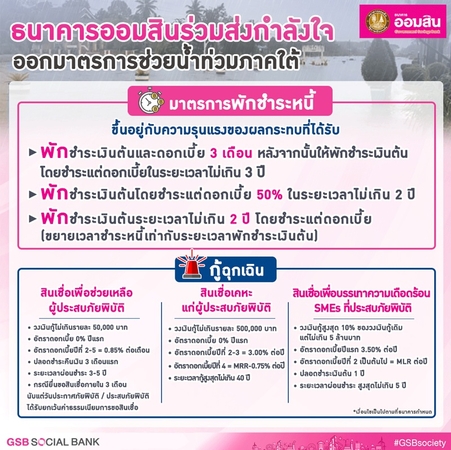
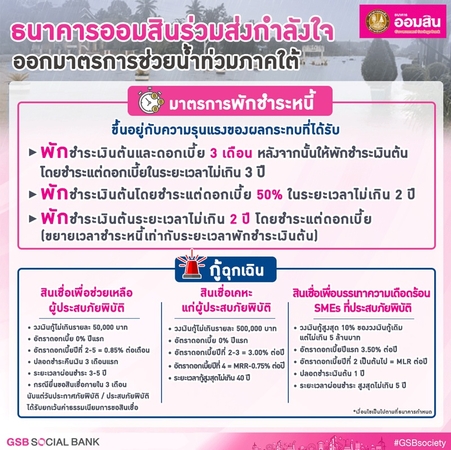
The Government Savings Bank (GSB) has launched loan packages to relieve the burdens of flood victims in the South.

GSB president Vitai Ratanakorn said flooding in many southern provinces had taken a toll on livelihoods.

In response, the bank has also provided victims with 3,500 bags of relief supplies and drinking water.

Among the worst-affected provinces are Nakhon Si Thammarat and Surat Thani, where GSB has more than 957,000 deposit and loan customers.

To relieve customers’ burdens, the bank has launched a debt suspension programme for all loan types. The suspensions come in three grades.

Those suffering the highest impacts will be allowed to suspend principle and interest repayments for three months.

Those flooded for over seven days and needing to repair or renovate their residences are allowed to suspend principle payment and pay 50 per cent of interest for up to two years.

For the lowest impact level, those flooded for over seven days can suspend principle payment for up to two years and pay only the interest.

The bank is also offering special disaster-relief loans of up to Bt50,000 per person, with no interest for the first year, then a monthly flat rate of 0.85 per cent over 3-5 years with a grace period in the first three months.

Meanwhile the GSB will extend mortgage loans for flood-related house repairs at a rate of 100 per cent of the appraised damage, up to Bt500,000. Annual interest in the first year is 0 per cent before rising to 3 per cent in the following two years. The rate from the fourth year onward is MRR-0.75 per cent per year.

GSB is also offering loans to its corporate customers at a maximum 10 per cent credit limit of their existing loan but not exceeding Bt5 million. The repayment term is five years with a one-year grace period for principle payment. The annual interest rate in the first year is 3.5 per cent and the rate from the second year onward is MLR (GSB’s current annual MRR rate is 6.245 per cent and the MLR is 6.15 per cent).

SET up 0.80% as vaccines, oil price lift investors’ mood #SootinClaimon.Com

#SootinClaimon.Com : ขอบคุณแหล่งข้อมูล : หนังสือพิมพ์ The Nation.

SET up 0.80% as vaccines, oil price lift investors’ mood (nationthailand.com)

SET up 0.80% as vaccines, oil price lift investors’ mood

EconDec 04. 2020

By The Nation

The Stock Exchange of Thailand (SET) Index closed at 1,449.83 on Friday, up 11.51 points or 0.80 per cent. Total transactions amounted to Bt82.7 billion with an index high of 1,454.94 and a low of 1,439.14.

In the morning session, an analyst at Krungsri Securities expected the day’s index to hit 1,445 points as foreign funds continue to flood the Thai stock market amid hopes of a US stimulus package, positive news of Covid-19 vaccines and a rising oil price after Opec+ decided to extend the cap on oil production.

“However, we advise investors to speculate for short-term profit as the index’s price-to-earnings ratio is 28 times,” he cautioned.

The 10 stocks with the highest trade value today were PTT, KBANK, IVL, TMB, BAM, PTTEP, AOT, SCGP, SCB and ADVANC.

As of 5pm, the price of oil rose by US$0.67 or  1.47 per cent to $46.31 per barrel, while gold rose by $4.30 or 0.23 per cent, to $1,845.40 per ounce.

Other Asian indices were mixed:

Japan’s Nikkei Index closed at 26,751.24, down 58.13 points or 0.22 per cent.

China’s Shang Hai SE Composite Index closed at 3,444.58, up 2.45 points or 0.071 per cent, while Shenzhen SE Component Index closed at 14,026.66, up 55.97 points or 0.40 per cent.

Hong Kong’s Hang Seng Index closed at 26,835.92, up 107.42 points or 0.40 per cent.

South Korea’s KOSPI Index closed at 2,731.45, up 35.23 points or 1.31 per cent.

Taiwan’s TAIEX Index closed at 14,132.44, up 155.35 points or 1.11 per cent.

Digital Marketing in 2021: How SEO Has Become an Essential Part of Online Strategy for Businesses #SootinClaimon.Com

#SootinClaimon.Com : ขอบคุณแหล่งข้อมูล : หนังสือพิมพ์ The Nation.

Digital Marketing in 2021: How SEO Has Become an Essential Part of Online Strategy for Businesses (nationthailand.com)

Digital Marketing in 2021: How SEO Has Become an Essential Part of Online Strategy for Businesses

Dec 04. 2020

It is generally known that search engine optimization (SEO) is what a business owner does to ensure their digital properties (such as web pages) can be found online when their target audience searches the web with keywords related to their industry, products or services.

But, given that 68% of online experiences begin with a search engine, do business owners really realize just how essential SEO has become today as an online marketing strategy? Many actually don’t, and therefore tend to take it lightly.

No wonder the experts at Inspira Digital Agency here in Thailand see the need to highlight how SEO has become the key to digital marketing success for businesses in 2021 and beyond.

First, it’s important to understand that organic search today is the major source of website traffic for businesses, whether small, medium, or large. In fact, according to research by Bright Edge, up to 53.3% of all website traffic comes from organic search; and Google, as the organic search market leader, controls a whopping 92.96% of this organic search traffic.

What this tells us is that PPC campaigns, social media and other traffic sources pale in comparison to organic search when it comes to traffic generation, and SEO happens to be the only way business owners can claim their share of organic traffic.

When it comes to building trust and credibility, and being recognized as an industry authority, any business with an online presence simply cannot disregard SEO. As Cookie Veeratat, Account Manager at Inspira Digital Agency, states, “our clients are beginning to understand more and more, the necessity of SEO to strengthen their target consumers’ perception of their brand as an industry authority.”

She further explained that “this could be as a result of them coming to realize that the more their target audience keep seeing their brand name and web pages on the number one search engine results page of a leading search company like Google when they search for pertinent information, the more these consumers will regard their business as relevant, credible, and authoritative.”

For a brand looking to build authority and trust which are vital for success in marketing, ranking its web pages high on Google’s (or any other search platform’s) SERPs can only be achieved with good SEO, which accounts for optimized content and on-page elements, quality backlink profiles, positive user behavior, and machine-learning signals.

As the use of mobile devices to access the web continues to grow, so does the need for small and medium-sized businesses to optimize their web pages for local search. Consumer insights obtained from a study by Think With Google have it that 30% of all mobile searches are related to location, and 76% of people who use their smartphones to search for nearby products and services visit a business within a day.

So local SEO, which involves the optimization of digital properties for a particular locality such as a town or city, ensures consumers who are in the same vicinity as a locally optimized business can find it quickly and easily.

Commenting on how essential local SEO can be for businesses, Xavier Cloitre, Managing Director of Inspira Digital Agency, notes that “local SEO is a sure way to increase engagement, traffic, and conversions.” Going further, he revealed that “in order to boost engagement on the local level, the first thing our SEO pros do is to optimize a brand’s Google Business Profile, its Knowledge Graph panel, and its social media profiles…”

Ultimately, in order to market better to their target audience and position their brand for constant growth, business owners need a good knowledge of the web environment, the tactics used by their competitors, and their own level of performance at any point in time. The good news is that the process of SEO can equip them with such useful insights as it incorporates in-depth research, tracking, and analytics.

“The bottom line remains that the essentiality of SEO as part of the online strategy of businesses today and in the future cannot be overemphasized – it is absolutely necessary for successful marketing,” Cookie Veeratat concludes. 

About Inspira Digital Agency

Inspira Digital Agency is a full-service digital marketing and SEO Company in Thailand focused on helping businesses achieve their online marketing goals. Find out more about how Inspira creates and executes effective digital strategies at inspiradigitalagency.com. You can also reach out via contact@inspiradigitalagecy.com, or call +66 (0)8 1466 7837.