Airports of Thailand (AOT) is revising its planned Bt44-billion northern expansion of Suvarnabhumi Airport, said AoT president Nitinai Sirismatthakarn.
The revision to bring the plan in line with the “new normal” concept is expected to take between one and two months to complete.
The new northern terminal will have annual capacity for 30 million passengers.
Also to be drawn up are details for projects to extend the existing passenger terminal eastwards and westwards, he added.
Nitinai expressed confidence the global aviation sector would return to normal next year when Covid-19 vaccines are expected to become available.
The number of passengers at Suvarnabhumi is forecast to return to pre-outbreak levels of 65 million in 2023.
Meanwhile, AOT expects to finish construction of Satellite Terminal 1 in 2022, boosting Suvarnabhumi’s annual capacity by 15 million passengers.
The next thing in green investing is a new kind of debt designed to help fund the trillions of dollars needed to wean the world from carbon.
Transition bonds are being developed for fossil-fuel companies and other heavy corporate emitters, which have largely been shut out of a booming green market. So-called brown industries would have to use proceeds from the sales to fund their clean-energy transformation.
Next year “will be a ramp-up phase for transition instruments,” said Marisa Drew, Credit Suisse Group AG’s chief sustainability officer. “We’ll have some experimental issuers tap the market and then we’ll see many investors lining up.”
The United Nations estimates the cost to decarbonize the world will be $35 trillion, and capital markets will have to play a role. Corporations such as Citigroup Inc. and Verizon Communications Inc. and governments from Chile to Sweden raised a record $235 billion this year in green bonds, used to fund environmentally-friendly projects.
Such financing is likely to get another boost next year from the European Union’s plans to start green bonds and from U.S. President-elect Joe Biden’s prioritization of climate policies. The coronavirus pandemic is also spurring an explosion in social bonds, where issuance is up eight times on last year to fund projects that benefit society as a whole.
Behind the scenes, bankers and investors are now writing rules for transition finance. The ground is fertile partly because there aren’t enough green bonds to satisfy investor demand, Drew said. That was shown by near-record bidding for a debut green sale from Germany, with the securities trading at a premium to the country’s conventional debt.
“I don’t think anybody thought in January, and certainly not since we became aware of the gravity of Covid, that this would be such a busy year for green bonds,” said Daniel Klier, HSBC Holdings Plc’s global head of sustainable finance. “It helped that governments and central banks put green topics at the heart of their recovery plans and that companies with superior environmental, social and governance profiles performed better in the crisis.”
As demand has risen for green bonds, their yields have fallen below those of conventional bonds. Enel SpA expects its cost of borrowing to decline because of the company’s decision to use sustainable finance for an increasing proportion of its debt. The Italian utility said its sustainability-linked debt cost it 15 to 20 basis points less than non-ESG debt.
The growing interest from borrowers and investors means green finance is heading for the mainstream with issuance set to surge by around 60% next year to reach $640 billion, according to NatWest Markets Plc.
Yet green bond sales alone will still fall short of what’s required to address climate change, said Tom Chinery, credit portfolio manager at Aviva Investors. Institutional funds have frowned upon oil firms and heavy industry issuing green bonds, since creating one environmental project doesn’t mean companies are cutting their overall emissions.
“What we need is for companies to sign up to whole-company, science-based, environmental targets to achieve meaningful impact,” Chinery said.
Companies have an incentive to commit to such targets because heavy polluters are facing the threat of tougher rules, as countries try to meet long-term emissions targets. Meanwhile, many banks and investors are planning to cut financing or divest funds from laggards, likely raising their cost of capital, as they pour money into ESG investments instead.
Transition bonds aim to provide a solution by tying funds to strict targets, aligning borrowers’ interests with wider policies such as the UN Sustainable Development Goals and the Paris Agreement on climate change.Several ideas how this might work have been suggested, including a proposal from French insurer Axa SA, and a more recent offering from the Climate Bonds Initiative that focuses on how companies can transition to low-emission solutions. The International Capital Markets Association, whose voluntary guidelines for other types of sustainable debt are widely used, is due to release a handbook for climate transition finance on Dec. 9.Yo Takatsuki, head of ESG research and active ownership at Axa Investment Managers, and one of the ICMA group’s coordinators, said climate transition finance rules need to be ambitious and have the Paris agreement at their heart. “This will be the first global attempt by the capital markets to set a framework for the transition,” he said. “If we don’t map out how to transform brown industries to green, then we won’t be able to achieve Paris.”The ICMA working group on climate transition finance has more than 80 participants, including building materials companies Buzzi Unicem SpA and LafargeHolcim Ltd., as well as oil producers Repsol SA and Total SE.
Only a handful of companies have so far sold transition bonds, given the lack of consensus on what they should be. One of the first was from a Brazilian beef producer, Marfrig Global Foods SA, which said proceeds from the $500 million bond would be used to buy cattle from ranchers in the Amazon region who comply with non-deforestation and other sustainable criteria. Other deals include an offering Monday from Italian gas pipeline operator Snam SpA, only the third euro transition bond sold year-to-date.Total, France’s largest oil company, announced plans last month to sell a “very large” transition bond, while other European majors have stressed the importance of a transition away from oil. LafargeHolcim raised 850 million euros of sustainability-linked bonds earlier this month that will pay a 0.75% higher interest rate if the company misses a carbon-emissions target.
“If done right, transition bonds can offer an important additional asset class for issuers alongside green bonds, and with that help to prevent greenwashing in the green bond market,” Mario Eisenegger, a money manager at M&G Investments, wrote in a blog posting earlier this year calling for industrywide standards for the securities.Greenwashing, where environmental benefits are exaggerated or misrepresented, is a growing concern as the sustainable finance market expands, said James Rich, senior portfolio manager at Aegon Asset Management. But if investors can successfully identify the most promising labeled bonds, that should ultimately push issuers to increase the sustainability of their business, he said.The ability of transition bonds to grow as an asset class, particularly as quickly as backers hope, depends on ambitious action across all parts of the financial system, said Ben Caldecott, director of the Oxford Sustainable Finance Program. That is needed given adapting to climate change is likely to be the most expensive shift in human history.
“All finance needs to become transition finance,” he said.
The government has set an ambitious target for itself – making Thailand one of the top 10 countries in the world for ease of doing business in the next two years, said Deputy PM Supattanapong Punmeechaow, who doubles as energy minister.
Thailand was ranked 21 in the World Bank’s Ease of Doing Business 2020 list of 190 countries surveyed.
He added that Thailand is ready on all aspects, especially logistics infrastructure, in order to achieve this goal.
Phongsaward Guyaroonsuith, director-general of the Strategic Transformation Office, said the office aims to complete 85 per cent of laws related to doing business within the next year to help boost the country’s ranking.
Nattapon Dejvitak, Loxley’s executive vice president, said the private sector is working with the government to develop a trade platform to help cut related costs for business operators in import-export transactions.
The platform, which will be linked up with 37 related state agencies, will go on trial in the first quarter of next year, before going into full use later in the year. This will help save between Bt4 billion and Bt5 billion per year on the cost of import-export documentation and related labour costs.
Thai economy shrank further in October, central bank says
EconNov 30. 2020Chayawadee Chai-Anant, senior director at the Bank of Thailand (BOT)
By The Nation
In October this year, Thailand’s economy contracted at a higher rate compared to the previous month due mainly to the fading of temporary factors and last year’s high base effect, Chayawadee Chai-Anant, senior director at the Bank of Thailand (BOT), said on Monday.
Private consumption indicators contracted after experiencing a marginal expansion in September, as the temporary factor of special long holidays came to an end. The value of merchandise exports excluding gold continued to rise from the previous month, but contracted at a higher rate compared to the same period last year partly due to 2019’s high base effect.
Base effect is the distortion in a monthly inflation figure that results from abnormally high or low levels of inflation in the same month the previous year. A base effect can make it difficult to accurately assess inflation levels over time.
Likewise, private investment indicators exhibited a higher contraction. Meanwhile, public spending also contracted as a result of the delayed disbursement of current expenditures.
The tourism sector, however, persistently experienced severe contraction due to travel restrictions on foreign arrivals, BOT’s report on October’s economic and monetary conditions said.
She added that private consumption indicators contracted after experiencing a marginal expansion the previous month, due to a decline in almost all spending categories. After the temporary factor of special long holidays came to an end coupled with last year’s high base effect during which the government implemented economic stimulus measures, spending on non-durable goods and services softened. Non-durables index contracted 3.5 per cent in October compared with 2.3 per cent growth the month before and services index contracted 24.2 per cent compared with 22 per cent contraction in September. However, the durables index contracted 4.5 per cent, slightly better than 4.8 per cent contraction in September.
The central bank said the overall private consumption continued on a recovery path, consistent with a gradual improvement of factors supporting consumer purchasing power including employment, farming and non-farming income as well as consumer confidence, together with new economic stimulus packages launched by the government.
The value of merchandise exports contracted by 5.6 per cent from the same period last year. Excluding gold, the value of merchandise exports contracted by 5 per cent, slightly worse than the previous month. Higher contraction was exhibited in some categories, particularly petroleum-related, agricultural and agro-manufacturing products influenced by the 2019 high base effect. On the other hand, exports in some categories continued to improve, for instance, electrical appliances, machinery and equipment, electronics and automotive and parts. However, manufacturing production experienced a lower contraction, mainly driven by automotive and petroleum sectors partly due to a low base effect on the industry last year.
Private investment indicators’ contraction was higher compared to the previous month, led by investment in machinery and equipment, as well as construction. Investment in machinery and equipment contracted at a higher rate mainly due to imports of capital goods. Meanwhile, investment in construction contracted slightly owing to the number of permitted contraction areas, in line with a drop in residential construction activities. Private investment index contracted 4.9 per cent in October compared with 2 per cent contraction in September.
Public spending, excluding transfers, contracted 6.2 per cent year on year after continuously expanding in preceding periods, as a result of the delayed disbursement of current expenditures. Nevertheless, capital expenditures of the government and state enterprises continued to expand and support economic recovery.
The value of merchandise imports dropped by 12.1 per cent from the same period last year. Excluding gold, the value of merchandise imports contracted by 9.9 per cent. In comparison to the previous month, a higher contraction was observed in almost all categories including fuel, consumer products and capital goods, consistent with the contraction of domestic spending.
The number of tourist arrivals contracted 100 per cent year on year as travel restrictions remained in place. Although the government began to allow foreigners holding the Special Tourists Visa (STV) to visit Thailand, the number of foreign arrivals was still small.
On the overall economic stability, headline inflation was less negative mainly due to an increase in energy prices. Core inflation decreased partly due to the sales promotion offered by entrepreneurs. Labour market continued to improve, in terms of both employment and income, but remained vulnerable. This was partially reflected by high unemployment and the elevated number of jobless claims in the social security system. The current account surplus decreased to $1 billion from $1.3 billion in September due to a higher deficit of net services, income and transfers while a surplus of trade balance stayed nearly the same.
The Stock Exchange of Thailand (SET) Index closed at 1,408.31 on Monday, down 29.47 points or 2.05 per cent. Total transactions amounted to Bt120 billion with an index high of 1,435.04 and a low of 1,408.02.
In the morning session, a Krungsri Securities analyst predicted the day’s index would fluctuate between 1,425 and 1,450 as investors awaited outcomes from the Opec+ meeting on Monday and Tuesday and the Constitutional Court’s ruling in a case against Prime Minister General Prayut Chan-o-cha on Wednesday (December 2). Prayut could be removed from office if found guilty of illegally benefitting by occupying his Army residence after retirement.
“Also, the MSCI’s move to rebalance its portfolio on Monday will cause volatility in the index,” said the analyst.
The 10 stocks with the highest trade value today were DELTA, PTT, STGT, KBANK, CPALL, ADVANC, IRPC, TMB, AOT and IVL.
As of 4.30pm, the price of oil dropped by US$0.61 or 1.34 per cent to $44.92 per barrel, while gold dropped by $11.20 or 0.63 per cent, to $1,776.90 per ounce.
Other Asian indices were on the fall:
Japan’s Nikkei Index closed at 26,433.62, down 211.09 points or 0.79 per cent.
China’s Shang Hai SE Composite Index closed at 3,391.76, down 16.55 points or 0.49 per cent, while Shenzhen SE Component Index closed at 13,670.11, down 20.77 points or 0.15 per cent.
Hong Kong’s Hang Seng Index closed at 26,341.49, down 553.19 points or 2.06 per cent.
South Korea’s KOSPI Index closed at 2,591.34, down 42.11 points or 1.60 per cent.
Taiwan’s TAIEX Index closed at 13,722.89, down 144.20 points or 1.04 per cent.
Majority of Thai-Chinese businesses see Thai growth below 2.5% next year
EconNov 30. 2020Chamber president Narongsak Putthapornmongkol
By The Nation
The Thai-Chinese Chamber of Commerce on Monday revealed that around 44.1 per cent of respondents in its latest survey projected the Thai economy would grow next year at less than 2.5 per cent, while 41.3 per cent forecast growth of 2.5-3.5 per cent.
Chamber president Narongsak Putthapornmongkol said the survey on confidence in the Thai economy in the first quarter next year was conducted on its committee members, network members, more than 60 Chinese business associations, and small and medium sized enterprises.
The survey focused on Thai-China relations, Thai economic indicators and other issues.
Almost two-thirds (61.5 per cent) of respondents were confident China’s economy would expand in the first quarter next year as the country had effectively contained the Covid-19 outbreak.
About half predicted that more China companies would invest in Thailand in the first quarter next year and that Chinese tourists would return. They said China’s economic growth momentum would also help the Thai economy to recover in the first quarter next year.
Their views are in line with the International Monetary Fund’s forecast that the global economy next year will expand 5.2 per cent, China 8.2 per cent and Thailand 4 per cent.
Narongsak said the emergence of Joe Biden as new US president would help ease the US-China trade war. About 70 per cent of respondents agreed that this would boost ties between the world’s two giant economies and improve the global trade climate, which would benefit Thailand in the first half of next year.
Trade between Thailand and China in the first 10 months of this year was worth US$64.763 billion, accounting for 17.89 per cent of Thailand’s total trade volume. Thailand’s export to China during the period were worth $24.542 billion, up 2.7 per cent year on year.
Gross domestic product (GDP) in theAsia-Pacific is expected to shrink about 2 per cent in 2020 and grow by 6.8 per cent in 2021, close to its previous forecasts at the end of the third quarter, according to S&P Global Ratings.
The report published on Monday by S&P Global Ratings titled “Asia-Pacific forecasts stabilise, risks now balanced”, said that uncertainty remains unusually high, but little in the past three months had led to large revisions to its views.
“In uncertain times, we need to pay much attention to the risks around forecasts,” said Asia-Pacific chief economist Shaun Roache. “Growth can be better or worse than we think and, for the first time in 2020, we see the probability of both as being roughly the same.
“Most important, the probability has risen of a safe and effective vaccine rolling out earlier than our baseline assumption of the second half of 2021. All the logistical challenges remain. Still, an early rollout would mean both a faster normalisation with less permanent damage to labour markets and balance sheets than we currently assume in our forecasts.”
There are other positive developments. Jobs have stabilised and some labour markets have shown unexpected vigour. A new US administration lowers the risk of an acute escalation in the economic conflict with China. The Regional Comprehensive Economic Partnership inks the first broad Asia-Pacific free-trade agreement in history.
“These developments either lower the probability of very bad outcomes or increase the probability of faster growth in the next 12 months and beyond. After a difficult year, this is new,” Roache said.
An early vaccine rollout would bring forward the recovery next year. Even if a recovery came one quarter earlier, it would have a large effect on growth for the full year. It would speed up domestic normalisation by reopening affected sectors and reducing voluntary social distancing, the report said.
“Tourism and travel would return faster, albeit with a lag. Still, trials data are preliminary and logistical challenges remain, so we maintain our assumption of wide distribution in the second half of 2021, for now,” the report said.
Fewer jobs were lost than expected, helped by timely policy interventions, including wage subsidies. Jobs are also rebounding faster than expected.
Several governments have announced budgets that provide support to the economy through much of 2021.
Trade should stay supportive over 2021. Exports may soften as demand in Europe and the US is hit by renewed infections but the prospects for export growth remain intact. The recovery in electronics and consumer goods will favour China, Singapore, and Taiwan, while capital goods, which may recover only later next year, benefit Japan and South Korea, the report said.
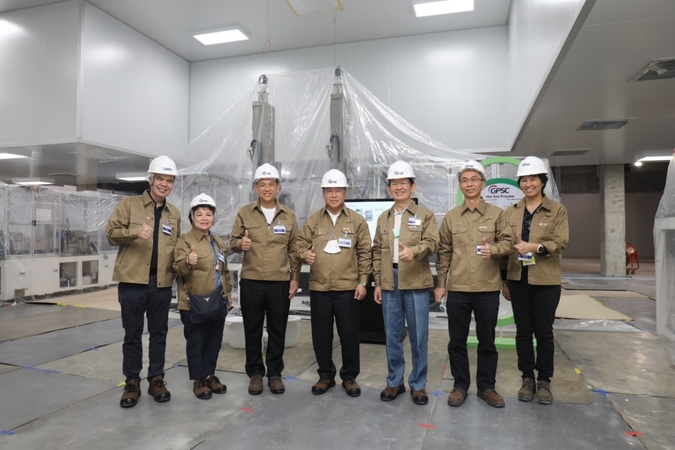
GPSC Board of Directors visited Thailand’s first production plant for semi-solid energy storage units to follow up on the construction progress.
Nov 30. 2020
Board of Directors of Global Power Synergy Public Company Limited or GPSC, led by Mr. Pailin Chuchottaworn, Chairman of the Board, recently visited the company’s energy storage unit production plant, located on a plot of 12 rai in Map Ta Phut Industrial Estate, Muang District, Rayong Province, to follow up on the construction progress. The manufacturing facility, worth over 1.1 billion baht, is Thailand’s first production plant for semi-solid batteries and will have the first-phase production capacity of 30 MWh. It is expected to complete construction and start of regular production in the second quarter of 2021. The Board of Directors was welcomed by Mr. Chawalit Tippawanich, Chief Executive Officer and President and other executives of GPSC.
About GPSC
The shares of GPSC are held by PTT (22.8%), PTT Global Chemical or PTTGC (22.7%), Thaioil or TOP (8.9%), Thai Oil Power or TP (20.8%) and public investors (24.8%) (PTT is under the process of purchasing 8.9% of GPSC shares from TOP which will increase PTT’s percentage shareholding in GPSC from 22.8% to 31.7%. The share purchase transaction is expected to be completed by the end of 2020).
GPSC, an electricity and utility flagship of PTT group with core business to generate and supply electricity, steam and utlities to its industrial customers, the Electricity Generating Authority of Thailand (EGAT) etc. The total current generating capacity according to Equity MW is around 5,031 MW of electricity, around 2,876 tons per hour of steam, around 15,400 refrigeration tons of water and around 7,372 cubic meters per hour of processed water.
Krungsri powers revamped website with new technologies
Nov 30. 2020
By The Nation
Krungsri (Bank of Ayudhya Pcl) has revamped its Krungsri.com website, implementing new technologies to increase convenience and ease of use by enhancing accessibility, using new designs and content layouts as well as adding new features.
Mingkwan Pattanawong, Krungsri executive vice president, head of corporate branding and marketing division, said: “Krungsri.com is a website that provides information of the bank that has more than 2 million page views per month.
“The majority of these are users searching for the bank’s products and services information, particularly about personal loans and savings. Our marketing strategy is to focus on reaching out to customers, providing convenience to those who have interest in the bank’s offerings to visit Krungsri.com website for more information and choose to leave their information to be contacted by our staff.”
Comparing 2019 and 2018, the number of new customers who were attracted by the website increased by 83 per cent, which is a clear indication that Krungsri.com has high potential in reaching out and appealing to the target audience.
“We conducted marketing research to determine the needs of customers on the bank’s website and use them to improve the online experience. These changes include improved speed in accessing information, more modern designs, a search-friendly content arrangement, while adding more features for users to manage their personal information by themselves.”
The new technologies include “real-time analytics”, and “market automation system.”
Real-time analytics analyses the behaviour of website visitors, showing a handful of useful data, including the order of user access to the website, content that have been moved past, and the order of content that have been viewed. These pieces of information will be incorporated into the bank’s “big data” that can be used to improve the user experience in the future.
“Marketing automation system memorises user behaviour and interacts with them at a personal level, such as presenting banners based on users’ interests and offering promotions that suit customers’ lifestyles.
In addition, the website has also improved its page loading speed, while offering self-service for customers to issue their bank documents, such as requesting for a home loan certificate through e-mail and purchasing travel insurances online.
Users will be able to communicate with the bank customer service unit via the Live Chat feature on Krungsri.com as well.
CK Power’s Bt4-billion debenture oversuscribed 3.9 times
Nov 30. 2020Thanawat Trivisvavet
By THE NATION
CK Power has issued Bt4 billion worth of debentures as the company prepares to invest in a hydroelectric power plant in Laos.
Pre-orders soared to 3.9 times the issue size.
The company has been awarded an “outstanding” rating in performance evaluation by the Thai Institute of Directors for three consecutive years as well as being selected as one of the 2020’s Thailand Sustainability Investment Index (THSI) by the Stock Exchange of Thailand.
Thanawat Trivisvavet, managing director of CK Power Pcl (CKP), revealed that the company has recently issued debentures (non-subordinated, unsecured with bond representatives type) totalling Bt4 billion to large firms and investors. The debentures were divided into 3 sets: Bt1 billion baht debentures with a tenure of two years at interest rates of 2.31 per cent per year; Bt1.5 billion debentures with a tenure of three years at interest rates of 2.62 per cent per year; and Bt1.5 billion debentures with a tenure of seven years at interest rates of 3.76 per cent per year. These sets of debentures were assigned a credit rating of “A-/Stable” by TRIS Rating Co Ltd (“TRIS Rating”).
“The company’s debentures drew a lot of attention from investors. We have received pre-orders 3.9 times the amount initially offered. On behalf of CK Power, I would like to express my appreciation and sincere gratitude to investors for their continuous support and confidence in our debentures,” said Thanawat.
As of November 30, CKP will have raised a total of Bt10.5 billion through debentures. However, the company can raise another Bt9.5 billion to support future growth, although the company is yet to schedule the issuance of such debentures in the foreseeable future. With the issuance of these recently issued debentures included, CKP will have the net interest-bearing debt-to-equity ratio of 0.72, which is considered low.
Thanawat said that the purpose of issuing these new debentures was to pay off outstanding debentures, which are due for payment in the first half of 2021, in order to reduce the average financial cost of CKP and its subsidiaries and to prepare the company for future investment in new hydroelectric power plants in Laos.



 Deputy PM Supattanapong Punmeechaow
 Chayawadee Chai-Anant, senior director at the Bank of Thailand (BOT)
 Chamber president Narongsak Putthapornmongkol


 Thanawat Trivisvavet

