PTT Group’s three flagships, Thai Oil, PTT Global Chemical and IRPC, have drawn up a plan to synergise their activities with the aim of adding value to the group’s international trading business and enhancing the group’s competitiveness in the global market.
Project One will allow the three companies to jointly manage and procure crude oil, which will increase their bargaining power in the global market, said Disathat Panyarachun, PTT’s senior executive vice president for International Trading Business Unit.
Joining forces will also allow them to avoid redundant investment in the petrochemical and refinery businesses.
Meanwhile they plan to launch joint international trading activities next year.
Land in Phuket becoming more attractive to local investors
Oct 07. 2020
By The Nation
Over the past nine months, Phuket has weathered an economic storm from the loss of foreign tourists due to the Covid-19 outbreak.
Yet, despite a scarcity in available land, leading property consultant CBRE has seen an increased demand from domestic investors and individual buyers.
Prakaipeth Meechoosarn, who oversees investment and resort land for CBRE Phuket, said: “In the past, the Phuket real-estate market attracted more foreign investors, as it is a leading resort destination. However, due to travel restrictions, now more local players are eyeing Phuket as a potential investment, especially if the property has an attractive price tag.”
Though the government launched a Special Tourist Visa since October 1 to attract high-end, long-stay tourists in a bid to rebuild the tourism sector, foreign investors are not rushing to purchase land in Phuket.
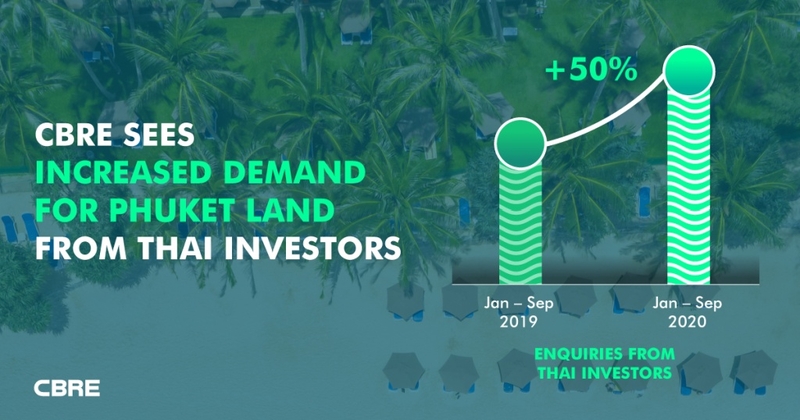
Records from CBRE’s Investment and Resort Land team in Phuket show that land enquiries from local buyers in the first nine months of this year had risen by 50 per cent compared to the same period last year. Of these inquiries, 62 per cent are from local developers seeking plots for new developments or private buyers looking to build holiday homes.
“Land that fits conventional requirements for development, such as beachfront and ocean view, is still low in supply. However, more plots are becoming available. As the current situation is a buyer’s market, landowners are more open to negotiations and willing to consider options,” Prakaipeth added.
“Phuket is a good option for investment as land is being offered at reasonable prices. The market has not been this attractive since the pre-COVID-19 days. However, investors and buyers may have less time for decision-making, due to a shortage in supply.”
Charoen Pokphand Foods (CPF) has introduced its “U Farm” brand of meats that are free from biochemicals for consumers conscious about food safety and animal welfare, chief executive officer Prasit Boondoungprasert said.
“Under the U Farm brand, Cheeva Pork is high quality meat that contains a high volume of good fat and Omega 3 for health conscious consumers. It is now available at selected retailers including Central, The Mall, Foodland, Villa and CP Fresh Mart,” Prasit said.
“Next, we will push for export of Cheeva Pork to Hong Kong and Japan, markets where we had previously successfully penetrated with U Farm’s Benja chicken meat and processed pork,” he said.
According to Prasit, pigs for Cheeva Pork will be raised without the use of biochemicals or growth hormones in group pens that allow the animals to move around freely while the facility is air conditioned by evaporators. The pigs will not receive any vaccine for at least a month before going to the slaughterhouse to ensure there is no chemical residue in the meat.
“Cheeva Pork is certified by NSF International, an American product testing, inspection and certification organisation. This brand of pork also received the food innovation award at the ThaiFex-Anuga Asia 2020 trade exhibition last month,” Prasit said.
“The cost of producing Cheeva Pork is roughly 10 per cent higher than ordinary pork, with a capacity of 400-500 pigs per day, which could be expanded when market demand increases,” he added.
CPF executive vice president of the firm’s pig business Somporn Jermpong said the company now has approximately 900,000 breeder pigs in its domestic and foreign farms, making it the world’s third largest breeder pig producer.
“The second place goes to a manufacturer in China, which has a little over 1 million breeder pigs, making it quite possible for us to overtake them soon and grab the title of the world’s 2nd largest breeder pig producer,” he said.
In Thailand, CPF produces around 5 million pigs per year and is the biggest producer in the market of around 18 million swine per year.
“Our production capacity is expanding at 1-2 per cent annually, with most of the pigs being bred for domestic consumption. Exports, in the form of processed pork, are only responsible for a small portion,” Somporn said.
“Due to the African Swine Fever outbreak, China is suffering from a pig-supply shortage and is looking to import pigs from Russia, where we also have farms. So this is a good chance to expand our presence in the Chinese market,” he added.
The Stock Exchange of Thailand (SET) Index rose by 10.13 points, or 0.80 per cent, to 1,273.84 in the morning session on Thursday.
An analyst at Krungsri Securities expected the index to rise to between 1,270 and 1,275 points before falling in response to the news that US President Donald Trump made a u-turn and is moving again to promote economic stimulus measures and inject cash to help the aviation industry and small businesses. Another positive factor is Thailand’s Centre for Economic Situation Administration (CESA) approving measures to stimulate expenses from October 23 to December 31.
However, the analyst warned investors to beware of mass sell-offs of shares by foreigners as this would still pressure the index.
He recommended investors buy the shares of:
> CRC, HMPro, JMart, Com7, KTC, Centel and Mint that will benefit from the CESA’s measures.
> Banpu and Age that are benefiting from a rising coal price in response to strong Chinese demand.
> TU, PlanB, STGT and Com7, whose third-quarter performance is expected to grow.
The SET Index closed at 1,263.71 on Wednesday, up 13.56 points, or 1.08 per cent, while transactions amounted to Bt52.31 billion, with an index high of 1,264.29 points and a low of 1,245.09.
The price of gold dropped by Bt50 per baht weight in morning trade on Thursday, the Gold Traders Association reported.
As of 9.21am, the buying price of a gold bar was Bt27,800 per baht weight and selling price Bt27,900, while gold ornaments cost Bt27,303.16 and Bt28,400, respectively.
At close on Wednesday, the buying price of a gold bar was Bt27,850 per baht weight and selling price Bt27,950, while gold ornaments cost Bt27,348.64 and Bt28,450, respectively.
The spot gold price moved to US$1,887 (Bt58,971) per ounce on Thursday morning after the price dropped by $18 to $1,890.80 per ounce at close on Wednesday due to uncertainty over the rollout of US economic stimulus measures after US President Donald Trump first called off negotiations until the end of the presidential election but then decided to promote the stimulus bill again.
The Hong Kong gold price dropped by HK$60, opening at $17,440 (Bt70,320) per tael in the morning, the Chinese Gold and Silver Exchange Society reported.
By Syndication Washington Post, Bloomberg · Vildana Hajric, Claire Ballentine · BUSINESS, US-GLOBAL-MARKETS Stocks climbed to a more-than-one-month high on renewed optimism that U.S. lawmakers could still reach an agreement on additional stimulus. Treasuries and the dollar fell.
The S&P 500 rose as much as 1.9% after a barrage of overnight tweets from President Donald Trump advocating a piecemeal approach. Trump sent stocks tumbling late Tuesday by ending talks with Democrats. House Speaker Nancy Pelosi, D-Calif., signaled openness to a standalone airline relief bill in a conversation with Treasury Secretary Steven Mnuchin on Wednesday.
“The seesaw we’ve seen since yesterday’s plunge is just case and point for the volatility we may encounter as we close in on the election,” said Chris Larkin, managing director of trading and investment product at E-Trade Financial. “That said, with President Trump’s call for aid to airlines, an obviously hard-hit area of the market, traders may be eyeing bullish opportunities.”
Some investors who’ve watched Democratic challenger Joe Biden’s lead in the polls swell in recent days are now speculating that a victory by him would bring an increase of federal spending to boost the economy. Biden leads among likely voters Florida, Iowa and Pennsylvania, Quinnipiac University polls found. Tech stocks also mostly rose, even after a House panel’s proposal late Tuesday for stricter antitrust rules to curb the power of Amazon, Apple, Facebook and Google. The four tech giants account for more than 15% of the S&P 500. Eli Lilly & Co. gained after advances on its covid-19 antibody drug.
“People are now talking again about this blue wave,” or election sweep by Democrats in Congress and the presidency, said Marc Odo, client portfolio manager at Swan Global Investments. “The one thing we do need is a very clear cut result coming out of this election.”
Minutes of the Federal Open Market Committee’s Sept. 15-16 meeting released Wednesday showed some U.S. central bankers sought further debate on the future of the Federal Reserve’s asset purchase program when they met last month, signaling they’d be open to altering or increasing bond buying.
With Trump now out of the hospital, investors continue to monitor the virus’s impact on economic recoveries around the world. Signs are mounting that the virus is returning to the New York area, with infection rates reaching three-month highs.
“There is going to be heightened volatility,” said Bryce Doty, senior portfolio manager at Sit Investment Associates. “You have an extraordinary amount of uncertainty between timing of vaccine, when will this current uptick in cases top out.”
Oil fell after U.S. government data showed crude stockpiles increased and gold advanced.
The European Commission, meanwhile, is close to a deal to procure more of the coronavirus treatment remdesivir from Gilead Sciences.
White House lurches in new direction on stimulus talks, pushing for airline aid
EconOct 08. 2020Treasury Secretary Steven Mnuchin/File photo
By The Washington Post · Jeff Stein, Erica Werner · NATIONAL, BUSINESS, POLITICS, CONGRESS, WHITEHOUSE, US-GLOBAL-MARKETS WASHINGTON – The White House’s ever-shifting economic relief agenda lurched in a new direction Wednesday as Treasury Secretary Steven Mnuchin tried to make a deal with House Speaker Nancy Pelosi to rescue the airline industry, a day after President Doanld Trump abruptly cut off talks on a broader stimulus bill.
Mnuchin and Pelosi, D-Calif., had two conversations Wednesday – one in the morning and another in the evening – about the possibility of a stand-alone bill for the airline industry, which just began mass layoffs after federal aid expired. Pelosi also discussed with Democratic lawmakers the possibility at a closed-door meeting Wednesday evening, according to three people with knowledge of the discussion who spoke on the condition of anonymity to describe it.
Two of these people said Democratic members still would prefer a comprehensive bill but are sensitive to the many jobs at risk in the airline industry.
The new effort to fast-track airline aid comes as negotiators appear to have largely shelved prospects for broader unemployment aid and other assistance. But the situation seemed somewhat fluid in the wake of a late-night change of heart from Trump on Tuesday, where he demanded piecemeal legislation on $1,200 stimulus checks and small-business assistance, in addition to airline aid.
White House Chief of Staff Mark Meadows said the administration still held out hope for such one-off measures – even though Democrats have consistently rejected that approach – and Trump broke his coronavirus isolation Wednesday afternoon to go into the Oval Office, where a spokesman said he was being briefed on stimulus talks.
After sinking on Tuesday, the stock market rallied sharply Wednesday on the prospect of a partial deal. The Dow Jones industrial average closed up 531 points, or nearly 2%. Airline stocks fared even better, with American and United airlines seeing their share prices rise more than 4%.
The herky-jerky nature of the economic relief talks has played out over months, as the White House and Democrats have failed to agree on a broader support package. The economy showed some signs of recovery over the summer, but pockets appear to be softening again. The travel industry last week announced layoffs, and the labor market has weakened while the coronavirus pandemic remains a factor across much of the country.
Trump and Pelosi exchanged insults again Wednesday, a sign that the broader relief talks are unlikely to be revived. But both sides did appear interested in trying to work out immediate aid for the airline industry, which has not recovered from the pandemic’s impact. Last week, American and United began furloughing more than 30,000 employees.
The White House’s approach has changed multiple times in the past few days. On Tuesday, Trump called off all talks until after the election. Mnuchin’s outreach Wednesday morning came after Republicans running for reelection questioned – and in some cases denounced – Trump’s directive to walk away.
Pelosi last week urged airlines to wait on the layoffs, saying she would renew a payroll support program either as a stand-alone bill or part of a broader deal.
Rep. Peter DeFazio, D-Ore., tried Friday to advance a $28 billion bill to help airlines keep workers on payroll under a procedure that would have required unanimous consent from lawmakers. Republicans blocked the move, with GOP aides saying they’d had barely any time to review the bill.
Senate Republicans have pushed a package of similar size for the airlines that has less stringent requirements on how the aid will be used. It’s unclear whether Pelosi and Mnuchin could come up with a deal on airlines that both parties would support, especially after Tuesday’s bizarre events that began when Trump suddenly announced on Twitter that “I have instructed my representatives to stop negotiating until after the election.”
The backlash was swift. Seven hours after Trump said talks were terminated, he appeared to reverse himself in a new string of tweets.
At 9:54 p.m. Eastern time, he called on the House and Senate to “IMMEDIATELY” approve $25 billion in new aid for the airline industry, which has already begun laying off thousands of employees after federal aid programs expired last week.
At 10:18 p.m., he called for Congress to direct $1,200 payments to millions of Americans and said he wanted immediate aid for small businesses.
“I am ready to sign right now,” he wrote. “Are you listening Nancy?”
He was referring to Pelosi, though he also tagged White House Chief of Staff Mark Meadows and congressional leaders in the Twitter post.
White House officials and congressional leaders couldn’t spell out how the process would play out.
Meadows told reporters on Wednesday morning: “The stimulus negotiations are off.”
All of Trump’s new directives and position changes have come from pronouncements on his Twitter account. He hasn’t been seen in public since returning to the White House from the hospital on Monday evening.
“It’s hard to see any clear, sane path on what he’s doing, but the fact is he saw the political downside of his statement of walking away from the negotiations,” Pelosi said Wednesday in an appearance on “The View.” “He’s rebounding from a terrible mistake he made yesterday, and the Republicans in Congress are going down the drain with him on that.”
Pelosi also questioned publicly whether the steroids Trump is taking as he battles coronavirus might be affecting his cognition, a notion she’d floated privately to Democratic lawmakers Tuesday. “Also if you have the coronavirus it has an impact as well. So the combination is something that should be viewed,” Pelosi said on “The View.”
The House speaker said there should be “an intervention” by people around the president because “something’s wrong.”
Democrats have for months rejected the idea of passing stimulus funding on a piecemeal basis, instead insisting on one comprehensive package to aid the economy, although Pelosi has suggested Congress could act first to help the airline industry. The president’s demands Tuesday night also left out addressing the expiration of additional federal unemployment benefits for tens of millions of jobless Americans.
Meanwhile, lawmakers reacted strongly to the called-off negotiations. The Problem Solvers Caucus, a bipartisan group that proposed a $1.5 trillion stimulus package, called for a resumption in negotiations, while Rep. John Katko, R-N.Y., a House member in a difficult reelection race, said he disagreed with the president and would “strongly urge” Trump to rethink the decision.
Sen. Lindsey Graham, R-S.C., a Trump ally who is also in a tough reelection fight, wrote on Twitter Wednesday that Trump should look at the Problem Solvers proposal. “It has many good things for individuals and businesses,” Graham wrote.
White House National Economic Council Director Larry Kudlow told CNBC on Wednesday that there was a “low probability” of approving additional legislation in time for the election but reiterated the call for passing piecemeal legislation.
“We’ve only got four weeks to the election, and we have a justice of the Supreme Court to get passed. It’s too close to the election – not enough time to get stuff done at this stage in the game,” Kudlow said. “What the president was saying is, ‘We’re too far apart for a gigantic bill.’ “
The president has long sought an additional stimulus package ahead of the Nov. 3 election, and it remained unclear exactly why he suddenly gave up on talks, although Republicans have been skeptical all along of whether Pelosi would agree to anything that would be widely acceptable to the GOP. On a phone call with Trump on Tuesday shortly before he tweeted that talks were over, Senate Majority Leader Mitch McConnell, R-Ky., suggested that Pelosi might be stringing him along, according to two people with knowledge of the call who spoke on the condition of anonymity to discuss it.
“It became very obvious over the last couple days that a comprehensive bill was just going to get to the point where it really did not have much Republican support at all,” Meadows said. “It was more of a Democrat-led bill, which would have been problematic more so in the Senate.”
The White House and Congress approved nearly $3 trillion in economic aid earlier this year in response to the coronavirus pandemic. A number of the programs in those laws, such as enhanced unemployment aid, small-business aid, rental assistance, airline aid and student loan protections, have expired. House Democrats have passed two large bills to direct more aid. The first bill would have approved more than $3 trillion in new assistance, while the second bill was scaled back slightly, seeking more than $2 trillion in new aid.
The White House has sought a roughly $1.6 trillion bill. One of the biggest sticking points between the White House and congressional Democrats is how to handle the budget crises facing states and cities. Democrats want to approve a large package of assistance for these governments, while Trump has repeatedly expressed opposition.
Federal Reserve Chair Jerome Powell warned Tuesday that the economy could suffer without more fiscal relief, a viewpoint Trump appeared to endorse before he began his second string of Twitter posts late in the evening.
Bualuang Asset Management (BBLAM) said investors should purchase shares in the banking, tourism and medical sectors as the economy is expected to pick up in the fourth quarter over hopes of Thailand reopening its borders and development of a Covid-19 vaccine.
Peerapong Jirasevijinda, BBLAM’s chief executive officer, said shares in three sectors should rise by 20 to 30 per cent, while Thai stocks’ price to earnings ratio (P/E) is expected to stand at 16 times this year and in 2021.
“Foreign investment is also likely to flow into the country if the government’s moves to reopen the country go well,” he said.
He added that BBLAM has launched new mutual funds in line with investors’ financial plans for the remainder of the year, adding that the company is also devising business strategies for next year.
“BBLAM recently launched three BMAPS open-end funds that allow investors to purchase a stake in assets overseas depending on their ability to tolerate risks and expectation of returns. These funds are suitable for three to five years investment,” he said.
“The BMAPS25, BMAPS55 and BMAPS100 open-ended funds are being offered for a week from Wednesday at Bt10 per unit. Each fund is valued at Bt5 billion and the minimum purchase is Bt500.”
He explained that BMAPS25 and BMAPS55 funds will invest 25 per cent and 55 per cent respectively in stocks, while the remainder will be invested in other assets, such as gold, property and bonds which suitable for investors who want to take low and moderate risks.
Meanwhile, BMAPS100 will invest 100 per cent in stocks which is suitable for investors who can tolerate high risks.
“The performance of BMAPS25 over one year and 10 years as of June 30 have been estimated at 3.08 per cent and 4.39 per cent, BMAPS55 4.54 per cent and 7.7 per cent, and BMAPS100 2.05 per cent and 10.82 per cent respectively,” he added.
Gulf Energy Development (GULF) on Tuesday became the second-largest shareholder of Intouch Holdings (INTUCH) after securing a 10-per-cent stake in the company.
Gulf’s board of directors had previously approved spending up to Bt19 billion to boost its Intouch shareholding via the Stock Exchange of Thailand or other methods.
As of Tuesday, Gulf held 320.65 million Intouch shares, upping its stake from 7.99 per cent to 10 per cent.
Singtel Global Investment holds the largest stake in Intouch, with a shareholding of 21 per cent.
By Nu To Van, Sukanok Suthinan Special to The Nation
The following article explains the key principles of the proposed e-services tax, scheduled to come into effect in Thailand in mid-2021.
First, a short recap: the e-services tax will be in the form of VAT imposed on online activities. Companies that are covered by the e-services tax need to register for VAT (either as service provider or electronic platform) and pay VAT electronically through a new simplified monthly return.
Due to the broad definition of digital services and its expected broad coverage, in this article we will focus on practical questions companies may have once the e-services tax is implemented. For example, what type of services will be covered, does it make any difference to whom the services are provided, etc.
To illustrate the different tax treatment and implications, we will use a fictitious case study and examples of transactions to highlight whether or not these transactions would be covered under the e-services tax.
Case study – ‘In The Cloud Services’
Our fictitious company “In The Cloud Services” (“ITCS”) is based in the US and is trying to increase its online business footprint in Thailand. The company’s physical servers are all located in the US and the company does not have any office or staff in Thailand.
The company has a variety of online businesses and provides them to customers in Thailand – both to businesses (B2B) and consumers (B2C), including the following:
1. Online cloud storage services and providing digital content streaming services
2. Selling products through their US-based platform
3. Platform services to online sellers
So, does ITCS have to be worried about the new e-services tax?
Let’s go through the company’s online services one by one.
1. Provision of online cloud storage and digital content:
The company provides online cloud storage and digital content streaming services to its customers in Thailand who are both Thai consumer (B2C) and Thai VAT-registered entities (B2B). Customers in Thailand simply subscribe for these online services through ITCS’ website and pay online for these services by monthly subscription.
Although the services and the fees charged to its customers are the same, the tax implications and treatment of both transactions are different, as illustrated by the pictures below.
a. B2C as a service recipient
b. B2B as a service recipient
2. Online sale of products:
ITCS operates an online platform selling a wide range of products to both Thai consumers and Thai entities.
Once products are ordered online, ITCS arranges the shipments, clearance in Thailand, and delivery to its customers (both consumers and companies) in Thailand. The customs clearance and delivery of products is carried out by a local Thai company.
Selling of goods online is currently not covered by the proposed e-services tax. However, there may be other considerations relevant to ITCS, such as whether or not the Thai local company might be considered an agent from a VAT perspective, which could lead to a taxable presence in Thailand.
3. Use of its platform:
ITCS also allows other online retailers to sell their products online to both Thai consumers and Thai entities through its platform. In return for using its platform, ITCS charges these online retailers a service/commission fee. The tax implications and treatments are illustrated below.
What should companies do to prepare themselves prior to the enforcement of e-services tax?
Based on the above simplified scenarios, it is clear that different transactions may lead to different tax treatments. For our fictitious company, it would mean that for the B2C services that they provide to their customers in Thailand, they need to register for VAT purposes in Thailand once the e-services tax is implemented. This could mean that going forward, ITCS may need to make a commercial decision and choose whether or not to potentially upset its customers (by increasing its selling prices) or accept lower profits due to higher tax costs.
There is still time for companies to prepare as the supplemental regulations have not yet been published. Facilities such as simplified registration and monthly VAT return submission are expected to be available at the Thai Revenue Department (TRD)’s website in order to encourage more registration from foreign digital service providers.
However, foreign digital service providers may be more or less likely to comply with the requirements depending on how strongly the TRD enforces the new e-services tax.
The current penalty for non-compliance is two times the VAT shortfall plus a 1.5 per cent monthly surcharge and imprisonment not exceeding one month or a fine not exceeding Bt5,000, or both. The question is whether or not companies will be allowed a certain transition/grace period (similar to what has happened in Malaysia) or whether the TRD will start enforcing the new tax very strictly as it searches for more revenue sources.
Adding to the complexity are other potential tax implications and considerations, such as whether or not the registration of the company for VAT purposes will trigger risk from a corporate tax perspective or whether the company has to obtain a (online) business licence in Thailand.
Although there is still time before the e-services tax is implemented, it would be prudent for foreign service providers/platforms to already start mapping out their online service activities and determine which ones are affected by the new e-services tax, since it is very likely that some (if not all!) of their activities will be caught by the e-services tax net.
Nu To Van and Sukanok Suthinan are, respectively, partner and senior manager for Tax & Legal Services at Deloitte Thailand.





 Treasury Secretary Steven Mnuchin/File photo


 What should companies do to prepare themselves prior to the enforcement of e-services tax?

