Capella Bangkok tunes up new luxury riverside resort option
Oct 01. 2020Capella Bangkok
By The Nation
Capella Bangkok officially opened its doors today, becoming Capella Hotels and Resorts’ first property in Thailand.
Situated within the prestigious Chao Phraya Estate, the urban resort is now inviting visitors to discover the rich cultural heritage of Bangkok’s historic waterfront district.
The resort also boasts the highly-anticipated Côte by Mauro Colagreco, the first Southeast Asian outpost for Chef Mauro, the Italo-Argentinian culinary maestro whose three Michelin-starred restaurant in France, Mirazur, was voted No 1 in the world at the World’s 50 Best Restaurant Awards in 2019. Or there’s Phra Nakhorn, an alfresco riverside restaurant showcasing the time-honoured Thai recipes of this storied district.
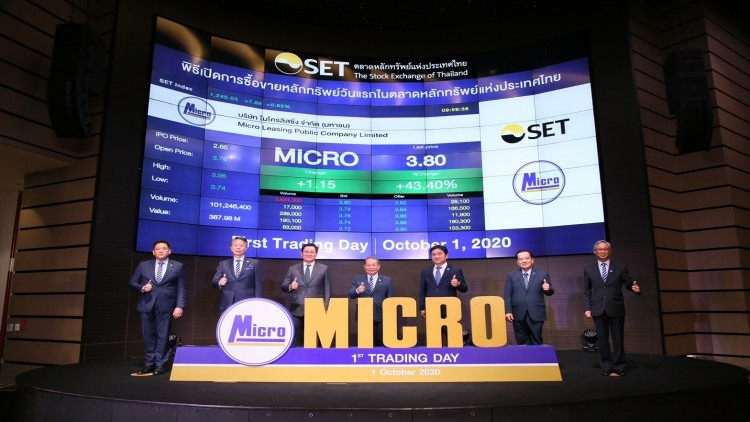
Micro Leasing (MICRO), a financing service provider for second-hand trucks, expects to meet its lending growth target of 30 per cent this year to between Bt2.4 billion and Bt2.5 billion, manging director Winit Piyamaythang said on Thursday.
The company began trading in the Stock Exchange of Thailand on Thursday.
The listing will help enhance the company’s competitiveness, broaden expansion opportunities as well as strengthen its capital base.
Fundraising will be allocated to its hire-purchase business expansion, loan repayment and investment in the IT system for the development of a mobile lending application.
MICRO provides hire purchase financing services of second-hand trucks for commercial operation as well as other loan services with second-hand trucks as collaterals.
Walmart’s next health foray is Medicare plan with startup Clover
CorporateOct 02. 2020Shoppers wearing protective masks leave a Walmart store in Lakewood, Calif., on July 16, 2020. MUST CREDIT: Bloomberg photo by Patrick T. Fallon.
By Bloomberg · John Tozzi · BUSINESS, HEALTH, RETAIL, HEALTH-NEWS
Walmart will make its first foray into the fast-growing market for privately managed Medicare Advantage plans next year with two products for Georgia seniors jointly branded with insurance startup Clover Health.
The plans will give seniors access to new Walmart Health centers that the retail giant is testing in stores outside Atlanta. Those clinics and other providers in the plan will use Clover’s technology to track patients’ health and improve care, the companies said Thursday.
Walmart’s health-care strategy has been closely watched, and the retail giant is seen as a potential threat to established providers and insurers. The Georgia offering will make Walmart a player in the Medicare Advantage program, a lucrative market dominated by UnitedHealth Group Inc., Humana Inc., CVS Health Corp.’s Aetna unit, and BlueCross BlueShield branded plans, some of which are also expanding their offerings.
More than a third of Medicare beneficiaries opt to get their benefits through private Advantage plans that collect fees from the government in exchange for managing members’ care. The plans often combine traditional Medicare benefits with other services such as vision and dental care, gym memberships, and prescription drug coverage.
Seniors often choose Advantage plans over traditional Medicare to get those benefits, though they may have to agree to use a limited network of doctors and hospitals. Clover’s new plans with Walmart will use a preferred-provider organization network, though Clover said members won’t face additional fees for going out-of-network.
One of the two plans won’t charge monthly premiums, and both will offer free primary care, the companies said. Members will get $400-a-year benefit for over-the-counter health expenses that can be spent in Walmart stores or on its website, similar to a perk the retailer offered Anthem Medicare subscribers through a deal two years ago. Clover will underwrite the insurance plans, branded “LiveHealthy: Clover Powered, Walmart Enhanced.”
Other companies are expanding as well. Cigna Corp. plans to sell Medicare Advantage plans in five new states, and UnitedHealth said its expansion in 2021 in almost 300 counties would be its largest in five years. Humana plans to launch dozens of new plans across hundreds of counties, the company said. Aetna is adding 115 new counties, and Anthem is expanding into more than 80.
Clover said its product with Walmart will be distinguished by low costs and convenience. “Our vision is, we deliver care wherever our members want to get care,” said Andrew Toy, Clover’s president and chief technology officer. A Walmart spokeswoman said company officials weren’t available for interviews. In addition to Walmart’s health clinics, the network will include 31 hospitals and 8,000 providers in the region, which covers eight Georgia counties mostly outside Atlanta.
Walmart began opening health clinics in Georgia stores in 2019 and now has six locations there and one in Arkansas, according to the company’s website. Cash prices are posted in price sheets online and in waiting rooms: $40 for basic office visit and $20 to test for strep throat, for example. The clinics offer primary care, vision, dental care, lab tests and mental health visits.
Walmart will continue expanding its health centers, with seven more Georgia locations planned in the months ahead and additional centers coming in the Chicago area and some cities in Florida, according to a company blog post Sept. 17.
“The demand definitely tells us that Americans are looking for access to quality care, and we think Walmart – its footprint – should be a part of that,” Walmart U.S. Chief Executive Officer John Furner said in an investor conference this month.
Other moves by Walmart into the sector include a collaboration with Oak Street Health, a Medicare-focused primary care company, to open clinics at three supercenters in the Dallas-Fort Worth area, according to a press release this month. The retailer recently formed an insurance agency to enroll customers in Medicare health plans, the Arkansas Democrat-Gazette reported in July, citing job ads and corporate filings. The company also sells monthly supplies of low-cost generic prescription drugs for $4.
Founded in 2014, Clover is among a handful of new entrants like Devoted Health and Oscar that are trying to use technology to improve health care. Backed by almost $1 billion from investors including GV, the venture capital arm of Alphabet Inc., the company has about 57,000 members in seven states and plans to triple the number of counties where it offers plans next year.
Clover’s software for medical professionals, known as Clover Assistant, will be deployed in the Walmart clinics and to other providers in the network. The program analyzes data from patient records, labs, socioeconomic data, and other sources to prompt clinicians to recommend actions like screening tests and adhere to evidence-based treatment guidelines, Toy said.
Exxon flags further losses that add to pressure on dividend
CorporateOct 02. 2020An Exxon Mobil gas station in Falls Church, Va., on April 28, 2020. MUST CREDIT: Bloomberg photo by Andrew Harrer.
By Syndication Washington Post, Bloomberg · Kevin Crowley · BUSINESS, US-GLOBAL-MARKETS Exxon Mobil Corp. likely made a third consecutive loss in the last quarter, heaping further pressure on the energy giant’s ability to pay its $15 billion-a-year dividend, currently the third-highest in the S&P 500 Index.
Exxon suffered further losses in its refining division in the third quarter while higher oil prices were likely not enough to push its production operations back into profit, the Irving, Texas-based company said Thursday in a filing. Refining margins took a negative hit of as much as $600 million in the period while chemicals made a small profit.
A third-quarter loss would suggest Exxon still isn’t able to fund either its dividend or capital expenditure from operational cash flow, meaning it’s reliant on debt to get by. The last time the company generated enough free cash to cover its dividend was the third quarter of 2018, according to data compiled by Bloomberg.
In aggregate, Exxon probably made a loss of about 30 cents a share, compared with analyst expectations of a 1-cent loss, analysts at Tudor, Pickering, Holt & Co. said in a note to clients. The update from Exxon will likely weigh on the shares, they said.
“We suspect investors will continue to focus on the path forward for the business with operating cost and capital cuts in focus to shore up the balance sheet in a bid to defend the company’s dividend,” the analysts said.
Exxon’s dividend yield has risen to more than 10% over the past few days, indicating shareholders believe the dividend is unsustainable at current levels and may be cut. Rival oil supermajors Royal Dutch Shell Plc and BP Plc slashed their payouts earlier this year as Covid-19 savaged oil demand globally. Reducing its dividend would be a seismic shift for Exxon, which has made a rising payout the keystone of its investment strategy for the last 37 years.
Shares of Exxon were down 1.1% at $33.97 at 9:42 a.m. in New York trading.
The United Nations Framework Convention on Climate Change (UNFCCC) released its report on “Commitments to Net Zero Double in Less Than a Year” during this year’s Climate Week held in New York from September 21 to 27.
In the release, UNFCCC said more governments and businesses across the world committing themselves to reducing their greenhouse gas emissions. Currently 22 regions, 452 cities, 1,101 businesses, 549 universities and 45 of the biggest investors have committed to the cause.
New institutions that have joined the “race to zero” include the Australian state of New South Wales, logistics giant Brambles, automaker Ford, buildings materials company LafargeHolcim and Thailand’s agri-food giant Charoen Pokphand (CP) Group.
These companies will lend a hand in limiting global warming to 1.5 degrees Celsius.
Suphachai Chearavanont, chief executive officer of CP Group, was quoted on the UNFCCC website as saying: “CP Group has a role to play in reducing the agriculture sector’s carbon footprint and encouraging consumers to adopt more sustainable food choices. With our commitment for net zero emissions within our operations by 2030, we aim to meet this opportunity by leveraging innovation and working closely with all our partners and stakeholders.”
The CEO also spoke with Nigel Topping, a high-level climate champion for Climate Action COP 26, on the challenges of alleviating global warming problems and achieving net zero carbon emissions.
Suphachai said to help the agricultural sector transition to net zero carbon, efficient, energy-saving farming practices will have to be adopted. He also said that reducing food waste will require support from consumers and partners across the supply chain, while new technology will help empower farmers leading to a neutral carbon footprint.
“I have been motivated by the fact that the global threat of climate change is real, recognising that the bio-sphere we live in is extremely fragile. Here in Thailand, we have seen first-hand its impact on agriculture, tourism as well as human health. We have digitised our operations to unlock both sustainable practices and business value. Our supply chain management is more transparent and integrated. I truly believe that CP Group has the scale, skills and most importantly, ‘the mindset to lead and succeed’.”
Also joining the commitment to reduce their carbon footprint were Microsoft president Brad Smith, LafargHolcim’s chief executive Jan Jenisch and L’Oreal CEO Jean-Paul Agon.
The price of gold rose by Bt50 per baht weight in morning trade on Friday, the Gold Traders Association reported.
As of 9.26am, the buying price of a gold bar was Bt28,300 per baht weight and selling price Bt28,400, while gold ornaments were priced at Bt27,788.28 and Bt28,900, respectively.
At close on Thursday, the buying price of a gold bar was Bt28,250 per baht weight and selling price Bt28,350, while gold ornaments were Bt27,742.80 and Bt28,850, respectively.
Spot gold price moved to US$1,897 (Bt59,949.44) per ounce on Friday morning after the price rose by $20.8 to $1,916.3 per ounce at Thursday’s close.
Gold price closed in positive territory from investors’ mass buy-ups of the precious metal in response to weak US economic data, especially the manufacturing Purchasing Managers’ Index in September that was worse than expected.
Meanwhile, investors are waiting for the US non-farm payroll in September, which will be announced on Friday.
The Stock Exchange of Thailand (SET) Index fell by 5.73 points, or 0.46 per cent, to 1,241.86 in the morning session on Friday.
An analyst at Krungsri Securities expected the index to fluctuate between 1,240 and 1,255 despite positive sentiment from the ongoing process of the US$2.2-trillion US economic stimulus bill.
“The sharp fall in oil price due to uncertainty over fuel demand and foreign investors’ mass sell-offs of Thai shares would pressure the index,” he said.
As an investment strategy, he recommended that investors buy:
▪︎ Banpu and AGE that will benefit from rising coal price in response to China’s strong demand.
▪︎ PSL, TTA and RCL that benefit from the sharp rise in Baltic Dry Index
▪︎ Delta, Hana, KCE and SMT that benefit from the weakening baht.
The SET Index closed at 1,247 on Thursday, up 10.55 points or 0.85 per cent, while the volume of total transactions was Bt44 billion from hopes of US lawmakers reaching an agreement on new economic stimulus measures and mass buy-ups of SCC and BANPU shares.
By Syndication Washington Post, Bloomberg · Vildana Hajric · BUSINESS
U.S. stocks advanced, led by gains in the biggest technology companies, as investors weighed the chances Democratic lawmakers and the White House will reach a deal for a fiscal-stimulus package. Oil tumbled on concern the market may be oversupplied.
The Nasdaq 100 reached the highest in almost a month as Amazon.com, Microsoft and Tesla rose. The S&P 500 Index’s advance was limited by declines in energy producers. Trading was volatile, with stocks pushed around by the latest developments in efforts to forge a stimulus bill acceptable to Democrats and Republicans. Talks were set to continue Thursday as officials sought a breakthrough.
European stocks closed slightly higher. Gold advanced, while Treasury yields dipped. Oil tumbled to about $39 a barrel on concern about oversupply amid sluggish economic growth.
U.S. stock markets have been whipsawed this week by speculation over whether lawmakers will agree to provide new pandemic-relief aid amid high unemployment and growing rates of infection in some areas. While the S&P 500 Index is up more than 50% from its March low, it’s still down more than 5% from a record high reached last month.
In Asia, the Tokyo Stock Exchange halted trading for the entire day Thursday because of technical problems. The exchange will replace hardware and restart its system, aiming to resume trading Friday.
These are the main moves in markets:
Stocks
– The S&P 500 Index rose 0.5% as of 4 p.m. EDT.
– The Stoxx Europe 600 Index rose 0.2%.
– The MSCI Emerging Market Index rose 0.3%.
Currencies
– The Bloomberg Dollar Spot Index declined 0.3%.
– The British pound fell 0.2% to $1.2889.
– The Japanese yen fell 0.1% to 105.56 per dollar.
Bonds
– The yield on 10-year Treasurys fell one basis point to 0.68%.
– Germany’s 10-year yield fell one basis point to -0.54%.
– Britain’s 10-year yield climbed less than one basis point to 0.23%.
– New Zealand’s 10-year yield climbed two basis points to 0.505%.
Commodities
– West Texas Intermediate crude tumbled 3.8% to $38.70 a barrel.
EEC firms urge Prayut to boost public-private collaboration
EconOct 02. 2020PM Prayut Chan-o-cha (Photo credit: Government House)
By The Nation
Prime Minister Prayut Chan-o-cha received proposals from companies in the Eastern Economic Corridor (EEC) to draw more investment to the zone on Thursday.
The suggestions were made during the premier’s visit to survey progress of EEC projects and listen to private-sector ideas for its further development.
WHA Corporation chief executive officer Jareeporn Jarukornsakul said the formation of a joint private sector-government team to woo foreign investment via roadshows overseas was among the proposals. The team should include Board of Investment and EEC executives, she added.
Businesses also urged closer cooperation between government and the private sector to develop the zone.
Government spokesman Anucha Burapachaisri said that the combined value of projects applying to invest in the EEC over the past eight months was Bt85 billion.
Stimulus measures under consideration to lift property sector, consumption
EconOct 02. 2020Permanent secretary at the Finance Ministry, Krisada Chinavicharana
By The Nation
The Finance Ministry is considering more stimulus packages to support the property sector and increase consumption.
The newly appointed permanent secretary at the Finance Ministry, Krisada Chinavicharana, said on Thursday that he would meet with senior officials to discuss ways to help the economy recover from the Covid-19 impact.
There are signs of recovery, but the ministry wants to look into how to stimulate the economy in the short and medium term, he said on Thursday, his first day in office as permanent secretary. Krisada is a former director-general of the Customs Department.
The ministry will look into which businesses or groups of people need more support. The government has been implementing Covid-19 relief packages, assisting small businesses and low-income groups.
He said some real estate segments, such as low-rise property, are doing well, while some segments may face difficulty, referring to high-rise or condominium developers who are hit by oversupply of residential units and a decrease in people’s purchasing power.
The ministry will also look into whether to resume the shopping package, known as “Eat, Shop and Spend”, which subsidised people shopping for goods, travel and dinning at restaurants.
The latest economic indicators in August have shown signs of recovery since July, but the economy is expected to see a close to 10 per cent contraction this year as exports and tourism — the two main engines of the Thai economy — have not recovered yet due to the persistence of the Covid-19 pandemic worldwide.
The Bank of Thailand reported that business confidence in September rose for the fifth consecutive month to 47.5 while the manufacturing confidence index touched 50 for the first time since the virus outbreak early this year.

 Capella Bangkok
 Shoppers wearing protective masks leave a Walmart store in Lakewood, Calif., on July 16, 2020. MUST CREDIT: Bloomberg photo by Patrick T. Fallon.
 An Exxon Mobil gas station in Falls Church, Va., on April 28, 2020. MUST CREDIT: Bloomberg photo by Andrew Harrer.



 PM Prayut Chan-o-cha (Photo credit: Government House)
 Permanent secretary at the Finance Ministry, Krisada Chinavicharana

