Household debt has risen to alarming levels over past decade, BOT study finds #ศาสตร์เกษตรดินปุ๋ย

#ศาสตร์เกษตรดินปุ๋ย : ขอบคุณแหล่งข้อมูล : หนังสือพิมพ์ The Nation.

Household debt has risen to alarming levels over past decade, BOT study finds 

EconSep 30. 2020

By The Nation

Thai household debt rose to 80.1 per cent of gross domestic product in the first quarter of this year, up from 50.4 per cent in 2009, according to a study.

The high debt has adversely impacted economic growth while the Covid-19 outbreak has made it more challenging to solve the household debt problem and they have the potential to delay economic recovery, said the study by researchers at Bank of Thailand (BOT)’s Puey Ungphakorn Institute for Economic Research.

Over the past 10 years, more people are bearing a debt burden and the size of the debt has increased from Bt70,000 to Bt128,000 each (median value), according to the study released at BOT Symposium 2020 on Monday.

The share of bad debt/non-performing loans has decreased from 22 per cent to 16 per cent, which is considered still high. The median value of bad debt was Bt 65,000, up from Bt35,000 previously.

The study also found it astonishing that debtors who had started borrowing money at a young age continued to bear the burden even after retirement.

About 60 per cent of people aged 29 to 30 years old have debt. Among them, 25 per cent were in the bad-debt category. Pensioners still have debt, with median value of Bt70,000 to Bt80,000 per debtor.

Researchers believe the first-car scheme launched in 2011 was a major factor in the rising debt of urban residents. Farm subsidies, such as debt moratorium to support farmers also resulted in rising debt among people upcountry.

This suggested that a moratorium could not solve the debt issue.

The Covid-19 outbreak has worsened the situation and many are unable to service their debt.

Of the large number of people who had applied for financial aid under the central bank’s scheme between April and June, 71 per cent asked for temporary suspension of debt payment, 26 per cent demanded reduction of debt instalments and 3 per cent applied for debt restructuring as they were no longer able to repay the debt.

Those who applied for debt relief were concentrated in the lower-northeastern region covering Nakhon Ratchasima, Buri Ram, Surin, Si Sa Ket and Ubon Ratchathani provinces. About 40 to 60 per cent of applicants were personal loan borrowers followed by mortgages, while most of those in Bangkok and vicinity provinces, the South and upper North applied for restructuring of their bad debts or non-performing loans (NPLs).

Non-bank lenders represent a large share of debtors asking for debt relief. Most of the debts are hire-purchase loans. Should the coronavirus linger on, non-bank lenders would have high risk stemming from debt default, the researchers said. Each has debt of about Bt500,000.

In July when some financial aid expired, the study found that 2.1 million debtors exited the scheme, and they represented about 36.7 per cent of total debtors who received debt relief.

The study called for urgent actions to solve the rising household debt.

One proposal is to amend the bankruptcy law that will allow debtors to file for court protection and then they can start their lives anew after three years of the debt payment process, in the same manner as corporates currently applying for bankruptcy protection.

Reopening the country to foreign tourists would also boost economic activities, which could help many debtors as rising income would increase their debt payment capacity, the study said. But it will come with the risk of a new wave of virus infections, so the reopening for tourism must be managed carefully, the study said.

Concerned parties may need to apply different solutions for debtors in different regions, the study suggested.

The study is based on information collected from the National Credit Bureau Co, whose data base covers 23.1 million retail borrowers with combined debt of Bt 11.9 trillion, representing 88.3 per cent of the total household debt, and data from Bank for Agriculture and Agricultural Cooperatives.

Govt to borrow Bt1.3 trillion, as public debt borders fiscal sustainability threshold #ศาสตร์เกษตรดินปุ๋ย

#ศาสตร์เกษตรดินปุ๋ย : ขอบคุณแหล่งข้อมูล : หนังสือพิมพ์ The Nation.

Govt to borrow Bt1.3 trillion, as public debt borders fiscal sustainability threshold

EconSep 30. 2020

By The Nation

The Cabinet on Tuesday approved the public debt management plan proposed by the Finance Ministry for fiscal year 2021 (October 2021 to September 2021), Government Spokesman Anucha Burapachaisri said.

The Finance Ministry’s Public Debt Management Office plans to borrow Bt1.3 trillion and manage existing debt totalling Bt387.5 billion.

The ministry said facilitating recovery of the economy hard hit by the Covid-19 pandemic and financial aid packages to support affected people and corporations had resulted in large budget deficits. The government also wants to borrow more to boost economic activities and its cash flow.

Should the government go ahead with the borrowing plan, public debt will jump to 57.23 per cent of gross domestic product, close to the sustainable level of 60 per cent of GDP. As of July 31, public debt stood at Bt7.6 trillion, or equivalent to 47.04 per cent of GDP, according to the Public Debt Management Office.

In related development, the Cabinet also approved a Bt1.51-trillion spending plan for 44 state enterprises for fiscal 2021.

Combined with other state enterprises’ spending, the expenditure of all 52 state enterprises would be Bt1.55 trillion of which capital spending is Bt432 billion. The capital spending is expected to boost economic growth, said Rachada Dhnadirek, deputy government spokeswoman.

Cabinet hikes budget for high-speed rail by Bt12 billion #ศาสตร์เกษตรดินปุ๋ย

#ศาสตร์เกษตรดินปุ๋ย : ขอบคุณแหล่งข้อมูล : หนังสือพิมพ์ The Nation.

Cabinet hikes budget for high-speed rail by Bt12 billion

EconSep 30. 2020

By The Nation

The Cabinet agreed to increase the budget for the Bangkok-Nong Khai high-speed rail line, Phase 1, by another 12 billion.

The Cabinet also approved the setting up of a subsidiary to manage State Railway of Thailand (SRT)’s assets. The company is expected to earn more than Bt600 billion in 30 years, clearing all debts and making a profit.

The Cabinet agreed to revise the credit limit and draft an employment agreement and contract for rail, electrical and mechanical systems including purchase of trains and organising training of personnel, a complete version of the cooperation project between Thailand and China in developing a high-speed rail system to connect regions Bangkok – Nong Khai (Phase 1 Bangkok – Nakhon Ratchasima), deputy government spokeswoman Traisuree Taisaranakul said.

The budget has been increased from Bt38.55 billion on August 29, 2017, to Bt50.63 billion, including 7 per cent VAT, or an increase of Bt12.08 billion.

The increased budget covers:

1. Relocation of high-speed rail system works overlaid within the scope of construction works for Bt7.03 billion, which is the procurement of machinery and equipment for infrastructure maintenance, EMU facility, track welding and long track storage base.

2. Changing the EMU vehicle model from CRG2G (Hexie Hao) to CR Series (Fuxing Hao), a new model with better technology and performance, which increases the cost by Bt2.53 billion.

3. Modification from a ballast track to a ballastless track in the section between Bang Sue Station and Don Mueang Station, Ayutthaya station, Saraburi station, Pak Chong station, Nakhon Ratchasima station and inside the tunnel for easy maintenance and reducing future maintenance costs. It also maintains the image and scenery as well as tackkes pollution caused by road maintenance. The cost of changing the road structure will amount to Bt2.22 billion

4. Other expenses such as guarantee fee from defect from 1 to 2 years according to the regulations, operating fees and other expenses totalling Bt284.39 million.

The Cabinet also approved the setting up of a subsidiary company — Railway Asset Development Co Ltd — of the SRT to manage its assets, with a registered capital of Bt200 million, with approval for SRT to borrow Bt200 million as capital as well. The SRT will take responsibility for repaying the loan principal, interest and expenses, and the Ministry of Finance will be the loan guarantor, including considering the appropriate borrowing methods, conditions and details.

BoI eyes new schemes to woo investment, foreign talent #ศาสตร์เกษตรดินปุ๋ย

#ศาสตร์เกษตรดินปุ๋ย : ขอบคุณแหล่งข้อมูล : หนังสือพิมพ์ The Nation.

BoI eyes new schemes to woo investment, foreign talent

EconSep 30. 2020BoI secretary-general Duangjai AsawachintachitBoI secretary-general Duangjai Asawachintachit 

By The Nation

The Board of Investment (BoI) is planning to come up with several schemes to woo investors and help those affected by the Covid-19 outbreak, BoI secretary-general Duangjai Asawachintachit said on Tuesday.

She added that BoI will propose next month that its board consider adding clinical study as a new type of medical equipment business that can enjoy tax privileges. She said clinical study is one of the fundamentals of the medical equipment industry.

Applications for BoI tax support in the production of medical equipment has surged after it began offering certain additional benefits to investors in April.

The BoI offered these extra benefits to those who are committed to investing within this year and plan to sell more than 50 per cent of their products domestically.

Between May and August this year, BoI has received applications for investment worth Bt13 billion in the production of medical equipment.

The BoI will also propose the launching of measures to help investors retain their employees during the ongoing crisis.

BoI will also revise its smart-visa policy, making it easier to woo more foreign talent to work in Thailand.

Thailand’s smart-visa programme was launched to woo skilled workers, investors, executives and start-up entrepreneurs to work in targeted industries here.

The government’s Centre for Economic Situation Administration on September 16 approved in principle amendments to the criteria of granting smart visa to foreigners in a bid to woo more investment. 

Related story: Govt eyes new visa rules in bid to woo investors

The value of the projects applying for BoI support during the first half of this year was Bt158 billion, down 17 per cent year on year. Duangjai believes investment will improve next year as Thailand’s economy has bottomed out.

Cabinet gives green light to smart park in Rayong #ศาสตร์เกษตรดินปุ๋ย

#ศาสตร์เกษตรดินปุ๋ย : ขอบคุณแหล่งข้อมูล : หนังสือพิมพ์ The Nation.

Cabinet gives green light to smart park in Rayong

EconSep 30. 2020Deputy government spokesperson Ratchada ThanadirekDeputy government spokesperson Ratchada Thanadirek 
By The Nation

The Cabinet on Tuesday approved the Industry Ministry’s proposal to develop a smart park worth Bt2.37 billion in Rayong province, deputy government spokesperson Ratchada Thanadirek said.

The park will occupy 1,383 rai, 621 rai of which will be allocated for the industrial zone, 150 rai for the commercial zone, 373.35 rai for utilities and infrastructure, and 238.32 rai for the green buffer zone.

The park aims to woo advanced industries, such as robotics, aviation, digital and medical businesses.

She added the construction of the park’s infrastructure will take three years to complete, and it should be fully occupied within four years of completion.

The park is expected to generate a cash flow of Bt1.34 billion per year.

Rise in share value of cosmetics firms ‘a short-term phenomenon’ #ศาสตร์เกษตรดินปุ๋ย

#ศาสตร์เกษตรดินปุ๋ย : ขอบคุณแหล่งข้อมูล : หนังสือพิมพ์ The Nation.

Rise in share value of cosmetics firms ‘a short-term phenomenon’

EconSep 30. 2020

By The Nation

Shares in the cosmetics sector rose after dropping by 30 per cent year on year, but experts believe the boost is short-term from the news of the country reopening.

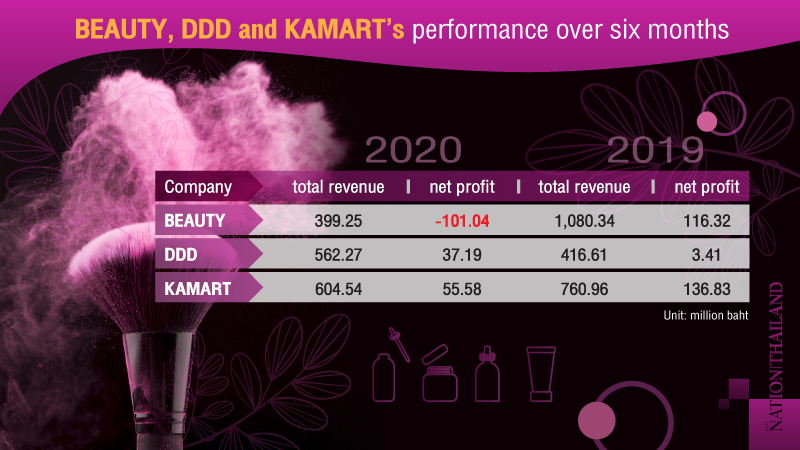
On Tuesday, the share price of Beauty Community (BEAUTY) rose by 14.78 per cent to Bt1.32 per share, Do Day Dream (DDD) rose by 6.81 per cent to Bt18.80 per share and Karmart (KAMART) rose by 11 per cent to Bt3.22 per share. However, the share prices of the three companies still contracted by 30 per cent from the end of last year.

BEAUTY’s net profit in the first six months of the year fell to Bt101.04 million from Bt116.32 billion in the same period of the previous year.

KAMART’s net profit over six months was Bt55.58 million, down 59.4 per cent year on year, while DDD’s net profit was Bt37.19 billion after facing losses for four consecutive quarters.

Tareetip Wongsaengpaiboon, senior president at Kasikorn Securities, said the share price of the three companies rose in response to the news of the government’s move to allow tourists to enter the country.

She explained that DDD and BEAUTY get more revenue from tourists than KAMART, but these companies still lack positive sentiment to boost their performance although they have adjusted their business strategy. So, it is necessary to see the number of tourists coming in after reopening the country.

“These companies need stronger positive sentiment, so we cannot advise investors during this time,” she said.

Recently, the Centre for Covid-19 Situation Administration agreed to allow six more groups of tourists to enter Thailand. Separately, an AirAsia flight carrying a group of 150 tourists from China’s city of Guangzhou will land in Phuket on October 8, while a Thai Smile Airways flight carrying another group of 126 flies to Bangkok on October 25.

On November 1, 120 tourists from Scandinavia and other European countries will arrive in Bangkok on a Thai Airways flight. These tourists will spend their first 14 days at alternative state quarantine sites in Chonburi, Buri Ram and Phuket.

Napon Jaisan, an asset analyst at Bualuang Securities, said if Bt23 million dividends from financial assets and Bt86 million net profit from fair value measurement are excluded, DDD would show a Bt44-million loss in the second quarter of this year compared to a Bt23-million profit in the same period of the previous year.

“Although DDD’s sales in the second quarter of this year were affected by the Covid-19 outbreak, Kuron sales were not affected by the said crisis, so it is considered a good decision that DDD acquired Kuron because it helped diversify the company’s risks,” he said.

“We expect DDD’s second-quarter performance to be its worst this year, but we advise investors to wait and watch because it is necessary to see a recovery in cosmetics demand and the tourism sector after reopening the country.”

An analyst at Tisco Securities expected BEAUTY to report Bt68 million in losses this year before rebounding with a Bt122-million net profit next year, adding that more than 28 per cent of the company’s revenue came from foreign countries, especially China.

Covid-19 delivers shock to East Asia on three fronts, as World Bank predicts growth of just 0.9% this year #ศาสตร์เกษตรดินปุ๋ย

#ศาสตร์เกษตรดินปุ๋ย : ขอบคุณแหล่งข้อมูล : หนังสือพิมพ์ The Nation.

Covid-19 delivers shock to East Asia on three fronts, as World Bank predicts growth of just 0.9% this year

EconSep 29. 2020

By The Nation

The Covid-19 outbreak has delivered a triple shock to the developing East Asia and Pacific region (EAP) – the pandemic itself, the economic impact of containment measures and reverberations from the global recession, a World Bank report entitled “From Containment to Recovery: Economic Update for East Asia and the Pacific, October 2020” released on Tuesday said.

The EAP region, where the virus originated, has suffered less from the disease than other parts of the world. Countries that have contained the spread of the disease to date used a combination of stringent lockdown measures, extensive testing-based strategies and information programmes to encourage precautionary behaviour. 

However, the pandemic and efforts to contain its spread have led to a significant curtailment of economic activity. Each country’s outcomes were generally related to how efficiently the disease was contained and how exposed they were to external shocks. Output in China, for instance, contracted by 1.8 per cent in the first half of this year, and by 4 per cent on average in the rest of the region. 

Containment measures in some countries is leading to the revival of domestic economic activity, though the region’s economy is heavily dependent on the rest of the world. Trade is slowly beginning to revive as global economic activity gradually resumes, but tourism will remain subdued. Though short-term capital has returned to the region, global uncertainty still inhibits domestic and foreign investment. The capacity of financially strained governments to stimulate their economies is also limited.

The region as a whole is expected to grow only by 0.9 per cent this year, the lowest rate since 1967. While China is forecast to grow by 2 per cent in 2020 – boosted by government spending, strong exports and a low rate of new Covid-19 infections. However, checked by slow domestic consumption, the rest of the EAP region is projected to contract by 3.5 per cent. 

Prospects for the region, however, will be brighter next year, with growth expected to be 7.9 per cent in China and 5.1 per cent in the rest of the region based on the assumption that of continued recovery and normalisation of activity in major economies, linked to the possible arrival of a vaccine. 

However, output is projected to remain well below pre-pandemic projections for the next two years. The outlook is particularly dire for some highly-exposed Pacific island countries where output is projected to remain about 10 per cent below pre-crisis levels through 2021.

The Covid-19 pandemic is not just keeping people in poverty, but is also creating a class of “new poor”. The number of poor people in the region is expected to rise by as much as 38 million in this year, including the 33 million who would have otherwise escaped poverty and another 5 million pushed back into poverty, using a poverty line of US$5.50 a day. 

The impact of the pandemic on employment and earning has been large and widespread. Sales in some EAP countries were 38 to 58 per cent lower in April-May this year, compared to the same period last year. Larger firms seem to be recovering faster than small and medium-sized enterprises – with SMEs both more vulnerable to the crisis and less able to adapt by going digital. Both wage employees and those working in family businesses have experienced a significant drop in come. 

EAP governments have on average committed nearly 5 per cent of their GDP to improve health systems, help households to smooth consumption and help firms avoid bankruptcy. However, several countries are finding it hard to scale up their narrow social protection programmes, on which they previously spent less than 1 per cent of the GDP. Even with this increased spending, the report found that in some countries, assistance has reached less than one-quarter of households whose incomes fell and only 10-20 per cent of firms reported receiving help since the pandemic began.

School closures due to Covid-19 could result in a loss of 0.7 learning-adjusted years of schooling in EAP countries, and as a result, the average student in the region could face a reduction of 4 per cent in expected earnings every year of their working lives.

Covid-19 will have a lasting impact on inclusive longer-term growth by hurting investment, human capital and productivity. Public and private indebtedness, along with worsening bank balance sheets and increased uncertainty, are likely to inhibit investment and pose a risk to economic stability. Sickness, unemployment and school closures could lead to the erosion of human capital and earning losses that may last a lifetime. Firm closures and disruption in employer-employee relationships could hurt productivity by leading to a loss of valuable intangible assets. The disruption of trade and global value chains could hurt productivity by leading to a less efficient allocation of resources across sectors and firms and dampening the diffusion of technology.

Left unremedied, these consequences of the pandemic could reduce regional growth over the next decade by 1 percentage point per year. The poor will be disproportionately disempowered because of worsening access to healthcare, education, jobs and finance.

Social Security Office offloads over 41,000 BBL shares #ศาสตร์เกษตรดินปุ๋ย

#ศาสตร์เกษตรดินปุ๋ย : ขอบคุณแหล่งข้อมูล : หนังสือพิมพ์ The Nation.

Social Security Office offloads over 41,000 BBL shares

CorporateSep 29. 2020

By The Nation

The Social Security Office (SSO) sold 41,100 Bangkok Bank (BBL) shares on September 24, the Securities and Exchange Commission (SEC) reported on Tuesday.

The SEC said it received the SSO’s report on acquisition or disposition of securities stating that the company sold 41,100 BBL shares, accounting for 0.0021 per cent of total shareholding.

This makes SSO shareholding in BBL drop to 95.40 million shares, accounting for 4.99 per cent of total shareholding.

As of June 30, approximately 68 per cent of SSO investment was in government bonds and 12.09 per cent in Thai stocks. The company has a policy to invest 80 per cent in safe-haven assets and 20 per cent in volatile assets.

The company realised gains of Bt23 billion in the first half of this year – Bt21 billion from interest, debt instrument sales and asset borrowing fees, and Bt2.7 billion from dividends and equities and investment unit sales.

SET slumps over prospect of student-led political rallies #ศาสตร์เกษตรดินปุ๋ย

#ศาสตร์เกษตรดินปุ๋ย : ขอบคุณแหล่งข้อมูล : หนังสือพิมพ์ The Nation.

SET slumps over prospect of student-led political rallies

EconSep 29. 2020

By The Nation

The Stock Exchange of Thailand (SET) Index closed at 1,257.34 on Tuesday, down 5.68 points or 0.45 per cent. The volume of total transactions was Bt38.20 billion with an index high of 1,267.67 and a low of 1,254.34.

In the morning session, an analyst at Krungsri Securities said he expected the index to rise to between 1,270 and 1,275 points, as investors were ready to take more risks for larger returns leading to a rise in global stock markets.

However, Therdsak Thaveeteeratham, Asia Plus Securities vice president for research, said the index has limited room to rise due to the Covid-19 outbreak and the domestic political situation, as student-led protesters are set to hold a rally in October.

This is despite the fact that US lawmakers have finally come to an agreement on economic stimulus measures.

The top 10 stocks with the highest trade value today were DELTA, PTT, CPALL, KBANK, AOT, BBL, STGT, MINT, ADVANC and CPF.

As of 4.30pm, the price of oil dropped by US$0.31 or 0.76 per cent to $40.29 per barrel, while gold rose by $6.90 or 0.37 per cent, to $1,889.20 per ounce.

Other Asian indices were mixed:

Japan’s Nikkei Index closed at 23,539.10, up 27.48 points or 0.12 per cent.

China’s Shanghai SE Composite Index closed at 3,224.36, up 6.82 points or 0.21 per cent, while Shenzhen SE Component Index closed at 12,900.70, up 139.76 points or 1.10 per cent.

Hong Kong’s Hang Seng Index closed at 23,275.53, down 200.52 points or 0.85 per cent.

South Korea’s KOSPI Index closed at 2,327.89, up 19.81 points or 0.86 per cent.

Taiwan’s TAIEX Index closed at 12,467.73, up 4.97 points or 0.040 per cent.

SET rebounds over news of US stimulus measures #ศาสตร์เกษตรดินปุ๋ย

#ศาสตร์เกษตรดินปุ๋ย : ขอบคุณแหล่งข้อมูล : หนังสือพิมพ์ The Nation.

SET rebounds over news of US stimulus measures

EconSep 29. 2020

By The Nation

The Stock Exchange of Thailand (SET) Index should rebound in the short term as there is limited room for it to rise, experts say.

The SET Index rose sharply on Monday after the market underwent correction for six consecutive days by 18.08 points or 1.45 per cent, closing at 1,263.02. Total transactions stood at Bt41.29 billion, most of which were mass buy-ups in energy and power plant shares.

As of 12am today, SET Index stood at 1,263.38, up 0.36 points or 0.03 per cent.

Koraphat Vorachet, director of research and investment at Capital Nomura Securities said the index rebounded after the US government decided to launch new economic relief measures, resulting in investors’ confidence on volatile asset investment.

He also said that investors began buying energy and power plant shares because their prices had dropped drastically. However, he believes SET has limited room to rise and that it will move sideways down between 1,245 and 1,275 due to lack of positive sentiment.

Therdsak Thaveeteeratham, Asia Plus Securities vice president of research, said SET rebounded technically because the political situation last week was not severe, while the index gained positive sentiment from the rise in Dow Jones Futures and strengthening the dollar, causing the cash to flow into volatile assets.

Like Koraphat, he too said the index has limited room to rise due to the Covid-19 outbreak and the domestic political situation, as student-led protesters are set to hold a rally in October. The index’s support line will stand at 1,250 and resistance line between 1,275 and 1,280.

Wikij Tirawannarat, director of individual customer research, expects the SET to rise by 10 per cent to 1,350 in line with foreign stock markets as it gained positive sentiment from hopes over US economic stimulus measures.