Five branches of the Metropolitan Electricity Autjority (MEA) have won gold awards from the Ministry of Natural Resources and Environment for government buildings with efficient waste water management.
The MEA offices in Thonburi, Bangkhuntian, Samsen, Yannawa, and Bangkhen won the honour.
Somboon Somdulkanok, MEA deputy director-general, received the honorary plaques from the representative of the Pollution Control Department at the Ministry of Natural Resources.
The MEA said it remained committed to providing quality service to customers in metropolitan areas while promoting environment conservation and sustainable management of water resources.
Dtac Business offers new solutions for corporate clients
Sep 25. 2020
By The Nation
Dtac Business, a Total Access Communications (Dtac) unit created to provide solutions to corporate customers, is highlighting three new offerings to help Thai businesses leapfrog into a digital future.
• Mobility solution: A simple package with zero hidden fees that offers unlimited free calls to all networks and “worry free” SIMs that automatically upgrade data packages. This means existing clients are guaranteed plans that are equally attractive as those offered to new customers. The service also covers device care and virtual PBX for a more efficient management of calls and data usage to keep costs low.
• IoT solution: This package is integrated with Dtac’s own technology, including a managed IoT cloud platform and 4G IoT SIM connectivity. The solution offered includes machine to machine (M2M) links with SIMs supporting communications between devices such as ATMs, vehicles and telematics. Users will also be provided with consultancy services on IoT investment that is tailored to each industry.
• SmartConnect: A turnkey cloud solution that enables remote work, boosts collaboration and heightens security. Dtac Business is adopting multiple cloud services, building on the provider’s strength in connectivity and mobility, as well as synergising with strategic partners in leading cloud services.
Dtac is also offering customisation of multi-cloud services to offer innovative solutions. Its cloud solutions are suitable for both large corporations and SMEs, making operations more agile and efficient.
Dtac Business has also launched an e-care and e-store to cater to changing customer behaviour, where consumers prefer to manage their call and data plans themselves. Dtac has also launched a new business call centre to cater to corporate clients.
Rajiv Bawa, Dtac’s chief executive officer, said: “Business is always tough, but 2020 is particularly disruptive. Making the need for simple, worry-free solutions all the more pressing in Thai companies, particularly SMEs. They need data and call packages that are affordable and without extra charges. They need simple IT tools that can be implemented without an IT team, and that can help make their data both more secure and more easily accessible remotely. And finally, all customers expect improved digital channels. That pressure is both on our customers and on us, which is why we’ve launched a new e-care platform.
“Much of the pressure to digitalise is coming one or two years earlier than anticipated. We want to make the digital future an opportunity rather than a threat for our clients. We can help them embrace digital solutions internally but also in their communication with their customers, allowing them to grow their business with touch-free experiences adapted to the new normal,” he said.
Swarovski has joined with Warner Bros and DC to come up with a special sparkling collection to celebrate Wonder Woman ahead of the December 25 release of “Wonder Woman 1984”.
The designs in this collection draw their inspiration from the superhero’s golden armour and eagle wings, symbolising a combination of femininity, strength and determination.
The Wonder Woman collection features:
Cuff: Swarovski shines a new light on the iconic silhouette with a striking pavé and crystal mesh cuff.
Hoop earrings: This pair of versatile earrings can be worn in different ways. Wear the hoops on their own for a simple daytime look or dial up the sparkle with the Wonder Woman motif.
Necklace: This sparkling necklace will amp up necklines from day to night thanks to Swarovski crystal pavé embellishment.
Double ring: Put this on to add a stylish statement to any ensemble.
Bracelet: This shimmering piece adds a subtle dose of superpower to your everyday look.
Tassel earrings: The fringe-like, versatile earrings can be worn in multiple ways and gently swish a with every move.
The Swarovski x Wonder Woman collection is available exclusively at the brand’s boutique at CentralWorld. Discover inspiration and ways to create sparkle via the #SparkDelight hashtag on Instagram.
Thai Smile Airways is planning flights to Nan in the North and Nakhon Phanom in the Northeast, seeing the potential for tourism growth in these two provinces.
Chief executive officer Charita Leelayudth said that the carrier had resumed domestic flights on June 1 and had got a good response from passengers. Its cabin factor is between 60 to 70 per cent.
The carrier launched a new route from Bangkok to Nakhon Si Thammarat on September 10.
Bankers are optimistic that rising bad debts driven by Covid-19 are manageable, though the second phase of the moratorium offered by many banks will end next month.
They estimate non-performing loans (NPLs) to rise to 5 per cent by the end of this year, up from 3 per cent at the end of last year.
Siridej Aungudomsin, senior executive vice president at Bangkok Bank (BBL), said on Friday that though bad debt was on a rising trend, there would be no repeat of the situation during the 1997 Asian financial crisis when it skyrocketed to 40 per cent. NPLs were expected to stay at around 3 to 5 per cent currently, he said.
About 70 per cent of small and medium-sized enterprises (SMEs) clients of BBL have not requested an extension of the debt moratorium after the first phase of assistance implemented in March came to an end, he said.
The impact of the Covid-19 outbreak has been severe, but Thai banks are resilient due to their strong capital base and ample liquidity, he said.
BBL is still offering customers debt restructuring in order to help them survive the pandemic crisis, he added.
Surat Leelataviwat, executive vice present at Kasikornbank, revealed that as of June 30, all commercial banks assisted a large number of customers whose combined loans amounted to Bt4.5 trillion, representing 31 per cent of total loans of Bt14 trillion.
SMEs were the most affected group and 23 per cent of their total Bt4 trillion debt was restructured and 26 per cent were allowed a moratorium.
Of the SMEs, 100,000 are customers of Kasikornbank. The bank conducted a survey and found that 80 per cent of them do not need extra financial support. Only 400 firms closed their businesses. “It is quite surprising that the situation is not as serious as previously estimated,” he said.
Rak Vorrakitpokatorn, president of Thai Credit Guarantee Corporation, said that NPLs among SMEs were 6 to 6.5 per cent in the second quarter, up from 5.6 per cent of the total Bt6 trillion loans at the end of last year.
Some have forecast significant NPLs concealed in the debt moratorium and if there were no debt aid, the NPLs could spike to 20 to 30 per cent of total loans, he said. He was also optimistic that bad debts would be manageable.
Niyot Masavisut, president of Sukhumvit Asset Management Co, said that about 100 clients had requested debt moratorium and 40 per cent of them could continue their businesses, while the remaining 60 per cent have requested extra assistance, he said.
He predicted NPLs to rise in the next two years, while banks and over 60 asset management companies would work together to tackle the bad debt. NPLs would rise to 5 per cent this year, up from 3 per cent last year, he added.
The cleaning and disinfection sector has boomed during the Covid-19 pandemic, according to the Department of Business Development (DBD).
From January to August, 218 companies in the segment were set up with total registered capital of Bt278.52 million, said DBD deputy director-general Sorada Lertarpachit.
Highlighting the future potential for cleaning services, she said average yearly applications for construction of buildings now totalled about 60 million square metres. The service fee for cleaning and disinfection is currently about Bt15-20 per square metre.
There are currently 3,143 registered cleaning and disinfection companies in Thailand.
The Stock Exchange of Thailand (SET) is expected to face volatility during the fourth quarter of this year due to the US presidential election and the SET’s zero plus tick rule, experts said.
Tisco Securities explained that the outlook for the Thai stock market this year was gloomy, especially during the first quarter when the SET fell from the highest at 1,850 in the previous year to the lowest at 969. The index then rebounded to 1,400 in the second quarter before falling to 1,250 last week. The index this year still contracted by approximately 20 per cent compared to the previous year.
Considering transactions so far, foreign investors made net sales of Bt270 billion, but individual and institutional investors made net buys of Bt200 billion and Bt67.5 billion, respectively.
Apichat Poobunjirdkul, Tisco Securities’ senior director, expected the SET to fall at the beginning of the fourth quarter due to domestic and international negative factors.
“Domestic factors include risk of political unrest when student-led protesters hold a big political rally in October this year and extension of the state of emergency, while international factors include the US presidential election, Covid-19 outbreak, and delay in the rollout of US economic stimulus measures,” he said.
“These factors will cause a decline in economic data and lead to mass sell-offs of stocks in the next two months.”
Meanwhile, he expected the index to rebound later in the fourth quarter, as the US presidential election would be over and cash flow direction would be more visible, while a Covid-19 vaccine would be ready and the improvement in listed companies’ profit are expected to be seen in the first quarter of next year, resulting in confidence among investors.
For investment strategy, he said investors should buy stocks with growth potential when the index falls to 1,250, such as food, healthcare and small-cap shares.
“The securities company aims to cut the index forecast for the end of this year to between 1,250 and 1,300 points from the current 1,400, while the index low and high are expected to be at 1,200 and 1,300, respectively,” he added.
Koraphat Vorachet, director of research and investment at Capital Nomura Securities, expected the SET to face volatility at the beginning of the fourth quarter, setting the index’s support line at between 1,150 and 1,200 and the resistance line at 1,330.
He said the market is preparing to deal with risks from the SET’s move to use the zero plus tick rule that allows investors to short-sell stocks at a price equal to the trading price from October 1 onwards.
“Currently, the SET uses an uptick rule that forces investors to short-sell stocks at a price higher than the trading price to mitigate volatility in the index, which helped reduce the value of short sales to Bt500 million per day from Bt3 billion per day before the Covid-19 outbreak,” he explained.
“After the zero plus tick rule comes into effect, the value of short sales is expected to be equal to the value before the Covid-19 outbreak, but it depends on Thai stock market fundamentals and the country’s economic recovery.”
He said after the result of the US presidential election is known, the Covid-19 outbreak and Covid-19 vaccine development would influence the SET from November to December, adding that there was no sign indicating foreign investors would invest in the Thai stock market.
“It depends on the economic recovery and listed companies’ performance whether Thai and other Asian indices would gain positive sentiment from foreign investors’ asset allocation after the US presidential election,” he said.
For investment in the last quarter of this year, he advised investors to pick stocks whose performance is expected to improve, such as export, food, beverages and electronic parts group.
“Also, investors should invest only 25 per cent in stocks during the market correction at the beginning of the fourth quarter,” he said.
He added that a few institutional investors would engage in window dressing at the end of the third quarter because they often do that in the middle of the year and the year-end.
Kitichan Sirisukarcha, from CGS-CIMB Securities (Thailand), expected the Thai stock market to face low volatility between 1,200 and 1,330 in the fourth quarter and move to 1,280 at the year-end because the market has always responded to positive and negative sentiments quicker than other markets, adding that listed companies’ third-quarter performance would be better than the previous quarter.
Also, he expected foreign investors’ net sales to hit a new high from the current high of Bt287 billion in 2018 due to lack of positive sentiment.
As investment strategy, he advised short-term investors to speculate on profits, and long-term investors to buy shares after the US presidential election.
“If the Covid-19 situation improves, we recommend buying retail, oil refinery and hospital shares,” he said.
China’s middle-class dream of a second home in Malaysia dashed by coronavirus and geopolitical tensions
Sep 27. 2020Hot property: Affluent Chinese people are eager to make overseas investments or embrace a new lifestyle abroad, including in Malaysia. Photo credit: The Star
By The Star
Patricia Li is dismayed and saddened by the exodus of Chinese people she is witnessing in Johor, the southernmost state in Malaysia.
When she moved to the tropical Southeast Asian country from Yunnan province in 2017, the outlook was bright. Thousands of middle-class Chinese investors were flocking to Malaysia to buy property and secure a second home beyond China’s borders.
A number of Chinese developers have also invested heavily in Johor, promoting its proximity to Singapore and developing real-estate projects tailored for affluent Chinese people eager to make overseas investments or embrace a new lifestyle abroad. Since 2011, Guangdong-based developer Country Garden says it has invested close to RM20 billion (US$4.83 billion) in Malaysia, creating more than 1,500 jobs.
For her part, Li opened a teahouse in Johor to serve the Chinese community that was growing there, with many taking advantage of the Malaysia My Second Home (MM2H) programme, which launched in 2002 and offered foreign investors long-stay visas of up to 10 years.
A model of Country Garden’s Forest City development plan is seen in Johor Bahru city, Malaysia, in 2016. Photo: Bloomberg
But so much has changed in such a short time. The coronavirus outbreak and a worsening geopolitical environment have made Chinese investors wary, and the latest blow came last month when Malaysia decided to suspend the MM2H programme, in line with the government’s decision to bar foreigners from entering amid the pandemic.
Amid so much uncertainty, those dreaming of settling down in Johor have been forced to rethink their plans. Many have opted to simply leave Malaysia amid the pandemic. Unsure about when they might be able to return, some are taking the drastic step of selling their Malaysian homes remotely, at a steep loss.
“It’s quite depressing when you see social media posts [on WeChat] trying to sell a 48-square-metre [517 sq ft] apartment for only about 600,000 yuan (US$88,640). I spent more than 1 million yuan for the same type of unit in 2016,” Li said, referring to her teahouse, which she was forced to close as Chinese people left Johor, leaving her with few customers.
Whether to sell their property in Johor at a loss has become a worrisome topic of conversation among Li and her fellow middle-class friends who bought Malaysian property in the last few years.
“I once thought assets here would appreciate, and the tea cafe would be full of the growing number of new arrivals of Chinese. But it’s so different from what I expected,” she said.
Wendy Wu, a Beijing resident who also invested in property in Johor, is also worried amid the increasingly murky outlook.
“No new Chinese investor will come to buy property here if there’s no long-stay visa guarantee,” Wu said from Johor.
Between 2002 and 2018, the MM2H programme resulted in the approval of 43,943 visa applications from 131 countries and territories – and about 30 per cent involved mainland Chinese residents. But that door is closed now. When and if it will reopen is anyone’s guess.
According to the Malaysian My Second Home Consultants Association, 90 per cent of the applications they submitted between September and November 2019 – even before the emergence of the coronavirus – were rejected without any reasons or justifications.
Wu added that the pandemic and worsening relations between China and other countries have led to concerns about how safe it is to be living overseas.
Many Chinese students studying in Johor’s international schools also returned to China amid the outbreak.
For Li, those schools were among the enticing elements of life in Malaysia. Four years ago, when she first visited Johor on a free “investment tour” with a number of other middle-class Chinese residents looking to buy property, the region seemed like the perfect fit for their dreams of owning a home overseas and providing their children international educations.
Back then, China’s overseas investment was still booming among mainland enterprises as well as rich and middle-class individuals. Besides Li, a large number of Chinese middle-class citizens were attracted by the tropical environment and clean air. Many put money down on a new home during their first trip to Johor, especially after learning that the average property prices there were about a quarter of those in downtown Beijing.
Most of these Chinese individual investors are not prepared – financially or psychologically – for the risks of overseas investment
Simon Zhao
Buying a home abroad was seen as a short cut to a better life for Chinese families. Not only did people see an asset that would appreciate over time, they were also enticed by a tropical environment that appeared to be conducive to raising a family, while still being relatively close to mainland China and Singapore.
Simon Zhao, an associate dean with BNU-HKBU United International College’s Division of Humanities and Social Sciences, says the scale of Chinese middle-class investments overseas has dropped sharply due to the pandemic, particularly as the spending power of many people has taken a big hit in the economic downturn.
“Most of these Chinese individual investors are not prepared – financially or psychologically – for the risks of overseas investment,” Zhao said. “They have experienced only economic growth and a booming property market on the mainland for decades, and they lack the funds and risk awareness to deal with the downside [of the economic cycle].” — South China Morning Post
Airlines face worst crisis since 9/11 as funding ends
CorporateSep 27. 2020Air transportation jobs plummet Photo by: Michael Laris — The Washington Post Fi
By The Washington Post · Ian Duncan, Lori Aratani, Michael Laris · NATIONAL, BUSINESS, WORLD, TRANSPORTATION, TRAVEL
For Jennie Ballesteros, having the wings of a United Airlines flight attendant ceremonially pinned to her chest was the fulfillment of a dream she’d held onto for years – ever since some crew members she served as a waitress told her she might have what it takes.
“I’m going to make it,” Ballesteros recalls thinking. “I’m going to have some security. A retirement. A 401(k). This is an amazing job. I was just so happy.”
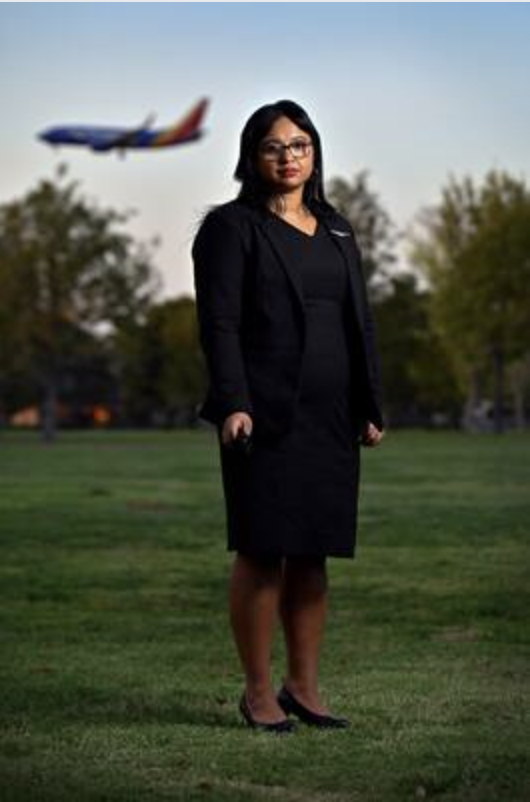
In her first months as a flight attendant, Jennie Ballesteros worked evacuation flights as the world shut down. She may be lose her job Thursday, when Cares Act funding to airlines expires. CREDIT: Photo by David Becker for The Washington Post
It was Jan. 2.
“I said, ‘2020 is going to be my year.’ ”
Soon, news of a novel coronavirus from Wuhan, China, began spreading. In her first few months on the job, the 29-year-old was working evacuation flights as people sought to get to their home countries as the world locked down.
Now she’s on the verge of seeing her long-held dream end, facing being furloughed as one of 16,300 United employees – and more than 35,000 across the airline industry – set to be out of a job come Thursday. It’s another devastating blow for an industry facing a crisis analysts say is already far worse than it experienced after the Sept. 11, 2001, terrorist attacks, and one that has already seen employment in air transportation decline by 100,000 jobs according to one measure.
The employees facing furlough will be victims of the ongoing devastation the pandemic has inflicted on airlines, which have seen demand for travel drop precipitously since March, but also of a Congress that says it wants to protect their jobs with billions of dollars in aid and yet has been unable to reach agreement on a bill to do so.
“I feel kind of abandoned by our representatives,” said Ballesteros, who is based in San Francisco.
Leaders of her union, the Association of Flight Attendants, along with other labor groups and airline heads were in Washington last week to make a final push for an extension of financial aid known as the Payroll Support Program. At a news conference in the shadow of the Capitol on Tuesday afternoon, their frustration was clear.
“What Congress and the administration did back in March was a remarkable effort to save the U.S. economy and to save aviation,” United Airlines Chief Executive Scott Kirby said. His airline, which employs 79,000 people, received $5 billion in the first coronavirus relief package.
“But this is taking longer than most people expected six months ago and the reality is we need to do more to keep those professionals and to keep their support of the economy intact.”
Lawmakers say they didn’t intend to create a precipice when they gave airlines an initial $25 billion in aid on the condition that they not lay off workers until October. Like many Americans, they expected the virus to be under control by now. Instead, it continues to spread and air travel is stuck at about 700,000 passengers a day, a third of its normal rate.
The prospects of a deal remain uncertain, with Democrats and Republicans still haggling over a broader relief package, of which help for the airlines would likely have to be a part.
– – –
Airline employees are far from the only workers suffering as the pandemic continues to wreak havoc on the U.S. economy. But their situation is particularly dramatic because the industry is concentrated in a few very large and very visible companies, and there is a bright deadline on the calendar. Airline industry employees may not come to mind when many Americans think of “essential workers.” But airline employees say they have risked their own health to keep planes in the air during the pandemic, transporting those who had to travel and moving essential goods, including medical supplies. Some 45 to 50 percent of freight typically moves in passenger jets.
The more than 35,000 facing furlough are only part of the industry’s story. Tens of thousands more have already taken unpaid leave, or left their airlines for good. Others have seen hours cut and worry about pay cuts this fall.
More than 1,800 U.S.airline planes remain parked – a third of the industry’s fleet – and cuts to service are likely to follow the job losses.
Though the aviation industry took a hit from 9/11, a different coronavirus outbreak in 2003 and a deep recession in 2008, economists say those episodes – while painful – pale in comparison to this year’s calamity.
Labor Department figures released this month show there are more than 100,000 fewer air transportation jobs in the U.S. than in March, a decline of more than 20 percent.
“This is just unprecedented,” said Joseph Sobieralski, an airline labor expert at Purdue University.
That overall figure goes beyond airlines to cover both passenger air travel and cargo-related employment, and doesn’t include many support jobs and the layoffs put on hold by the federal bailout. But the number is a good stand-in for gauging the severity of the downturn, Sobieralski said.
The uncertainty of life in pandemic-stricken America has made for a historic crisis for airlines and their employees.
“The 9/11 situation was abrupt. It was shocking. It knocked people back on their heels. This situation seems to be a little bit more sinister, simply because we don’t know,” said Eric Jones, chair of the maintenance science department at Embry-Riddle Aeronautical University and a former mechanic for Southwest Airlines. “There’s a sense of unknowing about, well, when is covid going to recede? When is this vaccine going to happen?”
Furloughed employees will have the right to be called back to their old jobs, but industry leaders and analysts expect the recovery to take years.
The Trump administration has faced sharp criticism for downplaying and mismanaging the pandemic, and for failing to put in place a national testing infrastructure and other measures that could slow the virus’s spread and give airline passengers and others the confidence to resume a more normal life.
Daniel Elwell, deputy administrator at the Federal Aviation Administration, recently told state aviation leaders that the government is consulting with airlines and international officials on plans to “incentivize travel while keeping passengers safe and healthy,” and said details would be forthcoming. The goal, Elwell told the National Association of State Aviation Officials, is not “to create zero risk or to eliminate any chance of covid,” but rather to “bring the highest level of health security into the system without making it so burdensome that we can’t fly.”
Individual airlines have adopted different strategies in response to the crisis. United and American Airlines began warning of mass furloughs in the summer. But Delta Air Lines has been able to avoid doing so, instead using the summer to convince 40,000 of the 90,000 people it employed in March to go on temporary unpaid leave and another 17,000 to accept separation packages. The company received $5.4 billion from the payroll support program.
Delta’s leaders have praised employees’ willingness to make sacrifices for the good of the company, but two flight attendants interviewed described receiving a barrage of emails that left them feeling intensely pressured to leave.
“I definitely feel like that was implied, you’re a bad employee if you don’t take the leave,” said one of the flight attendants, who spoke on the condition of anonymity because she feared retaliation and like nearly all Delta employees, is not protected by a union.
Delta, in a statement, said the decision about whether to take a leave, “was left up to each individual Delta employee to make on behalf of themselves and their families.”
“Delta people have done everything to step up during this pandemic which is completely a function of our unique culture and why there will be no involuntary furloughs for Delta front-line ground and flight attendants in the U.S.,” the company said.
United and American, which are heavily unionized, kept most employees on their payrolls, and the two airlines account for nearly all of the coming job losses. American, which accepted $5.8 billion in payroll support, is preparing to furlough 19,000 of its 107,000 employees. Chief Executive Doug Parker said that with his company burning through $1 billion a month, he has no choice but to move forward.
“As painful as it is that is absolutely what we would have to do,” Parker said in a phone interview from the airline’s Washington office, where he spent the week pursuing the campaign for more federal assistance.
Should the money come through, Parker and Kirby both said they expect demand for travel to be robust enough in six months that the industry will be ready to start standing on its own again.
However, Parker said if workers are furloughed, the airline won’t be able to quickly rehire enough people to match that demand because they will require months of retraining, something he said could hamper a broader economic recovery.
“It would be a really bad thing for American Airlines and it would be a really bad thing for our country,” he said.
Southwest, which also is largely unionized, is trying to avoid that situation, agreeing to pay thousands of its employees not to come to work – for up to five years in the case of pilots – or to retire early.
The carrier, which employs 62,000, received $3.3 billion from the payroll program. Southwest has also raised more than $15 billion by borrowing, selling assets and leasing them back and issuing new stock.
With its “Extended Emergency Time Off” program, the company is trying to stop hemorrhaging money on salaries, but still maintain ties with employees it has already spent large sums training and hopes it will eventually need again.
The volunteers keep a significant chunk of their wages and all their benefits. About 12,500 employees are participating. Pilots were offered about half of their pay, a Southwest pilot said in an interview, though the company declined to provide specific compensation figures. The company can call the pilots back to work with a minimum of 30 days notice, but said it would try volunteers first “if additional pilots are ever needed.”
More than 4,200 flight attendants, mechanics, pilots, and customer service and ground crew workers have agreed to leave Southwest altogether, the airline said in a regulatory filing. Employees said the departures were sweetened with generous incentive packages.
Avoiding layoffs is a point of pride at Southwest, something the company boasts it has never had to do in its 49-year history. Chief Executive Gary Kelly said Southwest is not planning pay cuts or involuntary furloughs this year either, though “we will continue to plan for multiple weak scenarios and maintain our preparedness.”
While avoiding the pain of layoffs, the thousands of early retirements and departures have made for a tumultuous, and at times emotional, stretch at the airline.
“The great thing is, you’re getting rid of your top earners,” said the Southwest pilot, who spoke on the condition of anonymity because employees are not authorized to speak to media. “It helps all of us.”
But the idea of cutting short their careers and time in the cockpit was a struggle for many, the pilot said.
“A lot of these guys just love it. They love what they do,” the pilot said. “But the package was so good it really made people think. There are a lot of people who wish they were in a position to take it, myself included.”
Some lawmakers have questioned the airlines’ efforts to cut labor costs while accepting billions in federal aid meant to shore up their payrolls. Rules for the payroll grant program, part of the massive aid package known as the Cares Act, said airlines could not involuntarily put people out of work or cut pay if they accepted the money, but some airlines interpreted the language to mean that cutting work hours was allowed.
Delta cut hours by 25% for many employees, a policy Delta Chief Executive Ed Bastian said would continue through the end of the year. United sought to force a cut in some 15,000 employees’ hours, but backed off under pressure from political leaders and a lawsuit by one of its unions. Several airline contractors are under investigation by House Democrats, accused of laying off workers immediately before receiving the payroll aid money.
Nonetheless, there is broad bipartisan support for renewing the program through April, even among those like Rep. Jan Schakowsky, D-Ill., who questioned why the Treasury Department allowed companies receiving aid to cut hours. She said she hopes “that it can be reauthorized quickly” and that new safeguards could be included in an extension.
The problem has remained finding a route for turning that support into legislation.
Early last week, Sens. Roger Wicker, R-Miss., and Susan Collins, R-Maine, who lead committees with responsibility for aviation, introduced a stand-alone bill to extend the payroll protection program. About two dozen other Senators have signed on as co-sponsors of the legislation, including two Democrats.
White House press secretary Kayleigh McEnany said the Trump administration wanted lawmakers to pass one-off aid bills, including help for the airlines.
But Democratic leaders in the House have been committed to passing several trillion dollars in aid as a single package. Rep. Rick Larsen, D-Wash., who chairs the aviation subcommittee, said he could not foresee a stand-alone bill being successful when there are also local government workers whose jobs are on the line and people are on the verge of being evicted.
“All these folks and more need to have their needs reflected in a covid-19 relief package,” Larsen said.
On Thursday, House Speaker Nancy Pelosi, D-Calif., said she would begin crafting a new proposal that would include help for the airlines and took steps to open negotiations with the Trump administration.
For front-line airline workers counting down the days to Oct. 1, the regular struggles of life were magnified to huge proportions by the virus and the impending loss of their livelihoods.
– – –
In March, when President Donald Trump signed the Cares Act, Toni Valentine felt like she finally had time to breathe.
The payroll protection program included in the law offered her assurance she could keep her job as a reservations agent at United, she said, and gave her family stability at a time when so much else in their world was uncertain.
For Valentine, 2019 had been a difficult year: Six months after starting a new job, her husband suffered a massive stroke.
“We lost a whole income, medical benefits,” she said. “It just seemed like it happened overnight.”
These days, Valentine, 41, who has worked at United for 15 years, finds herself anxious and worried. Worried about supporting six kids. Worried about bills – phone, electricity and gas. Worried about what she’ll do if she’s furloughed and loses her medical coverage in the midst of a pandemic.
Her family is doing what they can. Her 19-year-old son left college to help her manage, caring for his younger siblings and overseeing their online schooling. She’s thankful for that and other small things. Her voice quivered as she recalled how quietly relieved she was that school would be online and not in person: There wasn’t any extra money for new school supplies and clothes this year.
And so she prays. And works. And prays. And works. And every day she said it gets just a bit harder.
“I have to put on this brave face and be the best employee I’ve got to be knowing that . . . I might not have a job,” said Valentine, who lives in the Detroit suburbs. “And that’s the hardest thing ever.”
Andrea’ Myers has spent the last few months in a fog of worry. Myers, also a United reservations agent, was diagnosed with cancer in February and had surgery to remove a tumor in March, just as the pandemic was beginning to shut down cities across the country.
Since the hospital only allowed one person to be with her due to coronavirus restrictions, three carloads of relatives sat in the hospital parking lot for nine hours as she underwent surgery. While she was in the hospital recovering, she got covid-19.
But Myers returned to work in July, relieved to still have a job. Then came word of possible furloughs. Now just days from the deadline, she’s grappling with the idea she may have to leave the company she’s been with for 21 years, losing her health insurance. Her husband was laid off from his job as an electrician, and so was her son, who worked for Hertz.
“We just need to make sure that people understand that we’re people,” said Myers, 46, who also lives in Detroit. “We’re not just a number at United Airlines. We have families. We have things we have to get done.”
For Ballesteros, the elation of becoming a flight attendant began to give way to dread as the virus took hold.
In March, she flew on a packed 787 to Munich, returning German residents home from the U.S. At first she was excited to be going to Europe, only to realize she couldn’t leave her hotel. And when she was in the van on the way to the hotel, she learned her foster father had had a heart attack.
He’d already been undergoing chemotherapy, and Ballesteros said she had avoided visiting him so as to not potentially expose him to the coronavirus.He died just as she was getting back from Munich.
“I still haven’t gone home,” she said. “I haven’t been able to hug my foster mom.”
If there’s no aid deal, Ballesteros said she doesn’t know what she’ll do. At one point it looked like she’d lined up a bartending job at a new restaurant, but because of the pandemic, it’s not going to open. Unemployment will barely cover her rent and car payment. She spent her savings to break a lease in Las Vegas and move to San Francisco for the new job.
“I’m at the absolute bottom,” she said.
She plans to keep working this week. Then she might have to turn in her company property. But, Ballesteros said, she would keep the wings.
BOT plans credit-term limit as SMEs hit by big firms’ delaying tactics
CorporateSep 26. 2020Experts brief the press about plans to introduce a mandatory credit term with financial penalties. From left, Thita Phakanont, Sauwanee Thairungroj, Chitkasem Pornprapunt.
By The Nation
The central bank plans to punish large firms who delay paying their debts to small companies.
The move comes after a study showed that big corporates are taking advantage of small and medium-sized enterprises (SMEs) by delaying payments, leading to a credit crunch for SMEs, said Sauwanee Thairungroj, adviser to the University of Thai Chamber of Commerce.
Cash payment represents only 4 per cent of transactions among businesses, most of whom rely on credit. Usually, businesses settle their bills within 30 to 45 days, but during the Covid-19 outbreak, big corporates have delayed payment by up to four months or 120 days, she said.
The delaying tactics have cost SMEs dearly, with their liquidity dropping by 38.5 per cent, debt rising by 27.6 per cent and debt payment ability falling by 16.2 per cent.
The response from small firms has been mixed, with 40.6 per cent asking for partial up-front payment, 35.5 per cent offering discounts, 15 per cent seeking credit from loan sharks and the rest applying for loans from financial institutions.
Thita Phakanont, senior economist at the Bank of Thailand (BOT), noted that other countries have created solutions to problems caused by extending credit terms.
Britain requires payment within 60 days, after which debtors have their rights to do business with state agencies revoked. Australia requires payment in 30 days, after which debtor-firms can have their certification revoked. The European Union sets a 60-day credit term, with fines or interest-rate penalties for violators. China sets a deadline of 30 to 60 days, after which debtors must pay interest equivalent to the rate on a one-year loan.
In Thailand, a possible credit term of 30 to 45 days is being studied by the central bank, National Economic and Social Development Council (NESDC) and Thai Chamber of Commerce. Those who fail to meet the deadline could be subject to a fine and interest rate charge. The study will also explore whether the Stock Exchange of Thailand should disclose names of listed firms which delay debt payment.
Incentives may be also needed for firms to stick to the set credit term, Thita added.
Senior BOT director Chitkasem Pornprapunt said the results of the study would be proposed to Cabinet for approval. If given the green light, central bank may introduce a compulsory credit term by December this year. The rule would be applied to big companies first – manufacturers with at least Bt500 million annual revenue and service-sector firms with at least Bt300 million yearly revenue.






 Hot property: Affluent Chinese people are eager to make overseas investments or embrace a new lifestyle abroad, including in Malaysia. Photo credit: The Star

 Air transportation jobs plummet Photo by: Michael Laris — The Washington Post Fi
 Experts brief the press about plans to introduce a mandatory credit term with financial penalties. From left, Thita Phakanont, Sauwanee Thairungroj, Chitkasem Pornprapunt.

