The private sector will propose four measures to boost the eastern region’s economy to the mobile Cabinet meeting in Rayong on August 24-25.
The proposals will be put forward by the Thai Chamber of Commerce, East Region, as ministers meet in Rayong, the heart of the government’s flagship Eastern Economic Corridor infrastructure project.
The first measure covers improvement of regional tourism and linking roads along the coast, while the second is for development of infrastructure, said Pratya Samalapa, who chairs the chamber’s committee on eastern region economic development.
The third is for new water resources, while the fourth aims to boost quality of life by upgrading hospitals in Rayong and Chonburi.
Investors have been warned to avoid speculating on initial public offering (IPO) shares as some listed companies take advantage of the market situation by setting the share price higher than its base price, experts said.
Anurak Boonsawaeng, a large investor who specialises in value investing, said many IPO shares were launched recently, and some of those attracted investors with good returns, tempting companies that were in the preparatory stages to list on the market to cash in on the positive sentiment.
“I believe that this factor led to high IPO share price because many companies took advantage by setting the price higher than its base price and the IPO share price rose by 200 per cent, hoping that investors would buy their shares on the first day of trading,” he said.
“Personally, I would like to warn investors to avoid investment in IPO shares if they are hoping that the share price will rise by 200 per cent on the first day of trading because the price of IPO shares will drop after rising for a while.”
He explained that the reason for the 200 per cent appreciation of an IPO share price on the first day of trading may be due to lower free float.
“I do not recommend investors buy IPO shares if they are hoping that share owners will boost the price, because they will not allow investors to take profit easily,” he said.
“Therefore, investors who have not subscribed should avoid investing in IPO shares, unless it has good fundamentals because the price will eventually reflect the company’s fundamentals.”
He said he has over 50 shares in his investment portfolio.
“I advise investors to gradually buy shares that have good fundamentals because, sometimes, the price of some IPO shares may remain in negative territory for the long term,” he said.
He added that the time when the Stock Exchange of Thailand (SET) Index falls sharply is a good opportunity to buy shares that have good fundamentals.
Meanwhile, Watchara Kaewsawang, another large investor, said investors should be careful while selecting IPO shares.
“Initially, investors should check the company’s fundamentals, such as business direction, profit, free float, especially its price whether the subscription price is higher than its base price or not,” he said.
He added that whether the price of IPO shares would rise sharply or not, would depend on market conditions as well.
“In the past two months, the price of IPO shares was higher than the subscription price because the stock market performed well,” he added.
Amid increasing calls from student activists for reforms to the monarchy, the steep rise in the annual budget for Palace agencies over the years has drawn the attention of netizens.
The House committee for vetting the national budget bill for fiscal year 2020-21 spent only two minutes at Thursday’s meeting discussing the annual budget of the Palace agencies, pegged at Bt8.98 billion, Thanathorn Juangroongruangkit, leader of the Progressive Movement and former leader of the disbanded Future Forward Party, posted on his Facebook page on Friday.
Thanathorn, as an adviser to the committee, attended the budget scrutiny meeting on Thursday. He took notes and posted the details of the committee’s discussions on the Progressive Movement’s Facebook page on Friday.
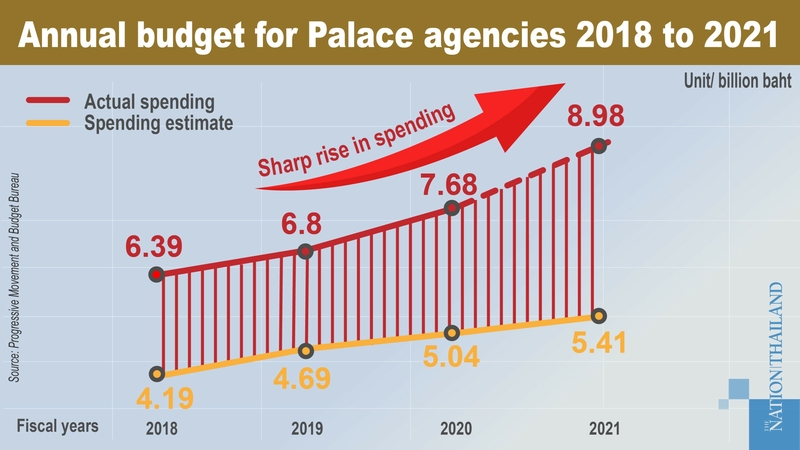
Palace agencies have asked for Bt8.98 billion for 2021 fiscal year (October 2020 to September 2021. The amount was up 16.8 per cent from Bt7.68 billion spent in the current fiscal year, compared to a 3.1 per cent rise in the overall national budget, Thanathorn pointed out.
He questioned at Thursday’s meeting about the wide gap between estimated and actual spending of Palace agencies from 2018 to 2021.
According to Budget Bureau records, the estimated spending for fiscal 2018 was Bt4.19 billion, but actual spending was 52.5 per cent higher at Bt6.39 billion.
The estimated expenditure for fiscal 2019 was Bt 4.69 billion while actual spending was Bt6.8 billion; the estimate for fiscal 2020 was Bt5.04 billion while actual spending was Bt7.68 billion, and the estimate for 2021 is Bt5.41 billion, but Palace agencies are seeking Bt8.98 billion.
Viyada Chotrattanasiri, deputy director at the Budget Bureau, explained to Thanathorn that the government had issued an emergency decree last year to transfer security units from the Defence Ministry to Palace supervision, so that added about Bt2 billion to the Palace agencies’ budget in the current fiscal year. Excluding that amount, the budget was actually down by Bt833 million, she noted.
For fiscal 2021, the Defence Ministry had cut its budget by Bt1.3 billion while the budget for personnel of Palace agencies had risen by Bt1.29 billion, she said.
Thanathorn said that he had questioned the increasing budget allocation by the government to Palace agencies, which is on a sharp upward trend until fiscal 2024, with current estimates rising to Bt10.69 billion and the potential of actual spending overshooting the estimate.
He called for a cut in the budget allocation for Palace agencies in line with the overall national budget, saying he was concerned about the fallout of Covid-19 on common people, public debt and dwindling tax revenue.
As of Sunday evening, Thanathorn’s Facebook post on the Palace budget had got over 38,000 likes, 3,800 comments and 15,000 shares.
Thanathorn’s request comes as anti-government protesters put pressure to reform the monarchy, in addition to demanding the drafting a new Constitution, ending government intimidation of people having divergent opinions, and dissolving Parliament.
By The Washington Post · Jeff Stein, Tony Romm · NATIONAL, BUSINESS, POLITICS, PERSONAL-FINANCE WASHINGTON – Just two weeks after President Donald Trump approved executive actions aimed at bypassing stalled stimulus negotiations with Congress, only one state has said it is paying new jobless benefits, few evictions have been paused, and leading employers have made clear that workers will not benefit from the president’s new payroll tax deferral.
After talks with congressional Democrats faltered, the president on Aug. 8 signed four executive actions aimed at staving off further economic turmoil. They included a $300-per-week benefit for jobless Americans, after the previous enhanced benefits expired in late July. Trump also directed a deferral of payroll taxes, as well as a halt to evictions and a suspension of student loan payments.
But Trump’s directives have so far produced limited economic relief for Americans hurt by the coronavirus pandemic, despite promises by top White House aides that help would come within weeks. By Friday, only Arizona had started sending the extra $300 to its residents.
Thirteen states have been approved to give the enhanced payments, and some, including Montana and Kentucky, will kick in a $100 match, meaning out-of-work residents there could get up to $400 in enhanced benefits. Many other states either have said they’re applying or have not said whether they will move forward and offer the payments. South Dakota has turned down the jobless benefits.
For the majority of the 28 million unemployed workers who had been getting an extra $600 a week, relief remains elusive. Just last week, jobless benefit claims rose slightly compared with the previous week, to more than 1 million. It’s the 21st week that unemployment claims have topped 1 million during the pandemic.
“I don’t know when my next paycheck will come, unemployment has not been helpful, and I’m not sure when the furlough will end. It’s extremely stressful,” said Caleb Dunlop, 28, who lost his job in college athletics in western Washington state on July 1. Dunlop said he had $9 in his bank account after paying rent and utilities last month, and he missed payments for his medication for treating chronic depression.
Trump and his economic team have repeatedly suggested that the executive actions largely render talks with Congress unnecessary, with the president saying that they would “take care of pretty much this entire situation.” National Economic Council Director Larry Kudlow boasted that the orders had led to a dramatic increase in the stock market, while Treasury Secretary Steven Mnuchin said after the orders were signed that the new unemployment payments would arrive “immediately.”
The next day, Mnuchin said the payments would be arriving “within the next week or two.” Kudlow also said at the time that the benefits would take “about two weeks” to be paid out.
The administration’s assessment of the timing of the benefits has almost certainly proved too optimistic. So far, only Arizona has reported sending the extra $300 week on top of traditional state unemployment benefits, according to Michele Evermore, an unemployment expert at the National Employment Law Project, a nonprofit.
Numerous governors have complained that the program is too complicated and could take several more weeks to set up. The White House also stipulated that people receiving less than $100 per week in unemployment benefits from their states are not eligible for the extra $300, effectively preventing as many as 1 million jobless Americans from receiving the benefit. And guidance from the Federal Emergency Management Agency – which manages the disaster relief fund that’s being tapped for the payments – suggested the extra benefit would last only three weeks.
About 20 states have said publicly they will apply for the program. Most are expected to need anywhere from “at least a few additional weeks to a couple additional months” to get the money out, said Evermore, who has been in regular contact with state unemployment officials. Some states may not be able to send the new payments out until the end of September, Evermore said.
Exacerbating the delays are financial and technical challenges, requiring states to update computer systems that in some cases are decades old. Similar upgrades kept some Americans from receiving their jobless aid for weeks or months earlier in the pandemic, as labor officials struggled to implement the new programs authorized under the $2 trillion Cares Act.
State unemployment officials have said that it would be easier if Congress adopted a new coronavirus aid package rather than piecemeal programs that require constant computer fixes. There appears to be little chance of that happening soon. The White House and congressional Democrats have not restarted meaningful negotiations since Trump’s executive actions, and congressional aides do not expect talks to resume until after Labor Day. Many economic experts say the absence of a deal with Congress is sharply limiting the recovery and is hurting unemployed Americans, given the administration’s challenges in implementing the new jobless benefits.
White House officials say they acted rapidly to help the unemployed, without ceding to Democrats’ demand to provide up to $1 trillion in aid to states, cities and tribal governments; Trump officials said that would be a bailout to blue states and localities that mismanaged their budgets. Mnuchin said this week that the White House was not willing to go along with Democrats’ “unreasonable” demands.
“President Trump has provided relief for American workers, where Congressional Democrats have failed,” White House spokesman Judd Deere said in a statement.
But the lack of urgency in reaching a deal on an aid package also reflects the White House’s view that no more federal help is needed to stimulate the economy. Kudlow has repeatedly said that the United States has now entered a “self-sustaining” recovery.
Stock markets – one of Trump’s favorite economic indicators – have soared even without an additional federal stimulus package. Sales of previously owned houses skyrocketed in July by a record 24.7 percent, the National Association of Realtors reported Friday, thanks to cheap mortgage rates.
“The economy right now is in a very strong rebound, which in my view is a self-sustaining recovery,” Kudlow told reporters Thursday. “I’m not making this stuff up. These are the government statistics . . . the stock market is correctly portraying a V-shaped recovery.”
Kudlow has also said the administration’s actions to defer payroll taxes will provide a “gigantic” wage increase to as many as 140 million Americans. Trump’s order opened the door for those employees’ taxes to be deferred starting Sept. 1 through the end of the year, but it doesn’t absolve those debts outright – meaning Americans who defer may owe thousands of dollars in 2021 without an intervention by Congress.
Lawmakers of both parties continue to express an unwillingness to end the payroll tax, given its impact on the budget and federal entitlement programs such as Social Security and Medicare. Roughly 30 industry groups – representing auto part suppliers, restaurateurs, retailers and others – told the White House this week that the plan is “unworkable” from a technical and logistical standpoint.
Deere, the White House spokesman, said in a statement: “President Trump used the authorities available to him to give employers the opportunity to put more money in the pockets of their employees, and he encourages all employers to take advantage of this to support hard-working Americans.”
On evictions, the president’s executive action instructed federal agencies to “consider” whether additional moratoriums were necessary. The Federal Housing Administration temporarily extended its foreclosure and eviction ban, but that covers only FHA-backed properties – a tiny portion of the U.S. rental market, said Diane Yentel, president and CEO of the National Low Income Housing Coalition.
State and local eviction moratoriums across the country are expiring, and census data suggests that as many as 40 million Americans fear losing their homes by the end of the year, a sharp increase from typical numbers.
“If Congress does nothing, we are very likely to see millions of renters face displacement or eviction, starting in September and October,” Yentel said. Trump “literally did nothing to stop or prevent evictions. There’s no requirement to do anything.”
Trump said on Aug. 11 of his eviction order: “We are not letting people be evicted.”
Ernie Tedeschi, a former economist in the Obama administration, said that the recovery was to a large degree fueled by the extraordinary levels of federal support approved by Congress in March. With that support vanishing, Tedeschi said, the White House may be prolonging the depths of the recession and spreading pain unnecessarily.
“The broader picture is there are still people and many sectors who are hurting and not able to recover yet,” Tedeschi said.
Cyn Brunelle, 41, of Cranston, R.I., receives disability benefits, and her husband, Elijah Brunelle, 40, worked as a cook at a nearby nursing home. Because Elijah Brunelle has diabetes and asthma, his employer told him not to return to his high-risk job. When his unemployment benefits expired, he went from receiving $698 a week to $198 a week. The family is now struggling to make ends meet even though they have three roommates and their son, a high school senior, has taken an additional job washing dishes.
“We went from being able to afford groceries and afford transportation to really struggling hard just to afford anything,” Cyn Brunelle said. “It’s really hard, very difficult and very stressful.”
EconAug 22. 2020Ekniti Nitithanprapas, the Revenue Department’s director-general
By The Nation
E-services tax, or value-added tax, is likely to be levied next year on foreign digital platforms that do not have a subsidiary company in Thailand, and it is expected to generate Bt3 billion per year revenue to the state, the top Revenue Department official said.
Ekniti Nitithanprapas, the department’s director-general, said the House of Representatives had approved the draft bill, adding that it was under consideration by the Senate committee.
“Once the e-services tax draft bill is approved by the Senate committee and the Constitutional Court, and is announced in the Royal Gazette, the act will be effective within 180 days, or in 2021,” he said.
He explained that the e-services tax aimed to create a level playing field between foreign and domestic online business entrepreneurs, as foreign entrepreneurs who operate businesses in Thailand are required to register for value added tax. The act will not be a burden on customers, he assured.
“However, the department expected that e-services tax collection will generate Bt3 billion revenue per year to the state,” he said.
“This will enable the Revenue Department to achieve the revenue collection target in fiscal year 2021.”
He added that in fiscal year 2020, the Revenue Department would not be anle to achieve its revenue collection target of Bt2.116 trillion.
“Revenue collection in the first nine months of this year is expected to be Bt1.26 trillion,” he added.



 President Trump
 Ekniti Nitithanprapas, the Revenue Department’s director-general


