JKN Global Media appoints KTZ to underwrite Bt400m debenture issuance
Jul 13. 2020
By THE NATION
JKN Global Media Plc has appointed Krungthai Zmico Securities as its lead underwriter to issue debentures worth Bt400 million. The issuance will fund JKN’s working capital and investments in current businesses.
“The senior unsecured debentures will be offered to institutional and high net worth investors from July 21-23 with minimum buying value of Bt100,000. The debentures will offer an interest rate at 6.6 per cent per annum with a tenor of 2 years and 9 months [maturity in 2023],” said ML Thongmakut Thongyai, CEO of Krungthai Zmico Securities (KTZ).
“JKN has plans to spend the whole amount of its proceeds from the debenture issuance this year on its working capital as well as to support its ongoing businesses,” Thongmakut added.
As of July 13, JKN’s market capitalisation on the Stock Exchange of Thailand (SET) was Bt3,705.74 million.
EXIM Bank signs deal for solar power plant in Vietnam
Jul 13. 2020
By THE NATION
EXIM Thailand is collaborating with ICBC (Thai) and ICBC Hanoi to provide a US$38.39-million (Bt1.2-billion) financial facility to Super Energy Corporation Plc for investing in a 50-megawatt solar power plant in Vietnam’s Phu Yen province.
Pisit Serewiwattana, president of Export-Import Bank of Thailand (EXIM), along with Shiqiang Lin, chief executive officer of Industrial and Commercial Bank of China (Thai) (ICBC (Thai)), and Jormsup Lochaya, chairman of the board of Super Energy Corporation Plc, recently signed the agreement for Thinh Long Phu Yen Solar Power Joint Stock Co, established in Vietnam and wholly owned by Super Energy, to invest in a solar power plant with a generating capacity of 50MW.
The EXIM and ICBC collaboration aims to promote and encourage high-worth Thai investors to invest in renewable energy projects in response to demands from both public and private sectors in Vietnam after its government liberalised the renewable energy businesses under the National Energy Development Master Plan.
According to the plan, solar power generating capacity is targeted to jump from 850MW in 2020 to 12,000MW within 10 years. The financial collaboration is in line with Thailand’s policy to foster connectivity with Asean as well as expand the Kingdom’s economic cooperation with neighbouring countries in a bid to help the region move forward with sustainable development.
Israel signs pact to recruit 25,000 more Thai workers
Jul 13. 2020
By The Nation
The governments of Israel and Thailand signed an agreement in Jerusalem today (July 13) to recruit a fresh batch of 25,000 Thais for agricultural work in the Middle East country, a press statement said.
The agreement follows a bilateral pact signed in December 2010 to enable the recruitment of Thai workers in a “legal and transparent manner”. The 2010 agreement regulates the procedure to prevent illegal actions, including high charges which were paid by Thai workers to private recruitment companies.
“This agreement is a flagship project of bilateral relations between Israel and Thailand,” Israeli Ambassador Meir Shlomo said today. “I have no doubt it will continue to contribute significantly to more prosperity in Thailand and in Israel, and to enhance job creation especially during these times of economic difficulties.”
The new bilateral agreement is a significant milestone in the cooperation between the two countries as it forges a close connection between the two peoples, the statement said. Within this framework, tens of thousands of Thais have worked in Israel so far, under protected and respected employment.
Israel is considered an attractive work destination for Thais as they enjoy attractive income as well as legal protection of employment rights according to Israeli law.
“Moreover, these workers can transfer valuable knowledge in agricultural techniques from Israel to be put into practice in Thailand upon their return,” the statement said.
Thai agricultural workers in Israel are an important component of the Middle East country’s economy, which needs a skilled agricultural work force.
“Over the years, the dedication and hard work of Thai workers have greatly contributed to success in Israeli farming, which is recognised worldwide as a global leader in agricultural technologies,” the statement said.
“We sincerely thank the Labour Ministry and the Thai government for successfully holding intensive negotiations during recent months, despite the very challenging circumstances of the Covid-19 pandemic,” the ambassador added.
A health insurance plan for foreigners with long-stay visas
Jul 13. 2020
By The Nation
Southeast Insurance is offering a health insurance plan for foreigners holding O-A and O-X visas who are more than 50 years of age and wish to apply for renewal of visa for residency in Thailand.
“We are ready to take care and provide premium health coverage at over 293 hospitals,” Chiravuthi Bunyasiri, managing director of Southeast Insurance Pcl, said.
“Southeast is ready to support the policies of the government by launching our long-stay-visa insurance plan for retirement visa holders for both one-year temporary stay [non-immigrant visa O-A] and 10-year long-stay [non-immigrant visa O-X],” Chiravuthi said.
“For O-A visa holders, the plan is ideal for foreigners who travel to Thailand for short-term medical tourism or for other health services such as health recovery or wellness purposes. For O-X visa holders, the plan is tailored for foreign business persons who travelled to Thailand for work who had entered into transactions i.e. purchase of condominiums, vehicles etc. Both types of visa holders are required to renew their visas annually. Considering their health risks, the plan offers protection throughout the period of their stay in Thailand with not less than Bt40,000 out-patient treatment expenses and not less than Bt400,000 for in-patient treatment expenses,” Chiravuthi added.
Southeast Insurance is one of the companies collaborating with Thai General Insurance Association in the campaign for foreign tourists residing in Thailand with O-A and O-X visas.
The insurance plan for foreigners provides comprehensive service through a network of more than 293 hospitals, Southeast Insurance said. The plan covers in-patient treatment at hospitals or medical facilities from accidents and illnesses with maximum expenses of Bt500,000 per year and Bt45,000 per year for out-patient treatment along with Bt100,000 for emergency.
The policy can be purchased at the website of Thai General Insurance Association: longstay.tgia.org. For holders of health insurance of an international company, the insured amount shall not be less than the amount of health insurance required in Thailand.
By The Washington Post · Aaron Gregg · NATIONAL, BUSINESS, NATIONAL-SECURITY
The Defense Department plans to spend $1.2 billion for eight Boeing-developed F-15EX fighter jets over the next three years, the company and the Air Force announced Monday, a contract that will boost the embattled aerospace manufacturer at a time when the market for commercial aircraft remains in turmoil.
The deal marks the first major purchase in a long-term, $23 billion program to update the Air Force’s aging fleet of fighter jets and provides a competitive option for Lockheed Martin’s F-35 Joint Strike Fighter.
Under the terms of the deal, Boeing will build a new version of its F-15, an older fighter jet developed in the 1960s, with new automated flight controls and electronic warfare capabilities. The newer model, known as the F-15EX, will be designed to carry heavier weaponry than smaller, stealthier jets such as the F-35.
“The F-15EX’s digital backbone, open mission systems, and generous payload capacity fit well with our vision for future net-enabled warfare,” said Will Roper, assistant secretary of the Air Force for acquisition, technology and logistics.
A Boeing news release published Monday boasted that engineers would be able to adapt from older F-15 jets to the new F-15EX in a matter of days. Its larger capacity will allow it to carry hypersonic weapons, a major recent priority for the Defense Department.
“We listened to our customer every step of the way when developing this exciting jet,” said Prat Kumar, Boeing vice president and F-15 program manager. “What we will soon deliver is a modern and robust aircraft that supports our nation’s defense by incorporating the latest systems, sensors and weapons.”
Although a purchase of this size was expected based on the Defense Department’s recent budget requests, it nonetheless comes as a massive win for Boeing at a time of historic vulnerability.
Boeing’s commercial aircraft division, once a cash-generating machine that enabled the company to underbid its rivals on major defense competitions, has lost billions due to equipment flaws in its signature 737 Max jet. Global travel restrictions imposed to combat the coronavirus pandemic has led many of Boeing’s airline customer to cancel orders.
The turmoil in commercial aviation has upped the profile of Boeing’s military sales divisions, which are coordinated by the company’s Arlington, Va.-based defense, space and security division. A majority of Boeing’s sales came from government contractors in the company’s most recent quarter, a mark of how the company’s dual crises have reshaped its business.
That division has been bolstered by a series of high-profile wins in recent years, including a $9.2 billion contract for Air Force training jets and an $805 million contract to develop aerial refueling drones.
The F-15EX program gives Boeing a stable source of short-term cash and a foothold in a lucrative Pentagon fighter jet business that is dominated by Lockheed Martin. The contract announced Tuesday carries a ceiling of $23 billion, and Pentagon planning documents call for purchases of about 12 per year.
But analysts caution that the long-term value of the program could hinge on political factors. If the defense budget were restricted by new leadership in Congress or the White House, the F-15EX might be at risk.
“There’s a very good chance that if the Trump administration ends, this program is going to end,” said Richard Aboulafia, an aerospace analyst with Teal Group.
Charoen Pokphand Group (CP), Thailand’s largest agribusiness conglomerate, last week filed a document with the Trade Competition Commission seeking permission to merge its retail business with Ek-Chai Distribution System Co Ltd, the operator of Tesco Lotus, the commission’s chairman Sakon Varunyuwatana said.
This move follows CP Group’s recenttakeover of the British retailer Tesco’s business in Thailand and Malaysia.
However, Sakon said the commission has yet to consider the application as the documentation is incomplete. He said CP Group has been asked for additional documents, including records on related business structures and market shares. Once all the documentation is filed, the commission will take 90 days to make a decision.
When considering the merger, the commission will check to see if it can be damaging for the economy or affect consumers.
CP Group also needs to submit its merger plan, shareholding structure, as well as documents on market share, sales and market analysis before and after the merger.
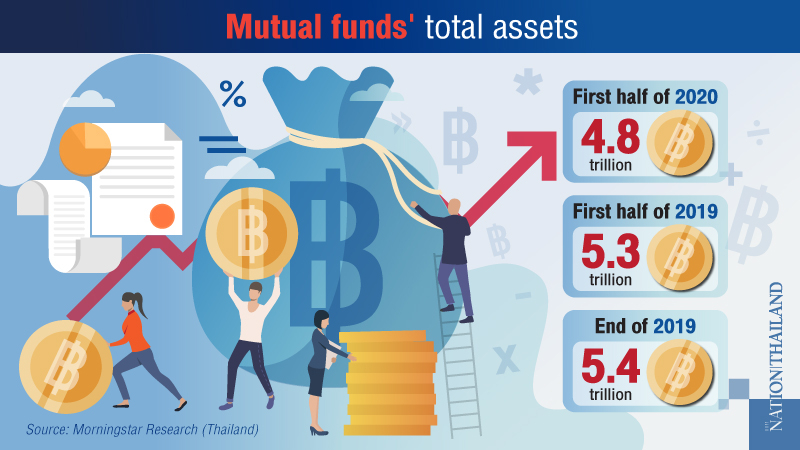
Mutual funds saw a sharp drop in total assets in the first half of this year as market volatility caused investors to turn to low-risk assets, said Morningstar Research (Thailand).
Assets under management (AUM) of mutual funds fell to Bt4.8 trillion, down 10.3 per cent from the Bt5.4 trillion at the end of 2019, said Chayanee Juengmanon, Morningstar Research senior research analyst. AUM in first half of 2019 totalled Bt5.3 trillion, she added.
“We expect cash flows into mutual funds to decline in the second half of this year due to high risks and volatility, causing investors to turn to low-risk assets with cash mostly flowing into money market funds,” she said.
“Investors are also avoiding mutual funds due to uncertainty following economic impacts and long-term investment conditions.”
She advised investors to follow each funds’ return because listed companies’ performance would drop as the country’s gross domestic product (GDP) this year is expected to contract by 8.1 per cent.
Mutual funds’ net outflow in the first half of 2020 was Bt350 billion, with net inflow of just Bt40 billion, she said.
“Cash mostly flowed into the money market and equity funds that invest in foreign countries and were able to escape the Covid-19 impact, while Thai equity funds saw limited inflows despite many companies launching Super Savings Funds Extra [SSFX] in June,” she said.
“Meanwhile, cash mostly flowed out of fixed income funds, commodity funds, and mixed funds that invest in Thailand and gold.”
She said that most mutual funds’ delivered positive results in the second quarter of this year.
“Global technology funds generated an average return of 27.9 per cent in the second quarter of this year and 14.9 per cent in the first half because they benefited during the Covid-19 outbreak,” she said. “Meanwhile, small and mid-cap equity funds generated an average return of 27.6 per cent in the second quarter of this year, but contracted 8.8 per cent in the first half.”
By Syndication Washington Post, Bloomberg · Sarah Ponczek, Claire Ballentine · BUSINESS, US-GLOBAL-MARKETS
U.S. equities rose on expectations earnings will offer an optimistic outlook for the world’s biggest economy amid a raging coronavirus pandemic. The dollar was mostly lower.
U.S. stocks declined after the S&P 500 briefly touched the highest level since the coronavirus pandemic sent markets tumbling worldwide in March. Crude oil also turned lower.
The main U.S. equity index stumbled in afternoon trading on signs the virus was throttling reopening plans in states like California. An increase in tensions with China also damaged sentiment. The measures had almost reclaimed a gain for the year before stumbling. It’s still down almost 7% from a Feb. 19 high.
The volatility in the S&P also corresponded with prices swings in Tesla Inc., which is in the Nasdaq Composite. The Nasdaq hit another record high before closing in the red. The Dow Jones industrial average finished the day slightly higher.
“It’s remarkable how optimistic investors seem to be,” said John Carey, portfolio manager at Pioneer Investment Management. “But there are a lot of uncertainties remaining and it’s a little bit early to assume it’s going to be back to business as usual anytime soon.”
Traders are awaiting reports this week from a slew of companies that have yet to provide concrete guidance on the impact of the virus. Shares of PepsiCo Inc. rose after the snack-maker reported stronger-than-expected second-quarter sales.
European stocks rose with government bond yields. Oil declined ahead of an OPEC+ meeting at which the group may announce plans to start tapering historic production cuts.
With global stocks trading near their highest since February, the focus has turned to whether the profit outlook will back up bullishness fueled by central bank and fiscal policy support. Traders have largely shrugged off new coronavirus outbreaks in some parts of the world. California’s two biggest school districts said they would offer remote learning only in the fall despite calls by the Trump administration for classrooms to fully reopen. The state reported a record number of people hospitalized with coronavirus.
There’s reason for optimism even though earnings are estimated to have contracted by more than 40% in the worst quarter since the financial crisis, as analysts upgrade their forecasts for the rest of the year.
“The backdrop is positive for all sectors of the market,” said Gerry Sparrow, president of Sparrow Capital Management Inc. “The reason for that backdrop is that the recovery has taken hold, so jobs data, consumer credit, home building strength signaled that the economy has shifted in a positive direction.”
These are the main moves in markets:
Stocks
The S&P 500 Index dipped 0.9% to 3,155.35 as of 4 p.m. EDT.
The Dow Jones industrial average was little changed at 26,086.34, the highest in a week.
The Nasdaq Composite Index dipped 2.1% to 10,390.84, the largest decrease in more than two weeks.
The MSCI All-Country World Index decreased 0.3% to 540.26.
Currencies
The Bloomberg Dollar Spot Index rose 0.1% to 1,210.52.
The euro increased 0.4% to $1.1349, the strongest in more than a month.
The Japanese yen weakened 0.3% to 107.24 per dollar, the largest drop in almost two weeks.
Bonds
The yield on two-year Treasurys was unchanged at 0.15%.
The yield on 30-year Treasurys decreased two basis points to 1.32%.
Germany’s 10-year yield gained five basis points to -0.42%, the highest in more than a week on the biggest advance in more than a week.
Commodities
West Texas Intermediate crude decreased 2.1% to $39.69 a barrel.
Narong Paewpolsong, secretary-general of the Office of Vocational Education Commission (OVEC), on Monday (July 13) released guidelines on the production of vocational personnel to support investment in the Eastern Economic Corridor (EEC), in a bid to attract investment in industries that require skilled personnel.
According to OVEC, the EEC will in five years require some 475,000 workers, of which 253,000 should have a vocational education, 213,000 should hold at least a bachelor’s degree, while the rest will need to have a master’s or doctorate.
The industries targeted are automotive industry, which should need at least 53,000 people, artificial intelligence 58,000 personnel, tourism 17,000, robotics 36,000, aviation 32,000, digital business 116,000, medical business 11,000, high-speed railway project 24,000, commercial shipping 14,000 and logistics 100,000.
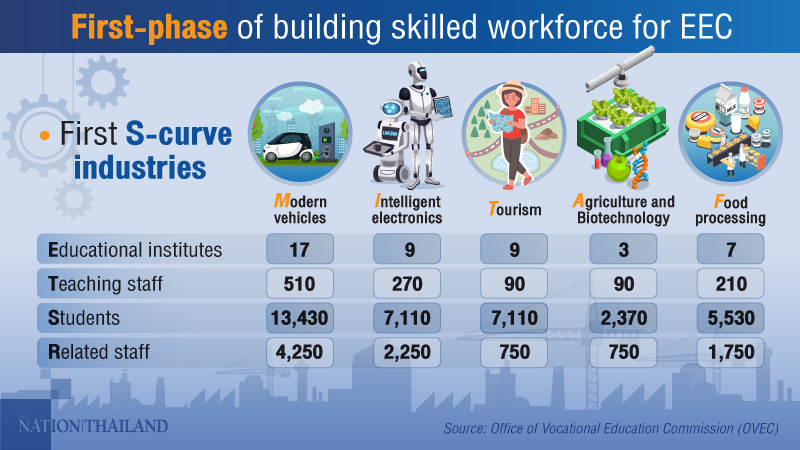
In order to meet this potential demand, OVEC has adjusted curriculums in vocational colleges in the three EEC provinces, namely Chonburi, Rayong and Chachoengsao. There are 10 educational institutes that are equipped to produce personnel for the first S-curve industries, namely artificial intelligence electronics, tourism, biotechnology and food processing.
Personnel will also be required for new S-curve industries in other EEC provinces, namely Chanthaburi, Sa Kaew, Trat, Prachinburi and Nakhon Nayok. The industries targeted here are automobiles, smart electronics, tourism, food processing, industrial robotics, aviation, logistic and digital business.
He added that there are already 370 teaching personnel in place to help with this task.
Apart from eyeing the development of a new workforce for the EEC area, OVEC is also developing vocational institutes so they can upgrade to centres for specialised technical education in both targeted industry groups and advanced industries. There are currently 92 vocational institutes with necessary faculties such as aircraft mechanics, rail systems, petrochemicals, power generation, commercial marine shipping, smart farming, mechatronics, robotics, digital technology, modern automotive, aviation business etc.
Narong added that OVEC has submitted a budget request of Bt1.132 billion for building both a workforce and teaching staff.
“Though this project only requires Bt1.1 billion, we can develop existing teachers and boost the teaching force to 2,490 people. Increasing the number of people who complete their studies in vocational college or pick up a bachelor’s degree by 65,570, including 20,750 students in these fields, will make them an important resource for the country,” Narong said.
Apart from building a highly-skilled workforce for industry, OVEC also aims to open schools to teach English and Mandarin languages to 700,000 students, as well as a job-seeking institute for vocational students.
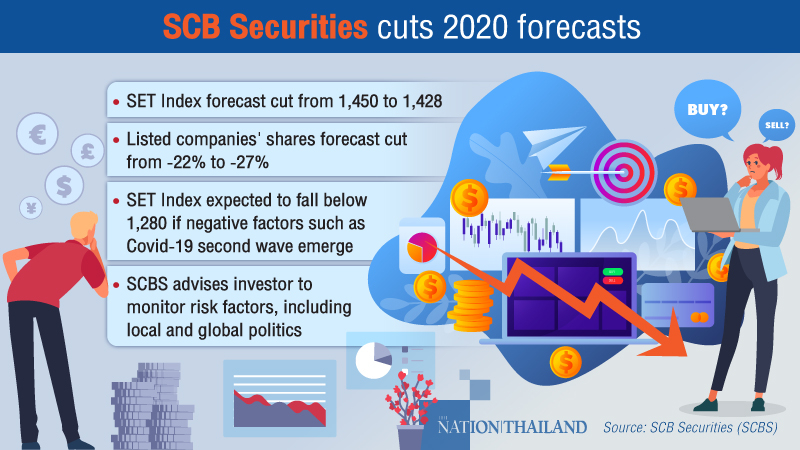
SCB Securities (SCBS) has cut its forecasts for the Stock Exchange of Thailand (SET) Index and listed companies’ shares this year due to numerous negative internal and external factors.
The securities arm of Siam Commercial Bank has reduced its 2020 SET forecast from 1,450 points to 1,428, and its forecast for listed companies to an average Bt62.57 per share – down 27 per cent from 2019’s Bt86.19 per share.
However, SCBS expects share prices to recover next year by 28 per cent or Bt79.96 per share, said Sukit Udomsirikul, managing director of SCBS research group.
“The index lacks new positive sentiment, which can be seen from foreign investors’ mass sell-offs totalling over Bt200 billion. As a result, the index is currently gaining support only from domestic individual and institutional investors, as well as the Super Savings Funds Extra [SSFX],” he said.
Among the many negative sentiments still pressuring the SET Index were concerns over a second wave of Covid-19, the ongoing US-China trade war, debt defaults by small and medium-size businesses, pending changes to the Thai Cabinet and economic team, and this year’s US presidential election.
“The government’s move to reorganise the [Cabinet] economic team has triggered uncertainty among investors because the Thai economy will come under pressure if economic stimulus measures cannot be issued in the third quarter of this year,” said Sukit.
“We expect listed companies’ profits this year to drop because many companies are facing a decline in growth,” he added.
“Meanwhile, the SET Index valuation is still high compared to other countries, so we expect the index to fall below 1,280 if there are more negative factors, such as a second wave of Covid-19.”
He advised investors to invest in food, retail, transportation, ICT and defence stocks, such as BDMS, BEM, BTS, CPF, ADVANC and BCH.
“Also, we suggest investors buy BBL, ERW, IVL and HANA and hold them speculatively for three months,” he added.



 Israel is considered an attractive work destination for Thais as they enjoy attractive income as well as legal protection of employment rights according to Israeli law.