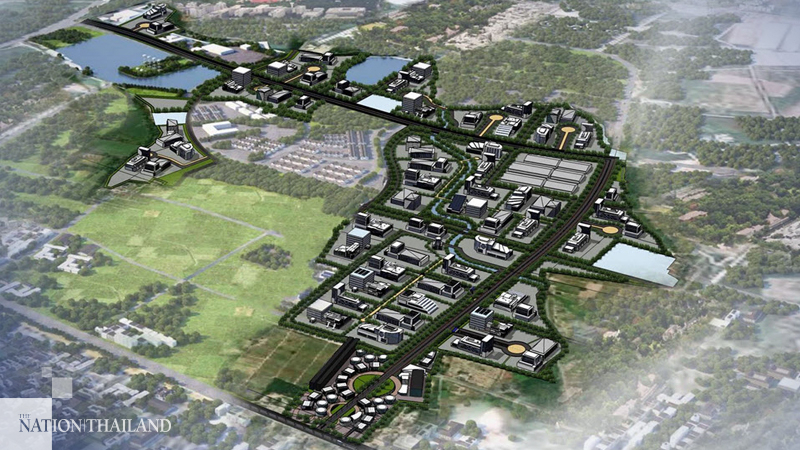
The Industrial Estate Authority of Thailand (IAET) is expected to begin construction of a Bt2.37 billion “smart park” industrial zone in Rayong early next year, said governor Somchint Pilouk.
The project is part of the government’s flagship Eastern Economic Corridor infrastructure programme and is scheduled for completion in three years.
The IEAT board approved the project in January this year, and it will be submitted to the National Economic and Social Development Council next month.
Somchint said the venue will be a role model for modern industrial parks thanks to its adoption of advanced industrial technology, communications, and transport and energy systems.
The project occupies 1,383 rai, of which 621 will be set aside as industrial zones and 238 as a “green” buffer zone.
The park is designed to host four new S-curve industries: aviation and logistics in a 299-rai zone, medical industry (180 rai), robotics (over 74 rai) and digital industry (over 66 rai). The venue will bring an estimated 7,459 new jobs and cash flow of Bt1.342 billion per year. It is expected to draw industrial investment of Bt53 billion.
The Bank of Thailand (BOT) has launched pre-emptive measures to prevent a financial crisis like the one in 1997, BOT deputy governor Ronadol Numnonda said in response to investors’ concerns about the resilience of local commercial banks in the Covid-19 fallout.
The Stock Exchange of Thailand (SET) Index closed at 1,352.18 on Monday (June 22), down 18.64 points or 1.36 per cent. Total transaction volume was Bt65.772 billion with an index high of 1,367.98 and a low of 1,347.60. Stock analysts are blaming the central bank’s measures for pulling down the index.
BOT on Friday ordered commercial banks to hold off on paying interim dividends and also stopped them from buying back shares to strengthen their capital ratio in response to the pandemic.
To clarify this move, Ronadol said the central bank was only taking pre-emptive measures.
“We have learned from the 1997 crisis that we should not let the situation get out of hand. At that time, bad loans skyrocketed to 50 per cent of total bank loans because no pre-emptive measures had been taken. Today, we are implementing preventive measures and bad debts are just 3.05 per cent of total bank loans,” he said.
Bad debts stood at Bt490 billion at the end of this year’s first quarter.
BOT has also called on commercial banks to conduct a stress test on the management of their capital in the next one to three years.
Bank capital adequacy ratio is at the heart of the banking business, as it underpins bank lending and reserves against risk assets in case debtors get into trouble in the future.
Banks are expected to submit results of their stress test to BOT as of late July.
Ronadol, meanwhile, reassured investors that banks have strong capital. As of the end of the first quarter, the average BIS capital adequacy ratio was 18.7 per cent, which can be considered relatively high compared to the minimum requirement of 8.5 per cent, he said.
During the 1997 financial crisis, the BIS ratio was 8.1 per cent.
“After consulting with bankers, we believe that when BIS ratio is between 11.5 and 12.5 per cent, banks could handle the Covid-19 fallout,” he said.
If the BIS ratio falls below that level, banks will have to conduct capitalisation through different methods, such as holding off on paying dividends or buying back shares. Banks can also increase their Tier 1 capital by selling shares or raise Tier 2 capital by issuing debentures, he said.
The Ministry of Higher Education, Science, Research and Innovation has unveiled its plan to boost the gross domestic product of the country’s bio-circular green (BCG) economy, to strengthen Thailand’s economic sustainability.
Minister Suvit Maesincee said that if things go as planned, the BCG sector’s GDP will surge to Bt4.4 trillion in next five years from the current Bt3.4 trillion. The value could reach Bt6.5 trillion in 2030, he added.
The ministry has joined with related state agencies and private firms in drawing up plans to promote BCG in the following seven fields.
1. Agriculture: This includes the development of smart farmers and tax incentives to encourage smart farming. The goals are to make Thailand one of the world’s top 10 exporters and boost farming income to Bt240,000 per household per year. It aims to boost the GDP of the farm sector to Bt400 billion in the next five years.
2. Food sector: The development will focus on the functional food industry and functional food ingredient industry as well as medical food. It aims to boost GDP in the food sector to Bt300 billion in the next five years and reduce food industry waste to 15 per cent from the current 30 per cent by 2024 and to 10 per cent by 2030.
3. Energy and biochemical sectors: The plan will promote the use of ethanol, the use of a smart national electricity grid, and the introduction of a Green tax. It will set up the centre and fund for the bio-refinery industry and integrated bio-products. These will add value to farm products and stabilise the price of sugar cane and palm oil.
4. Medical supplies and vaccines. The ministry will set up a fund to support R&D of medicines and vaccines. It will also promote the Genomics Thailand project. It aims to boost GDP in the medicine and vaccine sector to Bt90 billion in next five years from the present Bt40 billion and cut public healthcare costs by Bt70 billion per year. To achieve these goals, the government will support R&D ranging from work in labs to clinical trials, and amend some vaccine procurement rules.
5. Medical equipment: The ministry will set up a fund to develop equipment standards and an institute to certify the standards of the medical technology and medical equipment innovations.
6. The tourism sector and creative economy sector: The plan includes the support of Thai digital platforms to promote tourism.
The plan will promote northern provinces as the “luxury retirement centre of Asia” to draw long stay-tourists and high-income, aged tourists worldwide.
It will also promote Thailand as Asia’s creative-content production hub.
The plans aims to boost GDP in these two sectors to Bt300 billion in the next five years.
7. Circular economy: It will draw up a law to recycle waste and plastic packaging, promote knowledge of the circular economy and waste separation, and promote the use of farm waste such as rice straw and sugar cane leaves.
Jun 23. 2020Prime Minister Prayut Chan-o-cha orders related state agencies to consider offering additional tax incentives to woo investors for the new S-curve sectors.
By THE NATION
Prime Minister Prayut Chan-o-cha has instructed related state agencies and the Board of Investment (BoI) to consider offering additional tax incentives to attract investment in the five new “S-curve” sectors in the Eastern Economic Corridor, EEC Office secretary-general Kanit Sangsuban said on Monday (June 22).
The five new S-curve industries are medicine, aviation, automation and robotics, digital and bio-technology industries. Most of the initial EEC investment concentrated on S-curve businesses such as auto parts, agriculture and processed food.
An S-curve is derived from S-like shape of a sector’s growth – it is flatter at the beginning and end and steeper in the middle.
According to the BoI, the value of projects applying to invest in EEC during the first five months of this year was Bt32 billion, versus Bt53 billion over the same period last year.
The Washington Post · Heather Kelly, Geoffrey A. Fowler, Reed Albergotti
SAN FRANCISCO – The pandemic isn’t stopping one of tech’s summertime standbys: Apple unveiling updates to the software of the iPhone, iPad, Mac and Apple Watch . . . and maybe a few product surprises, too.
This year, however, Apple’s WWDC – which stands for Worldwide Developers Conference – is going virtual. On Monday at 1 p.m. Eastern, 10 a.m. Pacific, CEO Tim Cook and other Apple executives will stream their announcements online instead of presenting them in person to a convention center audience filled with app developers.
Apple is expected to demo its next iPhone software, iOS 14, as well as new versions of iPadOS and MacOS, the software that runs its tablets and computers. In recent years, Apple has made early-release test versions of these updates available in “public beta” over the summer, before making final versions available to everyone in the fall.
Heading into the event, Apple finds itself in a brouhaha over how it runs its successful App Store, where it sells more than 2 million apps. The company takes a portion (typically 30%) of the revenue from apps that sell subscriptions. But the new email service Hey.com – which sells subscriptions on its website – says Apple threatened to remove it from the App Store when it refused to offer an in-app subscription option and share a cut.
One potential WWDC announcement that’s been generating buzz: Apple switching its Mac computers to ARM-based processors, an alternative to the Intel chips that Apple has used for 14 years. Apple’s iPhones, iPads and watches already use ARM chips, which give Apple the ability to customize them to its own specifications. Last year at WWDC, Apple made inroads toward making apps that run on iPads also run on Macs, and a switch to the same kind of processors would bring Apple’s mobile devices and computers even closer together.
As Apple streams from somewhere at its Cupertino, Calif., headquarters, the pandemic could be a chance for the company to update its approach to product announcements. The choreographed events have followed a predictable format since Steve Jobs made them his signature way of generating headlines, though much of the secrecy that made them exciting is largely gone. Executives in crisp casual wear talk up the company’s stats – sales, number of active devices, newest stores – then roll through updates with special guests and glossy promotional videos.
Cook has sometimes used the start of Apple events to address current events, like immigration. This year he’s also likely to talk about Apple’s work to develop exposure-tracing apps for the coronavirus.
Usually a five-day, $1,600 event for developers to learn about the latest tools for making apps, WWDC will be entirely virtual and free this year. Developers can watch videos or request one-on-one sessions with Apple engineers.
Apple did not say if the keynote was being streamed live, streamed on a delay or prerecorded. The word live does not appear in Apple’s descriptions of the announcement.
Jun 22. 2020Wirecard headquarters in Munich on Feb. 12, 2019. MUST CREDIT: Bloomberg photo by Michaela Handrek-Rehle
By Bloomberg · Chanyaporn Chanjaroen · BUSINESS
Wirecard, the troubled German payments company, withdrew its financial results, saying the missing 1.9 billion euros ($2.1 billion) of cash on its balance sheet probably doesn’t exist.
Concerns over the missing money have prompted a collapse in Wirecard shares and the resignation of CEO Markus Braun, who was replaced by James Freis, who will serve on an interim basis. In an indication of the company’s worsening outlook, Moody’s Investors Service said on Friday it cut Wirecard’s credit ratings six levels, putting it one step from the lowest tier of junk.
“There is a prevailing likelihood that the bank trust account balances in the amount of 1.9 billion euros do not exist,” the company said in a statement early Monday. It withdrew results for fiscal 2019 and preliminary results for the first quarter of 2020. The firm had repeatedly delayed filing its statements.
Wirecard said it was continuing to investigate the matter and could not exclude potential effects on the financial accounts of previous years.
The company said it was in “constructive discussions” with its lending banks, including the extension of lines coming due at the end of June. It is working with investment bank Houlihan Lokey on a sustainable financing strategy. Also under consideration are cost reductions, a restructuring, and disposal or termination of business units and product segments, according to the statement.
Wirecard’s lenders are demanding more clarity from the company in return for the extension of almost $2 billion in financing after it breached terms on the loan, people familiar with the matter said earlier. At least 15 commercial lenders, including Commerzbank and ABN Amro, are in hectic negotiations about the steps to take, they said.
The deepening mystery over the lost money last week centered on two Philippine lenders after Wirecard said a couple of unnamed Asian banks had been unable to find accounts with the cash.
Both the Bank of the Philippine Islands and BDO Unibank said that Wirecard wasn’t a client and that they hadn’t seen the money.
A document purporting to show a link between Wirecard and BPI was “bogus” and may be part of an attempted fraud, the bank’s President Cezar Consing said Friday. BDO Unibank CEO Nestor Tan said it was a matter of “document fraud which was subsequently clarified by the bank as spurious.”
By Syndication Washington Post, Bloomberg · Charlotte Ryan, Siddharth Philip · BUSINESS, WORLD, TRANSPORTATION, EUROPE
Airbus plans to pursue voluntary job cuts before seeking forced reductions, as it aims to bring down costs without inciting a political uproar in France and Germany, according to people familiar with the matter.
The European planemaker will mandate redundancies only as a last resort after looking at voluntary layoffs and early retirement across its manufacturing operations, said the people, who asked not to be named because deliberations are ongoing. The total is likely to range between 12,000 and 16,000 employees, estimates George Ferguson, a Bloomberg Intelligence analyst.
Caught in a demand downturn that could last as long as five years, Airbus must scale back quickly to stop cash outflows and regain its financial balance by year-end, Chief Executive Officer Guillaume Faury warned in his latest letter to staff, seen by Bloomberg.
The magnitude of the crisis calls for “heart-wrenching decisions,” Faury said. “What this means in reality is a necessary downsizing of our business.”
Airbus has raised liquidity, slashed production and put factory workers on rolling furloughs since the coronavirus spread across the globe earlier this year. The Toulouse, France-based company has yet to put in place a plan for permanent job cuts.
It would be a first for a company that has only grown for decades, and the task is complicated by political sensitivities in its home countries of France and Germany, which have committed massive amounts of virus-response aid to aerospace and major airlines like Air France-KLM and Deutsche Lufthansa AG that are big customers.
“We’re striving as a management team to find the right balance,” Faury said.
The letter, following a communication in late April that struck a similar tone, is part of constant dialog with employees, said Stefan Schaffrath, a spokesman for Airbus in Toulouse. He declined to discuss specifics.
The company expects to give more detailed guidance to employees by the end of July, Faury said in the letter, reported earlier by La Tribune.
France and Germany are Airbus’s biggest shareholders, and political pressure in those two countries — along with the potential for labor unrest — will factor into Airbus’s decisions. French Finance Minister Bruno Le Maire has already said that forced staff reductions are a “red line” at Air France, which will make it tougher for the airline to regain its financial footing.
At Airbus, “I would expect cuts to be similar to the drop in build rates, so would expect they need to cut close to 30% to maintain profitability,” Ferguson said. “But that will be politically untenable and they will look to the need for more workers as the market recovers, and probably land closer to 15-20%.”
France’s 15 billion-euro ($17 billion) package of support for the country’s aviation sector also includes measures to help finance plane sales by Airbus. In Germany, a state bailout of Lufthansa, Europe’s biggest airline, is shaping up to top 9 billion euros.
Airbus has also taken advantage of government-subsidized furlough programs across Europe, buying time with temporary measures that were recently extended in the U.K. and Spain.
In the letter, Faury warned staff that air traffic is unlikely to reach 2019 levels before 2023 at the earliest and potentially not until 2025. “After decades of growth, this comes as a significant shock,” he said.
The significance of the drop underscores the additional challenge, of keeping Airbus’s supplier network healthy for the downturn.
The 40% cut in output announced in April — a measure based on the labor that goes into making a single-aisle plane — so far “seems to be enough,” Faury said. He warned, however, that if air traffic recovers more slowly than expected in the second half of the year or next year, the company could be forced to cut production even further, “pushing down output to perilously low levels.”
Airbus had almost 81,000 workers in its commercial aerospace division at the end of 2019, the unit hardest-hit by the downturn.
“No company can cut headcount in line with output,” said Richard Aboulafia, an analyst at Teal Group. “It’s further complicated by the fact that Airbus has no experience dealing with downturns, they’ve only been moving up for over 30 years.”
The Stock Exchange of Thailand (SET) Index closed at 1,352.18 today (June 22), down 18.64 points or 1.36 per cent. Total transaction volume was Bt65.772 billion with an index high of 1,367.98 and a low of 1,347.60.
In the morning session, a stock analyst at Krungsri Securities projected the index would fall to 1,350-1,355 points before rebounding.
“Commercial banks and non-banking-entity stocks were under pressure from the Bank of Thailand’s order to hold off payment of interim dividends and buyback of shares to strengthen their capital ratio in response to the Covid-19 fallout,” the analyst said.
“Meanwhile, investors were worried about a second wave of Covid-19 after the number of new cases rose sharply, especially in Brazil, the US and India.”
He said the index would rebound as energy and petroleum stocks gained positive sentiment from the rising crude oil price and mass buy-offs in super savings funds for tax deduction.
“The price of crude oil rose almost US$40 [Bt1,238.82] per barrel after the number of active oil rigs in the US dropped by 10 to 189, while the Opec+ grouping is working on cutting oil production,” the analyst said.
The 10 stocks with the highest trade value today were KBANK, BBL, SCB, PTTEP, BAM, CPF, CPALL, AOT, PTT, and STA.
As of 4.30pm, the price of crude oil was unchanged at US$39.75 per barrel, while gold rose by $9.10 or 0.52 per cent, to $1,762.10 per ounce.
Changes in other Asian indices were as follows:
Japan’s Nikkei Index closed at 22,437.27, down 41.52 points, or 0.18 per cent.
China’s Shang Hai SE Composite Index closed at 2,965.27, down 2.36 points, or 0.08 per cent, while Shenzhen SE Component Index closed at 11,702.44, up 34.31 points, or 0.29 per cent.
Hong Kong’s Hang Seng Index closed at 24,511.34, down 132.55 points, or 0.54 per cent.
South Korea’s KOSPI Index closed at 2,126.73, down 14.59 points, or 0.68 per cent.
Taiwan’s TAIEX Index closed at 11,572.93, up 23.07 points, or 0.20 per cent.
The Stock Exchange of Thailand (SET) Index is expected to rebound by the end of June as institutional investors are likely to buy up stocks as “window dressings”, experts said.
Window dressing is a strategy used by mutual-fund and other portfolio managers close to the year end or quarter end to improve the appearance of a fund’s performance before presenting it to clients or shareholders.
Asia Plus Securities research manager Paradorn Tiaranapramote said that in the past ten years, the SET Index has risen approximately 0.63 per cent during the last ten days of June, predicting that the index will rise to 1,380 points by the end of this month.
“In the past ten years, institutional investors have bought stocks as window dressings at the end of June and December,” he said. “Capital approximately worth Bt8.4 billion and Bt14 billion have flowed into the stock market in June and December, respectively,” Paradorn said.
He expected more capital to flow into the market because from June 1 to 18, institutional investors bought stocks totalling Bt1.48 billion, lower than the previous five months and lower than the original average of Bt8.4 billion.
“The market would gain positive sentiment from mass buy-offs in super saving funds for tax deduction, sales of which will end on June 30,” he said. “Meanwhile, we expect institutional investors to buy large-cap stocks, with prices rising more than the market.”
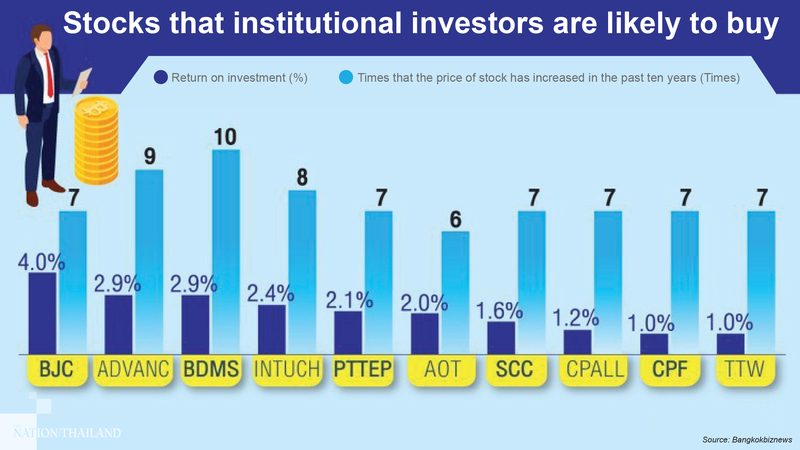
He recommended ten stocks institutional investors would buy – Berli Jucker (BJC), Advanced Info Service (Advanc), Bangkok Dusit Medical Services (BDMS), Intouch Holdings (Intuch), PTT Exploration and Production (PTTEP), Airports of Thailand (AOT), Siam Cement (SCC), CP All (CPAll), Charoen Pokphand Foods (CPF), and TTW.
Meanwhile, Tisco Securities senior strategist Apichat Poobunjirdkul said that according to a study on the movement of the Thai stock market at the end of every quarter since the global financial crisis in 2009, the chance that institutional investors will go in for a window dressing in the first quarter is 67 per cent, and 64 per cent in the second, third, and fourth quarters.
“Returns from window dressing in the first quarter are approximately 1.2 per cent and 1.4 per cent in the second quarter, contracting 0.5 per cent in the third quarter, and 0.0 per cent in the fourth quarter,” he said.
The price of gold rose by Bt150 per baht weight in morning trade today (June 22), the Gold Traders Association reported.
As of 9.27am, the buying price of a gold bar was Bt25,600 per baht weight and selling price Bt25,700, while gold ornaments were priced at Bt25,135.28 and Bt26,200, respectively.
At close on Saturday (June 20), the buying price of a gold bar was Bt25,450 per baht weight and selling price Bt25,550, while gold ornaments were priced at Bt24,998.84 and Bt26,050, respectively.
The Gold Spot Index price this morning moved to around US$1,755 (Bt54,389) per ounce after the price rose by $21.9 to $1,753 per ounce at close on Friday.
Investors bought gold as a safe haven asset due to uncertainty following the second wave of Covid-19 infections in the US and China.

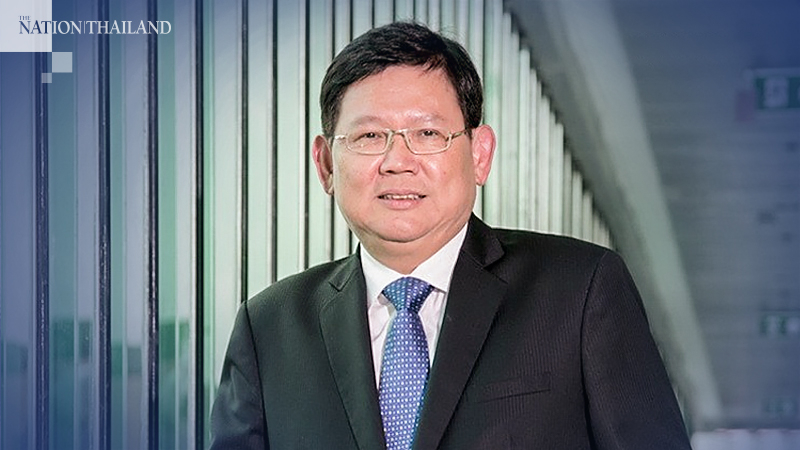
 BOT deputy governor Ronadol Numnonda
 Prime Minister Prayut Chan-o-cha orders related state agencies to consider offering additional tax incentives to woo investors for the new S-curve sectors.

 Wirecard headquarters in Munich on Feb. 12, 2019. MUST CREDIT: Bloomberg photo by Michaela Handrek-Rehle