Krungsri Research reckons Thai economy will only fully recover in last quarter of 2022 #ศาสตร์เกษตรดินปุ๋ย

#ศาสตร์เกษตรดินปุ๋ย : ขอบคุณแหล่งข้อมูล : หนังสือพิมพ์ The Nation.

Krungsri Research reckons Thai economy will only fully recover in last quarter of 2022

Econ

Jun 18. 2020Dr Somprawin ManprasertDr Somprawin Manprasert

By THE NATION

Krungsri Research expects the Thai economy to make a U-shaped recovery and return to pre-outbreak levels by the fourth quarter of 2022, though sectors affected by the spread of Covid-19 will recover at different times.

Dr Somprawin Manprasert, chief economist and head of Krungsri Research, said: “The Covid-19 outbreak has unprecedently affected the Thai economy. Thus, Krungsri Research is keeping its 2020 GDP projection unchanged at 5 per cent contraction and it is likely that the economy will gradually recover, while business sectors will have to adapt to new trends, which will be clearer in 2021.”

The Covid-19 outbreak has affected not just current economic activities, but also those that are medium- and long-term, in four ways: businesses forced to close due to lockdown measures, a drop in overall demand, disruption in global supply chains and a change in consumer behaviour.

These four points will determine a path of sectoral recovery. The sectors hit by the lockdown measures will have severely contracted, but they will also recover faster than other sectors.

However, sectors affected by the change in consumer behaviour will take a longer time to recover, so therefore, relief measures and business adjustments will be different and vary depend on each sector’s path of recovery.

As per Krungsri Research’s analysis of the impact Covid-19 has had on the business sector, 26 out of 60 sectors or 46 per cent are severely affected by the outbreak. Meanwhile, 24 sectors are moderately hit, while 10 are only suffering mild impacts.

The research house expects the health and food-manufacturing sectors to return to the pre-outbreak level by 2021, while the retail, wholesale, electricity and natural gas sectors that have been severely affected, may rebound relatively faster than other business sectors.

However, sectors affected by the change in demand, such as airlines and hospitality industry, will take a longer time to recover.

Tourism is one of the key sectors to have sustained the largest damage from the outbreak, while sectors related to public gatherings, like concerts, performances or matches, will also take a longer time to recover.

“Most sectors in Thailand are unlikely to recover to the pre-crisis state by 2021, though Thailand has a strong health-management sector, which has allowed us to efficiently control the outbreak in the first half of 2020.

“However, the outbreak has severely affected the global economy and led to a change in daily behaviour. Hence, we expect the global economy to bottom out in the second quarter, though negative consequences will last into the next year,” Somprawin said.

“Funds from the government’s relief measures will be released in the system in the third quarter, which will help shore up the economy.

“However, it remains to be seen whether assistance measures will be effective enough to revive the economy and able to create jobs that will generate more money to circulate in the economy and ensure that households have sufficient income to repay their debts thus mitigating risks in the financial sector, and whether there are appropriate measures to help each sector get back on the path to recovery,” he added.
Thailand on road to becoming cashless society: Visa study #ศาสตร์เกษตรดินปุ๋ย

#ศาสตร์เกษตรดินปุ๋ย : ขอบคุณแหล่งข้อมูล : หนังสือพิมพ์ The Nation.

Thailand on road to becoming cashless society: Visa study

Econ

Jun 18. 2020

By The Nation

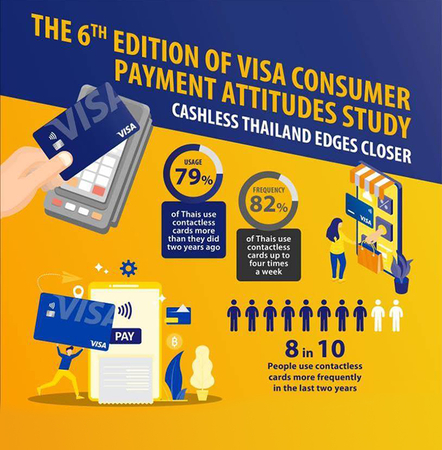
Almost eight in 10 Thais (79 per cent) are using contactless payments more often than they did two years ago, according to a study released by Visa on Thursday (June 18).

The study, which tracks consumer payments habits across Southeast Asia, also revealed three in four Thai respondents who are not using contactless payments today, are interested in doing so in the future.

Suripong Tantiyanon, country manager for Visa Thailand, said: “It is heartening to see Thai consumers embracing new payment technologies, especially the use of contactless cards for payments. The shift in behaviour and the rise in confidence can be attributed to an industry effort to educate the general public on the benefits of contactless and an increase acceptance points. Contactless payments are still in the early stages of adoption in Thailand, but we are optimistic for their growth due to the speed, convenience, security and global acceptance.”

Top reasons consumers cited for adopting contactless payments are: not needing to carry cash (68 per cent), innovative way to pay (58 per cent), and faster payment (55 per cent).

On frequency of contactless payments, 82 per cent of respondents said they used cards at least once a week.

Top places for contactless card payments were overseas destinations (17 per cent), supermarkets (12 per cent), and retail shops (11 per cent).

The study also delved into demographics: While Gen Y is more likely to use contactless cards (55 per cent), use among older Gen X users was significant (45 per cent). The younger generation uses contactless payments more frequently, with three in 10 making payments more than four times a week, while only one in five Gen X users will make the same number of payments.

State of the Nation: Cashless Society

Based on the findings, over two in five respondents (43 per cent) said they carry less cash now than they did two years ago. 

Increasingly, Thai consumers are confident in going cashless, said Visa. Two in five (38 per cent) believe they can last more than a month without cash. In contrast, nearly six in 10 (58 per cent) believe they could only get by for 24 hours without paying by cash.

When asked how long it would take for Thailand to become a cashless nation, 40 per cent of the people surveyed believe it will take between two to five years, 27 per cent thought it would take between six to 10 years, and 7 per cent believe it could happen next year.

Worries over second wave of Covid-19, cut in bank interest rates hammer SET #ศาสตร์เกษตรดินปุ๋ย

#ศาสตร์เกษตรดินปุ๋ย : ขอบคุณแหล่งข้อมูล : หนังสือพิมพ์ The Nation.

Worries over second wave of Covid-19, cut in bank interest rates hammer SET

Econ

Jun 18. 2020

By The Nation

The Stock Exchange of Thailand (SET) Index dropped 3.20 points or 0.23 per cent, closing at 1,372.98 today (June 18), with transactions amounting to a total of Bt70.282 billion with an index high of 1,377.39 and a low of 1,358.11.

In the morning session, a stock analyst at Krungsri Securities said he expected the index to fall to between 1,360 and 1,365 due to uncertainty over a second wave of Covid-19 infections as the subsequent slowdown of economy.

“Investors are worried that the US and China will issue lockdown measures to curb the contagion again after the number of new cases in the US rose to 26,000, while China has reintroduced emergency,” the analyst said.

“The stocks of banks and financial institutions will be under pressure after the Bank of Thailand told them to cut their interest rate by 2 to 4 per cent from July 1 to the end of the year in order to ease people’s suffering from the Covid-19 fallout.”

The top 10 stocks with the highest trade values today were SUPER, AOT, KBANK, SAWAD, CPF, MINT, KTC, BAM, DIF, and TASCO.

As of 4.30pm, crude oil rose by US$0.25 or 0.66 per cent to $38.21 per barrel, while gold dropped by $10.40 or 0.60 per cent to $1,746.00 per ounce.

Changes in other Asian indices were mixed:

Japan’s Nikkei Index closed at 22,355.46, down 100.30 points, or 0.45 per cent.

China’s Shanghai SE Composite Index closed at 2,939.32, up 3.44 points, or 0.12 per cent, while Shenzhen SE Component Index closed at 11,494.56, up 73.72 points, or 0.65 per cent.

Hong Kong’s Hang Seng Index closed at 24,464.94, down 16.47 points, or 0.067 per cent.

South Korea’s KOSPI Index closed at 2,133.48, down 7.57 points, or 0.35 per cent.

Taiwan’s TAIEX Index closed at 11,548.33, up 13.74 points, or 0.12 per cent.

ADB expects Thai economy to shrink by 6.5% #ศาสตร์เกษตรดินปุ๋ย

#ศาสตร์เกษตรดินปุ๋ย : ขอบคุณแหล่งข้อมูล : หนังสือพิมพ์ The Nation.

ADB expects Thai economy to shrink by 6.5%

Econ

Jun 18. 2020

By The Nation

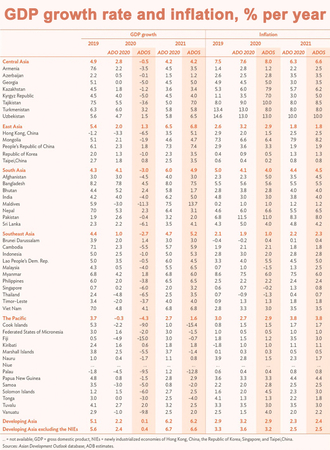
The Asian Development Bank (ADB) has downgraded its forecast for the Thai economy to a 6.5 per cent contraction due to the severe impact of Covid-19.

In April, the ADB predicted the Thai economy would sink 4.8 per cent this year. 

The new forecast makes Thailand the worst-hit economy among Asean countries, followed by Singapore’s 6 per cent contraction, while Vietnam is predicted to be the top performer with 4.1 per cent expansion.

ADB also paints a gloomy future for developing countries in Asia.

Developing Asia will barely grow in 2020 as Covid-19 containment measures hamper economic activity and weaken external demand, according to a new set of ADB forecasts released on Thursday (June 18).

IADB forecasts growth of 0.1 per cent for the region in 2020, down from the 2.2 per cent forecast in April and marking the slowest growth for the region since 1961. 

Growth in 2021 is expected to rise to 6.2 per cent, as forecast in April. Gross domestic product (GDP) levels in 2021 would remain below what had been envisioned and below pre-crisis trends.

Excluding Hong Kong, South Korea, Singapore and Taiwan, developing Asia is forecast to grow 0.4 per cent this year and 6.6 per cent in 2021.

“Economies in Asia and the Pacific will continue to feel the blow of the Covid-19 pandemic this year even as lockdowns are slowly eased and select economic activities restart in a ‘new normal’ scenario,” said ADB chief economist Yasuyuki Sawada. “While we see a higher growth outlook for the region in 2021, this is mainly due to weak numbers this year, and this will not be a V-shaped recovery. Governments should undertake policy measures to reduce the negative impact of Covid-19 and ensure that no further waves of outbreaks occur.”

Downside risks include multiple outbreak waves in the coming period and sovereign debt and financial crises cannot be ruled out, said the bank. It also identified risk of renewed escalation in trade tensions between the United States and China.

East Asia is forecast to grow 1.3 per cent in 2020 – the only subregion to experience growth this year – while growth in 2021 would recover to 6.8 per cent. Growth in China is forecast at 1.8 per cent this year and 7.4 per cent in 2021, compared to the April estimates of 2.3 and 7.3 per cent.

Hit hard by Covid-19, South Asia is forecast to contract by 3 per cent in 2020, compared to 4.1 per cent growth predicted in April. Growth prospects for 2021 are revised down to 4.9 per cent from 6.0 per cent. India’s economy is forecast to contract by 4 per cent in fiscal year 2020, ending on March 31, 2021, before growing 5 per cent in FY2021.

Economic activity in Southeast Asia is expected to contract by 2.7 per cent this year before growing by 5.2 per cent in 2021. Contractions are forecast in key economies as containment measures affect domestic consumption and investment, including Indonesia (-1.0 per cent), the Philippines (-3.8), and Thailand (-6.5). Vietnam is forecast to grow 4.1 per cent in 2020. While that is 0.7 percentage points lower than ADB’s April estimates, it is the fastest growth expected in Southeast Asia.

Central Asia’s economic activity is expected to contract by 0.5 per cent compared to the 2.8 per cent growth forecast in April due to trade disruptions and low oil prices. Growth is forecast to recover to 4.2 per cent in 2021.

Restricted trade flows and declining tourism numbers have dampened economic outlook for the Pacific subregion. The subregional economy is forecast to contract by 4.3 per cent in 2020 before rising to 1.6 per cent growth in 2021.

Inflation for developing Asia is forecast at 2.9 per cent in 2020, down from a forecast of 3.2 per cent in April, reflecting depressed demand and lower oil prices. In 2021, inflation is expected to ease to 2.4 per cent.

Strengthening dollar pressures gold price #ศาสตร์เกษตรดินปุ๋ย

#ศาสตร์เกษตรดินปุ๋ย : ขอบคุณแหล่งข้อมูล : หนังสือพิมพ์ The Nation.

Strengthening dollar pressures gold price

Econ

Jun 18. 2020

By The Nation

The price of gold rose by Bt50 per baht weight in morning trade on Thursday (June 18), the Gold Traders Association reported.

As of 9.26am, buying price of a gold bar was Bt25,350 per baht weight and selling price Bt25,450, while gold ornaments were priced at Bt24,892.72 and Bt25,950, respectively.

At close on Wednesday (June 17), buying price of a gold bar was Bt25,300 per baht weight and selling price Bt25,400, while gold ornaments were priced at Bt24,847.24 and Bt25,900, respectively.

The Gold Spot Index price on Thursday morning moved to around US$1,725 (Bt53,708) per ounce after the price dropped slightly by 90 cent to $1735.6 per ounce at close on Wednesday.

The gold price was pressured by the strengthening dollar, while investors reduced gold in their assets after European stock indices rose.

The price in the Hong Kong gold market rose by HK$40 to $15,960 (Bt64,126) per tael this morning.

SET slides amid concerns over economic impact from second wave of Covid-19 #ศาสตร์เกษตรดินปุ๋ย

#ศาสตร์เกษตรดินปุ๋ย : ขอบคุณแหล่งข้อมูล : หนังสือพิมพ์ The Nation.

SET slides amid concerns over economic impact from second wave of Covid-19

Econ

Jun 18. 2020

By The Nation

The Stock Exchange of Thailand Index dropped by 13.72 points, or 1.00 per cent, to 1,362.46 on Thursday morning (June 18).

A stock analyst at Krungsri Securities expected the index to fall to between 1,360 and 1,365 due to uncertainty following the second wave of Covid-19 cases, as it would slowdown the economy.

“Investors are worried that the US and China would issue lockdown measures to contain the spread of Covid-19 again after the number of new cases in the US rose to 26,000, while China has raised its emergency level back,” the analyst said.

“In addition, bank and financial stocks would be under pressure after the Bank of Thailand asked financial institutions to cut interest rate by 2-4 per cent, starting from July 1 until the end of this year in order to relieve people’s suffering from the Covid-19 impact.”

He recommended investors to buy:

▪ Stocks whose second-quarter performance will improve, such as CKP, TASCO, STA, and RS.

▪ Defensive stocks, such as INTUCH, TTW, and DIF.

▪ Marine shipping stock that benefit from rising freight rate, such as PSL, TTA, AMA, and PRM.

The SET Index rose by 9 points on Wednesday, or 0.66 per cent, closing at 1,376. Total transactions amounted to Bt71.5 billion.

Net sale by foreign investors amounted to Bt1.861 billion in stocks, while net buy of bonds was Bt11.492 billion. There were 11,020 net short TFEX SET50 contracts.

Ajinomoto holds the 2020 Ordinary General Meeting of Shareholders #ศาสตร์เกษตรดินปุ๋ย

#ศาสตร์เกษตรดินปุ๋ย : ขอบคุณแหล่งข้อมูล : หนังสือพิมพ์ The Nation.

Ajinomoto holds the 2020 Ordinary General Meeting of Shareholders

Jun 17. 2020

By THE NATION

Mr. Hiroharu Motohashi (Middle, 2nd row), President of Ajinomoto Co., (Thailand) Ltd., presided over the 2020 Ordinary General Meeting of Shareholders in order to report the company’s business performance of fiscal year 2019 and to inform next growing step of business plan in fiscal year 2020.

The meeting was attended by Ajinomoto’s directors and other shareholders. The meeting was recently held at Ajinomoto Co., (Thailand) Ltd., Head Office, Bangkok.

Hong Kong dealer woos Thai car fans with diecast models #ศาสตร์เกษตรดินปุ๋ย

#ศาสตร์เกษตรดินปุ๋ย : ขอบคุณแหล่งข้อมูล : หนังสือพิมพ์ The Nation.

Hong Kong dealer woos Thai car fans with diecast models

Shopping

Jun 17. 2020

By The Nation

A Hong Kong model company, Tiny, is catering to high demand from car lovers for diecast models, including models of special significance to Thai fans.

Tiny has appointed Hong Kong Select to be its official agency.

Most of the models made by this brand are various cars that can be seen on the streets of Hong Kong, but they have also added diecast models of exciting cars from all over the world.

Diecast models have been gaining in popularity since the 1970s. Most of the buyers are collectors fascinated with the beauty and realistic details incorporated in a compact car that is commonly produced in a 1/64 ratio.

To reinforce the popularity of diecast cars in Thailand, Tiny is offering two legendary race cars — the Inno 64 – 1/64 Nissan Skyline GT-R BNR32 #83 and the Inno 64 – 1/64 Mitsubishi Lancer Evolution III #2.

INNO 64 - 1/64 NISSAN SKYLINE GT-R BNR32 #83 “AIM MOTORSPORT” JTC Fuji 500KM 1992

INNO 64 – 1/64 NISSAN SKYLINE GT-R BNR32 #83 “AIM MOTORSPORT” JTC Fuji 500KM 1992

The Nissan Skyline is a model of the race car driven by Pruttirat Rattanakun Seriroengrit who competed in the 1992 Japan Touring Car Championship. It comes in bright red, which is a favourite of many racers because of its power and beauty.

INNO 64 - 1/64 MITSUBISHI LANCER EVOLUTION III #2“ ”SINGHA RALLIART“ ”Rally of Thailand 1995 Winner

INNO 64 – 1/64 MITSUBISHI LANCER EVOLUTION III #2“ ”SINGHA RALLIART“ ”Rally of Thailand 1995 Winner

The second model, the Mitsubishi Lancer Evolution III, was the racing car of the Mitsubishi Rallyart World Rally team. The driver, Tommi Mäkinen, won the Rally of Thailand in 1995. The car uses a white-yellow tone, the colours of the main sponsors.

In addition to the exteriors, the company said it had devoted a lot of attention to the interior too, from the car console, the steering wheel, to the racing seat.

Both cars were scheduled to be launched and sold at the Thailand Toy Expo on April 30 but due to the Covid-19 pandemic, the event was cancelled. Both models are now available at the Hong Kong Select online store. There are only 1,200 products in stock.

Collectors can check it out on Shopee: https://shopee.co.th/hongkongselect?smtt=0.0.9 and Facebook Page: https://www.facebook.com/hkcthai/

Aunt Jemima to get new name as PepsiCo concedes ‘racial stereotype’ #ศาสตร์เกษตรดินปุ๋ย

#ศาสตร์เกษตรดินปุ๋ย : ขอบคุณแหล่งข้อมูล : หนังสือพิมพ์ The Nation.

Aunt Jemima to get new name as PepsiCo concedes ‘racial stereotype’

Corporate

Jun 18. 2020A box of Pinnacle Foods Inc. Aunt Jemima Frozen Breakfast brand breakfast in an arranged on June 27, 2018. MUST CREDIT: Bloomberg photo by Daniel Acker.
A box of Pinnacle Foods Inc. Aunt Jemima Frozen Breakfast brand breakfast in an arranged on June 27, 2018. MUST CREDIT: Bloomberg photo by Daniel Acker.

By Bloomberg · Richard Clough · BUSINESS, RACE, RETAIL 

The Aunt Jemima brand will be phased out – and Uncle Ben’s and Mrs. Butterworth’s could follow suit – as nationwide protests prompt a sudden corporate reckoning on institutionalized racism.

PepsiCo Inc. plans to change the name of its Aunt Jemima pancake mix and syrup, acknowledging that the 131-year-old brand is rooted in racially problematic tropes. The company’s Quaker Oats unit will also remove the image of a Black woman from its packaging and marketing beginning in the fourth quarter, according to a statement.

“We recognize Aunt Jemima’s origins are based on a racial stereotype,” Kristin Kroepfl, chief marketing officer of Quaker Foods North America, said in the statement. “While work has been done over the years to update the brand in a manner intended to be appropriate and respectful, we realize those changes are not enough.”

Some of America’s oldest and best-known consumer brands are under scrutiny as the country reflects on the systemic racism in the business world and broader society. Many companies have donated money, pledged to boost hiring of Black workers and taken other steps to support the Black community following protests sparked by the police killing of George Floyd in Minneapolis last month.

Mars Inc., which owns the Uncle Ben’s rice brand, said it’s “evaluating all possibilities” regarding changes to its product line, which features an image of a smiling Black man.

“We recognize that now is the right time to evolve the Uncle Ben’s brand, including its visual brand identity, which we will do,” it said in a statement.

Conagra Brands Inc., similarly, announced a “complete brand and packaging review” for its Mrs. Butterworth’s syrup, which comes in a bottle shaped like a woman. The original design was based on the Black actress who portrayed “Prissy,” a maid in Gone With the Wind. That film was temporarily removed from HBO Max’s lineup recently due to its racist themes.

“We stand in solidarity with our Black and Brown communities and we can see that our packaging may be interpreted in a way that is wholly inconsistent with our values,” Conagra said in a statement.

– – –

The Aunt Jemima change “is not only welcome in the world of retail brands, but long overdue,” James O’Rourke, a management professor with the University of Notre Dame’s business school, said via email. The brand’s reputation “was built on a racial and cultural stereotype that is widely regarded as offensive.”

Other brands associated with nonwhite characters could face a similar backlash, said O’Rourke. B&G Foods Inc., maker of Cream of Wheat, did not respond to a request for comment on its brand imagery including a Black man.

This year butter maker Land O’Lakes decided to remove the image of a Native American woman from its products.

The Aunt Jemima name dates back to 1889 and was inspired by a song and character from a minstrel show, which featured White performers in blackface. The Aunt Jemima character’s appearance changed over the years, removing a headscarf and adding pearl earrings. In 1994 Gladys Knight appeared in a commercial for the syrup.

The changing traits suggest brand managers recognized the character could be offensive, O’Rourke said. “But the effect, because of the name, is the same.”

– – –

The brand had faced growing criticism recently, with Reddit co-founder Alexis Ohanian tweeting “how is Aunt Jemima not canceled?” and linking to a video critical of the character. The viral clip by the singer Kirby, titled “How To Make A Non Racist Breakfast,” has millions of views online.

PepsiCo also said Tuesday that it would donate $400 million over five years measures to promote racial equality. The Aunt Jemima brand specifically will donate $5 million over that span.

“As we work to make progress toward racial equality through several initiatives, we also must take a hard look at our portfolio of brands and ensure they reflect our values and meet our consumers’ expectations,” Kroepfl said. PepsiCo has owned Aunt Jemima since it bought Quaker Oats in 2001.

The name change will be announced at a later date, the company said.

Covid-19 crisis ‘brought opportunities for PTTEP’ #ศาสตร์เกษตรดินปุ๋ย

#ศาสตร์เกษตรดินปุ๋ย : ขอบคุณแหล่งข้อมูล : หนังสือพิมพ์ The Nation.

Covid-19 crisis ‘brought opportunities for PTTEP’

Corporate

Jun 18. 2020

By THE NATION

The Covid-19 pandemic has resulted in opportunities of merger and acquisition for PTT Exploration and Production (PTTEP), its president Phongsthorn Thavisin said.

He said the pandemic has put some petroleum companies in financial difficulties that they are considering selling their businesses.

Meanwhile, he added that PTTEP aims to boost its production ratio of natural gas to 80 per cent from the current 70 per cent and that of oil down to 20 per cent from 30 per cent. This is in line with the global trend of rising demands for natural gas.