Gold price rises on weak US economic data, US-China trade war worries #ศาสตร์เกษตรดินปุ๋ย

#ศาสตร์เกษตรดินปุ๋ย : ขอบคุณแหล่งข้อมูล : หนังสือพิมพ์ The Nation.

https://www.nationthailand.com/business/30388039?utm_source=category&utm_medium=internal_referral

Gold price rises on weak US economic data, US-China trade war worries

May 18. 2020
By The Nation

The price of gold rose by Bt250 per baht weight in morning trade today (May 18), the Gold Traders Association reported.

As of 9.24am, the buying price of a gold bar was Bt26,400 per baht weight and selling price Bt26,600, while gold ornaments were priced at Bt25,923.60 and Bt27,100, respectively.

At close on Saturday, the buying price of a gold bar was Bt26,150 per baht weight and selling price Bt26,350, while gold ornaments were priced at Bt25,681.04 and Bt26,850, respectively.

The Gold Spot Index price this morning moved to around US$1,763 (Bt56,483) per ounce after the price rose by $15.4 to $1,756.3 per ounce at close on Friday.

Investors were buying gold as a safe haven asset due to weak US economic data and uncertainty following a renewed US-China trade war.

Meanwhile, the Hong Kong gold price rose by HK$180 to $16,050 (Bt66,333) per tael.

SET gains from rising crude oil price, 2nd phase of lockdown easing #ศาสตร์เกษตรดินปุ๋ย

#ศาสตร์เกษตรดินปุ๋ย : ขอบคุณแหล่งข้อมูล : หนังสือพิมพ์ The Nation.

https://www.nationthailand.com/business/30388038?utm_source=category&utm_medium=internal_referral

SET gains from rising crude oil price, 2nd phase of lockdown easing

May 18. 2020
By The Nation

The Stock Exchange of Thailand (SET) Index opened at 1,290.32, up 9.56 points, or 0.75 per cent, this morning (May 18).

A Krungsri Securities’ stock analyst expected the index to rise to 1,290 points before falling as energy stocks gained positive sentiment from a rising crude oil price.

“The price of crude oil rose more than US$30 [Bt961] per barrel due to increasing oil demand after several countries eased their lockdowns and Opec+ moved to cut oil production,” he noted.

“In addition, retail stocks gained positive sentiment after the Centre of Covid-19 Situation Administration approved the second phase of lockdown easing.”

The analyst said the index would fall due to uncertainty following a renewed US-China trade war after the United States tightened chip export rules to ban the shipping of chips to Huawei, while China might retaliate as well.

“We advised investors to beware of mass sell-offs due to a drop in the first-quarter performance of corporates,” he added.

He recommended investors buy these stocks:

● Energy stocks, such as PTT, PTTEP, TOP, PTTGC and SPRC, due to a rise in the price of crude oil.

● Retail stocks, such as CRC, CPN, HMPro, Global, Com7, and DoHome, due to the second phase of lockdown easing.

● Stocks whose second quarter performance would increase, such as CKP, Tasco and EPG.

Economy sinks 1.8% in Q1: NESDC #ศาสตร์เกษตรดินปุ๋ย

#ศาสตร์เกษตรดินปุ๋ย : ขอบคุณแหล่งข้อมูล : หนังสือพิมพ์ The Nation.

https://www.nationthailand.com/business/30388037?utm_source=category&utm_medium=internal_referral

Economy sinks 1.8% in Q1: NESDC

May 18. 2020
By The Nation

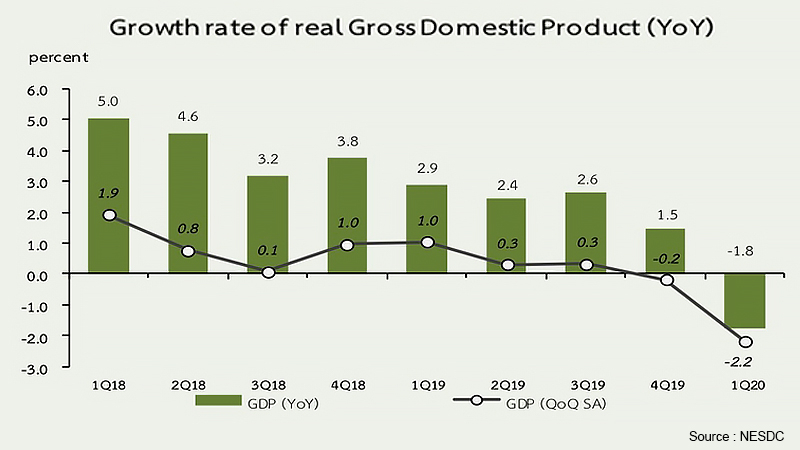
The economy sank by 1.8 per cent year on year in the first quarter, state think-tank the National Economic and Social Development Council (NESDC) said today (May 18).

The economic contraction in the first quarter was largely due to the Covid-19 fallout, said secretary-general Thosaporn Sirisumphand.

In it’s full-year forecast, the Council said the economy would drop by 5 to 6 per cent, close to the 7.6 per cent contraction during the 1997 financial crisis.

The Gross Domestic Product in the first quarter dropped by 1.8 per cent, compared to a rise of 1.5 per cent in 2019 Q4, as a result of the decrease in exports of goods and services, private and public investments and the government’s final consumption expenditure. However, the private final consumption expenditure grew at a decelerated rate, according to the NESDC.

On the production side, the agricultural sector decreased by 5.7 per cent, due mainly to the drought. The non-agricultural sector decreased by 1.4 per cent, in contrast to a rise of 2.0 per cent in 2019 Q4, resulting from the manufacturing sector falling by 2.7 per cent and a reduction of the services sector by 1.1 per cent , compared to a drop of 2.2 per cent and a rise of 4.1 per cent in the previous quarter, respectively. The services sector reduction was mainly because of the decreased number of tourists, which has hit related sectors, particularly affecting transportation and storage, and accommodation and food service activities.

Meanwhile, key services sectors such as wholesale and retail trade, vehicle and motorcycle repair, information and communications, and real estate showed decelerated growth.

As for expenditure, private final consumption expenditure grew by 3.0 per cent, compared to a 4.1 per cent growth in 2019 Q4. However, government final consumption expenditure, gross fixed capital formation, exports and imports of goods and services contracted by 2.7, 6.5, 6.7 and 2.5 per cent, respectively.

After seasonal adjustment, the economy declined by 2.2 per cent in the first quarter of 2020, the NESDC added.

NESDC report expected to project bleak economic outlook for the year #ศาสตร์เกษตรดินปุ๋ย

#ศาสตร์เกษตรดินปุ๋ย : ขอบคุณแหล่งข้อมูล : หนังสือพิมพ์ The Nation.

https://www.nationthailand.com/business/30388025?utm_source=category&utm_medium=internal_referral

NESDC report expected to project bleak economic outlook for the year

May 18. 2020
Some workers have returned to work at department stores and other businesses started to reopen on May 17 after the government implemented the second phase of easing of restrictions.  A full reopening of the economy is a long way off as the international flight ban has been extended to June 30.

Some workers have returned to work at department stores and other businesses started to reopen on May 17 after the government implemented the second phase of easing of restrictions. A full reopening of the economy is a long way off as the international flight ban has been extended to June 30.
By The Nation

The National Economic and Social Development Council (NESDC) is expected to revise downward its economic projections for the year when it releases its quarterly economic report on Monday (May 18).

The NESDC, a government think-tank, is expected to report Thailand’s worst economic performance in the past 22 quarters, a source said.

The economy in the first quarter is expected to fall from a growth rate of 1.6 per cent in the fourth quarter of last year. Previously the NESDC had predicted GDP growth rate at between 1.5 to 2.5 per cent for 2020. The Bank of Thailand expected the economy to contract by 5.3 per cent, but others predict up to a 10 per cent contraction.

The Covid-19 crisis started to impact the economy in January, and had a more severe impact in the following months as it spread to Europe, the United States and other countries, forcing most countries to impose lockdowns, said the source.

The lingering impact on the economy will continue as nobody knows how long the Covid-19 crisis will drag on. The Thai tourism industry, one of the main economic drivers, would be hit hard, as the number of foreign tourists are expected to plummet by at least 70 per cent this year compared to 2019, he said.

The government has extended its ban on international flights until the end of June, as a precaution against a second wave of infections, making a recover for tourism unlikely this year.

The manufacturing sectors, such auto and parts are also down, auto and beverage production declined by 20 per cent in March alone.

The world economy is expected to contract by 2 to 3 per cent.

Thailand’s tourism industry employs about four million people. Laid-off workers totalling 1.2 million have asked for compensation from the Social Security Fund, while 23 million self-employed have asked for Bt5, 000 cash handouts from the government.

The virus pandemic has impacted both consumption, private investment, manufacturing, services and exports, added the source at the NESDC.

The virus sent millions of European workers home – some forever #ศาสตร์เกษตรดินปุ๋ย

#ศาสตร์เกษตรดินปุ๋ย : ขอบคุณแหล่งข้อมูล : หนังสือพิมพ์ The Nation.

https://www.nationthailand.com/business/30388012?utm_source=category&utm_medium=internal_referral

The virus sent millions of European workers home – some forever

May 17. 2020
Shoppers wearing protective face masks while browsing fruit and vegetable stalls at an open air market in Bucharest, Romania, on May 5, 2020. MUST CREDIT: Bloomberg photo by Ioana Epure.

Shoppers wearing protective face masks while browsing fruit and vegetable stalls at an open air market in Bucharest, Romania, on May 5, 2020. MUST CREDIT: Bloomberg photo by Ioana Epure.
By Syndication Washington Post, Bloomberg · Andra Timu · WORLD, EUROPE 

After covid-19 killed the elderly woman Mihaela Danaila had been taking care of for nine years in northern Italy, she joined a rush of about 1.3 million Romanians working abroad and headed home.

The 37-year-old had been part of a steady exodus west after the continent’s ex-communist contingent joined the European Union. Open borders allowed doctors, engineers and builders to garner higher salaries elsewhere, escaping corruption and poor health care in the process. The shift helped richer countries struggling with aging populations but left the workers’ homelands scrambling to fill jobs.

Seasonal foreign farm workers harvest asparagus at a farm in Hurcott, England, on May 5, 2020. MUST CREDIT: Bloomberg photo by Hollie Adams.

Seasonal foreign farm workers harvest asparagus at a farm in Hurcott, England, on May 5, 2020. MUST CREDIT: Bloomberg photo by Hollie Adams.

The virus has reversed a chunk of the migrant flows almost overnight: eastern countries now have an abundance of workers. The question is whether they’ll stay. While wages haven’t caught up, the region suffered far fewer Covid-19 deaths than western Europe and governments in Romania, Ukraine and Serbia are keen to retain at least some of those who’ve come back. People like Danaila may stick around.

“I don’t want to return to Italy because life among strangers is hard,” she said. “I’ll see what happens in the next few months. If I manage to get a job here, that would be great.”

Looking for employment right now is tough as eastern Europe’s boom of recent years becomes what’s shaping up to be its deepest slump since the fall of the Iron Curtain. But despite hitting records, unemployment isn’t seen reaching the levels of places like Italy and Spain.

Romania — which lost at least 4 million citizens to emigration since joining the EU in 2007, more than any other member-state — reckons at least a third of those who have returned are actively looking for jobs and can help power construction, agriculture and industry in the coming years. One initiative is targeted at them: a 40,000 euro ($43,350) grant to start a farm.

“It’s a priority for the government to retain these people — we’ll do it through investments, by creating new jobs,” Finance Minister Florin Citu said. “Before the crisis, many companies complained that they can’t find workers. Now, the workforce is here and we need to support it.”

In Ukraine, President Volodymyr Zelenskiy has longed to lure back those who left after the EU granted visa-free travel in 2017. As many as 1 million were in Poland alone before the crisis struck.

While there’s been less of a rush home than in Romania, Ukraine’s central bank estimates that about 300,000 people returned during lockdown — 10% of the total. One program will offer them cheap loans to start businesses. A ‘Great Construction’ project to upgrade roads will add 170,000 jobs.

Companies looking to fill seasonal positions in the U.K., Finland and Germany with Ukrainians are also facing a tougher time. They must provide medical insurance and contracts of at least three months.

In Serbia, President Aleksandar Vucic says about 400,000 workers have arrived home amid the pandemic, most having lost temporary jobs and social and health insurance. The inflow is equivalent to 6% of the population and a fifth of the workforce. Officials have urged them to take jobs in agriculture.

Not all eastern European nations have seen big influxes. Poles, who make up the biggest foreign group in the U.K., are largely settled and have remained where they are. It’s a similar story for the Baltic region, which has been among the worst-affected by mass emigration since the collapse of the Soviet Union.

And those who have come back did so for an array of reasons — Easter being a big one. Bulgaria is a case in point. While 360,000 citizens returned since February, 285,000 have left again. Data later this year on remittances, which reached $12 billion in Ukraine in 2019, will paint a clearer picture.

“In the short term, the impact will be on higher social spending for the state because the economy won’t be able to absorb everyone,” said Dan Bucsa, an economist at UniCredit Bank. “It’s very likely most will leave again once the situation calms down.”

Romania, like most countries, has enough to worry about with the virus, having suffered more than the other eastern EU members. But if officials can find time and resources to reach out to people like Danaila, it may be better off once the economy overcomes its slump.

“I have a 12-year-old son who’s the main reason I want to stay,” she said. “Being away from him has been the most difficult thing I ever did but when I look at the things he has now — a computer, clothes, everything he needs — I realize that with the wages in Romania I’d never have afforded it all. People say things have changed here as well. I’ll see.”

THAI dismisses bankruptcy rumours #ศาสตร์เกษตรดินปุ๋ย

#ศาสตร์เกษตรดินปุ๋ย : ขอบคุณแหล่งข้อมูล : หนังสือพิมพ์ The Nation.

https://www.nationthailand.com/business/30388002?utm_source=category&utm_medium=internal_referral

THAI dismisses bankruptcy rumours

May 17. 2020
By The Nation

Thai Airways has clarified that it has no intention to file for bankruptcy, responding to several rumours about the national flag carrier’s future.

There were rumours that Thai Airways would file for bankruptcy in court on May 15.

THAI’s recovery plan has been approved by the airline’s committee on May 17 and the State Enterprise Policy Office will supervise it.

The plan is soon to be presented to the Cabinet to give more clear directions on the future of Thai Airways.

Bike, scooter services ready to fill transit gap #ศาสตร์เกษตรดินปุ๋ย

#ศาสตร์เกษตรดินปุ๋ย : ขอบคุณแหล่งข้อมูล : หนังสือพิมพ์ The Nation.

https://www.nationthailand.com/business/30387989?utm_source=category&utm_medium=internal_referral

Bike, scooter services ready to fill transit gap

May 17. 2020
A bicyclist with a mask rides a bike from Capital Bikeshare as he crosses town in the District of Columbia. MUST CREDIT: Washington Post photo by Matt McClain

A bicyclist with a mask rides a bike from Capital Bikeshare as he crosses town in the District of Columbia. MUST CREDIT: Washington Post photo by Matt McClain
By The Washington Post · Luz Lazo · NATIONAL, BUSINESS, TRANSPORTATION

While it’s unclear when Americans will return to life as normal following the coronavirus pandemic, experts are fairly certain work habits will change dramatically, with more people returning to solo car commuting and more teleworking to protect against infection.

Bikeshare and e-scooter companies are hoping to capitalize on the public’s need for social distancing and come back stronger than before the pandemic when the devices were ubiquitous on streets and sidewalks around the country.

Cities are hoping for a resurgence in the modes to avoid a return to pre-pandemic traffic levels and to help fill gaps left as most public transit systems continue to provide reduced service.

“Given the choices we have, [bikes and scooters] seem to be the much safer modes of transportation. You are able to social distance yourself and still have a means to get to where you need to get to without a car,” said Ashish Kabra, a professor at the University of Maryland School of Business who studies shared transportation.

There are early indications that use of bikes and scooters is already increasing. Bike and scooter sales are up, according to reports, and operators of rental services are reporting ridership has picked up and new riding patterns: People are using the bikes and scooters to make longer trips, rather than shorter rides to connect to transit.

Once people return to work, industry leaders and experts are projecting that commuters may feel a greater sense of protection against the virus using personal and shared bikes and scooters than taking public transit or services such as Uber or Lyft.

Industry officials say they, like those in other transportation sectors, have taken extra cleaning measures and will maintain more rigorous disinfecting routines. They also plan frequent reminders to users about good hygiene practices while riding, such as washing their hands after their trips.

Subsidized bikeshare programs, such as the popular Citi Bike in New York and Capital Bikeshare in the Washington, District of Columbia, region, continued to supply transportation during the pandemic, and some systems including Citi Bike have seen such increased demand during the pandemic that they are planning expansions.

The District Department of Transportation is planning to add 30 new Capital Bikeshare stations this year, though officials declined to say whether the service faces any budget uncertainties as a result of the health crisis.

DDOT Director Jeff Marootian said Capital Bikeshare remains a central piece of the city’s transportation system and plans to expand its access to as many people as possible. Marootian also said the city is ready to be flexible to allow private rental services to expand if demand grows.

The city also plans to continue to promote the use of car alternatives to avert increases in vehicle traffic and setbacks to environmental and traffic safety goals.

Several cities around the country, including Seattle and Oakland, are encouraging bike, scooter and pedestrian traffic by shutting down some streets to vehicles.

Some cities are also easing regulations on scooter and bike operators. Portland is offering incentives for residents to use scooters through a partnering with Spin. The city allowed Spin to add more scooters to its fleet and temporarily waived fees in exchange for Spin cutting the cost of its rides by half.

Across the Atlantic, the United Kingdom earlier this month announced a multibillion-pound plan to boost cycling and walking during and after the lockdown and fast-tracked a program to allow e-scooters on U.K. roads as early as next month – nationwide – instead of in just a few cities. Montreal, Paris and Milan have built temporary bicycle and pedestrian facilities as part of their coronavirus response.

“This is the moment really to encourage as many people who are interested and are willing to try bikes or scooters to do it and to set up the infrastructure and support them,” said Greg Billing, executive director of the Washington Area Bicyclist Association. He said there is already a renewed interest in biking amid the pandemic.

David Spielfogel, chief of policy at Lime scooters, said the company is working closely with cities to beef up their operations and ensure access and availability is widespread when commuters return.

“Cities are demanding change more quickly,” Spielfogel said. “Local governments are desperate for open air mobility options that allow for social distancing, and they’re quickly turning to bikes and scooters.”

Most private rental operations shut down amid the health crisis, and while some have returned, they are in only a fraction of their pre-pandemic markets.

The pandemic has driven some of the scooter and bike start-ups to the brink of financial ruin. And for some of the bigger companies that hoped to turn a profit, those plans have been derailed, too. Lime, which had already announced layoffs early in the year, laid off 13 percent of its global workforce in late April. Its competitor, Bird, laid off nearly one-third of its 1,400 employees in late March, giving workers the bad news in a 2-minute message via Zoom, according to The Verge.

Uber and Lyft have also laid off hundreds of employees combined, affecting their scooter and bikeshare operations.

Last week, Uber offloaded Jump, its bike and scooter business, to Lime as part of a $170 million investment. The deal ensures Lime has “the resources to not just weather covid, but to have the runway to reach full company profitability, which we expect to do in 2021,” Spielfogel said. And by absorbing Jump into its operations, Lime’s fleet will grow significantly. However, it remains to be seen whether that’s a benefit to the company when Jump was losing $60 million a quarter.

Even before the crisis, scooter and bike rental companies had started to pull out of some markets. Officials with Lime and Bird said they are now evaluating what markets they will return to as demand grows.

“My guess is some of the smaller companies, if they don’t go out of business, they’ll be acquired,” said Sarah Catz, a research associate at the University of California at Irvine’s Institute of Transportation Studies. As a whole however, the industry, she said, “will be a survivor from the pandemic and come out stronger.”

In places where private scooter and bike operators remained or have resumed service, officials said they are seeing promising ridership trends. In South Korea, Lime ridership is up 14 percent compared to pre-pandemic levels, according to the company.

Lime is operating in 20 of the about 120 global markets – including cities and college campuses – where it was operating before the pandemic.

In Columbus, Oklahoma City and the District, companies report users are taking scooters for longer rides, signaling that riders are making their full commutes on the devices rather than for first-mile, last-mile trips.

Bird, which returned to the streets of the nation’s capital this month after weeks weathering the pandemic, said demand is in-line with pre-pandemic numbers.

The District is one of a few markets where Bird has resumed operations; the company was in more than 100 locations before the health crisis.

Rebecca Hahn, chief corporate social responsibility officer for Bird, said the company is planning to resume service in more cities as demand rises.

“We’re able to limit or decrease the number of individuals using public transit while at the same time providing an option that is a responsible social distancing mechanism. You’re one individual on one vehicle at one time,” Hahn said. “And that allows us to adhere to these social distancing guidelines that I imagine will be in place for quite some time.”

Those in the industry say they want to support local governments in their goals, and work with cities during society’s reopening and after public transit comes out of the crisis. Cities and the industry agree that micromobility options can alleviate some of the crowding on trains and buses. Some transit systems, including Metro, have said they don’t plan to resume normal operations for months while they look to enforce social distancing aboard trains and buses.

“We’re well poised to provide transportation service during reopening,” said Samantha Herr, executive director of the North American Bikeshare Association.

If the early days of the crisis offer any lessons, she said, it is that people in major cities turned to bikes and scooters to get around as transit systems began to reduce service and more people grew concerned about riding in crowded trains and buses.

“Shared mobility continued to be a viable option for those people that had to move around” at the onset and during the pandemic, she said, noting that bikeshare and scooter systems that remained in operation during pandemic were critical to support hospital and other essential workers.

“It is a great transportation option for folks as states and localities start to reopen.”

What you can do now to plan and manage a home renovation once conditions are right #ศาสตร์เกษตรดินปุ๋ย

#ศาสตร์เกษตรดินปุ๋ย : ขอบคุณแหล่งข้อมูล : หนังสือพิมพ์ The Nation.

https://www.nationthailand.com/property/30387993?utm_source=category&utm_medium=internal_referral

What you can do now to plan and manage a home renovation once conditions are right

May 17. 2020
Do side-by-side comparisons between various contracting firms and big-box stores to determine which option best works for you. MUST CREDIT: Washington Post photo by Jabin Botsford

Do side-by-side comparisons between various contracting firms and big-box stores to determine which option best works for you. MUST CREDIT: Washington Post photo by Jabin Botsford
By The Washington Post · V. Dion Haynes · BUSINESS, FEATURES, HOMEGARDEN 

Like everyone else, you’ve been spending lots of time at home during the past several weeks. And you’ve probably become more acquainted with all the flaws in your home: the outdated kitchen cabinets, the frayed carpeting in the family room that needs to be replaced by hardwood, the spare bedroom that needs to be converted into a dedicated office.

Maybe the thought of a renovation has crossed your mind. But this couldn’t possibly be the right time for one, could it? Well, it depends.

Amid the coronavirus pandemic, home construction – including remodeling – had been deemed an essential business under the original stay-at-home orders in some states. But whether a specific project is considered appropriate is a matter largely determined by homeowners and contractors.

“Putting a roof back on is essential,” said David Merrick, president of Merrick Design and Build in Kensington, Maryland.

Merrick, who also serves as chairman of the government affairs committee for the National Association of the Remodeling Industry (NARI), said contractors are more likely to take on outside rather than inside projects. In the case of a customer seeking to renovate the basement of her Washington, D.C., rowhouse, the decision was made to wait until the late spring or early summer when everyone would feel more comfortable.

Not surprisingly, home construction activity nationwide has fallen significantly since the covid-19 outbreak, according to the Remodeling Futures Program at the Joint Center for Housing Studies of Harvard University, and is not expected to recover until well into 2021.

The slump in activity may work to your advantage, experts say. Because work has dried up, some contractors may be more willing to give you a better deal on the pricing than they would have several months ago when demand for their services was high.

If you opt to wait until the pandemic eases, experts say, you can still use this downtime to plan your project and get on your contractor’s radar.

“If you have a four to five month timeline, you can talk to friends on who they used and look at Angie’s List reviews on their performance,” said Kermit Baker, project director at the Harvard remodeling program. “You can do your due diligence as you prepare to get the project ready.”

Once you decide on what work needs to be done and when to do it, be sure to put your order in right away. “If you wait until September to place your order, [contractors will] have five months of orders in front of you,” Merrick said. Then, it will “be hard time to get the contractor to return your phone call.”

Here are some other factors you can consider ahead of time during this lull:

– Budgeting and financing

Probably the best thing you can do is not get too caught up in the aesthetics but to invest considerable time concentrating on the logistics.

“Every home improvement project will cost more than you think it will and will take more time than you planned,” Bob Harkson, chief financial planner at Phase2 Wealth Advisors in Gig Harbor, Wash., told The Post in May 2019. Harkson said the biggest problem he sees with his financial-planning clients is that they haven’t budgeted enough.

The tricky thing about home improvement is maximizing your return on investment. You want to spend money that will yield a return when you sell your home, but not overspend way beyond what a buyer would be willing to pay you. So how do you find the sweet spot?

Experts say that kitchen and bathroom renovations are among the projects that provide homeowners the best yields. According to Remodeling magazine, kitchens recouped 62.1% and bathrooms 67.2%. Others include: 70.8% for windows; 75.6% for siding; 68.2% for roof; and 75.6% for deck.

Dan DiClerico, a smart-home expert for HomeAdvisor, a New York-based home improvement platform, offered this rule of thumb: “You should spend about 5 to 15 percent of your home value on kitchen renovation,” DiClerico told The Post in May 2019. “So, if your home is worth $300,000, you should spend $15,000 to $45,000 on the kitchen. A bathroom renovation should cost about 3 to 7 percent of your home value.”

If you’re into analytics, HomeAdvisor’s State of Home Spending offers data and charts to help you determine whether your budget is in line with what other homeowners pursuing similar projects paid. Another useful source is the Remodeling Cost vs. Value Report, which offers searchable databases to compare renovation costs by Zip code.

“The more thorough you are in the planning stages, the more likely you are to come in on budget for your project,” DiClerico said.

A major component of planning involves accounting for surprises. Sonu Mittal, head of retail mortgage lending for Citizens Bank in Plano, Texas, said you should budget an extra 10% for unforeseen expenses.

So how do you pay for a home improvement project? There is no shortage of methods. Here are a few:

Savings: This is the easiest because it doesn’t require getting approval or paying fees and interest.

A Federal Housing Administration (FHA) 203(k) or Fannie Mae HomeStyle Renovation loan: “An FHA 203(k) loan offers flexibility because you can finance up to 97.75% of the improved home value,” Catherine Holtman, operations support manager for Embrace Home Loans in Middletown, R.I., told The Post in May 2019. “There’s a streamlined version for improvements up to $35,000 that are nonstructural and a standard version for major renovations including structural changes.”

Home equity line of credit (HELOC): This provides homeowners flexibility in that they only pay interest on the line of credit they use, and the closing costs are minimal.

Cash-out refinance: Borrowers should keep in mind that closing costs for cash-out refinancing is higher than a HELOC, but interest rates are lower.

Personal loan: A personal loan is best for borrowing smaller amounts because it has to be paid back sooner and have higher interest rates than a HELOC.

401(k) loan: The loans have a low interest rate. Financial advisers discourage these type of loans because they must be paid back immediately if the borrower leaves their company.

Credit card: This is a simple way to pay for a project. However, they come with high interest rates.

– Undertaking a major project

Before embarking on a major renovation, you should take some time to determine the best approach given your budget, timeline, patience and willingness and ability to do some of the work yourself. Here are seven methods:

Design-build firm: These firms, which include designers and architects, can manage the project from beginning to end and oversee all the subcontractors. The downside is that they can be costly.

Kitchen designer: These firms specialize in kitchens and can often provide a more custom look for your project.

General contractor: A general contractor is best for people who know what they want but need someone to manage the project. Because of their relationships with vendors, general contractors often can get discounts on supplies.

Specialty kitchen store: These retailers offer discounts on kitchen components and fixtures and custom services.

High-end design firm: This is for homeowners who want the best of the best, and don’t mind paying for it.

Big-box store: Stores such as Home Depot and Ikea can often get special discounts on labor and can generally offer their services at prices lower than general contractors.

DIY: For people who would like to save a ton of money, and are also handy.

If you’re pursuing a bathroom renovation, for example, keep in mind that 50% to 75% of the project’s cost will be labor. So it’s important to educate yourself on how to negotiate labor costs or hire a contractor who can do so.

– Working with limited dollars

If you’re looking to start off small to get your feet wet, Zillow offers some suggestions on lower-cost projects that can give you a bigger bang for your buck. For instance, Zillow says spending $3,000 on outdoor “curb appeal” projects such as paint and landscaping can yield $3,500 when selling.

Zillow also recommends that when renovating to sell that you try to incorporate the latest design trends into your home.

When trying to prioritize limited dollars, Zillow recommends that you simply ignore the basement. Basement projects, according to Zillow, yield only 50 cents on the dollar even when a bathroom is added.

Justin Pierce, a real estate investor and real estate agent, suggests that homeowners opting to manage their own projects should use a construction journal to stay on top of the project and to give them a record with contractors when something goes awry.

“Keeping a journal has really helped me,” Pierce wrote in a Washington Post column in July. “If things go badly, it can be useful in court or arbitration. Contractors, especially shady contractors, are good at complicating the issue or adding doubt in your mind. They blame delays and increased costs on the weather, additional work, inspectors and the client. You may be shocked to receive $10,000 in change orders at the final accounting. This is impossible to unravel six weeks down the road. It’s best to note things as they happen and share milestones and your understanding of them with the contractor.”

Pierce said the journal should include the start date, major milestones, inspection dates, subcontractor work schedule and change orders.


Developer SC Asset announces y-o-y growth of 4% #ศาสตร์เกษตรดินปุ๋ย

#ศาสตร์เกษตรดินปุ๋ย : ขอบคุณแหล่งข้อมูล : หนังสือพิมพ์ The Nation.

https://www.nationthailand.com/property/30387786?utm_source=category&utm_medium=internal_referral

Developer SC Asset announces y-o-y growth of 4%

May 13. 2020
By THE NATION

SET-listed property developer SC Asset Corporation earned Bt3.133 billion in the first quarter of 2020, growing 4 per cent year on year, chief operating officer Attapol Sariddipuntawat said.

He said 93 per cent of revenue came from the corporation’s houses and condos, while the remaining 7 per cent was from rental and services.

SC Asset reported total assets of Bt47.035 billion and total debts of Bt29.142 billion.

SC Asset’s projects number 52 in total – eight condominiums and 44 “horizontal” developments of single units.

Attapol said that SC Asset’s online strategies for selling those horizontal projects had been successful.

In the second quarter, the corporation aims to finish work on six single-house developments and launch four new single-house projects.

Among the four new projects, Bangkok Boulevard Vibhavadi and Bangkok Boulevard Rama 5 will open for pre-sales on May 16 and 17 (Saturday and Sunday). Meanwhile, the Gentry Vibhavadi and Venue Flow Chaengwattana will begin taking pre-sale orders on May 23 and 24.

MEA allows users to submit documents online to get electricity deposit back #ศาสตร์เกษตรดินปุ๋ย

#ศาสตร์เกษตรดินปุ๋ย : ขอบคุณแหล่งข้อมูล : หนังสือพิมพ์ The Nation.

https://www.nationthailand.com/biz-moves/30387907?utm_source=category&utm_medium=internal_referral

MEA allows users to submit documents online to get electricity deposit back

May 15. 2020
By THE NATION

The Metropolitan Electricity Authority (MEA) will let users who have registered to get back the deposit for their electricity metre to submit additional documents via online channel.

The campaign is part of the government’s strategy to help ease people’s financial burden during the Covid-19 crisis which MEA has set up online and telephonic channels since March 25 for users to apply for refunds.

Electricity users in Bangkok, Nonthaburi and Samut Prakarn area can simply go to http://measy.mea.or.th and click on the plus icon to register and submit the evidences. Registered users who have not been approved for refund can also submit additional documents online by clicking on the magnifying glass icon.

Users who pass the verification process will get their refunds within three working days via PromptPay or over the counter at 7-Eleven, or within seven working days via accounts at Krungthai Bank, Bangkok Bank and Siam Commercial Bank, and within 10 working days for Kasikorn Bank account holders.

The online registration will stay open indefinitely to accommodate users and reduce the risk of Covid-19 spreading that might happen if users come down to MEA branch offices.

For more information, consult https://www.mea.or.th/content/detail/87/5353.