CP All gets franchise rights to operate 7-Eleven stores in Cambodia #ศาสตร์เกษตรดินปุ๋ย

#ศาสตร์เกษตรดินปุ๋ย : ขอบคุณแหล่งข้อมูล : หนังสือพิมพ์ The Nation.

https://www.nationthailand.com/business/30387433?utm_source=category&utm_medium=internal_referral

CP All gets franchise rights to operate 7-Eleven stores in Cambodia

May 07. 2020
Photo credit: PxHere

Photo credit: PxHere
By THE NATION

CP ALL (Cambodia) Co Ltd has been granted franchising rights for the establishment and operation of 7-Eleven Stores in Cambodia for a period of 30 years.

CP All (Cambodia), an indirect subsidiary of CP All Plc, on May 5 entered into a Master Franchise Agreement with 7-Eleven, Inc under which the parties may agree to extend by two additional 20-year terms.

CP All (Cambodia) Co Ltd is a newly-incorporated subsidiary, established in accordance with the laws of Cambodia for the operation of the 7-Eleven business under the Master Franchise Business in Cambodia

AOT to open bids for repair of Suvarnabhumi taxiways #ศาสตร์เกษตรดินปุ๋ย

#ศาสตร์เกษตรดินปุ๋ย : ขอบคุณแหล่งข้อมูล : หนังสือพิมพ์ The Nation.

https://www.nationthailand.com/business/30387347?utm_source=category&utm_medium=internal_referral

AOT to open bids for repair of Suvarnabhumi taxiways

May 07. 2020
Photo credit: PxHere

Photo credit: PxHere
By THE NATION

Airports of Thailand (AOT) is expected to call bids in July or August for the Phase 1 of repairing the surface of Suvarnabhumi Airport’s taxiways.

Anant Wangchingchai, deputy director of the airport, said the project will cost Bt1.3 billion and should cover 395,000 square metres.

The airport is drafting details for the bid, while repair work is expected to start in October and be completed in 18 months. The entire project is divided into four phases.

Disney sees profit drop because of coronavirus, but worst is likely yet to come #ศาสตร์เกษตรดินปุ๋ย

#ศาสตร์เกษตรดินปุ๋ย : ขอบคุณแหล่งข้อมูล : หนังสือพิมพ์ The Nation.

https://www.nationthailand.com/business/30387360?utm_source=category&utm_medium=internal_referral

Disney sees profit drop because of coronavirus, but worst is likely yet to come

May 06. 2020
Photo credit: PxHere

Photo credit: PxHere
By The Washington Post · Steven Zeitchik · BUSINESS, ENTERTAINMENT 

With a pandemic battering its businesses, The Walt Disney Company on Tuesday reported notably lower profit figures for its most recent quarter. More significantly, it offered few specifics on when many of its divisions might return to normal operations or how it would make up shortfalls in the interim.

As its theme parks began to be shuttered, movies could not be released and sports could be played, Disney saw total operating income drop 37 percent to $2.4 billion in the quarter ending March 31. Parks and cruises had profit go from $1.5 billion in the quarter last year to $639 million this year, with a loss of about $1 billion in revenue.

Earnings-per-share, meanwhile, dropped to just 60 cents, a 63 percent decline compared to the same quarter a year ago and lower than the 89 cents many forecasters expected.

Those reduced numbers were cushioned by the fact that much of the quarter played out before the crisis hit in the U.S., and many analysts and investors believe the worse is yet to come. The quarter, for instance, included only a few weeks of the park shutdowns in the U.S.

And team sports, on which Disney cable network ESPN heavily relies, were not suspended until about the same time. The company currently lacks a wide range of revenue streams for the new quarter, which runs through June; there is no timetable, for instance, on the reopening of U.S. theme parks.

“Today’s not the point,” said Lloyd Greif, a veteran Los Angeles-based investment banker who closely follows Disney. “We haven’t seen ugly yet. Third and fourth quarter is where the rubber will really hit the road.”

Disney’s executives had few answers for analysts on what they could do to stem the tide until the American entertainment economy can resume at anything close to full capacity. They pointed to few scattered revenue-drivers, such as high ratings for its ESPN docuseries “The Last Dance” and growing subscriptions for Disney Plus, as a way of keeping dollars flowing.

Instead, executives sought to paint a longer-term picture that relied on more general advantages like the trustworthiness of the Disney brand.

“As someone who’s been around for a while and led the company through some really tough days. … I have absolute confidence we’ll get through this challenging period and recover successfully,” Bob Iger, the company’s executive chairman and until several months ago its chief executive, told analysts in a call.

He said he thought it “quite possible” Disney’s properties will now resonate with consumers more than ever. “People find comfort and inspiration in our messages of hope and optimism,” he said.

Iger, the often-celebrated chief executive who stepped down shortly before the crisis erupted in the U.S. to focus on content, has retaken more of a public role from successor Bob Chapek as he tries to right the company and his legacy.

On the call, Chapek said he thought the cruise ship business, which has been at the epicenter of the corona crisis, could also rebound in the long term. He said Disney’s lines will be “much more resilient” than competitors and noted that “consumers trust our business to react in a responsible way to protect them.”

For now, though, the numbers are bleak, and may get bleaker. Disney’s film studio saw an operating income drop of about 8 percent, to $466 million, as the company was unable to release its much anticipated “Mulan” at the end of March. That film has been postponed until the end of July. The effect of other postponed spring releases, such as Marvel picture “Black Widow,” will be felt in the new quarter. The movie has been postponed from May to November.

There is no timetable for the playing of NBA and Major League Baseball games that drive viewership to ESPN.

The earnings figures preview a potentially dramatic fall for a company that just a few months ago had an iron grip on the entertainment industry. Disney closed 2019 with all five of the top-grossing movies in the world and more than $20 billion in revenue for the quarter ending Dec. 31, a 36 percent increase from the previous year. Parks alone generated more than $7 billion in revenue and $2 billion in profit.

Disney was facing some challenges, including cord-cutting and a potential slowdown in theatrical revenue, before coronavirus hit. But the pandemic has slammed nearly all of its key divisions.

The cruise-ship and theme-park unit, which Chapek until recently oversaw, accounted for nearly 40 percent of Disney’s overall revenue last year.

Though there is no timetable for the re-openings of U.S. parks, Chapek suggested that the company would go slowly, and also not reopen if executives weren’t confident visitors would follow.

“We would not reopen any park until we can make a positive contribution to overhead and operating-profit level,” he said.

Chapek did say that Shanghai Disneyland will open on Monday. He said contact tracing, social-distancing and “early detection systems” will be among the tools used to limit virus exposure. Masks will be given to staff and guests, he said.

The opening will serve as a test case for potential U.S. reopenings in Florida and California, particularly on the issue of capacity. The Chinese government is mandating about 30 percent capacity, or 24,000 of the roughly 80,000 people who visit the park daily. The first few weeks will see Disney cap the number at below even that, Chapek said, as staffers work out the new protocols.

Disney has furloughed as many as 100,000 employees beginning in April. Executives have said they will accept cuts in their own compensation. Chapek says he had no timetable on the furloughed employees return. The senior-executive salary cut will continue “until we see a substantive economic recovery.”

Disney Plus has been a bright spot for the firm amid the pandemic, with 50 million global sign-ups as of early April. Still, the company does not expect profitability from the service for at least three years. The service is also affected by production shutdowns, limiting its ability to churn out new shows that will attract and retain subscribers.

Executives said that they still planned on opening “Mulan” in theaters at the end of July, and would have the benefit of what Chapek called a “competitive movie” – Warner Bros.’ “Tenet” – opening the week before to see how consumers react. At that point, however, it would likely be too late to change release plans.

Disney chief financial officer Christine McCarthy declined to offer definitive comment on any shareholder dividend in 2020, saying only there was none planned at the moment and the company will address the matter again “in the next six months.” The company has provided a dividend in recent years as its stock price has risen.

Disney’s share price has dropped about 10 percent since the U.S. closures due to coronavirus became probable the second week of March. The stock dropped 2 percent in after-hours trading Tuesday with the earnings news.

Power plant operator seeks delay to PTT gas supply deal #ศาสตร์เกษตรดินปุ๋ย

#ศาสตร์เกษตรดินปุ๋ย : ขอบคุณแหล่งข้อมูล : หนังสือพิมพ์ The Nation.

https://www.nationthailand.com/business/30387335?utm_source=category&utm_medium=internal_referral

Power plant operator seeks delay to PTT gas supply deal

May 06. 2020
By THE NATION

SET-listed Ratch Group Plc has asked the Electricity Generating Authority of Thailand (EGAT) if it can postpone a deal with PTT for gas to fuel its Hin Kong power plant. Ratch had been due to sign the deal with PTT on April 30 but now wants to postpone until the end of the year.

The gas-fired Hin Kong plant is being constructed in Ratchaburi and will have a capacity of 1,400 megawatts on completion. The project is currently preparing an environmental impact assessment report.

The first of its two electricity generating units is scheduled to begin operating in 2024, the second in 2025.

EGAT sources said Ratch Group must sign agreements on power purchases and gas sales, but they added it would first negotiate with PTT because it wants to gain access to imported liquefied natural gas and seek more opportunities to reduce the price for gas.

“However, this postponement will come into effect after being approved by EGAT governor Viboon Rerksirathai,” the sources said.

Ratch CEO Kijja Sripatthangkura has said the company is currently considering various ways to reduce its cost of generating electricity, including buying gas from PTT or other companies and importing liquefied natural gas.

PTTEP announces oil discovery off Mexico #ศาสตร์เกษตรดินปุ๋ย

#ศาสตร์เกษตรดินปุ๋ย : ขอบคุณแหล่งข้อมูล : หนังสือพิมพ์ The Nation.

https://www.nationthailand.com/business/30387332?utm_source=category&utm_medium=internal_referral

PTTEP announces oil discovery off Mexico

May 05. 2020
By THE NATION

PTT Exploration and Production Pcl (PTTEP) and its joint venture partners made two deep-water oil discoveries in the Block 29 concession off Mexico, with good-quality reservoirs, according to a statement by the company released on Tuesday (May 5).

Commercial potential of the new discoveries will be assessed in the next phase.

Phongsthorn Thavisin, PTTEP’s president and CEO, revealed that PTTEP Mexico E&P Limited, S de RL de CV, a wholly-owned subsidiary of PTTEP, together with its consortium announced successful discoveries by two exploration wells in Block 29, located in the Salina Basin, offshore Mexico.

The first exploration well, “Polok-1”, was drilled to a depth of 2,620 metres and encountered approximately 200 metres of net oil pay. The second exploration well, “Chinwol-1”, drilled down to a depth of 1,850 metres and encountered net oil pay of approximately 150 metres.

Both exploration wells show high potential, said the company. Together with its joint venture partners, PTTEP will now work to obtain approval from Mexican regulators, preparing an appraisal as well as further development plans.

The Polok-1 and Chinwol-1 wells are located at depths of 583 metres and 464 metres, respectively, and lie about 88 kilometres off the Mexican coastline of Tabasco.

The joint venture partners in the project consist of PTTEP Mexico E&P Limited, S de RL de CV with 16.67 percent interest, Repsol Exploración México, SA de CV (Operator) with 30 percent interest, PC Carigali Mexico Operations, SA de CV (the Mexican subsidiary of Petrona) with 28.33 percent interest, and Wintershall Dea with 25 percent interest.

PTTEP began investing in Mexico in 2018, following the company’s move to expand investment in petroleum prolific areas. PTTEP currently holds two exploration blocks in offshore Mexico, Block 29 and Block 12, where it is also carrying out exploration activities.

Stronger baht hits Thai Union’s profits despite high consumption of seafood #ศาสตร์เกษตรดินปุ๋ย

#ศาสตร์เกษตรดินปุ๋ย : ขอบคุณแหล่งข้อมูล : หนังสือพิมพ์ The Nation.

https://www.nationthailand.com/business/30387330?utm_source=category&utm_medium=internal_referral

Stronger baht hits Thai Union’s profits despite high consumption of seafood

May 05. 2020
By THE NATION

The net profit for the first quarter of leading seafood exporter, Thai Union Group, stands at Bt1.016 billion, down 20.19 percent compared to the same period last year due to losses caused by currency exchange and a drop in revenue from red lobster.

However, sales in the first quarter was higher at Bt31.103 billion, up 5.9 percent from the same period last year.

“The pandemic has brought many challenges, especially when it comes to exporting frozen seafood to the United States and Asian countries,” a company staff said. “However, the sale of processed seafood has risen because more people are eating at home in compliance with lockdown measures.”

ONYX Hospitality boosts hygiene, safety standards at 52 properties #ศาสตร์เกษตรดินปุ๋ย

#ศาสตร์เกษตรดินปุ๋ย : ขอบคุณแหล่งข้อมูล : หนังสือพิมพ์ The Nation.

https://www.nationthailand.com/business/30387321?utm_source=category&utm_medium=internal_referral

ONYX Hospitality boosts hygiene, safety standards at 52 properties

May 05. 2020
By THE NATION

ONYX Hospitality Group has announced enhanced hygiene and safety standards as part of a new initiative that will be implemented at its properties including Amari, OZO, Shama and Oriental Residence Bangkok as it prepares to welcome travellers back to its hotels, resorts and serviced apartments across the Asia-Pacific.

“‘ONYX Clean’ will impact every step of the guest journey from arrival to departure, with updated standards and operational procedures that complement the group’s existing health and safety initiatives,” the firm said in a press release.

The initiative will be introduced at all of the company’s 52 properties across seven countries in the coming weeks, and at all new openings.

“ONYX team members are continuously engaged while staying home as they participate in an online learning platform that offers a wide variety of training programmes, including in-house produced educational videos that help deliver awareness on pathogen risks and demonstrate enhanced cleaning and sanitising methods and updated guest service protocols,” the release said.

Each property has appointed an in-house ONYX Clean champion who will ensure the implementation and internal audit of all standards based on a property-wide checklist developed in partnership with Ecolab, a global leader in hygiene, safety and energy technology solutions and supplier of many cleaning products.

“As one of the leading medium-sized hospitality players in the Asia-Pacific region, we have always taken pride in our high levels of hygiene and our longstanding commitment towards the safety and well-being of our guests, team members and the community,” group president and CEO Douglas Martell said.

“With the impact of Covid-19 leading to new norms and heightened consumer interest in hygiene and safety, we would like to assure all travellers – both new and returning – that we have their safety and well-being as our number one priority,” he added.

Under the ONYX Clean initiative, arriving guests will need to have their temperature taken, hands sanitised and requested to complete a health and travel questionnaire. Physical distancing will be implemented in the event of queues or when waiting for check-in.

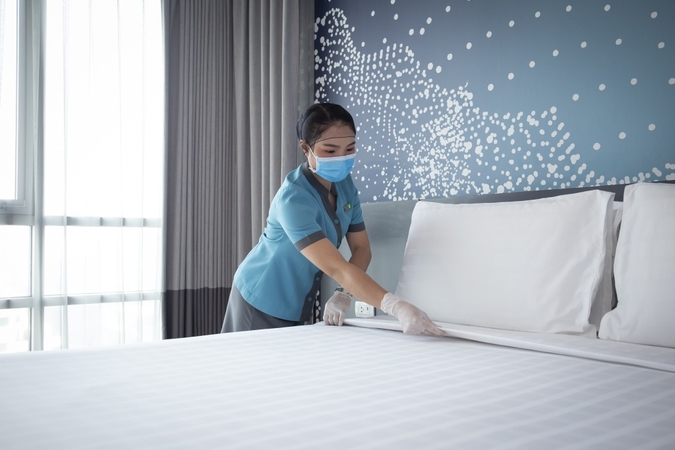
A room seal will be placed on every room door to indicate to arriving guests that their personal space has not been tampered with since being thoroughly cleaned and disinfected. Housekeeping teams will wear hotel-issued masks and gloves, and carry a list of high-touch surfaces such as table tops, chairs, door handles, lift buttons, TV remotes, room controls and faucets, which will all be wiped down with approved sanitisers and further sterilised with UV-C wands, the firm said.

Also, all food and beverage outlets will be rearranged to ensure a safe distance of at least one metre between tables and bar chairs, with queue management during busy meal periods such as breakfast. Kitchens and food preparation areas, spas, pools and fitness zones will also undergo enhanced sanitisation and crowding minimized, it added.

ONYX Hospitality Group said it has 20 hotels in the pipeline, scheduled to open in the coming years in locations such as Pattaya, Niseko, the Maldives, Penang, Colombo and Vientiane.

GE to slash 13,000 jobs in aviation amid air travel plunge #ศาสตร์เกษตรดินปุ๋ย

#ศาสตร์เกษตรดินปุ๋ย : ขอบคุณแหล่งข้อมูล : หนังสือพิมพ์ The Nation.

https://www.nationthailand.com/business/30387280?utm_source=category&utm_medium=internal_referral

GE to slash 13,000 jobs in aviation amid air travel plunge

May 04. 2020
By Syndication Washington Post, Bloomberg · Richard Clough · BUSINESS, US-GLOBAL-MARKETS

General Electric will cut about 13,000 jobs from its jet-engine operation, in the latest sign of the devastating impact of the coronavirus outbreak on global air travel.

The reductions, going well beyond cuts announced in March, will include “voluntary and involuntary actions” affecting about 25% of GE Aviation’s workers worldwide, the company said Monday in a statement. The total includes a previously announced move to cut about 2,600 positions in the U.S.

“The deep contraction of commercial aviation is unprecedented, affecting every customer worldwide,” GE Aviation Chief Executive Officer David Joyce said in the statement. “We have responded with difficult cost-cutting actions over the last two months. Unfortunately, more is required.”

The job cuts, coming after GE last week reported deep financial strains in its jet-engine manufacturing division, underscore the severe impact of the pandemic on aviation and the broader economy. Planemakers Boeing and Airbus, along with airlines worldwide, have launched desperate efforts to preserve and raise cash as demand has fallen sharply.

For GE, in particular, the stress on a key business threatens a broader turnaround effort as CEO Larry Culp attempts to shore up the balance sheet and pull the company from one of the deepest slumps in its history. GE Aviation had been a bulwark for the Boston-based company as it dealt with depleted cash and a slump in the power-equipment business.

The aviation job cuts, which will be permanent, will be rolled out “over the coming months,” Joyce said. GE previously announced employee furloughs in addition to layoffs.

The latest moves are part of a $3 billion plan announced last week to reduce costs and preserve cash in the engine unit. GE said when it reported quarterly earnings that installations have dropped 45% for new engines in the second quarter and slid 60% for spares.

The global airline industry is expected to reach only 60% of its typical traffic by year-end, Alexandre de Juniac, CEO of the International Air Transport Association, said Monday on a French business news TV program. The trade group in mid-April estimated that the industry would lose $314 billion in ticket sales this year. In the U.S. alone, air traffic is less than 10% what it was a year ago.

GE fell 4.2% to $6.23 at 10:27 a.m. in New York. The stock plunged 42% this year through May 1, while the S&P 500 fell 12%.

Buffett dumps airlines and his aerospace pain only worsens #ศาสตร์เกษตรดินปุ๋ย

#ศาสตร์เกษตรดินปุ๋ย : ขอบคุณแหล่งข้อมูล : หนังสือพิมพ์ The Nation.

https://www.nationthailand.com/business/30387271?utm_source=category&utm_medium=internal_referral

Buffett dumps airlines and his aerospace pain only worsens

May 04. 2020
Warren Buffett, chairman and chief executive officer of Berkshire Hathaway Inc., speaks during the virtual Berkshire Hathaway annual shareholders meeting seen on a laptop computer in Arlington, Va., on May 2, 2020. MUST CREDIT: Bloomberg photo by Andrew Harrer.

Warren Buffett, chairman and chief executive officer of Berkshire Hathaway Inc., speaks during the virtual Berkshire Hathaway annual shareholders meeting seen on a laptop computer in Arlington, Va., on May 2, 2020. MUST CREDIT: Bloomberg photo by Andrew Harrer.
By Syndication Washington Post, Bloomberg · Katherine Chiglinsky, Siddharth Philip, Hailey Waller · BUSINESS, TRANSPORTATION, US-GLOBAL-MARKETS

Warren Buffett’s Berkshire Hathaway Inc. dumped its stakes in the four largest U.S. airlines but the billionaire investor remains deeply exposed to the collapse in air travel.

Berkshire still owns all of Precision Castparts Corp., a supplier of aerospace parts that’s bracing for lean times as Boeing and Airbus cut jetliner production. Berkshire bought Precision Castparts in 2016 in a transaction valued at $37.2 billion, making it one of Buffett’s biggest deals.

Now the maker of jet-engine blades and aircraft structural components is facing a double whammy as the coronavirus pandemic all but erases demand for flights, prompting airlines to park jets and slash schedules. That means less need for replacement parts and a big drop in aircraft purchasing. With carriers predicting that flying won’t return to 2019 levels for as long as three years, aerospace suppliers are hunkering down for a protracted slump.

“The current downturn is quite different from regular economic cycles,” said Nick Cunningham, an analyst at Agency Partners in London. “Normally, there’s an exaggerated short-term impact with a fairly quick return. This time around, the impact seems to be significant as you’re looking at a collapse in air travel around the world.”

In the U.S. alone, passenger totals are down about 95% from a year ago. An index of major U.S. carriers has lost more than half its value this year, paced by a 70% drop for United Airlines. Buffett said he lost money on his investments in the industry, which also included stakes in American Airlines, Delta Air Lines and Southwest Airlines.

“The airline business — and I may be wrong and I hope I’m wrong — but I think it’s changed in a very major way,” Buffett said. “The future is much less clear to me.”

Airline shares sank sharply in pre-market U.S. trading Monday, with big players like American and United falling more than 10%. Boeing slid 4% while General Electric Co. was down 1.8%.

Greg Abel, Berkshire’s vice chairman for non-insurance operations, acknowledged at Berkshire’s annual meeting Saturday that Precision Castparts was getting hit, although its defense business remained strong. The parts maker is working to adjust the business to meet current demand, he said, and Buffett pointed out that the pain is rippling throughout the supply chain.

“We’re going to have aircraft in this country, we’re going to be flying. But the real question is whether you need a lot of new planes or not and when you’re likely to need them and it affects a lot of people,” Buffett said. “And it certainly affects Precision Castparts, it affects General Electric. It obviously affects Boeing.”

Boeing and Airbus have also tumbled by more than half, with steeper declines at suppliers such as Spirit AeroSystems Holdings and Triumph Group.”It’s good for Precision Castparts that they’re not a standalone public company right now, because if they were, they’d certainly have a very low stock price,” said James Armstrong, who oversees investments including Berkshire shares as president of Henry H. Armstrong Associates. “It’s not great news for them, but I don’t think that business goes away. I think it slows down.”

Precision Castparts has been hit by two massive and unpredictable blows that weren’t in any way its fault.

Even before the covid-19 outbreak pushed airlines into the worst crisis in industry history, Boeing’s 737 Max was grounded in March 2019 after two deadly crashes. The Chicago-based planemaker halted production of the Max, its best-selling jet, earlier this year as the flying ban dragged on.

The fortunes of Precision Castparts are largely tied to those of Boeing, said Scott Hamilton, a consultant at Leeham Co. who publishes a popular aviation news website. As goes the aerospace giant, so goes its suppliers, he said.”Nobody could have foreseen the airline industry collapse in which 95% of the traffic evaporated virtually overnight,” Hamilton said. “Nobody could foresee the grounding of the Max lasting what may be 18 months. And just as Precision is tied to Boeing, Boeing is tied to the airlines.”

Precision Castparts watched its sales slip in the first quarter across all of its major markets, Berkshire said Saturday in its earnings report. That was partly due to the effects of Boeing’s Max problems as well as reduced shipments to customers hurt by the pandemic. That contributed to a 7.3% decline in pretax earnings in the period.

The parts maker ended up temporarily halting work at a plant in Portland, Oregon, and later said it would “significantly” cut its workforce, according to a report in The Oregonian. Berkshire said that the business faced higher production costs because of “manufacturing inefficiencies primarily attributable to Covid-19.”

Boeing also briefly paused production of multiple aircraft programs. The company has said it will reduce employment by 10%, or about 16,000 jobs, and lower production of jetliners including the 787 Dreamliner.

Precision Castparts, with its advanced technologies for casting and forging metals, will remain a key cog in the aerospace supply chain. In addition to the robust defense business in aircraft parts, the company serves customers in the power and energy industries.But with commercial air travel facing a long and uncertain recovery, Buffett’s bet on Precision Castparts will remain a drag on Berkshire for the foreseeable future.”That’s a big-time dud,” said Bill Smead, chief investment officer of Smead Capital Management, which owns Berkshire shares. “He obviously in retrospect made a real bad whole-company purchase.”

Sketches from a crisis: How a handful of small businesses are managing to survive #ศาสตร์เกษตรดินปุ๋ย

#ศาสตร์เกษตรดินปุ๋ย : ขอบคุณแหล่งข้อมูล : หนังสือพิมพ์ The Nation.

https://www.nationthailand.com/business/30387224?utm_source=category&utm_medium=internal_referral

Sketches from a crisis: How a handful of small businesses are managing to survive

May 04. 2020
Photo credit: Pressfoto

Photo credit: Pressfoto
By The Washington Post · Rick Noack, Terrence McCoy, Christine Spolar, Isabelle Khurshudyan, Eva Dou

Small businesses make up the majority of the economy all over the world. And most of them are hurting badly right now as the spread of the coronavirus has forced lockdowns and closures that have made business as usual all but impossible. Whether these businesses will be around to see the end of the pandemic could depend on where they call home.

– – –

– In Germany, a friendly tax man and free money – fast

BERLIN – As Europe began shutting down in early March, 61-year old Mario Rizzello and his 30-year old daughter, Daria, watched nervously from their small family-owned Italian restaurant in Hamburg.

Once Germany imposed its own restrictions a couple of weeks later, the 16 tables in the Rizzellos’ “Trattoria Toscana” – usually crowded with businesspeople during lunch and with regulars in the evenings – were suddenly empty. Mario Rizzello feared for the survival of the restaurant he had spent much of the last 30 years in.

“We don’t know … how to get through this,” the family wrote on its website in a message to customers.

Partially because Germany had been quick to respond to the pandemic, restrictions on restaurants such as Trattoria Toscana were more relaxed than in other countries. Customers were not allowed to dine in,but Trattoria Toscana was permitted to sell takeout food, drawing many loyal customers who wanted their local restaurant to survive.

Still, revenue dropped by more than half. Within weeks, the business would have faced a financial squeeze.

Then, help arrived.

“I had applied for government aid but assumed it was going to take four or five months to be approved,” Mario Rizzello recalled. Instead, within one week after filing his application, he found himself with emergency aid of about $15,000. About two-thirds of the money came from the national government, which set up a $54 billion rapid-fire rescue package for small businesses and freelancers; the rest came from the Hamburg regional government. The restaurant also applied for tax deferral under newly-created government programs.

The restaurant’s $15,000 grant does not have to be paid back and covers more than half of the restaurant’s operating costs for three months. Earnings from takeout sales cover most of the remaining overhead.

“Everyone has been really friendly, from the tax authorities to the emergency fund officials – it’s been pretty easy,” Daria said of the process to secure the funding, even though she added the current solution remained “unsustainable in the long run.”

The family deems itself to be in a more comfortable position than friends and relatives in their virus-stricken home country, Italy, where many business owners are waiting for far smaller amounts of aid.

“I’m happy to be in Germany right now,” Mario Rizzello said.

– Rick Noack

– – –

– Working for peanuts, waiting for help in Brazil

RIO DE JANEIRO – For most of his working life, Paulo Roberto Nunes knew exactly who he was. He was a peanut salesman – the most renown in town, in his opinion.

“I’m famous,” he boasted from his house in Rocinha, the largest favela in Brazil. “But it has been difficult.”

It has never been more difficult than this. No one is buying peanuts. Most people are inside their homes, and those who aren’t on lockdown are too fearful to buy nuts from the heated tray he hauls through the favela. His monthly income has plummeted from around $400 to around $25.

He fears his two young children and wife will go hungry, so he applied three weeks ago for the monthly $110 the government has offered to informal workers who represent roughly 40 percent of the workforce. But he’s still waiting. The phone application the government rolled out says only his case is “under analysis.”

The federal government’s attempt to help its poorest has been a stew of bureaucratic snafus, technical glitches and political infighting. President Jair Bolsonaro has said stay-at-home orders aren’t working and informal workers – maids, street salespeople, Uber drivers – need to make money to survive. But local officials say the federal government isn’t providing enough support to offset lost incomes and to allow people to stay home. This week, lengthy lines curled outside of banks in Rio de Janeiro, as people lined up for their handout, undercutting official calls for social distancing.

Among the millions in need was Nunes. He had never wanted to take help from the government. It made him feel “powerless.” But he can’t see any other way. So he checks his phone daily for news on his case.

“I can’t do anything else,” he said. “I have children at home.”

– Terrence McCoy

– – –

– U.K. firm finds ‘reason to keep fighting’

LONDON – In early March, Simon Freeman kept track of news about the spread of the coronavirus in Asia and wondered how it could affect his business if it hit hard in Britain.

Freeman owns the digital platform Freestak, which works with the likes of Nike and Under Armour to connect them with outdoor and endurance influencers – a coterie of amateur and elite runners, hikers and cyclists who chat, post videos and generally enthuse about their exploits. As a test, he asked his 11-person team of staffers and contractors to work at home for a week to determine whether they could be as efficient there as in their small office in north London. They did and they were.

Freeman, 45, and his wife, Julie, seemed well-positioned when British authorities on March 23 ordered offices to close. Launched four years ago, Freestak was projected to generate about $1 million in revenue this year, but no one planned for a life-changing pandemic. Within weeks, Freestak dropped all contractors and furloughed three of its six U.K.-based staffers, and Freeman and his wife took deep pay cuts. And there was the matter of the $1,300 monthly office rent – cheap by London standards, but tough to pay without cash flow.

Then, the landlord rang. “‘You’ve been great tenants,'” Freeman recalled her saying before she offered to waive rent for April, May and June.

Freeman received another pleasant surprise. The government came up with hundreds of billions of dollars for loans and aid, including tax breaks, to ease the financial pain to companies and workers. One program promised to reimburse employers for roughly 80 percent of monthly wages – or as much as about $3,100 per worker – for those they furloughed. Freeman submitted his request to cover the three furloughed employees, and on April 27 he saw roughly $9,000 in government funds had been transferred into Freestak’s account. “I applied, but I never thought it would work out,” Freeman said. “The money gives us a reason to keep fighting.”

Someday, he plans to return at least one big favor. “My landlord! I will repay her as soon as I can afford it.”

– Christine Spolar

– – –

– Russian tattoo parlor drowns in red ink without government help

MOSCOW – Thanks to a sympathetic landlord, the rent for April still hasn’t been paid. May rent might have to wait, too. If the Faux Pas Tattoo studio can’t open by June, it’ll likely cease to exist.

“One month is over and the next one will be the last we can survive without opening,” said Pavel Zelentsov, who co-owns Faux Pas with Vitaly Kazantcev.

The coronavirus pandemic has hit Russia’s small-business sector especially hard as the country has held off from rolling out a broad stimulus package comparable to those in the United States and Europe. Meanwhile, with Russia eclipsing 100,000 confirmed cases of the disease, President Vladimir Putin has extended the “nonworking” period until May 11, keeping nonessential businesses shuttered whiledirecting them to continue paying employee salaries.

Russia’s government has encouraged lenders to be flexible amid coronavirus closures, but Zelenstsov said Faux Pas hasn’t received any state aid, in part because it’s unclear to him if there’s any available. The business has survived the past month thanks to the understanding of its landlord.

Chief among the Kremlin’s measures was a tax holiday and a plan for state-owned banks to offer companies interest-free salary loans to ensure they can keep paying workers. But on April 10, Central Bank Governor Elvira Nabiullina acknowledged the program got off to a “slow” start – just 1.2 percent of the loans applied for had been approved after two weeks.

Faux Pas, which Zelentsov said makes around $13,500 a month, covered salary for its four administrative staff, but since its resident artists are typically paid by the client, they haven’t received any money from the tattoo studio since Moscow imposed strict stay-at-home orders on March 28. Zelentsov, 37, said Faux Pas has also continued to pay the woman who regularly cleaned the parlor because “we have to support her, too, in these difficult times.”

To try to bring in income while still closed, Faux Pax has started online consultations for those who want a custom tattoo design; a completed design costs $40. It’s also offering gift cards, so those who plan to get a tattoo there in the future can financially support the business in the interim.

“I have thought about how in other countries, there is more government support,” Zelentsov said. “But we have what we have here.”

– Isabelle Khurshudyan

– – –

– Cheese (the dog) and huge tax savings ease pain for Chinese start-up

Early Wednesday morning, Claire Gong masked up and flew to meet a client in Hangzhou.

As co-founder of Beijing-based artificial intelligence start-up Mor.AI, Gong, 31, was used to crisscrossing China to tout the company’s software – and its newest offering, a robot receptionist.

What was different this time was that she had 30 surgical masks in tow. A gantlet of temperature checks lay ahead.

“It’s a little more complicated now,” she said as she pulled out of the airport in a taxi.

When the lockdown began in January, Cheese – Gong’s golden retriever – would pop into work video conferences, and colleagues’ babies wailed and parents wandered into view to see what was going on.

There were other inconveniences, of course. Cheese’s dogwalker no longer could come over. Gong had to make all her own lunches. With the pink streaks fading from her hair and salons still closed, Gong bought blue dye online and redid her highlights herself.

But Gong and Mor.AI, which has around 70 full-time employees, are fortunate, despite the travails of the last several months. The company is the kind of emerging technology business that Beijing is hoping to prop up as it rolls out its pandemic stimulus, which offers tax breaks for small businesses. Gong said Mor.AI qualified for several weeks of free office rent worth $6,800. The company was also allowed to forego $184,100 in social security contributions that enabled it to avoid layoffs and keep its employees on full salary.

Gong declined to discuss her company’s revenue, other than to say it plunged significantly in the first quarter as electronics manufacturing clients paused production; some even went broke, she said, and venture capital has also dried up.

“Because of the virus and the economic situation, it’s made them very conservative,” Gong said.

Gong said she and her colleagues are looking for opportunities in e-commerce to offset their manufacturing client losses this year. She also hopes there will be more visitors soon for their robot receptionist, which has suffered in silence for several weeks on a lonely Mercedes showroom floor in Shenzhen.

– Eva Dou